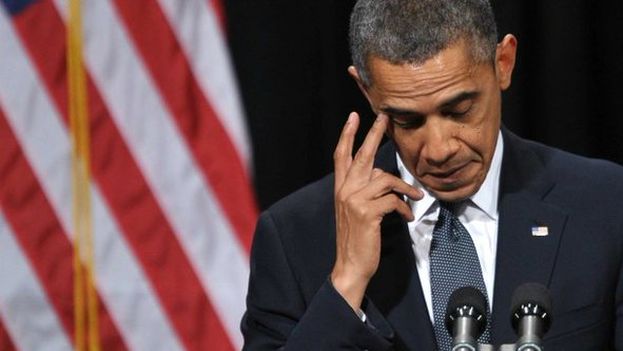
US President Barack Obama, this February. (White House)
14ymedio (with information from agencies), Havana, 8 March 2016 – The president of the United States, Barack Obama, is pondering announcing new changes in regulations regarding travel, trade and banking before or during his visit to Cuba, scheduled for 21-22 March, according to a revelation from Reuters on Tuesday. The news agency cited as sources congressional aides and people outside of government, some of whom indicate 17 March as a possible date for the announcement.
Following the implementation of a package of relaxation measures in January and September of 2015 and in January of 2016, Reuters claims that Obama’s advisors are considering changes to authorize individual trips to the island, although within the framework of the current 12 permitted categories of purposes, which exclude tourism. continue reading
A source close to the discussions informed the agency that the White House is examining the possibility of using the dollar in trade with Cuba. The deputy National Security advisor and advisor to Obama, Ben Rhodes, told the New York Times this Sunday that the island’s government has complained that the embargo forces it to make international transactions in euros and other convertible currencies.
The US president will travel to Cuba this month in the company of 20 members of Congress, both Democrats and Republicans. Among them is Arizona Senator Jeff Flake, one of the main promoters of easing the restrictions of the embargo.
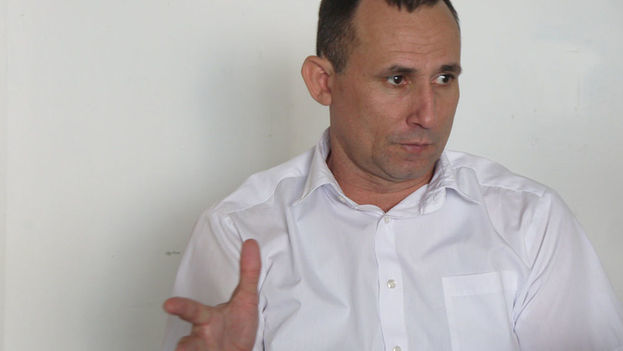
Jose Daniel Ferrer, leader of the Patriotic Union of Cuba. (14ymedio)
14ymedio, 8 March 2016 — According to various opposition sources, the leader of the Patriotic Union of Cuba (UNPACU), Jose Daniel Ferrer, was arrested Tuesday in Havana with two other activists. The former prisoner of the Black Spring was going to to participate on Wednesday in a forum convened for the Otro 18 (Another 2018) campaign, that seeks an electoral solution of the current system.
Ferrer had been in the capital since last Sunday and at the time of his arrest was with the dissident Rafael Alba Macias, and Iliana Hernandez, a member of the group Somos+ (We Are More), who were also arrested. The latter, who resides abroad, was was released five hours later, as confirmed by this newspaper. continue reading
Ferrer’s arrest coincided with the arrest of Berta Soler, leader of the Ladies in White, who was arrested on Tuesday morning to prevent her from attending the trial of activist Jaquelín Heredia Morales, detained since Sunday 28 February, after participating in the Ladies in White customary Sunday march on 5th Avenue in Havana’s Miramar district; she has been charged with contempt.
The US government reacted to the arrests and Assistant Secretary of State for Western Hemisphere Affairs, Roberta Jacobson wrote in her Twitter account that she was “Very concerned by reports that the Cuban gov has detailed @jdanielferrer & @bertasoler #Cuba#DDHH”.
The arrests come less than two weeks after the visit to the island by US President Barack Obama, who will arrive on March 21.
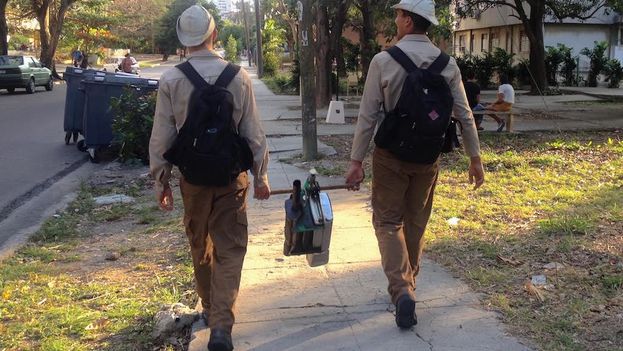
Young recruits from the Youth Labor Army, EJT, during the fumigation campaign against the Aedes aegypti mosquito. (14ymedio)
EFE / 14ymedio, Havana, 7 March 2016 – Cuban President Raul Castro urged an increase in discipline and acting “energetically” against the unfinished and “constant” hygiene campaign undertaken on the island to combat the mosquito that transmits the Zika virus and other illnesses, according to the official media on Monday.
“This cannot be one more campaign,” said Raul Castro during a meeting he chaired at the Ministry of Public Health to analyze the measures taken throughout the country to avoid the spread of diseases transmitted by the Aedes Aegypti mosquito, according to the state newspaper Granma. continue reading
At that meeting the health authorities, the government, the ruling Communist Party, and the Revolutionary Armed Forces (FAR), the Cuban president said that it is “vital to ensure that everything is being done well, with integrity and that it is maintained over time.”
He also classified the situation of garbage collection in Havana as “chronic,” with 23,800 cubic meters of trash generated every day, of which 6,300 remain in the street for lack of trucks.
Castro ordered a “final solution” to this project, “without improvisations” and with “discipline” in the scheduling, the repairs and maintenance of the equipment dedicated to this service in the country’s capital.
For several weeks, Cuba has been developing an action program that includes the mobilization of 9,000 troops from the Revolutionary Armed Forces and 200 police with fumigations and inspections in homes and workplaces to confront the viruses that cause Zika, Dengue fever and Chikungunya.
At the meeting with health authorities, the government, the Communist Party, the Revolutionary Armed Forces (FAR), the Ministry of Interior and social organizations in the provinces, he recalled that so far Cuban has had two cases of the Zika virus imported from Venezuela and “active” vigilance is being maintained over “non-specific fever syndromes.”
It was also learned from the daily media that more than 800 active police have participated in the campaign to take action against those who refuse to fumigate and take sanitation actions in their homes and yards.
According to the report, at the end of the second cycle of the hygiene campaigh 12,737 homes were reported as unfumigated because they were closed, due to “inadequate planning” of the work and “deficiencies” in the notices to residents, and frequent “failures” to meet the established schedule.
Health authorities have explained through the local media that the objective of the plan is to fight the Aedes aegypti and Aedes albopictus mosquitoes, transmitting agents of these diseases, as both are present in several areas of the island.
On 22 February, President of Cuba Raul Castro urged Cubans to take as “a personal matter” fighting the mosquito that transmits these diseases in a statement entitled Call To Our People, reported in the mainstream media of the island.
We are measured by the most demanding scales and they ask from us the greatest patience. (Photo: Silvia Corbelle)
14ymedio, Yoani Sanchez,Generation Y, Washington, 3 March 2016 — A few days after the murder of two young Argentine women tourists in Ecuador, a man in the city of Santa Clara in Cuba set fire to his house with his two children inside, as revenge against his ex-wife. Violence against women runs freely in Latin America and on most of this planet. A day like this March 8th, a day of tributes, flowers and speeches full of praise, does not erase the horror, nor the belittling.
The constant aggression we women suffer takes the form a blow from an abusive husband, but also is present in every minute of our lives, both in the professional order and in the social order. To walk alone at night, to sit alone in a park, or to take the sun on a beach “unescorted” by a partner, are moments that many Cuban women experience with more discomfort than enjoyment. continue reading
The limits within which we can move are made clear very early: Respectable or whore? Good wife or questionable spinster? Dedicated mother or bad mother? Submissive or quarrelsome? Made up or slovenly? Good cook or useless in the kitchen? Every attempt to free ourselves from these narrow frames implies double the effort for a man and a proportional quantity of external insults.
The violence starts from the time we’re small, when we prepare to be “beautiful and delicate,” forcing our tastes, affinities and vocations. They impose on us to be condescending and sweet, demure and silent; subordinate to masculine initiative and patiently bearing all. The ways girls are raised, in their families and in the education system still prevailing in our country, lock us into narrow, 19th century gender roles.
We are measured on more demanding scales and asked for the highest levels of patience. If a woman is the victim of lewd abuse in the street, most people’s immediate reflection is that she is wearing “very provocative clothing” or wiggling her hips too much. The aggressor is considered someone who “is acting like a man” while the woman is the brunt of the worst adjectives.
Women television presenters must be luxuriant and attractive, while her masculine colleagues can be gray-haired, double-chinned and pot-bellied, and no one bothers him about it. In government something else happens. The “male chauvinist” power we have lived under for nearly 60 years likes to be photographed with pretty faces and hold honeyed ceremonies on International Women’s Day. They give us flowers and call us “compañeras,” while the rest of the year they put the brakes on women’s demands and the independence of any initiative for gender equality.
What has happened to Cuban feminism is what happens to a professional woman who ends up locked in the house with a jealous and dim-witted husband. They take her best years, keep her from experiencing life and taking to the streets to demand her rights and now demand that she remain calm, gentle, supportive of those who mix testosterone and power, which is another form of violence masked by supposed praise and compliments.
The appropriation of our bodies by force is a heinous crime, as is taking our freedom, imposing on us a model of what we should be, and prolonging these discriminatory patterns, this false market of values, where ovaries are worth less than testicles.
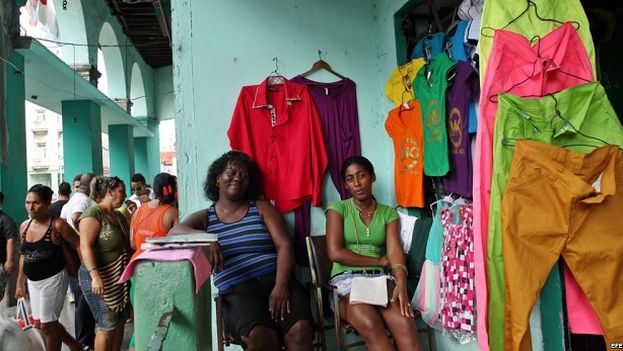
14ymedio, Lilianne Ruiz, Havana, 8 March 2016 – “Chinese or brand name?” Sandy asked a customer who had come to order some shoes. They talk inside the house with the door closed, in the same room where three years ago the saleswoman had one of the most frequented boutiques in Central Havana. Today she is still in business, but no longer has a sign in the window or models on view for those passing by on the sidewalk.
Despite all the customs restrictions, the sellers of imported clothing have managed to maintain a stable and varied offering. On 31 December 2013, a ban on selling clothes or other products made abroad went into effect, plunging the market into illegality from which it continues to operate, moving millions of pesos a year. continue reading
Most of the clothes Sandy sells are “Chinese,” a popular moniker for non-brand-name products. In the corner of her bedroom, several suitcases are full of leggings, shirts, jeans and dresses of various colors. “I have every size, even extra large,” she says. Unlike the state stores, which don’t accept payment in installments, the vendor allows her clients to pay things off “little by little.”
Sandy explained to 14ymedio that among her merchandise the best denim comes from Panama, where she can buy jeans for 18 dollars and sell them here for 25 CUC. The young woman took advantage of a seamstress’s license to sell imported clothes, but had to go underground when the government decreed that that license only allowed the sale of handmade clothing. “Just imagine, I don’t know how to sew a single stitch. My thing is this: buy to sell later,” she said.
Along with the restrictions on this kind of self-employment, customs regulations were also tightened, by Resolution 206. In 2014, limits were established to “determine the commercial character of imports by natural persons,” by any route. Now it is only possible to bring in 24 shirts, 20 blouses, 10 pants or 10 dresses.
However, the flow of goods does not seem to have suffered a drastic fall off in the informal market. “We have to be more careful, but we keep on selling,” comments Karina, a “mule” who frequently makes the trip from Panama, Ecuador and Mexico to buy from large wholesale stores, thanks to an Italian passport that she obtained after living in that country for some time.
To get through customs, Karina says she relies on her luck and on having a network of contacts that allow “suitcases and briefcases through, leaving behind a few goodies,” for the airport staff. She doesn’t consider it a crime to corrupt a few officials, because, she justifies, “It’s clothes! Not arms or drugs!”
The General Customs of the Republic has not released figures of seizures of “miscellaneous” items since Resolution 206 went into effect more than two years ago. An official of the Customs Disclosure Department told this newspaper, by phone, that “this data isn’t published,” and refused to confirm the final destination of the seized merchandise.
Along with the “Chinese” shops, in the underground clothing business there are boutiques, with choices for higher quality and higher prices. In Cuba the preferred brands are the most economical, “we’re not talking Louis Vuitton,” affirms Solveig, passionate about the latest fashion trends.
The young woman, 22, has numerous contacts, and so is able to dress herself with a certain “touch of exclusivity.” She explains that brands like Mago, Zara, Berskha and H&M are marketed in parallel in a country where there are no franchises or large chains. “Desigual brand clothes cost double, and the same with Pull&Bear,” although “the clothes are originally acquired in liquidation.”
“People still prefer to buy clothes from private sellers,” affirms Solveig, which is consistent with many people’s opinions of the clothes in state stores. “They are years behind the times and the prices are outrageous,” she complains. She dreams of being able to enter a “closed circle” selling “good clothes,” where a trader has a fixed clientele and knows their preferences. “If you are not in that group you have to knock on the door and they don’t sell to you or alter things,” she laments.
Marcia is operating at this level and buys most of her clothes through Amazon, thanks to a relative abroad. Her relative buys the clothes on line and sends them by way of “mules” or package services to the island. Her clientele comes to a night show, ready to pay much higher prices thanks to the long trip.
The experienced seller downloads pages from Amazon and prepares a digital collection that she shows her customers on a tablet. The buyers choose and when she connects “on wifi on La Rampa or at the home of a friend” she makes the selection and her sister buys them. “I fill a virtual cart and tell my sister so she can pay,” she explains.
“First of all, the people who do this have to have contacts over there,” says Marcia, pointing north. “This is a business of attention to detail.” She is right when she says that, because they have to know the costs for buying things, the delivery services and the costs of sending the packages to Cuba. A complicated arithmetic formula whose profits are shared among all concerned.
The system for shipping parcels is also undertaken by agencies such as Bacuba, Fromline and Caribexpress, which have contracts with the state-owned Cubapack. If the packages exceed three pounds, there is a tax of 20 CUC for each kilogram. A sender abroad can only send two to four packages each time, but there are no limits for the recipient. Packages can take between ten days and a month to get to the island.
Marcia is waiting for a “significant” package. A famous singer has commissioned a dress for a special night. “I’m counting the days until it comes, because if all goes well I’ll earn an excellent client,” she says, convinced that this will allow her to have her own “circle of famous people” who will buy “name brand clothes to order.”
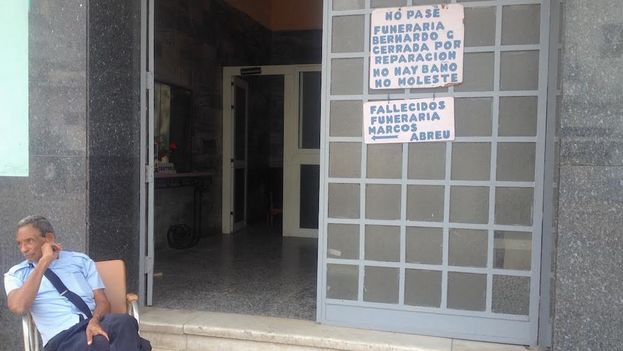
Bernardo Garcia Funeral Home closed for repairs. (14ymedio)
14ymedio, Luz Escobar, Havana, 7 March 2016 — One’s last will reveals much about the life one had or wanted to have. Some ask for a glass of rum or a lit cigar at their wake, while others dream of returning their ashes to the courtyard where they took their first steps. To achieve these “dreams for eternity,” the families of the deceased have to overcome many obstacles, which range from the lack of funeral transport to the scarcity of “boxes for the dead.”
At nine in the morning this Friday, at the Marcos Abreu Funeral Home on Zanja Street, the employee serving the public cannot cope. The phones are ringing off the hook and in front of her a crowd is trying to streamline the sad paperwork of burying or cremating a loved one. But death in Cuba also takes its time, just like the bureaucrats. continue reading
Official stamps, death certificates and the identity cards of several deceased people pass in front of the official’s eyes, as she tries to be efficient, but the intricate funeral mechanisms don’t let her. “My deceased has spent 24 hours at the crematorium and no one is telling us anything, we don’t know what’s going on,” complains Lorenzo Julian, an architect, 67, whose sister left in her last will that she wanted to be cremated.
Amid the pain of the loss, there is barely time to cry. “Here you have to line up even to die,” a recently-widowed lady shouts at the door of the office, protesting the poor quality of the coffin assigned to her husband. “It is practically bottomless and they didn’t give us the pane of glass to be able to see him so the bad smell doesn’t get out,” explains the old lady.
An elegant woman asks if there isn’t some option other than the State-produced coffin. But death equalizes many on the island. Privately-run casket businesses barely exist. “Here we can’t accept coffins made elsewhere,” the employee clarifies to the demanding bereaved. “Before we could offer metal boxes, if you paid in convertible pesos, but this option no longer exists,” she concludes.
The owner of a carpentry shop on Salud Street close to the funeral home says, “Here we make beds, living room furniture, display cases, but I’ve spent 28 years in this business and we’ve never made coffins,” and he adds that they don’t have the boards for that kind of work. “I would only make those things over my dead body, it gives me the creeps just thinking about it.”
Despite the jokes and necrological allusions that fill the popular imagination, Cubans have a very serious relationship with death. Unlike our neighbor, Mexico, with its grinning skull Catrina and family meals around the graves of the deceased, on the island every funeral ritual is serious and tearful. Only in some cases are goodbyes enlivened with music or parties.
“He wanted his rum and rumba, so we are doing it to please him,” explained Asdrubal, whose 91-year-old grandfather died this week in Central Havana and left specific instructions for his send off. “I don’t want to cry, no I don’t want to cry, when I die I don’t want to cry,” the young man says his grandfather used to sing. “So we did it like a song, without crying,” he added.
The tears that weren’t shed with the last breath of the family patriarch were about to fall during the paperwork to arrange his wake. The Bernardo Garcia Funeral Home, on Zanja and Belascoain Streets, has closed for repairs because of the poor condition of the property and the worse quality of service. The body of Asdrubal’s grandfather had to wait more than ten hours for them to take it from the house. The employee who answered the complaint kept asking for “calm,” because there wasn’t any “transport available.”
Finally, the remains of the old man arrived in one of the rooms of the Marcos Abreu Funeral Home. Then began what his grandson calls “the old man’s second death.” The deceased had said he wanted to be cremated, but an employee of the state establishment said the only working crematorium was in Guanabacoa and the one in Santiago de las Vegas was broken and its work was piling up.
The service must be requested at the funeral home that corresponds to the place of residence, and it is there that the family is told if there is capacity in the furnaces. Subsequently, they pay 340 Cuban pesos in advance and choose the option of going to the crematorium or collecting the remains at the funeral home itself.
The relatives present their documentation and choose the urn in which to collect the ashes. If they want, they are shown the body of the deceased through a glass, just in front of the entrance to the incinerator. The process lasts between an hour and an hour and a half and at the end the customer is given the urn with the ashes.
An employee of the Guanabacoa crematorium, who preferred to remain anonymous, told 14ymedio that the problem wasn’t only that “the equipment breaks” but that “there are more and more people choosing to be cremated.” The process of cremation started in 2006, subsidized by the state and costing 300 Cuban pesos (less than $15 US), but often there is an “extra payment” to the employees to get a turn or to hasten the entrance to the oven.
However, many families prefer going through this web of corruption rather than dealing with what for many years has been the vicissitudes of a vault or a tomb in one of the island’s cemeteries. Buying a private niche in a cemetery in the capital costs around 400 Cuban convertible pesos (CUC) on the informal market, a year’s salary for the average worker.
“We are going to bring this home, which is where he should be, with his family” said Asdrubal regarding the ashes of his grandfather, who finally and thanks to a family member who emigrated and who sent the money in record time through Western Union, was cremated this weekend.
During the last session of Parliament, the Commission of Health and Sports warned of the poor “technical availability of hearses,” the delays in collecting the corpses and the poor quality of the wood “allocated by the State Forestry Enterprise for the production of coffins.” The problems facing the sector are compounded by the lack of “surgical gloves, cotton, cosmetics, razors, among other resources necessary for the work undertaken in funeral homes and cemeteries.”
Lined with a dark gray cloth, the boxes for the dead sold at the subsidized price have declined in quality over the years and can barely contain the body of the deceased. “We have to support them carefully from below, because it’s happened to us that the dead have fallen out before being put in the grave,” confessed Nicanor, an old gravedigger at Columbus Cemetery who is not under contract but whom other employees give “a little something” for his work.
The coffin of a dead man who arrived at Havana’s most important cemetery this Friday is made from pine, twisted and hollowed out by termites. In one corner the nails are missing and the relatives fear that it will come open in the midst of the church service. “This shows a lack of respect,” a nephew of the deceased told 14ymedio. “What can you expect for the dead with things are equally hard for the living?” he asked. The deacon hurries the final goodbye and the box leaves the chapel on the verge of falling apart.
A few minutes later a pompous funeral arrives with several cars and buses carrying the colleagues of the deceased officer of the Armed Forces. The widow weeps in front of the polished wood coffin. The ministries and important institutions such as the Council of State have their own carpenters for when a “personality” dies. Their coffins are very different from those of ordinary Cubans: solid and with metal inlays.
While the polished box with the soldier’s remains is being placed in the niche, several kilometers away Asdrubal’s family hastily downs their rum and celebrates the arrival of the amphora with their grandfather’s ashes. “Old man, you are where you wanted to be, with your family and your drink close by,” says the grandson, while filling a glass and lighting a cigar.
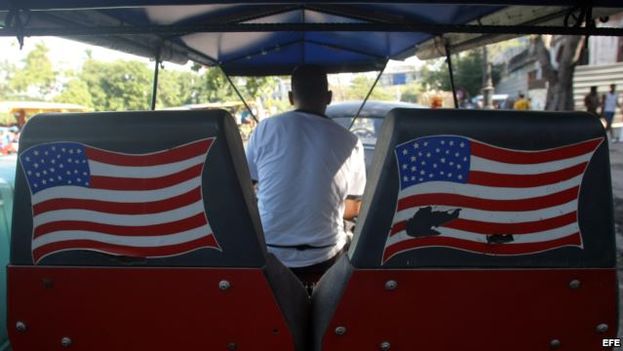
A man pedaling a pedicab with the American flag through the streets of Havana. (EFE)
14ymedio, Regina Coyula, Havana, 5 March 2016 — The analysis of relations between Cuba and the United States, during almost sixty years of single-party government on one side and 11 presidents alternating in a two-party government on the other, is a magnet for political scientists and historians from different latitudes, but with a special emphasis, for obvious reasons, for Cubans and Americans. Last week, a text appeared on Cubadebate– a Cuban government run site – the objective of which was to dismantle myths about these controversial relations.
Starting with the introduction, the author, the academic Elier Ramirez Cañedo, announces that, despite the well-studied historical parenthesis, there are underlying mistaken ideas (myths) about the performance of the parties, and he immediately goes on to warn that “the historical distortion is a form of attack against the Cuban project, within a broader strategy of cultural war against socialism in Cuba.” continue reading
Despite emphasizing this quote, I do not intend to focus on the perceived cultural war, and much less on Cuban socialism. I will try to put aside my emotional and historic proximity to the events, to disagree with the author’s arguments.
Before engaging in an analysis of demystification, I cannot ignore a statement that is not true: “The United States blocked any possibility of the existence of a national bourgeoisie in Cuba.” Geographical proximity favors, with a growing presence from the colonial era and above all taking advantage of the economic crisis in the second decade of the last century, American capital’s engagement with a good part of the Cuban economy, which until that moment had been essentially Spanish. But the United States not only failed in its effort to block the existence of a native bourgeoisie, but, by 1959, this same bourgeoisie possessed the majority of the national wealth, including banking.
Moreover, the introductory text states, “The US government did everything possible to prevent a bourgeois nationalist government led by the orthodox party from taking the reins of the country.” In reality, it did not have to do anything to prevent it, because what did away with the future of this party and so with the constitutional future of the country, was not a maneuver by the CIA – nor even a maneuver by Batista – but a badly calculated shot by Eduardo Chibas, who very likely could have been elected president of the Republic in 1952.
Myth 1: “The root of the conflict was in the alliance of the Revolution with the Soviet Union, because the Eisenhower administration was willing to reach an understanding with the democratic nationalist project in Cuba.”
To claim the analysis of the conflict derived from the Revolutionary triumph of 1959 as a consequence of the unconfessed desire or manifesto of the United States to seize Cuba, starting in the late eighteenth century, responds to a vision that passes its entire optics through the sieve of a very punctilious anti-imperialism. With the difficulty of accessing texts of philosophical, historical and political thinkers with a more ecumenical approach, the Cuban reader has a Manichean perspective of bilateral relations with the United States, born of American dissatisfaction at not being able to decide the destiny of Cuba.
National sovereignty is a pillar of this approach, putting forward examples from the time of proconsuls and invasions. But this pillar is undermined in the last 60 years, and not specifically because of the interference of our neighbor to the north. No analysts among those who surgically tease apart the intentions and reach of American influence have interested themselves in doing the same with the Soviet influence, it seems, a task for future historiography, especially given that we are now living in a kind of second season with Russia and Putinism.
In the context of the Cold War, the US government would have been very naïve if it had not observed with growing concern how things were developing, barely 90 miles to the south. From the conciliatory and humanist discourse of 1959, the language of the leader and voice of the Revolution was changing his tone. But not only the speeches became more aggressive and anti-Yankee.
To the agrarian nationalizations without compensation of 1959, was added the fact that in the autumn of the same year the Soviet ambassador in Mexico came to Havana with two main principals: the reestablishment of diplomatic relations and the visit of Anastas Mikoyan, First Vice President of the USSR and Khrushchev’s right hand man; a trip that took place in February of 1960 and, in an unprecedented event, lasted nine days.
From this trip stemmed agreements for more than 100 million dollars. America’s concern was not free, the terms of the agreement by which Cuba would sell the USSR 300,000 metric tons of sugar were remarkably advantageous – more so than the sugar agreement with the United States before 1959.
It would be interesting to see – if the Soviet documents were declassified – how Operation Mongoose, under the direction of the CIA and the Department of State, found its counterpart in the KGB and Gremlin. And how plans were developed to increase our country’s influence through collaborative programs, technical assistance, trade and cultural exchanges as the first step to then arming and training a regular army and intelligence organs – the spearhead against its enemy – which conferred on Cuba the highest priority in the foreign policy of the USSR. Every power according to its interests.
These new best friends could not be looked on with indifference. In fact, the relationship is considered a precursor of the Soviet influence in the so-called Western Hemisphere. However, the analysis of Cuban historians should also focus on how the opportunity was lost to achieve a true independence and sovereignty as a nation and a republic for the first time; there are no records of the revolutionary government seeking alternatives in the Latin American context, for instance, to establish political, commercial and financial relations that would have allowed it to step outside the epicenter of the bipolar conflict.
The exhibition is full of intimate moments, indoors, in the heat of the home where the Cuban identity is expressed in a gesture, an attitude or simply the nostalgic feel in a gaze.
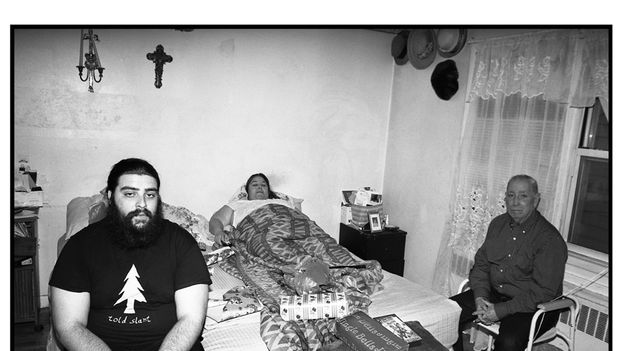
14ymedio, Yoani Sanchez, Generation Y, 6 March 2106 — There is an aunt with her hair in rollers and a maternal gaze, a neighbor in a housecoat and that friend blowing out the birthday candles. They are known faces, family members, but they live hundreds of miles from the island, and come to us, as in a mirror that returns our image without distortions or cracks, through Gandy Pavón (b. Las Tunas, Cuba, 1974) and his exposition, The Cuban-Americans.
In that far off geography, the emigrants weave their dreams, taking on new customs, maintaining their taste for rice with beans, and sighing for a country that only exists in their memories. In that “internal space” where Cuban-Americans pass their lives, what the writer Gustavo Pérez Firmante called the hyphen or dash, “that unites, while separating, nominally and culturally, the Cuban and the American.” continue reading
Pavón captures in a series of black and white photographs that were exhibited at the Cervantes Institute of New York, a part of the nostalgia of those who carry their roots on their shoulders so that a new generation can bear fruits. Parents who left behind their world of references, the house where they were born and even their wedding rings, with the obsession of giving their children a future. They are like us, but they have lived more, and the title of “Cubans” sounds sweetly and painfully in their ears.
Their names are Josefa, Paco, Pedro, Yosvany, Miguel… and they have experienced daily contact with other cultures, the pleasure in the little things they managed to carry with them: a yellowed photograph of Grandma and a memory of the dog barking from the farm path. They are also burdened with the depression of exile, the conviction that they don’t belong entirely to the land they left behind nor to the one that received them. They are beings who carry with them their own homeland.
The author of The Cuban-Americans took as a reference Robert Frank’s famous series of photographs, The Americans. The work of the American artist was heavily criticized in its time for not embodying “the image of progress and greatness they wanted to project in the fifties,” recalls Pavón. Like Frank, he also wanted to escape “the stereotypes, the commonplace.”
This “no man’s land,” where the exiles have found themselves because of politics, intolerance and immigration restrictions, resembles in many details the island we have woven within the bubble of our intimacy. An identity hard to catch in the tourist snapshots or sepia postcards that so content the foreign eye. More than a photographic work, Pavón has had to undertake a true immersion in that abyss of Cuban identity.
From this plunge, he has returned without beautiful ruins, old cars, or easy smiles. Instead of that, the artist claims to have “found another Cuba outside Cuba,” a nation that long ago ceased to be contained on an island.
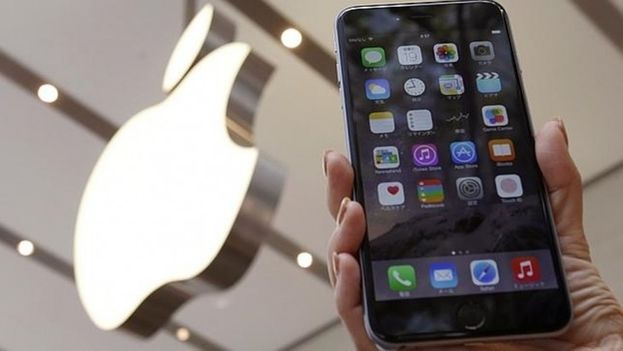
14ymedio, Generation Y, Yoani Sanchez, Washington, 5 March 2016 — When they returned his mobile phone all his contacts had been erased and the card with the photos was gone. Stories like this are repeated among activists who have been detained, over whom an iron vigilance is maintained with the complicity of the Telecommunications Company (ETECSA), the technology arm of repression in Cuba. An entity that should take note of the rebuff Apple has dealt the FBI in the United States, by refusing to access its clients’ data.
For decades, Cuban society has become accustomed to the government’s failing to respect individuals’ private spaces. The state has the power to delve into personal correspondence, to display medical records in front of the cameras, to air private messages on television, and to broadcast phone conversations between critics of the system. In such a framework, intimacy doesn’t exist, one’s personal space has been invaded by power. continue reading
People see as “normal” that the phones are tapped and that in the homes of opponents hidden microphones capture even the smallest sigh. It has become common practice for ETECSA to cut off dissidents’ phone service during certain national events or visits from foreign leaders, and to block the reception of messages whose contents upset them. This Orwellian situation has gone on for so long, that few take note any more of the illegality involved and the violation of citizens’ rights it entails.
The feeling of constant supervision has come to affect the way we speak, filling it with whispers, gestures and metaphors, to avoid saying those words that could get us into trouble. To the extent that few mention the names of Fidel or Raul Castro, substituting a gesture over the face as if touching a beard, or making slanted eyes, or placing two fingers on one’s shoulder to allude to “them,” “the power,” “the government,” “the Party.”
The limits of the state to obtain private information are currently at the center of an international debate, sparked by the United States government demand that the technology company Apple unblock the telephone used by a terrorist, who participated in a shooting in California where 14 people died. The discussions have risen in tone between those who brandish the needs of the security agency, and those who see it as a danger to violate the rights to protected data.
These kinds of questions are very far from Cuban society, where the need to reconquer the privacy lost over more than half a century of the interference of power in every sphere of daily life is never publicly raised. Even keeping a private diary, closing the door of a bedroom, or speaking softly, are frowned upon by a system that tried to replace individuality with massification, and to eradicate intimacy in the promiscuity of shelters or barracks.
Apple fears that by creating software to unlock its phones, it cannot avoid the government or hackers from collecting the private information of millions of innocents. It knows that any power is insatiable with regards to the information it wants to have about others, hence the law should curb and rein in those excesses of interference that characterize all governments.
The dispute over privacy and security will continue for a long time, because it is the eternal tension between the limits of social space versus personal space. The clash between the interests of any nation and that fragile but essential part that makes us individuals.
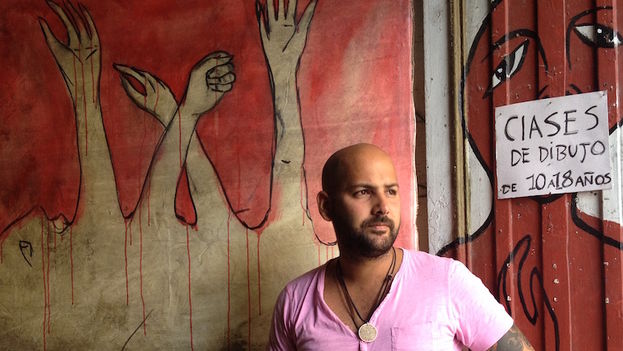
The artist Yulier Rodriguez Perez. Sign: Drawing classes for 10-18 years. (14ymedio)
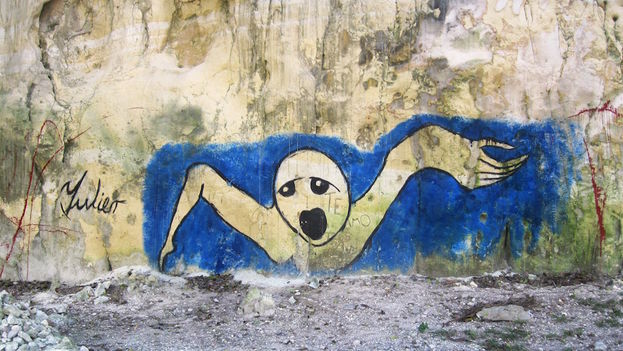
14ymedio, Luz Escobar, Havana, 3 March 2016 — They never accepted him at the San Alejandro Academy. Perhaps this is why, the work of the artist Yulier Rodríguez Pérez (1989) is not part of the narrow mold of what is learned in the classroom. He came from Florida, Camagüey, to settle in Havana in an aunt’s house with the obsession with being a painter. Along the way, he realized that he did not need a gallery, but to go out in the street and take this space to leave his work.
Luz Escobar. You are known as a painter, graffiti artist and sculptor; which of these artistic aspects do you most identify with?
Yulier Rodriguez Perez. I associate more with street art and don’t try to correct that version, because of the visibility my work on the street has given me. But it all starts in the studio, the workshop and the canvas. All these characters that form our reality through my perspective of the everyday come out on the easel. I live in the Industria y Trocadero district, so I live in shit and work on Prado Street, which is more shit. All the daily cinematography of these slums guides me in finding my own discourse. continue reading
Escobar. What are the motivations that most often lead you to the easel, the wall or the drawing paper?
Rodriguez. My pictures are like fables, a portrait of people’s experiences. Others are more personal, but almost always reflect neglected and discontent scenes. They are like souls, because at some point we stop being people and now we are souls in a purgatory called Cuba.
We live condemned by ourselves, because this is the result of our decisions and our inability to see beyond the fear and a thousand other things. The images are just that: our souls that reflect the internal pain, the impotence, the fear and the sadness.
Escobar. Choosing as an exhibition gallery facades and bus stops is not very common among Cuban artists. What made put your hand to this singular exhibition hall?
Rodriguez. I presented several projects in galleries and exhibitions, but I was always marginalized. In the best case they told me I would have to wait a few months. I offered a work now and it would be shown in a year, when at best I was no longer thinking about it. The work evolved and my intention as an artist had never been to have a retrospective of my art, but to share it with the public at the moment it was created.
A friend in the urban art scene in Germany came to Cuba and we started to do things. One day we went out to paint at night, everything was dark and I didn’t know anything about this world. It caught me, it was like an adrenaline rush and I was there with another graffiti artist who wasn’t very well trained artistically, his work was more about making letters, but he had experience as a street painter, he had lost his stage fright. That union helped me a lot and I started to do my work.
Escobar. During your years as a street artist did you ever fear reprisals for your work?
Rodriguez. At first I was worried because the pieces showed a reality that many people do not want to see and others don’t want to be seen. At the end I was losing my stage fright on the fly and I started helping my friend with the theoretical part of conceptual expression, finding a language. It was a mutual help. Then he left the country.
Escobar. What are the antecedents of graffiti art in Cuba?
Rodriguez. The lack of examples of street art is very strong. Who can I mention? Street Art, with Maldito Menendez, but the majority of them don’t live on the island. There is no urban Cuban art, right now there is no movement, there are isolated artists working and that’s good. I only know two who speak of the reality, El Sexto and me.
The difference between El Sexto and me and that he takes an essentially political posture and has declared war against Fidel Castro. That is his posture and I respect it. He does totally political work, he is an activist, while I dialog with the public through art and a more elaborate style with a certain lyricism. My work isn’t linked to anyone, I defend my opinion, I like art and I self-finance everything I need to do this work.
If right now El Sexto and I quit it’s hard to find others who, in a serious and constant way, see this as an artistic expression. Once we tried a collective painting in El Cerro, but people from the government appeared with their story of counterrevolution and cut off everything.
Escobar. It’s hard to believe you’ve done all these paintings on the walls of Havana and you didn’t have any problems with the police. Have you been arrested or fined?
Rodriguez. I’ve never had problems, but once in a while they send out the police. Working in the street is very sensitive, but I believe it had to open up. The Cuban cinema, for example, is showing the reality in a more raw way and they have had to let them because it can’t go against reality. When I came out with these visual chronicles it was the best, because I had already had a small opening, bit by bit. Now things can no longer be hidden like before.
Escobar. Have you ever slept in a cell because of your art?
Rodriguez. For me that is a mystery, because they have sent out three police patrols and nothing happens. They came predisposed and, when they got out of the car, and looked at the piece and listened to my explanation, they called on the radio and said, “the boy isn’t doing cartoons, it has nothing to do with politics.”
So far they have let me go. The only time there was friction with the police was at the Villa Panamerica [sports complex]. At the stop I did a graffiti of people standing on the wall in various awkward situations, like shouting. That day the order came from above. A woman from the (Communist) Party had passed by on a “camel” [a kind of urban bus] and called the police to tell them that I was doing “something counterrevolutionary.” At the police station they sorted it all out, it wasn’t even 20 minutes, the same guard told me to get a permit. I explained that was exactly why I had gone to the streets, because the permissions are very slow and if you waited for them you would never paint.
Escobar. What are the most frequent places where you have painted?
Rodriguez. I do not invade any place, rather I look for destroyed walls and places. I try to give them some aesthetic value and thus promote a future urban art movement.
Yulier Rodríguez Pérez graffiti
Escobar. It is common for graffiti to get covered with dabs of paint or pro-government slogans. Has this happened in the case of your work?
Rodriguez. Most of my graffiti has survived, some of mine has been painted over by the government, but others have been painted over by others. I have a stronger enemy than the government, which is religion. It has already happened several times that Jehovah’s Witnesses or Christian extremists see in my work diabolical figures and they erase them.
Escobar. So far, have you only been displayed in the streets or in a workshop, or have you also managed to hang some artwork in a gallery?
Rodriguez. I participated in some group exhibitions, including one here at the Central Park Hotel, and a personal one in Light and Crafts. This year I want to organize a show with the rubble of collapsed buildings, bringing them to the workshop and painting them. I see the rubble as a historical document that holds the memory of those buildings where people lived and suffered in a space of time and they are pieces of our identity.
Escobar. The José Martí Community Workshop, where you do part of your work belongs to the Prado People’s Council. How does it work?
Rodriguez. I’m in charge of this project that interacts a lot with the community. We do drawing workshops for children and our doors are always open for any activity. What I do is I will not allow this to become trinkets for tourists. We try to maintain works that take off from sincerity and seriousness. Many people left because they were not prepared to work on those terms, three or four of us remain. We have been improving the space with a great deal of our own effort, because it was in very poor condition.
Escobar. What artists have most influenced the way you carry out your work?
Rodriguez. I agree with Banksy in the way of seeing street art. For me, street art is a dialogue with the public and my work is that.
Escobar. Is there any work that you remember with particular enthusiasm?
Rodriguez. During the Book Fair, I did a public intervention that is on my Facebook, where I crossed swimming from one side of the bay to the other to paint a huge face with no mouth, no ears, no nose, only eyes. I did it so it can be seen from the far side. Then I swam back to the Malecon.
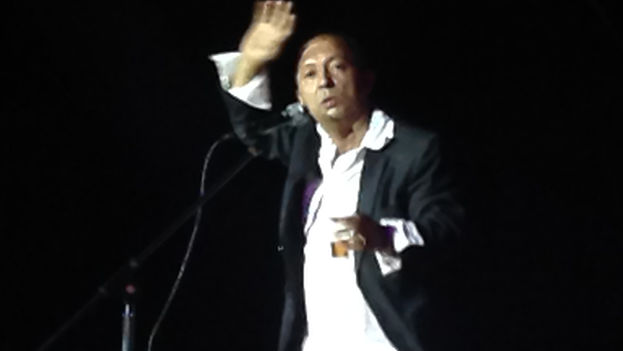
14ymedio, Reinaldo Escobar, Havana, 4 March 2016 – To be a part of the audience at the comic El Bacán’s stand-up show, feels like participating in a conspiracy. It was a feeling we in the audience had this Thursday at the actor-director’s most recent presentation under the Big Tent, west of the Cuban capital.
Nelson Gudin, bureaucratic pseudonym of a character called El Bacán, appears on stage with a glass of rum. He staggers in front of the microphone and speaks as if under the effects of drunkenness. His histrionic appeal lies in the ambiguous situation; if it is true that a drunk will not be listened to, under the influence of alcohol people are uninhibited and tell the truth. continue reading
In a sequence that unfolds cleverly, we hear anecdotes and reflections where the actor uses an irreproachable naivetéas an effective weapon. Anyone who laughs is necessarily an accomplice. What he is saying with such sincerity is only funny because he no longer believes in the system and knows that no one can have so much faith after so many failures.
El Bacán justifies his alcoholism as a way to heal the frustration of his high hopes. He confesses to being a man who doesn’t give up and says he believes just like the first day. So he begins with complaints about the price the audience has paid to see the show and continues with his laments about the poor performance of the baseball team at the last Caribbean Series in Santo Domingo, his surprise at the visit of the pope and his stupefaction over the announcement of Obama’s trip to Cuba.
All of reality is subject to El Bacán’s biting irony: national television programs, shortages, government reforms, foreign telenovelas, epidemics, the political police and even the jokes that he himself spills on the stage.
The audience applauded frenetically from the stands this Thursday, belting out demands for “a la carte” humor. Among the most requested was the Cyprus monologue, a viral phenomenon in which the national audiovisual distribution networks criticize the silence of the official press about national problems while offering extensive coverage of the situations of far off nations, like Cyprus.
Nelson Gudin demonstrated, on Thursday, that drunkenness and madness have moments of painfully sober, hilarious lucidity.
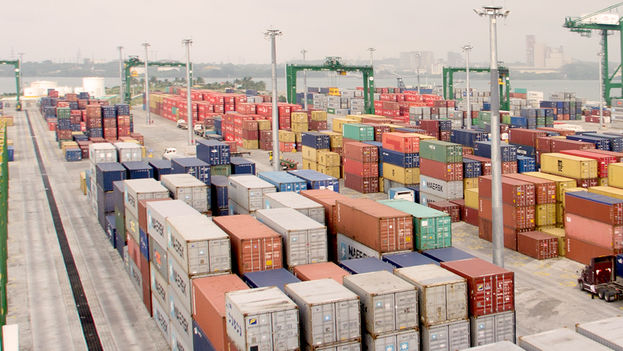
Container terminal in Cuba’s Mariel Special Development Zone. (Zedmariel.com)
EFE/14ymedio, 4 March 2016 — Cuba’s opening to foreign capital does not mean the “accelerated privatization” of its economy, so the island insists on attracting investment projects that “match” the “public policy” of the country, according to an article Friday in the official newspaper Granma.
Deborah Rivas, Director General of Foreign Investment of the Ministry of Foreign Trade and Foreign Investment (MINCEX), told the state media that there more than 200 businesses with foreign capital, 35 of which were approved under the new Foreign Investment law, March 2014. continue reading
“The objective is not to sell the country, it is not about doing any project that interests some foreign investors. It’s about attracting investors whose projects are consistent with our public policy. We are not undertaking an accelerated process of privatizing the Cuban economy,” said Rivas.
The MINCEX director said that most of the investments come from Europe and Canada, but added that the country is interested in the “diversification” of its economic partners to avoid “by all means, relying on a single market.”
With the growing interest of US businesspeople in doing business with their Cuban counterparts, Rivas said that because the United States still maintains an embargo on Cuba, “this is not one of the issues that will be solved most quickly” in the current process of normalization between the two countries.
Foreign investment is one of the pillars of economic reforms that Cuban President Raul Castro has ben seeking since the 2011 “update” of the country’s socialist model.
The new Law on Foreign Investment and the Mariel Special Development Mariel Zone (ZEDM), which provides favorable conditions for the establishment of foreign corporations, are the two flagship projects on the island to attract foreign capital, although the results still have not been felt.
The island is currently promoting a portfolio of business opportunities that includes 246 projects distributed in 11 economic areas which would total about 8.7 billion dollars.
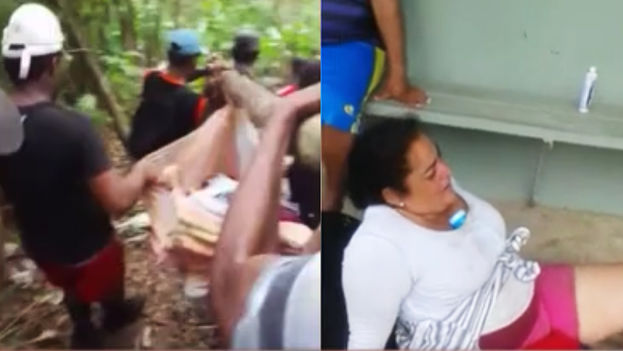
A Cuban migrant is rescued by local people after falling into a ravine. (Telemetro.com)
14ymedio, Havana, 4 March 2016 — A Cuban migrant was rescued from a ravine Friday by residents of La Miel, a border area between Colombia and Panama. The woman, in her 40s, had been abandoned by the group she was traveling with when she broke her leg while trying to reach the United States.
The woman, who spent the night in the ravine in a steep jungle area, was rescued by locals on a makeshift stretcher and received medical attention.
The locals explained to the local press that it is not the first time they have rescued migrants on the way to the United States.
EFE/14ymedio, Miami, 4 March 2016 — The Cuban dissident Martha Beatriz Roque told EFE on Friday in Miami that she would like to be received by the US President, Barack Obama, to ask him to “straighten out” the process of normalization of relations with Cuba.
In that process, “the only thing the Cuban government does is demand and it has given very like in exchange,” said Roque, an economist condemned to 20 years in prison in the 2003 “Black Spring” for violating the “independence and territorial integrity of the State,” collaborating and receiving resources from the United States, and trying to undermine the principles of the Revolution. continue reading
The dissident, who saw her sister for the first time in 55 years this Thursday, said that she would return to Cuba on 31 March and so will not be there when Obama visits the island on 21st and 22nd, although she would like to be able to speak with him before his trip to explain to him her opinions about the process of normalizing relations announced at the end of 2014.
“Not to be radical, I must say that the Cuban government has given very little. It does only what is required to get the embargo lifted, return Guantanamo, close Radio and Television Marti,” she said in a telephone interview with EFE.
In her view, the United States should “straighten out” this, so that the Cuban government offers something from its side.
Roque said it now is not the time to judge whether Obama was or was not wrong about the agreement he reached with Cuban President Raul Castro to end the antagonism between the two countries, which has already resulted in a restoration of diplomatic relations.
She would like to be received by Obama before traveling to the island to give him her views on the situation in the country and the changes needed, as she did with the United States Secretary of State, John Kerry, when he visited Cuba.
Roque, from the Assembly to Promote Civil Society, said that after this “private trip” she will return to Cuba on March 31 and will be subject to the parole conditions she received in 2004, unable to leave the country again.
A large group of those convicted in the Black Spring Group of 75 left Cuba under an agreement between the Cuban government, the Catholic Church and the Spanish government in 2010. Of the 11 who remained in Cuba, only seven have received permission to take one trip outside of Cuba, and of these three are not going to travel, for various reasons, according to Roque.
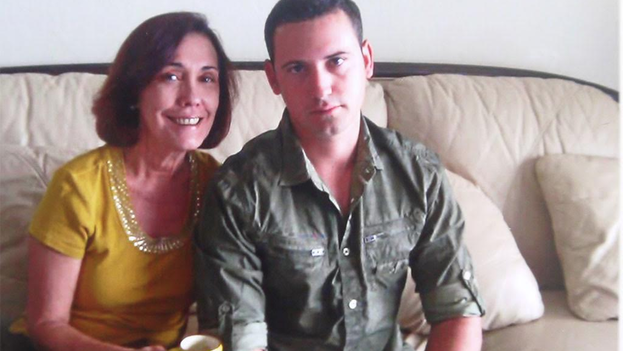
Nieves Santos with her son, Raibel Pacheco, one of the four convicted. (Courtesy of the family)
14ymedio, Yoani Sanchez, Washington, 4 March 2018 – On hearing the serenity of her voice over the phone, few would believe that Nieves Santos Falcon is going through the worst time of her life. Her son Raibel Pacheco Santos has been sentenced to 15 years in prison in Cuba for the crime of terrorism, in Case No. 2 of 2014. However, Nievos Santos, a biologist at the School of the Medicine of the University of Havana, is confident that justice will prevail.
Yoani Sanchez. For two years there has been barely any information about the judicial proceedings against José Ortega Amador, Obdulio Rodríguez González, Félix Monzón Alvarez and your son, Raibel Pacheco Santos. What has happened in recent days that made you decide to talk to the press?
Nieves Santos Falcón. I traveled to Cuba to visit my son on 22 February and that same afternoon they told me he had been sentenced to 15 years in prison. The hearing took place on 30 October of last year at the People’s Provincial Court of Havana and the trial had concluded with sentencing. continue reading
Sanchez. You hired a lawyer in a collective law firm take on the defense. How did that lawyer perform?
Santos. In July 2014, when my son was still being held in Villa Marista, they explained to me that he had the right to a lawyer. As Raibel was a resident in the United States we had to pay 6,000 CUC. We could have had any kind of attorney, but I hired a “Revolutionary attorney,” like the government told me to.
Sanchez. Did you believe during the trial in the independence of the court regarding any political or exemplary bias and that the Government wanted to bring to the case?
Santos. During the two long years we waited for the hearing, I always had confidence in what Cuban officials sent me. I was confident that justice would be done. I went to the hearing with much hope, because I saw it as clear and transparent. The lawyers exercised their full rights. It made an impression on me to see how those young people used their office, with professionalism and fairness. Especially since they used the facts and evidence and asked that they be applied according to the Penal Code.
Sanchez. If the defense attorney made every effort to reduce the sentence and even achieve an acquittal, why do you think that Raibel received a 15 year sentence?
Santos. The judges’ power of discretion was unfair. The prosecutor asked for eight to 15 years for my son and the judges ruled the maximum sentence. Without facts or evidence.
Sanchez. What was your child’s defense?
Santos. The lawyer raised two issues. One, that it was impossible because an unarmed person cannot take arms into a military unit, because of all the protection of these places and how difficult it is to even get past the post barracks entrance. So to do something like that was impossible, they should absolve him.
Number two: lack of evidence. The prosecutor made his argument basically on what the defendants said, starting from the ideas they had of provoking an uprising, a civic-military uprising. So, the defense lawyer agreed that they had “ideas,” “attempted rebellion,” but nothing else and asked the judges for a sentence of between two and four years.
Sanchez. What is the crime for which Raibel and the other three defendants were tried?
Santos. They accused him of terrorism and categorized, judged and sentenced him as he it were a terrorist, even though the defense attorney clarified during the trial that it wasn’t about terrorism, or even terrorist ideas. My son and others weren’t caught with even a knife.
Sanchez. What is Raibel’s situation with regard to his imprisonment right now? What prison is he in and under what conditions?
Santos. Raibel is in the Combinado del Este prison in Havana, and is well. He is in a cell with 35 men and has not had any problems so far with anyone. He has not committed any indisciplines and there have been no complaints about him. He is quiet, in good health, including putting on weight, because when he left Villa Marista he had lost 28 pounds. We can see him every other month.
Sanchez. What was the relationship between the four defendants? Were they friends or acquaintances? How did they contact each other before reaching Cuba?
Santos. In the trial it was shown that they knew each other, but I don’t know anything more than that. My son has never talked to me about that.
Sanchez. After arriving in Miami at 21, he started studying at college and had a future ahead of him in the United States. Did he think of returning to Cuba with their idea of instigating a popular uprising?
Santos. First of all, he is Cuban, not a foreigner and he left the country because of dissatisfaction with the system. He is also a young man who had dreams of seeing his country free. He loves to read a lot and perhaps he felt the need to do something for his country. Many young people in exile feel they have turned their back on their country. I also want to make clear that my son had no criminal record either in Cuba or the United States.
Sanchez. It is speculated that the conviction of your son could be government revenge against his father, Manual Pacheco Toledo, rector of the Univresity of Holguin and an official in the Cuban embassy in Mexico, who fled to the United States. Do you agree?
Santos. If so, it would be a doubly unjust conviction, because my son was not raised by his father, he left the family when the boy was nine. We divorced in 1993 and I raised my children alone. I came to America precisely because I no longer had any family in Cuba, all my relatives were here.
I try not to judge anyone without evidence and would like to continue to trust that this is not a grudge match.
Sanchez. Do you have any hope that your son won’t have to serve such a long sentence, that there will be some amnesty or a prisoner exchange with the United States government, which will get him out in the short term? Perhaps now with Barack Obama’s visit to the island?
Santos. In Cuba after the triumph of the Revolution, there has never been an amnesty and there are many men in prison. For me, as a Cuban it would be an enormous satisfaction if this happened. The intentions of both governments to establish peace fills me with expectations. If Obama is going to talk about human rights in Cuba and touches on the issues of the prisoners, I would like him to address the case of these four detainees: two of them are U.S. residents and the other two are Cuban-Americans.
Sanchez. What steps have been taken to appeal the decision of the judges and the sentence imposed on Raibel?
Santos. Where I first made known my opinion on the hearing and the judgment it was in a letter to Raul Castro that I delivered to the Council of State in Havana. I have always taken into account the Cuban government.
Right now I’m appealing the case, which is valid for all the defendants, and I hope that the misuse of power by the arbiters, which are the judges, will be corrected, because it has been an unjust and excessive sentence. I am persevering because Raibel has a future ahead of him, a wife who is expecting a baby. Why take from him the right to see his child born, if he hasn’t done anything?
Sanchez. If the appeal does not reduce the sentence, will you appeal to an international body?
Santos. I will continue until the last step. If a mother does not defend her son, who is going to defend him? If Raibel is guilty of misconduct he needs to be corrected, but if they have been unfair to him, I have every duty and obligation to take the case to every possible body.
 14ymedio (with information from agencies), Havana, 8 March 2016 – The president of the United States, Barack Obama, is pondering announcing new changes in regulations regarding travel, trade and banking before or during his visit to Cuba, scheduled for 21-22 March, according to a revelation from Reuters on Tuesday. The news agency cited as sources congressional aides and people outside of government, some of whom indicate 17 March as a possible date for the announcement.