Cuba’s Most Notorious of 2025

Los más infames de 2025 (Ilustración: Mary Esther Lemus)

The Most Notorious of 2025
Cubanet, Luis Cino, Havana, 30 December 2025

Miguel Díaz-Canel Bermúdez. Photo: Cuban News Agency (ACN)

1-Miguel Díaz-Canel Bermúdez

As he has done since taking office, the most inefficient and unpopular ruler that Cuba has ever had repeats in first place. This past 2025, Díaz-Canel has enthusiastically added to his track record, further increasing his total disconnection from reality: faced with the catastrophic situation in the country, in almost-daily meetings, all he managed to talk about was “creative resistance.”

The hand-picked ruler demonstrated his lack of charisma and empathy when, during his pointless and choreographed tours of the eastern provinces in the wake of Hurricane Melissa, he lost his composure before complaints from several victims. And this year he also threatened once again to make those protesting in the streets over power outages and water shortages feel “the full weight of the law”; a mere handful of people, according to him, whom he described as being “confused by the narratives created by enemy propaganda,” and even “lowlifes and criminals.”

2-Alejandro Gil Fernández

Alejandro Gil Fernández, Photo: Cuban News Agency (ACN)

The man sentenced to life imprisonment—Gil, the now-former Minister of Economy—once so hated by the people (as was Marino Murillo Jorge*) because of the chaos and inflation unleashed by the failure of the Ordering Task**, now is to be pitied. In the most significant purge since “Case Number One of 1989,”*** Gil was chosen as a scapegoat, and the blame for ill-conceived decisions—approved by the regime’s top leadership at the most inopportune moment—was placed squarely on him. But he wasn’t only blamed for that: among other charges, Gil was accused of “espionage.” It is unknown for whom he was spying. This remains unknown because the two trials against him were held behind closed doors. Therefore, the corrupt individuals involved in the case, who must be numerous and highly placed, also remain unknown.

Gil had more luck than Arnaldo Ochoa and Tony de la Guardia and avoided the firing squad. But, given how much he knows, he will most likely die in prison: he’ll have a heart attack or be “suicided”.**** Just like José Abrantes, the former Interior Minister who was purged in 1989. But, in Gil’s case, they likely won’t even announce his death.

3-Vicente de la O Levy

Vicente de la O Levy
Photo: Video capture, Canal Caribe

With help from the services of his sidekick, journalist Bernardo Espinosa of the jet-black dyed hair, Energy and Mines Minister de la O has comfortably beaten other scoundrels for this ranking on the list by the many and lengthy blackouts (planned or not) occurring on his watch, the energy generation deficits, the thermoelectric plant breakdowns, the National Electric System failures, and the unconvincing explanations that nobody understands.

4-Manuel Marrero Cruz

Manuel Marrero Cruz (Photo: Estudios Revolución)

Prime Minister Marrero, despite habitually staying closer to reality than Díaz-Canel, got himself into a straitjacket when trying to explain (but only superficially and with a dearth of detail) the so-called “Government Plan to Correct Distortions and Restart the Economy.” For the most part, he left us Cubans dumbfounded by his prattle about “dollarizing now so that we can gradually de-dollarize later.”

5-Bruno Rodríguez Parrilla

Bruno Rodríguez Parrilla (Photo: Cuban News Agency – ACN)

Besides his attacks on the US Secretary of State, the Cuban-American Marco Rubio, and his accusations of piracy against Washington for its operations in the Caribbean—Foreign Relations Minister Rodríguez also made time to complain about his compatriots’ hate speech and incitements to violence via social media, and declared himself to be all for moderation and respect. He, no less, who represents before the world a regime that advocated revolutionary violence, preached hatred, and which today–through official spokespersons as well as the so-called “cyber catfishers” *****–dedicates itself to insulting its adversaries and muddying their reputations. And the chancellor knocked it out of the park when he denied that in Cuba there are political prisoners or people who are going hungry.

6-Raúl Castro Ruz

Raúl Castro Ruz, Photo: Prensa Latina

Fidel’s hermanísimo [‘Supreme Brother’] and successor to head the Castro network, Raúl Castro has returned this year to frustrate those who believed the rumors of his demise. It has happened so many times before, that when it finally occurs for real, nobody will believe it. But the fact that the nonagenarian Army General continues to cling to the world of the living is no longer news. What is novel is that he’s no longer content to have one foot in the stirrup, but rather, given how screwed up everything is, he has decided to show that he is the one in charge. After all, isn’t he, by dynastic right, the “Leader of the Revolution”?

Castro already proved that he is determined to leapfrog over institutional processes, and anything else, whenever he deems it opportune. Such as when he postponed until further notice the IX Congress of the Communist Party (PCC), which was supposed to take place in April, 2026–a decision that was not his to make, but rather up to Díaz-Canel, First Secretary of the PCC.

7-Marta Elena Feitó Cabrera

Marta Elena Feitó Cabrera in the National Assembly of People’s Power. Photo: Cubadebate

Once the Minister of Social Security, Feitó resigned in July. This followed the great controversy provoked by her brazen insensitivity in declaring that the indigents seen on the streets rummaging through the garbage and panhandling are not beggars, but rather people in costume seeking easy money or hunting for recyclables.

The sad thing is that many of the parliamentarians who applauded these shameless statements of the then-minister, such as Yosuán Palacios, later applauded Díaz-Canel when he lambasted Feitó and left her with no other choice than to resign.

8-Sandro Castro Arteaga

Sandro Castro Arteaga during the podcast, ‘‘Solo gente bonita’’ (Only nice people). Photo: video capture

The grandson of the deceased “Maximum Leader,” indifferent to the embarrassment he must cause his family, Castro continues performing his clown show. The most recent episode involved “Vampicash,” a convertible currency exchange, which Little Prince Castro—fancying himself “Mama’s Boy in Chief”— tried to establish before the National Bank announced the official floating rate.

9-Oscar Pérez-Oliva Fraga

Photo: Cuban News Agency (ACN)

The nephew of Fidel and Raúl Castro (he is the grandson of Ángela, a sister of theirs) Pérez-Oliva rose fast like foam this year. From Vice Minister of Foreign Commerce he went on to Minister and, more recently, to Vice Prime Minister of the Republic, one of the highest State positions. Additionally, he was elected deputy to the National Assembly of People’s Power, which makes him presidential material.

Many believe that this engineer, a member of the dynasty albeit he doesn’t bear the surname Castro, will be the one who takes the place of Díaz-Canel. If this comes to pass, it is to be supposed that next year (if the regime lasts that long), Pérez-Oliva will rise higher on this list also.

10-Luis Carreres Ortiz y Belissa Cruz Pupo

The actors Luis Carreres Ortiz and Belissa Cruz Pupo. Photos: MINCULT [Ministry of Culture]/ TVC
The actor from Santiago, who was so funny in his role as the coarse Voltímetro in the lamented TV show Vivir del Cuento [“To Live By Lies”], Carreres lost his charm and a considerable portion of his fan base recently when—more than acting appeasing and compliant—he declared himself against the anti-Castro exile and the street protests in Cuba.

A similar loss of public favor happened to the actress Belissa Cruz. Not even lending aid alongside her colleague Alejandro Cuervo to the victims of Hurricane Melissa has managed to improve her standing after she appeared in a TV spot and cynically suggested that Cubans should solve their energy problems by buying their own electrical plant instead of protesting the blackouts. And Cruz made matters even worse when she tried to rectify her comments but ended up complaining about her critics.

Translated by: Alicia Barraqué Ellison

Translator’s Notes
* Marino Murillo Jorge is the president of Tabacuba, the Cuban state-owned enterprise that oversees all aspects of the Island’s tobacco industry.
** The “Ordering Task” (Tarea Ordenamiento) was a set of measures that include eliminating the Cuban Convertible Peso (CUC), leaving the Cuban peso as the only national currency, raising prices, raising salaries (but not as much as prices), opening stores that take payment only in hard currency which must be in the form of specially issued pre-paid debit cards, and a broad range of other measures targeted to different elements of the Cuban economy.
*** “Case Number One of 1989” refers to the trial and execution of General Arnaldo Ochoa and other officials on charges of drug smuggling and treason.
**** “….[to be] suicided” is a colloquialism used by Cubans when referring to someone, usually a prominent figure, who is reported by official channels to have committed suicide but whose death is popularly suspected to have been perpetrated by the government.
***** “Catfishing” is pretending to be someone else online, i.e., stealing someone’s identity. In this context, the term refers to fake, pro-government, social media accounts operated by Cuban government-recruited trolls. See Freedom House’s Cuba: Freedom on the Net 2024 Country Report.

In Cuba, Even the Will To Live Is Lost

Currently in Cuba, along with hunger, poverty, ill health, disease, criminality, and repression, suicides are on the rise

Source: El Toque

Cubanet, Luis Cino Álvarez, Havana, 17 March 2025 — Rare is the day we don’t hear of a suicide: someone of any sex or age who hanged or poisoned themselves, jumped off a bridge or rooftop, shot themselves, slit their wrists, set themselves ablaze, threw themselves under the wheels of a bus or truck.

At this time in Cuba, along with hunger, poverty, ill health, disease, criminality, and repression increase, suicides are on the rise.

According to official data, which are most likely conservative, the suicide rate in Cuba has ranged between 12 and 20 for every 100,000 persons.

According to the Pan American Health Organization (PAHO), the suicide rate in Cuba is 14.11 for every 100,000 inhabitants. The worldwide average is 9.49, and 7.3 on the American continent.

According to data from the National Office of Statistics and Information (ONEI), in 2021 the suicide rate in Cuba was 16 per 100,000 inhabitants, and in 2022, 12.9 suicides.

In the neighboring Dominican Republic, the rate is almost half that: 6.3.

In 2015, ONEI stated that suicide was the tenth leading cause of death in Cuba. But in the last five years, with the country’s economic and social continue reading

conditions worsening to extreme levels, the number of persons taking their own lives must have increased significantly.

The number of Cubans who die by suicide is surpassed only by deaths from traffic accidents, heart attacks, strokes, and cancer.

In official reports (police, forensic, demographic, etc.), they avoid using the term “suicide.” So as not to admit the fact that so many Cubans (even among the elite, as was the case with Fidel Castro Díaz-Balart) are unhappy, stressed, and depressed enough to prefer death. In official Cuba—given as they are to euphemisms—they use a rather long one to refer to suicides: “death by intentionally self-inflicted injuries.”

Capable as they are of any absurdity in official circles, I don’t know if they also use that euphemism when there are no injuries, as in cases of poisoning, which are among the most common, especially among women, children, and adolescents.

Regarding the latter, the Statistical Health Yearbook revealed that suicides among minors between the ages of five and 18 rose from 18 in 2022 to 28 in 2023; and that among adolescents between the ages of 10 and 18, suicides increased from 31 to 34, making it the fourth leading cause of death in that age group. These are mostly due to bullying, family problems, and also, among those aged 16 to 18, to avoid compulsory military service.

If the authorities deem that the attempt to take one’s own life disrupts the public order and “civil peace,” the failed suicide is sent to prison. A military conscript who tried to kill himself is also put in jail. How can a draftee attempt to take his own life, which, like the means of production, information, and everything else, also belongs to the socialist state?

Translated by: Alicia Barraqué Ellison

Popular Protests Have the Cuban Regime Backed Into a Corner / Cubanet

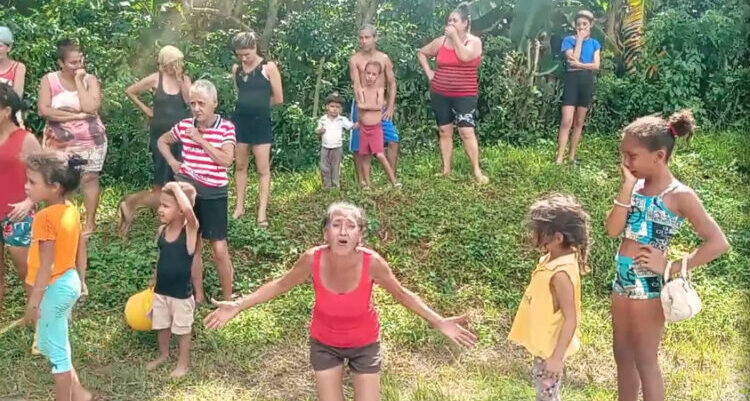
Mothers protesting in Maisí, Guantánamo Province, Cuba (captured from YouTube)

Cubanet, Luis Cino, Havana, 27 March 2024 — More than a few Cubans in exile are skeptical about the scope and effectiveness of the current protests by the Cuban population. They belittle them, arguing (in agreement with the official narrative) that the demonstrations are only about food and electricity, and that to calm them down will take only bestowing a little rice and beans from the state reserves, reducing the blackouts a little, blasting some reggaeton from loudspeakers, and hauling in the kegs to dispense beer on tap.

Many who think this way are disgusted and scared when they see protesters in flip-flops, the men without shirts, yelling vulgarities and expletives against Cuban President Miguel Díaz-Canel. They cannot conceal their elitism and contempt for what they consider to be easily-manipulated mobs of hungry rabble, politically illiterate. Thus, they betray a dissociation from reality and an arrogance as great as that of the leaders of the Castro succession.

If it is true that six decades of dictatorship have eroded societal values and civic sensibilities, and managed to keep many Cubans in a state of confusion and degradation, the populace overall has had enough of so much misery and oppression, and will not be meekly herded back into the fold.

The women and men who took the streets to protest are demanding freedom, because that is what they need to live with dignity–not only food, water, and electricity, as those trickster-bosses who try to hide the will of the people would have us believe. continue reading

There is room for agreement with those who speak of the need–now and in the future, if we aspire to democracy and not banana-republic anarchy–for the protesters to have leaders who can present a coherent political program as an alternative to the regime. But we cannot look down on those who, since July 11, 2021 (11J), in their own way and within their range of possibility, have been resisting the government with demands that, within a totalitarian state, inevitably become political.

The sum total of protests documented since 2021 by the Cuban Observatory of Conflicts produces a statistic that until very recently would have been inconceivable: 12,972. And that number will only increase.

Ordinary men and women, many of them illiterate, who demand to live as human beings, are managing to back the regime into a corner — something which the pro-democracy opposition did not achieve in decades.

We must humble ourselves and, however painful it may be, recognize that those of us who were endowed with civility and a certain intellectual baggage, opposing the regime since the 1990s, have failed in our efforts. We
have done so without knowing the job, improvising as we went, with a high level of idealism, without explicitly proposing to take power; all the while denouncing the abuses of power, and struggling to open spaces for democracy in the very smallest chinks feasible, as happened with the Varela Project, the high point of the opposition. And throughout, with a high toll of beatings, imprisonments, banishments, and even murders.

But we were unable to fully connect with the average Cuban. How were we going to reach a blackmailed, frightened population, who after decades of indoctrination and ideological manipulation, was sick of harangues and rejecting anything that smelled of politics? To top it off, this population was subjected to a constant bombardment of defamation against the oppositionists, who had no right of reply via any of the media in service to the State.

Everything conspired against opposition movements. And it was not only the repression. It was also the lack of resources and the ill-use or embezzlement by unscrupulous elements of the little that there was available; insufficient or poorly directed international support; internal disagreements and conflicts due to inflated egos and roles — often fomented by undercover State Security agents; the vices and tricks of Castroism transplanted to the opposition camp; the opportunists and imposters opposition to obtain a refugee visa.

Today, leaders who were moral role models are missed, such as Oswaldo Payá, Laura Pollán, Vladimiro Roca, Elizardo Sánchez, and Gustavo Arcos Bergnes.  

José Daniel Ferrer, Félix Navarro, and dozens of other oppositionists are in jail. Hundreds more have been forced into exile.

But currently, the regime has to face the daily demands of a people who are fed up with abuses and lies. Because the government has no solutions to offer, these protests will continue. And the people, unlike the stubborn bosses, have learned lessons from 11J.

In his article, “The art of protest in Cuba”,  Omar López Montenegro explains, “Neo-Castroism stopped being the only referent in the life of Cubans and, therefore, the whole false mythological construction undergirding it fell apart — including stereotypes such as ‘nobody can fix this thing, but nobody can do away with it, either,’ and so many others that for years nourished a culture of apathy and acceptance of injustice as an inevitable evil. The people what changes, they want them now, and they want them as a result of their own actions, not regime accommodations or miraculous intervention by third parties.”

Translated by: Alicia Barraqué Ellison

Gentlemen Politicians, Don’t Give Sustenance to the Deception / Cubanet, Miriam Celaya

Raúl Castro receives Democratic Senator Patrick Leahy and other American legislators. 2013 (acn.cu)

cubanet square logoCubanet, Miriam Celaya, Havana, 23 February 2018 — Without much fanfare, the visit to Havana of an American congressional delegation ended last Wednesday. The delegation included Democratic lawmakers led by Senator Patrick Leahy.  During the visit, almost nothing was accomplished: the “talks” between politicians and officials from both sides of the Strait continue to run in the style of conspiracies.

Judging by the soothing notes appearing in the official press and by the insubstantial statements made by the visitors at the press conference held at the US Embassy at the end of the visit, it is evident that the usual secrecy that has surrounded these meetings from the very beginning of the Obama-Castro confabulations persists, and the idea of the impossibility of a Cuba-US understanding in the current scenario is reinforced. continue reading

As has also become common practice, US politicians sympathetic to the policy of rapprochement with Cuba – as is the case of the aforementioned visitors – have strongly criticized the setback in diplomatic relations under the Donald Trump administration, after the toughening of the embargo and of the crisis unleashed by the enigmatic and yet to be clarified “sonic attacks”, which, according to US authorities, affected more than two dozen of their diplomats while they were carrying out their missions in Havana.

However, the common denominator of Cuba-US supporters and detractors for the existence of ties between the two countries is the defense of their respective positions at all costs, and in the case of the congressional delegation headed by Senator Leahy – a true activist in the defense of this line, whose efforts can only be assumed to be proportional to the interests he represents – is manifested in the repetition of a script based on a few basic elements, without going into much detail, and which is roughly summarized in the following points: retreat is detrimental to both Americans and Cubans, retorting to the “paranoia and suspicion” that has characterized US policy toward Cuba over 50 years, paralyzing cooperation projects between the two countries and preventing the US from “getting drawn into” the upcoming generational leadership relay process that will take place with the departure of the Cuban general-president this coming April.

The weakness of this position – which is not necessarily inferior to the opposite position, defended by those in favor of breaking off relations and maintaining the Embargo – consists in pretending to ignore the political immobility of their Cuban counterpart and their absolute lack of political resolve to effectively benefit the Cuban people by taking advantage of the breakthrough measures dictated by the former president, Barack Obama, in the heat of the brief period of thaw between the White House and the Plaza of the Revolution.

To this we would have to add the return to the barricade speeches and the deadlock in the ideological “anti-imperialist” trenches that have been imposed from Havana before the arrival of the Trump administration, just since then President Obama finalized his visit to the Cuban capital, in the course of which – and to his chagrin – the Cuban government noted both the overwhelming sympathy of Cubans for the “enemy Empire” and the real possibility that a true rapprochement among Cubans and a real application of the flexibilization, as conceived by Obama, constituted sources of citizen freedoms in Cuba that endangered the survival of the Castro dictatorship. No more, no less.

Therefore, although the current White House policy constitutes a return to strategies that have been proven unsuccessful for half a century, it is no less true that the reversal was not initiated by Trump, but by the Cuban government. Only that the Cuban setback consisted in an attack against those sectors of private entrepreneurs in Cuba, whose small businesses had begun to prosper in the shadow of the reestablishment of the links with the USA that favored a greater influx of American visitors and, with it, the increase of the benefits for a growing number of industrious Cubans who depended less and less on tutelage and government “protection”.

It is fair to remember that the systematic asphyxia of the tiny private sector in Cuba is a State policy to prevent true changes from taking place within the Island.

Thus, set in context, it is appropriate to mention another assertion that is becoming dangerously recurrent: “Cuba is changing”. This monotonous ritornello has become a kind of mantra among some foreign visitors – supposedly well-intentioned – who seem to confuse reality with wishes.

The damaging portion of this erroneous misperception is that, at the international level, it tends to create favorable opinion positions to the fraudulent change that has been brewing on the Island since the departure of Castro I from the public scene, and at the same time discourages millions of Cubans to their aspirations for democracy, in particular those inside and outside of Cuba who have been fighting in singular disparity against the longest dictatorship in the history of this hemisphere.

In truth, the “generational change” in the political power that looms over Cuba does not imply a political change or respond to the existence of a young emerging political class, full of new ideas and proposals. Quite the opposite. It is simply a consequence of the natural course of biology that imposes the retreat of the olive-green gerontocracy from visible government – not from real power – and the imposition of a faithful puppet, just a fresher face that guarantees permanence of the caste system established in 1959 and the privileges of their anointed ones. This is why it is very unlikely that the generational transfer implies a significant change or an evolution towards authentic transformations of the Cuban reality.

Moreover, to suppose that the diplomatic relations with the US government would allow its “involvement” in the Cuban political scenario is not only illusory but also arrogant by implicitly ignoring the ability of Cubans to, in a propitious scenario, decide the political future of the Island without “essential” intrusions of the White House.

That, in terms of politics. With regard to the social scenario, what “changes” have been taking place in Cuba from governmental actions or from the existence of US relations or the lack thereof? Neither necessary nor sufficient ones.

It must be recognized that in recent years certain modifications have been introduced into Cuban legislation (often referred to as breakthroughs by some stubborn optimists), but in good faith, these do no more than recognize rights that for decades have been denied us, such as the purchase and sale of housing and automobiles, the pseudo immigration reform, the (limited and expensive) access to the Internet and mobile telephone networks, the appearance of computers in state stores, the expansion of private sector activities and the granting of licenses for the same (although these are currently “frozen”), among others. Such “reforms” have not had an effective social reach nor have they meant an improvement in the life of ordinary Cubans.

In fact, material shortages have increased in recent years, the cost of living has risen, health services and the quality of education have worsened, corruption has deepened and crime has increased, and the general crisis in values is notorious, all of which intensify the uncertainty, despair and apathy of the population.

So, gentlemen politicians, do not be deceived… Or, rather, do not give sustenance to the deception. Cuba really needs a miracle but it will not come from the hands of a servile amanuensis of the dictatorship or from those who rule the US; be it a charismatic and wise mestizo of friendly disposition or a blond-haired rabid and belligerent radical.

Translated by Norma Whiting

Opposition March in Havana in Remembrance of Orlando Zapata Tamayo

The group of activists walking the streets of Havana (Photo: Enrique Díaz)

cubanet square logoCubanet, Enrique Díaz Rodríguez, Havana, 19 February 2018 – Nearly eight years after the physical disappearance of Orlando Zapata Tamayo, nineteen human rights activists staged a march in Havana streets in remembrance of the Cuban opposition martyr.

The group of activists, made up of women dressed in white and members of the Orlando Zapata Tamayo Civic Action Front (FACOZT), gathered in the early hours of this Sunday, February 18, in a park located in the El Palenque neighborhood of La Lisa municipality.

Carrying posters that read “Freedom for Cuba,” “Freedom for Political Prisoners,” “Zapata Vive,” “Long Live Human Rights,” exclaiming anti-government slogans and remembering the names of Laura Pollán, Pedro Luis Boitel and Orlando Zapata, the activists marched peacefully for several blocks. continue reading

The group gathered in a park they themselves have done in recognition of Zapata Tamayo (Photo: Enrique Díaz)

In 2012, when the FACOZT was known as the Hard Line and Boycott Front, the movement baptized the aforementioned park with the name of the martyr, placing a metal tag that was later torn off by agents of the State Security.

At the end of the march it was learned that the home of the opposition couple consisting of Hugo Damián Prieto Blanco, leader of the FACOZT, and Lazara Bárbara Sendiña Recalde, was being watched by agents of the State Security and the National Revolutionary Police.

Some 25 Years After the "Special Period" the Bikes Keep Rolling / Orlando Gonzalez

cubanet square logoCubanet, Orlando Gonzalez, Havana, 20 February 2018 – “I won my bicycle in 1993 for being a ’vanguard’ worker. I’m a Physics teacher and I remember all the requirements that had to be met to be rewarded with one of these.

“In those days the only thing that mattered to me was not having absences, participating in all political activities and volunteer work and being an excellent worker. They made us compete with our own coworkers and friends to win the bike.

“At that time the ’Special Period’ was very hard, for me it was a great relief when I won it, it was like winning the lottery because it solved my transport problem, pedaling was the best [way to travel],” recalls Ángel González, who, like many Cubans, found a bicycle changed his life in the 90s. continue reading

“I remember that first day taking my son to sit on the Malecon. It was almost 20 miles of pedaling but I didn’t feel it because the need was so great and the transport system was so bad that it was my only option; the happiness on the face of my 11-year-old boy that day I will never forget it,” added Ángel, who 25 years later still has the same “Flying Pigeon,” although he no longer uses it to travel long distances because the transport system “has improved” and, in addition, he’s no longer young enough to pedal the 20 miles.

Bicycles from that time and even some that go back to the 50s still roll on Cuban streets, having come to be more valuable than current models because they are “tougher.”

“Now there are a few parts that are Chinese, the chain ring has an adaptation where the original parts are removed and mounted in a ball box. The front and rear hubs and nuts are made by turners with thick sprockets, and the tires and inner tubes are also manufactured by hand. The pedals are made of wood and last longer than the original ones. The seats are also made by hand. In short, only the frame, the handlebars and the fork are the ones that originally came with the bicycle,” Ángel explains.

A whole industry and its market revolve around spare parts for bicycles. The tires, manufactured by hand using old tires, are sold for a price of 8 CUC; the innertubes are also handmade and have a value of 4 CUC.

The “poncheros,” — the self-employed workers who are dedicated to repairing tire punctures — almost always market all these products made by craftsmen. Adrián González, owner of a private workshop, explained to CubaNet how his business works: “When I first set up the repair shop, I had workers who were dedicated only to fixing punctures; then I realized that the spare parts were a good business and I set up a workshop for repairs and the sale of accessories.”

“Some parts, like the front and rear axles, hubs and nuts, are made by turners using old rods and irons; others, like the tires and innertubes, I also get from private factories. I only resell these pieces and I have the manpower to change them in case the client asks, and with that I have enough to live on,” he adds before concluding: “The bicycles are rolling in Cuba today because of all these inventions, because the original pieces are almost impossible to find in the State stores, and when the resellers come in, they hoard them immediately, the demand is so great.”

Felipe has been a turner for more than 30 years and has found a source of income by manufacturing spare parts for bicycles. The great demand caught his attention.

“I am a turner, several years ago I realized the great demand for spare parts for bikes (and) then I began to manufacture nuts, hubs and axles for all the models that exist in Cuba,” he explains. “Although most are Chinese bikes that entered the country in the 1990s, I also manufacture pieces for Russian bikes that are older but more sturdy, those have been rolling since the 70s.”

In the network of state stores, the price of a bicycle exceeds 120 CUC, the equivalent of several months wages for an average Cuban.

However, bicycles were recently removed from almost all state stores. Jorge Medina, the manager of one of them located in Boyeros, explains: “We had several models at different prices that ranged between 110 and 240 CUC; last month they took them all and did not give us an explanation, they came in a truck belonging to TRD [the state chain of hard currency stores] and they were taken away.”

At the same time, “throughout the network of hard-currency stores in Havana today there are very few bicycles for sale and prices have risen considerably,” Medina added.

Even today, more than 20 years after the start of the so-called “Special Period,” cycling is still a key transportation mode in Cuba.

Miami Has It All, Even Russian Meat / Cubanet, Luis Cino Alvarez

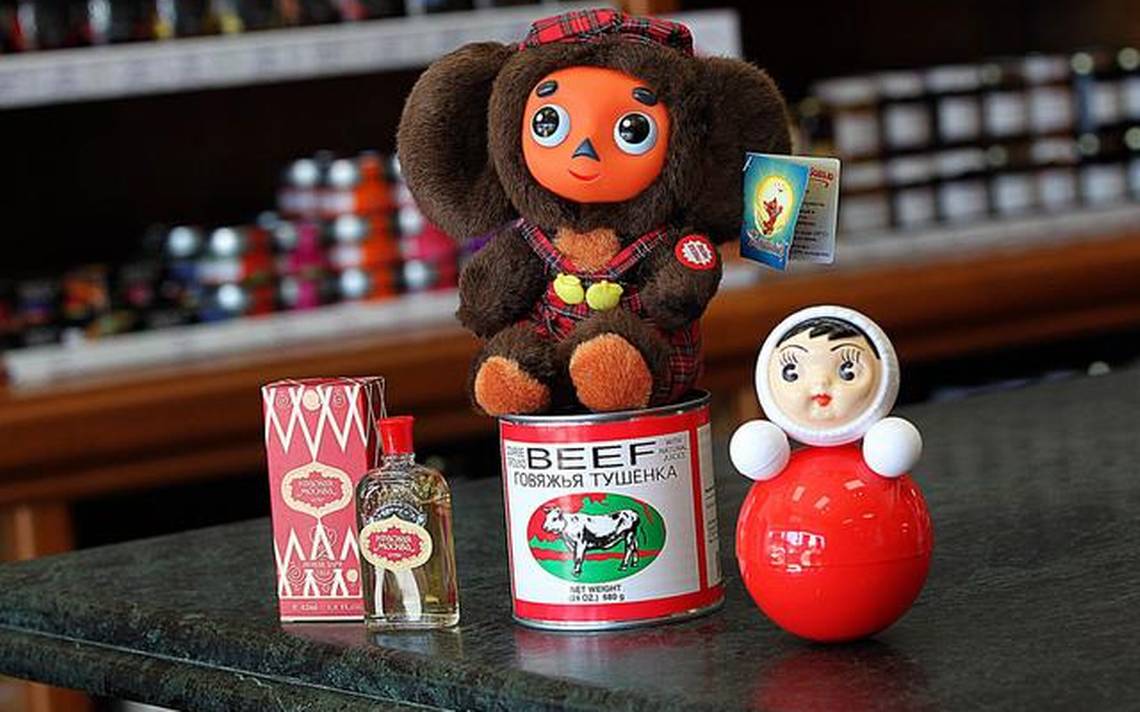
Some of the Russian foods, toys and perfumes for sale at Marky’s in North Miami (Photo: El Nuevo Herald)

cubanet square logoCubanet, Luis Cino Alvarez, Havana, 18 May 2017—A neighbor of mine in Arroyo Naranjo recently had to ask an old friend of his who lives Miami to help him obtain some amitriptyline. A psychiatrist had recommended this medication for my neighbor’s wife to treat a nervous condition that would worsen without it.

This drug, among many others on a very long list, has been off the shelves of Havana pharmacies for months. The official excuse, aside from usual ones such as “the criminal blockade [U.S. embargo],” is that the cash-strapped Cuban state has been unable to square its debts with foreign pharmaceutical companies. continue reading

For the very astute customs officials at Cuban airports, ever on the hunt for drug trafficking and other illegal activities, it is a headache to conduct their painstaking inspections of the troves of medicines and vitamins that are brought in by travelers from the U.S.

Thus, it is no surprise that in Havana at this time, it is easier to find Tylenol than aspirin, and Centrum or Kirkland brand vitamins than the yellow multivitamin powder produced by the state, which some prefer not to use because it “whets their appetite too much.”

Cubans on the Island are evermore dependent on the remittances and packages they receive from their relatives and friends abroad, primarily those in the U.S., whom the regime demonized for decades, called traitors, and tried to cut their emotional ties to Cuba.

Many Cubans depend on the emigres and exiles not only for medicine, sustenance and clothing, and the monthly recharging of their mobile phones. They also request and obtain from them the most varied and sundry goods: from santería necklaces and white garments for the iyabó to school uniforms, and even parts for Russian-made automobiles.

That’s right. You heard it. In various Miami establishments one can find parts for Soviet-era automobile makes such as Lada and Mokvich, and for Ural and Berjomina motorcycles. In today’s Russia it is probably difficult to find these parts, they may not even be produced anymore, but in Miami, I know not how, there is an abundance of them. And obviously they are aimed at Cuba, where Russian cars compete for longevity with the Fords and Chevrolets more than 60 years old that are still circulating.

But do not be surprised by the availability of Russian products in Miami (let us hope this is not a plot by Czar Putin and his intelligence service). When I visited that city last year, I spotted on the shelves of a well-stocked bodega (it being so Cuban I hesitate to call it a supermarket), located on Southwest 27th Avenue near Coconut Grove, nothing less than Russian canned meat. Those very same cans that we would refuse back in the day, the ones we said contained bear flesh or god-knows what other greasy Siberian beast, and that today, after so many years of enforced vegetarianism, cause our mouths to water as though they were the most exquisite delicacy. It appears that in Miami, while hunger is not their motivation, there are Cubans who are nostalgic for Russian canned meat, because I doubt very seriously that the only customers for this product would be the wealthy Russians who reside in Hallandale and Sunny Isles.

In Hialeah, which is like a piece of Cuba transplanted to South Florida (but without the ration books and the CDR) it probably is not very difficult to find those damned cans of Russian meat.

Also there, and in any other part of Miami, one can hear reggaeton and watch the pigswill of Cuban TV. And don’t be surprised if the generation of Bolek and Lolek manage to get their hands on those cartoons they had to watch as children in Cuba, when Pluto, Porky Pig and Donald Duck were considered agents of the imperialist ideological penetration.

Those who cannot resign themselves to watery coffee and bland cigarettes—if they wish to smoke (to the horror of the nonsmokers, always such scolds) stronger cigarettes than American Spirit and the Wranglers sold by the Indians in Kendall—can find in Hialeah, and not too expensive, cigarettes directly from Cuba: H. Upmann, Populares and even the unsmokeable Criollos and Titanes, a.k.a. “chestbusters.”

It seems to be true what I heard from a Cuban American who, as a sort of savior-magus bearing gifts, was visiting his impoverished relatives in Mantilla: “You can find everything in Miami, anything, whatever it is.”

luicino2012@gmail.com

Translated by: Alicia Barraqué Ellison 

Police Block Activist Lia Villares From Traveling to the United States / Cubanet


cubanet square logoCubanet, 2 May 2017 — Independent activist Lía Villares missed a flight that would have taken her to the New Orleans Jazz Festival after being “abducted” by police on Monday morning.

Speaking to CubaNet, Villares describes that two patrol cars under the command of State Security Agent “Jordan” were waiting for her near her home this morning when she was left to go to José Martí Airport. Villares had taken a taxi to go to the air terminal, but the vehicle was intercepted and the activist arrested.

The young woman describes how she was taken by the agents to Tarará, at the other end of the Cuban capital. The delay caused her to miss her flight, apparently the primary objective of the operation against her. Villares has a passport to travel, and permission to enter the United States.

Hours later, Villares was released without charges. She said he would try to buy a ticket and travel again because the authorities did not give a legitimate reason for her arrest.

“On A Daily Basis I Prepare Around Fifty Lunches” / Cubanet

Source: Cubanet

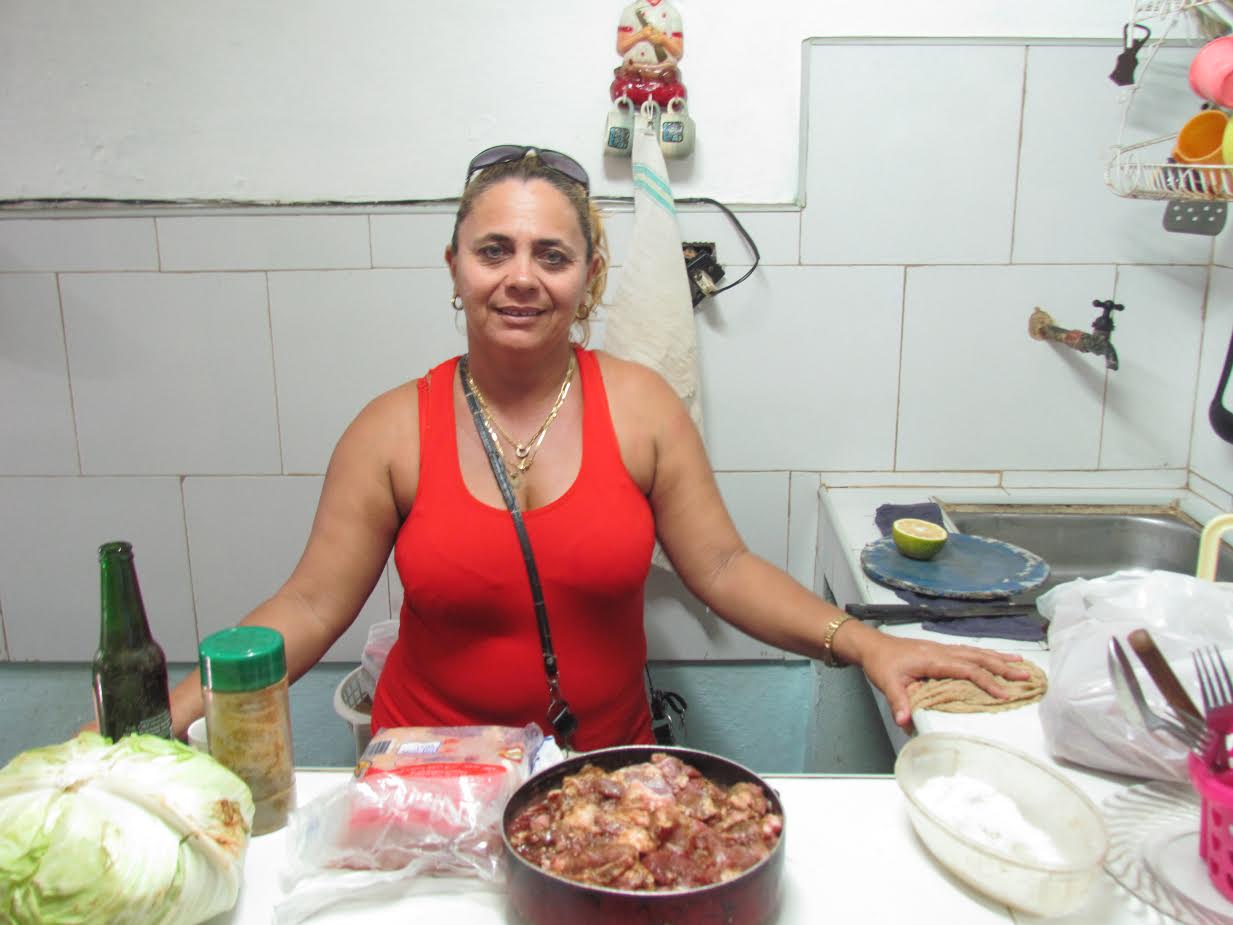
cubanet square logoAy mi’jo, I would die of shame if I told you the things I’ve had to do, to earn a living (…) Fortunately, the best thing about working on my own is that even though beginnings are hard and there are always difficulties, I have managed to find my business (…)

Since I’m from Bauta [municipality about 25 miles southwest of Havana] I have to get up early almost every day, from Monday to Saturday, to be in Havana from 7 to 8 AM at a friend’s house who rents me her kitchen in Cerro. Then I have until noon to cook the food I’ll sell, and I have to make it well (…)

On a daily basis I prepare around fifty lunches. I put them in the containers I have, and around noon I go and sell them at a taxi stop by Parque de la Fraternidad.

Afterwards, I’ll go back to my friend’s house and prepare for the next day, buying anything I might need, or defrosting and seasoning meat. In the afternoon, I’m off to Bauta once again (…)

It’s been like that for five years (…) I’ve always been a dreamer, with many hopes and aspirations, but now at my age I try to not expect much from the future. Better to have it surprise me.

Translated by Leidy Johana Gonzalez and Brenda Rivera

“What I Want Most Is To Get Back To Volleyball” / Cubanet

Source: Cubanet

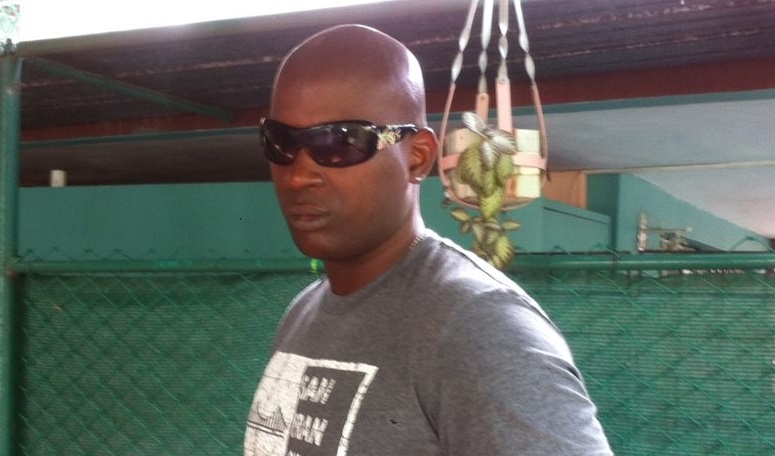
cubanet square logoI was a volleyball player in the last golden era of the sport in Cuba. I played alongside the best in the world: Marshal, Dennis, Pimienta, Diago, Iosvany Hernández. I played on the national team in the 1999 Tournament of the Americas in the United States, and in 2000 I almost went to Sydney, but right after that, during the best moment of my career, the team changed coaches and volleyball practically finished for me. They never called me again for the team and I decided to retire from the sport (…)

Since then, I’ve tried a thousand times to get back in.  I started training young boys, and I was even on a sports mission to Portugal, but I couldn’t maintain myself financially with that, and I had no choice but to start working as a security guard in various nightclubs, like so many others. (…)

What I want most is to get back to volleyball, at least to train and prepare the youth, but the way things are now, I believe I’m just going to have to keep maintaining law and order in the Havana nights.

Translated by Jorge Vásquez, Aliaksandra Rabtsava, Vanessa Parra Henao

“There’s No Place To Skate So You Have To Adapt” / Cubanet

Source: Cubanet

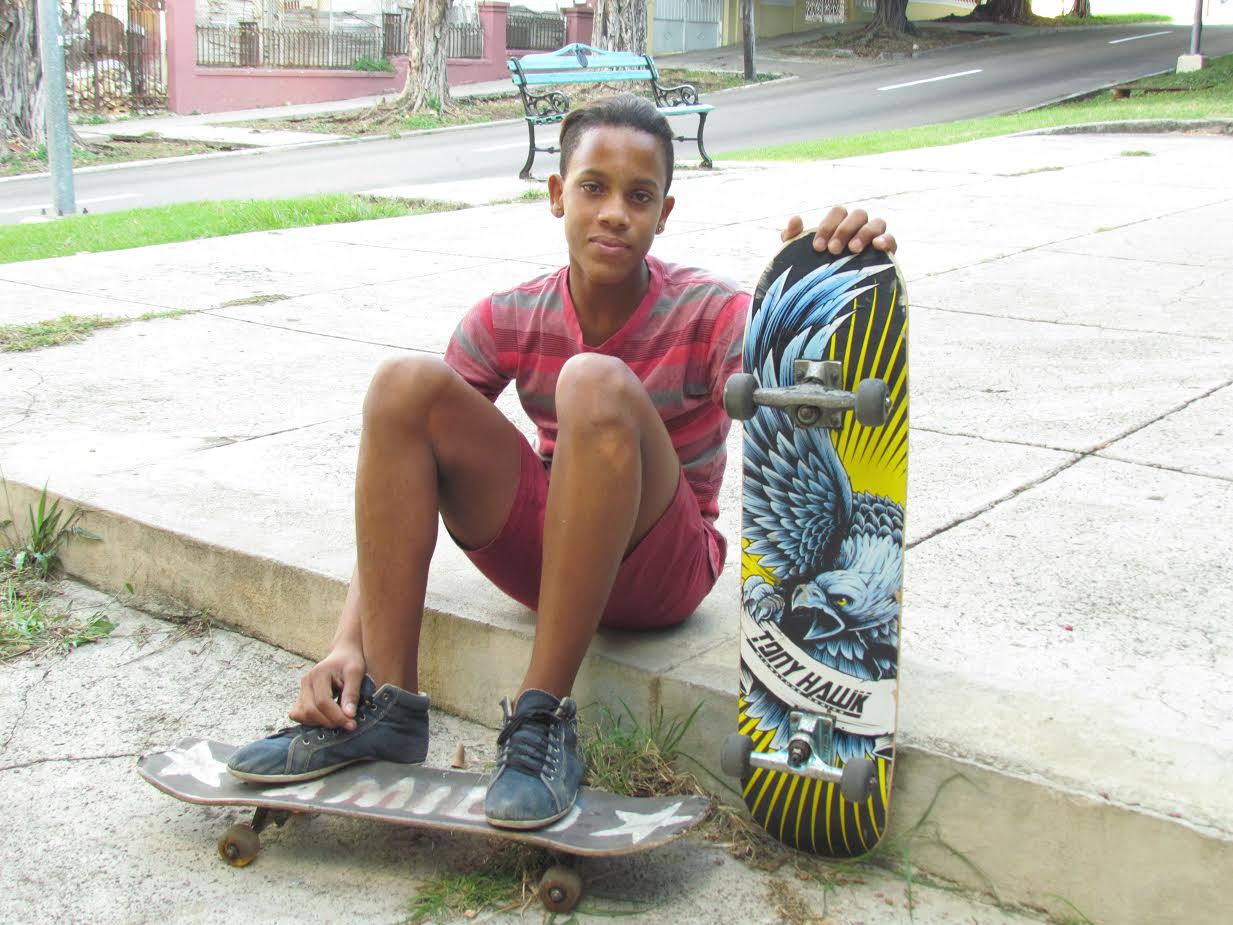
cubanet square logoThere’s hardly anyplace left to skate. You can walk around here and the only thing you can find are parks, which are really useless and sometimes we bother people. Old people scold us. I have friends that practice in the middle of the street because the ramps and installations that once existed are in ruins and no one bothers to fix them.

I’m not a professional; those who are more involved with skateboarding skate around Prado. I skate more often in Paseo. I do it as a pastime or as a hobby, like they say in English. Sometimes before coming out I watch extreme sport videos. There are even kids who win competitions with incredible technique.

I don’t know if there are competitions here in Havana. I don’t think so. It’s difficult because there’s no place to skate so you have to adapt. My favorite athlete is Tony Hawk, one of the toughest skaters I have seen. But personally I’ve never dreamed of skating seriously, I mean professionally.

I am in 10th grade and there is not much entertainment here, or anywhere else. While other kids my age are listening to reggaeton or, I don’t know, wasting time talking nonsense and telling lies, I grab my skateboard and spend a few hours in the afternoon riding it.

Translated by Cynthia Vasquez Bermeo, Josselyn Lopez, Natalia Pardo

“And Then You Hear People Say That Racism Doesn’t Exist In Cuba” / Cubanet

Source: Cubanet

cubanet square logoI literally just saw a police officer ask a couple of kids for their identification and I’m pretty sure he did it because they were black. That’s just the life they were dealt. I have almost never seen the same happen to white kids. It’s as if whites are invisible to the police.

And then you hear people say that racism doesn’t exist in Cuba. And the funny thing is that it could’ve been those same whites that just finished robbing a house around here because whites also steal. I walk a lot around the neighborhood of Vedado, so I see many things.

Because of the color of my skin and my mean look, I get stopped all the time by the cops. I don’t want any problems. People look at me and think that I’m a tough guy but really, I don’t like fights or drama.

My thing is, I just like walking around town from time to time, finding small little jobs here and there to make money. Some days I sell fish and on other days I sell cans of paint.

I’m not really committed to anything right now but I have to find my way. I live alone but regardless I have to take care of myself. And on the weekends, I like to drink a little, like anybody would.

Definitely not beer though, because it’s more expensive. Besides, I’m more of a ‘rum’ type of guy, even though I advise people not to drink it. Rum is the reason why so many people are messed up in this country. I have a friend who went blind because he drank whatever he could get his hands on. I think he ended up drinking wood alcohol.

Translated by Oliver Inca, Patricio Pazmino, Marta Reyes

“San Lazaro Has Been My Savior” / Cubanet

Source: Cubanet

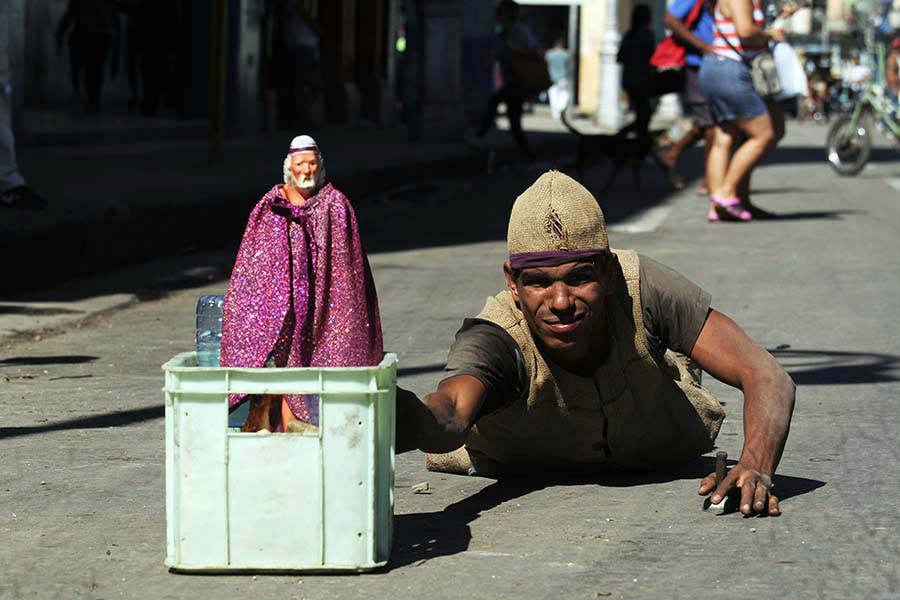
cubanet square logoSan Lázaro has been my savior. I’ve been through some very hard times and only when I placed my faith in San Lázaro was I able to find my way. Many people don’t understand why I do this. I left school in ninth grade, quite early, to work and help my mom. She earned very little money. How was she going to raise my ailing brother and me, if the money was never enough, not even for food?

They always called us ‘poorly dressed’, and to top it off we lived in a house cramped with people. (…) Since 2007 I’ve been making my pilgrimage. I remember the first time, I did the whole trip in somersaults. My brother went with me. I swear that one was the most exhausting trip. I passed through many villages, but I was told that was how it was supposed to be, I had to prove my faith. And I did.

Once I got to El Rincón they took pictures of me, movies… I felt that San Lázaro was with me. It was my first time at the Santuario del Rincón [the church dedicated to San Lázaro in the village of El Rincón to the south of Havna], and when I came in the door it was something amazing. Seeing the photographers and the people shouting, giving me water, it felt good. (…)

Today I’m alone, my brother feels better. I start my trajectory in November and I go around the streets of Havana collecting alms. Everyone stops, even the children. I see fear in their little faces, but one day they will understand.

Translated by: Beverly James, Aliya Kreisberg, Aracelys Pichardo-Bonilla

“Now That ‘El Supremo’ Is Gone, I’ll Be The King Of Havana” / Cubanet

Source: Cubanet

cubanet square logoYou’re lucky to be witnessing the debut of one of the major go-getters in the bicitaxi business. Old Havana is crammed with ‘yumas’ [foreigners]. You see them on the streets, getting crazy, desperate to move from one place to another, looking and always asking. (…) And here’s Pancho, ready to be of service to those who need it. (…) I’ll admit I still have to fix up my “ship”, paint it, add cushions, lights, music. I’ll even have to dress better; I know the competition will back-stab you with those little details. (…)

Even though it’s my first week, I can already see that a lot of people are trying to get into the bicitaxi trade. You’re in constant contact with foreigners who are the ones with big bucks. (...) Since networking is everything, I’ve already partnered with some hotel owners, so I can play that card. If I happen to pick someone up who doesn’t have a place to stay, I’ll drive them to one of my contacts and afterwards I’ll collect my commission.  (…)

I have a lot of advantages, but I’m just getting started. I know the neighborhood. I know five languages, at least enough to communicate the basics. Besides, now that “El Supremo” is gone, I’ll be the king of Havana. As the saying goes: I’ve got my charm going for me, asere! I have the key!

Translated by Camila Fernandez, Kendra Gil, Jingqi He

“My Father Washed His Hands Of Me And My Mom Did The Best She Could” / Cubanet

Source: Cubanet

cubanet square logoI studied at a Camilito [one of the Camilo Cienfuegos Military Academies]. But for financial reasons, I had to drop out and start working. My father washed his hands of me and my mom did the best she could. When I used to go out on the weekends, I would come home with no shoes. It was very hard.

I started working as a bicycle taxi driver approximately four years ago. My work hours are around 7AM to 5PM, and I pay 3 CUC [equivalent to $3.00 U.S.] a day for the bicycle rental. Clients call me or look for me because I have a reputation for being trustworthy and honest. Thanks to them I always have work.

What I’d really like is the restaurant business, to be a bartender or something like that. I’ve always wanted to better myself professionally, but if I were attending night school I couldn’t work past 1pm. That wouldn’t allow me to earn enough money to accomplish the goals I’ve set. If I continue down this path, ten years from now, I’m not going to be much good to anyone unless my quality of life changes for the better.

I have thought about leaving Cuba. I love my country, but there is so much that needs to be changed and no one knows where to start. My dream is to have my own business. I’m willing to make sacrifices. But I don’t want to do it for no reason.

Translated by Mayra Condo, Karlina Cordero, Stephanie Desouza