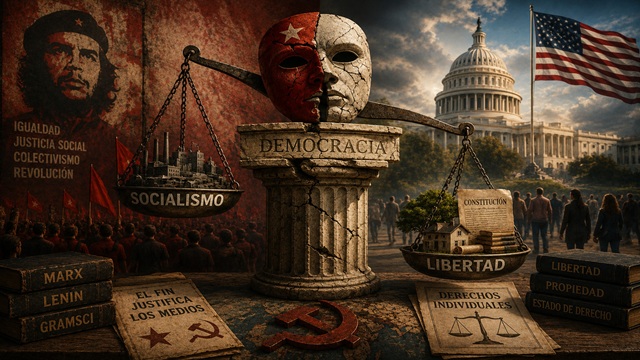
The CubanAmerican Voice. Julio M. Shiling, August 28, 2026 / “Democratic socialism” is a rhetorical convenience, not a coherent political category. It is an oxymoron because the ends of socialism—collective ownership or decisive state control of the means of production, the subordination of private property, culture, and market signals to a comprehensive plan for social justice, and the remaking of human relations according to an egalitarian moral template—cannot be achieved or sustained by democratic means. Enforcement requires coercion. Coercion on that scale corrodes the very institutions that make democracy possible. The historical pattern is consistent: what begins as a promise of popular empowerment hardens into authoritarian administration and, frequently, totalitarian control.
Socialism is not primarily an economic arrangement. Economics is the instrument. The deeper project is political and anthropological: the redesign of society so that private interest, traditional authority, and spontaneous association yield to a master conception of the good. Property rights, contracts, family forms, cultural production, and even moral language must be brought into alignment with that conception. Once the goal is comprehensive restructuring rather than incremental redistribution, the tools of democratic deliberation become obstacles. Voters may reject higher taxes, nationalizations, speech codes, or curriculum mandates. Markets may generate inequalities the plan cannot tolerate. Civil society may shelter dissenting associations. At that point the socialist project must either retreat or override the obstacles. Override is the more common choice.
The twentieth century supplies the evidence. Bolsheviks, after seizing power in the name of the workers, quickly suppressed rival socialist parties, independent trade unions, and the free press. Vladimir Lenin’s party had entered the Russian Social Democratic Labor Party as a faction; it exited as the monopoly of power. Mao’s China, Castro’s Cuba, the Eastern Bloc after 1945—all began with the language of popular liberation and ended with one-party rule, secret police, and the criminalization of private initiative. Even milder experiments that retained formal multiparty competition—Allende’s Chile, for a time—relied on extralegal pressure, expropriation without reliable compensation, and the polarization of institutions until constitutional order collapsed. The pattern is not accidental. When the state claims the authority to reallocate capital, labor, and cultural capital according to a single plan, it must also claim the authority to silence, re-educate, or liquidate resistance. Democracy, which presupposes contested elections, independent judiciary, and protected private spheres, cannot survive that claim indefinitely.
Contemporary Western Marxists understood the difficulty and shifted the battlefield. György Lukács, Antonio Gramsci, and the Frankfurt School recognized that economic determinism alone was insufficient in advanced societies. Cultural hegemony—control of the universities, media, churches, the family, and the language of everyday life—became the necessary precondition for political power. Once the cultural means of production are captured, socialist moralism can be presented as common sense and dissent as pathology. The project remains totalizing; only the sequence has changed. Democratic forms are retained as long as they advance the hegemony and discard it when they impede it.
This is why the Democratic Socialists of America should be read carefully. Their program is not a Nordic-style welfare state. It is the gradual dismantling of the liberal-democratic and republican architecture that makes markets and limited government possible. The analogy to Lenin’s entryism is not hyperbolic. A disciplined minority seeks to capture a major party, redefine its vocabulary, and use electoral success as a platform for deeper institutional transformation. The rhetoric of “democracy” functions as camouflage. The United States is currently undergoing the threat of this Trojan horse offensive.
Confusion with social democracy or Christian Democracy is therefore a category error. Both of those traditions operate inside a market economy and a constitutional order that protect private property and political pluralism. They tax, regulate, and redistribute to varying degrees—sometimes heavily—but they do not aim to abolish the price system or to re-engineer the human person. Otto von Bismarck introduced the first modern welfare provisions precisely to undercut socialist agitation while preserving the existing order. The Nordic countries remain capitalist economies with high labor-market flexibility, private ownership of most capital, and robust democratic competition. Their success is evidence that markets plus transfer payments can coexist with democracy. It is not evidence that socialism can.
The distinction is acutely significant for any society contemplating a democratic transition, including Cuba. A post-communist Cuba that adopts a welfare-state model within a market framework and genuine multiparty competition would not be socialist. A Cuba that retains the party’s monopoly on the commanding heights of economy and culture, merely rebranding itself democratic socialist, would remain dictatorial under a new label. The former preserves the possibility of course correction; the latter does not.
Socialism’s moral appeal is real. Many of its advocates are sincere in their desire to reduce suffering. Sincerity, however, does not alter the institutional logic. To enforce a comprehensive redesign of political, social, cultural, and moral life requires instruments of power that democratic societies rightly constrain. Those instruments, once normalized, do not remain limited. “Democratic socialism,” therefore, names a temporary and unstable hybrid. The democracy is the packaging; the socialism is the product. History shows which element prevails.
© The CubanAmerican Voice. All rights reserved.