I can imagine the number of onions, potatoes, mangoes, and peppers that won’t survive another day to be sold this Saturday.
 14ymedio, Yoani Sánchez, Havana, May 23, 2026 / I need onions. I take advantage of the electricity and go down in the elevator, also carrying the garbage that has accumulated during the days of blackout on our 14th floor. On the corner, the bins are no longer visible because a mountain of waste has covered their blue plastic. Several wheels have also been ripped off to make wheelbarrows for hauling water. One has its plastic ripped lengthwise, the other has holes caused by the flames of some fire. Neither has a lid.
I continue along Factor and turn onto Tulipán Street. A cart loaded with plantains and papayas catches my eye and makes my mouth water. It belongs to a family who come every weekend from San Antonio de los Baños, in Artemisa. I calculate the distance, consider the work it must take to move the merchandise to Havana, amidst the fuel shortage. “Everything is brought here because this is where the money is; in our town, there’s not even enough room to tie up a goat,” the matriarch of the clan, who also sells guavas, confides in me.
There was a time when I used to go to San Antonio de los Baños a lot. I would take my German students to visit the Museum of Humor, we’d go boating on the Ariguanabo River, and we’d even sneak into the International Film and Television School. The last few times I’ve been to that small town, a bridge between so many other areas of “red earth” and old pre-university schools in the countryside, I’ve barely recognized the once beautiful village. After 11 July 2021, which erupted right in its streets, the small town has become a place of silence. “We don’t even have water,” the vendor tells me as she offers me a handful of tiny plantains.
They tell me that “they’ve given the order to go to the march for Raúl [Castro]” and that’s why the most important market in the area hasn’t opened.
I continue along Tulipán Street to the farmers market, but I came across a closed gate and other people, like myself, arriving and feeling frustrated to see the empty stalls and an eerie silence that hangs over the place, on a Friday that is traditionally bustling. No one knew what had happened. I turned around and approached the other gate, which opens onto Marino Street. Inside, two young men were dozing in a guard booth. At my insistence, they told me that “they’ve given the order to go to the march for Raúl [Castro]” and that’s why the most important market in the area hadn’t opened.
An elderly man approaches with perplexed look upon hearing the justification. “So all this is because we went to support that old guy who shot down the planes,” he says angrily. Fury has taken hold here, where complaints used to be voiced with a touch of irony, a half-smile. Now anger has become the state in which we spend most of our time. We’re angry the 24 hours of the seven days in the week. There aren’t even jokes left to tell amidst a collapse that, according to one of my neighbors, “hasn’t hit rock bottom yet.”
Standing in front of the silent market, I imagine the countless onions, potatoes, mangoes, and peppers that won’t survive another day to be sold this Saturday. A single day of closure skyrockets spoilage, costs, and losses. Nor can I imagine the private vendors who fill these stalls, once run by the Youth Labor Army (EJT), crowding into the Anti-Imperialist Tribune to support a man they feel is both distant and responsible for the debacle we’re living through. There go the military personnel, the relatives of Castro, a fugitive from US justice, where he has been indicted on criminal charges including murder for the downing of the Brothers to the Rescue planes in 1996. There go the workers from the military conglomerate Gaesa, who can’t refuse these calls to action. There go those who haven’t realized, or don’t want to realize, the rage that throbs in these streets.
There go the military personnel, the relatives of Castro, a fugitive from US justice, where he has been charged with criminal offenses.
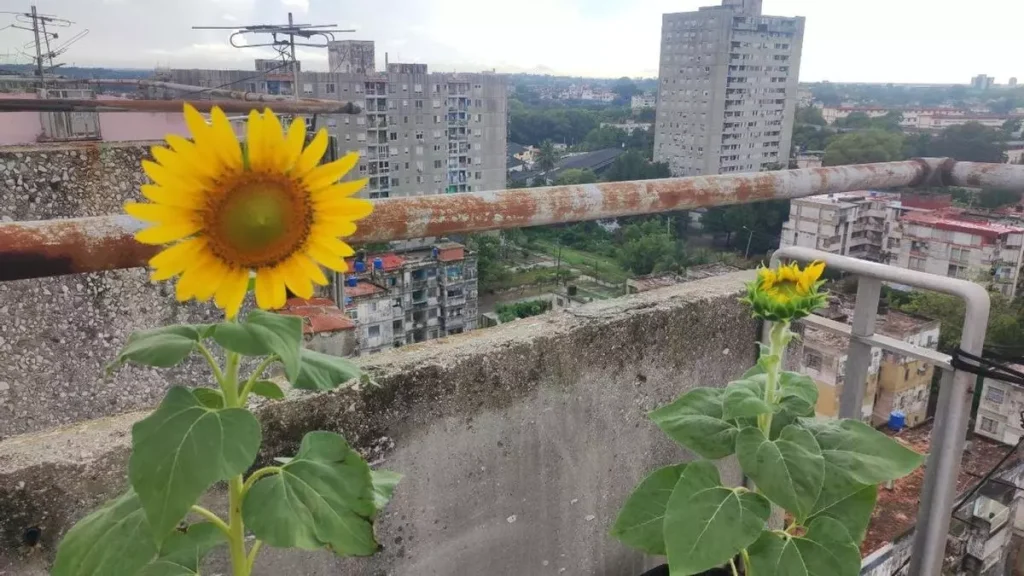
The onions will have to wait for another day. I’m heading home quickly before the blackout hits. Last week was terrible. One day we only had electricity for an hour and a half, divided into two 45-minute blocks. They couldn’t pump water to our building’s tank those days, and to top it all off, the Havana Water Company announced a break. One morning we only had one pitcher of drinking water left, but a sunflower I’ve been carefully cultivating absolutely needed some water.
You have to hold on to something. Waiting for those yellow petals to open in the middle of the rooftop gave me hope. Should I drink the blessed glass of water or give it to this spindly plant that won’t make it to tomorrow if I don’t water it now? I faced the dilemma. With its drooping leaves and limp stem, it didn’t have much of a chance. I’m definitely not prepared to survive by trampling over other lives. I poured the last of my water on it. That morning, miraculously, the electricity came back on and they were able to pump water into the tank.
This Friday, when I returned from the closed market, the sunflower on the rooftop was waiting for me in full bloom. I’m not ready to give up on beauty, not even amidst so much pent-up anger.
Previous Havana Chronicles:
Along Carlos III Street and towards Ethiopia
Sleeping Is Also a Privilege in Havana
A Desperate Plea in the Middle of the Dark Havana Night: ‘Light!’
Under a Picture-Postcard Blue Sky, the Country is Crumbling
Fatigue Barely Allows One to Enjoy the ‘Lights On’ in Havana
Dollars, the Classic Card, and a Havana Without Tourists
A Journey Through the Lost Names of Havana
The Shipwreck of a Ship Called “Cuba”
Havana Seen From ‘The Control Tower’
In Havana, the Only Ones Who Move Are the Mosquitoes
Reina, the Stately Street Where Garbage is Sold
Searching for Light Through the Deserted Streets of Havana
The Death Throes of ‘Granma’, the Mouthpiece of a Regime Cornered by Crisis
The Anxiety of the Disconnected Cuban
One Mella, Three Mellas, Life in Cuba Is Measured in Thousands of Pesos
It Is Forbidden To Leave Home in Cuba Today Because It Is a “Counter-Revolutionary Day”
Vedado, the Heart of Havana’s Nightlife, Is Now Converted Into a Desert
______________________
COLLABORATE WITH OUR WORK: The 14ymedio team is committed to practicing serious journalism that reflects Cuba’s reality in all its depth. Thank you for joining us on this long journey. We invite you to continue supporting us by becoming a member of 14ymedio now. Together we can continue transforming journalism in Cuba.