In addition to setting up tables for the initiative, the Committees for the Defense of the Revolution are visiting citizens house by house.
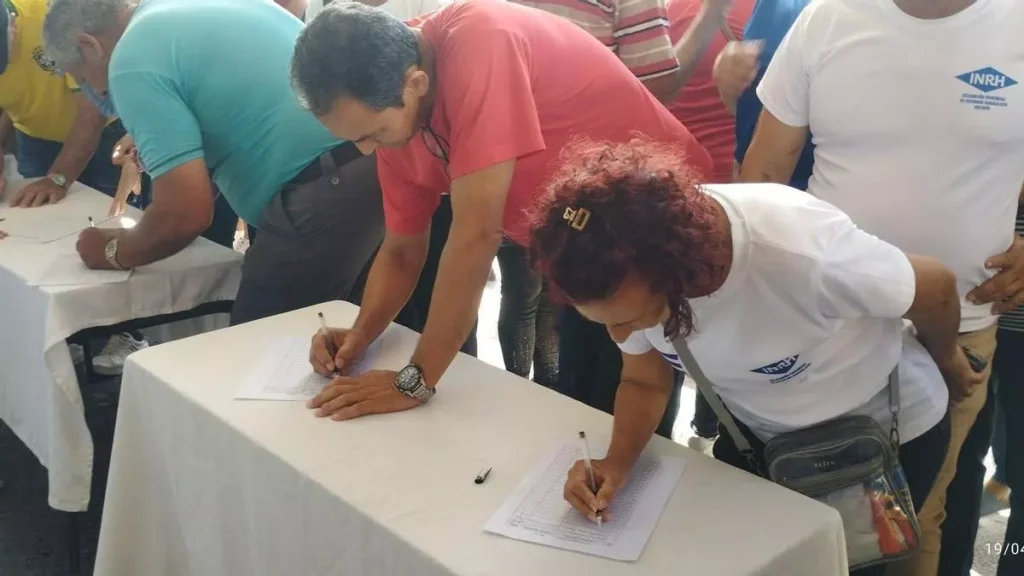
 14ymedio, Mercedes García, Sancti Spíritus, April 20, 2026 / Cuba’s state workers have already been ordered to participate in the “process” called “My Signature for the Homeland,” initiated this Sunday with his own signature by President Miguel Díaz-Canel, with which the regime intends to counter the pressures of the United States for a change in Cuba.
“They didn’t set up sign-in points at the workplaces, but instead established locations at the library, the cultural center, and other places. Companies are now telling employees they have to go there to sign,” an employee from Sancti Spíritus, who preferred to remain anonymous, told 14ymedio. How do they verify that the workers went to sign? “They sign a list that they went to sign,” the man replied.
The Committees for the Defense of the Revolution (CDR) have also mobilized to go door-to-door. Another resident of Ciego de Ávila recounts: “They came to my mother’s door, and she, being very old, signed. I don’t know what they told her. I already told my husband not to even think about opening the door.”
The woman compares it to what happened in 2002, following the Varela Project launched by Oswaldo Payá , when then-President Fidel Castro ordered the Committees for the Defense of the Revolution (CDRs) to force citizens to sign a “counter-project” that ended up enshrining in the Constitution “the irrevocable and inviolable nature of socialism,” which popular humor dubbed “constitutional mummification.” “In my house, we don’t sign anything like that,” the woman asserts.
“They even came to my mother, and she, being very old, signed. I don’t know what they said to her. I already told my husband not to even think about opening the door.”
The Ciego de Ávila newspaper, Invasor, gave a detailed account this Monday of the official government’s mobilization, focusing not so much on its ability to mobilize people as on its use of triumphalist rhetoric. Lianet Pazo Cedeño, a member of the Municipal Party Bureau, declared that the people of Ciego de Ávila “are prepared to demonstrate to the world the free will of the Cuban people to preserve the sovereignty and independence of the nation, but without submitting to blackmail or renouncing their principles.”
Provincial government leaders, such as Odelsys Valcárcel Pérez, general secretary of the Federation of Cuban Women, contributed to the impassioned speeches published by the state newspaper: “Let us unite and denounce the barbarity. Let us make our stance the firmest and most resolute condemnation of all policies contrary to the life and rights of the Cuban people and in support of the Declaration of the Revolutionary Government.”
Several official posts also showed the lines forming at tables set up in Holguín for signatures—which will continue until May 1—although the faces didn’t reflect much enthusiasm. From Guantánamo, a resident reported to this newspaper that the Committees for the Defense of the Revolution (CDRs) are going door-to-door “collecting information on people who are sick and those who are fit to come forward to defend the homeland.”
The call, disguised as a civil society initiative, aims, in the words of the statement issued by the Presidency, to support “the call made by the president at the event for the 65th anniversary of the declaration of the socialist character of the Revolution, to organizations in Cuba and the world so that the truth about Cuba is known in every corner of the planet,” seasoned, of course, with an allusion to “this people’s commitment to peace” and “the firmness and willingness to defend sovereignty.”
“At least don’t sign out of habit, think about it for a while, let’s try for a moment to be civic-minded and responsible with our destiny, don’t give away your signature.”
Immediately, activists inside and outside Cuba lashed out against the initiative. One example is the #PorEsoYoNoFirmo (That’s Why I’m Not Signing) social media campaign, which users have joined by accompanying the hashtag with images of the situation on the island, including the repression of peaceful demonstrations, blackouts, and giant piles of uncollected garbage.
Art historian Miryorly García reflects on her Facebook wall: “And many people will go there to sign irresponsibly once again, because Cubans have adapted to double standards,” and asks her fellow citizens: “At least don’t sign out of inertia, think about it for a while, let’s try for a moment to be civic-minded and responsible with our destiny, don’t give away your signature, don’t give away your approval.”
From this distancing, she reasons, “it may depend on them being more afraid than the one they’re trying to impose on us through repression, on the fear shifting sides and them packing a suitcase and fleeing, because they’ll realize full well that they have no support.” She elaborates on the same idea: “You have a business that’s struggling because you almost never have electricity, you have a salary that isn’t enough, you live off remittances from someone who had to leave to help you survive… For all these reasons, you need to refuse to sign; you have nothing left to lose. Are you doing it to keep your job? What job, in a country that’s grinding to a halt!” And she concludes: “You have to decide to do your part if you want to see the sand on an entire beach. Cuba changes if we change.”
______________________
COLLABORATE WITH OUR WORK: The 14ymedio team is committed to practicing serious journalism that reflects Cuba’s reality in all its depth. Thank you for joining us on this long journey. We invite you to continue supporting us by becoming a member of 14ymedio now. Together we can continue transforming journalism in Cuba.