
Dissidents Locked Up in Their Homes and Internet Outages to Prevent the Repetition of July 11th Protests (11J) in Cuba

In some parks in Havana, this same day, schoolchildren were seen singing revolutionary slogans. (14ymedio)

14ymedio bigger14ymedio, Havana, July 8, 2022 — As July 11 approaches, State Security deploys its tentacles to neutralize any attempt to celebrate the first anniversary of the historic protests that took place in dozens of places throughout the island.

This Friday, independent reporter Luz Escobar was summoned to receive a very clear warning: On July 11, 12 and 13, she will be under “surveillance” at home and, therefore, will not be able to leave.

“The State Security officer who calls himself Ramses, and who frequently represses me, called this afternoon to tell me that I’m summoned tomorrow at 10 am to the identity card office for an ’interview,’” Escobar reported on her social networks on Thursday. “He says that, based on new regulations, they don’t have to give me written notice.”

The journalist confirmed what she predicted: “He wanted to let me know that as a result of the ’complicated’ days that are coming now, I will have surveillance and a group of police on the ground floor of the building to prevent me from going out on the street in those days.” Ramses himself assured her that he would be on duty.

Leo Fernández Cruz, from Guanabacoa, was also quoted this Friday. “On the past July 11, I didn’t take to the streets,” he recalled. Months later, the young man was arrested for six hours, after the frustrated call of the Archipelago platform for the Civic March for Change on November 15.

Likewise, other activists on the island, such as Yerly Velázquez, from Santa Clara, have also been summoned by the political police. The young man, his mother told this newspaper, was accused this Thursday of “contempt” for his posts on social networks and they even asked him to appoint a lawyer for his defense. continue reading

Sources from Cienfuegos say that some schools have been closed since Friday to be able to concentrate police and soldiers in anticipation of this coming Monday.

In some parks in Havana, on the same day, schoolchildren were seen singing revolutionary slogans. “My children have already been summoned to activities in the nearest park, for today, Friday and Monday the 11th,” Juliette Isabel Fernández, wife of journalist and opponent Boris González, who was also threatened by State Security, wrote on social networks. “It would be crazy that, with a father summoned to receive the warning that on Monday the 11th he won’t have the right to leave the house and move through the streets, our children would attend that call,” she said, while reporting that “patriotic music” had been playing in the neighborhood since the morning.

From Sancti Spíritus comes a report that they are “mobilizing” workers to be “guards” in state enterprises. At Alexander Fábregas’ home, reports his brother, U.S. resident activist Néstor Estévez, the whole family is “peacefully quartered,” from this Friday at three in the afternoon until Monday, to protest “inside the house” for the anniversary of July 11.

According to other testimonies, in several buildings in Havana residents have been called this weekend for an “exercise of revolutionary popular surveillance,” consisting of putting up “decorations and flags” as a way to show that “we are still in combat,” in the words of the president of the neighbors’ council of a building in El Vedado.

In addition, since this Thursday, Internet service on the island has been slow at times. It doesn’t go unnoticed that the communication blackout was one of the tactics carried out by the regime, with the help of the state telecommunications monopoly Etecsa, to prevent the repression of 11J from being broadcast in real time, such as the first demonstration of that day in San Antonio de los Baños.

Translated by Regina Anavy

____________

COLLABORATE WITH OUR WORK: The 14ymedio team is committed to practicing serious journalism that reflects Cuba’s reality in all its depth. Thank you for joining us on this long journey. We invite you to continue supporting us by becoming a member of 14ymedio now. Together we can continue transforming journalism in Cuba.

Can State-owned Enterprises Change the Ways of Thinking and Redesign Production Processes?

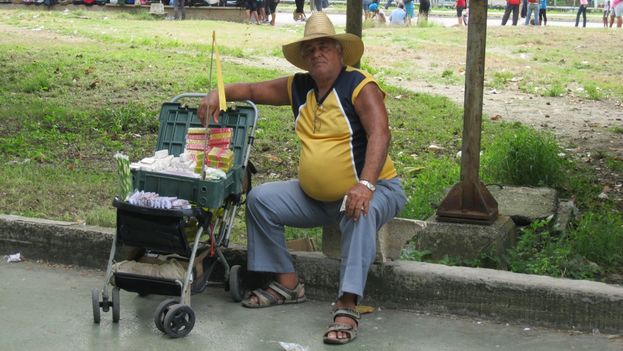
A sole proprietor sells peanuts and sweets in Havana streets.  “Businesses” this small were confiscated during the 1968 Revolutionary Perspective. (Luz Escobar)

14ymedio bigger14ymedio, Elías Amor Bravo, Economist, July 7, 2022 — Before the next International Congress of Business Management and Public Administration to be held in Havana until July 8, the Deputy Minister of Economy, Johana Odriozola, has made statements to the official newspaper Granma that have been published under the title “Transformations in the Cuban business system in order to grow with efficiency.”

It seems that this congress will address how to “change the ways of thinking and redesign production processes to incorporate into the Cuban business system topics such as Industry 4.0, Artificial Intelligence, Big Data, the Internet of Things and cloud computing.” What a great waste of time!

Cuban communists are convinced that in their socialist model it’s possible to develop a business system that is dependent on the state, on what they call a socialist state enterprise, which they want to promote and give a more relevant role within the economic system. But haven’t these socialist companies been protagonists in Cuba’s economic history since 1959?

After the end of the confiscation proceedings initiated in 1959, with the so-called “Revolutionary Offensive” of 1968, all Cuban productive capital passed into the hands of the state without leaving room for private economic activity. The state became the owner of the means of production and the companies, so its ability to influence the economy and society increased significantly. The companies were all state-owned, and there was no room for private enterprise. And this is how the Cuban economy worked until a few years ago when formulas such as self-employment or micro, small and medium-sized enterprises were approved, which, however, have little to do with the concept of private enterprise that we know.

Private enterprise is based on three fundamental elements: property rights, autonomy and profit motive. None of the three are present in Cuban socialist state enterprises, and therefore, the leaders are unable to attract investments for them, or take advantage of the human talent they have, or give as much flexibility as possible, nor autonomy for the exercise of their rights. And this formula is what Mrs. Odriozola wants to present and vindicate at the congress. continue reading

To achieve transformations in the business system, the communists have opened their hand with respect to state enterprise, for example, with measures such as “the elimination of profit distribution limits, the expansion of its corporate purpose, a link with the non-state sector and the creation of state-owned micro, small and medium-sized enterprises.”

Nothing to do with the implementation of a legal framework based on private property rights, as a main reference for the exercise of business activity, much less with decision-making autonomy or the generation of profits. These elements would give the business system a boost, but they are despised by the Cuban communist leaders, who don’t even want to hear anything about them.

Apparently, the leaders of the regime are concerned about the insertion of the new economic actors into the Cuban business system; above all, that the regime might lose the ability to interfere and control the activity of the private sector, within the Marxist philosophy of economic interventionism. It is in the interest of the regime that companies, state or private, be servile and subject to the principles of political hierarchy that establish, of course, who rules and who obeys.

That is why, at the same time that they introduce the previous solutions to lend a hand to the state company, they see the need to keep the new economic actors under control, recognizing that any opening of spaces for state enterprises has its transfer to the private sector.

López Calleja already saw it at the time from GAESA,and that is why he used all his power to limit and stop the development of self-employment in tourism or gastronomy. The problem with the Cuban socialist state enterprise is that it’s inefficient by its own nature, lacks motivation and incentives, and is unable to face private competition when it receives a simple authorization from the state to operate.

Hence, Castro leaders think that the transformations that have been implemented in recent years have benefited private actors, but they haven’t done so to state companies, and, therefore, they want to recover lost space and time. Another thing is that they get it. The intention of the regime, announced by Mrs. Odriozola, is that what remains of the Management Task, the 63 measures of the agricultural sector, the macro programs of the National Economic and Social Development Plan 2030, government management based on science and innovation and territorial development, Díaz Canel’s Strategy — everything will be reviewed to put it at the service of socialist state enterprises.

The deputy minister said that the implementation of these measures has had unexpected and undesirable effects on the regime, citing as an example the informal market with a dollar exchange rate that doesn’t conform to the officially approved rate and that slows down the links between the state sector and private actors. It’s a false argument, which is not sustained, because that informal market was born from the incompetence of the regime to consolidate a fixed exchange rate system by the Central Bank, lacking the necessary currencies.

Other unwanted effects, such as the scarcity of bank financing, are due to the growing demand for financial resources by the state to finance its growing deficit and indebtedness; on the other hand, the idea of streamlining import processes has not worked because the state intermediary agencies created by Malmierca don’t function efficiently.

Therefore, starting to build the house from the roof, as Mrs. Odriozola wants to do, won’t work. To get state-owned companies to “change the ways of thinking and redesign production processes, with topics such as Industry 4.0, artificial intelligence, Big Data, the Internet of Things and cloud computing” requires much more than an international congress. It takes political will, clear ideas and assuming the failure of the socialist business model.

The leaders will not get anywhere if that business system is not consolidated with firm legal bases for the respect of property rights. And there is a long way to go.

Translated by Regina Anavy

____________

COLLABORATE WITH OUR WORK: The 14ymedio team is committed to practicing serious journalism that reflects Cuba’s reality in all its depth. Thank you for joining us on this long journey. We invite you to continue supporting us by becoming a member of 14ymedio now. Together we can continue transforming journalism in Cuba.
Cuban Imports of U.S. Chicken Falls for the Second Consecutive Month

Since February, Cuba has imported 54% less chicken from the United States. (14ymedio)

14ymedio bigger14ymedio, Havana, 8 July 2022 — The renewed scarcity of chicken in grocery stores and its high price — as much as 270 pesos a pound on the black market — coincides with a drop in exports from the United States, the main supplier to the Cuban market.

According to data released by Cuban economist Pedro Monreal on Thursday, the amount of chicken imported by Cuba from its neighboring country fell 54% since February, little more than three months ago. “This could indicate a period of import scarcity,” he says.

Monreal cites recent data released by the U.S. Foreign Agricultural Service which indicates that chicken exports fell substantially in May — 28% in terms of tonnage — for the second consecutive month, a level not seen since November 2020.

In May 14,248 tons of chicken, valued at $14,308,000, was sold. The price per kilogram of U.S. chicken sold to Cuba rose one dollar, an increase of 9.9% compared to a 9.1% increase the previous month, when 19,740 pounds were sold. continue reading

Despite the decrease, Monreal notes, “These levels are still relatively high compared to historical data in terms of both price and weight.”

Cuba must import 80% of the food it consumes at an annual cost of two billion dollars. With other sources of protein such as fish, eggs and beef virtually unavailable and pork now at sky-high prices, imported chicken has become an essential item on Cuban dinner tables.

Buying in bulk during hot summer months like these runs the risk that the frozen chicken will spoil during long electrical power outages that are common throughout the island. Consumers have two choices: either buy a little at a time and have no chicken stashed away in the freezer or see your purchase go to waste during a prolonged blackout.

____________

COLLABORATE WITH OUR WORK: The 14ymedio team is committed to practicing serious journalism that reflects Cuba’s reality in all its depth. Thank you for joining us on this long journey. We invite you to continue supporting us by becoming a member of 14ymedio now. Together we can continue transforming journalism in Cuba.
A Report Warns of Possible Rebellions ‘Of Magnitude’ in Cuba in the Short Term

Protests motivated by economic and social rights predominated for the second time, totaling 175. (Screen capture)

14ymedio biggerEFE (via 14ymedio), Miami, July 6,  2022 — Cuba may be the scene of many rebellions in the short-term, according to a report by the Cuban Observatory of Conflicts (OCC) released on Tuesday, which points out that the 258 protests of last June exceeded by 11 those of the same period in 2021.

The June report considers that the possibility of “one or more rebellions of considerable magnitude is extremely high in the short term, whether or not they occur this July.”

The OCC report, an autonomous civil society project supported by the Foundation for Human Rights in Cuba, based in the United States, emphasizes that Havana continues to believe that “without solving the hell of daily life it will prevent new rebellions by cutting off communications among potential rebels.”

In June, protests motivated by economic and social rights predominated for the second time, totaling 175 (68%), while 83 (32%) focused on political and civil rights.

The OCC indicates that, in fact, the largest increase occurred in protests for economic and social rights, 62% more than the previous month. This can be attributed to the deterioration of living conditions, which the OCC classifies as “daily death.”

In addition to the protests against product shortages, inflation and the collapse of the health system, 39 caused by power outages were added.

The report points out that since July 11, 2021, when Cuba witnessed the largest anti-government protests in its recent history, the Government “has demonstrated with its immobility that it didn’t understand that popular consent to the system had been exhausted.” continue reading

“These circumstances, together with the sudden death of General (Luis Alberto Rodríguez) López-Calleja and the ever closer eventuality of the death of Raúl Castro, mean that new scenarios of social rebellions can open up in the coming months,” it warns.

The report says that rebellions can have “violent tonalities in the increasingly deteriorated Cuban reality,” creating conditions for a rupture in the chain of command of the Ministry of the Revolutionary Armed Forces and the Ministry of the Interior if there are units that refuse to repress them.

It indicates that the threats to governance in Cuba go beyond the conflict between the population and power, since there are other factors such as the social distance between generals associated with the Grupo de Administración Empresarial S.A (Gaesa) and officers exclusively in charge of military tasks.

The OCC claims to know that there is a growing malaise within Gaesa in the active and retired officers of the Revolutionary Armed Forces (FAR), a multisectoral complex with more than fifty companies that is not accountable to the National Assembly.

’There are indications that this was the factor associated with the abrupt dismissal of General Leopoldo Cintra Frías” in 2021, it emphasizes.

Translated by Regina Anavy

____________

COLLABORATE WITH OUR WORK: The 14ymedio team is committed to practicing serious journalism that reflects Cuba’s reality in all its depth. Thank you for joining us on this long journey. We invite you to continue supporting us by becoming a member of 14ymedio now. Together we can continue transforming journalism in Cuba.
Cuban Artists Otero Alcantara and ‘Osorbo’ Refuse to Appeal Their Sentence

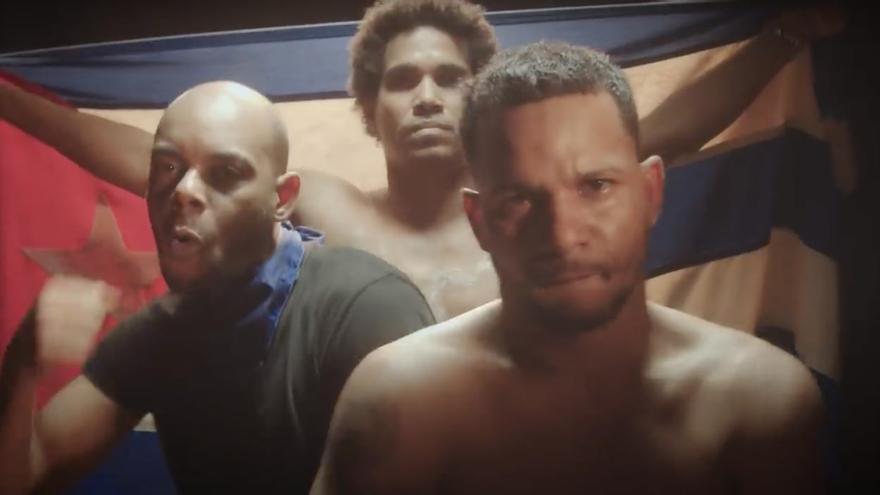
The artist Luis Manuel Otero Alcántara, with a Cuban flag, behind El Funky and Maykel Castillo ’Osorbo’, in a scene from the video clip of ’Patria y Vida’. (Screen capture)

14ymedio bigger14ymedio/EFE, Havana, 8 July 2022 — The artists and opponents Maykel Castillo Osorbo and Luis Manuel Otero Alcántara refused to appeal their sentences of nine and five years in prison, respectively. In addition, the latter has announced that he began a new hunger strike – the third since he was in prison – on July 4 to demand his immediate and unconditional release.

“After a few days of careful thought, Maykel has decided not to appeal the 9-year sentence that was unjustly imposed on him and ignoring all international demands,” ​​says a statement posted on his Facebook profile.

According to the text, Osorbo keeps in touch from prison with regular calls and has asked to say that “he will no longer lend himself to that circus… The whole world saw the caricature that a dictatorship makes of a judicial system and how coercion, in the midst of these events, not only makes them exist behind closed doors, but also expands to the streets and social actors that can be a threat, even physically far from the scene,” the post continues.

The rapper began in November 2021 to have “vomiting, fever, sweating and a lot of fatigue” and is sick without having received a reliable diagnosis, according to his relatives. “Maykel and all of us who accompany him are demanding that he be released and that he leave Cuba to be treated by a doctor and to save his life.”

The message indicates that Osorbo recently wrote a letter in which he spoke “of everything that would have to happen for Cuba to enter the 21st century,” a vocabulary that, according to the text, is also used by Otero Alcántara and the activist Omara Ruiz Urquiola.

For his part, Otero Alcántara has not specified any reason why he refuses to appeal, although it is presumed, due to the statement released by the San Isidro Movement, that it is the same as that of Osorbo. continue reading

The text denounces that the conviction reached the press, through the Cuban Prosecutor’s Office, before it was shared with the interested party. “Luis is not allowed to socialize with other prisoners, or go out to the patio to take the sun. He remains confined in a cell with another detainee. The only sun he takes in is through the bars of his cell, no matter how dramatic this description sounds,” it adds.

The post also maintains that during the trial State Security blackmailed Otero Alcántara by telling him that if he did not accept a forced exile agreement, Maykel Osorbo would not be able to leave Cuba to attend to his health problem either.

The trial against both artists — considered prisoners of conscience by Amnesty International (AI) — took place on May 30 and 31 in the Court of the municipality of Marianao of Havana.

Representatives from European embassies tried unsuccessfully to gain access to the hearings. During those days a strong security operation was deployed around the court.

Otero Alcántara was punished for the crimes of outrage against the symbols of the country, contempt and public disorder, while Osorbo was convicted of contempt, attack, public disorder and defamation of institutions and organizations, heroes and martyrs, according to the Attorney General’s Office the Republic (FGR) on June 24.

The FGR then assured that the court considered it proven that Otero Alcántara had “the express intention, sustained over time, of offending the national flag, by publishing photos on social networks where he is used in denigrating acts,” alluding to Drapeau, a performance in which the MSI leader wore the flag on his body for a month.

In addition, he argued that Osorbo — co-author of the song Patria y Vida, winner of two Latin Grammys and anthem of the 11J protests — “used false images” to “outrage, affect the honor and dignity of the country’s highest authorities.” The rapper was also accused of making “direct interventions from his personal profile to dishonor the role of law enforcement officers in society.”

The Prosecutor’s Office also collected previous facts in its petitions, such as “offensive writings against the flag” on the networks and publication of memes on Facebook to “ridicule and discredit” Miguel Díaz-Canel.

In addition to those two, the Court sanctioned Juslid Justiz Lazo and Reina Sierra Duvergel with 5 years in prison for attacking opponents Félix Roque Delgado and 3 years of correctional work without internment. He considered it proven that all of them had helped Osorbo to resist his arrest.

____________

COLLABORATE WITH OUR WORK: The 14ymedio team is committed to practicing serious journalism that reflects Cuba’s reality in all its depth. Thank you for joining us on this long journey. We invite you to continue supporting us by becoming a member of 14ymedio now. Together we can continue transforming journalism in Cuba.
Cuban Biologist Ruiz Urquiola is on a Hunger and Thirst Strike in Front of the UN in Geneva

Ruiz Urquiola in front of the headquarters of the Office of the United Nations High Commissioner for Human Rights in Geneva, Switzerland. (Facebook)

14ymedio bigger14ymedio, Havana, 6 July 2022 — Cuban biologist Ariel Ruiz Urquiola began, on this Wednesday, the third day of a hunger and thirst strike in front of the headquarters of the Office of the United Nations High Commissioner for Human Rights in Geneva, Switzerland.

Ruiz Urquiola decided to start the protest to demand that the island’s regime respect the right of all Cubans to return to their country after Havana prevented his sister, the activist Omara Ruiz Urquiola, from returning to Cuba on June 25, from the United States where she was receiving medical treatment.

According to the independent journalist Carlos Manuel Álvarez, Ruiz Urquiola has also decided “to suspend his antiretroviral drugs as a patient with HIV (human immunodeficiency virus) until the entity makes a statement on the violations of individual rights committed against him and his sister,” whom “Cuban State Security has just sentenced to political exile.”

In December 2019, the activist denounced to several German NGOs that the Cuban government inoculated him with HIV. Ruiz Urquiola then said that he had medical proof that a strain of the virus had been inoculated into him at the Abel Santamaría Provincial Hospital in Pinar del Río, when he was in the final phase of a hunger and thirst strike.

The Actions for Democracy Movement published a statement on Wednesday in which it affirms that the activist’s claim has as its objective that the UN pronounce itself not only with regards to the forced exile tof his sister, but also to “take defining measures with the Cuban dictatorship once and for all, extending its resolution to all the governmental institutions of the European Union.” continue reading

The NGO, based in Madrid, urged “the Government of Spain and the opposition parties PP, Ciudadanos and Vox to speak before the European Parliament and its representative for Foreign Affairs, Josep Borrell, so that it, in turn, intercedes and denounces this outrage that we are sure it will serve as the climax to end the complicity with the Cuban regime.”

Support for Ruiz Urquiola from activists, artists, and Cuban civil society has poured in immediately. “But if Ariel is right now in front of the UN on strike, it is because this new violation against Omara is part of multiple abuses already perpetrated against their family,” curator Anamely Ramos wrote on Facebook. “They are defenders of human rights on an international scale, so leaving them to their fate is something that international organizations cannot do,” she added.

“Once again the arbitrariness of the regime leading people to put their lives at stake, as a last resort to claim their rights,” the Mexico-based journalist José Raúl Gallego wrote on the same social network, and accompanied his message with a video that shows the moment in which Ruiz Urquiola arrived on July 4 at the headquarters of the UN High Commissioner.

A Doctor of Sciences, Ruiz Urquiola participated in several research projects on Cuban biodiversity, especially linked to marine and terrestrial species. He was expelled from the Marine Research Center under the official argument of unjustified absences, but, according to the scientist, it was a plot against him for not being “trustworthy” for the authorities of that institution due to his political leanings.

Ruiz Urquiola has previously carried out several hunger strikes. One of them in front of the Oncology Hospital in Havana, when his sister, Omara, was not given a medicine against the cancer that she suffers from. Two others were carried out during his arrest in 2018 when he was sentenced to one year in prison for the alleged crime of “disrespect.” On that occasion, the fast ended with the release of the scientist, who currently resides outside the Island.

____________

COLLABORATE WITH OUR WORK: The 14ymedio team is committed to practicing serious journalism that reflects Cuba’s reality in all its depth. Thank you for joining us on this long journey. We invite you to continue supporting us by becoming a member of 14ymedio now. Together we can continue transforming journalism in Cuba.
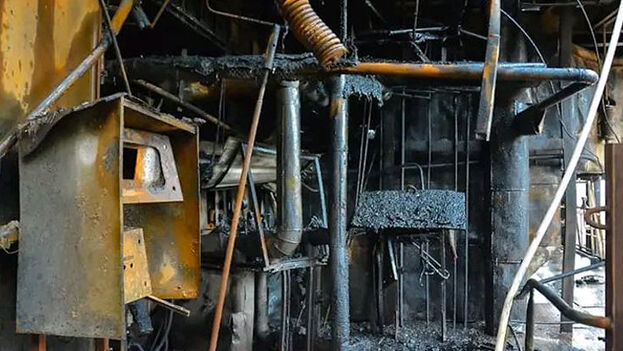
Cuba One Year Since July 11 (11J): The Blackouts Get Worse

Damage after the fire at the Felton thermoelectric plant. (Periódico Ahora)

14ymedio bigger14ymedio, Elias Amor Bravo, Economist, 9 July 2022 — We are approaching the first anniversary of July 11, the day when the Cuban people peacefully and courageously expressed that they were in a position to demand a political change for democracy, freedom and human rights in Cuba. And while the regime recreates itself in propaganda and manipulation, in this blog we are going to review what has happened in the Cuban economy during the last year. Because if one thing is true, it is that the accelerated deterioration of the economic situation in 2021 due to the “Ordering Task*” was a catalyst that prompted the people to protest against their rulers and convey an idea: things are not going well and they have to change.

As will be shown in this blog post and the next ones until July 11, Cubans have no reason to think that their complaints have been addressed by the communist regime. Quite the contrary.

Let’s begin with the blackouts. During the last year, at an average of two hours per day without power, the average Cuban has had to endure more than 700 hours of blackouts. That is to say, put all the hours together, and that is the equivalent of more than 30 24-hour days/year without a power supply. So no one can live normally.

It’s true that last year the blackouts weren’t as continuous and intense as this year, and people remain distressed because the situation isn’t adequately explained, nor can it be resolved with their own means. Worst of all, people end up learning about what is happening a posteriori and contemplate with dread the idea that behind the interruption of power there is nothing more than the laziness of the leaders.

And in this way, in a situation recognized by the regime of lower production than consumption, it turns out that a misfortune occurs. A large fire interrupted the final tests that were carried out, after 129 days of maintenance and interruption of its functions, of block 2 of the Felton thermoelectric power plant in Holguín, one of the most important in the country. continue reading

As a result of the fire, which caused damage to the unit’s turbine, there was a leak in one of the boiler tubes through which national crude was circulating. Once again, national oil and its disastrous sulfur composition are blamed. So even when the boiler was turned off, the high temperatures inside ended up causing the fire. And as a result of all this, the necessary synchronization with the National Electrical System (SEN) couldn’t be carried out, which meant a loss of production.

Like playing with fire. On this occasion, the regime forced the general director of the thermoelectric plant, in an exceptional situation, to make a statement to the Cuban television news, to explain that workers of the plant and forces of the fire brigade put out the flames in just 45 minutes, highlighting that there were no injuries or deaths.

Viewers were overwhelmed by the appearance of the director on national television. They don’t usually descend to these levels of the hierarchy, and it seems that the regime opted for the saying “each stick holds its candle.” Cubans learned on the news that because of the fire, which occurred at 2 p.m., Block 2 of Felton had damages described as “considerable and not easy to eradicate,” in a clear acceptance that power outages will continue. The photo report in the state press gave a good account of the disaster caused by the flames.

So, as a preventive measure, after the fire that paralyzed Unit 1, which provided stability of around 250 megawatts to the SEN, was put out, production resumed in order to synchronize the power at night. Nothing was said about this alleged return to normality.

Cubans, a year after the July 11 demonstrations, are fed up with so much talk and the technical, anodyne explanations about the origin of the blackouts, and increasingly confused about when the lights will come on, because there is more time of darkness than light. They know that blackouts appear and reach some areas while in others they don’t.

For example, in the most confrontational neighborhoods, where the regime detects a higher level of social unrest in the population, electricity is maintained, while it disappears in the interior areas of the country and where there are medium-sized populations. This is intended to lessen the feeling of anger at the regime, which these blackouts keep alive in large sectors of the population. Blackouts have continued, a year later, with even greater incidence. There is no solution to this problem in the Cuban communist regime.

The blackouts will continue. *Translator’s note: Tarea ordenamiento = the [so-called] ‘Ordering Task’ is a collection of measures that include eliminating the Cuban Convertible Peso (CUC), leaving the Cuban peso as the only national currency, raising prices, raising salaries (but not as much as prices), opening stores that take payment only in hard currency which must be in the form of specially issued pre-paid debit cards, and a broad range of other measures targeted to different elements of the Cuban economy. 

Translated by Regina Anavy

____________

COLLABORATE WITH OUR WORK: The 14ymedio team is committed to practicing serious journalism that reflects Cuba’s reality in all its depth. Thank you for joining us on this long journey. We invite you to continue supporting us by becoming a member of 14ymedio now. Together we can continue transforming journalism in Cuba.
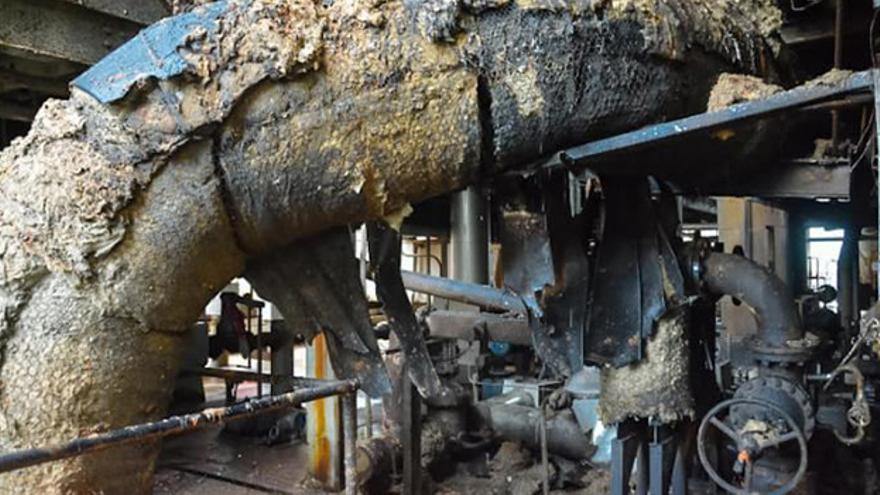
There Will be More Blackouts in Cuba Due to the ‘Considerable Damage’ of a Fire at the Felton Plant

Damage after the fire at the Felton thermoelectric plant. (Periódico Ahora)

14ymedio bigger14ymedio, Havana, 9 July 2022 — A large fire in unit two of the Lidio Ramón Pérez Thermoelectric Power Plant, in Felton, in the Holguin municipality of Mayarí, occurred this Friday afternoon with no reported loss of human life. The disaster aggravates the energy crisis that the Island is going through and augers new days of blackouts.

The local television station in the province of Holguín, Telecristal, reported that the incident was controlled by the workers, “with their own means,” and the Fire Department. The state press channel, with a source in Osmel Maturel Reyes, director of the thermoelectric plant, assured that “no deaths or injuries were reported in the accident area,” although it did mention “considerable damage” to the facility.

Maturel explained that, after two in the afternoon, “while the Block 2 turbine was running, as part of the tests prior to its complete start-up, a leak occurred in one of the boiler tubes, through which national crude oil circulated.” Although “the boiler was turned off, its high temperatures caused a fire that caused considerable damage” to the unit.

The radio station Radio Angulo, for its part, added that “the greatest impact” of the incident “is identified in the systems linked to the boiler.” Some videos of the fire circulated on social networks in which an intense gray smoke was seen that covered a large part of the plant.

“After putting out the fire, they have returned to Block 1 for its subsequent synchronization to the National Energy System,” added the Telecristal note. continue reading

The media also announced that “specialized expert teams are investigating the causes of the fire and its consequences,” and that the authorities of the Party and the provincial government “immediately went to the scene of the event.”

The fire took place the same day that the visit to the thermoelectric plant by Esteban Lazo Hernández, president of the National Assembly of People’s Power, was reported as part of the tour he was taking until this Friday in Holguín, according to the Cuban News Agency (ACN).

In the note it is reported that Maturel Reyes had informed Lazo that unit two “is already in the phase of the first running of the turbine, with a view to its synchronization to the National Electric System in the coming days.”

This block of the plant had been undergoing maintenance for several months and at the end of June it was reported that they were carrying out “individual tests on the boiler systems, as well as hermeticity tests to correct any defects that may exist in all the aggregates and auxiliary equipment.”

The ACN also indicated that work was being done on “the final alignment of the turbine with the generator, on cleaning the oil systems, with the aim of putting the machine in spinner mode to carry out the final tests, approximately, on 28 of June”.

However, according to the Twitter account of the Ministry of Energy and Mines, there has been “important damage that will require a partial reconstruction of the boiler,” and whose effects on the island’s precarious energy outlook will be felt.

The Lidio Ramón Pérez Thermoelectric Power Plant, inaugurated on January 5, 2011, had been described by the official press as “the one with the largest installed capacity in the country.”

____________

COLLABORATE WITH OUR WORK: The 14ymedio team is committed to practicing serious journalism that reflects Cuba’s reality in all its depth. Thank you for joining us on this long journey. We invite you to continue supporting us by becoming a member of 14ymedio now. Together we can continue transforming journalism in Cuba.
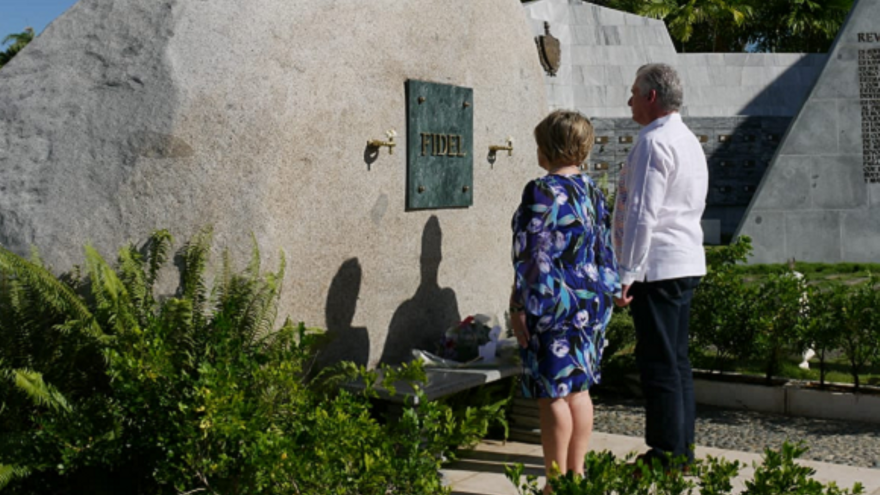
Cuba, Between Sects and Heretics

The fundamentalism of the Castro sect is radicalizing as the crisis of faith in its practitioners increases. (Cubandebate)

14ymedio bigger14ymedio, Yunior García Aguilera, Madrid, 6 July 2022 — According to the Pan-Hispanic Dictionary of Legal Spanish, a sect is a religious group usually characterized by a charismatic, messianic and dogmatic leader, with a vertical and totalitarian structure, which demands absolute detachment from its members. Any Cuban who reads this definition could agree that, effectively, the Cuban Revolution is a sect. Much more so now that the maximum leader of the doctrine rests on a stone altar, as if he were an Egyptian pharaoh.

The fundamentalism of the Castro sect is radicalizing as the crisis of faith in its practitioners increases. We have seen the high priests of the Politburo cling to the rock with the same devotion of a penitent before the Wailing Wall. “Talk to us, we need you!” murmur the worshipers with beards and uniforms before the rosary of plagues that a country that is so far from God and so close to Miami suffers.

But the new anointed one completely lacks what the Greeks called areté and that could be translated as the virtue that Olympus gives you. No white doves perch on his shoulder, only dyed doves of very bad omen. The only thing that he is capable of multiplying are lines, blackouts and discontent. The prosperous and sustainable paradise that he keeps promising is, in real life, the worst hell imaginable.

And those who dare to dissent are quickly excommunicated, demonized, expelled from the congregation. Whoever writes these lines many years ago was expelled from the Jehovah’s Witnesses and today he is once again a heretic, a wandering Jew, an apostate. That is my karma. But my real crime, my cardinal sin, has been refusing to die on the cross.

I do believe in what they call “anthropological damage,” I have seen it with my own eyes. I have seen how even those who oppose the cult can end up recycling its methods and fanaticism. They are like Thomas, the unbelieving apostle, who after seeing Jesus walk on the water, still needed to put his hand on the wound to be convinced that miracles exist. continue reading

Many of those who yesterday wanted to turn anyone into a messiah and pushed him to martyrdom, today claim that the same person is possessed by the demons of State Security. The G2 is more ubiquitous than the Holy Trinity. Many of those who shout the word freedom at the top of their lungs actually prefer their leaders behind bars, so that they become credible. Morbidity is stronger than reason and common sense. Many of those who learned Patria y Vida by heart continue to function with the logic of “fatherland or death.”

Small groups that proclaim themselves the “only true opposition” grow on social networks. There is a whole conspiracy and apocalyptic explosion burning other opponents at the stake of defamation. They have no proof, but they have no doubt either. Everyone is a traitor until proven otherwise. Anyone who does not agree with the new dogma is automatically declared a false prophet. The sects do not understand democracy, only inquisition.

The playwright René Ariza affirmed that we Cubans should be very careful with the Castro that each one carried within. Coca-Cola versions of Fidel are just as bad as the original. Never again should we allow single thinking, blacklisting, or acts of repudiation. The homeland will have to belong to everyone or we will continue, indefinitely, going around in circles. But Cuban civil society could take years to heal the wounds that seven decades of intolerance have caused us.

Although, when it comes to sins, I prefer to be optimistic. It only takes an ounce of lucidity to identify those whose mentality is as authoritarian as the dictatorship itself. They can swear that their ideology is the opposite, they can fill their profiles with anti-communist slogans, but deep down… they are Fidel. They repeat the scheme that excludes those who think differently. They hate the plurality of voices. They only accept their own speech.

As July 11 approaches, each of us should place less emphasis on the speck in the other’s eye. The dictatorship may be about to fall and we may not even be ready to prevent a new cycle of intransigence. Let’s not waste a single minute in slandering the other who is also risking everything. My truth, your truth, are only parts of a larger and more complex truth called Cuba.

____________

COLLABORATE WITH OUR WORK: The 14ymedio team is committed to practicing serious journalism that reflects Cuba’s reality in all its depth. Thank you for joining us on this long journey. We invite you to continue supporting us by becoming a member of 14ymedio now. Together we can continue transforming journalism in Cuba.
Havanatur Sells Tourist Packages to Cubans at Impossible Prices and Without Transportation

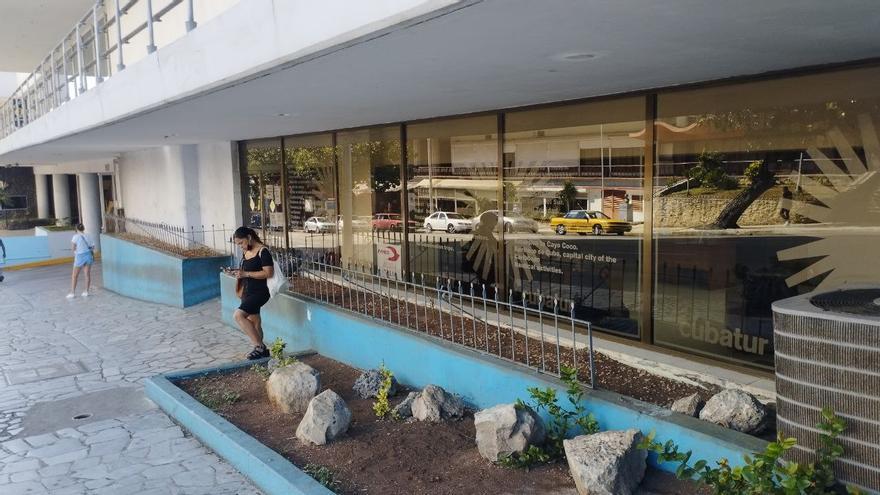
Cubatur offices on the ground floor of the Habana Libre hotel in the capital, this Friday. (14ymedio)

14ymedio bigger14ymedio, Juan Diego Rodríguez, Havana, 8 July 2022 — In the past, on a day like this Friday, after Havanatur announced the tourist packages for the start of the high season on the Island in October, the line in front of the Cubatur offices would have been as considerable as in previous years. It wasn’t the case today. The prices published by the state operator, whose cheapest rates do not fall below 4,000 pesos per night, are prohibitive for nationals.

Thus, the three people who were waiting at their doors, under the Habana Libre hotel, in Havana’s Vedado, did not have to wait long to be attended to. At the counter they were not offered cheaper solutions for vacationing and, in addition, they were given another bucket ​​of cold water: the packages did not include transportation.

“It is not known if there will be transportation by then or not,” explained an employee, without giving more details, simply nodding when one of the women who was being helped alluded to the lack of fuel. “No wonder there was no one today, who is going to stand in line with these prices and without transportation?” the lady lamented as she left the place empty-handed. continue reading

According to the Havanatur website, the Habana Libre Hotel is the one that offers the cheapest night for two people: from 3,780 pesos. It is followed by the Iberostar Grand Hotel Trinidad, in that city of Sancti Spíritus, from 5,472 pesos, and Iberostar Parque Central, in Havana, with one night from 7,000 pesos.

If those urban rates are coercive, those of hotels on the beaches are impossible for the average Cuban, whose salary is less than 4,000 pesos a month. In Varadero, a room at the Hotel Meliá Internacional, all inclusive, is available from 20,000 pesos; in Paradisus Princesa del Mar, from 15,500; at Meliá Varadero, from just over 12,000 pesos, and at the Hotel Sol, from 11,000.

As for Cayo Coco, the Meliá Las Dunas offers a night from 11,112 pesos and the Hotel Tryp starts at almost 8,000 pesos.

You practically have to carry the money in a bag to be able to afford an all-inclusive weekend in one of those spa accommodations. Now, when it is only 14 years since Cubans residing on the island were allowed to rent a room in national hotels, vacationing in one of these places is once again prohibitive, and this time the red line is marked by money.

____________

COLLABORATE WITH OUR WORK: The 14ymedio team is committed to practicing serious journalism that reflects Cuba’s reality in all its depth. Thank you for joining us on this long journey. We invite you to continue supporting us by becoming a member of 14ymedio now. Together we can continue transforming journalism in Cuba.

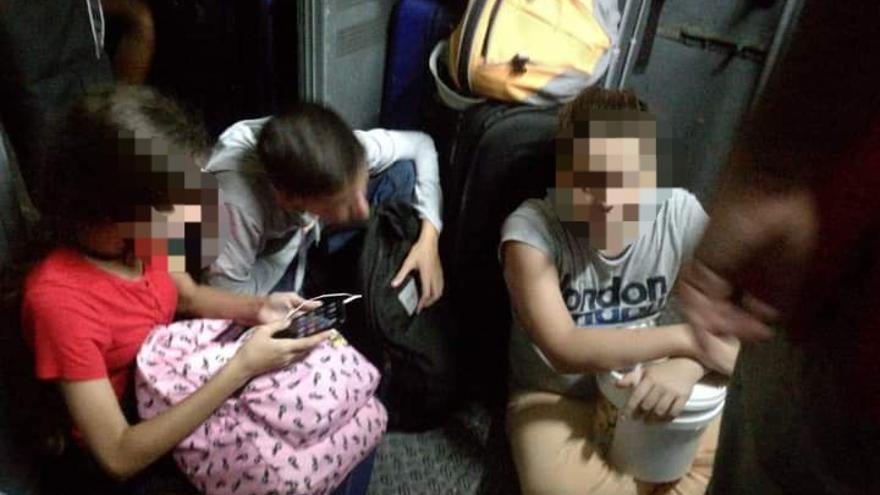
Children Travel to Cuba’s National School Games on a Train With No Seats and Delayed for Hours

One of the images broadcast on transport networks of children participating in the National School Games. (Twitter/@dlesmesfajardo)

14ymedio bigger14ymedio, Havana, 6 June 2022 — After two years without being held due to the covid-19 pandemic, the National School Games have restarted this Wednesday with an official event in the city of Santa Clara, but the Games began with setbacks. The children participating in this 58th edition had to travel from other provinces sitting on the floor of the train due to poor management by the organizers.

With 22 disciplines that are disputed in 14 Cuban provinces, the Games were inaugurated by the president of the National Institute of Sports, Physical Education and Recreation (Inder), Osvaldo Vento, an act that the official press covered without mentioning the discomfort of parents and children due to transportation problems that made several athletes desist from participating.

“They allocated only one train for all the athletes. It is the same one that goes from Havana to Guantánamo, picking up children and leaving others because some disciplines are played in one place and others in another. For example, judo competitions are in Guantánamo,” details Lesmes Fajardo, uncle of one of the children who participates in the Games in the discipline of chess.

“The Inder coordinated a train that was going to leave from La Coubre with the athletes from Pinar del Río and Havana, which would go through the entire island picking up the participants and distributing others according to the place where their specialty is contested. My nephew had to go from Matanzas to Santa Clara, luckily he didn’t have such a long stretch,” explains Fajardo, who currently resides in Guayaquil, Ecuador. continue reading

“The train had to have left at 8:30 at night and it was one in the morning and it still hadn’t left. It arrived in Matanzas after four in the morning. The children from Matanzas were at the station from 7:00 pm and they didn’t give them any information. They called those from Havana and they didn’t know when it was going to leave either,” he explains to 14ymedio.  

“Since it left Havana it already was traveling with the children sitting on the floor,” he adds. “My sister’s first reaction was to tell my nephew that they were no longer going to the event because ’he was going to arrive dead’ after traveling sitting on the floor, but he insisted because it is the National Games. He did it because of his commitment to the sport.” That “was total chaos” emphasizes the emigrant.

“My sister was like if they stabbed her, she would not bleed because of poor organization,” he says. Fajardo kept in touch with his family during the long wait. “Those in the image are not children trying to cross into the United States in containers. They are Cuban children, high-performance athletes traveling to the National School Games on a train arranged by the Government that will run from Havana to Guantanamo. No seats,” he wrote annoyed on Twitter.

“The abuse, the irresponsibility and the apathy we all know are rampant in Cuba, but they don’t miss the opportunity to surprise us. Then the dictatorship regrets when its athletes stay behind at the first international tournament they go to,” said the emigrant. Fajardo’s sister also called the treatment of the children “degrading.”

In Santa Clara the chess, boxing and table tennis athletes stayed but others had to continue their journey still on the floor of the train. “My son has to go to Guantánamo because he is a judoka, they did not let us accompany him because they said that the parents could not go, but I thought that my child would be well taken care of,” laments the mother of another athlete, who prefers to remain anonymous.

“My son still hasn’t been able to get a seat and he will arrive at Guantánamo very tired, but nobody takes that into account for the competition,” questions the woman who lives in the city of Matanzas. “Everything has been very improvised but many parents do not dare to file a complaint so that their children do not look for problems. Surely the Inder officials travel in comfortable cars.”

As of this moment, the train had not yet completed its journey. “It’s in Ciego de Ávila,” says Lesmes Fajardo.

____________

COLLABORATE WITH OUR WORK: The 14ymedio team is committed to practicing serious journalism that reflects Cuba’s reality in all its depth. Thank you for joining us on this long journey. We invite you to continue supporting us by becoming a member of 14ymedio now. Together we can continue transforming journalism in Cuba.
After His Escape Attempt was Frustrated, the Cuban Boxer Andy Cruz Requests to Step Down

Cuban boxer Andy Cruz will now have to wait for the lengthy processes of discharge and the unlocking of his passport (Gramma).

14ymedio bigger14ymedio, Havana, 6 July 2022 — Cuban boxer Andy Cruz, who spent several days in detention after an attempted escape from the island, requested his withdrawal from the sport. The journalist Francys Romero pointed out that the Olympic champion in Tokyo 2020 appeared last Tuesday at the Ciudad Deportiva Coliseum in Havana to carry out the procedure.

As explained by the Romero on his social networks, Cruz must “wait for the lengthy processes of discharge and passport unlocking to which athletes who represent a national interest and who do not want to continue competing under the Cuban system are subjected.”

The boxer saw his escape frustrated by the denunciation of Rolando Céspedes, El Prosecutor, a man who has been in the business of athletes who leave for more than 10 years and who has contacts with immigration officials in Cuba. This person “demanded a large sum” that was not delivered, so he denounced the whereabouts of Andy Cruz and baseball player César Yanquiel Hernández, who intended to leave the island.

The athletes were surprised and taken to Moa, where they remained for 10 days. So far the boxer has not offered any comment. continue reading

“In addition to the abandonments and mass exoduses, withdrawal requests have spread to all sports in recent times,” tweeted Romero, who is based in the US.

After being excluded from the Under-23 team that participated in the World Championship that took place in Aguascalientes, outfielder Roidel Martínez requested his withdrawal. This case recalled the one experienced by Luis Enrique González and Darlin Jíménez, who were “erased” at the last minute from the list of the Under-23 team that traveled to Mexico in 2021 for the World Championship held in the state of Sonora.

Last April, the silver medalist at the London 2012 Olympic Games and world champion in Beijing 2015, Yarisley Silva, also requested her withdrawal, but this was from the Cuban National Athletics Team. Her decision came after she was left out of the 18th edition of the World Indoor Athletics Championships, which took place in Belgrade (Serbia), due to problems bringing her own poles.

____________

COLLABORATE WITH OUR WORK: The 14ymedio team is committed to practicing serious journalism that reflects Cuba’s reality in all its depth. Thank you for joining us on this long journey. We invite you to continue supporting us by becoming a member of 14ymedio now. Together we can continue transforming journalism in Cuba.
Belgian Buses Pulled Out of Service in Havana, to be Air-Conditioned, After Complaints of Unbearable Heat

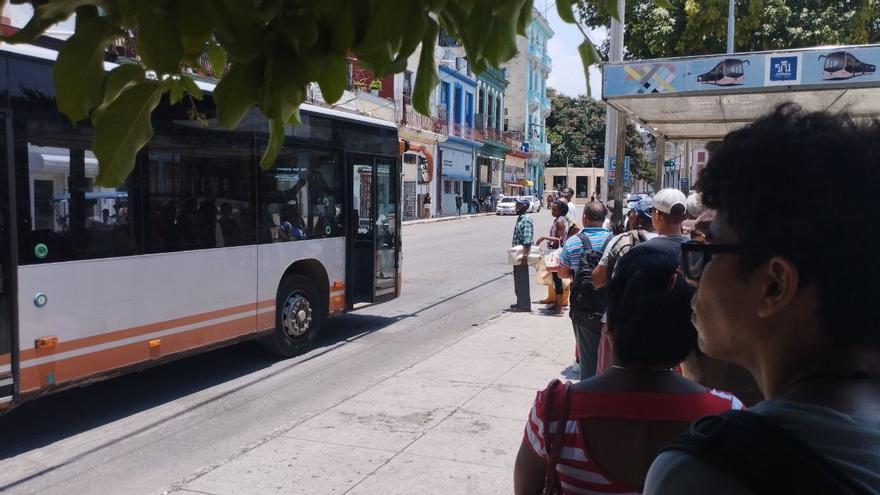
A line for the P12 bus route this Tuesday, in Havana, and the Arrival of one of the Belgian Buses

14ymedio bigger14ymedio, Havana, 6 July 2022 — The provincial transport company of Havana affirmed that the Belgian buses will improve their air conditioning system. Barely half an hour had passed since 14ymedio published a chronicle recounting the trip made by one of our reporters and in which he confirmed that the oppressive heat in the vehicles was not an unsubstantiated rumor circulating on social networks, when the authorities issued the statement warning of upcoming changes.

The message states that “despite not knowing basic elements of the operation of these teams, on July 4 the operation of 5 articulated buses began on route P12 and 5 rigid buses on route P16.” However, it maintains that the problem of air conditioning “had already been identified previously”.

To solve the problem, “work is being done on the coupling of windows of the buses. It is intended to change 3 windows in the rigid cars and 5 in the articulated ones; in addition to the current ventilation system,” details the note, reproduced by the official press.

It is not clear what “the current ventilation system” is, as some users suspect that the air conditioning has been switched off to save fuel.

The company points out that the poor transportation situation is what motivated the rapid start-up of the vehicles while at the same time adapting to the island’s climate. “The air conditioning that they have does not withstand the high temperatures of the country,” specifies the information, a statement that has generated discomfort among users who know the buses in many cities in the world in which high temperatures are reached without the air conditioning stopping to function. continue reading

“Here in New York the buses stop at every stop and that’s not why they lose the air conditioning, please invent something else,” says a user on Facebook. The company had disdained the previous opinions arguing, moreover, that the opening and closing of doors reduces the effectiveness of the air conditioning, a fact that is not entirely accurate. “That the air does not cool down because of the heat in Cuba? As if in Belgium the temperatures did not reach almost 40 degrees (104F)… And there the buses do not stop, they make direct trips? Like the Yutones?” reacted another.

The company took the opportunity to explain that, when the air conditioning problems have been resolved, more equipment will be incorporated, “up to 16 in operation; 9 on line P12 and 7 on line P16”.

The buses were manufactured in 2007 and, although “they have been in operation for 14 years,” they are well preserved and have “a high technological level,” they have presented technical faults, which “we are working on solving,” the company explains.

The 29 buses arrived in the Cuban capital on June 24 and were received by Luis Carlos Góngora, vice president of the Provincial Administration Council of Havana, and the Belgian ambassador, Jean-Jaques Bastien, who were photographed next to the flag of the European country.

The operation began this Monday and the complaints multiplied rapidly through social networks. Passengers complained that, through the ceiling grille, the air that came out was soft and hot, as if the system was in ventilation mode and not cooling.

“These buses are not for here,” some travelers repeated this Tuesday, probably oblivious to the fact that, in most countries that have air-conditioned vehicles, it fulfills the function for which it has been designed. Although on the street temperatures exceed 40 degrees (104 F).

____________

COLLABORATE WITH OUR WORK: The 14ymedio team is committed to practicing serious journalism that reflects Cuba’s reality in all its depth. Thank you for joining us on this long journey. We invite you to continue supporting us by becoming a member of 14ymedio now. Together we can continue transforming journalism in Cuba.
High School Vandalized to Extract Materials Collapses in Santiago de Cuba

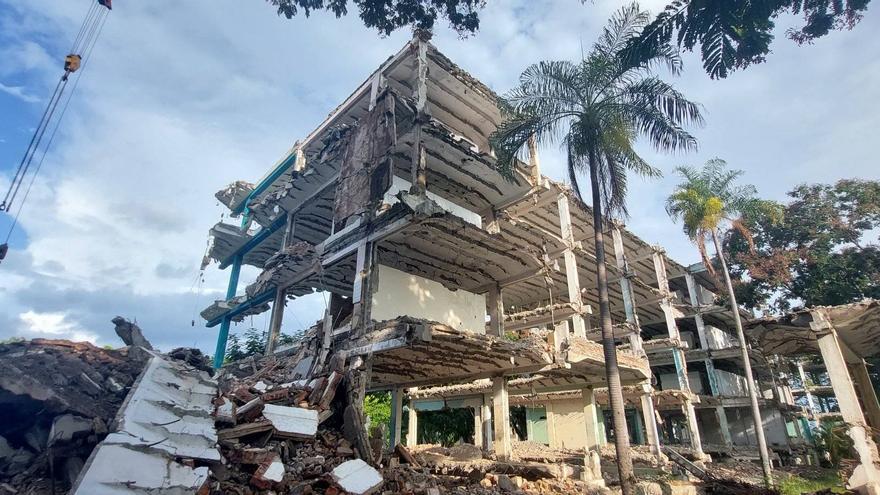
Rubble of what was the Antonio Maceo Grajales Vocational Pre-University Institute of Exact Sciences, in Santiago de Cuba. (Facebook/Iran Suarez)

14ymedio bigger14ymedio, Havana, 7 July 2022 — A man was rescued from the rubble of what was the Antonio Maceo Grajales Vocational Pre-University Institute of Exact Sciences (IPVCE), in Santiago de Cuba, this Wednesday night, after the collapse of a disused and ruined structure, which had been vandalized for years to extract construction materials.

The news was spread on social networks, which reported the rescue of  Girardo Ortega Atencio, who had been among the rubble since four in the afternoon. Journalist Iran Suarez shared on Facebook that the man was given fluids before the rescue.

Before Ortega Atencio was removed from the ruins, another person was rescued from the scene and taken to the Saturnino Lora Provincial Hospital. The identity and state of health of both are unknown.

“Two citizens were illegally removing steel strips from the structure on the fourth level,” Suárez wrote in his report on social networks.

According to engineer Isabel Rodríguez, the collapsed structure was “still young” and “of the Girón type,” a building model used in Cuba during the 1970s, especially for schools in the countryside, pre-university, junior high schools and other official buildings. continue reading

The specialist adds that in 2006 a study on seismic vulnerability was carried out and it was determined that this place represented an imminent risk, due to the occurrence of tremors in Santiago de Cuba. “The structure was less than 40 years old at the time,” says Rodríguez.

The collapse was lamented by some residents of the city, who affirmed that for years theft of construction materials, extracted from the old structure, began to occur in the place and that it should have collapsed a long time ago to avoid tragedies. “The neighbors of Quintero and Santamaría have been denouncing this situation for years, the truth is that it is a miracle that more thieves have not died,” wrote Angela María Callis Vicente.

Others commented on the rapid deterioration of the place. “Until a few years ago we used to do the entrance exams for Higher Education there. Seeing it in that state now has impacted me,” said Nuria Napoles also on Facebook.

The Fire Department, the Red Cross, the Integrated System of Medical Emergencies (SIUM), the Cubiza company, authorities of the Communist Party, the Ministry of the Interior and Civil Defense attended the scene.

Seventeen hours after the event, the state press has not noted it in its reports, but it has reported the visit of President Miguel Díaz-Canel, to the province of Santiago where the collapse occurred. According to the State newspaper Granma, the visit “began with a tribute to the founders of the nation, Martí, Céspedes, Mariana and Fidel, and ended at the Antonio Maceo thermoelectric plant.”

The pre-university scholarships, especially the vocational centers, prepared students who would pursue university studies in science and technology specialties, and were one of the jewels in the crown of the Cuban educational system during the years of the Soviet subsidy.

However, over the years, the refusal of families to send their children to these centers, material deterioration and food shortages caused the initiative to capsize. In 2009, Raúl Castro closed the scholarships and schools in the countryside, which accelerated the ruin of vocational pre-university schools.

____________

COLLABORATE WITH OUR WORK: The 14ymedio team is committed to practicing serious journalism that reflects Cuba’s reality in all its depth. Thank you for joining us on this long journey. We invite you to continue supporting us by becoming a member of 14ymedio now. Together we can continue transforming journalism in Cuba.

‘The Only Thing Taken to Cuba Were Che’s Hands,’ Says the Man Who Captured Him

Cuban-American Félix Rodríguez, the CIA agent who led the operation in Bolivia to capture Guevara. (EFE)

14ymedio biggerEFE (via 14ymedio), Jorge I. Pérez, Miami, 7 July 2022 –Cuban-American Félix Rodríguez, the CIA agent who led the operation in Bolivia to capture Ernesto Che Guevara that culminated in his execution in 1967, told Efe on Wednesday that “the only thing that could be buried in Cuba” are the hands of the guerrilla.

“The body was never where they say they found it,” he stresses in a telephone conversation. According to Rodríguez emphatically, the Argentine guerrilla “was not buried at the side of the runway with seven other bodies as Fidel (Castro) said; Che was buried at the head of the runway with two more corpses, there were only three.”

A few days before the 25th anniversary of the discovery of Che’s body at the Vallegrande airport (Bolivia), the 81-year-old former CIA agent, retired in Miami, denies the official version of what happened on 28 June 1997.

According to the official Cuban version, the body of the revolutionary leader was found that day in a mass grave at the Vallegrande airport and, after being identified in a hospital in Bolivia, his remains were sent to Cuba, where a mausoleum was erected in his honor in Santa Clara.

According to the media outlet Cubavisión Internacional, the remains of the Argentine guerrilla were found on an abandoned runway in Vallegrande. There, says the media, a group of Cuban experts found the grave where seven guerrilla men were buried, including their leader Ernesto Che Guevara.

“Obviously, if he (Fidel Castro) buried his hands, then there is a part of Che in the Santa Clara monument, because the hands were taken there by the (then) Minister of the Interior (Antonio) Arguedas,” along with a copy of the guerrilla’s diary in Bolivia, says Rodríguez.

According to the former CIA agent, “at dawn a Bolivian doctor went with my partner, (Gustavo) Villoldo, and then they cut off his hands, put them in formalin and put them in a volqueta (dump truck), as they call the pickups, they took Che to the end of the runway where there was a bulldozer that was widening the runway for larger planes to land. continue reading

“And there they buried him, at the end of the runway next to two corpses and Fidel says they found him to one side with seven more. That was not Che Guevara,” he says.

On how it became known that Che was in Bolivia, Rodríguez, whose mission was to save his life, although he now says that his execution was “the best thing that could happen,” recalls that it had to do with the French philosopher and writer Régis Debray.

“It was confirmed when they took (Argentine intellectual Ciro) Busto and Régis Debray prisoner; they went to visit Che and when they were taken prisoner they confirmed that the person was Che Guevara. If it wasn’t for them, it wouldn’t have been known that Che was in Bolivia,” he says.

On October 9, 1967, Rodríguez landed in Bolivia to capture Che and later saw him “tied hand and foot.”

“My mission was to save his life at the request of the US government. It was very important to keep him alive, killing him was a decision of the Bolivian president, General René Barrientos,” he said. It was the Bolivian sergeant Mario Terán who executed Guevara in La Higuera that same day.

According to Rodríguez, the burial of the body “was not a military secret, they simply did not tell anyone.”

“They took a driver that day and buried him at the end of the runway, and gave out the news that he had been cremated and that the ashes had been thrown from a helicopter into the air, which was not true,” he says.

And he adds: “That was the official news that was given to the Bolivian people: that (Che) was cremated and his ashes scattered over the Bolivian jungle, but the truth is that he was buried at the head of the runway, you can put it to bed,” he asserted.

____________

COLLABORATE WITH OUR WORK: The 14ymedio team is committed to practicing serious journalism that reflects Cuba’s reality in all its depth. Thank you for joining us on this long journey. We invite you to continue supporting us by becoming a member of 14ymedio now. Together we can continue transforming journalism in Cuba.