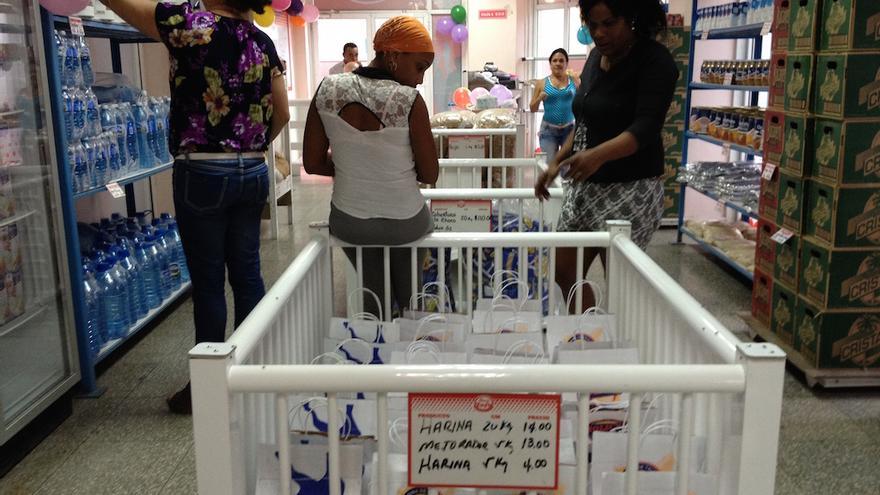

Without Chicken, With Long Lines and Police Surveillance, the Sale of Food in Hard Currency Begins in Cuba

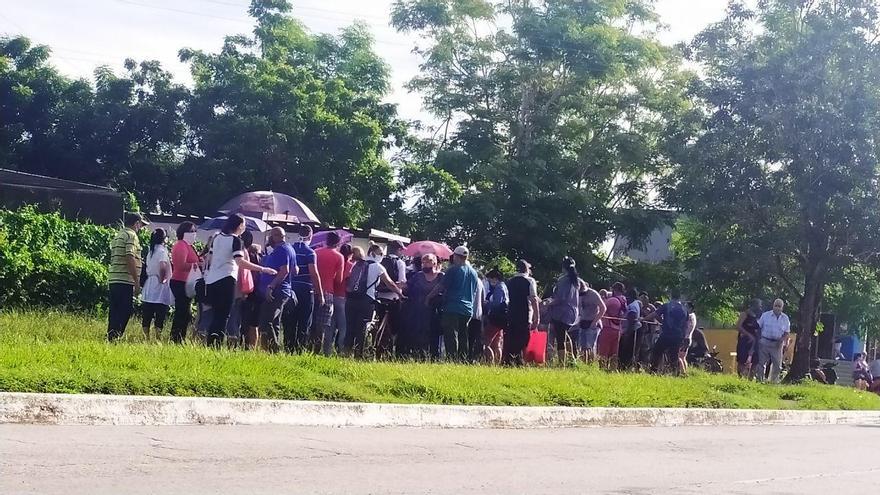
In the city of Sancti Spíritus, the line formed outside the Zona+ shop before dawn. (14ymedio)

14ymedio bigger14ymedio, Havana/Sancti Spíritus, 20 July 2020 — Since before dawn on Monday, the same scenes repeated themselves throughout the Island in front of the new divisa (hard-currency) shops: people lining up before the 9:00 a.m. opening, much police surveillance and, finally, not one single piece of chicken, the favorite product. The 14ymedio reporters confirmed this in several shops in Havana and the provinces.

The first light of day barely began to outline the contours of a park near the market of Boyeros and Camagüey in Havana, one of the places chosen on July 20 to offer food, domestic appliances and cleaning and personal hygiene products in “freely convertible money” (MLC), using debit cards.

Before 7:00 in the morning, more than 200 anxious clients had already accumulated in a scattered and chaotic line. Most of them were trying to shelter from the rising sun and the swarms of mosquitos that were taking advantage of all those bodies gathered together.
At the first light of dawn, some 250 people were already waiting near the shop of Boyeros and Camagüey to buy in divisas. (14ymedio)

A little later, an employee accompanied by a police official with two stars on his lapel approached the beginning of the line and began to assign the first 100 people to enter the shop in a group. The customers asked so many questions that the handover of the numbered tickets was interrupted several times by calls for silence and calm from the police official, who threatened to stop assigning numbers if they didn’t cool it. continue reading

Then came an employee who presented himself as the “head of the business” and addressed the line near the police, to explain the details of what was for sale. Now the sun was burning everyone’s shoulders, adding one more hardship for hundreds of customers who, upon arriving, were warned that they couldn’t take photos and would only be allowed to pass in a group when the previous one left.

“This shop has two categories: the sale of electronics, in addition to food and cleaning products,” screamed the employee so the whole line could hear. “This means that, for the sake of control over the electronics, the first 10 in line must hand over their identity cards to make sure they can get domestic appliances.” To the surprise of those who were waiting patiently, he added, “Just because we sell in MLC doesn’t mean that things aren’t limited.”

There followed an extensive explanation about the rationed equipment. “The air conditioners are limited to four per person; right now we have eight freezers in the shop, and more will be coming this week.” But cold water was really thrown on everyone when he said: “We can’t sell chicken. Until they supply all the shops in the country with chicken, we can’t.” A murmur of resistance came from the crowd.
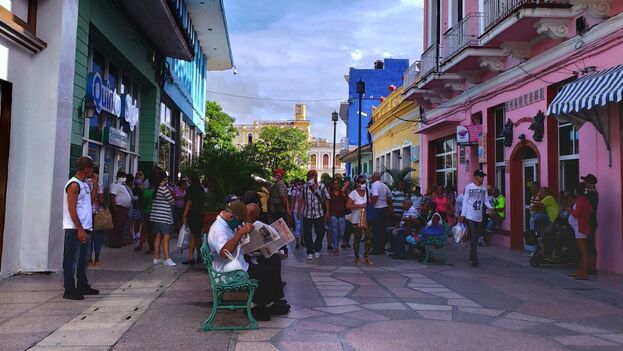
Dozens of people were waiting Monday on the Boulevard de Sancti Spíritus to enter the shop La Colonial. (14ymedio)

“It’s the same line everywhere,” someone declared. “There are fryers but no refrigerators. We have a virtual shop, Almacén Habana, and the articles they sell on the website are the same ones they have here.”

The panorama at that hour was quite different outside the Doble Nueve shop, on Havana Boulevard, which was selling personal hygiene and cleaning products in MLC. Without customers, the morning’s peace was interrupted only by a police presence and the questions of some curious people who were passing by. The possible reason for the contrast is the shop’s location in the municipality of Centro Havana, where a low-income population resides.

The situation repeated itself at the nearby shop La Arcada on the same street, where the neighbors preferred to continue their daily activities earlier in the morning before stopping at the shop windows, where plenty of preserves, pasta and grains were on display.

At Línea and 12, the central corner of Vedado, the buying power of the district was noticeable. Some 100 people were waiting to enter the shop; they already knew by the rumors that there was beef, ground turkey and cheese in the refrigerators, plus shampoo, a product that has disappeared from the Cuban convertible (CUC) and Cuban peso (CUP) shops in the last weeks.

“There’s no powdered milk, only evaporated,” warned a beleaguered customer who approached to talk with the first buyer who left the shop, with two bags half-full. “She told me that what they have is more or less the same that they had some years ago in the shoppings (the CUC stores), no more no less,” says the woman.

“I came to look for a package of chicken breast at 33 CUC,” comments another customer who had been there before dawn but had given up on the line because the product she wanted wasn’t for sale. “The offers weren’t what I was hoping for; from what they announced it seemed like they were going to have everything, but it’s not true,” whined another.
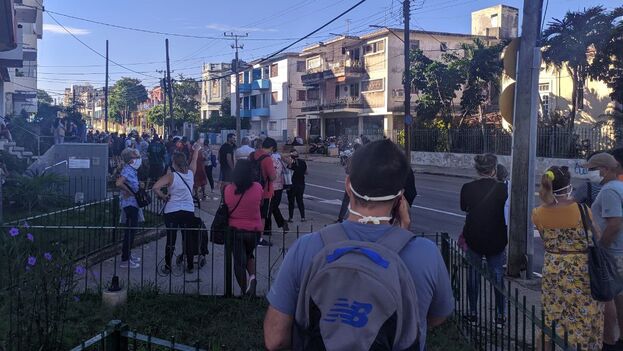
At Línea and 12, the central corner of Vedado, the buying power of the district was noticeable. (14ymedio)

The frozen chicken, normally imported from the United States or Brazil, has become a national obsession these last months, and the lines to buy it, in strictly limited quantities, can last for days. There was an expectation that these supposedly “high-quality” shops would sell this type of meat.

In other provinces, the assortment is poorer than in the Cuban capital. The Zona+ shop in Sancti Spíritus didn’t have chicken; nor did it have detergent or oil. People decided to organize themselves with a view to the next few days in hope of a greater supply. “Let’s make a list for those who are waiting for new products,” recommended a customer.

“Hey, Mercedes, it’s the same old shit! There’s nothing, the only thing that’s changed is the money,” yelled an annoyed Santería woman from one side of the line. She said she had been there since 4:00 in the morning in order to, finally, “not enter the store, because they have nothing of what they said they were going to have.”

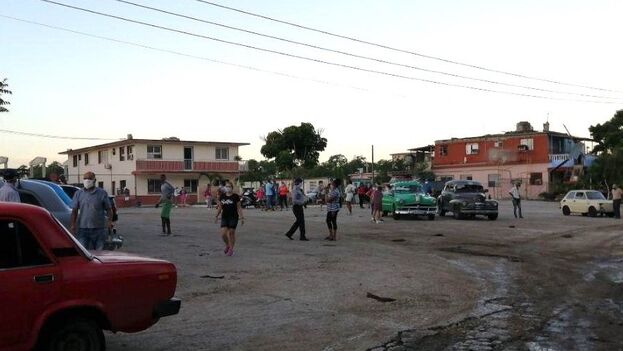
On the Boulevard de Sancti Spíritus, La Colonia, an old discotheque transformed into a CIMEX (Cuban army corporation) money exchange business, managed to attract dozens of the curious from early morning. The line is some distance from the entrance of the premises, and only customers in the vicinity who already have a ticket are let through. Each time someone comes out with a bag and walks a few steps, a nest of curious hornets falls on the person to ask questions.

“Do they have powdered detergent? What about toothpaste? Did you see if they have yogurt? How are the prices? Do you know if they have enough ground meat or if they got just a little?” The questions come from all sides. One woman with a serious face and nothing in her hands comes back through the door a few minutes after entering. “I stood in line for fun,” she announces in front of the grim expressions of the police, who are staked out along the whole street.

As far as prices go in the 74 new shops along the length and width of the country, customers complain that they are “higher than the exchange rate for CUCs to dollars” if you take into account the taxes in CUC of the shop merchants. But, yes, “everything was very clean, with air conditioning everywhere, and the employees were very friendly,” says a customer from the shop at Boyeros and Camagüey.
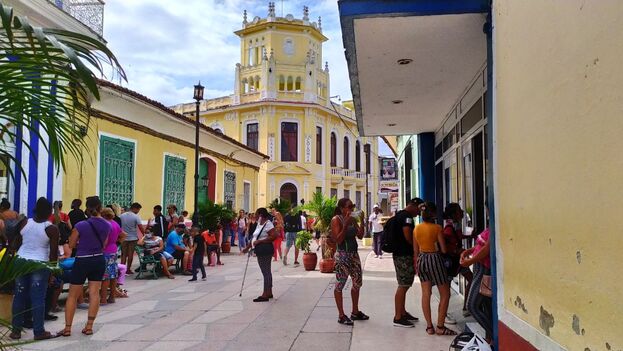
The shop La Colonia, on the Boulevard de Sancti Spíritus, was an old discotheque transformed into a business. (14ymedio)

“I remember in the ’90s when they opened the dollar stores that all of them were really nice, but then they deteriorated little by little,” adds the same woman. “I don’t know how long this one will stay in good condition, but if it’s anything like the country, maybe 15 days. It all begins well and then half a month later doesn’t function. I came today even though I had to stand in line.”

A glass jar with 1.8 kilos of preserved white asparagus, of the Spanish brand Aldaketa, costs a little more than 68 dollars, practically the double of what this product sells for in other shops outside the Island.

Among the predominant brands are the Spanish Vima and Celorrio, in preserves, and Kiriko in personal hygiene and cleaning products. Also, the Gallo and Romero for pasta or Luengo for beans, packaged in Spain but produced in the Ukraine.

Translated by Regina Anavy

__________________

COLLABORATE WITH OUR WORK: The 14ymedio team is committed to practicing serious journalism that reflects Cuba’s reality in all its depth. Thank you for joining us on this long journey. We invite you to continue supporting us by becoming a member of 14ymedio now. Together we can continue transforming journalism in Cuba.

Yomil Denounces "Medical Negligence" in El Dany’s Death and Calls for Justice

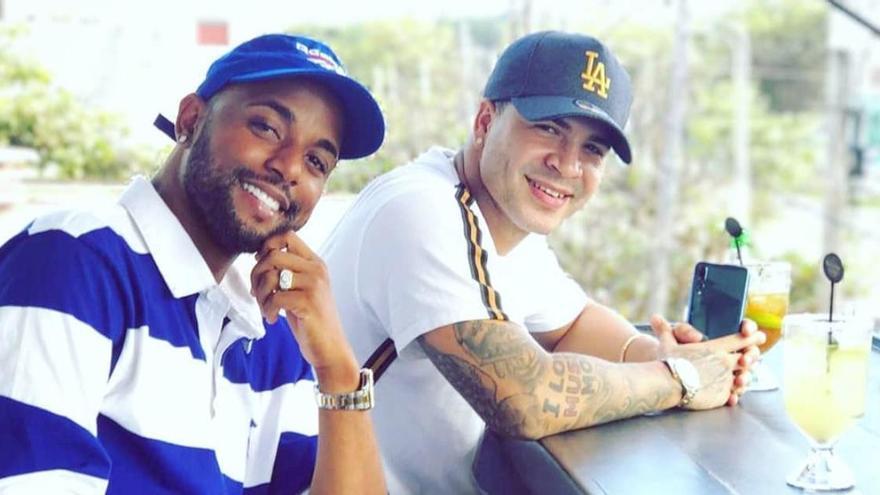
After the death of ’El Dany’ (left), reggaetoner Yomil (right) made a live broadcast through Instagram to report a case of ’medical negligence’. (Facebook)

14ymedio bigger14ymedio, Havana, 19 July 2020 — The death of the popular reggaeton player Daniel Muñoz Borrego, El Dany, was due to “medical negligence,” according to his friend Roberto Hidalgo Puentes, Yomil, who demanded that “the guilty parties pay,” during a live broadcast this Sunday through Instagram.

As detailed by his partner in the musical duo created in 2015, El Dany had been admitted for “a week” in the Calixto García hospital in Havana, due to “pain in the legs” and “he could not walk, it seems that for playing basketball, he felt a little affected.” The artist explained that at that time they did “many tests” but did not reach a clear diagnosis.

Dany died early Saturday morning at age 31. The news sparked an avalanche of speculation about the cause of his death, but state media blamed the death on an “acute cardiovascular condition.” continue reading

The Provincial Directorate of Public Health of Havana issued a note this Sunday stating that the musician “was admitted on the 12th for presenting a clinical picture of peripheral neurological manifestations” and “died at 9:05 am on Saturday, July 18, 2020, as a consequence of an acute cardiovascular event.”

The note, released by the official press, maintains that a commission has been appointed to investigate the causes of his death and the conclusions will be made public if the family authorizes it.

But the official version is put in doubt with Yomil’s words. Throughout his very emotional speech, the musician specified that the doctors “decided to leave him in hospital and put him on a ten-day treatment with serum in his vein.” Treatment was focused on injecting “a little bit of vitamins” for a nerve problem, doctors said.

“All I ask is that justice be done to my brother,” said Yomil, who was visibly moved during the more then ten minute broadcast. “Today I woke up without my brother in arms, who started with me from scratch. I woke up without a friend and not just any friend.”

A doctor from Calixto García, consulted by 14ymedio on condition of anonymity, confirmed Yomil’s suspicion. “We are facing an unfortunate case of iatrogenesis, which is nothing more than the damage or affect that is caused to a patient while trying to alleviate his condition.”

“At the hospital we are all very affected, in recent weeks we have had very difficult days and this death, which could have been avoided, has been a very hard blow to the team,” says the doctor.

In its broadcast this Sunday, Yomil confirmed the official version, broadcast on the television newscast, that there had been no wake by family decision. He said he tried to convince his friend’s wife to be able to offer El Dany “all the honors as a great man” but that the choice she made must still be respected.

He also said he was very grateful for the love from his public and the messages from friends and followers received and the tribute that was given to him in the streets of Cayo Hueso, a popular neighborhood in Central Havana: “I couldn’t see them all because I start to cry, but thanks.”

After the news of El Dany’s death spread, dozens of people gathered outside the hospital to pay tribute to the musician. The burial took place shortly after, around two in the afternoon, in the Cristóbal Colón cemetery. During the night in various neighborhoods of Havana, and spontaneously, the young people remembered the reggaetoner, singing his songs and dancing.

Yomil and El Dany’s popularity was based in part on the fusion of electronic rhythms they made in their music. Both managed to mix hip hop and Cuban sounds with contemporary reggaeton. The duo’s album Sobredosis reached first place in the sales of Google Play in 2016, in the Top Albums of Latin Music, while the song Tengo was ranked eight in the Top World Albums on the app.

_________________

COLLABORATE WITH OUR WORK: The 14ymedio team is committed to practicing serious journalism that reflects Cuba’s reality in all its depth. Thank you for joining us on this long journey. We invite you to continue supporting us by becoming a member of 14ymedio now. Together we can continue transforming journalism in Cuba.
The Music of ‘El Dany’ Sounds in the Streets of Havana as a Farewell to the Reggaetoner

Daniel Muñoz Borrego, popularly known as ‘El Dany’. (Screen capture)

14ymedio bigger14ymedio, Havana, 18 July 2020 —  A few hours after the burial of the popular reggaetoner El Dany, hundreds of young people gathered on Saturday night on the corner of San José and San Francisco in the neighborhood of Cayo Hueso, Central Havana, to pay tribute to the musician, who died the previous morning. His songs played through dozens of portable speakers all night.

Daniel Muñoz Borrego, popularly known as El Dany, died at the Calixto García hospital in Havana, at just 31. The cause of death has not been specified, but 14ymedio was told by some medical sources that he suffered cardiac arrest after being hospitalized and undergoing treatment at the hospital for several days for presenting inflammation and pain in his legs.

As the hours pass, speculation about the cause of the reggaetoner’s  has flooded social networks in the absence of an official version. State media blamed the death on an “acute cardiovascular condition,” while other voices pointed to kidney problems, a possible drug rejection, and even Covid-19. continue reading

A hospital medical source explained to this newspaper that the cause of death was “acute myocardial infarction and at that age, it is unlikely to be atherosclerosis, the most frequent cause in adults.” According to the doctor, possible reasons for heart failure include: a “coronary spasm, in the arteries that bring blood to the heart induced by a substance or thrombopathy, derived from a disease that causes the blood to clot more easily.”

After the news of his death spread, dozens of people approached the vicinity of the Calixto García Hospital Emergency Room to pay tribute to the musician. The burial took place shortly after, around 2 pm, in the Havana Cristóbal Colón Cemetery but many followers of El Dany were unable to attend, given the speed with which the burial took place, a rush that has surprised many and upset some of his audience.

However, despite the short time between death and funeral, dozens of people managed to reach the main cemetery in the Cuban capital to accompany the family. Several videos of the moment, show great dismay and disbelief at the death of a young man who a few hours earlier was still sharing messages on social networks.

“Cuban urban music lost one of its main exponents with the death of the singer El Dany, of the duo Yomil y el Dany,” lamented music critic Michel Hernández on his Facebook account after hearing the news of the singer’s death. “This performer left popular neighborhoods to impose a musical style that, although it was criticized and censored at the beginning, gained enormous popularity among a wide sector of Cuban society, especially among young people,” he added.

Along with Roberto Hidalgo Puentes, Yomil, El Dany formed a group that for years was the most listened to reggaeton players in Cuba. Previously known for being part of projects such as Los 4 and Jacob Forever, respectively, both young people joined a group that did not stop gaining fame in the discotheques, the private parties and the music section of the weekly packet.

The popularity of Yomil and El Dany has been due in part to the fusion of electronic rhythms between which hip hop appears, and the most Cuban of  cadences, all that mixed with the catchy reggaeton. His album, Sobredosis, reached first place in the sales of Google Play in 2016, in the Top Albums of Latin Music, while his musical track Tengo was ranked eight in the Top World Albums on the app.

The reggaetoner Yoandys Lores González, Baby Lores, published an emotional farewell message on social networks after learning of the death of El Dany. “I think it’s a lie. And to think that we talked a few days ago and recorded a beautiful song… Your music will live forever and we will never forget you.”

“In recent years, El Dany and Yomil have expanded their range of influences and have managed to reach the media in Cuba and present themselves internationally,” Michel Hernández stressed on Saturday. “The duo was very prolific on record and had an important influence on urban music and on the rest of the groups in this scene that have emerged in Cuba.”

______________

COLLABORATE WITH OUR WORK: The 14ymedio team is committed to practicing serious journalism that reflects Cuba’s reality in all its depth. Thank you for joining us on this long journey. We invite you to continue supporting us by becoming a member of 14ymedio now. Together we can continue transforming journalism in Cuba.
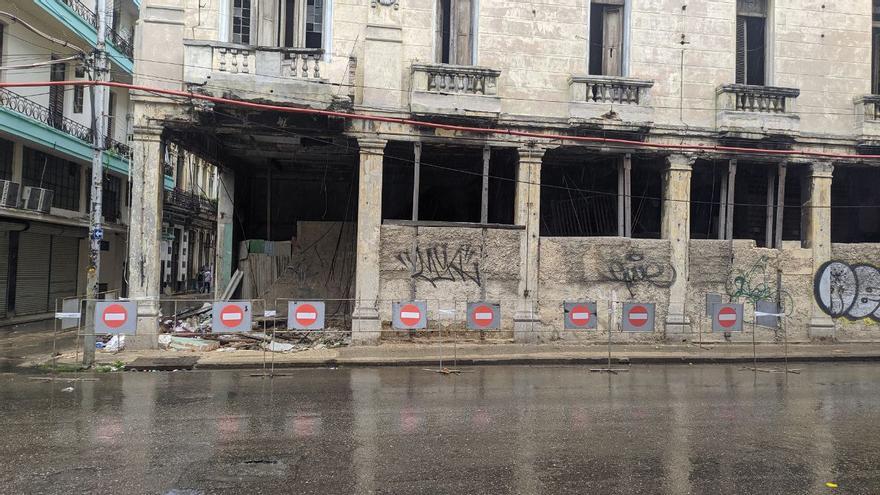
Man Dies in Partial Collapse of a Building in Havana

The building had long been showing serious deterioration. (14ymedio)

14ymedio bigger14ymedio, Havana, 22 July 2020 — A man died Saturday morning from the partial collapse of a building in Central Havana, according to neighborhood sources. The victim, whose name this newspaper could not say, was a worker with the Communal Services who was collecting the garbage in San Miguel and Belascoaín when part of the wall fell on him.

According to sources from the Services, the man was cremated that same day around midnight.

The authorities cordoned off and marked the area, which is in clear deterioration, as residents have denounced through multiple negotiations with the administration in which they have detailed, without success, the danger and unhealthiness of the area. On the morning of this Wednesday an operation was visible with men in civilian clothes that prevented the neighbors from approaching the place or taking photos. continue reading

“It is necessary that the authorities of Central Havana, Housing and the local Government, assume their responsibilities on time and undertake the urgent actions required by this important corner of this city through which we all pass, since nothing is more important than saving life of the people, not only from Covid,” denounces the source.

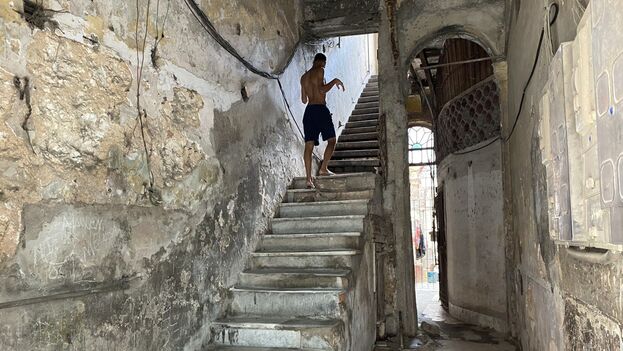
For more than forty years, the building, one of the tallest in the area, has been at the center of neighbors’ fears. Deep cracks in its facade, with several balconies that have collapsed and wooden shoring in its portal since the 80s, passers-by avoided passing near it and went down the sidewalk on that section of Belascoaín street.

In 2017, a family who lived on the second floor of the building fell to the ground after the floor collapsed under their feet, an incident that led several families to leave the place. For decades, garbage and debris have been accumulating on the basement of the building, between the columns, which community workers then collect with heavy machinery.

Despite being officially uninhabited, the property is frequently occupied by homeless families, especially migrants from the eastern provinces of the Island who, finding themselves without legal papers in Havana, have many difficulties in renting a home. Despite the degree of deterioration of the building, the garbage containers on that block are located just below its main facade.

This is the second serious incident in the capital this year since, in late January, three girls died as a result of the collapse of a balcony in Old Havana. The children, who were about 11 years old and were in elementary school, had left the school and were passing by when the structure collapsed, killing one of the victims on the spot, while the other two lost their lives in the hospital.

Neighbors climb the battered staircase from the beginning of the last century and propped up in various areas. (14ymedio)

Probably due to the ages of the deceased, the population reacted with special pain to this event, which was first reported by the independent media and reported by the official press three days later. At that time, many publications took stock of the unfortunate situation in which a large number of buildings are located in the capital, but no action has been taken in this regard and the arrival of the pandemic has taken the limit of the situation they are going through into the background. infrastructures on the Island.

Recently, a similar tragedy occurred involving a minor. It was on November 3, in the Playa municipality, when a building collapsed, leaving two fatalities, a 13-year-old girl and her mother. On that occasion there was a survivor, the minor’s grandmother

Also in March, another person died in similar circumstances in the Cerro neighborhood. On that occasion, a building that collapsed was one that neighbors had been requesting to be fixed for fifteen years. After there was a fatality, the building was demolished and the 36 people who lived in it were evicted.

Four other people died in July 2015, also in Old Havana. A building on Havana Street, between Obispo and Obrapía, collapsed around six in the morning when the inhabitants, for the most part, were still asleep. In the incident, a girl of just three years old, two young men of 18 and a woman of 60 died.

All these cases have in common the poor condition of the buildings and the negligence of the authorities to take measures that could have prevented these deaths.

Some 1.7 million houses, that is to say 39% of the housing fund in Cuba, is in a fair or poor state, according to the Housing authorities. The situation is particularly serious in Havana.

 See: Havana is Collapsing – A Photo Essay: Part 1, Part 2, Part 3, Part 4

_________________

COLLABORATE WITH OUR WORK: The 14ymedio team is committed to practicing serious journalism that reflects Cuba’s reality in all its depth. Thank you for joining us on this long journey. We invite you to continue supporting us by becoming a member of 14ymedio now. Together we can continue transforming journalism in Cuba.
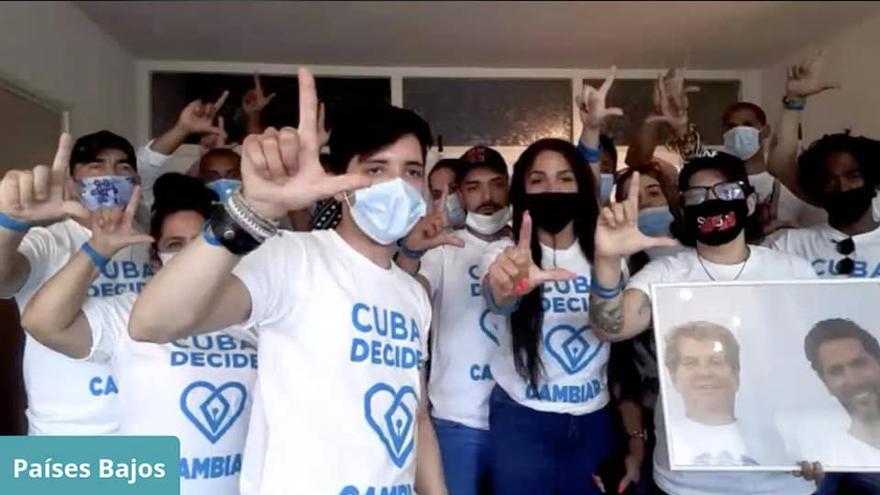
Global Online Event Commemorates Oswaldo Paya and Harold Cepero

Young people in the act of homage to Oswaldo Payá and Harold Cepero this Wednesday in the Netherlands. (Facebook / Cuba Decides)

14ymedio bigger14ymedio, Havana, 22 July 2020 — Activists of the Christian Liberation Movement (MCL) denounced on social media on Wednesday that they were harassed by the Police, in Havana, to prevent them from approaching the grave of Oswaldo Payá, in the Cristóbal Colón cemetery in the Cuban capital.

Wednesday marks eight years since the death of Payá and Harold Cepero, in a car crash whose circumstances have not yet been clarified and which the family has always considered to be murder.

In his memory, there is a world event organized by the Cuba Decides association and the Foundation for Pan American Democracy. The event comprising 12 hours of online transmission from different cities of the world and Cuba, addressed the different facets of the activists. continue reading

The day started in the Netherlands at nine in the morning, Cuba time, with a forum for politicians and young exiles in Europe. Later, other young people joined the tribute from Spain.

At one o’clock in the afternoon, a remote roundtable took place between different Latin American parliamentarians — Mexicans Ricardo Morales Kuhn and Cecilia Romero, Colombia’s Paola Holguín, and Guatemala’s Aníbal Samayoa — which analyzed the influence of Castroism on the continent and honored the dissidents with the sign of the “L” for “freedom” that Payá made famous.

Other tribute events include a ceremony at the Monument to the Victims of Communism in Washington DC; the presentation of the book written by Payá and published posthumously The night will not be eternal and a mass in the church of St. Raymond of Peñafort in Miami.

Oswaldo Payá, founder of the MCL, was the architect of the Varela Project, which, based on the 1992 Cuban Constitution, sought to collect the signatures of citizens to propose new laws. Payá managed to gather some 25,000 signatures to request a referendum in Cuba with the aim of establishing, among other changes, free elections and freedom of expression.

____________

COLLABORATE WITH OUR WORK: The 14ymedio team is committed to practicing serious journalism that reflects Cuba’s reality in all its depth. Thank you for joining us on this long journey. We invite you to continue supporting us by becoming a member of 14ymedio now. Together we can continue transforming journalism in Cuba.
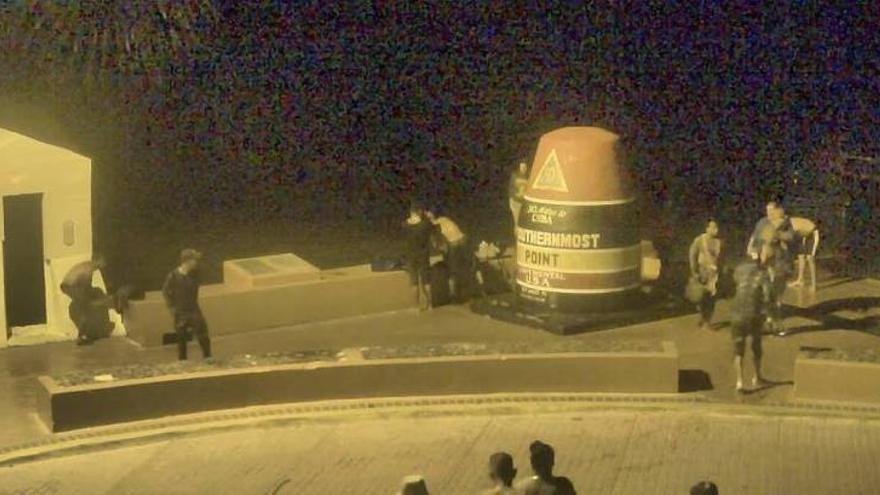
In the Middle of the Pandemic 31 Cuban Balseros Arrive in Miami

According to official data, so far in fiscal 2020, which began in October, 96 Cubans were intercepted at sea. (CBP)

14ymedio bigger

14ymedio, Havana, July 17, 2020 – A group of 31 Cuban balseros (rafters) arrived at dawn on Thursday on the coast of Cayo Hueso, Florida, according to local media reports. A short while after their arrival, authorities announced the arrest of 20 of them in Miami.

According to the migratory agreement signed under Barack Obama’s administration with the Cuban Government, the migrants will be returned to Cuba.

“Twenty Cuban migrants were arrested in the Miami sector,” John R. Modlin, the head agent of U.S. Customs and Border Protection, said on Twitter.

“The migrants were exposed to extreme temperatures in an overloaded, homemade boat without safety equipment. This type of trip from Cuba, it’s dangerous!” he added. continue reading

The landing was filmed by a couple who, in an interview with America TV, explained that they were shocked to see a mother holding a child among the rafters.

Junior Ramos and Katherine Molina were the young people who filmed the arrival, and according to what the migrants told them, it took one and a half days to get there from Cuba.

“We two were there and welcomed them to a free nation,” said Ramos. The couple confessed that the event would mark them “for life.”

According to official data, so far for fiscal 2020 (which began in October), 96 Cubans have been intercepted on the high seas. In 2019, a total of 481 immigrants from the Island were captured on the journey.

In 2017, Obama eliminated the policy of “wet foot, dry foot,”,which allowed Cubans who set foot on land to be admitted as refugees, with an expedited path to permanent residence.

Before the end of the “wet foot, dry foot” policy, in 2016, the U.S. Coast Guard counted the arrival of 1,845 rafters. In 2007, another tense year for U.S.-Cuba relations, the number reached 4,161.

The Cuban Adjustment Act, still in effect, allows for the regularization of migratory status for Cubans after one year of residence in the U.S., but it requires that they be admitted legally at the border. If they’ve arrived illegally by sea, they can’t invoke this rule. However, not all legal routes are closed, Alejandro Vázquez, an immigration attorney, told the Nuevo Herald.

“Immigrants who arrive by sea and aren’t detained can request asylum like anyone else,” he said.

The lawyer assured that even those Cubans who are detained upon arrival and show credible fear of returning to the Island can be released under personal recognizance or bail, pending an asylum trial, or remain detained pending a repatriation trial.

Translated by Regina Anavy

____________

COLLABORATE WITH OUR WORK: The 14ymedio team is committed to practicing serious journalism that reflects Cuba’s reality in all its depth. Thank you for joining us on this long journey. We invite you to continue supporting us by becoming a member of 14ymedio now. Together we can continue transforming journalism in Cuba.
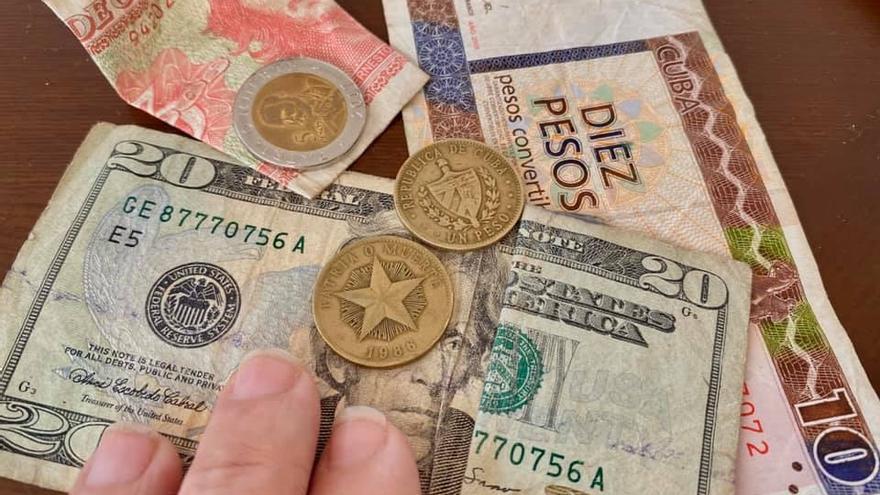
The ‘Truly’ Convertible Money Now Prevails In Cuba

Besides household appliances and auto parts, Cubans can now buy food and personal hygiene and cleaning products with dollars in the CIMEX* shops. (14ymedio)

14ymedio bigger

14ymedio, Reinaldo Escobar, Havana, July 16, 2020 – in the midst of a growing shortage in Cuban markets, the Government has decided to increase the distance between consumers and merchandise, improving the capacity to buy for holders of debit cards that can only be nourished with foreign currency. This commercial modality started at the end of last year for the sale of household appliances and auto parts, but now it’s being applied to food and personal hygiene and cleaning products.

The reason for this “partial dollarization” of commercial activity is that despite its name, the CUC (Cuban convertible peso) is not a convertible currency in international markets. It doesn’t make sense for the State to buy merchandise abroad in euros, yen or dollars to sell it later in the internal market in exchange for a piece of paper that has no real value and can’t be exchanged off the Island for any other currency.

Monetary unification has been announced many times, only to be postponed. As of yesterday, the Cuban peso (CUP), with which salaries are paid, won’t inspire envy, and the chavito (slang for the Cuban convertible peso) is now humiliated. What is valuable for real life will be the currency that is truly convertible: dollars, euros, yen or crowns. It’s not important that customers can’t get their hands on it; it’s enough that an electronic device can read the card and verify that the value is there. continue reading

In the absence of a political explanation that justifies this measure, it will undoubtedly be supported with reasons related to the restrictions imposed by the U.S. on Cuba, and with the infallible argument that what is collected will swell State funds in order to maintain social benefits. So a privileged minority that has access to foreign currency will finance a deprived majority.

When Fidel Castro introduced the dollar into the economy, he already accepted foreign investment and authorized self-employment, arguing that he was doing it to save the Revolution’s achievements.

Almost three decades later, it should be stated that, more than “saved,” these achievements only survived, at a high price and a highly regrettable standard. At this point, it’s not possible to go back to repeating the same argument.

Among the foreseeable consequences of this risky step, salaries will be farther away from being the natural support of the family economy, since almost everyone who has access to the debit cards won’t be part of the work force. This isn’t money earned “with the sweat of the workers,” but rather received as a handout or gift from the exterior.

The already growing social inequality will now extend to a highly sensitive sector: nutrition. What they’re going to sell in these stores aren’t “delicacies” but rather products of primary need, for which there’s a pressing demand.

What are they going to tell the kids of someone employed by the State when they ask why some of their classmates bring food to school for snacks that they can’t get?

Despite what is established in the Cuban Concept of the Social and Economic Model, in the Communist Party guidelines and in Article 65 of the Constitution, the new rule now won’t be “to each according to his work” but rather to each according to their relatives or friends abroad who are ready to send remittances. As a result, no one will now have the same enthusiasm for “the common work that provides justice to all,” but will strive to improve their personal relationships.

The dollarization of one indispensable part of retail commerce isn’t in itself bad news. It’s almost a blessing that this has been established by the present authorities, so that there won’t be leftist criticism of those who, after a foreseeable change, propose that everything be dollarized. In this sense they are already including other “advances,” like the elimination of workers’ dining rooms, the closure of Schools in the Countryside or the elimination of illegal gratuities.

The defect in this measure is its incoherence in relation to the other economic, social and political factors. It’s enough to remember that point 19 of the macroeconomic policies of the Party guidelines proposes “consolidating the pecuniary functions of the Cuban peso, with the goal of strengthening its role and preponderance in the monetary and financial system of the country.” Can undercutting the ability of the Cuban peso to convert itself into goods and services be a way of strengthening it?

When complaints about poverty are combated by arguing the inviolability of principles, believers close their mouths and forge ahead; but something will have to happen when principles are trampled underfoot and the suffering increases.

*Translator’s note: CIMEX is a State-owned Import-Export corporation. Its financial branch, FICIMEX, controls credit card transactions in Cuba and remittance wire transfers from other countries.

Translated by Regina Anavy

______________

COLLABORATE WITH OUR WORK: The 14ymedio team is committed to practicing serious journalism that reflects Cuba’s reality in all its depth. Thank you for joining us on this long journey. We invite you to continue supporting us by becoming a member of 14ymedio now. Together we can continue transforming journalism in Cuba.
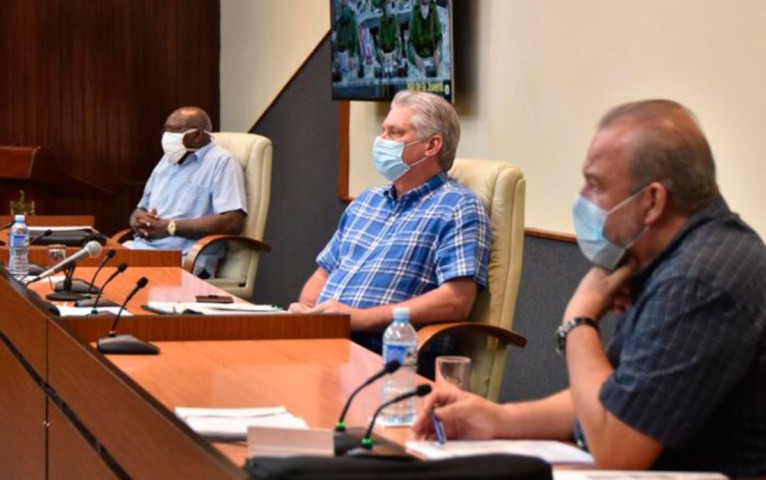
Cuba: The “Strategy” of Desperation

(Photo: Estudios Revolución)

Cubanet, Miriam Celaya, Havana, 19 July 2020 — If I had to briefly describe the general impression that emerges from the new Economic and Social Strategy of the Cuba’s upper echelons of power, I would choose three preliminary adjectives: wrong, late and incomplete.

It is wrong because it continues to estimate in a foreign currency what they call “impulse to the economic development of the country” – more noteworthy, in the “enemy’s” foreign currency which supposedly generates all the ills – and in items that are not related at all to the results of the production of the (ruined) national industry: family remittances from abroad, the eternally “potential” foreign investment capital and the eventual foreign tourism income, now disappeared.

It is late because each and every one of the proposed guidelines, such as the “flexibilities” announced for the private sector, financial “autonomy” for state-owned companies, the introduction of micro and small and medium-sized companies, among other measures could and should have been implemented many years ago, especially during the thaw period, with the administration of the then-US President, Barack Obama, when the Castro regime had its best opportunity to implement these and other changes. continue reading

On the other hand, the official proposal for economic reforms in the current national and international context (though it is noteworthy that the term “reforms” was not uttered), far from projecting an alleged interest of the power claque to expand the economic potential of citizens or a real desire for change, only evidences despair and a sense of urgency to increase hard currencies.

But perhaps the most relevant feature of this official strategy, which they now offer as the holy grail to try to revive the depressed economy, is its incompleteness. And here, it is worth dwelling on several root considerations when it comes to economic efficiency.

According to the leaders of the Castro court, the priority objective of all the theoretical-strategic scaffolding – which until now is only about that: theory and intentions – is food production. In fact, the spokesman of the constituents of the Political Bureau of the PCC, comrade Díaz-Canel, in his scolding speech before the Council of Ministers on the morning of July 16th made reference to the urgent need to achieve “food sovereignty”, a kind of religious invocation resulting from the delusions of the Deceased-in-Chief, whose status has never advanced beyond that of a chimera, and who only sounds yet again like a bad omen in the current scenario.

But, getting to the heart of the matter, producing food at a level that satisfies domestic demand, substitutes imports and even generates income from exports – as these hallucinated ones claim – necessarily goes through the everlasting problem of property relations over land, a critical point of which no mention was made on last Thursday’s Roundtable television program.

If the farmer is not the legitimate owner of the land he works; if, in addition, laws (not simple paper “strategies”) that grant legal nature and protection to the producer are not implemented; if the inopportune interventions of the State that establish price limits, criminalize commerce or impose leonine taxes are not irreversibly suspended; in short, if, simultaneously with the “flexibilities” in the economy, the corresponding civil and political rights are not recognized for citizens, there will be no effective progress, nor will the necessary and profound changes take place.

The official rhetoric, so worn and rotten that its seams seem to pop, deserves a full stop.  About said rhetoric I will only mention some brushstrokes that stand out in the midst of the ideological patch that preceded the information on the masterful “Strategy”, through the intervention (in effigy) of the president by appointment, which makes clear the absence of a compass of a political power that weighs itself down as obsolete and ineffective.

When Díaz-Canel, in his parliament, reminiscent of a “Cantinflas”* movie plot, declares that “to benefit everyone, sometimes you have to take measures that seem to favor a few but in the long run favor everyone”, and when the differentiation of access to goods is established as a norm and services according to the income of citizens, privileging those who receive foreign exchange – to the detriment of the state worker who receives his salary in national currency (CUP) and the most humble sectors of society, without access to remittances or other income – and establishing the bases for a new and deeper social gap between the poor and the rich, are in fact establishing the same “neoliberal” strategies that have been so widely criticized by the seat of power when it comes to other governments in other latitudes.

But if, to add to the humiliation, the official media offers to the most disadvantaged the promise of two “additional” pounds of rice and six ounces of beans, to be distributed for two months through the ration card, then discrimination is compounded by insult.

Hopefully, all of us Cubans, here or overseas, will finally place ourselves at the height of the conflict. This time it is worth paraphrasing the maker of national ruin to tell those who humiliate and insult us from the seat of power that we don’t want them; we don’t need them.

*Translator’s note: Cantinflesco: A term derived from Mexican actor Mario Moreno Cantiflas’ movie genre: laughable, ridiculous, caricature-like.

Translated by Norma Whiting

Elimination of the 10% Tax on the Dollar

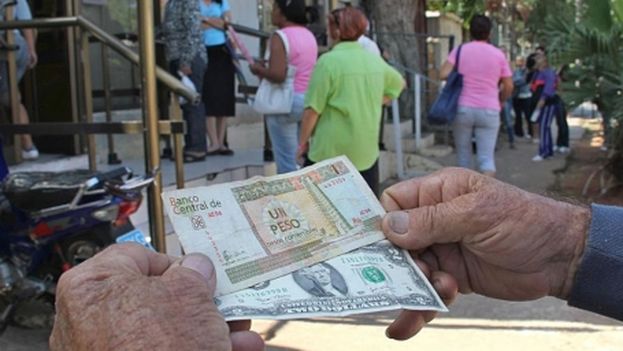
The Cuban convertible peso and a US two dollar bill. (EFE)

14ymedio bigger

14ymedio, Elías Amor Bravo, Economist, July 17, 2020 – Let’s imagine a government that spends 61 years calling another government an enemy, accusing it of economic harm. That includes, among other things, a prohibition against using the other country’s money. It also condemns to prison those who are caught transacting on the informal economy (the black market). Then, having said this, the government has no other solution but to return to authorizing transactions in said prohibited money for the purchase of food and cleaning products that are basic to the population.

And in addition, the authorities of this government maintain that the same old measure is fair and benefits all Cubans inside and outside the country. Incredible, because this is Cuba in the time of Díaz-Canel, and this is how the international communication media have covered this news coming from the Island.

Fidel Castro did it another way. When, in the middle of the Special Period he saw that the dollar was devouring the Cuban peso and that the national money was scorned by the population in the face of the free-for-all that brought with it the collapse of the Berlin wall, he created a fictitious currency, the CUC (Cuban Convertible Peso), in order to collect hard currency directly, and he didn’t bat an eyelid. continue reading

The dual currency in Cuba has been here for a quarter of a century and could continue indefinitely, in spite of the strain it puts on the functioning of the economy.  But Fidel Castro created the CUC, and no one up to now has had the courage to eliminate it. The CUC won’t survive the present measures. That’s for sure.

But let’s go to the heart of the matter, which has attracted the attention of the international media. It’s clear that this country, which had prohibited the use of the foreign enemy’s money, had established a tax of 10% on transactions, generally on remittances made in said currency. All of a sudden they decide to eliminate this tax. As there are few governments that act this way, you have to ask why the Cuban Regime has decided not to charge this 10% on transactions in dollars.

The question is easy to answer. Basically, a system of commercial intermediation was conceived last year with the sale of appliances, air conditioners, computers, auto parts, refrigerators, etc., and now they want to extend it to basic goods and cleaning products in 72 shops that will certainly have everything, as opposed to the State stores where, after long lines and wait times, you normally can’t get the product you want. Let’s say that, in addition, they have announced more products and shops for August. The Cuban Government sees commercial transactions with hard currency as a way to overcome the present Covid-19 crisis.

Why are we saying this? Basically, because now food can be imported and paid for with the hard currency that’s collected in the dollar stores by the sale of products—hard currency that doesn’t exist in the national economy because tourists haven’t come to the Island in four months, as the Minister of the Economy recognized. Thus, the dollars needed to buy corn or rice from the U.S. can be obtained in the shops which sell in Moneda Libremente Convertible [Freely Convertible Money). These shops are being inaugurated on Monday, July 20, by the Communist Regime, and everyone is very happy because the threat of a food crisis is thereby removed from the dismal scenario of the Cuban economy.

But this same measure has two sides, like the money. Side A is positive, because it allows Cubans who have access to dollars to open accounts in certain banks, obtain debit cards and embark on buying what they want in the stores. But the question is, what happens to the 80% of Cubans who have no access to the dollar, nor family in the exterior to send remittances?

This is Side B. They would have to save a lot, which is very complicated with the salaries they are paid, and they would have to exchange Cuban pesos with the dollar. The Cuban peso will be the first to notably depreciate in the informal market, and, most probably, these Cubans won’t be able to buy anything in these stores.

Surely Cubans will regulate this injustice in the informal economy, with creative formulas that show us how clever and capable they are. Meanwhile, State Security is training to put an end to the so-called “illegalities”, which are nothing less than a cry for freedom.

For the moment, let’s say adiós to the 10% tax on transactions with dollars, which Fidel Castro also established in 2004 to respond to what he called “attacks of the embargo”. The reality is that nothing has changed since then, even if the application of Title III of the Helms Burton Law has made things more complicated. Now the Cuban Communist Regime has decided to eliminate the tax so people won’t lose that 10%, which still doesn’t make anyone jump for joy.

No one should expect these measures to revolutionize an economy that, according to the latest data from CEPAL (the Economic Commission for Latin America and the Caribbean), will sink to -8% in 2020 (remember that in April they had estimated only -3.8% because things were going badly, and what is worse, much worse, is that this decline will continue). The Government has reacted by applying, inside the profit margins allowed, a measure that tries to obtain all the hard currency circulating in the country from remittances (the only hard currency that presently comes in).

The older generation remembers Fidel Castro’s dialectic against the U.S. and the threat of the dollar. Decriminalizing the possession of dollars took place in 1993 during the so-called Special Period, but before that date many Cubans suffered imprisonment and heavy fines for having dollars. History can’t be easily forgotten, and much less should it fall into oblivion when the past is reconstituted.

Before 1959, the U.S. wasn’t insulted for meddling in the Cuban economy. Prices in stores were established in dollars, and the peso was on a parity with the dollar. The Cuban economy rested on more solid fundamentals.

So much demagoguery and long hours with speeches empty of content in order to stop selling pork, shampoo and hamburger meat in dollars to Cubans in a series of select shops. Basic products in prices given in dollars in a country with two official currencies in circulation, the historic Cuban peso and the Castro invention called Cuban Convertible pesos. Sometimes history goes backwards from good sense to those who offend it by playing Russian roulette. What’s going to happen in Cuba starting from next Monday, July 20, has a lot to do with those lost battles by governments and political regimes, in which there is no type of justification for supporting them.

What’s bad about all this is that they want to present these measures as something beneficial for the Cuban people, when they aren’t. That 80% of Cubans don’t have access to the dollar leaves many people on the margin of this commercial system oriented to capturing hard currency. This causes discontent, because no one is going to understand this difference. In Cuba, the access to buying goods and services that don’t exist in other shops isn’t going to be a function of the value of work, strength, motivation or performance, without having family or friends in the exterior to send dollars. Is this the moral lesson that the Castro Regime wants Cubans to have? If those who govern the country have nothing better to do than insult those who question these measures, let them retire and make way for others. They are losing very valuable time that can’t be recovered. Luckily, Cubans know it.

Translated by Regina Anavy

____________

COLLABORATE WITH OUR WORK: The 14ymedio team is committed to practicing serious journalism that reflects Cuba’s reality in all its depth. Thank you for joining us on this long journey. We invite you to continue supporting us by becoming a member of 14ymedio now. Together we can continue transforming journalism in Cuba.

There Was Food But Not For Us

Images from this morning show the shelves full of meat. (14ymedio)

14ymedio bigger14ymedio, Yoani Sanchez, Generation Y, Havana, 20 July 2020 — When the sun rose this Monday, about 250 people were already waiting outside the Boyeros y Camagüey store in Havana to buy food and toiletries with foreign currency. Since last week, when the Cuban government confirmed what the independent media had already reported, the start of the sale of food in foreign currencies through magnetic cards has monopolized the talks and the outrage.

This weekend several images were leaked from the interior of one of the shops preparing to open its doors on July 20. So, we came face to face with a reality that we suspected but that we have seen confirmed on those shelves full of preserves, in the refrigerators loaded with meat, and on the shelves full of toiletries. There were products but not for those who only had national currency.

Where were all these sauces, these cuts of beef, the ground beef and these packages with beans when for months people have had to spend hours, if not days, in a line to buy what little stores had for sale in convertible pesos? Is it that they are going to make us believe that all this arrived in the country last week, circumventing the American embargo that the Plaza de la Revolución always uses as a pretext for the shortages? continue reading

These goods were here but the authorities did not want to sell them in the stores in Convertible and Cuban pesos (CUP and CUC). All those arguments that there were no raw materials and that the pandemic had left the country without the ability to buy basic items, were just to justify why there were no products for sale in exchange for those colored slips of paper that they still insist on calling “Cuban pesos,” when in reality they seem to levitate with so little worth.

They have kept us passing most of our lives in a long line to get a package of frozen chicken or some detergent, while in state warehouses there were tons of merchandise that was reserved exclusively for those who have the currency of that country which, in official propaganda, remains “the enemy.” This peculiar adversary, whose currency it is necessary to use to sustain a dysfunctional and unproductive system like the one that exists on this Island.

Today, when the police distributed the first 200 turns in line outside the Boyeros and Camagüey market, customers prepared not only to buy food and cleaning supplies, but also to peer into that inventory of products that has been hidden from us for months.

_____________

COLLABORATE WITH OUR WORK: The 14ymedio team is committed to practicing serious journalism that reflects Cuba’s reality in all its depth. Thank you for joining us on this long journey. We invite you to continue supporting us by becoming a member of 14ymedio now. Together we can continue transforming journalism in Cuba.
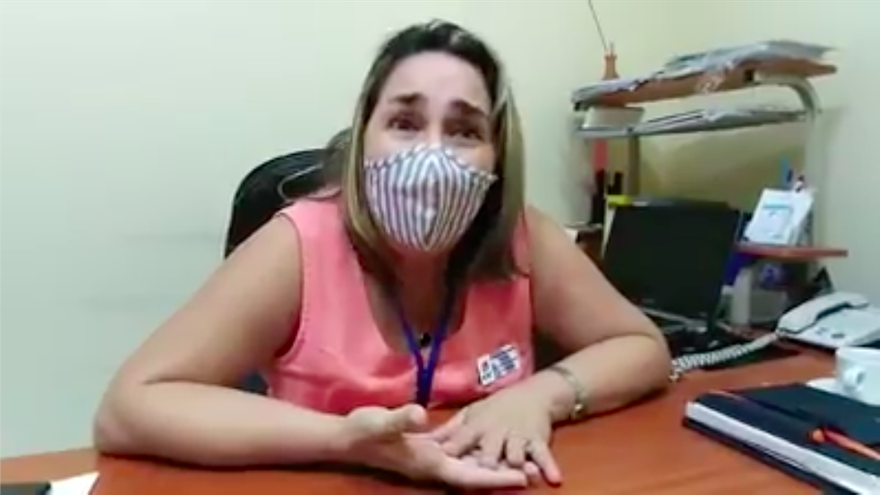
Cenesex Talks About Political Manipulation and Yusimi Persists

Yusimi González in her interview with Francisco Rodríguez Cruz, as reported by the journalist on his Facebook page.

14ymedio bigger

14ymedio, Havana, July 16, 2020 – The discussion about the homophobic statements attributed to an official of the Cuban Institute for Radio and Television (ICRT) has prompted the National Center of Sex Education (Cenesex) to make a statement giving a soft rap on the knuckles to Yusimi González Herrera and the organization, whom we’ve invited for a dialogue. In a meeting, González criticized the “affected voices” of some professionals on national radio because they don’t transmit a “credible message” to the audience.

“These last few hours we have become aware of an audio that is circulating on social networks in which Yusimi González Herrera, Director of Communication and Content for the Cuban Institute of Radio and Television and Deputy of the National Assembly of People’s Power, uses expressions that could be considered discriminatory in an analysis about the work of announcers, journalists and collaborators of Cuban radio,” Mariela Castro, Director of Cenesex, published on her Facebook page.

“Our mission and commitment to educate on subjects of sexual and reproductive rights prompt us to speak with the official and her institution. Such situations confirm for us the need to continue our work of training and awareness in the ICRT. Prejudices are not quickly overcome and thus require a permanent formative impact,” adds the text. continue reading

For this center, success with the official confirms the importance of “continuing to defend an educative process that sometimes may be more difficult”.

“We go forward together and close the doors to any manipulation that tries to convert these rifts into a political weapon in order to discredit what we are advancing,” concludes the note.

Yusimi González was interviewed by the journalist Francisco Rodríguez Cruz, who has offered a preview of the conversation; the entire text will be posted Thursday on his blog, Paquito de la Cuba.

“I’m sorry that I hurt people with a manipulated audio; really the one who should apologize is the person who manipulated this audio and used it to hurt people, to make them feel excluded and humiliate them to some extent. That never has been the intention of the Cuban Institute of Radio and Television. The Institute works with everybody; it has an inclusive policy,” says the representative in the preview video, which barely lasts two minutes.

González adds that the Institute “wants all its professionals, whatever their specialties, independently of their sexual orientation or any limitation or disability they have, to come into what is their house, which always receives everyone when they come to construct, unite and dignify a social project.”

The leaked audio generated a wide rejection in the LGBTI community on the Island, and some on social networks even have asked that the official be fired after this incident.

Translated by Regina Anavy

__________________________

COLLABORATE WITH OUR WORK: The 14ymedio team is committed to practicing serious journalism that reflects Cuba’s reality in all its depth. Thank you for joining us on this long journey. We invite you to continue supporting us by becoming a member of 14ymedio now. Together we can continue transforming journalism in Cuba.

Cuban Radio and Television Must ‘Be Careful About Political Propaganda Voices’

After the stir caused by her statements, Yusimi González excused herself from an interview with the journalist Francisco Rodríguez Cruz. (Facebook/F.R.C.)

14ymedio bigger

14ymedio, Havana, July 17, 2020 – “We have to be careful about the voices that transmit our political propaganda.” Thus, Yusimi González Herrera, a representative of the Cuban Institute of Radio and Television (ICRT), tries to explain what she said. Her controversial statements about the abundance of “high-pitched” voices on the Cuban airwaves became news this week.

In a new audio shared this Thursday on social networks, González, in conversation with Alfredo Zamora Mustelier, director of programs and the head of ICRT’s propaganda, spoke about the importance of the “architecture” and “design” of voices used to transmit political propaganda. “Can you imagine how people called to a march feel when they hear a high-pitched voice?” asked Zamora, provoking laughs among those present.

“More than that, Zamora,” interrupts González. “We have to be careful about the voices of those who transmit our political propaganda,” she explained, alleging that “they contain our identity, the defense of the Cuban nation, the country”. continue reading

After the stir caused by her statements, González excused herself in an interview with the journalist Francisco Rodríguez Cruz, whose full text was disseminated Thursday in his blog, where he said that the audio, the first of those played, corresponds to “a work meeting that lasted several hours”.

“It’s my voice and it comes from a meeting I had in 2016 about techniques of locution and other questions. It was a work agenda, and this was among the themes we discussed,” González said.

“What were we defending at that time and still defend today? That our channels and emissions all have a profile, a profile that defends and defines us, from rhythms, a profile across editorial lines, of sounds, timbres, tones. (…) That’s what we were talking about. (…) I believe the fragment that was selected comes from here, when we referred to high-pitched voices. There are high-pitched voices that work for one type of program, but not for another,” she added.

González said that the audio was “edited” to “convey the idea of the person who edited it” and “to imply that the station was evaluating high-pitched voices and whether people with this type of voice could work in the communication media, when it’s not true”.

“It’s never been the position of radio or television to limit anyone by sexual orientation, disability or skin color. This isn’t the case.”

In addition, she recognized that it’s possible that “at some moment” the Institute of Radio and Television could have been wrong “because humans can always improve themselves”, but she noted that they “knew enough to offer apologies”.

Asked if a specific apology for her words in that meeting would be fitting, she said that anyone who knows her “knows that this audio isn’t how I think”. However, she said she was sorry that some people “felt hurt” because “no one has the right to hurt anyone”.

Upon ending the interview, González denied having been aggressive, “as a professional, mother, daughter”, or that she also hurt her family and friends. “A speech has been manipulated, a contribution or a construction of my thinking at that moment. It has been used to injure other people, to try to create divisions, to mistreat people. And that’s not fair, it’s not something good people do, it’s not real”, she concluded.

Translated by Regina Anavy

____________

COLLABORATE WITH OUR WORK: The 14ymedio team is committed to practicing serious journalism that reflects Cuba’s reality in all its depth. Thank you for joining us on this long journey. We invite you to continue supporting us by becoming a member of 14ymedio now. Together we can continue transforming journalism in Cuba.
The Dollar Returns to Rule Our Lives

This week, after the independent press leaked the information that stores were enlisting for the sale of food and toiletries in foreign currency, many emphatically denied that possibility. (14ymedio)

14ymedio bigger14ymedio, Yoani Sanchez, Generation Y, Havana, 18 July 2020 – The first time I entered a hard currency store was in long distant 1994. I had to show the three one-dollar bills that a friend had given me, and thus managed to enter the shopping* on the ground floor of the Seville hotel, near the Capitol in Havana. The smell of cleanliness, the air conditioning and the shelves full of products were a hard blow for this Cubanita who, until then, had only known about state-run businesses and the rationed market. Since then it has rained a lot, but it also seems that history moves in circles on this Island.

This week, after the independent press leaked that stores were being prepared sell food and toiletries in foreign currency, many emphatically denied that possibility on the premise that “something like this cannot be.” Curiously, until Miguel Díaz-Canel confirmed, this Thursday afternoon, that the network of businesses managed by Cimex was going to offer food in dollars, euros or other foreign currencies, some clung to the conviction that such a segregationist measure could not be implemented in this country.

Memory is a slippery animal. This is exactly what Fidel Castro did when, in August 1993, he authorized the possession of dollars and fired the starting gun for the appearance of a vast network of state stores where you could pay only in that currency. The time came when those lacking US banknotes looked on – salivating – as others bought cookies, frozen chicken, sausages or soda in a type of store that, soon after, began to introduce the convertible peso (CUC) into its operations. continue reading

We have already experienced this, but many do not remember or do not want to remember. The dual monetary system became something so ordinary that, little-by-little over the last 20 years, we “normalized” the idea that to acquire merchandise of better quality and variety you had to have convertible pesos. The only difference now, with respect to recent years, is that the currency that once again governs the country’s destinies, and that guarantees a certain personal comfort, is the one with the faces of Lincoln and Franklin, one that had already determined our life in the 90s but that, this time, operates through magnetic cards.

This is nothing new: every time in the last half century that the Plaza of the Revolution has felt that the critical economic situation could shake its power, it has allowed certain winds of the market to flow over the Island and a social group to find accommodation in some shots of consumption. Nothing should surprise us in that strategy, which they have repeated so many times, although the double talk of proclaiming one political model and applying another that is so different, must not fail to outrage us.

Among those who until Thursday doubted that foreign exchange stores would include food, at a time of brutal shortages of food in the markets that sell in local currency, most were from my son’s generation. Cuban youths who were born after the shoppings opened, and the free circulation of the dollar allowed and the subsequent appearance of the commonly called chavito, the Cuban convertible peso (CUC).

For them, state commerce operated in two currencies: the CUC and the CUP… but they forgot – or could not remember due to age issues – that under the skin of those colored pieces of paper called convertible pesos there was always the bristling hair of a wolf named the dollar, a wolf which is now about to become the owner of the new hard currency stores. Any other version is bedtime story about Little Red Riding Hood.

____________

COLLABORATE WITH OUR WORK: The 14ymedio team is committed to practicing serious journalism that reflects Cuba’s reality in all its depth. Thank you for joining us on this long journey. We invite you to continue supporting us by becoming a member of 14ymedio now. Together we can continue transforming journalism in Cuba.
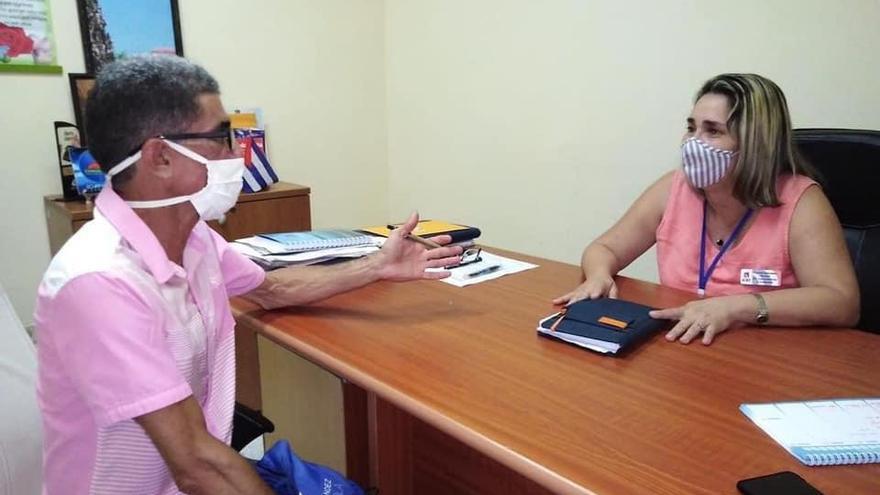
Cuba’s Caribe Stores and Their 47 Basic Products

What is the point of spending hard-to-get currencies to buy something that you can buy with national bills? (Luz Escobar / 14ymedio)

14ymedio bigger14ymedio, Reinaldo Escobar, Havana, 17 July 2020 — Among the presentations on Cuban State TV’s Roundtable program on Thursday, July 16, Ana María Ortega Tamayo, general director of Tiendas Caribe (Caribe Stores), appeared with the task of assuring the population that the opening of stores that will sell food and toiletries in freely convertible currency does not mean this particular merchandise is no longer sold in the 4,800 stores throughout the country that take payment in one of Cuba’s two currencies: Cuban convertible pesos (CUC) and Cuban pesos (CUP).

After clarifying payment through magnetic cards (MCL) loaded with hard currency, will focus on what she called “the deep assortment”, she maintained that the 47 basic products that until now have been marketed in these stores, which Cubans call shopping, using the English word, will remain.

While it is still unknown what will be included in the vague definition of “mid-range and high-end products” that will be offered by the new stores, it is also vague to precisely name the list of 47. In an internet search, the only the products that appeared were subject to control to prevent hoarding. If we include those that, due to customer experience, are not regulated but are sold, the list that we put at the end of this text can be formed. continue reading

It can be assumed that most of the 47 will also be traded in stores in convertible currency, and so the question that falls under its own weight is this: what is the point of spending hard-to-get currencies to buy something that you can buy with national bills?

A can of tuna, for example, will merit being bought in MCL stores for only two reasons: it is cheaper than at the shopping or to avoid the line. There is also the silly argument of vanity, of being able brag about having a magnetic card with better capabilities.

The most powerful reason for spending hard-to-get bills (and it’s not that getting the others is easy) will be the absence of many of the 47 items in the usual markets. If those who distribute the goods in both commercial modalities are the same, you can guess where the tuna cans will go when there are few left, because the ship was delayed, because the embargo prevented it, because the financing was lacking, because the the country was in debt to the supplier or for the infinite reasons why a product can become a shortage.

It is false, as President Díaz-Canel warned, that the sale in the current stores will now be suspended to bring the products to the new ones that operate in convertible currency. The question is what will happen when the dilemma arises of where it will be more profitable to sell what little is left of a merchandise.

Here we leave a list of what, without being official, can be assumed to be on the list.

Foods

      1. Vegetable oil

      2. Water

      3. Rice

      4. Sugar

      5. Coffee

      6. Candies

      7. Beer

      8. Chewing gum

      9. Jams and jellies

      10. Canned meat

      11. Canned fish

      12. Link sausages

      13. Noodles

      14. Cookies

      15. Crackers

      16. Grain

      17. Burgers

      18. Wheat flour

      19. Powdered milk

      20. Evaporated milk

      21. Tomato paste

      22. Other tomato preserves

      23. Pasta

      24. Turkey and mixed hash

      25. Beef hash

      26. Chicken

      27. Tomato puree

      28. Cheese

      29. National soft drinks

      30. Salt

      31. Vinegar

      32. Dry wine

      33. Yogurt

Personal care and grooming products

       34. Sanitary pads

       35. Toothbrushes

       36. Shampoo

       37. Toothpaste

       38. Disposable diapers

       39. Deodorant

       40. Detergent

       41. Floor cleaning cloths

       42. Washing soap

       43. Hand soap

       44. Toilet paper

       45. Perfumes

       46. Wet wipes…. and others

Others

       47. Cigarettes

_______________

COLLABORATE WITH OUR WORK: The 14ymedio team is committed to practicing serious journalism that reflects Cuba’s reality in all its depth. Thank you for joining us on this long journey. We invite you to continue supporting us by becoming a member of 14ymedio now. Together we can continue transforming journalism in Cuba.
An Official ‘Check’ to Cuban Chess

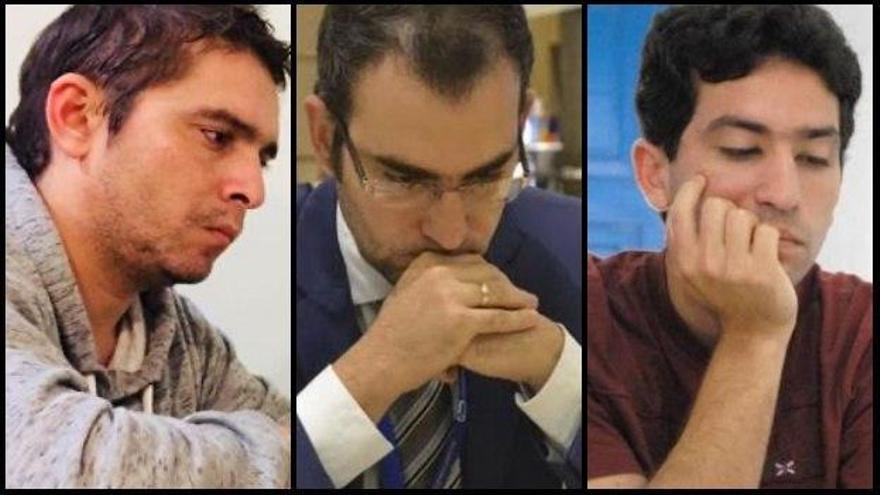
Chessplayors Bruzón, Domínquez and Quesada, whom officials have called “slaves” for playing under the flags of other countries.

(Translator’s note: this article makes reference to the Elo rating system, which is used to evaluate the relative skill levels of chess players. Amateur chess players typically have Elo ratings in the 1000-2000 range, while a rating of over 2600 places you in the world elite. The world champion currently has an Elo rating of 2863.)

14ymedio bigger
14ymedio, Rafael Alcides Pérez Coyula, Havana, July 15 2020 — There was a time when surpassing 2600 Elo points meant you were one of the world’s top 100 chess players. After former world champion José Capablanca (1888-1942), the next Cuban to reach those heights was Jesús Nogueiras, between the mid ’80s and early ’90s. Then, 18 years ago, he and Capablanca were joined by Leinier Domínquez and Lázaro Bruzón.

Ever since these two exploded onto the international chess scene, Cuba has had at least one representative in the top 100 players in the world, and, for the first time since the Elo rating list was introduced, in the top 10. Six Cuban players have passed the 2600 mark, appearing repeatedly in the most prestigious international tournaments. They’ve won two individual Panamerican titles, two qualifications to the World Team Chess Championship and have garnered excellent results in the Chess Olympiads, including individual medals for men and women. Lisandra Ordaz, for example, was awarded the international master title.

How then do we explain the fact that currently, no Cuban is rated above 2600 Elo, especially given that nearly 300 players worldwide have achieved that rating? It’s true that three Caribbeans hold that distinction, but none of them competes for the Cuban Federation. Grandmaster Neuris Delgado, who appears at number 161 on the FIDE rankings with 2621 Elo points, has played for Paraguay since 2013. Last year Leinier Domínquez (currently number 14 in the world rankings with 2758 Elo) made  his switch to the United States official. Now, Lázaro Bruzón (2644, number 111 in the world) has done the same. continue reading

Originally from the province of Las Tunas, Bruzón has lived for the last two years in the U.S., where he’s part of the chess team at Webster University in St. Louis, today’s chess mecca. Although he originally intended to continue playing under the Cuban flag, the inept handling of his move by the Cuban Chess Federation (FCA) eventually brought relations to a breaking point. Bruzón’s switch the U.S. Federation took effect on July 1st.

The FCA’s policy towards its players has amassed other victims as well. In the last three years they have sanctioned or “separated” some of their best known players from the National Team, players like the grandmasters (GM) Yuniesky Guesada and Yusnel Bacallao, the former for accepting work as a trainer in the U.S. after asking for permission and being denied, and the latter for protesting a two-year delay in payment of his prize money from the Capablanca Memorial Tournament.

The most recent case is that of GM Roberto García, who won 2nd place in the 2019 Cuban championships. The FCA normally provides a monthly stipend to all Cuban grandmasters, but has been denying this payment to García on the basis of his “repeated insubordination” and critical social media posts. What’s more, the Federation has interfered with García’s travel permits and insists that criticism of their actions will not be tolerated. All this is detailed in a letter written by Carlos Rivero, president of the FCA and National Sports Commissioner.

The absence of Cubans in the now-not-so-selective 2600 club is just the tip of the iceberg in the deterioration of the island’s chess scene. This started to become evident after the 2018 Chess Olympiad in Batumi, Georgia. Yuniesky had already fallen into disgrace while Bruzón’s problems were just beginning; then came the complaints about the organization and the conditions offered to the participants in the National Championships in 2019 and 2020.

Claims of delays in payment of prize money from the Capablanca Tournaments to Cuban players, while foreign players received theirs right away. Complaints by top players over the lack of high speed internet access, which is indispensable for any professional chess player these days. Calls for greater support for participation in high-level European tournaments, without which Cuban players have no opportunity to test themselves against the world elite.

The common factor in all these cases seems to be Rivero, who has been in charge of Cuban chess for nine years now. Rivero has faced criticism for failing to live up to the responsibilities of his office, and what’s worse, for not defending the real interests of Cuban chess.

Faced with these charges, the president has pointed to the large number of players who have achieved the grandmaster title during his tenure, the training programs he has implemented, and the number of young players who are currently dominating the national scene. But he ignores the generation of players whom Cuba has lost under his leadership, who have left the country or abandoned professional chess in search of better-paying work.

Meanwhile, at a more basic level, the problems just keep adding up. In schools, there is a lack of chess sets, boards, and even tournament clocks. There have been accusations of “phantom tournaments” that result in the sale of Elo points and international titles. And then there is the arbitrary retaliation against any hint of criticism.

The fact that for the first time since 2002 the leader in the national rankings sits below 2600 Elo is a reflection of the malaise that has overtaken Cuban chess. Carlos Daniel Albornoz, who is only 19 years old, has already reached 2573 Elo. Rivero is right in hoping for a brilliant future for the grandmaster from Camagüey. But while the Federation continues on its current course and U.S. universities continue strengthening their chess scholarship programs, it would be naïve to think that skill is the only realm in which Albornoz with emulate his predecessors.

 Translated by: Zach Young

_______________

COLLABORATE WITH OUR WORK: The 14ymedio team is committed to practicing serious journalism that reflects Cuba’s reality in all its depth. Thank you for joining us on this long journey. We invite you to continue supporting us by becoming a member of 14ymedio now. Together we can continue transforming journalism in Cuba.