 14ymedio, Havana, October 23, 2019 — 24 hours after her arrest, the activist Nancy Alfaya remains in an unknown location, as reported to 14ymedio by the independent journalist Jorge Olivera, who was with her at the time of her arrest.
“We left at 12:30 from our turn on the internet at the United States embassy. We were walking with Iván Hernández Carrillo, we went toward Coppelia, and then we entered a cafe on Calle J between 25 and 27,” says Olivera.
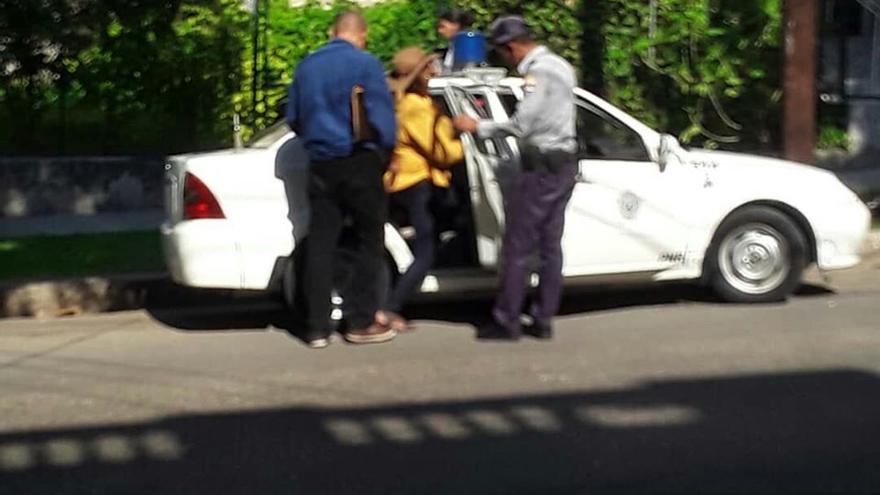
He explains that it was then that a patrol car arrived, and a police officer asked Nancy Alfaya for identification. “She was the objective, they also picked me up but they let me go at Infanta and Carlos III and I was able to hear an official from the political police who was on a motorcycle say to one of the police officers that Nancy was going to the 11th Unit of the PNR of San Miguel del Padron.” continue reading
However, a few hours later, when he called that unit on the phone they told him that she “never arrived.” Olivera later went to the Zanja and Dragones Unit to report the “disappearance” of Alfaya. They looked in the register of arrested but she wasn’t on the list. “It’s a forced disappearance,” he claimed.
The Citizens Committee for Racial Integration (CIR) reported harassment by State Security agents against civil society activists who work for female empowerment. Nancy Alfaya is a coordinator of the CIR’s Network of Women for Equality.
The CIR considered the arrest “state terrorism” and blamed the Confrontation Department of State Security, an organ of the Ministry of the Interior.
Juan Antonio Madrazo Luna, CIR spokesman, warned that “the political violence against the activist has increased in intensity in recent weeks” and condemned “these arbitrary practices,” while demanding “the immediate release of Nancy Alfaya.”
“Nancy Alfaya Hernández’s crime is working for female empowerment, mobilizing speeches on prevention against all forms of violence, demanding from the state public policies that protect women from the political violence in which state agents are the main offenders,” wrote Madrazo Luna on social media.
Translated by: Sheilagh Herrera
___________________
The 14ymedio team is committed to practicing serious journalism that reflects Cuba’s reality in all its depth. Thank you for joining us on this long journey. We invite you to continue supporting us by now becoming a member of 14ymedio. Together we can continue transforming journalism in Cuba.