From the headquarters of the San Isidro Movement, a call was made to donate flags and in a few days they have received dozens. (Facebook)
14ymedio, Havana, 14 August 2019 — A new challenge has been born in social networks. This time it is not about taking pictures lining up to buy chicken but uploading an image that contains the Cuban flag. With the label #LaBanderaEsDeTodos (The Flag Belongs to Everyone), the aim is to claim the non-partisan or ideological character of the national banner, weeks after a Law of Symbols that strictly regulates its use went into effect.
The catalyst for the initiative was the arrest of Luis Manuel Otero Alcantara for carrying a Cuban flag on his shoulders, while performing a performance with the title of Drapeau (French for “flag”), in which the artist carries with him for a month the national banner. When the police arrested Otero Alcantara, they confiscated the flag and kept him for 48 hours in an unknown location, until he was released on Monday.
After leaving his confinement, the artist launched the challenge on the internet and so far has accumulated more than a hundred images from various parts of the world in which Cuban flags are seen in different contexts and situations. In an airport, in the middle of the field, on a rooftop, waving on a balcony, facing the sea or captured by the hand of a painter; the artist’s Facebook account is full of blue stripes, the red triangle and the lonely star. continue reading
But the task has not been easy. The flags sold on the island’s network of state stores are priced prohibitively for most wallets. A regular size flag can exceed 15 CUC, the third part of a doctor’s monthly salary. Those who have one take care of it and protect it from rain and sun.
From the headquarters of the San Isidro Movement, of which Otero Alcantara is a part, a call was made to make donations of flags and in a few days they have received dozens.
The official response to the initiative has been unexpected in social networks and some Internet users close to officialdom have responded with the label #ConMiBanderaNoTeMetas (Don’t Mess With My Flag) that has so far has had much less of an impact and tries to link this symbol to an ideology and a party.
_______________
The 14ymedio team is committed to serious journalism that reflects the reality of deep Cuba. Thank you for joining us on this long road. We invite you to continue supporting us, but this time by becoming a member of 14ymedio. Together we can continue to transform journalism in Cuba.
Price controls in farmers markets run by self-employed and private sector workers take effect on August 15.
14ymedio, Havana, 12 August 2019 — Price controls now seem inevitable for privately run markets and services. According to a announcement from the Provincial Administrative Council (CAP), maximum prices private businesses and self-employed workers in Havana may charge will be regulated starting Thursday, August 15. The affected businesses also include supply-and-demand markets and pushcart vendors.
The measure applies to fruits and vegetable but also to pork, a product that often serves as a barometer of the state of household finances. As of Thursday the top price for a pork leg will be set at 5 Cuban pesos, while a boneless cut or a porkchop may cost no more than 45 pesos. Ribs will cost 25 pesos and fat will go for 15 pesos.
The measures will remain in effect until September when CAP will revise prices based on “the time of harvest for those products” according to the announcement. continue reading
Other high demand products such as kidney beans will top out at 20 pesos. A malanga — a taro-like starchy vegetable much sought after by families with small children and elderly individuals recuperating from illness — cannot go for more 8 pesos. Nor a plantain for more than 3.5 pesos.
Some retailers will be exempt. They include six markets, most located in Playa or Plaza of the Revolution, that sell process or packaged foods. Vendors at those locations will be allowed to charge 30% above the fixed price at other markets.
The six market locations are as follows:
23rd Street between 310 and Cangrejeras, Siboney
23rd Street between 214 and 218, Atabey
23rd Street between 206A and 214, Atabey
15th Street between 222 and 234, Siboney
202nd Street between 19 and 21, Atabey
26th Street between Linea de Ferrocarril and Via Ciclo, Plaza
Because markets are generally open from Tuesday through Sunday, most were closed on Monday. However, by the start of week the news had already begun spreading among merchants, who did not view the CAP’s decision favorably.
“I supply pork to a market in Central Havana,” says Yasdiel, a young man who transports his merchandise in a mid-20th century vehicle from Alquizar in Artemesia province to Havana. “A pound of meat from a live animal, still on its feet, right now goes for 27 Cuban pesos if I buy it directly from the producer.”
But Yasdiel calculates that the new rates wil leave him with a very slim profit margin. “I don’t know if I want to keep doing this because I won’t make much money,” he says. He points out that he has to pay to have the animal slaughtered, cleaned and butchered. Then there is the gasoline to transport the meat to Havana and his agricultural wholesaler’s license fee.
“We are baffled by these prices,” says Yasdiel, paraphrasing a historic quote from the wars of independence that has been widely used in recent months by officials in reference to the Helms Burton Act and the United States. “I’m thinking of postponing any purchases until they reconsider and get rid of these price controls. I can always sell directly to customers.”
Economist Pedro Monreal, who has harshly criticized these recent economic decisions, has also questioned the CAP’s decision. “This measure makes little economic sense,” he tweeted. “Reducing prices in low-end markets will not have a great impact on reducing mid-range prices, which is what would benefit the consumer.”
Monreal added, “What impacts the pocketbook of most consumers is not the low-end supply-and-demand economy. It’s the broader average pricing in the state-run economy, which is the predominant one.” And price controls have already been imposed in the latter.
Customers do not seem happy about it either. “Ther’ve imposed price controls but only on the upper end. What I am never going to see again is something priced below what they have set,” complained a regular customer at the San Rafael Street market in Havana on Monday. She fears that, when she goes to buy produce on Tuesday, “all the prices will be equally high.”
“If you think charging 4 pesos for a pound of yucca and 3 pesos for sweet potato is a good idea, you don’t know anything about what it takes put food on the table,” the woman adds. “It’s true that controls will keep prices from going up but now they won’t go down either.”
________________
The 14ymedio team is committed to serious journalism that reflects the reality of deep Cuba. Thank you for joining us on this long road. We invite you to continue supporting us, but this time by becoming a member of 14ymedio. Together we can continue to transform journalism in Cuba.
SNet has turned its users into the best organized and connected group in Cuba outside the ruling party. (Karla Gómez)
14ymedio, Yoani Sanchez, Generation Y, Havana, 14 August 2019 — Its users cannot talk about politics or religion, but even so, the Street Network (SNet), which connects tens of thousands of Cubans through the Wi-Fi signal, has become a place of citizen freedom and convergence. This virtual web, where people play, chat and exchange content, is now in the eye of the official censors after new legislation that regulates the use of radio spectrum space on the Island took effect on 29 July.
Creativity has been an escape valve in Cuba for decades of material deficiencies and excessive control. As recipes are invented in kitchens to make the few ingredients sold in the markets less boring, many young people use offline tools that replace part of the experiences they might have on the web to alleviate internet connectivity problems.
SNet was born more than a decade ago, precisely, as a space for videogames, forums, social media substitutes and the transfer of files among those who did not have the ability to frequently access the world wide web. With devices bought mostly on the black market and others manufactured by the users themselves, customers began to connect, the first nodes emerged and even administrators appeared to manage a phenomenon that intertwined Havana with invisible threads. continue reading
During all this time they existed in a legal vacuum, somewhat tolerated by an officialdom that preferred to have those thousands of young people more focused on learning the latest videogames than on exercising some civic posture. But even so, SNet never pleased the Plaza of the Revolution, especially because it allowed people to connect and create communities beyond ideology and politics. For a government obsessed with knowing every detail in the lives of its citizens, that was a danger.
In their favor they have the largest reasonably organized in. Against them, a system that deeply fears its citizens will unite without being given the order to do so.
The new legislation for wireless networks gives SNet legality but has put it on the verge of death. The regulations include rigid technical requirements that, if met, would reduce the range, speed and number of users that can connect. It is a regulation that seeks to cut the influence of this network underpinned by NanoStations and Mikrotiks, some of the devices that compose it. The official decision is a way to kill it without prohibiting it, to diminish its importance by limiting its technology.
The official response has not been positive and SNet users are preparing for new actions. In their favor they have the largest reasonably organized and connected community that exists in Cuba beyond the official mass organizations. Against them, a system that deeply fears its citizens will unite without being given the order to do so.
The 14ymedio team is committed to serious journalism that reflects the reality of deep Cuba. Thank you for joining us on this long road. We invite you to continue supporting us, but this time by becoming a member of 14ymedio. Together we can continue to transform journalism in Cuba.
Cuban president, Miguel Díaz-Canel, along with his Venezuelan counterpart, Nicolás Maduro. (EFE)
14ymedio, Carlos A. Montaner, Miami 4 August 2019 — The axiom was confirmed again: “Thieves steal in all the opportunities that arise, even if the victims are very poor.” The party was in Caracas from July 25 to 27. It cost the hosts, in round numbers, 19 million dollars, of which, as usual, they stole half. It is not a small amount for a nation in which 82% of people are starving to death.
According to Diosdado Cabello, 700 guests attended. According to Venezuelan TV commentator and investigative journalist Nelson Bocaranda only 150 arrived. The rest was “padding,” he said in his legendary show Runrunes. Probably Bocaranda is right. He is very knowledgeable. Maduro and his regime are bad words. No honorable person wants to be associated with that gang of undesirables.
What do groups like the Democratic Revolutionary Party (PRD) of Panama do in the Sao Paulo Forum (FSP), which is now led by politician and businessman Laurentino “Nito” Cortizo, who has just won the elections in that country with a moderate discourse? continue reading
What do three of the biggest Dominican parties do: the Dominican Liberation Party of Danilo Medina and Leonel Fernández (PLD), as well as the Dominican Revolutionary Party of Miguel Vargas and its detachment, the Modern Revolutionary Party, led by Luis Abinader e Hipólito Mejía?
Why hasn’t Lenin Moreno, president of Ecuador, taken his music elsewhere — he who likes to sing and does not do it badly — to break once and for all the fateful relations between the Movimiento Alianza País (Country Alliance Movement) and the FSP, Forged when Rafael Correa ruled, who today is a fugitive from justice accused of corruption?
The list of parties affiliated with the FSP is a monument to irresponsibility. How is it possible that the Chilean socialists continue to be part of that spawn after the report by Michelle Bachelet, who today heads the United Nations Department of Human Rights?
Why does Tabaré Vázquez allow the Uruguayan Broad Front to continue giving its support to Maduro and his band, when former President Pepe Mujica admits that “Maduro is crazy like a goat,” and that Luis Almagro, Secretary General of the OAS, not only is not in service to the CIA, but is a lawyer truly committed to the law?
How can we believe in the Mexican AMLO and his National Regeneration Movement (MORENA) for his supposed respect for Human Rights, when his party dances in the troupe organized by Maduro, and the first thing he did when he arrived in Los Pinos was to take Mexico out of the Lima Group created to pressure the Chavista regime?
It is consistent that FARC narcoterrorists figure in, along with Farabundo Martí, Daniel Ortega’s Sandinista Front, the Movement to Socialism of Evo Morales, the PSUV of Maduro, all of them under the implacable baton of Cuban Miguel Díaz-Canel, but what are the parties and movements that presume to be really democratic doing in the FSP? That doesn’t make the least sense.
It is not true that the FSP is a Cold War body. It is a Post-Cold War Anti-American International. Fidel Castro, with the help of Lula da Silva, created it in a hurry to continue the Cold War after the demolition of the Berlin Wall (1989). And he created it precisely to continue the battle at the moment when Moscow threw in the towel. The task of that enlightened fanatic was to collect the debris left by the USSR in Latin America and continue fighting “until victory always.”
Victory against whom? To understand the FSP, you have to know the hatred Fidel Castro had for the United States and read his 1958 letter to his friend and lover Celia Sánchez, when he was still a guerrilla in the Sierra Maestra, in which he declared that his destiny was to fight eternally against the Yankees.
Is that really what FSP affiliates want? To consume temselves in a sterile and useless battle against the United States? Jean-François Revel said that “anti-Yankeeism is the ideology of fools.” He was right.
_____________
The 14ymedio team is committed to serious journalism that reflects the reality of deep Cuba. Thank you for joining us on this long road. We invite you to continue supporting us, but this time by becoming a member of 14ymedio. Together we can continue to transform journalism in Cuba.
Roberto de Jesús Quiñones plans to deliver his appeal brief on Monday. (Cubanet)
14ymedio, Havana, 8 August 2019 — On Wednesday, the People’s Municipal Court of Guantanamo requested a sanction of “one year of deprivation of liberty” which can be replaced by a year of correctional work with internment, for the independent journalist Roberto de Jesús Quiñones, accused of “resistance and disobedience.”
Quiñones, a collaborator with Cubanet, was summoned last Thursday to a trial that was held on the morning of August 7. In a telephone conversation with 14ymedio, the reporter described the process as “shameful” and explained that he has three days to file the appeal.
“The penalty would be in a forced labor camp, they will have to take me to prison because I am not going to work for them, it is depressing to see the state of Cuban justice,” said Quiñones who is also a lawyer. He also said that he asked to defend himself because, as detailed, this is allowed by Decree Law 81. continue reading
To assume his own defense, he must first obtain a certificate from the registry of jurists of the Provincial Directorate of Justice but said that the lawyer in charge of issuing the document “has missed going to the office for two days with different excuses,” first saying that “he was in a meeting” and then that he had high blood pressure.
Quiñones thought all that was a story. “State Security is here handling everything, the only thing I could do in the trial is to speak as a defendant but nobody could defend me, because they told me yesterday that ultimately I could not get the document, it was almost noon, I could no longer get the services of a lawyer.”
On Monday, the journalist had expressed in court that they were “giving him the run around with the issuance of the document” to prove his status as a lawyer registered in the Register of Jurists. “They told me that without that document I could not assume my self-defense.”
In the end, this Wednesday, half an hour before the trial, Quiñones was able to access his file to assume his defense but he refused to do so in those conditions. “I could not assume the defense. In such a short time it is impossible to look at a file and prepare for a case. I said that if they suspended the trial I accepted it but that if it was in those conditions I could not,” he denounced.
He also says that during the trial, the police officers who served as witnesses were constantly “lying in front of the court with total shamelessness…They accuse me of resistance and disobedience, and they say that I was in court that day haranguing the population and speaking counterrevolutionary slogans; for me it was something that they made the witnesses learn by heart.”
Quiñones insisted that they bring officer Víctor Víctor to testify in his case because, he says, he was in charge of his case, but they told him that it was not necessary “because the State Security has nothing to do” with this trial.
The arrest of the journalist occurred on April 22 while he waited to cover the trial against pastors Ramón Rigal and Ayda Expósito, who refused to send their children to school and insisted on homeschooling. According to his testimony he was beaten by the officers during the arrest.
“I was at the courthouse chatting with the shepherds’ daughter and the officer Victor Victor ordered me to be arrested. At no time did I resist, I did not have time to do anything because they dragged me to the car and started hitting me,” he explained with regards to what happened that day.
Quiñones plans to deliver his “appeal brief on Monday” and says that “afterwards, we must wait for the court to say whether it will hold an appeal hearing or if it will issue a final ruling.”
For the appeal the reporter has the testimonies of the only people he knows who were there on the day of the events. “It’s about the relatives of the evangelical pastors that I’m going to see but you already know the fear that we live with in this country.”
The Inter-American Press Association (IAPA) criticized the Government of Cuba and ordered it to suspend the punishment and “not continue to overrun human rights.”
“Nothing surprises us about the Cuban Government, so accustomed to persecuting independent journalists in an effort to censor criticism, opinions and free information,” said IAPA President María Elvira Domínguez, director of the newspaper El País de Cali (Colombia) in her statement.
_______________
The 14ymedio team is committed to serious journalism that reflects the reality of deep Cuba. Thank you for joining us on this long road. We invite you to continue supporting us, but this time by becoming a member of 14ymedio. Together we can continue to transform journalism in Cuba.
Dozens of people met near the Ministry of Communications to protest a new rule that outlaws SNET. (14ymedio)
14ymedio, Havana, August 10, 2019 — On Saturday morning more than a hundred people met in a park in front of the Communications Ministry to peacefully protest new legislation on wireless networks that they believe will prevent operations of SNet (Street Network), the largest wifi network in Cuba.
“I’m in the park. We are waiting for more people to gradually join our just cause. #YoSoySnet,” tweeted Ernesto de Armas, one of the users who answered the call, keeping vigil until after SNet administrators had met with representatives from the Ministry of Communications (Mincom).
Plainclothes agents from State Security were also in the park along with officials from the National Revolutionary Police. But as of roughly 10:00 AM they had not made any attempt to engage with or evict demonstrators from the site, located near the Plaza of the Revolution. continue reading
Around 11:00 AM several SNet administrators announced to the demonstrators that the protests were ending and asked that they wait until Monday “to give Mincom an opportunity.” The request was based on the recently discussed possibility that authorities would begin “working together” with the independent network.
Several protesters said they would return to the park on Monday if the promise to keep SNet alive was not fulfilled or if it had only been a distraction to end the demonstration. “We will come back again and again until they listen us and let us exist,” warned a young man with more than eight years’ experience on the network.
This differed from a statement published on Friday morning on the network’s Facebook page after at a meeting between SNet representatives and Mincom executives. Among those present were the deputy director of communications, David Wong, the director of public relations, Noraimis Ramos, and three representatives of the Computer and Electronics Youth Club (JCCE).
The network’s administrators were not allowed to ask questions during the meeting because, according to Wong, it was strictly an information session. The official communicated the official response to the SNet request for a special operating license, saying that “no changes will be made in the regulations and no concessions or extensions of any kind will be made in their application.”
Network administrators are seeking an agreement that would allow them to continue operating. The new legislation limits wireless antennas outside homes to 100 milliwatts (mW) or 20 dbm, a capacity well below what it allows for Mikrotik, Bullet or NanoStation devices that make up the wireless network, which has more than 40,000 users.
“None of the proposals submitted [by members of SNet] that involve a change to the regulations were considered.” Rather than approving their requests, the Ministry of Communications granted these powers to the JCCE, enabling it establish wifi hotspots and extend its network “to the public to the extent the national economy allows,” said Wong.
SNet representatives have offered several proposals, among them a contract with ETECSA that would allow the state-owned telecommunications monopoly to extend wireless internet to all of areas of Havana where SNet operates. This option would have multiplied ETECSA’s current coverage, making it dozens of times larger.
For weeks SNet administrators had been asking for a meeting to request a special license that would have allowed them to operate at a capacity higher than that allowed by the new regulation. The law legalizes previously non-sanctioned internet connections but establishes strict limits on the capacity of antennas and devices that act as wireless stations.
After the meeting on Thursday the nodes that make up SNet “should no longer be operational or warning letters will be sent to the administrators responsible,” reads the note, adding that the network must “disappear and be permanently eliminated without exceptions.”
For its part, the Youth Club may not “enter into any agreement, union, annexation or cooperation with SNet or any other node.” Over the next few days the club will launch a pilot program to set up an internet hotspot for those living near Manila Park. Users may bring their laptops to the park to connect and use the few services provided by the club at an hourly rate that will be announced after the tests have been completed.
Administrators complained that Wong “abruptly left the meeting,” which he attended for only 30 minutes. Before leaving, one of the options he offered was to allow “the Youth Club to lease SNet infrastructure, or at least the main links that require greater capacity, or to somehow allow the club to adopt it as part of the club’s equipment inventory.”
The official did acknowledge that JCCE’s current ability to provide wifi connectivity to the public “is practical nil.” Upon leaving, he put the club’s representatives in charge of coordinating and conducting the preliminary tests at Manila Park.
“The response and the attitude of these representatives were truly disappointing and offensive, and completely at odds with what Wong indicated,” the note adds. The wireless signal that JCCE will provide allows the user to access only their services, which are very limited and have a strong ideological slant similar to the audiovisual content compendium Mi Mochila and the EcuRed encyclopedia.*
“It was obvious what would happen. They were just humoring [SNet administrators] in order to buy time,” tweeted a user identified as Leo. “What we must do now is keep a low profile and evolve… What’s the point of all the rules against talking about politics [which is the main topic on SNet] if those who dictate policy turn their back on them?”
The JCCE platform does not include social media platforms for customers who cannot afford high internet prices, an option offered by SNet. Nor does it have a platform for DOTA, one of the most popular video games in Cuba, nor for other such entertainment options.
Those who favor dialogue with authorities have asked that people refrain from public demonstrations and avoid all confrontation, which has caused a split within a network that has experienced numerous schisms throughout its history, which began more than a decade ago.
*Translator’s note: On its website Mochila (Backpack) is described as an “alternative audiovisual entertainment whose goal is the distribution of national and foreign material, offered free of charge by the Computer and Electronics Youth Club, that … corresponds to the principles and values promoted by the Cuban State.” EcuRed is an online government-sponsored encyclopedia.
_____________________
The 14ymedio team is committed to serious journalism that reflects the reality of deep Cuba. Thank you for joining us on this long road. We invite you to continue supporting us, but this time by becoming a member of 14ymedio. Together we can continue to transform journalism in Cuba.
After long weeks under the intense heat of summer, the days of August generate widespread irritation. (14ymedio)
14ymedio, Yoani Sanchez, Generation Y, Havana, 11 August 2019 — The poet T.S. Eliot was wrong… or at least his most famous verse does not work in the case of Cuba. “April is the cruelest month,” he wrote almost a hundred years ago, but on this Island that adjective belongs to August, the most difficult time of the year. After long weeks under the intense heat of summer, the days of August generate widespread irritation, a tendency to scream and rage.
To that we must add that the tortuous official bureaucracy becomes even more difficult to circumvent because many state entities work at half strength, many employees in that sector are on vacation and the phones of the institutions can ring for hours without anyone answering. In this eighth month of the year, suffocation and lethargy, despair and anger, are sharpened. Phrases like “better leave it for September” or “you won’t be able to do anything until August passes” are repeated everywhere.
Lovers repel each other with their sweat, buses are rolling saunas and the few air-conditioned offices become a fiefdom that employees defend tooth and nail from “non-authorized persons,” that is, citizens, who try enter to access services and incidentally enjoy temperatures under 77F. Everyone who has a fan in a public place feels themselves lord and owner of the situation, turning it to cool just their face, their desk, their small plot of power.
Oh, T.S. Eliot, how wrong you were with April, how good it seems that you never spent an August in Havana…
__________________________
The 14ymedio team is committed to serious journalism that reflects the reality of deep Cuba. Thank you for joining us on this long road. We invite you to continue supporting us, but this time by becoming a member of 14ymedio. Together we can continue to transform journalism in Cuba.
Cuban doctors Landy Rodriguez Hernandez and Assel Herrera Correa. (Facebook)
14ymedio, Havana, 8 August 2019 — The Kenyan army continues working to free the two doctors kidnapped last April, a task that does not fall to the police whose jurisdiction is limited by borders.
According to local press, Assel Herrera Correa and Landy Rodriguez Hernandez are in the vicinity of Gedo, near El Adde in Somalia, in good condition, and practicing their profession.
Police inspector Hilary Mutyambai updated the situation Tuesday for local media. “Our work as police ends at the border. … I am not in a position to account for the fate of the Cuban doctors, but we have a team working on it,” he said. continue reading
In July a security report indicated that the doctors were transported to the Halaanquo forest, near the city of Barawe, where they allegedly converted to Islam.
Surgeon Landy Rodriguez and general medicine specialist Assel Herrera Correa’s trail was lost April 12 when they were traveling in an official vehicle in order to work in the Mandera Hospital, near the Somali border.
That day Rodriguez and Herrera were escorted “as is customary,” Kenyan police spokesman Charles Owino confirmed at the time.
Nevertheless, the convoy was intercepted by armed men who killed one of the police officers in a gun battle, kidnapped the doctors, and took them to Somali territory.
A group of elder leaders from Kenya and Somalia went to the Somali region of Jubaland, controlled by Al Shabab, to negotiate on behalf of the Cubans.
The tribal leaders said that the kinappers demanded payment of about 1.5 million dollars in exchange for their liberation. “The figure was higher than that reported in the media,” said one of the negotiators, who specified that the parties did not come to an agreement.
The government of Kenya — a country hard hit by terrorism on its northeast border since its army invaded Kenya in 2011 to pursue Al Shabab — has so far been oppposed to any payment that might encourage new kidnappings.
“They [the Somali elders] warned against sustained military attacks in their countryside to search for the Cubans, and we agreed on condition that the doctors not be harmed,” added the aforementioned traditional Kenyan leader.
Translated by Mary Lou Keel
_______________
The 14ymedio team is committed to serious journalism that reflects the reality of deep Cuba. Thank you for joining us on this long road. We invite you to continue supporting us, but this time by becoming a member of 14ymedio. Together we can continue to transform journalism in Cuba.
As of May 2019, 605,908 self-employed people were working Cuba in the 128 authorized activities. (Alfonso B.)
14ymedio, Yoani Sanchez, Havana, 9 August 2019 — More than 20 years ago, when I was studying Philology at the University of Havana, a colleague did a study on the headlines of the official press. The young woman compared the verbs that headlined the national news with those used for international issues. The result was that most Cuban events carried positive terms, in the style of “developing,” “building,” “expanding,” or “growing,” while articles about other countries were often titled with words such as “kill,” “destroy” and “repress.”
Over the years, little has changed in this editorial line which has fueled the popular belief that “for the newspaper Granma, inside the Island everything is good and everything outside, bad.” But such contrasts are expressed not only based on where the news is generated, but also when addressing the state sector as opposed to the private sector. While public companies enjoy a good part of the triumphalist phrases, self-employed people are often the targets of criticism, stereotypes and accusations. continue reading
Separated by a few days, we have before our eyes two excellent examples of this difference in treatment. The first of them was the publication, on August 5, of a text by Oni Acosta under the title Music and nightlife: vampires on the prowl? The author complained about the musical choices of a private Havana bar whose name he never mentioned, preferring to define it as “you-know-who’s place,” and accused it of having a “mediocre” repertoire and “puro reparterismo” in the song lyrics.
In addition to failing to note that much of the same music is played from the speakers of State-owned bars and recreational centers, public areas in hotels and even school parties, Acosta (or his editor) chose to title the text with two pejorative words: “nocturnality,” which is mainly used to refer to the aggravating circumstance of a crime perpetrated at night; and “vampires,” which suggests bloodsuckers or people who take advantage of the customer to suck their money to the beat of reggaeton.
Acosta’s criticism raised eyebrows precisely because he approached the phenomenon in a manner partial to and skewed towards officialdom, but also because it prolongs and feeds the prejudice against the self-employed/private sector as a promoter of bad taste while being more interested in collecting cash than in promoting good music. As an insatiable Dracula, the small Cuban business owner looks more like a greedy exploiter willing to do anything for money, than an essential pillar of the national economy, as inferred from the text.
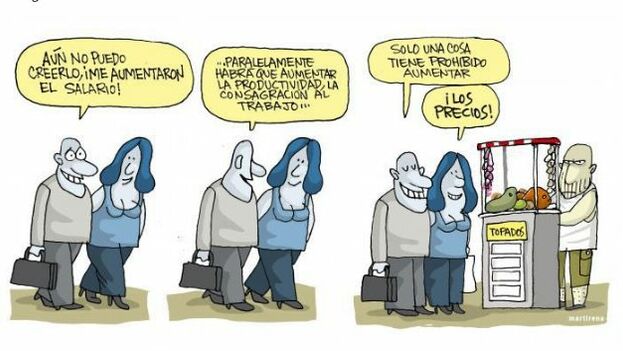
Not even three days passed and the onslaught against individuals has risen. This Thursday, the official organ of the Communist Party published a long article signed by Luis Toledo Sande on the salary increase announced this June. As an illustration, a vignette shows two smiling state employees commenting on the benefits of the new salary with phrases that nobody anywhere, in their right mind, would say. An example: “…in parallel we will have to increase productivity, dedication to work…”
The official newspaper ‘Granma’ published a vignette that shows two smiling state employees commenting on the benefits of the new salary. Panel 1: I still can’t believe it, they raised my salary. / Panel 2: …in parallel we will have to increase productivity, dedication to work… / Panel 3: Only one thing is forbidden to rise. Prices! / Sign on stand: Price caps (Granma)
The two workers are painted in a bluish shade, dressed as officials, and walk together to a stall selling agricultural products with a sign reading “price caps.” Behind the counter, the merchant is drawn in a very different way. With greenish-yellow skin, the face of a criminal recently escaped from prison and attired in a way that tries to ridicule him and make him appear vulgar; in short, the self-employed person looks like the bad guy in the scene.
The text reinforces the attack, as it includes a tirade against economists and academics who have sounded an alert about the dangers of capping the prices of products and services. In response to them, although he mentions no names, the author warms that “it is not accidental that they try to sow doubts and uncertainties against the current increases,” and their advice not to try to regulate the market so drastically is only a “liberal confusion,” according to Sande.
The text leaves a bitter aftertaste because it gives the impression that everyone who is against the imposition of capped prices for private transport, drinks in private cafes and agricultural markets is, at least, an enemy of the homeland. This thesis, together with the Manichean cartoon vignette that heads the article, is a calculated and visceral attack on entrepreneurship.
“We are not going to go back or stop, nor allow stigmas and prejudices towards the non-state sector,” Raúl Castro said two years ago insisting on an idea he had already outlined previously. But it is not enough to say it from time to time to demonstrate a good attitude towards the private sector. The facts, the treatment that is given to the self-employed people in the press and even the way in which they are shown graphically reveal more than the slogans.
If we let ourselves be carried away by what the Cuban newspapers publish, it could be concluded that the government continues to look on private businesses with animosity. For the authorities, they are an evil, although a necessary evil.
________________
The 14ymedio team is committed to serious journalism that reflects the reality of deep Cuba. Thank you for joining us on this long road. We invite you to continue supporting us, but this time by becoming a member of 14ymedio. Together we can continue to transform journalism in Cuba.
None of these Cubans voted in the 1976 constitutional referendum but all of them had the chance to do so in 2019. (Borja Garcia de Sola Fernandez)
14ymedio, Reinaldo Escobar, Havana, August 8, 2019 — If we accept the convention that a generation spans a period of thirty years, then the so-called “historic generation” would encompass those born between 1910 and 1940. Similarly, the “generation of heirs” — also known as “the grateful generation” — came into the world between 1940 and 1970. Therefore, those who follow can be placed in the period spanning 1970 to 2000.
By the time they turn sixty in 2030, members of the last group will have reached the maximum age the current constitution allows for someone to be president of the republic. Coincidentally, at age thirty, they also are the minimum age required to hold the office.
It is likely that some of the oldest members of this group took part in the military adventures in Africa that ended in 1991. They became aware, to a greater or lesser degree, that holding religious beliefs was permissible, as proclaimed that same year by the IV Cuban Communist Party Congress. They grew up during the worst days of the Special Period, during the dollarization of the economy, the revival of farmers markets and the advent of self-employment. continue reading
This is the last generation to see, hear and read a living Fidel Castro, and to witness his decline and death. They are the ones for whom moving to another country is not beyond the realm of possibility. None of them voted in the 1976 constitutional referendum but all of them had the chance to do so in 2019. They are our millennials, adept at using new technologies and social media.
Most of them had to spend their pre-university years in schools in the countryside but those born after 1995 escaped this requirement, graduated with college degrees and are now established in their careers. This latter group spent more time with their families and are less affected by indoctrination.
They also have an overriding respect for the environment, a belief in gender equality and acceptance of all manner of sexual preferences.
Can we place our hope in this generation?
Optimists would say they do not feel the “sense of debt to the historic generation” that crippled their predecessors. They argue that this younger generation did not go through collective hypnosis under the influence of a charismatic “maximum leader.” And their exposure to social networks has prevented them from falling victim to the regime’s monopoly on information.
But pessimists would point out that these younger Cubans were born into a world they think is normal, including the state’s dominance of the state over the citizen, the one-party system, and the lack of legal avenues for disagreement and for introducing political change. According to this view, an indifference towards the nation’s problems, disingenuousness as a tool for social advancement, and the belief that “life is elsewhere” renders them incapable of being agents of profound change.
The role that this generation might play depends on the time and manner in which the much anticipated transition to democracy takes place in Cuba.
Ideally, the transformation would be occurring right now, directed without bloodshed from above. The passing of the last surviving members of the historic generation could lead to the unmasking of their successors, who are now promising governmental, partisan and institutional continuity. The long death vigil has kept the reformists in the closet and given a significant advantage to the status quo, making the advent of democracy a more costly proposition.
Confidence that those younger than fifty support such transformations today could provide a very tempting motivation to move ahead. But right now no one wants to make the first move. By 2030, however, they may have to account for the failed promises they used to justify maintaining the current system.
If one reads the pretentious National Economic and Social Development Plan for 2030 — its drafting began in April 2001 and was a ratified by parliament in June 2017 — it becomes clear that the vision of “a sustainable and prosperous socialism” is a utopian fantasy if not an outright scam.
All of those who can look back at the past and say “I wasn’t there” will have the chance to sit down and talk to both insiders and outsiders. Their hands will not have been tainted by firing squads or expropriations. The generation that inherited the problem could do that now, knowing they have the full backing of those born after 1970. Or they could wait until the millennials take the reins of power.
Those who prefer to wait run the risk that the younger generation will become impatient and raise the temperature of the national cauldron. Once they start expressing resistance — on the street, in social networks, in their local assemblies and even at the polls — to anything that slows the pace of change, social pressure will increase.
And we know how dictatorships respond to such threats.
It is not a matter of having to wait until 2030 but you can be sure that the generation of Cubans born after 1970 will witness or have the leading role in the most significant change this country will have ever seen.
_________________
The 14ymedio team is committed to serious journalism that reflects the reality of deep Cuba. Thank you for joining us on this long road. We invite you to continue supporting us, but this time by becoming a member of 14ymedio. Together we can continue to transform journalism in Cuba.
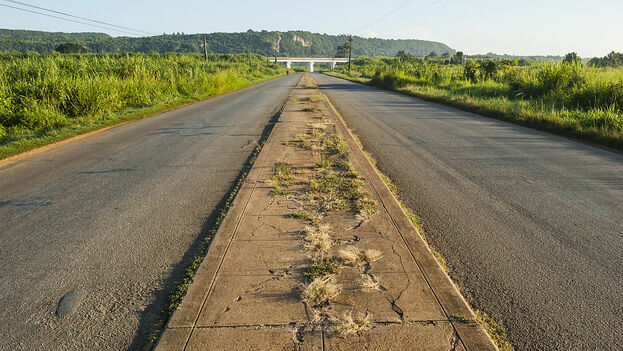
The Cuban road network covers approximately 71,138 km, of which 10,997 are of “national interest” and 2,303 of rural roads (CC)
14ymedio, Miriam Celaya, West Palm Beach, 7 August 2019 — The Ministry of Transportation (Mitrans) has once again announced a traffic program for the maintenance and supervision of roads. Far from being a novelty, this would be the most recent of the many road improvement plans that — like housing construction — have cyclically been announced in different periods after 1959 and that, for unknown reasons, after a spectacular investment program, whose real cost is never revealed, and a flood of press reports covering the development of the works in situ, have not been fulfilled in practice. They have been truncated or simply, silently, disappeared without further explanation.
Years of socialist neglect have caused the deterioration and even the destruction of numerous roads under the onslaught of natural phenomena, added to the inefficiency of the country’s sociopolitical system. The Island’s highways and roads system is experiencing its worst crisis since its construction, and its current deterioration imposes greater urgency and more resources in the midst of a new economic crisis. continue reading
The Island’s highways and road system is experiencing its worst crisis since its construction, and the current deterioration imposes greater urgency and more resources in the midst of a new economic crisis.
Now it’s the hand-picked president’s turn, whose “continuity” strategy does not leave room for optimism. But in Cuba, promoting the development of any subject is not exactly what it’s about, rather it’s about “having a development plan”. The experience of the last 60 years shows that fulfilling plans is not a priority, only the plan is an end in itself.
Therefore, though the aforementioned Roadways Program has not excelled — it does not even appear on the official website of the Mitrans, the entity in charge of its execution, nor will deadlines set for its different stages of development be known until the end of 2030 — at least in the government press, the work moves at full speed.
The data provided by sources of the Ministry of Transportation to the newspaper Granma indicate that the road network in Cuba covers a total of 71,138.5 km (44,204 miles), of which 17,168 km (10,668 miles) are classified as urban roads and about 24,000 km (14,913 miles) correspond to rural roads, with most of them considered “of specific interest” because they are owned by the Ministry of Agriculture and the Azcuba (sugarcane production) group. The same source adds that “in a general way” 24% of these routes are evaluated as “in good condition”, 37% “are in normal condition” and 39% “in poor condition”.
The figures quoted do not clearly reflect the importance rankings of the roads included in this phantom plan; however, the director of the National Road Center did report that for the period 2019-2030 ” priority investments associated with the development of the northern coastal cays areas plus the Special Development Zone of Mariel, as well as works of tourist interest and others in the economic and social field will be maintained.” He also assured that, in addition, “emphasis is placed on the improvement of road signs and activities related to the sealing of cracks, paving, milling and repair of bridges and sewers, and continue mainly on the National Highway and the Central Highway.
It is worth clarifying at this point that the so-called National Highway is a misnomer, since it does not even meet the required basic requirements
It is worth clarifying at this point that the so-called National Highway is a misnomer, since it does not even meet basic requirements, such as the absence of level intersections or crossings, with layouts allowing access to adjacent buildings directly from the road. It also does not meet the required deceleration lanes at entrances and exits, with nonexistent or diffuse and extremely narrow lateral shoulders at best, with scarce and deficient signaling system which is not consistent with high-speed traffic highways. The route lacks fences or railings that guarantee security and prevent the access of pedestrians or cattle (or other animals), among other infinite deficiencies related to the poor quality of the construction and not a few engineering errors of the original project.
The brand new “highway” does not even classify as a motorway, nor could it be compared to the marvel of engineering that was once the Central Highway, built between 1927 and 1931 under the Government of Gerardo Machado, and still considered Cuba’s most important road, extending for 708 miles through 14 of Cuba’s current provinces.
Nor does the ill-named freeway have a “national” rank since, although the project — originally devised by the now deceased Fidel Castro in his useless effort to emulate and overcome all the advances of the Republican Period — intended to build a modern high-speed road which would cross the island lengthwise in its entirety; the truth is that it only covers a total of just 597 km (371 miles) from the capital to the west, to the city of Pinar del Río, and to the east to the city of Sancti Spiritus, in the Central region of Cuba. The demise of the Soviet Union and with it the subsidies received by the Castro Regime marked the fate of a road that, to date, remains truncated.
But, returning to the issue of current maintenance and repair works whose execution is supervised by the same non-elected president, Miguel Díaz-Canel, it goes without saying that, this time, the information about the amount of the budget that will be dedicated to such commendable purpose was conspicuous by its absence. Commendable and urgent, if it were true, especially since each year the high accident rates take the lives of dozens of people and causes temporary or permanent injuries to thousand others.
Not to mention the corruption of bribing the officials responsible for ensuring the safety of all, both in the process of obtaining driver’s licenses and in the evasion of technical controls
Last June, the official radio station Radio Rebelde reported that between January and May 2019, 4,134 traffic accidents had taken place in Cuba, with a balance of 269 deaths and 3,063 injuries, “a discrete decrease” compared to the same period over last year’s numbers. However, the official version continues to consider Road Safety Code violations by vehicle drivers as the main cause of the high accident rate, which is a half-truth, because it masks the responsibility of the Government for the lousy state of roads, the precarious and defective signaling system, plus the poor technical condition of state-owned vehicles, including the ones that operate in passenger transport.
All this, not to mention the corruption through bribes to the officials responsible for ensuring the safety of all, which is present both in the process of obtaining licenses and in the evasion of technical controls — carried out by state inspectors — or fines that the traffic police should impose on offenders.
At the moment, Cuba’s current scenario is more doubtful than certain, and despite everything, the repair of roads — although also necessary — is perhaps the least of the priorities of a population where such essential issues as finding food to place on the table and housing are still pending subjects against useless plans and empty slogans.
Translated by Norma Whiting
_________________
The 14ymedio team is committed to serious journalism that reflects the reality of deep Cuba. Thank you for joining us on this long road. We invite you to continue supporting us, but this time by becoming a member of 14ymedio. Together we can continue to transform journalism in Cuba.
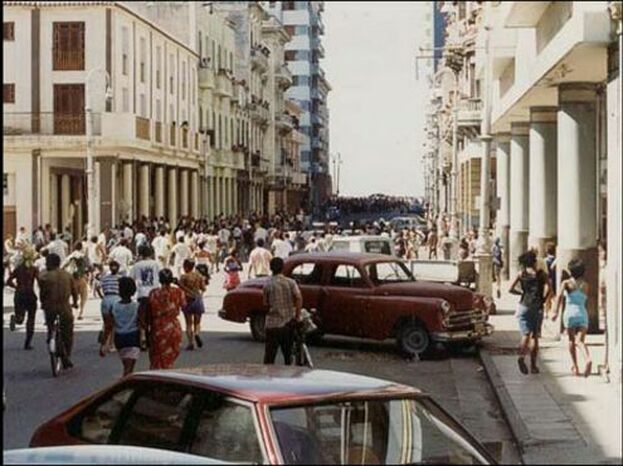
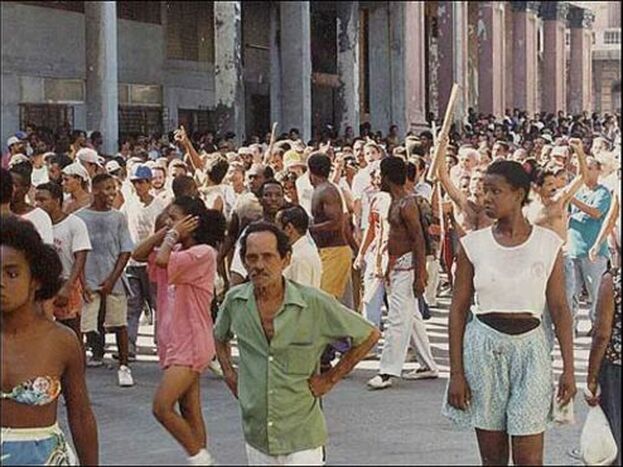
Caption 1: The popular uprising begagn on Avenida del Puerto and many people joined it along the Malecón. (Karel Poort)
14ymedio, Zunilda Mata, Havana, August 4, 2019 — “This was one of the places where more people joined,” remembers Loipa, a resident of Malecón and Escobar in Central Havana. Twenty-five years after the Maleconazo*, the events of that day have taken the form of an urban legend that older people tell and younger ones don’t know. “That fifth of August in 1994 it seemed that everything was ending,” stresses the woman.
The area has changed a lot since that social explosion that put Fidel Castro on the ropes. Calle San Lázaro near Maceo Park now has a quarter century more of deterioration, in several places entire buildings have collapsed, and “the majority of those who experienced that moment have left or have died,” says Loipa.
“I was a nurse at Hermanos Ameijeiras Hospital when everything happened,” she remembers of that Friday. “We started the day with no light and I didn’t have to work that day but I had gone out to look for some food because in the house we’d gone a week with only rice and a sauce that my mom invented with lemongrass and oregano from the ground.” continue reading
The crisis, which the government had baptized with the euphemism of Special Period, had been dragging on the lives of Cubans for several years. After the fall of the Berlin Wall and the collapse of the Soviet Union, the economy of the Island sank from the lack of fuel, the abrupt cutting of imports, and the lost of Soviet support that turned out “brutal,” according to the economist Carmelo Mesa-Lago.
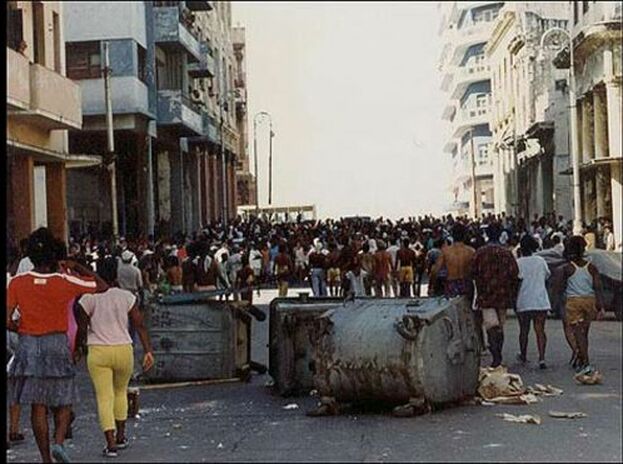
On August 5, 1994, the Cuban seaboard was witness to a popular revolt known as the Maleconazo. (Karel Poort)
That fifth of August, Loipa was unaware of what was brewing near her house. For days tension had been growing after authorities intercepted several boats sailing toward the coast of the United States. A rumor began to gain force on the street: that the Government was going to permit the arrival of boats from Florida to seek family members on the Island, just as had been done in 1980 during the exodus of the Mariel Boatlift.
“That morning my son came in the house and told us he was going,” remembers Fernando Soriano, a retiree who lives in a neighborhood “with a view of the sea,” as he likes to call it. On the avenue of Malecón and near the corner with Campanario, the now retired man is in the business of collecting beer and soda cans from businesses in the area to sell them in raw material centers and augment his pension.
A few months earlier, in an attempt to relieve the social pressure cooker, Castro had promoted self-employed work by permitting some licenses for the private sector. Thus were born the first private restaurants, the first small shops in decades that sold sweets, fried food, and pizzas in a legal manner, but the economic situation remained at rock bottom for the great majority of Cubans, trapped in a suffocating cycle of survival.
“Many people like my son went to the boat launch on the Regla wharf to see if they could go on the boats that were going to arrive,” remembers Soriano. “That filled up but the police already had surrounded the place because the residents of this area kept going down through all the streets to get to the Malecón wall in case the boats came.” In one moment the frustration erupted.
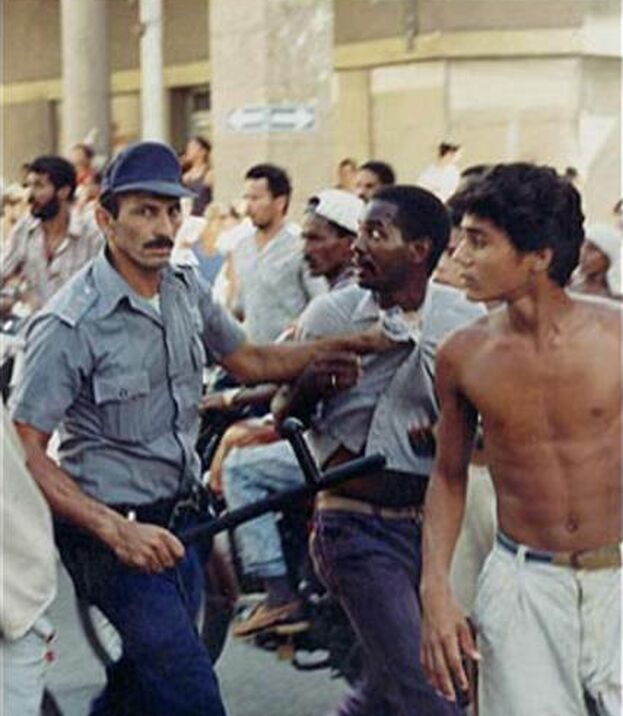
The area has changed a lot since that social explosion that put Fidel Castro on the ropes. (Karel Poort)
“The Malecón turned into a death trap, when the people came to realize that they weren’t going to let them go, the shock troops were already here,” he explains. Soriano points out the intersection of Calle San Lázaro and Belascoaín. “The Blas Roca construction contingent entered through here, with helmets and rebar in their hands, dealing out blows on all sides.”
Soriano believes that the protest didn’t turn into more because “it lacked leadership and they chose the route poorly.” He believes that “had they placed themselves in Central Havana and Old Havana and moved outward, thousands of people would have joined and then everything would have been different because it’s not the same thing to suppress a handful versus a sea of people.”
Castro had the skill of setting civilians against each other to avoid the image of uniformed soldiers hitting the population. “No one knew who was who, although I remember that those who were demonstrating looked skinnier and with more raggedy clothing,” says this Havanan.
Mesa-Lago believes that the worst year of the crisis that led to the Maleconazo was 1993, “but the crisis began in 1991,” he specifies. What was lost was not a small thing, between 1960 and 1990 the USSR injected around $65 billion into the Island’s economy. In the decade of the 80s that bulky subsidy generated a “golden” age of Cuban socialism that some still remember today with nostalgia.
After the fall of the Berlin Wall and the collapse of the Soviet Union, the economy of the Island sank. (Karel Poort)
Ernesto was born a year after that popular revolt and now he operates a pedicab in the vicinity of where on that day his father joined a group of those who were yelling and demanding that they be permitted to leave the country. “The old man has told me some things but he doesn’t like to talk about that day because the police arrested him and put him in jail.” Years later and after leaving prison, Ernesto’s father managed to get political asylum in the United States.
“Here almost nobody talks about that, although everyone still has the same desperation to leave,” reflects the bicycle-taxi driver. “People no longer go out in the street [to protest] because it was already seen that nothing is achieved, but the Maleconazo of today is outside of the embassies,” he believes. The event has been erased from official history and every August, the media praises the birthday of Fidel Castro, on the 13th, while they silence that other day that marked so many lives.
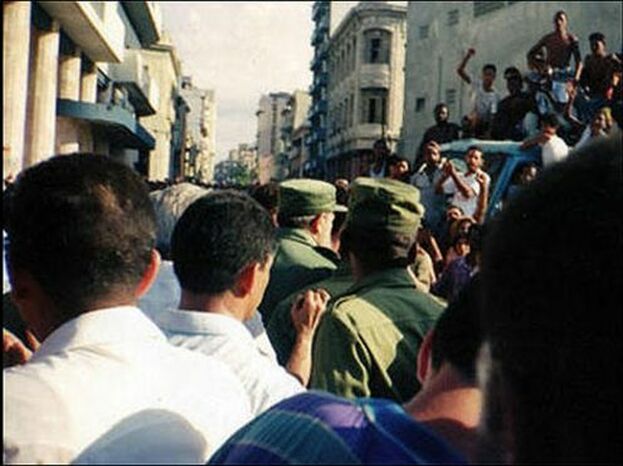
Castro had the skill of setting civilians against each other to avoid the image of uniformed soldiers hitting the population. Fidel Castro is in the green army cap center left. (Karel Poort)
The Rafter Crisis [Crisis de los Balseros] that erupted after, in which tens of thousands of Cubans embarked upon the sea, has also been erased from the anniversaries that are studied in schools and broadcast on national media.
On the same corner of Malecón y Belascoaín, one of the epicenters of the protest, now there is an esplanade where children play and at night groups of young people gather to share their dreams and a lot of rum. The adjacent building has some columns that look out on the sea, they have tried to hide the cracks with some paint.
A man rocks in a chair in the doorway while he sells paper cones of peanuts. He says that he doesn’t remember much of that day but that in the stairway of the entrance of the building “some children hid, one of them covered in blood because they had split his head.” The neighborhood of San Leopoldo, in Central Havana, was one of those that took the worst part of the suppression against the demonstrators on that fifth of August.
Cubans launched sticks and stones against Hotels like the Deauville and stores like La Época. (Karel Poort)
Propelled by frustration and rage, some of them began to break the glass windows of state-owned businesses and vandalize trash containers. “Here almost every family had a child beaten that day or who later left on a raft,” believes Soriano.
Official media broadcast the arrival of Fidel Castro to the area, like a sign that the revolt had been pacified and the Government had emerged victorious. “He only arrived when everything was already calm and the truth is that that wasn’t a happy day for anybody in this neighborhood,” says a resident of San Leopoldo who prefers anonymity and who was surprised by “all that” on the street.
But behind the official silence, the wound remains open. “I handed in my Communisty Party card a little after that, I had stopped believing in everything when I saw the builders splitting heads open and dealing out blows,” the woman makes clear.
*Translator’s note: In Spanish “azo” is an ending used to coin words and implies concepts such as “blow and hit, and also big.” In this case, added to “Malecon” it means the explosion/riot on the Malecon.
The 14ymedio team is committed to serious journalism that reflects the reality of deep Cuba. Thank you for joining us on this long road. We invite you to continue supporting us, but this time by becoming a member of 14ymedio. Together we can continue to transform journalism in Cuba.
A photo of the menu of one of the private locales that promote a combo of a domestic beer with fried food. (Facebook)
14ymedio, Marcelo Hernandez, Havana, August 6, 2019 — It took less than seventy-two hours after the imposition of price controls on beverages in privately owned Havana cafes for their proprietors to find creative ways around them. They involve menu combos that feature a soft drink with an appetizer or a dessert.
On his Facebook page the economist Oscar Fernandez posted a photo of a menu from one such business featuring a Cuban beer and an order of fried plantains for 50 Cuban pesos (or 2 convertible pesos — roughly $2 US), which makes a mockery of the the 30 peso (1.25 convertible peso) mandated price for the beverage.
A similar combo featuring an Hollandia or Heineken also goes for 50 pesos while another combo with a soft drink and dessert at the same cafe costs 25 pesos, well above the official price of 18 pesos for a canned soft drink or sparkling water. continue reading
“Two covertible pesos for a beer at a bar (and not just a privately owned one) is a reflection of a hard inequity: there is a segment of the population that can afford to pay that price,” writes Fernandez next to the photo. “The market is like a river. No matter how hard you try, you can’t grab the water with your hands. All you can do is channel it.”
The minister of Finance and Pricing, Meisi Bolaños Weiss, does not see it that way and warns in a tweet that cafe owners “should not resort to tricks to evade pricing regulations.” She added that “complaints and reports of violations should include the date and time they were observed to insure immediate and effective action.”
Since the announcement of salary increases at the end of June, authorities have urged customers to report any privately owned establishment that raises its prices.
“It took just a few days before someone figured out how to work around that restriction,” says Evelio, a regular customer at private pizzerias in Havana. He notes that many of them “are selling what they call a completa, which includes a pizza and a beer or soda, so nothing has changed.”
“I fear that soon it will be very hard to buy a cold beer in this city just by itself, without anything else.” Evelio is not surprised by this new combo fad. “Cubans are used to state stores packaging basic necessities with low-end merchandise and selling it at very high prices for Valentine’s Day or Mother’s Day.”
__________________________________
The 14ymedio team is committed to serious journalism that reflects the reality of deep Cuba. Thank you for joining us on this long road. We invite you to continue supporting us, but this time by becoming a member of 14ymedio. Together we can continue to transform journalism in Cuba.
Some parents had problems with illegible papers or errors. (14ymedio)
14ymedio, Luz Escobar, Havana, August 6, 2019 — Enormous lines and annoyance among parents marked this Monday the beginning of the sale of uniforms in the majority of municipalities in the capital. After days of waiting, uncertainty, and misinformation, Plaza de la Revolución, Centro Habana, La Habana Vieja, Regla, La Habana del Este, Guanabacoa, Cerro, and Marianao finally joined the communities of San Miguel del Padrón, Diez de Octubre, La Lisa, Boyeros, Arroyo Naranjo, and el Cotorro, which began the operation last Thursday, and Playa, which was added on Friday.
In a store called La Gloria, chosen for students from Plaza de la Revolución to buy their uniforms, the line began to form on Sunday at four in the afternoon.
“This was madness. Here in the front door of the store there was a little group that had the list. They were drinking rum and making a huge uproar. The parents who were arriving put their names down on the list, got their number, and left, but early in the morning there was even a knife fight and we had to call the police,” says a resident who everyone calls Nena and who carries a thermos of coffee in her hand from which she sells cups to others. continue reading
They had to keep the store open until midnight, due to the large number of people who had piled up on this first day in part of the capital. (14ymedio)
At eight in the morning, an hour before the opening of La Gloria, a crowd was gathered around the building. The list that had been made the previous day included the first hundred people in the line who had in their hands a ticket with a number. As the others arrived they asked “who’s last”* in the line for those “without a ticket” as they arrived.
There are hardly any children in the long line. The majority of the parents have chosen to bring a garment of their child to figure out the size and avoid a bad experience for the children. Those who couldn’t avoid bringing them, on the other hand, passed the time running around, sometimes desperate, going from one side to the other, or asking for water and food.
A slim woman comes in high heels, a business skirt, and a pearl necklace. After five minutes of waiting, leaning on a column, she takes some sandals out of her purse, puts away the heels, takes off the skirt, and remains with some shorts that she was wearing underneath. “Now I’m ready for this,” she says, and she takes off to rest against one of the walls surrounding the front door of the store after putting down a little nylon bag that she takes out of her purse. She gets comfortable, and now she is ready for a long wait.
A few minutes before nine in the morning, the manager of the store arrives and explains in detail the necessary requisites to make the purchase and all of its peculiarities. She warns that they are not yet selling high school uniforms for boys and that the voucher cannot having any corrections. She also asks the parents to carefully read the list of schools that shop there to avoid waiting in line in vain, a moment in which all of the parents check their papers to make sure.
One of the mothers is worried because the part of the voucher that indicates the sex of the student wasn’t very legible. “Here you can see that they wanted to turn an M into an F, so nothing is understood. We can’t accept that this way here,” the employee tells her. “Now you have to go to the municipality education office which is on H and 21 and get another,” she adds, to the annoyance of the woman.
The mother leaves after calling her husband, who picks her up on a motorcycle to right the wrong. She had arrived at the store at five in the morning and was among the first hundred in line, so she didn’t want to lose the opportunity. “There I had to make a big fuss for them to pay attention to me, because nobody is doing anything, but in the end I got a promise from an employee that they would send someone here with new vouchers to exchange,” she says upon returning.
An official from the Ministry of Education finally arrived, in a car and with a folder of papers, as a savior of the parents and not only gave a new voucher to that family but also to others in a similar situation. “They didn’t accept my voucher because it’s written in two different inks, imagine. The teacher’s pen ran out when she was filling out the information and I gave her mine to finish it,” explained a grandmother to the woman from the municipality. “Who would think of making a demand like that?” she complained.
Despite the incidents, the sale began punctually, at nine in the morning. At two tables, placed at the entrance to the store, workers took information from parents, who then passed inside to make the purchase. At the counter two very young girls, with white t-shirts with the face of Che, were in charge of sales, while a boy helped to take out and organize pieces from the storeroom.
At a rate of five minutes per person, at midday some 40 people had already made their purchases. However, the feeling was that it wasn’t advancing, and only after two in the afternoon were they able to organize the second part of the line, those who had no ticket. One of the mothers got everyone in a line and handed out a hundred new numbers to guarantee order and prevent cutting.
The list that had been made the previous day included the first hundred people in the line who had in their hands a ticket with an identifying number. (14ymedio)
At four in the afternoon, after eight hours of waiting, a grandmother sadly came out of the store. “I wasn’t able to buy anything because my grandson is starting first grade and she says that it’s only for the first ones,” explained the woman, who had missed the moment in which the manager had warned of that detail.
“You wait there, that is outrageous, why couldn’t they make an exception for you, an older woman? Now you have to come another day and wait in line, that cannot be,” yelled an older man who was accompanying his son. “I can’t sell to her on that voucher, because later when they do the audit, I’ll be the one with the problems,” explained the manager to the man who, despite everything, managed to extract from her the promise that, when sales to the second group begins, the woman will not have to wait in line again.
After an entire day in line, some parents began to sketch out ideas to solve the yearly disaster in sales of school uniforms. “The best thing would be to get rid of them, let each student come in dark pants and a light sweater and the problem is over,” said a mother. “I’m 41, and in my high school they gave out the uniforms in the school’s storeroom, where they gave you your books. And there were never problems, if they were missing a size they asked for it and it’s done, if they did that now they would get rid of a few problems,” says another.
At eight at night the parents who had come at eight in the morning were coming out with their purchases, although some no longer found the size they were looking for. Those who had arrived at nine or ten in the morning still had two hours of waiting ahead of them. The store was selling up until a few minutes before midnight. Today, in front of the store, the view is the same, hundreds of parents waiting to buy school uniforms for their children.
*Translator’s note: In Cuba people join lines by asking “who’s last” and then they know who is the person ahead of them. Once the next person comes and they identify themselves as “last” they can wander off, sit down, visit with friends and so on without losing their place.
Translated by: Sheilagh Herrera
______________________
The 14ymedio team is committed to serious journalism that reflects the reality of deep Cuba. Thank you for joining us on this long road. We invite you to continue supporting us, but this time by becoming a member of 14ymedio. Together we can continue to transform journalism in Cuba.
Raúl Castro and Díaz-Canel, Ramón Machado Ventura and Ramiro Valdés (photo: rtve.es)
Cubanet, Miriam Celaya, West Palm Beach, United States, 2 August 2019 — On July 30th, the digital edition of the Granma newspaper published yet another of the usual hodge-podge stew texts we are so used to, in which the term “mercenary” (through Wikipedia), the crisis of Venezuela, the Helms-Burton Act in its Third Chapter, the recent report on Venezuela prepared by Michelle Bachelet, the United Nations High Commissioner for Human Rights, which the autocrats of the Palace of the Revolution have found so hard to swallow, and – finally as a main course – the “stateless” in Cuba who, “by vocation” and even for chump change (…) lend themselves to any shady deal against the country that saw them draw their first breath”.
This time the official regurgitation would be perfectly inconsequential, except for its timing, in the midst of a true offensive against independent journalism and autonomous groups of the civil society. Also, by the prosaic manipulation of facts and terms with the sole purpose of conditioning public opinion in favor of an eventual raid against all public action that they deem adverse, it is punctually directed against the “traitors, stateless and ill-born mercenaries”, who have had the inexcusable audacity of exercising their legitimate right to request the presence of the United Nations High Commissioner for Human Rights and its observers in Cuba, as well as the preparation of the corresponding report. continue reading
In this regard, and putting aside the fact that Cuba is a UN member country, the Castro scribe says “that these reports come with the script and writing of the US Department of State and it is worth noting that all these infamies have crashed against Cuba in the presence of truth (…) and with the dignity of a whole people that knows how to identify, fight and defeat its enemies, be they internal or external ”.
Because the Plaza de la Revolución has an instrumental and bipolar vision of the international organizations to which it belongs: they are legitimate if they condemn the Embargo (“blockade”, as they call it), but they are spurious if they denounce the excesses of Castro’s power or that of their allies.
But not because it’s overused is the official strategy less perverse, especially when all the setbacks suffered in recent times by the cream of the crop of regional progress -today almost folded into Havana’s Palace of the Revolution and the Palace of Miraflores in Caracas -is added “the betrayal” of someone who was assumed until the day before, and not without foundation, to be a reliable ally, tolerant of the dictatorial excesses of her leftist friends, socialist Michelle Bachelet. Good times are definitely not here for the Castro regime’s “progressive” millionaires, and they prepare to defend their power, their lair and their privileges with equal intensity.
Thus, although neither the international organizations attached to the United Nations nor Bachelet herself in her years as President of Chile have ever given due attention to the demands of Cuban civil society and to allegations of human rights violations in Cuba, the dictatorship prefers to shield itself inward, just in case. And since the elders of the Historical Generation are running out of health or biological time to continue to face displeasure or to fight “battles” — even less so now that the adversaries are the current generations of Cubans who have taken the pleasure of feeling like citizens and not plantation slaves — their beneficiaries and scribes have the sacred mission of stepping out.
They are, paraphrasing Granma’s servile scribe, the true mercenaries of vocation (himself included). Or perhaps it is more accurate to call them insignificant low-cost mercenary slaves. It is they who function as verbal minions against Cubans who, for dignity and for their love of Cuba, have the courage to rebel against the dictatorship, it is they who bark “emboldened” because they feel protected by the landlord, they are also the ones that live on crumbs and “sell their soul to the devil” for travel and small perks and those who “lend themselves to the most vile actions against their fellow citizens.” If it were not for the poison he extracts and the danger that he contains, we almost would have to thank the reporter for the accuracy of the self-portrait.
And it is not that too many expectations need to be made about an eventual (and practically unlikely) incursion of the UN High Commissioner in Cuba, starting with one insurmountable obstacle, the dictatorship would not allow it. But the initiative is worthwhile, not only because Bachelet’s functions include attending to the claims of those who have been systematically violating basic human rights for 60 years, but because every civic front in Cuba undermines the foundations of totalitarianism, and sets precedents for the civic rebirth of Cubans.
The Scribe lord, mercenary slave of the Granma libel, does not understand, and neither do his masters understand that those of us who signed that letter that so much frightens them are not traitors or stateless, but quite the opposite. They do not understand, in their infinite stubbornness, that more and more Cubans than they can imagine are not “we are continuity”. We are rupture.
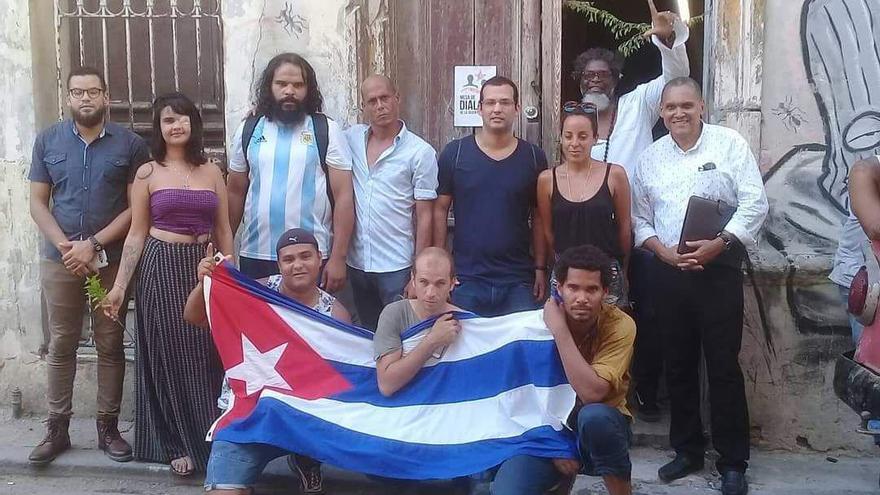
 14ymedio, Havana, 14 August 2019 — A new challenge has been born in social networks. This time it is not about taking pictures lining up to buy chicken but uploading an image that contains the Cuban flag. With the label #LaBanderaEsDeTodos (The Flag Belongs to Everyone), the aim is to claim the non-partisan or ideological character of the national banner, weeks after a Law of Symbols that strictly regulates its use went into effect.