Cuba 2017: Waiting for a Miracle / Iván García

Source: Remezcla

Ivan Garcia, 2 January 2018 — When the old Soviet-era truck was parked in front of a pharmacy in Havana’s La Víbora neighborhood, a line of more than thirty people soon formed to acquire some of the medicines unloaded. Nearby, at the entrance of a produce market, dozens of retirees and housewives waited to buy tomatoes.

In the last week of the year, on the busy Calzada Diez de Octubre, a crowd walked with elbows out loaded down with food. If you ask any of these people about the 1.6% economic growth announced by the regime in 2017, future strategies or their assessment of the rulers, you will find a wide range of responses, from disappointment in the state of affairs to indifference and frustration because nobody listens to them.

“What? The economy grew? That’s a story, partner. It grew for them. Where is that growth hidden that nobody sees it? There are lines everywhere, a total lack of some medicines and others where there’s not enough. Everything is a balloon,” says Armando, a carpenter, who has been waiting for an hour to buy Enalapril for his medical treatment. continue reading

The year 2017 started with bad news. In 2016, the Cuban economy had contracted, with GDP shrinking 0.9%, announced Ricardo Cabrisas, Minister of Economy and Planning. And the international scene looked ugly. Against all odds, Donald Trump, won the elections in the United States and the pact between President Barack Obama and the Cuban authorities began to take on water. In Venezuela’s Miraflores Palace, the brotherhood of ’Bolivarian’ compadres was clearly governing like a dictatorship. But the state oil company PDVSA is unable to produce higher oil shares and has had to make cuts that affect the Island.

“That is the key reason why Cuba is facing a dead end. The honorable thing is to throw all that nonsense of five-year plans and triumphalist speeches in the trash and undertake a deep economic reform. Communist nations like Vietnam and China initiated it and achieved an economic miracle,” says Ernesto, a scholar of the Cuban economy.

For his part, Carlos, a sociologist, believes that “one of the country’s biggest problems is its extravagant double currency system that transforms wages into a joke. That financial absurdity causes a flat screen TV to cost twenty times the salary of a professional; it means that agricultural production does not take off; it deforms the state accounting and causes a million people or more to dream of leaving their homeland for good.”

On Thursday, January 12, 2017, Obama repealed the wet foot/dry foot policy and the special program granted to Cuban doctors who could settle in the US any time they wanted. The possibility of stepping on American soil and starting a better life was cut off. In the fiscal year 2016, more than 50 thousand Cubans arrived in the United States, but in 2017 the migratory flow suffered a considerable decrease, according to Marti Noticias.

Heriberto, a retired university professor, thinks that “in response to Obama’s initiatives, the government reacted defensively. In the Palace of the Revolution they are already missing him. The dynamic could be different.”

But Castro’s Cuba responded with the usual petulance, believing that all these concessions were a debt owed by the White House after decades of “imperial aggressions.” And they let the train go by. They refused to develop solid economic foundations, invigorate a broad opening to small and medium-sized private companies and begin to rehearse an authentic and democratic social model.

They bet on stupid political stubbornness, putting their heads in the sand. They paralyzed economic reforms, stopped private work and continued to control and repress those who think differently. They temporarily closed the issuing of business licenses to individuals in many endeavors, and continued to arrest their opponents and seize the equipment of independent journalists.

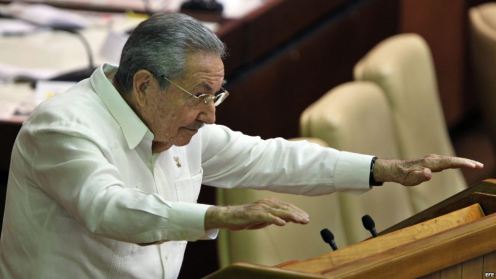
With the whole country burning down, Raul Castro wrote a letter to Vladimir Putin asking for oil aid. Speaking clearly: he suggested Putin act as the relay pitcher for Nicolás Maduro in energy matters.

“The old KGB fox is still checking accounts. Putin is nationalistic, authoritarian and likes to bang on the table and show that Russia is a center of world power. I think one of the possible scenarios could be to reuse Cuba as a source of conflicts with the United States. Whether reopening an espionage base in the style of Lourdes or a base for nuclear submarines,” argues a former official.

At the moment, the picture is black for Moscow. The US special services have reasonable evidence that the Kremlin manipulated the US election in favor of Trump, a matter investigated by a special commission led by Robert Mueller, former director of the FBI. The sale of state-of-the-art US weapons to Ukraine and a sanctions packages against Russia could be used by Putin to design his next move.

In that game of world chess, Cuba, as on previous occasions, is only a sacrificial piece. The regime knows in advance what it means to ally with Moscow. Raul Castro and his substitute (handpicked by the olive green autocracy), should handle relations with the Russian bear with subtlety.

In the summer, while it became more expensive and difficult to get food in Cuba, the AP agency unveiled a story that seemed to come out of the annals of the Cold War. In installments, AP published that more than twenty officials of the Embassy of the United States in Havana were victims of an alleged acoustic attack: stealth soundwaves that affected their hearing..

It was also learned that in February 2017, Raúl Castro had talked with US chargé d’affaires Jeffrey DeLaurentis and assured him that Cuba was not behind that sonic aggression. For the first time, the authorities allowed the FBI and other US intelligence agencies to investigate in Havana.

Although the White House has not directly accused Cuba, nor has it presented evidence of a hypothetical culprit, the affair resulted in the removal of 50 percent of the diplomatic corps accredited on the Island, and in turn, the regime had to withdraw the same amount of officials from its embassy in Washington.

This brought about a paralysis, until further notice, in the issuing of the 20,000 visas planned for family reunification. Now, those interested must travel to Colombia or Mexico and carry out the procedures there, which means a considerable increase in costs to obtain the stamp of entry to the United States. An official from the State Department, with whom I met at a Miami event, told me that the matter could be delayed for more than a year, “because every six months is when the situation of the Embassy in Havana is evaluated.”

In September, Cuba was affected by the very powerful Hurricane Irma, which for several hours sailed along the north coast of the island causing 10 deaths and considerable damage. Although the regime has not offered exact figures on the amount of the damages, a source told Martí Noticias that “it could exceed twelve billion dollars.”

Irma destroyed hundreds of houses, damaged thousands of homes and its consequences are still visible in agriculture, tourism, state enterprises, cultural facilities and private businesses. Because of the hurricane, the authorities claimed, the municipal elections for the People’s Power were delayed, contents in which about 300 dissenting candidates were considering running. Violently violating their own Constitution, State Security prevented all of these candidates from making it to the contests or being selected.

It is precisely that delay, that us the pretext offered by Raúl Castro to postpone his retirement until April 19, 2018. Meanwhile, the official propaganda works piece by piece, with homages to the deceased Fidel Castro, highlights of record figures in the production of pork and two billion of foreign investment, and pointing out that the number of tourists grew to 4.7 million. But those achievements are still not reflected on the dinner tables of ordinary Cubans.

On the contrary. Every day it is more difficult to find breakfast, lunch and dinner in Cuba. Dozens of medications are missing in pharmacies and hospitals. The quality of public health and education continue to be low. Public transport remains an unaddressed issue. And the real housing deficit exceeds one million homes. Macroeconomics is not something you can eat.

For 2018, no improvements are expected. The probable retirement of Raúl Castro does not excite people. The popular perception is that afterwards could be worse. “Cuba’s problem is systemic. One wonders if the government has a plan B to save us,” says Heriberto, a retired university professor. Will we have to wait for a miracle?
Criticism Grows In French Press For Exhibition On ’Che In Paris’

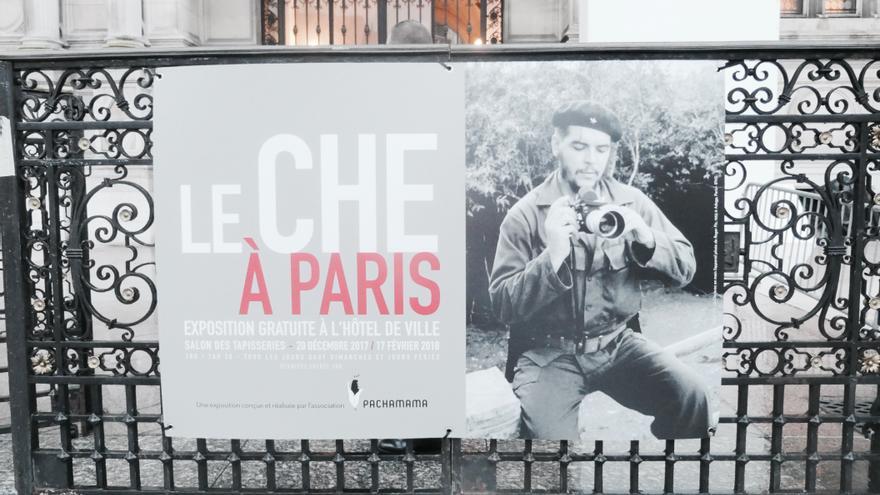
Sign on the entry gate for “Le Che Á Paris” exhibition.

14ymedio bigger14ymedio, Madrid, 4 January 2018 — The exhibition about Ernesto Che Guevara housed in L’Hotel de Ville, the Paris City Hall, is choking the institution. The critical campaign against the free show, entitled Le Che à Paris, started with the Cuban exiles in that European capital but has ended up spreading to French society itself.

The exhibition, organized by the Pachamama Association as a part of the tributes around the figure of Guevara on the occasion of the 50th anniversary of his death in Bolivia, opened on 20 December.

Just four days later, the Cuban professor and writer Jacobo Machover publicly released a letter in which he asked the mayor of Paris, Anne Hidalgo, to close the exhibition. In response, the mayor promoted the exhibition on her Twitter account, extending the controversy among French people who are critical of the figure of the guerrilla. continue reading

Hidalgo’s message on the web, which has had almost a thousand responses, said “the capital pays homage to a figure of revolution who became a militant and romantic icon.” In addition, the mayor accompanied her words with the emoticon of a closed fist.

With the exposition Le CHE à Paris, the capital pays homage to a figure of revolution who became a militant and romantic icon. See it free at  l’Hôtel  de Ville in Paris. — Anne Hidalgo (@Anne_Hidalgo) 28 December 2017
In the political sphere, criticism of the mayor spread like wildfire among her adversaries. Luc Ferry, former Minister of Education, expressed his indignation on Twitter: “Amazing, Anne Hidalgo celebrates the romanticism of Che, a bloodthirsty libertine who tortured and murdered with his own hands 130 unfortunates in the abominable concentration and torture camp he led. When will there be a tribute to Pol Pot, Béria and Mao?”

The republican deputy Valérie Boyer affirmed that the mayor of the capital was presenting herself as an “apologist for terrorism” with her words and the leader of the National Front Wallerand de Saint Just denounced the exhibition “for the glory of the Stalinist Che Guevara,” whom he described as an “ignoble butcher.”

Other criticisms against Hidalgo have come from the cultural sphere, such as the acid and ironic message on Twitter of the philosopher Raphaël Enthoven: “Magnificent, murders and romanticism in Paris. What is the value of the victims of Che against the homage of his executioner? Anne Hidalgo foresees an exhibition on Khmer tenderness titled ’Do not touch my Pol Pot.’ Here is the time of the assassins.”

On 31 December, the Cuban writer Zoé Valdés opened a petition on the Avaaz platform, which already has nearly a thousand signatories, in which she requests the intervention of the President of the Republic, Emmanuel Macron, so that the city can withdraw the exhibition.

Che Guevara was anything but a pacifist” she writes, “Today, Che would be considered a terrorist. This nefarious character does not constitute any example for youth and French citizens, on the contrary, he represents the most onerous and negative human being (…) It goes against human, civic and moral rights. Yes, I feel personally affected.”

In the press there has also been room to review the shadows of Che and reflect on the meaning of the opportunity to honor the Argentine guerrilla.

The most widely reasoned and critical article about the exhibition was published on 2 January in Slate France. It is an extensive text signed by Frédéric Martel, a fine connoisseur of Cuba, in which he asks himself in the title whether it was necessary to praise Che : “Was it necessary to remember this ‘figure of the revolution turned into a militant and romantic icon’ as Hidalgo said or should one avoid paying homage to a bloodthirsty, misogynist homophobe who has become a model for all Islamist terrorists? Because there are many Che’s.

The article details some formal characteristics of the exhibition, which he calls fake, like the official image of the show, which is none other than the iconic photo that Korda made of Guevara but with modern retouching, or a motorcycle similar to the famous Poderosa II belonging to the Argentine which in any case cannot be the genuine article (destroyed by the Latin American journey and the passage of time) but is presented as such.

According to the author, the exhibition is a succession of poor quality works without real interest, along with press clippings and some interesting photographs but ones already seen a thousand times. “The places frequented in Paris by Che (…) are illustrated by some vintage photos, the whole is a disconnected assembly, without explanation and without any allusion to Che’s crimes,” laments Martel.

The journalist reviews Che’s biography and his role in history to regret that someone like him can be honored. The critic also refers to the bourgeois origins of Guevara, a man “not predestined to rebellion or revolution,” he says.

The text ends up returning to the present to explain that today’s Cuban youth only want to leave Cuba for the USA and discredits the figures of Castro and Guevara.

“This is what will end up happening that day, when the young Cubans who remain imprisoned on the island or who cannot emigrate, burn Che Guevara’s portraits and denounce him as a simple ’son of a bitch’, all the privileged young Westerners, all the tourists who wear loose shirts with Che’s face, will understand their mistake. As those who commemorate him today will too.”

________________________________

The 14ymedio team is committed to serious journalism that reflects the reality of deep Cuba. Thank you for joining us on this long road. We invite you to continue supporting us, but this time by becoming a member of 14ymedio. Together we can continue to transform journalism in Cuba.

Group Of Cuban Exiles Rejects Paris Exhibition Dedicated To Ernesto Guevara

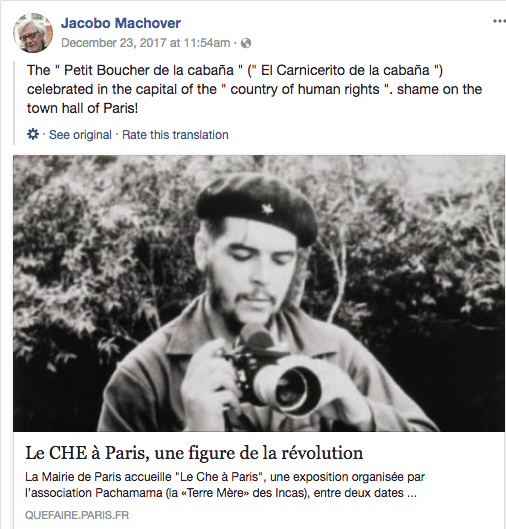
From Jacob Machover’s Facebook page: The little butcher of La Cabaña celebrated in ‘the country of human rights’….

14ymedio bigger14ymedio, Havana, 29 December 2017 — The Cuban professor and journalist exiled in France, Jacobo Machover, has published a letter of protest over the exhibition Le Che à Paris, dedicated to Ernesto Che Guevara, currently housed in Paris’s City Hall. The letter, which has already been signed by a score of people, describes the guerrilla as “one of the bloodiest, coldest, most cruel murderers of all the revolutions of the twentieth century.”

The text, broadcast on social networks, calls on the mayor of Paris, Anne Hidalgo, not to continue “sheltering in those premises, belonging to all Parisians, a pseudo-artistic masquerade that glorifies a murderer.” Machover appeals to Hidalgo to offer her “position of support for Cuban dissidence by means of a tribute to the Ladies in White at the Plaza de Hôtel de Ville [City Hall].”

The exhibition, organized by the Pachamama association, is dedicated to tributes around the figure of Guevara on the occasion of the 50th anniversary of his death in Bolivia. Its managers have used photos and documents to present the “insatiable reader, sportsman, traveler, guerrilla, Marxist who aspires to see the emergence of the new man.” continue reading

Poster of the exhibition ‘Le Che à Paris’ hosted in the City Hall of the French capital until mid-February. (PT)

The protest details, however, that Che “specialized in supervising the executions of about 200 Cubans, condemned to death by his own orders and those of Fidel and Raúl Castro,” during the first year after the triumph of the Revolution. Those executions were carried out “after a few ‘fabricated trials’ that lasted no more than half an hour, in their majority.”

“Those condemned, shot out of hand, were not war criminals but often simple soldiers who fought for what they thought was their duty,” he says. Among those executed were “even revolutionaries who believed in a democratic change, not a communist tyranny,” the letter says.

Machover, has worked for decades as a teacher, literary critic abd journalist and is the author of the book The Hidden Face of Che (2008). He is using his Facebook account as a means to protest the exhibition, calling it, “My Christmas gift to the City of Paris, as I promised,” and encouraging people to “spit on Che .”

“He himself attended the executions carried out in the fortress of La Cabaña in Havana, broadcast on television and by newsreels,” says the professor. “The Cubans, who feared him, called him “the butcher from La Cabaña” and speaking in the United Nations he boasted of his actions: ‘We shot, we are shooting and we will continue to shoot as long as necessary.”

The letter recalls other passages of the guerrilla’s biography that Cuban official propaganda and his admirers have tried to ignore. “Before the Revolution, he wrote: ‘I will slay my enemies …’ and defined the revolutionary as ‘an effective, violent, selective and cold killing machine’.”

Machover, who also describes the Argentine as a “sinister executioner,” accuses him of collaboration in the establishment of a dictatorial system that “transformed a once prosperous nation like Cuba into a human zoo for unconscious tourists.”

“He exercised his little medical knowledge to describe the trajectory of a shot that hit a supposed ‘traitor’ in the head,” wrote verses to “praise Fidel Castro,” and “was only a photographer of himself in a display of sickly narcissism,” the journalist responds to the description of Guevara prepared by the managers of the exhibition.

Machover denounces that among the organizers of the exhibition are several of those who “threatened some reporters with death during the visit to Paris, and to the halls of the same Mayor’s office, of the dictator Raúl Castro, in February 2016.” Groups whose “specialty consists of insulting and threatening Cuban opponents and exiles, both in their publications and in social networks.”

The letter concludes with a call to Parisians to boycott “that shameful exhibition and show your contempt towards that ‘so photogenic’ psychopath who only brought misfortunes to Cuba and the other countries where he fought.”

_______________________________

The 14ymedio team is committed to serious journalism that reflects the reality of deep Cuba. Thank you for joining us on this long road. We invite you to continue supporting us, but this time by becoming a member of 14ymedio. Together we can continue to transform journalism in Cuba.

The Man With The Flag Asks For Mogherini’s Help

Daniel Llorente has been deprived of his liberty for eight months, which he describes as kidnapping. (14y middle)

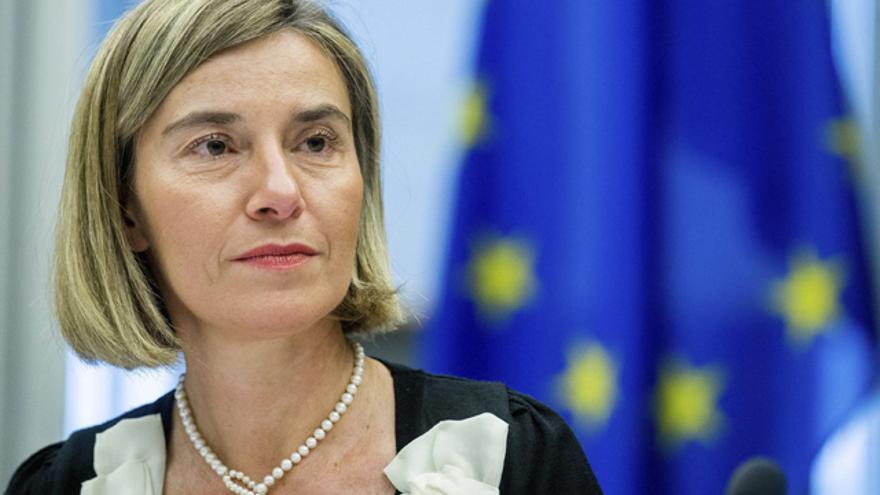
14ymedio bigger14ymedio, Havana, 4 January 2017 — Daniel Llorente, the man with the flag, has asked Federica Mogherini not to forget his case because it demonstrates “the lack of political freedoms in Cuba.” The activist who hoisted the flag of the United States during last year’s May Day parade has since spent eight months in detention including seven in a psychiatric hospital.

With the arrival on the Island of the High Representative of the European Union for Foreign Affairs and Security Policy, Llorente demands that justice be done and that he be released as soon as possible, according to a telephone conversation with14ymedio. continue reading

The head of European Union diplomacy arrived on Wednesday in Havana on her first trip since the signing of the Political Dialogue and Cooperation Agreement between the EU block and the island, which went into effect on November 1.

“I want to express to Mogherini that I am here, kidnapped, on the orders of Raúl Castro,” says the activist, who is being held at the Comandante Doctor Eduardo Bernabé Ordaz Ducungede Psychiatric Hospital, popularly known as Mazorra.

“I am grateful that she has come to our country and I thank the European Union for her interest in approaching Cuba, but always ensuring that human rights are respected,” he added.

“I am also requesting that she assess my case so that justice is done, because my social and political rights are being violated,” said Llorente, who has not yet received a medical evaluation of his case despite the repeated complaints he has made.

After several denunciations of his treatment in the independent media, the “man of the flag” is appealing to Mogherini to take “some measure” that allows “this situation to end, because the kidnapping has gone on for eight months.”

Llorente regrets that the Cuban government wants to make the world believe that he is a psychiatric patient. “No doctor has diagnosed me with a single mental disorder and no court has ruled against me.”

After eight months deprived of liberty, Daniel Llorente Miranda has come to the conclusion that the threads of his case are being handled from the highest levels of the Government.

“I accuse Raúl Castro Ruz of my kidnapping and of an abuse of power over me; if I was hospitalized I would be receiving medical treatment and that is not the case.” He adds that if he were imprisoned for a crime, then “he would have a [formal] case,” but no formal charges have been made against him nor has he been presented with a file number.

Known as the “man of the flag” Daniel Llorente has stood out for the activism he displayed, alone, after the diplomatic thaw between Cuba and the United States. His image traveled through social networks and made the covers of many international newspapers when he hoisted the flag of the neighboring country during the beginning of the last year’s May Day parade in the Plaza of the revolution. The digital newspaper The Washington Free Beacon chose him as 2017’s Man of the Year, calling him “Cuban Flag Guy.”

During the public intervention that ended with his confinement and that took place a few yards from a platform with high representatives of the Government, including Raúl Castro, and in front of the domestic and foreign press accredited on the island, the activist shouted for freedom for Cuba. As a piece of performance art, it broke the uniformity of a rehearsed choreography but lasted only a few seconds because his trajectory was interrupted by seven security agents who rushed at him and took him down him by force.

Since then he has not touched another flag of the United States other than the one he has tattooed on one of his hands, and his oppressors have managed to keep him away from the activism he performed on the streets.

Considered an opponent “on his own account,” he is characterized by his appearances at public events with the Stars and Stripes to demand a closer relationship with the neighboring country and democracy for Cuba.

The first time he publicly waved the US flag was during the reopening in Havana of the embassy of that country in 2015. The following year he did it again in the context of the visit to Cuba of US president, Barack Obama. Later he was detained for several hours after waving his flag to welcome the first cruise ship in half a century to arrive in Cuba from the United States.

Since his last arrest, which occurred on the same day as the incident in the Plaza of the Revolution, Llorente has not been allowed out in the streets for a single day. He spent the first weeks of his imprisonment in the 100 and Aldabó Prison, but at the end of May he was transferred to the Mazorra Psychiatric Hospital.

From there he went on a hunger strike, sent several letters and gave interviews to various independent media to denounce a confinement that he described as “unfair” since his case has been subject to no mediation by a court, nor is there any court decision that justifies the “post-criminal security measure” that they are applying to him.

______________________

The 14ymedio team is committed to serious journalism that reflects the reality of deep Cuba. Thank you for joining us on this long road. We invite you to continue supporting us, but this time by becoming a member of 14ymedio. Together we can continue to transform journalism in Cuba.

A Water Tank as a Sign of Prosperity

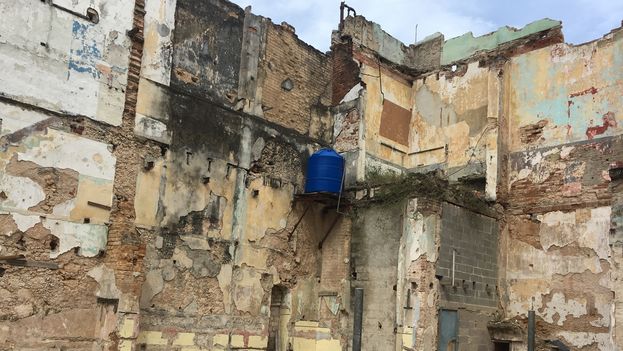
In the midst of Havana’s ruins, residents take advantage of any space to improve their living conditions. (14ymedio)

14ymedio bigger14ymedio, Marcelo Hernandez, Havana, 4 January 2017 – Building collapses and demolitions trace, in the urban landscape of Cuba’s capital city, a portrait of abandonment and desolation. The brushstrokes of time do not manage to erase all traces of human experience left in the decayed walls. However, life goes on and the need to solve everyday problems sparks inventiveness.

That institution known as “the water tank” presides over roofs and balconies. No one can remain in place without a supply from the garroted water networks that reach homes for a few hours each day or, in many cases, just a few hours a week.

With the correct lid to prevent the breeding of mosquitoes, the float mechanism that regulates its filling, a vent that allows a good outflow, the tank is a feature of mild prosperity in the midst of misery. It is like a lit advertisement that attracts glances, greed and envy. Connected to it is a “family with resources,” say the murmurs in the neighborhood.

A passing tourist cannot resist the temptation to collect the image with his camera. A prankster makes him believe that the ruin he sees is the result of “the last imperialist bombing.” But what mesmerizes the visitor’s gaze is the bright blue tank symbolizing the resistance waged in a much longer combat, the bold response of someone who refuses to concede defeat.

________________________

The 14ymedio team is committed to serious journalism that reflects the reality of deep Cuba. Thank you for joining us on this long road. We invite you to continue supporting us, but this time by becoming a member of 14ymedio. Together we can continue to transform journalism in Cuba.

Another Pandora’s Box Opens in Cuba / Cubanet, Miriam Celaya

Distribution of medicines in Cuba (file photo)

cubanet square logoCubanet, Miriam Celaya, Havana, 1 January 2018 — On 28 December 2017, the newspaper Granma published an extensive article that uncovers a serious criminal act: the adulteration of drugs detected in the Reinaldo Gutiérrez pharmaceutical laboratory, located in the municipality of Boyeros, in the Cuban capital, with the substitution of methylphenidate bya placebo, the latter an innocuous product “used for the cleaning of the machines once each production of medicines is conculded.”

The information is based on a report delivered to Granma by the Information and Analysis Department of the Attorney General’s Office, and includes a brief reference to a list of criminal acts detected during 2017, related to the theft and illicit trade in drugs in different entities subordinated to the Superior Organization of Business Management (OSDE) BioCubaFarma, with their corresponding criminal proceedings, without going into much detail.

However, in the case of the aforementioned laboratory, the scapegoats that usually accompany this type of news in the government media are mentioned, namely, a team leader in charge of the blister-packing machine, an operator, a shift manager and “stevedores of the provincial pharmaceutical retail company in the East” – that is, only the basic personnel directly related to the production process or to the handling and transportation of drugs – whom, it is affirmed, “received sums of cash totaling over 1,500 CUC.” continue reading

An insignificant figure, especially if you take into account a simple fact not mentioned by Fariñas Rodríguez in his article, but which is of major importance because of its implications: methylphenidate is a synthetic psychostimulant substance – that is, a drug – that raises the levels of dopamine and norepinephrine in the central nervous system. Because of its molecular structure, methylphenidate is similar to amphetamines, but its effects – which start approximately 30 minutes after the pill is ingested and last for several hours – are analogous to those of cocaine, although less powerful.

Thus, these criminals would extract, not the raw material of, say, the dypirones, the hypotensives or the diuretics – medicines that are scarce and in great demand among the population – but “coincidentally” a psychotropic substance… But the journalists, (piously?) overlook that detail. Could it be that on this Day of the Holy Innocents the official Cuban press tries to pull the wool over our eyes? Is it a question of deceiving the national public opinion by concealing what is clearly an illegal drug trade, that is, a drug trafficking network within the Island?

Undoubtedly, the official Cuban press is like fine lingerie: what it insinuates is much more interesting and attractive than what it really shows. The rest of the article leads into other administrative considerations, the kind absolutely not commented on in Granma, which should imply criminal consequences for others, much higher than those thugs trapped in the case and pointed out in the same old article.

So that the reader is immersed in an ocean of questions and many concerns.

Let us put forward some questions that emanate from this published article – not by the enemy press or by the spokesmen of the Empire to distort reality and damage the Revolution – but precisely by the official organ of the Communist Party of Cuba:

  • It is obvious that (at least) at the aforementioned laboratory there is no adequate control over raw materials, including those that constitute a strong potential for the development of an underground drug market in Cuba, with all that this implies;
  • Adequate quality control is not carried out with systematic and thorough randomized examinations of the batches of medicines produced in the laboratory, since indeterminate quantities of placebo went to the retail network, instead of the tablets with the appropriate components;
  • The technological records of pharmaceutical laboratories can easily be violated by unscrupulous people working in this industry;
  • The machinery of the laboratory is capable of being used at will by operators and other workers;
  • There is no effective surveillance system on the production process despite the fact that psychostimulants substances are handled which – as it is informally known – are beginning to flood many neighborhoods and very crowded areas of the Cuban capital.

At this point, it begs the question: what guarantees are there that these and other violations are not being committed in other laboratories, including the production of drugs that are exported to other countries?  Who can the parents of the children make claims to, since – according to the article –children were consuming adulterated tablets, ineffective for their illnesses? How serious and reliable can the certifications be that guarantee the production of medicines in Cuba?

How long will there be an inexcusable irresponsibility for all managers of the pharmaceutical industry and other officials related to it, from those closest to the production process up to the new president of BioCubaFarma, Mr. Eduardo Martínez Díaz and the Minister of Public Health, Dr. Roberto Morales Ojeda?

Is anyone really thinking that “the training of personnel, the sense of belonging, the ethical and moral values and political-ideological development” will be effective strategies to eradicate the crimes that in the article are euphemistically called “extraordinary events”?

Surely without meaning to, these correspondents of Granma have put their finger on a sore that, if they think about it, they might have preferred to leave hidden, because the truth is that the decay of today’s Cuban reality is so widespread and uncontrollable that it is impossible to be able to uncover a fraction of it without exposing a barrage of corruption that will splash even the most egregious feet when the crap hits the fan.

They have opened another Pandora’s box that, with all certainty, will have some sequels… perhaps some of which were not foreseen. They are the risks of the profession, even for those who exclude the commitment to the truth in order to prostrate themselves at the feet of ideologies.

Translated by Norma Whiting

Seven "Hoarders" Of Construction Materials Sent To Prison in Cuba

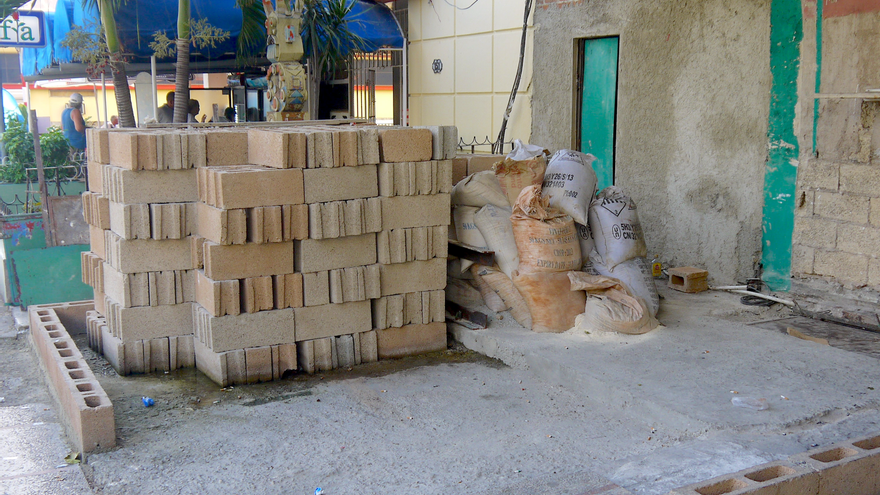
14ymedio biggerEFE / via 14ymedio, Havana, 26 December 2017 — Seven citizens from Pinar del Río province were sent to prison for the crimes of “hoarding and reselling” materials used for the construction of housing, one of the most problematic sectors of the island due to deficit of housing units and poor state of the housing that does exist.

The condemned bought and resold materials, specifically cement and steel bars that the State offers at partially subsidized prices. Three of them were sentenced to one year terms while the others were sentenced to 10 months, according to reports in the state newspaper Juventud Rebelde.

“Given the growing need of the population in terms of construction and improvement of the housing stock, it is necessary to be energetic and rigorous with those who, in an unscrupulous and opportunistic manner, profit from the needs of others,” the article said. continue reading

Among the goods seized in the searches were 1,697 bags of cement, 175 steel bars, 120 cement blocks, 11 LED lamps, 11 bulbs and a yard of gravel, which the resellers offer for double or triple their initial values.

The police have detained other citizens of the province for the same reasons, and they will be placed “at the disposal of the courts.”

The housing deficit is one of the most sensitive social and economic problems on the island, where more than three generations often coexist in the same household.

According to official data, at the end of 2016, Cuba registered a deficit of over 880,000 homes throughout the country, which currently has a total of 3.8 million homes. Furthermore, the housing stock is generally deteriorated and plagued with critical problems in large cities such as Havana and Santiago de Cuba.

In addition to the aging of the houses and the shortages at the points of sale for construction materials, the damages caused by the hurricanes that frequently hit the country add to the problems.

In the parliament’s last plenary session of the year, held last week, it was reported that on the island there are still more than 239,800 damaged dwelling units due to hurricanes such as the recent Irma, which left millions in losses after its passage last September.

President Raul Castro has insisted on a search for “agile” solutions to this deficit, which the Government tries to alleviate with a program of local production of materials to build homes, an approach almost paralyzed after the collapse of the Soviet Union in the early 1990s, but which in recent years has begun to show a slow rebound.

Since 2012, a policy of subsidies for the repair and building of homes has been in effect in Cuba, which has benefited 345,090 people with 115,030 grants.

In this way, 62,485 homes have been completed, and another 52,545 are in progress.

___________________

The 14ymedio team is committed to serious journalism that reflects the reality of deep Cuba. Thank you for joining us on this long road. We invite you to continue supporting us, but this time by becoming a member of 14ymedio. Together we can continue to transform journalism in Cuba.

Mrs. Mogherini, We Are Still Without Freedom

Federica Mogherini and Cuban Foreign Minister Bruno Rodríguez on a previous visit of the High Representative of the EU to Havana. (EEAS)

14ymedio bigger14ymedio, Yoani Sanchez, Havana, 3 January 2017 – Is a ship that has had all its parts replaced still the same ship? The question is known as Theseus’s Paradox and illustrates the European Union’s dilemma with Cuba: Does a dictatorship that moderated its diplomatic language, tried to make peace with its enemy and lost its personality cult leader continue to be a dictatorship?

The promoters of rapprochement between the European Community and the Plaza of the Revolution intuit that the planks added to the ship of Castroism have ended up changing its nature. This confidence in the renovation experienced by any political process over time, the arrival of new actors, and adaption to the international context are what bring Federica Mogherini to the Island on Wednesday.

The High Representative of the European Union for Foreign Affairs and Security Policy begins a two-day official visit to advance the bilateral relationship after the signing of the first agreement between the EU and Cuba. However, the rush to strengthen relations and the intention to cede first and demand later could play a dirty trick on the most visible face of European diplomacy. continue reading

Behind the text of the agreement between Brussels and Havana that came into force on November 1, in the spirit of rapprochement, is the opinion that only with an approach to Raul Castro’s government, with solid diplomatic ties and a fluid communication channel, can the EU influence the course of the lives of the eleven million people who inhabit this nation.

With the signing of the Political Dialogue and Cooperation Agreement, the EU’s 28 member states want to resume the exchange programs and the influence that was lost in Cuba with the application of the EU’s “common position” in 1996, which conditioned relations on an improvement in the human rights situation on the Island.

However, the approach can also be read as a gesture of legitimization, an act of support and solidarity with the Cuban government. At least that is how it has been presented by government propaganda within the island, losing no opportunity to reiterate that Raul Castro’s government disagrees with the conditions regarding human rights and will not accept “interference of any kind.”

From that time until now, the national “ship” has undergone several transformations. Among them is the transfer of power between El Comandante — Fidel Castro — and his successor, by blood: El General — Fidel Castro’s brother Raul Castro. With the latter in command, there has been the promotion of “work on one’s own account,” an official euphemism with which to designate the private sector, but only on the small scale of a pizza maker, a shoe repairer, or, in the most sophisticated cases, a restaurant.

The Cuban raft has also been subject to some patches regarding immigration policy, especially when the disgraceful requirement for an exit permit to leave the country was eliminated in January 2013, a flexibilization that has not ended selective travel restrictions against activists nor has it yet returned full rights to exiles to visit their native country.

Today Cubans can contract for a mobile phone line, stay at hotels, establish cooperatives, connect to the Internet from the Wi-Fi zones installed throughout the country and request a piece of land under a leasing arrangement known as usufruct.

The death of the Great Helmsman has put an end to the delirious decisions of a man sick with power who was an obstacle on the path of normalization of relations with the EU.

However, like Theseus’s boat, it is not only the planks and navigation accessories that make up the “personality” of a ship. For the most part, the name painted on the side, the flag that flies on the mast, the destination traced by the captain and the performance of its sailors define it better than a keel, new sails or a gleaming anchor.

This country, to which Federica Mogherini arrives today, continues to be ruled as a dictatorship. The proof of this is the absence of political pluralism, the criminalization of opinion, the arbitrary arrests of opponents and prison sentences with a visible political bias, a partisan monopoly over the press, the impunity with which State Security works and the permanent vigilance over every aspect of reality.

All these tools of control become more visible when they are exercised against activists, but they also run through every detail of society and touch all individuals. Fear, the mask of simulation, opportunism and self-censorship are some of the many effects provoked by this permanent Orwellian supervision over the life of every Cuban.

This Wednesday, the ruling party will deploy its arts so that Mogherini will be unable to verify how much of the old totalitarian structure of Castroism still stands. They will do everything possible so that she does not look overboard, does not look at the horizon, does not discover that under the new paint and the cosmetic adjustments, the compass that governs this country does not yet point towards freedom.

___________________

The 14ymedio team is committed to serious journalism that reflects the reality of deep Cuba. Thank you for joining us on this long road. We invite you to continue supporting us, but this time by becoming a member of 14ymedio. Together we can continue to transform journalism in Cuba.

The Successive Deaths of the Cuban Revolution

Fidel Castro’s ashes make their way across Cuba to the cemetery where they were interred.

14ymedio bigger14ymedio, Reinaldo Escobar, Havana, 2 January 2018 — The official media are celebrating, right now, a new anniversary of what they insist on calling the Cuban Revolution. The festivities around the 1st of January, when Fidel Castro marked a turning point in the nation’s history, show all the traces of a routine that has exhausted itself with an excessive prolongation in time, and the process of a growing loss of popular support.

Even the name of the phenomenon that began in 1959 is a matter of deep discussion, having been stripped of any character of change, transformation or impulse of renewal. The Revolution has died countless times over these almost six decades, and has received another shovelful of dirt every time it disappointed, betrayed or disenchanted those who supported it in its infancy.

At the beginning, when it was presented as a liberating act that overthrew the brief dictatorship of Fulgencio Batista, that political and social upheaval aroused popular enthusiasm. The balconies were filled with flags as — with cries of “Freedom! Freedom!” — Cubans welcomed the opportunity for change. continue reading

In the first hours of that first of January of 1959 the only opponents seemed to be the former tyrant’s torturers and the vampire embezzlers who used public funds for their own benefit. The crowds took to the streets to celebrate a new dawn for the country, with the majority never imagining that the long night of authoritarianism had begun.

In a short time, the dicontented of a new nature appeared. On the list of nonconformists were those who suspected that this was “communism” disguised as a libertarian process, along with those who did not approve of the excesses of the summary trials and executions, and those who waited for a commitment to guarantee democratic elections that never came.

That first wave of the disappointed also included those who saw in galloping atheism a threat to the exercise of their religious beliefs.

From that moment on, there were different sides, moments of definition in which each person could continue to support at all costs what Fidel Castro proclaimed, or maintain the reserve that allowed them to get off the train when things did not go along the expected path.

For some, the station they disembarked from was October 1962 with the irresponsible decision to turn the island into a missile launch ramp with nuclear weapons; for others the disappointment came a year later when the second law of Agrarian Reform, decreeing that the existence of the “rural bourgeoisie” was “incompatible with the interests and aims of the Socialist Revolution,” seized even small farms and forced the farmers into state-run cooperatives.

In March 1968, the Revolutionary Offensive confiscated all remaining businesses, right down to the fried food stalls, and in August of that same year, coinciding with the Soviet invasion of Czechoslovakia, dissidents appeared in Cuba who, although still feeling “revolutionary,” were not willing to accept every kind of act on behalf of the Government.

Then came the failure of the 1970 sugar harvest that brought the national economy to the brink of a debacle; followed by the Sovietization that was consolidated five years later and that set the island orbiting around the designs of the Kremlin; then the delirious decision to participate in distant African wars; and the repudiation rallies of 1980 when the exodus known as the Mariel Boatlift took place. After a five-year period of a relative bonanza, the collapse of socialism in Eastern Europe sounded like the coup de grace for a dying process.

The firing squad execution of General Arnaldo Ochoa and several senior military officers was a severe blow for many who had insisted on seeing the setbacks of the process as errors committed by bureaucratic officials or ministers who did not know how to interpret the designs of the Commander in Chief. In the Ochoa case, the highest power showed itself with an impiety that disappointed more than one.

Others, who had retained their faith in the process until then, ended up getting off the wagon of the Revolution when they were gripped by the deprivations of the so-called Special Period or watched a relative leave during the Rafter Crisis. Many more slammed the door definitively with the Black Spring of 2003 that sent dozens of opponents and independent journalists to prison for long sentences.

Later, came apathy and fatigue. The Revolution again received “deadly blows” but this time from the hand of weariness and the exhaustion of its discourse. The rise to power of Raul Castro, through dynastic succession, meant the consolidation of the immobility of the system, and was reflected in his lack of courage to carry out the changes needed by the nation and the fear that had been installed among the ruling elite.

“This,” as millions of Cubans now call it, who refuse to use another more glorious term, is (simply) the control that a group of octogenarians seeks to impose as a perpetual inheritance on new generations. A system without a future that no longer has any vestige of that liberating cause.

The country, the nation, the Island, the fatherland no longer support an obligatory synonymity with “the Revolution.” Sixty years seems too long.

_________________________________

The 14ymedio team is committed to serious journalism that reflects the reality of deep Cuba. Thank you for joining us on this long road. We invite you to continue supporting us, but this time by becoming a member of 14ymedio. Together we can continue to transform journalism in Cuba.

Cuban Government Happy Talk About the Economy is Not Convincing

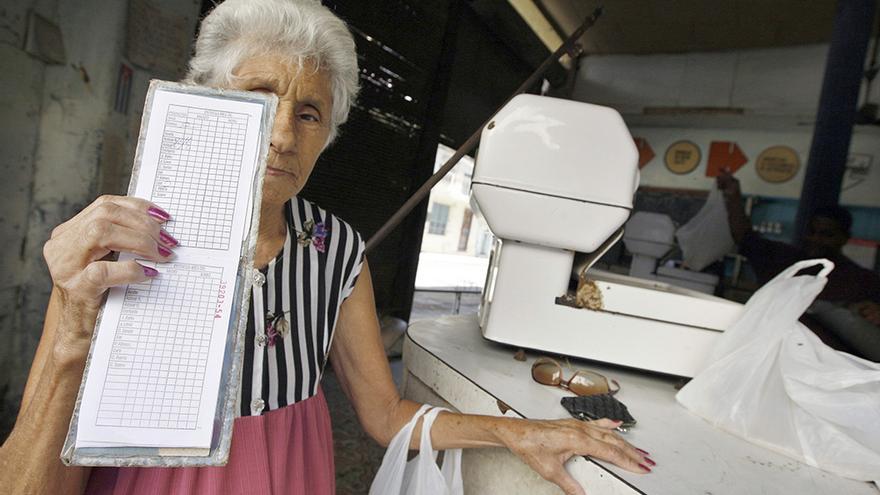
An old woman shows her Cuban ration card that every year covers fewer and fewer products subsidized by the Government. (EFE)

14ymedio bigger14ymedio, Mario J. Pentón, Miami, 23 December 2017 — Several Cuban economists consulted by 14ymedio consider the growth of 1.6% in the Gross Domestic Product (GDP) announced on Thursday by Cuban Economy Minister Ricardo Cabrisas before the National Assembly, meeting in Havana, unlikely.

Cabrisas offered a series of growth figures including numbers for construction (+ 2.8%), tourism (+ 4.4%), transport (+ 3%) and agriculture (+ 3%). The results of 2017 mark a recovery with respect to the previous year when the Venezuelan crisis led Havana to acknowledge that the economy contracted by 0.9%.

Surprisingly, the Cuban Government data are even better than those of the United Nations Economic Commission for Latin America and the Caribbean (+ 0.5%), considered by several experts as too optimistic. continue reading

“The Gross Domestic Product is not just a number, it is basically an indicator that should be reflected in the economy of individual families and should mean something about the value of what is in their pockets for daily life,” independent economist Karina Gálvez says from Pinar del Río.

Gálvez, who belongs to the Coexistence Studies Center, assures that on the Island “there is no growth that is perceptible to the people.”

“If any Cuban is asked what this growth has meant for their pockets, they will answer ‘nothing’,” the expert points out.

According to Emilio Morales, director of the Havana Consulting Group, “the performance of the Cuban economy in 2017 was bad.” Morales bases his analysis on the disastrous passage of Hurricane Irma in September, the economic crisis in Venezuela, Cuba’s main ally and benefactor, as well as the freezing of relations with the United States.

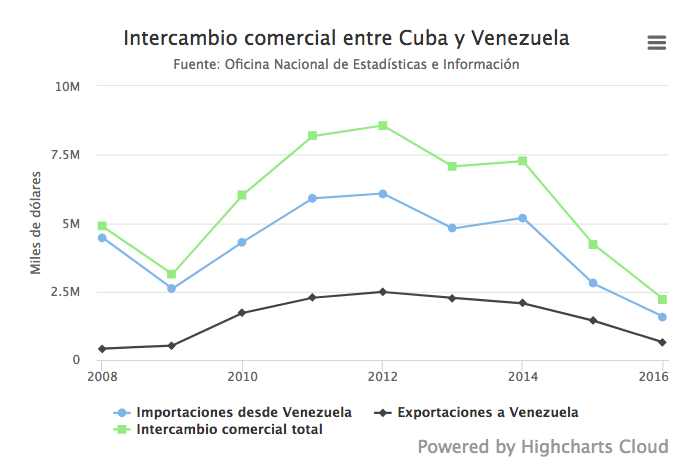
Commercial Exchanges Between Cuba and Venezuela

According to official data, the economic losses related to Hurricane Irma amount to 13.585 billion dollars. In the agricultural area there is great damage in the production of bananas and a shortage of basic products, such as eggs, is palpable, which has forced the authorities to establish contingency plans to increase production.

Morales, who is based in Miami, also points out “the decrease in exports, the low prices of nickel and sugar [in international markets] and the lack of liquidity” as some of the main problems of the Island to which he adds “the lack of payments to the usual suppliers of goods and low productivity.”

“The abandonment by the Venezuelan oil company PDVSA of 49% of the shares of the mixed company that controlled the Cienfuegos Refinery and the departure of the Brazilian company Odebrecht from the project in the sugar industry has been serious,” says the expert, who believes that the step taken by Caracas is a sample of the difficulties that the relationship between both countries is going through.

Commercial exchange between Cuba and Venezuela has reached historical lows. According to official figures, the last year (2016) it fell to 2.224 billion dollars, after exceeding 8.5 billion in 2012.

“The Venezuelan crisis has generated great uncertainty in the energy sector of the Cuban economy,” explains Morales, who believes that the Russian rapprochement is due only to a geopolitical interest and that Moscow is not willing to subsidize the Cuban economy in the way that the Soviet Union did.

Domestic fuel production has also lost steam and has been reduced to 2.8 million tons this year.

Nor is the sugar industry, another mainstay of the supposed economic recovery, living through good times. The damages from Hurricane Irma alone are calculated as losses of more than 4 billion dollars. To this must be added that this year the production plan foresaw 133,000 fewer tons than last year, already very deficient and resulting in a number comparable to that of the early years of the twentieth century.

“The recent exit of Odebrecht from the sugar industry generates a great unknown with regard to its recovery and the future of this industry in the country,” explains Morales, who believes that finding new partners is made increasingly difficult by the “financial burden and the history of defaults” on the part of the Cuban government when it comes to making promised payments to partners and lenders.

According to the economist Omar Everleny Pérez, who lives on the island, the growth figures reported by Cuba are “surprising.”

“In the first semester it grew 1%, according to official figures. I do not know what activities in the second semester could make that jump because the material production was stagnant,” says Pérez.

The export of services, the principal source of foreign currency for Cuba, thanks to the thousands of doctors, athletes and professionals working abroad, has also fallen in recent years. In 2014, the latest figure reported by the Government was 11.898 billion dollars but some experts believe that it has fallen by more than one billion dollars due to the Venezuelan crisis and the difficulties in the Mais Médicos program in Brazil, where thousands of doctors have escaped from the control of Havana, which keeps two-thirds of their salaries.

“In order to reach an adequate growth rate and start on the path of development, we need an annual growth of more than 4%, which we are still very distant from,” Pérez points out.

The economist Elías Amor, based in Spain, considers the reported GDP growth rate “false.” According to him, “the regime says that it has been achieved by tourism but this sector barely represents 6% of GDP and has no effect of pulling up the whole economy.”

“As of November, Cuba had received 4,257,754 international visitors, which reflects a growth of 19.7% over the same period in 2016,” Amor explains.

However, the growth in the number of tourists is not accompanied by greater profitability in the benefits left by visitors.

“The problem of tourism in Cuba is the low level of income received per traveler. With only $655 profit per tourist, the sector earns about half what it does in other countries in the region, and therefore appears in comparative terms as a market positioned as the lowest of all Caribbean countries,” explains Amor.

Simply growing the number of travelers without taking into account the average income per tourist is not a profitable strategy for the future, according to the economist, who points out “the high cost of investments made by the State,” such as the importing of food and other supplies, which are required to support the tourist industry.

___________________

The 14ymedio team is committed to serious journalism that reflects the reality of deep Cuba. Thank you for joining us on this long road. We invite you to continue supporting us, but this time by becoming a member of 14ymedio. Together we can continue to transform journalism in Cuba.

Cuban Observatory For Human Rights Criticizes EU for Dialogue With Cuba “Without Demands”

Federica Mogherini

14ymedio bigger14ymedio, Havana, 1 January 2018 — In a letter published on Sunday, the Cuban Observatory for Human Rights (OCDH) criticized the European Union for maintaining a “dialogue without demands” with the Cuban government. That complaint was published on the eve of the trip to Cuba of the High Representative for Foreign Affairs and Security of the EU, Federica Mogherini, who will be in Havana on January 3 and 4.

The OCDH, based in Madrid, estimates that the EU’s action with respect to Cuba “ignores requirements that are mandatory in the relationship between the Member States with the rest of the nations.”

The text, signed by the president of the OCDH, the economist Elías Amor, and the executive director of the entity, Alejandro González Raga, describes the stage that emerged as a result of the establishment of the new commercial and diplomatic framework between the EU and the Plaza of the Revolution as a process carried out “behind the backs of Cubans.” continue reading

Cuba and the European Union normalized relations on November 1, with the implementation of the first cooperation agreement between the two coinciding with renewed tensions between Washington and Havana.

The accord contemplates the possibility of suspending the agreement in the event of violations of human rights commitments and, in addition, lays the foundations for commercial relations between both parties.

Amor and González are concerned that the EU has been “dragged” to “abdicate from exercising an active influence in favor of democratization and human rights” on the island.

The text delves into what it defines as “the climate of violations of human rights in Cuba,” with “injustices and arbitrariness that would not be tolerated by the EU in any of its member states.”

“Do you know that more than 4,800 arbitrary detentions were committed in Cuba in 2017 and that there are roughly 114 political prisoners in their prisons, including prisoners of conscience like Dr. Eduardo Cardet?” the OCDH asks Mogherini.

In the face of the successive reports on violations of rights that the Observatory has sent, the office of the high representative has “come up with answers.” Meanwhile, in its annual report on Human Rights in the World (2016) it called the island “a one-party democracy.”

“A declaration that ignores political values and coexistence established in the West,” the authors of the text point out, asking if “the EU is redefining what democracy is in such a relativistic way?”

The repression against the independent candidates who tried to present themselves during the recent People’s Power electoral process is also described in the letter. “Is this what we must now understand as democratic for the European Union?” it says.

“The best and greatest good will, when it becomes voluntary and biased, can lead to huge errors,” warn Amor and González, who declare themselves “in favor of political dialogue. But not dialogue without demands, as has been established from Europe.”

The signatories of the letter conclude by saying that they do not understand “that the EU, to be present in geopolitics, has to stop being Europe; or at least abandon the values that have made it an example for the World.”

The agreement between the EU and Cuba still has to go through a long and complex process with regards to the application of all its clauses. So far, only Bulgaria, Estonia, Hungary and Slovakia have ratified the pact.

___________________

The 14ymedio team is committed to serious journalism that reflects the reality of deep Cuba. Thank you for joining us on this long road. We invite you to continue supporting us, but this time by becoming a member of 14ymedio. Together we can continue to transform journalism in Cuba.

Vietnam Uses 10,000 "Cyber Soldiers" To Fight "Bad Opinions" On The Internet

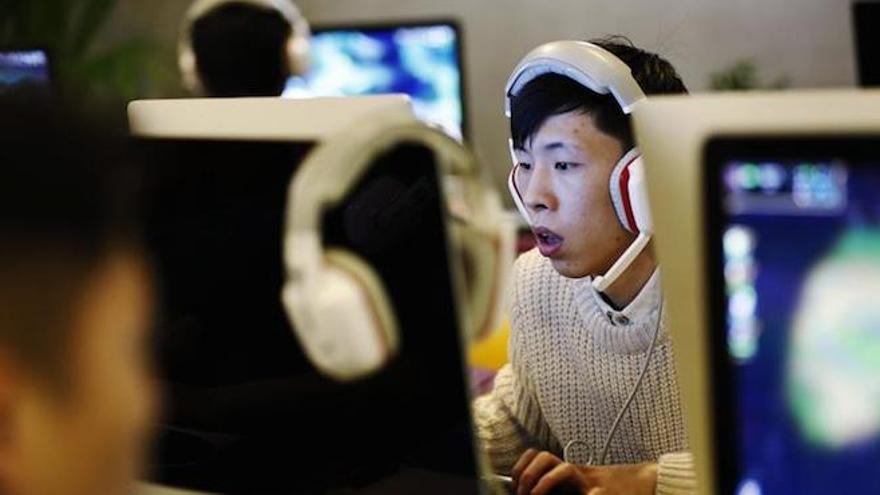
14ymedio bigger14ymedio, Hanoi, 27 December 2017 — The Government of Vietnam has created a special cyber unit of 10,000 “cyber soldiers” it has named Force 47, to combat the growing threat of “erroneous opinions” that proliferate on the Internet, according to local media, quoting Nguyen Trong Nghia, deputy director of the general policy department of the Vietnam People’s Army.

A piece of news that coincides in time with the requirement by Vietnam that YouTube and Facebook to remove content and accounts that may have damaged the reputations of the country’s leaders or promoted anti-party views.

In response, Facebook eliminated 159 accounts at the request of the Vietnamese Government, while YouTube withdrew 4,500 videos, or 90% of what the Government requested, according to news from VietnamNet that has been reported by Bloomberg.

Facebook, which has a process for governments to report illegal activities, removes content such as fake accounts and hate speech that violate their policies, Facebook said in a statement this fall.

Then CEO of Alphabet Inc., Eric Schmidt, pledged during a meeting with Vietnamese Prime Minister Nguyen Xuan Phuc in Hanoi in May, to work with Vietnam against “bad” content on YouTube, according to a government website.

On the other hand, the National Assembly is debating a cybersecurity bill that would require technology companies to store certain data on the country’s servers.

___________________

The 14ymedio team is committed to serious journalism that reflects the reality of deep Cuba. Thank you for joining us on this long road. We invite you to continue supporting us, but this time by becoming a member of 14ymedio. Together we can continue to transform journalism in Cuba.

The Magnified Danger to Castroism / Juan Juan Almeida

Raul Castro, President of Cuba

Juan Juan Almeida, 13 December 2017  — Time is an indelible and important imprint in any perspective. It is true that Cuba continues to be a country governed by a group incapable of coexisting with the opposition, beating down those who think differently, a criminal state that encourages the rupture of democracy and legality.

It is also a great truth that without Fidel Castro at the head of it, and with the bit-by-bit deaths of the historic leaders, the island loses its capacity to seduce, and today lacks the strength that allowed it to continue to be a force among certain sectors in Latin America.

The vacuum left by the largest of the Antilles is gradually being filled by the leaders of Russia and China respectively, Vladimir Putin and Xi Jinping. Both maintain a fairly aggressive line of commercial diplomacy, based on the growing importation of raw materials, loan offers, and investment agreements in infrastructure, energy and telecommunications. What should concern the US with regards to Cuba is the issue of global security. continue reading

The Maduro regime can survive without Havana. Venezuela is the main destination for Chinese investments in Latin America and Russia’s second largest trading partner in the region.

We must understand that, even with the diffuse romantic vision we have of history, Russia today is not the Soviet Union of yesterday. Moscow annulled the “Antillean Titan” when it announced the construction of an international training center in Nicaragua to provide regional training in the fight against drugs. A reasonable decision given that the Central American country has more to offer than Havana. And that’s what the Nicaraguan Vice Minister of Foreign Affairs, Luis Molina, let be known in March 2016 when he assured the Montevideo forum that his country wants to offer land to the Russians. “Of the 4.9 million hectares [12+ million acres] available in the country, only one million is being worked, the rest is waiting for the Russians …”

Nor can we say that the today’s Beijing is Mao’s China. The Asian giant has become the world’s leading economic power taking into account its gross domestic product, as well as its geo-economic and geo-strategic  presence and influence in all corners of the planet. However, the Caribbean island does not seem a priority for the golden dragon. Chinese exports to Cuba plummeted in 2017, dropping nearly 30% compared to the same period last year.

The trade between China and Bolivia is remarkable considering the volume of the economy and the Bolivian market. Chinese investments in that nation exceed three billion dollars in mining activities, construction of infrastructure and roads. At the moment, China intends to participate in the megaproject that proposes to build a way to connect the Pacific and Atlantic Oceans.

Without looking away from an island where the rights and freedoms of all its citizens are constantly violated, we should accept that, today, the regional danger is not located in Cuba but in this Russian-Chinese alliance that is emerging as a new world power with an explicit policy — with its overarching geo-influence in our hemisphere — to de-dollarize the world, to extend the use of the encrypted currency. Keep an eye on that.

Maybe it’s a bit late but I want to recall an old saying that my grandmother often repeated when I was about to make a mistake: “The best way to prevent a problem is to stop it before it is one.”

Cuban Faces 2017: José Conrado Rodríguez Alegre, Priest

Father José Conrado Rodríguez, priest of the Catholic Church in Trinidad, Cuba. (14ymedio)

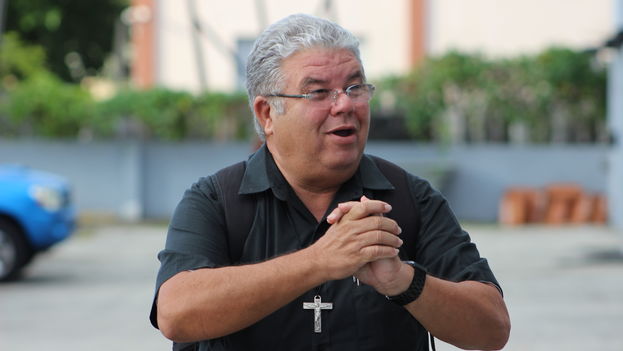
14ymedio bigger14ymedio, Havana, 30 December 2017 — More than a man who believes, the priest José Conrado Rodríguez Alegre (b. 1951, San Luis, Santiago de Cuba) is a human being who overflows with credibility from every pore of his skin.

He was ordained a Catholic priest in 1976 and since then he has managed to reconcile, without a shadow of contradictions, his devotion to the Church and his love for Cuba. He proved it in the almost 14 years that he was parish priest of the church of Santa Teresita in Santiago de Cuba and continues to do so in his new parish of San Francisco de Paula, in Trinidad, where he was sent in 2013.

In October, José Conrado presented his book Dreams and Nightmares of a Priest in Cuba at the Amphitheater of the American Museum of the Cuban Diaspora in Miami; in the book he says, “The Catholic Church of Cuba has a future of hope because despite the forces that have wanted to sow hatred in the Cuban nation, love has always triumphed.”

Among the irreverences noted next to Father José Conrado’s name in his secure police file is an open letter to the government of Fidel Castro, dated 1994, and another written in 2009 to the current president Raul Castro, as well as notes of his participation in the meetings of the Cuban Civil Society Open Forum.

Not satisfied, last July he accompanied the priest Castor Álvarez in officiating a mass at the headquarters of the Ladies in White in the Havana neighborhood of Lawton.

His pastoral work, his absolute detachment from material goods in favor of the most needy and, above all, his personal courage to conduct himself as dictated by his conscience, against all hierarchies, make this pastor a personality of the first order in today’s Cuba.

______________________________________

The 14ymedio team is committed to serious journalism that reflects the reality of deep Cuba. Thank you for joining us on this long road. We invite you to continue supporting us, but this time by becoming a member of 14ymedio. Together we can continue to transform journalism in Cuba.

Cuban Faces 2017: Karina Gálvez, Economist

Karina Gálvez, editor of the magazine ‘Convivencia’ in Pinar del Río. (Courtesy)

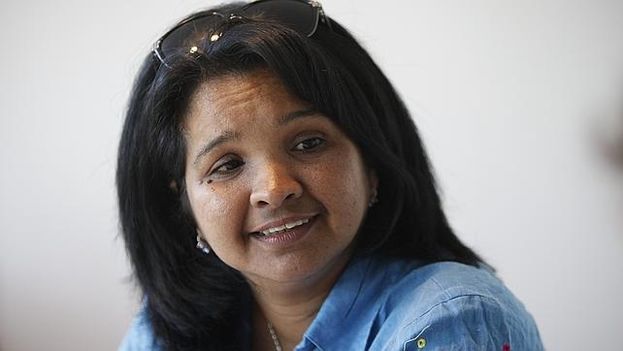
14ymedio bigger14ymedio, Havana, 30 December 2017 — For a whole decade the economist Karina Gálvez Chiu (b. 1966, Pinar del Río) has contributed to the development of the Convivencia (Coexistence) Project in a constant and effective manner. Editor, lecturer and a keen analyst of the Cuban reality, this woman from Pinar del Río born in the complicated decade of the ‘60s is one of the most visible faces of the initiative directed by Dagoberto Valdés.

Gálvez’s work as editor of an independent publication and member of the management of the Center for Coexistence Studies (CEC), has led to her frequent arrests, interrogations and threats from State Security.

In January of this year she was detained for a week in the Criminal Investigation Technical Directorate of Pinar del Río and later sentenced to three years of deprivation of liberty and the confiscation of her home, which had become a meeting place for members of the Convivencia team. In 2009, the patio of her parents’ house, where her colleagues met, had also been confiscated and closed off.

The most recent and disproportionate sanction is based on a charge of alleged tax evasion derived from the act of sale of the property. In addition, Galvez has been prohibited from exercising the right to vote or standing as a candidate in electoral processes, and has lost “the right to occupy management positions in the organs corresponding to the political-administrative activity of the State.” She is also forbidden to be “issued a passport and leave the national territory until the sanctions imposed have been terminated.”

The economist has not been imprisoned. The sentence contemplates that the term of deprivation of liberty can be served by three years of house arrest with correctional work, which she is currently fulfilling by cleaning floors in a school in the city.

_______________________

The 14ymedio team is committed to serious journalism that reflects the reality of deep Cuba. Thank you for joining us on this long road. We invite you to continue supporting us, but this time by becoming a member of 14ymedio. Together we can continue to transform journalism in Cuba.