Cubans Wanting To Emigrate See The United States As First Option / Ivan garcia

Cubans who want to emigrate prefer to go to the US

Ivan Garcia, 19 January 2017 — There are few things that spontaneously bring Cubans on the island together. For example, if the provincial team is crowned champion in the national baseball series, where, in between the infamous beer and a noisy reggaeton, in Communist Party-arranged pachangas, people celebrate at the tops of their voices.

It’s also a desire to live as well as possible in a country with the lowest salary in the third world and things for sale at the same price as in Qatar. And, God willing, to be able to travel abroad.

It’s all the same if it is for business, or a government mission, or an invitation from a relative, a friend, or a future fiancé or fiancée living in Europe. To emigrate for a fixed period of time or permanently, is an almost permanent plan on the part of many unmotivated young people or professionals who earn less than a hotel porter. continue reading

A wide cross-section of the Cuban population has it stuck in their imagination, like a postage stamp, that some foreign country ought to sort out their national disaster.

Instinctively and shamelessly, the government, Cubans in the street, trained intellectuals and dissidents, act the victim, and blame the mess on the trade embargo, the global crisis, tropical hurricanes, or the lack of help from the United States.

Any situation is held responsible for the economy not growing, not enough houses being built, the disaster area that is urban transport and waste collection and that the internet is not available everywhere.

With new measures adopted jointly by the White House and the Palace of the Revolution, abolishing the wet-foot/dry-foot policy, an inconsistent policy that Clinton enacted in 1994 which allowed Cubans who “touched dry ground” in the US to stay, the majority of Cubans have vented their anger at Barack Obama.

Let’s analyse it. Obama is a liar. He cannot publicly announce that certain migration laws exclusive to Cubans will not be changed, and then eight days before the end of his mandate, changed them.

And it isn’t that Barack is mistaken. No. He is right. Each sovereign nation designs its immigration regulations as it sees fit. The privileges for Cubans were at the very least counterproductive.

If being born in a country with a dictatorial communist government, where founding other political parties and the freedom of the press are prohibited, is a force majeure for the state which is the world’s greatest receiver of immigrants to offer an opportunity to Cubans, then it should not take any half-measures, and should defend its enacted legislation according to its ethical principles.

Democracy, opportunity and human rights are part of the pillars of American society. They should not find it difficult to safeguard them. Although, in the case of migration, it should be monitored.

A terrorist is not going to arrive from Cuba, and dangerous criminals rarely land. But sometimes there are scammers of Federal programs, people who bet on making money with the sale of drugs, or lazy intellectuals, accustomed to living in a parasitic state where natural human ambition is labelled as suspected delinquency, who abuse the support of the American government.

The wet-foot/dry-foot policy was a dangerous and badly implemented program. If you are going to receive immigrants, then receive them. Don’t make them go on a marathon by sea or land to reach the United States’ border.

That double standard of the American executive was absurd. If you want to help the hundreds of thousands, probably a million or two, who dream of emigrating, do it by safe routes.

Lotteries for visas, or, after analyzing the labour needs of different production and service areas, grant work permits. If you want to find out how many Cubans are fed up with the Castro military junta, I suggest that the White House grant a three-month extension and issue a visa to any Cuban who wants it and has no criminal history. The queues outside the embassy in Havana would be miles-long.

Sloppy regulations create a reckless mirage. Because what the letter of the law doesn’t prohibit is presumed to be permissible. That’s what happened to the policy repealed by Obama.

It’s a pity for his administration, which was certainly the most highly-regarded by the Cuban people, until it annulled the wet-foot/dry-foot policy. If you spoil a child, it will not behave reasonably later.

The United States federal government should allow the two or three thousand Cubans scattered throughout Central America and Mexico, to enter the US. Most of them burnt their boats. They sold their homes and valuable possessions. They cannot look back. They have nothing left.

The greatness of the United States is not its force, but its magnanimity. Those professionals, athletes and technicians, among others, who want to work hard to get on, should have a chance to emigrate safely from Cuba.

Some dissidents and exiles believe that after closing the immigration doors, many fellow countrymen would begin street protests demanding their rights.

It would be ideal. But I’m afraid that’s not going happen. Totalitarian States are whimsically different. If four generations of Cubans have left or have been expelled from their homeland, they can’t ask the rest to be heroes.

Most Cubans are peaceful people. They want the best for their family and to live in dignity. The Castro autocracy will fail because of its own inefficiency. But it has strength and will not hesitate to use it.

The silent mass of Cubans, who pretend to have loyalty to the regime and also yearn to emigrate, do not want to be cannon fodder. Patriotism and defence of their rights are not going to bring them together to challenge the regime.

It’s hard to accept, but it’s the way it is. They only want to emigrate. And to the United States as their first option.

Translated by GH
A Day Without Private Taxis / 14ymedio, Marcelo Hernandez

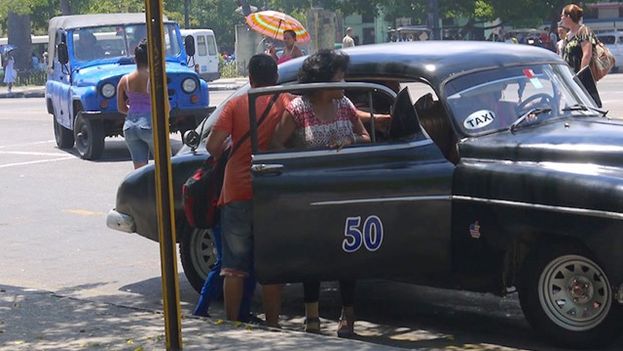
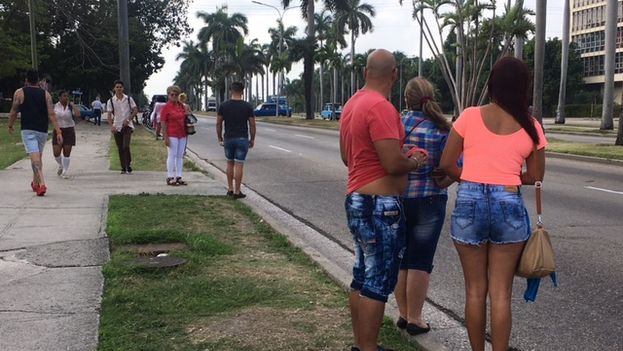
Customers wait on Rancho Boyeros Avenue for a taxi to take them to Vedado or Centro Habana. (14ymedio)

14ymedio bigger14ymedio, Marcelo Hernandez, Havana, 10 February 2017 — Without posters, lists of demands or protest demonstrations, Havana’s private taxi drivers are responding to the recently imposed fare caps. The authorities made a bold move, adjusting their previous fare caps – which the drivers got around by breaking their journeys into pieces and charging separately for each piece – to specifically apply the price controls to newly defined portions of a single trip. In response, the self-employed taxi drivers have offered a Friday from hell for Havanans trying to travel around the city.

At the edge of the sidewalk, desperately waving their arms, were hundreds of people this morning along the routes of the “almendrones” – as these shared taxis are called, in reference to the “almond-shape” of the old American cars called into service to run them. But the drivers rarely stopped on the grounds that they would only make “direct trips” between the first and last points of the journey. In this way they avoid fragmenting the payments and lowering the costs of the travel, in accordance with the new regulations.

Lacking a union to represent their demands, the drivers are trying to force the government to withdraw the pricing measure, by ensuring congestion in urban transportation. For its part, the government knows that a good share of the city’s residents need these shared taxis to get to their workplaces or schools. Without them, the country will be paralyzed.

As of yesterday, a silent pulse is developing in the streets, where right now the worst affected are the passengers.

Fidel Castro’s Ashes and Che’s Bones Compete to Attract Visitors / 14ymedio

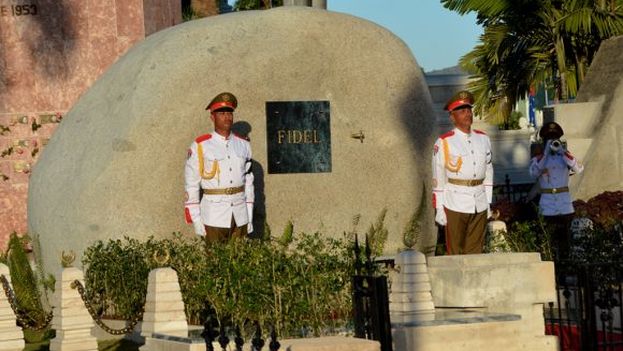
Mausoleum with the ashes of Fidel Castro, in Santa Ifigenia Cemetery in Santa Clara. (cc)

14ymedio bigger14ymedio, 10 February 2017 – The fight for popularity between Fidel Castro and Ernesto Che Guevara continues even after the death of both leaders. According to an article in last Saturday’s official newspaper Granma, some 150,000 people – both Cubans and foreign tourists – have visited Fidel Castro’s tomb in Santa Ifigenia Cemetery in Santiago de Cuba. The mausoleum was opened to the public on 4 December 2016.

For its part, the Ernesto ‘Che’ Guevara Sculpture Complex in Santa Clara, dedicated to the Argentine guerrilla who died in 1967, received a total of 374,900 visits throughout 2016. Che died in Bolivia at the hands of the Army of that country and his remains were allegedly exhumed in 1997 by a forensic team designated by Fidel Castro himself, just in time to celebrate the 30th anniversary of his assassination. continue reading

After a dubious process undertaken by Cuban doctors in Bolivia, described by Havana as a “scientific feat,” the alleged remains were brought back to Cuba and buried alongside the other guerrillas who accompanied him in his unsuccessful attempt to export the Revolution to South America. For Cuba, which was in the midst of the economic trauma of the Special Period, Che’s “return” was a much-needed injection of morale.

Despite the high number of visitors to the Guevara tomb – about 1,000 visits a day in average in 2016, including Cubans and many foreigners, especially Argentines, Italians and French – the forecasts announced by the authorities suggest that the struggle for post mortem popularity will be won by Fidel Castro.

The pantheon erected to the former president, who died on 25 November 2016 at age 90, receives an average of 2,000 visits per day. At that rate, and with the increase in visits the government predicts for the summer months, the number of visitors to the remains of Fidel Castro will reach 1 million before the end of the 2017.

Everything seems to indicate that the decision is already taken in favor of the former president. It is a political issue and the numbers do not have to be true. Nor does it matter whether Che’s remains are his or whether Fidel Castro’s ashes are really deposited in the interior of that strange artificial rock erected next to José Martí’s mausoleum.

Between 2 And 100 Cubans Expelled From Panama, According To Sources / 14ymedio, Mario Penton

Cuban migrants stranded in Colombia. (Archive)

14ymedio bigger14ymedio, Mario Penton, Miami, 9 February 2017 — A Cuban couple were deported Wednesday by the National Migration Service in Panama. Both were detained by the authorities in Guabalá, in Panama’s Chiriquí province.

According to immigration sources, the couple entered the country “irregularly.” Both were returned to Uruguay, where they legally reside. Their intention was to reach the US border.

The government office told 14ymedio that the deportations of migrants passing through Panama to reach the United States increased in January. continue reading

Last month 81 people were expelled, which means 20 more deportations than in January of 2016. Among the irregular migrants were 19 Colombians. Citizens of Ecuador, China and the Dominican Republic were also counted, with 9 immigrants expelled from each of these countries. According to statistics, only one Cuban was deported from Panama last month.

However, complaints from Cuban migrants who attempted to enter through the Darien jungle claim that there have been at least one hundred deportations of Cuban migrants on the border with Colombia.

Panama’s Director of Migration confirmed to this newspaper that access will not be allowed to Cubans, not even through the Darien Gap, a route where humanitarian posts were set up to help migrants after the border was closed on 9 May 2016.

Several hundred Cubans were stranded in Panama following then President Barack Obama’s elimination of the “Wet Foot/Dry Foot” policy on January 12th of this year.

About 200 migrants remain in the Caritas refuge center in Panama City, waiting to continue their journey to the United States or to regularize their situation in Panama.

According data from Panama Migration, in 2016 more than 27,000 irregular migrants crossed the territory on their way to the United States.

New Price Caps For Cuba’s Private Taxi Drivers / 14ymedio

An “almendrón” (fixed-route shared-taxi) in Fraternity Park, in Havana. (14ymedio)

14ymedio bigger14ymedio, Havana, 9 February 2017 — Private taxi drivers in Havana woke up this Thursday with the news of the imposition of price caps on the six most important routes served by their vehicles. The government has taken the measure so as “not to allow an increase over the maximum set prices,” according to an official note.

In July of last year local authorities decreed maximum fares for the so-called almendrones*, but the drivers responded by shortening the sections and breaking the cost of the journey into multiple parts. This week’s announcement seeks to “protect the population” from that maneuver that makes transportation expensive.

Taxi drivers who violate the stipulated fares risk being denounced by customers or surprised during an inspection. The penalty is the cancellation of the operating license under which they work and may include “confiscation of means of transport” according to the text, that is the seizure of their cars. continue reading

The measure is taken at a time when economic difficulties in Venezuela have caused it to fail to fulfill its commitments to supply oil to the island. This situation has forced the Government to reduce the volumes of fuel allocated to state entities.

As a result of these cuts, the price of oil diverted from the state sector has increased in price on the black market. From 8 Cuban pesos (CUP) per liter it rose suddenly to 15, while in the state gas stations, it is still being sold at 24 CUP a liter.

Reference prices of routes according to origin and destination, with intermediate sections are as follows:

ROUTE 1: PARQUE EL CURITA TO LA PALMA. PRICE. 15.00 CUP

  1. Departure or return from El Curita Park, up to La Calzada Diez de Octubre and Via Blanca. PRICE. 5.00 CUP, to La Vibora, PRICE 10.00 CUP and up to La Palma, PRICE 15.00 CUP.
  2. Departure or return from La Calzada Diez de Octubre and Via Blanca to La Viñora, PRICE 5.00 CUP and to La Palma, PRICE 10.00 CUP.
  3. Departure or return from La Viñora to La Palma, PRICE 5.00 CUP

ROUTE 2: PARQUE EL CURITA TO LA VEREDA, LA LISA. PRICE. 20.00 CUP

  1. Departure or return from El Curita Park, to Calzada Cerro and Boyeros, PRICE 5.00 CUP, up to 100th and 51st, PRICE 10.00 CUP, to Plaza Marianao, PRICE 15.00 CUP and up to La Vereda, La Lisa, PRICE 20.00 CUP.
  2. Departure or return from la Calzada Cerro and Boyeros, up to 100th and 51st. PRICE 5.00 CUP, to Plaza de Marianao, PRICE 10.00 CUP and up to La Vereda. PRICE 15.00 CUP.
  3. Departure or return from 100th and 51st, up to Marianao Plaza, PRICE 5.00 CUP and up to La Vereda, PRICE 10.00 CUP.
  4. Departure or return from Plaza Marianao, to La Vereda. PRICE 5.00 CUP.

ROUTE 3: PARQUE EL CURITA TO THE MILITARY HOSPITAL, PRICE 10.00 CUP

  1. Departure or return from Parque El Curita, to 21st and L (Coppelia), Vedado, PRICE 5.00 CUP, to Hospital Militar, PRICE 10.00.
  2. Departure or return from 21st and L (Coppelia) Vedado, to Hospital Militar, PRICE 5.00 CUP.
  3. Departure or return from 41st and 42nd in Playa, to Military Hospital, PRICE 5.00 CUP.

ROUTE 4: PARK THE CURITA TO SANTIAGO DE LAS VEGAS. PRICE. 20.00 CUP

  1. Departure or return from Parque El Curita, to Calzada Cerro and Boyeros or Ciudad Deportiva, PRICE 5.00 CUP, to Boyeros and Punte 100, PRICE 10.00 CUP, to Fontanar, PRICE 15.00 CUP and to Santiago de Las Vegas, PRICE 20.00 CUP.
  2. Departure or return from the Calzada Cerro and Boyeros or Ciudad Deportiva, to Boyeros and Punte 100, PRICE 5.00 CUP, to Fontanar, PRICE 10.00 CUP and to Santiago de Las Vegas, PRICE 15.00 CUP.
  3. Departure or return from Boyeros and Punte 100, until Fontanar, PRICE 5.00 CUP and to Santiago de Las Vegas, PRICE 10.00 CUP.
  4. Departure or return from Fontanar, to Santiago de Las Vegas. PRICE. 5.00 CUP.

ROUTE 5: PARQUE EL CURITA TO PARADERO PLAYA. PRICE. 20.00 CUP

  1. Departure or return from the Parque El Curita, to 21st and L (Coppelia) Vedado, PRICE 5.00 CUP, to Line Tunnel,. PRICE. 10.00 CUP, until 3rd and 70 or 31st and 60th, PRICE 15.00 CUP and to Paradero Playa, PRICE 20.00 CUP.
  2. Output or return from 21st and L (Coppelia), Vedado, to the Line Tunnel, PRICE 5.00, until 3rd and 70th or 31st and 60th, PRICE 10.00 CUP and to Paradero Playa, PRICE 15.00 CUP.
  3. Output or return from Linea Tunnel, up to 3rd and 70th or 31st and 60th, PRICE 5.00 CUP and to Paradero Playa, PRICE 10.00 CUP.
  4. Departure or return from 3 and 70 or 31 and 60 in Playa, to Paradero Playa, PRICE 5.00 CUP.

ROUTE 6: PARK THE CURITA TO GUANABACOA. PRICE. 20.00 CUP.

  1. Departure or return from El Curita Park, to Miguel Enríquez Hospital, PRICE 5.00 CUP, to the Virgen del Camino, PRICE 10.00 CUP, to Regla Cemetery, PRICE 10.00 CUP, up to Via Blanca and Corral Falso. PRICE 15.00 CUP and up to Guanabacoa, PRICE 20.00 CUP.
  2. Departure or return from the Miguel Enríquez Hospital, to the Virgen del Camino, PRICE 5.00 CUP, to Via Blanca and Corral Falso, PRICE 10.00 CUP and to Guanabacoa, PRICE 15.00 CUP.
  3. Departure or return from la Virgen del Camino, to Via Blanca and Corral Falso, PRICE 5.00 CUP and to Guanabacoa, PRICE 10.00 CUP.
  4. Departure or return from Via Blanca and Calzada Guanabacoa, to Guanabacoa, PRICE 5.00 CUP.

*Translator’s note: “Almendrón” is a term that refers to vehicles used as private fixed-route shared taxis. The word means “almond” and is a reference to the shape of the 1950s American cars that are commonly used in this service.


Invasive Marabou Weed, An Enemy That Became An Ally / 14ymedio, Bertha Guillen and Ricardo Fernandez

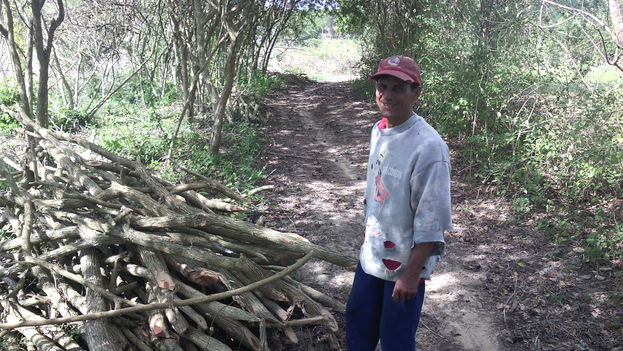
A pile of marabou branches beside the road waiting to be transported. (14ymedio)

14ymedio bigger14ymedio, Bertha Guillen and Ricardo Fernandez, Artemisa/Pinar del Rio, 9 February 2017 – When he was a boy, Jorge Luis Ledesma Herrera played around the charcoal ovens his father had built. Now, approaching 50, this Pinar del Rio man dedicates his days to a shrub that is both hated and appreciated: the invasive marabou weed, raw material for the first product that Cuba has exported to the United States in more than five decades.

Ledesma lives in El Gacho, a few miles from San Juan y Martinez, where the best tobacco on the island is grown. Also growing in the area is the spiny plant that has invaded the island since its arrival 150 years ago. Now, its hard branches provide sustenance to thousands of families across the island. continue reading

Cuba annually exports between 40,000 and 80,000 tonnes of charcoal produced from marabou, which occupies roughly 2.5 million acres of land that would otherwise be suitable for agriculture, or almost 17% of the island’s arable land.

Livestock areas have also been affected by this invasive weed that has conquered 56% of the land used for animal husbandry. The plague of threatening thorns spreads, thanks to the plant’s strong nature, but also due to the neglect and poor organization that affects the Cuban countryside.

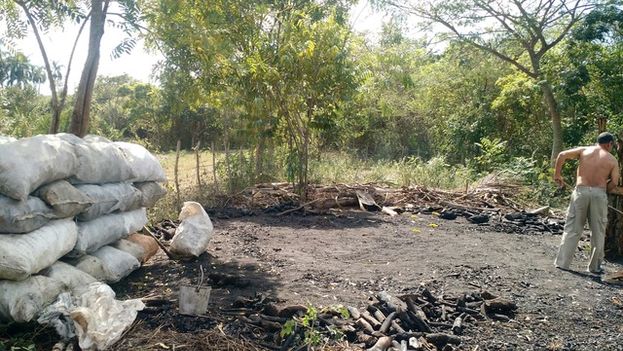
A pile of sacks filled with marabou charcoal after the dismantling of the oven (14ymedio)

The state maintains a good deal of control over land despite the fact that in recent years the cooperative sector has been expanded and land has been leased in usufruct to private farmers.

The Basic Units of Cooperative Production manage 25% of the land, the Agricultural Production Cooperatives 8% and the Credit and Services Cooperatives 38%, while state farms manage 29%, according to figures provided in 2015 during the XI Congress of the National Association of Small Farmers (ANAP).

Popular jokes praise the marabou as if it were the royal palm. They propose to replace that haughty national emblem on the Republic’s coat of arms and in its place enshrine the tangled anatomy of the invading species.

A decade ago Raul Castro joked about the repudiation of the bush during a speech in Camagüey, during the official commemoration of the assault on the Moncada Barracks. “What was most beautiful, what stood out in my eyes, was how beautiful the marabou was along the whole road,” he said after traveling from Havana to that central province.

After that harangue, the crusade against the marabou took on ideological status and became a symbol of Raul’s government, right alongside the promises of eradicating the dual monetary system, curbing corruption and lowering food prices. Shortly afterwards, enthusiasm for the battle was lost and it disappeared from the government’s list of critical projects.

In an irony of fate, the enemy plant has gradually become an ally. In 2007 the Spanish company Iberian and Solid Fuels (Ibecosol SL) began to commercialize charcoal made from marabou in several European countries. Its ability to burn slowly and the delicate flavor it adds to food has earned it a good reputation.

The earth has to be scorched first to make the oven work properly. (14ymedio)

Jorge Luis Ledesma Herrera knows these qualities well, because part of the marabou he processes ends up in his own stove. Every morning he spends hours cutting the logs that he then transports in an oxcart. His life is not very different from his grandfather’s, but he boasts of being able to count on “legal electricity” in an environment where low voltage “clotheslines” – as makeshift electrical wiring is called – abound.

He describes working with marabou as a real hell. The main limitation is the tools he has to work with. The axes and machetes are of poor quality, bought on the black market, and must be repaired all the time. With ingenuity, some have recycled blades from sugar cane harvesters to aid in cutting.

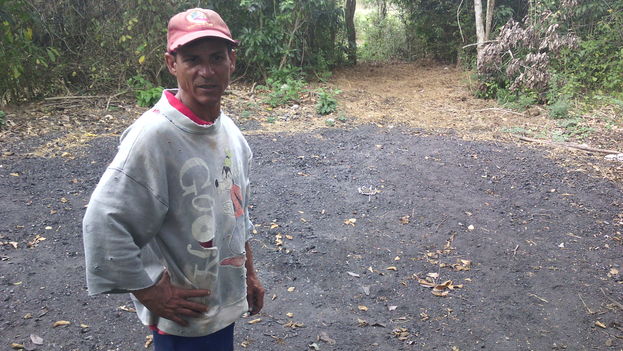
About two hundred yards from the farmer’s house is the flat ground where the oven is built. The earth is burned and looks fine, like black powder. The marabou must be heated to temperatures between 750° and 1300° F, with the wood stacked in a cone, covered over with straw and earth.

“Two months ago I took out of the oven an amount I calculated as 20 sacks – about half a tonne – and it started to rain. Although the rain only lasted a few minutes the hard coals cracked like broken glass,” he said. “I could only save five sacks.

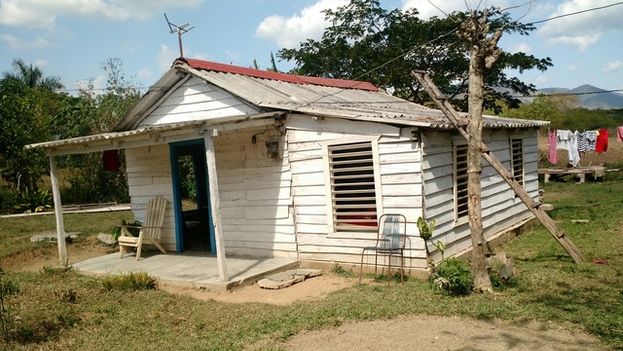
In the nearby Artemisa Joaquín Díaz, 56, has been engaged in the manufacture of charcoal since he was a child. He has been using marabou for years to cook, but now, with the news of its export, he processes it more delicately and takes greater care of the ovens. Like Ledesma, he only has access to water through a well, takes care of his personal needs in a latrine outside the house and his house has a light weight roof.

This charcoal producer in the village of Fierro, in the municipality of San Cristóbal, bears up under the sting of the rebellious shrub; like other farmers he uses gardening gloves to protect himself. Keeping his eyes away from thorns is also part of the precautions. When he prepares an oven he tries not to leave a gap between one stick and another, because “it doesn’t hold in the fire and then it goes out.” Care is essential. “As long as white smoke is coming out, the wood isn’t burned,” and it will only ready to dismantle when the smoke turns blue, which may take a week or more, Diaz explains.

In Pinar del Río, the companies that buy charcoal from the burners are the state-owned Acopio and the Integral Forest Enterprise. Payment is made through a temporary contract that allows them to be paid directly and not through the cooperatives. The charcoal-burners thus avoid the check cashing fee charged by those entities.

The house in Artemisa of the charcoal-burner Joaquín Díaz, age 56. (14ymedio)

The state pays for charcoal at 1.20 Cuban pesos (CUP – roughly 5 cents US) per kilogram (2.2 pounds) wholesale, or 30 CUP for a 25 kilogram sack. For premium charcoal they pay 0.10 CUC (roughly ten cents US) per kilogram. With luck, the producer will pocket the equivalent of 150 dollars for every tonne of best quality charcoal, which the state enterprise will sell in the United States for 420 dollars, almost three times what the charcoal-burner makes.

However, selling to the state comes with many problems of late payments. In addition, “the rigging of the process of selection and the weighing of the premium coal, makes it more reliable to sell it to private individuals,” says Ledesma. The private buyer pays 40 CUP per sack, “and many owners of pizzerias and private restaurants in Pinar del Rio” come to him to stock up.

Ledesma dreams of being able to sell his marabou charcoal directly, without going through the state as an intermediary. “If that could be done, I would buy myself a chain saw to increase production so I could change the way I live.” Of course if that were the case, he reflects, “even doctors would come here set up charcoal ovens in El Gaucho.”

Cuban-American Sues for Compensation for Property Expropriated in 1959 / EFE, 14ymedio

General view of the entrance of the port of Santiago de Cuba. (Networks)

14ymedio biggerEFE, via 14ymedio, Miami, 7 February 2017 — The Cuban-American neurosurgeon Javier García-Bengochea filed a lawsuit in US federal court against a Chinese company for building on property that he says was expropriated from his family by the Island’s government in 1959.

The civil suit, for 6.5 million euros, was filed last Friday in a local court in Jacksonville, North Florida, against the China Communications Construction Company Ltd., based in Beijing, according to court documents to which EFE had access.

The petitioner claims that he inherited the property in the port of Santiago in eastern Cuba from his cousin in 1972, although it was seized by the Cuban government in 1959. continue reading

The Government of Cuba has yet to resolve the 5,913 claims certified in the US regarding properties confiscated on the island, for a total amount of 1,780 million euros.

A first step in advancing these processes would be to activate Title III of the 1996 Freedom Act (Helms-Burton), but since its adoption Title III has been suspended, every six months, by order of Presidents Bill Clinton, George W. Bush and Barack Obama.

This clause allows Americans, even if they were not there at the time of the expropriation, to file US claims in US courts and prohibits foreign companies from “trafficking” these confiscated properties.

Garcia-Bengochea’s suit demands economic compensation from the Chinese company for “trafficking” his property in Cuba.

John Kavulich, president of the US-Cuba Trade and Economic Council, which brings together US companies interested in increasing trade with the island, told EFE that President Obama suspended the clause again for another six months on 5 January, 15 days before the end of his term.

First Group of Cuban Doctors Arrives in Miami after the End of the ‘Parole’ / 14ymedio, Mario Penton

14ymedio bigger14ymedio, Mario J. Penton, Miami, 6 February 2017 – Two dozen health professionals who abandoned their Cuban medical missions abroad arrived this afternoon at the Miami International Airport from Colombia. This is the first group to arrive in the United States after the end of the Cuban Medical Professional Parole (CMPP).

“This is a triumph for the whole Cuban American community, our organization and the offices of the Cuban American congressmen who have worked so that these guys can get the right deal, and their petitions were satisfactorily answered,” said Julio Cesar Alfonso, president of the organization Solidarity Without Borders (SSF) which supports Cuban doctors.

Yerenia Cedeno, a 28-year old Cuban doctor, characterized the situation they experienced in Venezuela as “horrible.” She escaped five months after arriving at the mission, pushed by insecurity and the precarious conditions where they worked. continue reading

“You would find out that they took the phone from this one or robbed that one on the minibus. It’s horrible,” explains Cedeno.

The doctor adds that she could not go back to Cuba because there she “would be marginalized and looked at badly.”

“They put you in another place, not in your job because they look down on you because you don’t agree with what you experienced and for what you were badly prepared,” she adds.

The doctor felt exploited in Venezuela, where she shared her work with her husband, also a doctor, who accompanied her on her trip to the United States but did not want to make a statement to the press.

Their plan is to take their little three-year old daughter who lives in Guantanamo out of Cuba and resume their studies in the United States.

“I want to work as a doctor or something similar. This is the start of a new life,” she says.

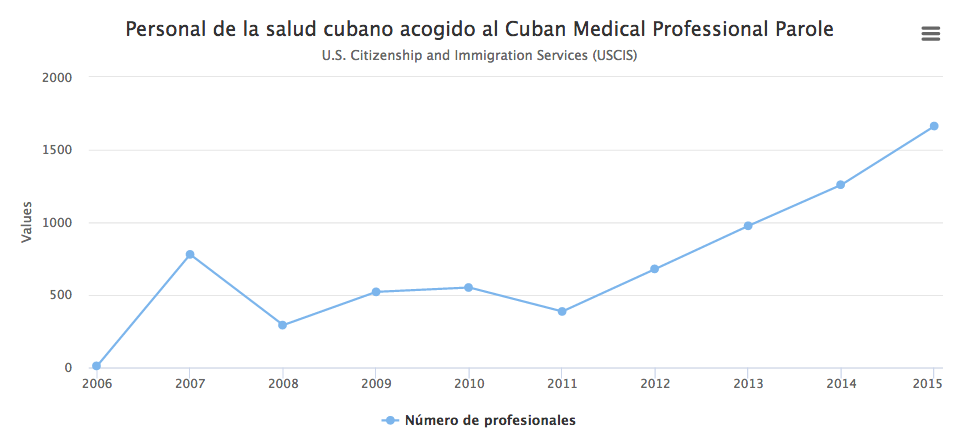
This past January 12, the then-president of the United States, Barack Obama, eliminated the CMPP, a program established under the administration of Republican George Bush that in a decade allowed the flight of more than 8,000 Cuban health professionals.

Cuban Health Personnel Received through Cuban Medical Professionals Parole


According to the non-profit organization Solidarity Without Borders, which helps integrate these doctors into the US health system, it helps those fleeing from the biggest human trafficking system in the modern history of the western hemisphere.

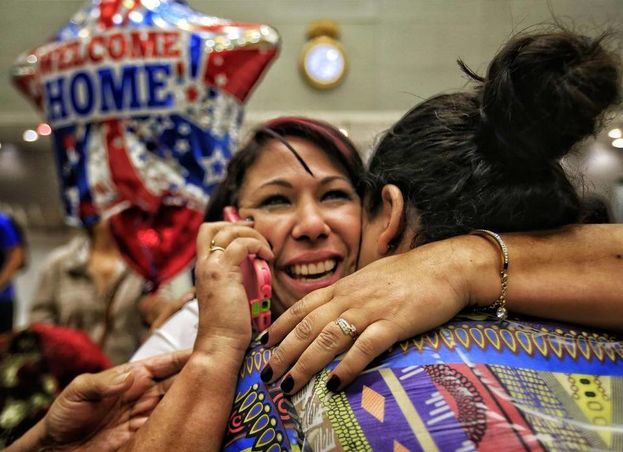
Arisdelqui Mora, a young Cuban who escaped the Island four years ago on a raft, waited for her half-sister Arianna Reyes, a Cuban doctor who escaped from the mission in Venezuela. The happiness of the reunion, which included the grandmother of both, received wide media coverage.

“We have been separated but during the whole time we remained in communication through the networks,” explains Mora to 14ymedio.

“They have worked a lot,” she adds.

Celia Santana, a dentist, only spent five months in Venezuela.

“Venezuela is much worse than my country. I never imagined that it would be like that. That country is a disaster, and of course the Venezuelan people are not to blame,” explains the doctor.

She spent five months awaiting the parole in order to travel to the United States.

“It’s absurd to end the program. They should have taken other measures,” she says.

“Cubans escape because of the economic situation and also because of the politics because they want freedom of expression.”

Mildre Ester Martinez, recently arrived in Miami, appreciates the help received through the media and the service of Solidarity Without Borders.

“I did not feel right. I was disgusted, disappointed by all the work we did there. I thank God to be here,” she added.

Maikel Palacios, health professional and spokesman for the group of Cubans, reminded that although Cuba has said publicly that they can rejoin the public health system, “they don’t let defectors enter the country for eight years.”

Health worker Veidy Diaz, from Cuba, is received by her family and friends on arriving at MIA from Colombia (NH).

Palacios also questioned the supposed good will of the Island’s government when the official communication from the Minister of Public Health did not mention the frozen bank accounts that the aid workers lose once they abandon the mission.

“They don’t talk about the money. There are people who have up to 7,000 dollars, and they lose it all the day they decide to escape,” he said.

The Cuban government appropriates two-thirds of the salary earned by the Cubans abroad. They are generally sent to the most remote places in deplorable working conditions. In countries like Brazil they do not have the right to receive their family while the aid program lasts, even though the laws of that country permit it.

Solidarity Without Borders is in the middle of a campaign to re-establish the Parole program for Cuban doctors. Currently they are working with the offices of Cuban American congressmen in order to present a proposal to President Donald Trump to reinstate the CMPP.

“We will keep working so that our colleagues may reach the land of freedom and in the near future the Parole program will be re-established for professionals who are in third countries,” explained the president of SSF, Julio Cesar Alfonso.

According to statistics from SSF more than 69 Cuban doctors have been killed in Venezuela in the last 10 years. The Cuban government has divulged that currently more than 50,000 professionals from the Island are dispersed throughout more than 60 countries worldwide.

Working conditions and political pressure push thousands of professionals to accept the missions proposed by the Cuban government. Even though the salary was increased in 2014, the average salary of a doctor in Cuba is about 60 dollars a month.

The massive exportation of health services has generated income for the government on the order of 8.2 billion dollars a year in 2014 according to official sources.

Translated by Mary Lou Keel

Police Search Home of Cuban ‘YouTuber’ / 14ymedio

14ymedio bigger14ymedio Havana, 8 February 2017 – Officers from Cuba’s National Revolutionary Police searched the home of ‘YouTuber’ and activist Alexei Gamez, in Jagüey Grande in the province of Matanzas. According to Eliecer Avila, leader of the Somos+ (We Are More) Movement, the agents entered the house in the morning and have not allowed access to family or friends.

“During the search they seized numerous appliances and the phones of all the family members,” explained Avila. Another source close to Gámez detailed that the young man was taken from his home “in police custody” and taken away in a patrol car. His mother tried to take a photo of the moment, but as a result was also arrested. continue reading

Alexei Gámez is a member of Somos+ and a self-employed worker. “He has a license that allows him to work as a motorcycle mechanic,” Avila explained. The activist is part of the Methodist community and in recent days has created a channel on YouTube to teach Cubans how to “make better use of the internet” on the island.

Under the name “Calle Mora,” the channel broadcasts advice on wireless networks and content sharing. To date it has published two videos with “alternative solutions to connect and better understand technology,” explains its creator.

Last November, Gámez was detained for seven days along with other members of the movement, after being arrested when he tried to participate in Academy 1010, a civic development initiative promoted by Somos+.

The latest video could be the cause of the police response as it details how to configure a NanoStation , a device for wireless communication widely used in alternative networks and to connect to the  Telecommunications Company of Cuba’s (ETECSA) wifi service, which is now available in more than one hundred plazas and parks in the country.

NanoStations have never been marketed in state stores, but are offered in the informal market at prices ranging from 180 to 250 Cuban convertible pesos (roughly the same in dollars). Bringing them into the country is regulated by the General Customs of the Republic, which requires the traveler to show authorization for the device from the Ministry of Communications.

Last November, Gámez was detained for seven days along with other members of the movement, after being arrested when he tried to participate in Academy 1010, a civic development initiative promoted by Somos+.

According to a report released Monday by the Cuban Commission for Human Rights and National Reconciliation, there have been 478 arbitrary arrests against dissidents. The independent entity also denounces the “seizures of their means of labor (laptops, cameras, mobile phones, etc.).”

Roof Collapse Injures Tourists at Their Cuban Wedding / 14ymedio

The Sol Río De Luna y Mares hotel, of the Meliá chain. (Tripadvisor)

14ymedio, Miami, 8 February 2017 — John and Sarah Wenham had planned the wedding of their dreams in Cuba, a country that in recent years has become a magnet for tourists from all latitudes. However, this young British couple did not suspect that their wedding would turn into a nightmare.

The Wenham saved a total of $30,000 over a period of years to get married in Cuba. They never imagined that the lobby ceiling of the Sol Rio De Luna y Mares hotel would be weaker than their love and completely collapse on them, wounding several guests, including the bride and groom.

The bridegroom has two fractured ribs and severe bruising as a result of the failed ceremony. The bride ended up with head and eye injuries. A wound on her face required 10 stitches and will probably leave a scar. continue reading

“We were just about to meet with the hotel staff to go over our wedding plans in the lobby, when John pointed to the ceiling as it started to move,” the 35-year-old bride told this newspaper.

“The was a loud bang and suddenly the roof collapsed right over us, leaving us trapped. The debris pinned us to the floor,” added the bride.

The couple’s lawyers will take legal action against the tour operator who arranged such a bitter experience for them.

The weight of the false ceiling prevented the couple from moving, amid the shouts from the crowd and the screams of Sarah’s daughters.

Other guests suffered serious injuries, including blows and wounds to their heads and spines, and broken bones. One of the guests had to have 19 stitches in his scalp.

The experience in the Holguin hotel was bad even before the falso ceiling collapsed. According to the English couple, from the second day of their vacation their room was flooded with sewage. There were unprotected electrical wires and several of the wedding guests got diarrhea, which was later confirmed to be caused by salmonella.

The couple’s lawyers will take legal action against the tour operator who arranged such a bitter experience for them.

“In a fraction of a second everything we had planned and saved for for so long disappeared,” said the bride and groom.

“We felt really bad because all these people spent so much money and they had traveled to be with us on our special day and then this happened.”

Young Cuban Journalists Look at Their Profession / 14ymedio, Reinaldo Escobar

The official press knows that it can criticize an official, but not a government policy. (14ymedio)

14ymedio bigger14ymedio, Reinaldo Escobar, Havana, 8 February 2017 – Now underway is the second meeting of young journalists at the Jose Marti International Journalism Institute in Havana. The main objective of the event, organized by the Cuban Journalists Union (UPEC), is to discuss “journalism and citizen participation, and communication in the context of updating Cuba’s social-economic model.”

The news reports published in the official press, in addition to reviewing the 24 proposals from the previous meeting, held in December 2015, reiterate “the urgency of a change in the routines of production and a transformation of the management model.”

It is likely that the young participants of this experience will leave with the belief that national journalism is on the verge of change, and that they will have a role in its transformation. This would be the healthiest mistake of their professional career. continue reading

The vast majority of those in charge of deciding what can be published and what must be silenced know perfectly well how diffuse are the limits of their responsibility

Imbued with this useful error, they will return to their newsrooms convinced that the sacred verse of “changing everything that should be changed” will be applied to the mass media so that the press will finally fulfill its social role of keeping the population informed about what is really happening in the country.

The vast majority of those in charge of deciding what can be published and what must be silenced know perfectly well how diffuse are the limits of their responsibility. They know, for example, that they can berate the negligence of an administrator at a collection point where the bananas are rotting on a truck, but they can never criticize the evil effects of the excessive centralization of public administration.

When it comes time to choose, these leading cadres prefer to censor rather than declassify, because, as they know, no director of a newspaper or radio station ever been dismissed for silencing a criticism or hiding complaints in a drawer.

When these impetuous kids return to their media with a new shot of adrenaline, their more experienced colleagues will take the time to explain to them that since the 3rd UPEC Congress, held more than 40 years ago, it seemed that everything would change if they fulfilled the theme of that event: “For a critical, militant and creative journalism.”

Since then, there as been a lot of talk from the podiums about the culture of secrecy and the essential need to undertake rigorous analysis of the problems that afflict the population.

A brief inventory of recent information lacunae could justify a certain pessimism about the future of Cuba’s official journalism. The most notorious example is that no one has reported on the cause of death of ex-president Fidel, despite the fact that his passing is the news that has occupied the most space in the media since the end of last year.

No journalist has tried to explain in the official media why Marino Murilla, in the last session of parliament, did not not offer his traditional progress report with regards to the implementation of the Party guidelines, nor what has been the fate of the new electoral law that Raul Castro announced in February 2015 would be forthcoming, but about which nothing more has been heard.

Silence reigns over such important topics as the date when the country’s dual currency system will end, or when the United Nation’s human rights covenants will be ratified, or the depth of the dredging in Mariel Bay

Silence reigns over such important topics as the date when the country’s dual currency system will end, or when the United Nations human rights covenants will be ratified, or the depth of the dredging in Mariel Bay, just to mention a few topical issues.

If we go back a decade, it comes to mind that there have been no explanations about how the super-entity called the Battle of Ideas ended, which was led by Mr. Otto Rivero, of whom nothing more has ever been said. Nor is there any official report on the ouster of Carlos Venciaga, a member of the Council of State, nor about that of the army of social workers who had become omnipresent, but which are now nowhere to be seen.

Vice President Miguel Díaz-Canel spoke with reporters Monday afternoon and emphasized “the need to perfect” the work of the media. In passing, he called attention to ways to confront “the platforms of ideological political subversion,” which target young people. Curiously, among these platforms appear all of Cuba’s independent journalism, which finds among its principal niches all the information that is never talked about in the official press.

Dangerous Current / 14ymedio, Marcelo Hernandez

This mess of bad connections is likely to have been conceived as an interim solution that has become permanent. (14ymedio)

14ymedio bigger14ymedio, Marcelo Hernandez, Havana, 8 February 2017 – In Central Havana where people live in very close quarters, popular speech develops at a dizzying speed and the illegal sellers have their kingdom among the corridors and passageways. But this part of the city is also among the few areas with an underground electrical system, an installation that has the great advantage of not suffering damages due to the collapse of polls or the effects of strong winds.

In the emerging Cuban real estate market, being located in an area where the wires run under the street adds a lot of value. The sellers boast of this detail, pointing to it with the same pride that others declare the high quality of their house because it was “constructed under capitalism,” or – and it’s the same thing – before 1959.

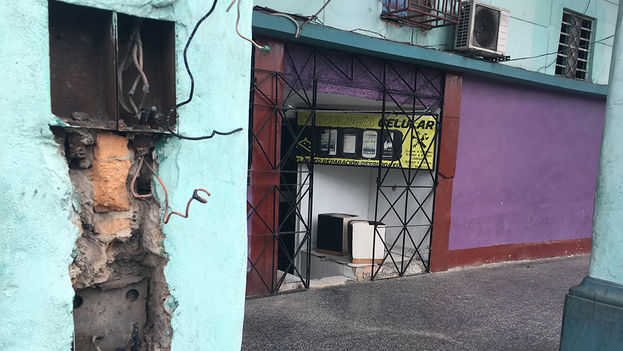
At the central corner of Galiano and Dragones there was once a discreet rewiring, barely perceptible, that has now become a public threat. This mess of connections was probably conceived as a temporary solution that has now become permanent. Passersby avoid it, the neighbors up above avoid throwing water from their balconies and parents make haste to warn their children, “don’t touch it.”

Maybe someone should hang a sign that says, “Dangerous Current.” Not only to warn of the risk of accidental contact, but also to point out how usual and common these kinds of scenes have become in the capital. A detail that no owner will reveal in the sugar-coated descriptions they publish to sell their house.

Airbnb, The Cuban Experience / 14ymedio, Luz Escobar

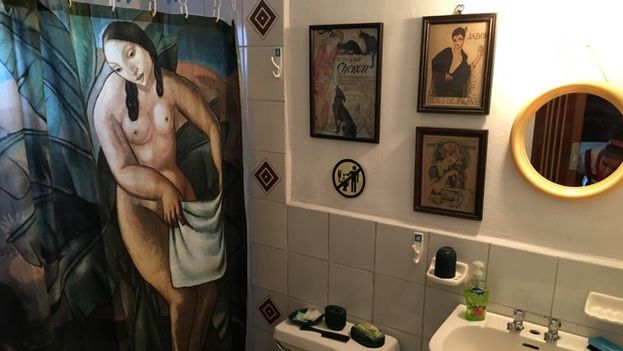
The bathroom of the RentArte lodging managed by the artisan and blogger Rebeca Monzó in Nuevo Vedado, Havana. (14ymedio)

14ymedio, Luz Escobar, Havana, 7 February 2017 — Rustic, elegant or family friendly. These are the preferred accommodations offered by Airbnb in Cuba. The hosts, for their part, prefer serious customers who pay well, but above all value the ability to directly manage their rental, two years after the huge international private rental platform opened its services in Cuba.

“There is nothing like Airbnb,” said Jorge Ignacio Guillén, a student of economics who rents out a house in the town of Soroa, Artemisa. Surrounded by lush vegetation, orchids and birds native to the area, the accommodation is described as “rustic” and in direct contact with nature. continue reading

The young man helps his family manage the home’s profile on the California website specializing in vacation rentals. Guillén signed up a year ago and his family’s house is now is one of the more than 4,000 rental options that Airbnb claims exist on the island.

Airbnb listings in Cuba range from exclusive mansions with pool that can cost up to $1,000 a night depending on the number of rooms, to single rooms with a bed or bunk for about 10 dollars

The San Francisco-based company, created nine years ago, expanded its services to Cuba in April 2015, just months after the announcement of the diplomatic thaw between Washington and Havana.

The offerings on the island range from the most luxurious to the simplest. From exclusive mansions with pools that can cost up to $1,000 a night depending on the number of rooms, to single rooms with a bed or bunk for about 10 dollars*. Hot running water, coffee upon awakening or a minibar are some of the options to choose from.

Of the more than 535,000 self-employed workers in the country at the end of 2016, at least 34,000 dedicate themselves to renting homes, rooms and spaces. An unknown number offer a house or a room “under the table,” without a state license and without paying taxes.

On the island, entrepreneurs need to obtain a rental license, in accordance with the regulations on self-employment implemented in the mid-1990s. Owners of registered rentals must pay license fees and taxes deducted from personal income. These vary depending on the location of the property, the square footage allocated to the rental, and the occupancy numbers.

Airbnb registration is simple. The first step is to fill out a detailed form about the accommodation you are offering and the guests you wish to host. Within a few minutes you will receive an email welcoming you to the platform. The last step is to attract customers, who will rate the accommodation through the company’s website.

The Guillén family has wanted to do everything legally to be able to take advantage of the growth in tourism. Last year, the number of foreign visitors reached 4 million, 6% more than the 3.7 million visitors initially forecast, according to the Ministry of Tourism (Mintur).

Most of the rooms offered on Airbnb are located in Havana, but other destinations such as Trinidad, Viñales, Santiago de Cuba and Matanzas are gaining prominence. The Cuban market stands out as the fastest growing in the history of the company.

Guillén learned about the service through a friend outside the island and as soon as he had the opportunity to connect to the internet he posted his advertisement. “From then to now business improved a great deal and we are finding a lot more customers,” he tells 14ymedio. Also, the new customers “are much better, more serious and more respectful,” and “they pay more,” he summarizes.

The family is offering “a simple country house,” and puts its guests in touch with a guide service and horseback riding. After the reservation, all the information is shared via email, the most fragile part of the operation due to the low connectivity to the internet still experienced in Cuba.

House being prepared for rent on Airbnb by Jorge Ignacio Guillén in Soroa (14ymedio)

Rebeca Monzó, a craftswoman and blogger who has a room for rent on Airbnb, complains of the difficulties involved in managing the service without internet access. Although an email account on the government Nauta service has alleviated the problem, responding immediately when she receives a reservation message is complicated.

Monzó, who has made clear her preference for “stable, professional and retired couples,” will receive her first customer in February, “a Mexican filmmaker who is coming with his wife.” For this coming March she already has another confirmed reservation.

The increase in the number of days of occupation per year is one of the advantages for local entrepreneurs who have joined Airbnb. Guillen confesses that although he still has “much to learn about the management of the platform,” he does manage, through it, to “maintain a good number of reservations.”

After the difficulties of eight years of construction to get their property ready in Soroa, a beautiful natural area, the young man’s family is reaping the fruits of their labors. However, they recognize that the most difficult thing continues to be “always having on hand the necessary supplies to meet basic needs,” because “there still is no wholesale market in the country.”

In Monzó’s Havana neighborhood of Nuevo Vedado, “almost everyone who rents to tourists has signed up for the service. The customer pays from their own country directly to Airbnb,” and then “they send an Airbnb representative to the house who brings the money in cash,” she says. It is the same formula frequently used by Cubans abroad to send remittances to family on the island.

But for Monzó, the business is far from a source of great profits. “When I signed up, I wasn’t thinking about being able to buy a yacht. I was just thinking I’d like to have a well-stocked refrigerator.”

*Translator’s note: Looking at the listings on Airbnb’s site as of today, single room rental rates (two guests) appear to be concentrated in the range of about $25-$35 (with many that are more and less than that). A professional employed by the state in Cuba earns roughly $40 a month; physicians earn roughly $60 a month.


More Than 50% Of Cuba’s Political Prisoners Belong To UNPACU, According To Human Rights Group / 14ymedio

Police search during the arrest of Karina Gálvez, in Pinar del Río. (Coexistence)

14ymedio bigger14ymedio, Havana, 6 February 2017 – A report released this Monday by the National Cuban Commission for Human Rights and National Reconciliation (CCDHRN) counts 478 arbitrary arrests against dissidents throughout the island during the month of January. The text states that during the past month, there were 20 arrests more than in December 2016.

The independent body documents “12 cases of physical aggression and 11 cases of harassment” of opponents, a situation that is part of the “policy of intimidating repression” that “has prevailed in Cuba for nearly six decades.”

The CCDHRN affirms that the Ladies in White movement continues to be a priority target of political repression, although the Patriotic Union of Cuba (UNPACU) also is a particular target of “the arbitrary arrests and destructive raids against its members.” continue reading

UNPACU, an opposition organization with a strong presence in the east of the country, has been the victim of “plundering of their means of work (laptops , cameras, mobile phones, etc.).” These police acts have been carried out “with a great deal of political hatred,” the Commission points out.

The report conveys the concern of the CCDHRN on “the situation in prison of Dr. Eduardo Cardet, general coordinator of the Christian Liberation Movement, who has just been adopted as a prisoner of conscience by Amnesty International.”

For ordinary prisoners, “material conditions and abuse continue to worsen” in the nearly two hundred prisons and prison camps on the island

The concern extends to the “arbitrary detention for several days, of Karina Galvez,” a member of the editorial board of the magazine Coexistence, accused of the crime of tax evasion and now awaiting trial. The economist was released on bail on January 17 after six days of detention.

The Commission states that “the number of politically motivated prisoners in Cuba is still over 100, of which 55 are active members of the Patriotic Union of Cuba.” For ordinary prisoners, “material conditions and abuse continue to worsen” in the nearly two hundred prisons and prison camps on the island.

The text states that the Government “continues to use prisoners as semi-skilled labor in various jobs for commercial purposes,” including “the production of charcoal for export, mainly to Europe and the United States of America,” referring to the recent shipment of charcoal made from the invasive marabou week to the United States.

Last year the CCDHRN documented a total of 9,940 arbitrary arrests, a figure that “places the Government of Cuba in the first place in all of Latin America” with regards to arrests of this type, according to a report by the independent organization.

Black Gold / 14ymedio, Marcelo Hernandez

The liter of gas that in an official establishment costs 1 CUC here has a price of 15 CUP, 40% less. (14ymedio)

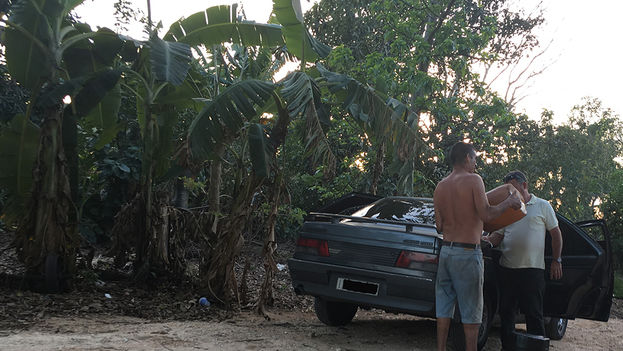
14ymedio bigger14ymedio, Marcelo Hernandez, Havana, 6 February 2017 — In a dark corner along the national highway, with no lights to identify it, the connoisseurs of the secret enter an unpaved road. A few minutes earlier they had called from their cell phone asking if there were any ripe papayas. They park in the middle of a banana grove and open the fuel cap.

In the middle of nowhere, a barefoot, shirtless man carries a plastic jerrycan and with the help of a funnel fills the gas tank of an unlicensed taxi, that runs between Cienfuegos and Havana. It all happens in silence, barely uttering a word.

The scene repeats at different points along Cuba’s roads. These “gas stations” are not announced in the yellow pages of the phone book, nor do they appear on the on-line ad site, Revolico. They are the clandestine suppliers of fuel that comes from the state warehouses, especially those dedicated to agricultural uses. continue reading

A liter of gas, which in an official establishment costs 1 Cuban convertible peso (roughly $1 US), here has a price of 15 Cuban pesos (CUP), some 40% less. The cheapest that can be found is 12 CUP, and, very exceptionally and only between friends, 10 CUP. Gone are the times when a liter could be had for 8. The rise in prices was due to a drastic reduction in the quotas the state delivers to farms and cooperatives after Venezuela reduced the supply of hydrocarbons it sends to the island.

The rise in prices was due to a drastic reduction in the quotas the state delivers to farms and cooperatives after Venezuela reduced the supply of hydrocarbons it sends to the island.

The so-called black gold has the power in this country to become even darker in the “irregular” market. In official events they have declared that there are municipalities where, for months, the state gas stations have not sold a single liter of fuel, even though private vehicles continue to circulate without serious problems.

In the middle of last year, the authorities imposed price caps for private transport in the capital and other areas of the city, but the drivers have found several tricks to evade the restrictions. A good part of them circulate with fuel bought in the informal market. If they had to buy their fuel at the state gas stations their fares would go through the room and be unaffordable to the passengers, but an invisible hand is in charge of getting around the government’s measures.