The Cuban Exile in Havana / 14ymedio, Regina Coyula

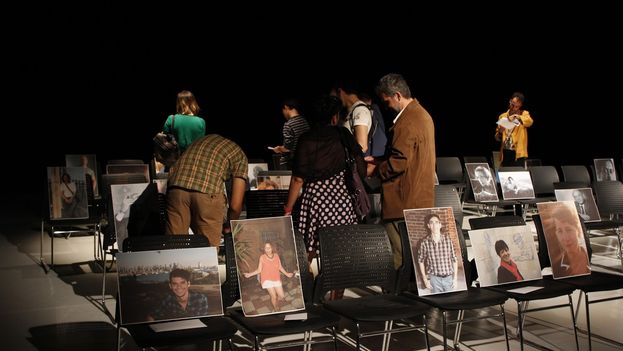
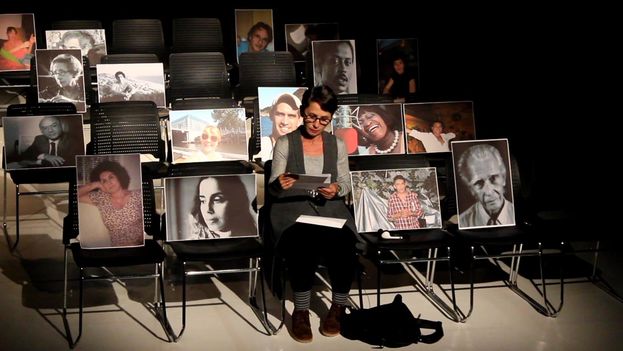
”Departure” is a performance by the company The Enchanted Deer that tackles the drama of those who left Cuba. (The Enchanted Deer)

14ymedio bigger14ymedio, Regina Coyula, Havana, 27 February 2017 — From the beginning you feel that something is missing, you shift awkwardly in the seat in the small room at The Enchanted Deer, although you want to seem calm. After a long version of Amazing Grace, you will be detached enough to take in what follows. The stage is lit, before us, almost like a mirror, and other rows of seats appear, occupied by photographs and a woman. The actress Mariela Brito leads us through a national memory that is not spoken of but that is among us, we Cubans, with an almost physical presence.

Mariela, in a colloquial tone, tells us why many of those who left went away, stories very similar to those we tell of our own families, between friends and acquaintances. But beyond the stories told, float others like empty rafts, those who didn’t live to tell and who are, somehow, the protagonists. This is the absence that the audience can fill with its own memories.

The staging, deliberately slow, allows us to digest, metabolize facts, moments that mark one of the great dramas of our country: the family and social fracture. As if that were not enough, a screen runs through the successive departures of the last 58 years. Scars that we carry and that – the performance is here to remind us – do not end.

The audience interacts with the performance ‘Departure’. (The Enchanted Deer)

At the end of the performance, the audience is invited to approach the proscenium and interact with the photos, read the texts in the form of short letters that accompany many of the images, confirm, now closer, that they are indeed Celia Cruz, Jorge Valls, Cabrera Infante or Ana Mendieta, along with Maria, Juan or Manuel. The empty seats seem to tell us: Do not forget. Do not forget, with that dangerous selective oblivion that does so much damage to society and that history needs to reconstruct.

Inevitably, the site acts as an emetic. The accounting of this period, begun in 1959, raises the question of whether a project built at the cost of such sacrifice, the exile and death of those who are beyond the performance on the stage of The Enchanted Deer, of those who are absent, was worth it. But this is a brief chronicle. That would be a very long reflection.

Police In Havana Deploy In Response To Taxi Driver Strike / 14ymedio

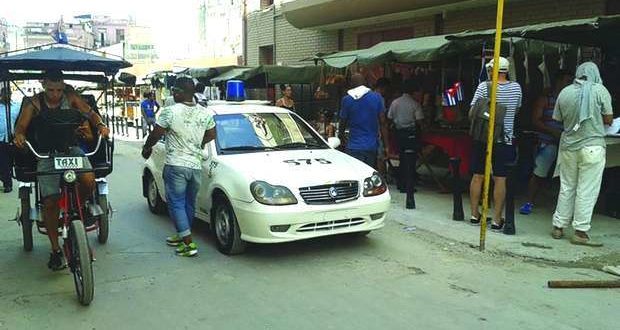
Police officer engaged in the deployment started Monday in reaction to the taxi drivers’ strike. (14ymedio)

14ymedio bigger14ymedio, Havana, 27 February 2017 — Residents of Havana woke up on Monday morning to a strong police deployment, motivated by the announcement of a strike by private taxi drivers. In response to a question from 14ymedio, a uniformed officer said that it was “an operation due to the overcharging by the taxi drivers.”

“As of Monday, 27 February, we drivers all over Cuba are going to strike. We will simply stay home and not wok on those days,” said a text that circulated several days earlier on the alternative media. However, many drivers were unaware of the initiative or declined to participate,” according to what 14ymedio was able to confirm.

The drivers’ discontent has been growing since the beginning of this month when the authorities of the capital set fixed rates for the portions of the routes of private taxi drivers. This decision has put an end to the law of supply and demand that regulated the private transportation of passengers for more than two decades. continue reading

“They are afraid that we will go to the Plaza of the Revolution like the pedicab drivers did last year,” a driver who preferred anonymity and decided not to work on Monday told 14ymedio. “I’m going to stay home all week, even if I lose money, it’s my right,” he said.

Faced with the pressures of the authorities many drivers have reacted by no longer serving the intermediate stops or selecting only those customers who make the complete route

Others have gone out to drive like any other day. “This ‘ship’ is the food for my family, I can’t give myself the luxury of not working,” explains Reinier, a young driver who works in a car he rents from its owner. For those who work in this way it is more difficult to join in any initiative to stop work or protest.

The passengers are complaining abut the delays. “I spent an hour and couldn’t move from this corner,” said a customer who was at the intersection of Infanta and Neptune waiting for a taxi to go to to Playa. “The transport situation was much worse today,” he added.

Faced with the pressures of the authorities many drivers have reacted by no longer serving the intermediate stops or selecting only those customers who make the complete route. The response of the carriers has been fewer taxis on the streets, a way to pressure the authorities to take a step back.

The call for a strike this Monday circulated anonymously and several drivers expressed to 14ymedio their doubts about the authenticity of the call. Nevertheless, all those consulted were aware of the proposal that was made known in blogs, news sites and television programs that are seen through the illegal antennas.

“We are victims of a daily siege by police agents, state inspectors and other entities,” the text warned. Those calling for a strike are demanding access to a wholesale market (for fuel and other needs), the reduction of taxes, and the right to create an independent trade union.

According to the latest data from the Ministry of Labor and Social Security, more than 535,000 people are self-employed, of whom 54,350 are engaged in freight and passenger transport.


Imported Clothing, An Illegal and Profitable Business / 14ymedio, Yosmany Mayeta Labrada

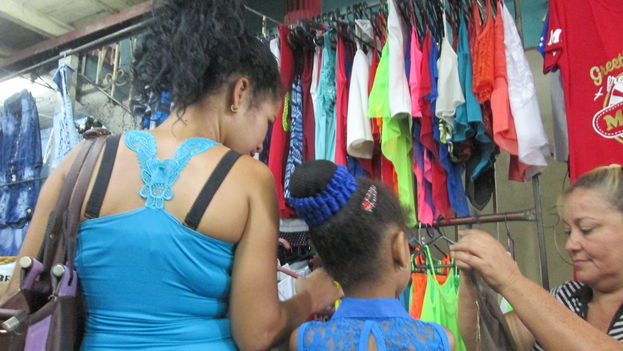
A woman sells clothes at the profitable business ‘Paris Viena’ on Monte Street. (14ymedio)

14ymedio bigger14ymedio, Yosmany Mayeta Labrada, Havana, 27 February 2017 – Regla has spent years working in a prohibited business. She used to do it in doorways on Monte Street in Old Havana, but when the government changed the law to block the trade in clothes and shoes, in December 2013, she had to find an even more discrete method. Now she maintains a point of sale in a state-owned place that rents spaces to private workers, but her little countertop that displays manufactured parts, only serves as a cover to attract customers who then trade in the merchandise that comes from countries Cubans can visit without a visa.

In the past, Regla made the clothes with raw materials “subtracted” from the state Wajay towel factory in Boyeros, and sold them through her self-employment license as a dressmaker. continue reading

“With that trick Regla also avoids paying a good part of the payment of taxes on her personal income. Of the 535,000 self-employed in the county, right now 170,000 of them must present their their affidavit, according to the latest figures from the Ministry of Labor and Social Security.

Among her ample catalog, Lycra pants printed with an American flag are a stand out.

“Everything I have is better quality than in the store,” the saleswoman explains with pride. This week she has again whispered to customers to look at her merchandise in the doorways, because the building where she has her stand is closed for repairs.

Among her ample catalog, Lycra pants printed with an American flag are a stand out. The official media have railed against this garment on repeated occasions, but its presence in the streets continues to grow.

The police control the areas where these sellers frequently offer their merchandise. The penalty for illegal sales includes the confiscation of all the products and a fine of 1,500 pesos. However, the informal sellers continue to dominate a good part of the market for clothing and shoes to the detriment of state owned “Hard Currency Collection” stores, as the state stores are formally named.

Yulia offers her products on Infanta Street. Mot of them come from Russia, Guyana and Haiti. “I started traveling to countries that did not require a visa, but for months I also bought in Haiti.” She thinks that the Caribbean country is a good destination to be supplied from because of the low prices of plane tickets.

This illegal market has also found its own ways of protecting itself

“I go to the home of relatives in Santiago de Cuba and I fly from there,” she explains. “I take clothes twice as big.” This is because the investment is lower than in the case of more distant trips, such as the distant Moscow.

Obtaining a visa for Haiti is relatively easy for Cubans, and Yulia recently also got the Haitian residency. Her new legal status will allow her to expand her business. “Everyone wants pretty clothes from outside the country,” says the saleswoman who has been in the trade for seven years.

This illegal market has also found its own ways of protecting itself. To the cry of “water!” the informal sellers of Monte Street hide their goods or vanish on some stairs. It’s the code to warn that the police are coming. When the authorities withdraw, they all return to their places. Until the next warning.

Why Foreign Investments Don’t Work in Today’s Cuba / Dimas Castellano

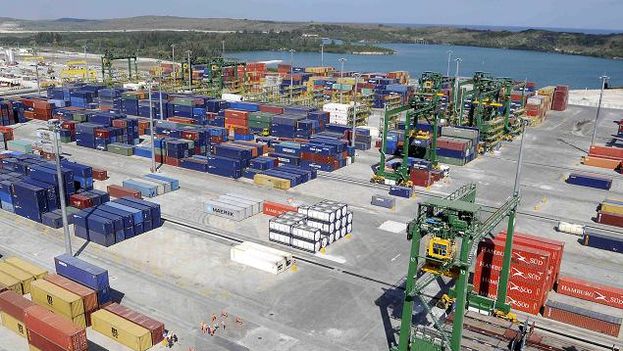
Photo: Mariel Special Development Zone – ZEDM – the operation of which is tightly controlled by the government.

Dimas Castellanos, 17 January 2017 — By 2007, after forty-eight years of revolutionary rule, inefficiency and a lack of productivity had turned state-run farmland into fields infested with marabú weed. Meanwhile, food prices were increasing on the world market. In light of this situation, General Raúl Castro proposed “changing everything that needs to be changed.”

Fast forward five years to May 2013 when the vice-president of the Council of State, Marino Murillo Jorge, publicly acknowledged that the methods used for decades to manage agricultural lands had not led to the necessary increase in production.

The inefficiency was reflected in the gross domestic product (GDP), which fell regularly for years until reaching 1% during the first quarter of 2016 before falling to 0.9% at year’s end. In other words, Cuba entered into recession, a period of negative growth, in 2017. The result made the need for foreign investment a priority, a need from which no nation can escape, much less an underdeveloped country in a state of crisis. continue reading

In 1982 Cuba passed Decree-Law No. 50, which legalized foreign investment. At the time, the prevailing attitude towards investors in those parts of the world which received Soviet subsidies was hostile. But the dissolution of the Soviet Union made it imperative in 1995 for the government to enact Law No. 77, a statute with many restrictions and an absence of legal protections for investors, who suffered the negative consequences.

Of the roughly 400 joint venture firms that began operation in 2002, half ended up leaving the country. In spite of the negative result, the government did not repeal the statute until it became clear that investors were showing little interest in the Mariel Special Development Zone.

Law  No. 118 was passed in March 2014 but, though more flexible than its predecessor, it too proved to be inadequate. According to Cuban authorities themselves, the country needed sustained GDP growth of 5% to 7%. Achieving this would have required income and investment rates of at least 25%, which would have meant annual investment figures of between 2.0 and 2.5 billion dollars.

Last year, foreign investment did not exceed 6.5% of these figures. Under current conditions the only way of even getting close to this target would be to implement a series of measures, including the following:

1. Allow Cubans — both those living on the island as well as those living overseas — to directly invest in the economy.

2. Acknowledge the social purpose of property and private propeerty. Abolish prohibitions against its concentration in the hands of individuals or legal entities, the only purpose of which is to exclude Cubans from economic enterprise.

3. Allow Cubans to engage in all manner of private sector manufacturing and customer service, and grant them legal status.

4. Provide investors with legal guarantees that allow them to settle disputes with their Cuban business partners before a judicial body that is not subordinate to the party or the state, which otherwise would make the government both judge and plaintiff.

5. Allow employers to freely hire their own employees.

6. Eliminate the dual currency system and its different exchange rates, which would provide for the emergence of a domestic consumer market and which would, in turn, encourage investment.

7. Recognize the right of workers to organize and form labor unions, a principle enshrined in Convention 87 of the International Labor Organization, to which Cuba is a signatory; in the Universal Declaration of Human Rights, of which Cuba was one of the promoters in 1948; and in the UN’s Covenant on Civil and Political Rights and the Covenant of Economic, Social and Cultural Rights, which Cuba has also signed but has not ratified.

These obstacles arise out of a history of antagonism towards investors and a failure to pay creditors. Therein lies the main cause of the country’s poor foreign investment climate, not the US embargo, which was relaxed under President Barack Obama. The level of Cuba’s state imvolvement in investment is uncommon for companies which operate in a market economy. Until that changes, the results will remain the same.

In a meeting of the Cuban parliament on December 27, the head of the Economic and Planning Ministry, Ricardo Cabrisas, observed, “Foreign investment continues to be quite low. It is not yet playing a significant role in economic development.”

Meanwhile, the president of the Council of State, Raúl Castro, stated, “Reinvigorating foreign investment in Cuba is of great importance… It is necessary to overcome, once and for all, the outdated and pervasive prejudice against foreign investment. We must divest ourselves of unfounded fears of capital from overseas.”

Therefore, if reviving a stagnant economy is impossible without a strong injection of capital and if “changing everything that needs to be changed” is more than mere rhetoric, then either a new investment law is needed or the current one needs to be substantially overhauled. In either case the word “foreign” should be dropped, making it simply the Investment Law.

Cuba is the only country in the region whose residents lack a right as basic as being able to participate fully in economic activity in spite of ample business opportunities and the professional training to do so. If this problem is not resolved, it will not only be a denial of our economic history but also of our social struggles and José Martí’s republican principles, which envision equality before the law for all those born in Cuba and for its many small property owners.

Besides being harmful to the nation, this prohibition violates the current constitution, which in Article 14 states, “The economy is based on socialist ownership by all the people of the fundamental means of production.” In other words the people, the supposed owner, has no right to participate in the investment process, a status contrary to law, western culture, of which we are a part, our economic history and human dignity.

A new investment law, one without qualifiers, would be an important, necessary and long-awaited sign of change. Proof that, despite long delay, the government is really willing to change everything that needs to be changed.

The First Tangible Labor Strike / Rebeca Monzo

A classic American car used as a shared fixed-route taxi. (14ymedio)

Rebeca Monzo, 21 February 2017 — New bureaucratic regulations governing the routes of shared fixed-route taxis have led to the first tangible labor strike by drivers. Of course, strikes have gone on for many years in our country due to the poverty-level wages paid to workers in the bureaucratic and service sectors. As the old saying goes, “the government pretends to pay us and we pretend to work.”

The best known example of the current strike involves boteros (literally “boatmen” — the taxi drivers of cars from the 1940s and 1950s). After bureaucrats set the prices for certain short trips at 5.00 Cuban pesos, the so-called national currency, drivers refused to pick up short-haul passengers. continue reading

After paying a high fee to the government for a license to operate, it is not profitable for a driver to charge 5.00 Cuban pesos when 0.25 CUC* (roughly the same in the other currency) does not even cover the high cost of fuel. Furthermore, anytime a car brakes, there is wear and tear on the tires and battery. And whenever a car door opens to let a customer get in or out, more fuel is consumed. Consider that a tire in this country costs approximately 160.00 CUC, about the same the price as a battery, not to mention that spark plugs go for almost 3.00 CUC apiece.

Boteros are helping to solve the serious problem of urban transport in this country. These new regulations have led to an increase in the number of bus riders, which has in turn led to a deterioration in public transportation.

Why do these same bureaucrats, who say they have adopted these regulations to protect the pocketbooks of average citizens, not work to reduce to extremely high cost of food priced in the national currency and especially in the convertible currency? Obviously, the state guarantees them an auto, gasoline and spare parts, so they are not directly and personally affected by the needs and problems that the Cuban population faces.

In short, the botero is not forcing you to be his customer. It is the state which is forcing you by not attending to or solving, after so many years, the big transportation problems in our country.

Translator’s note: Cuban convertible peso, equivalent to about 6.63 Cuban pesos.

Rafael Correa and the Populist Syndrome / 14ymedio, Carlos Alberto Montaner

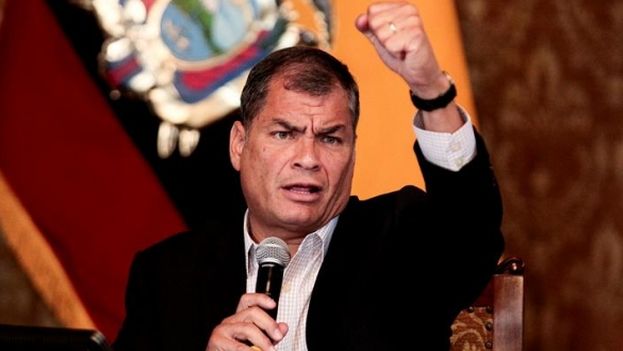
Rafael Correa, President of Ecuador (Archive image / EFE)

14ymedio, Carlos Alberto Montaner, 25 February 2017 — On May 24, Rafael Correa will leave the presidency of Ecuador. Not long now. Don’t despair. I understand; the wait has been long and painful. He has spent a decade in power. On that day, whoever wins the April 2 runoff will take over the government. If the opposition democrats remain united, Guillermo Lasso should succeed him in the post.

Who is Rafael Correa, this contradictory personage who calls himself a neo-developer, a 21st-Century socialist, a Catholic supporter of Liberation Theology, a left-wing nationalist and who, on top of all that, sings and plays the guitar? continue reading

Are we in the presence of a communist disguised, as Fidel Castro was until he confessed his true militancy in 1961 after denying it half a dozen times?

I don’t think that Correa was a communist. It’s something else. Although he is a mediocre economist without original thinking, he knows enough to realize that Marx’s ideas are harebrained.

Despite his speech before the Comandante’s ashes in November 2016, filled with admiration and radicalism, Correa is the quintessential Latin American populist. How do we know this? We know it by a study of his symptoms. Populism is a syndrome.

There’s not the slightest contradiction here. The Castros and Rafael Correa are brothers in populist devotion, authoritarianism and histrionics. Correa is a Fidelista by reason of being a populist. Perón also sympathized with Fidel and vice versa, as did Mussolini and Lenin. They loved each other in secret, like bolero lyrics used to say.

Naturally, you can be a populist and a communist or fascist. Makes no difference. There are populists to the right and left of the political spectrum. Populism consists of government measures to seize power and hold on to it. It’s related to the deep psychology of the man in charge. In addition, there’s no dearth of democratic leaders and parties that, lamentably, exhibit some populist elements.

It’s a question of parallel forms of governance that include several defining features:

Strongman-ism with all its defects, such as narcissism.

Exclusivism (the others are always a bunch of scoundrels.)

Patronage, through the abundant use of subsidies.

An exacerbated nationalism that is mistaken for chauvinism.

“Adamism” (they believe that the nation’s real history began with them.)

Statism, given that they mistrust private enterprise.

Excessive public spending to hold on to their political clients, which usually results in kickbacks and other forms of corruption in addition to total ruination.

A rejection of the market and international commerce (Correa — like Trump, although on the opposite end — was an enemy of the North American Free Trade Agreement).

Caustic language and a total absence of any vestige of civic cordiality.

No question about it. Rafael Correa is more akin to the fascists than to the Marxist-Leninists. He shares much with Perón and Velasco Alvarado, that ignorant Peruvian general who destroyed his country’s economy with populist measures.

Correa is a strongman convinced that he holds all the truths and that his adversaries are despicable people. Whosoever holds or expresses a different idea is a rascal who must be insulted and — if he doesn’t escape, like journalists Emilio Palacio and Fernando Villavicencio did — locked away.

A populist has not the slightest respect for institutions, the law or the adversary, but demands to be treated with reverence. When a ragamuffin once “gave the finger” to Correa from a sidewalk, the president stopped his motorcade and had him arrested.

The opposition has tallied several dozen insults and slanders spouted in Correa’s “Saturday chats,” radio programs that someday will be used as study readings in courses on the psychopathology of power.

Correa does not believe in tolerance or freedom of speech or in those who posit, as did Thomas Jefferson, that a society without an independent government but with a free press is preferable to the alternative.

He mocks or pursues those who criticize him and tries to ruin them, as he did with the owners of El Universo, a major newspaper in Guayaquil, because the rich — unless they’re on his side — are his natural enemies.

Anyway, in the first round of voting on February 19 the Ecuadoreans earned the right to be free. Bravo. They earned it in the days after the election, through their determination not to be cheated out of a victory. Now they’ll have to win in the April 2 runoff to finish the task. If they don’t, Correa will be back. He’s already threatening it.

English Translation from Carlos Alberto Montaner’s blog

Dismantling One of Fidel’s Houses and Saying Goodbye to His Bodyguards / Juan Juan Almeida

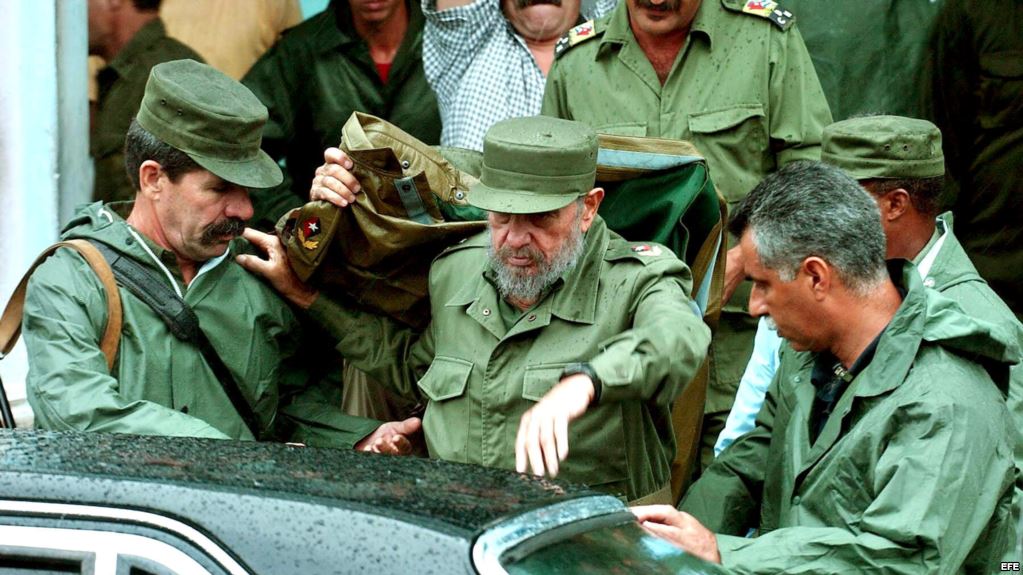
Fidel Castro getting into a car, surrounded by bodyguards.

Juan Juan Almeida, 24 February 2017 — They are dismembering the security apparatus at the bunker that for years served as a spiritual refuge for Fidel Castro: an apartment located on the third floor of 1007 11th Street in Havana’s Vedado district.

Little by little they are removing pictures, gifts and belongings along with some trash. The metal security chain, floodlights and even the guard post that prevented citizens from moving freely along the length of the block where the building is located have already been removed.

More than fifty bodyguards have been retired, leaving only a small temporary garrison of five men and one police officer, Colonel Nivaldo Pérez Guerra. continue reading

Strategically located in District 13, a downtown neighborhood near the Plaza of the Revolution, the building in question was one of the former Cuban leader’s three official residences. Though he had not visited the place for several decades, it remained his legal residence from 1976 until the day he died.

These actions are, it seems, an attempt to remove any evidence that media outlets and Cubans themselves, who have an excessive propensity for constructing legends and creating myths, might use to craft a heroic saga out of the daily habits and lifestyle of the late commander-in-chief.

“Ashes to ashes and dust to dust. They are getting rid of anything with even a whiff of age. In the case of #11 (as the building is known), the country’s leaders have sent us a message: ’The options are total demolition or a complete remodeling of the place; if we leave it the way it is, it could awaken the interest of an avid array of gossip mongers; and, you guys, you are to be relocated,’” says one one disgruntled man, who for years belonged to the tight inner circle of security personnel guarding the late revolutionary leader.

“But they are not going to sack us,” he adds. “What they are doing is speeding up our retirement, which is not quite the same thing. At the same time that they are removing Fidel’s things from #11, they are sending us to Personal Security, over there in Jaimanitas, where they present retirement as compensation for a lifetime of loyal service. They are giving us a Chinese car that looks a new Geely model CK but which is actually a discontinued clunker, a used tourist rental car with a lot of miles on it.”

A disbanded and discontented elite military force can be a terribly bad omen for a society on fire.

One need only go to the parking area of the Hotel Melia Cohiba or Hotel Melia Havana and ask any of the former Cuban president’s various bodyguards where one might find a good botero (taxi driver).

They will tell you that a group of them, who are all now unemployed, are planning to regroup and apply for licenses to operate a privately owned cooperative offering security services to celebrities and fashionable artists visiting the country.

A good business, I would think. No one can deny that, when it comes to personal security, these men have plenty of experience.

Weakness, Fear And Inability Erode The Cuban Government / 14ymedio, Pedro Campos

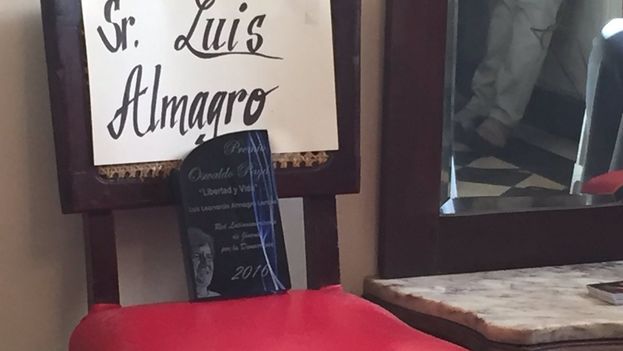
The empty chair with the Oswaldo Payá prize “Freedom and Life” that the Secretary General of the OAS, Luis Almagro could not come to Cuba to receive. (Networks)

14ymedio bigger14ymedio, Pedro Campos, Miami, 23 February 2017 — The recent “diplomatic” action by the Cuban Government to try to prevent the presence of foreign personalities in a private event in Havana to receive a symbolic prize bearing the name of the late regime opponent Oswaldo Payá, denotes the weakness, fear and incapacity that characterize its actions since the visit of Barack Obama to Cuba and the subsequent death of Fidel Castro.

According to the declaration of the Ministry of Foreign Affairs (MINREX) in the newspaper Granma, the plan was to mount an open and serious provocation against the Cuban government in Havana, generate internal instability, damage the international image of the country and, at the same time, affect the good progress of Cuba’s diplomatic relations with other states. continue reading

According to MINREX, Almagro himself and some other right-wing individuals had the connivance and support of other organizations with thick anti-Cuban credentials, such as the Democracy and Community Center, the Center for the Opening and Development of Latin America (CADAL), the Inter-American Institute for Democracy, and a person they call a CIA terrorist and agent, Carlos Alberto Montaner.

In addition, says MINREX, since 2015 there has been a link between these groups and the National Foundation for Democracy in the United States (NED), which receives funding from the US government to implement its subversive programs against Cuba.

The dictatorship of the proletariat, which prevailed in Cuba 57 years ago, has thus invented an “anti-Cuban” (against Cuba or against themselves?), “imperialist”, “counterrevolutionary” and “CIA” hoax behind what could have been a small and simple limited ceremony; in short, if they had been allowed to hold it without the presence of foreign guests it would have served the Government to improve its image with respect to the rights of Cubans as citizens and shown some tolerance.

If they were a little bit capable they could have “stolen the show,” but we already know that in Cuba ‘counterintelligence’ dominates in its broadest sense.

Their response to this assessment is given by the MINREX note: “Perhaps some misjudged and thought that Cuba would sacrifice its essence to appearances,” as if appearances are not an example of essence. It is the ignorance of the dialectic relationship between form and content.

But in short, not one step back. According to MINREX the military state is in danger from this provocation, without arms, without masses, without leaders who enjoy wide support among Cubans on the island. We cannot give ground to the “counterrevolution,” — they say — as if it were not precisely the defenders of the indefensible regime themselves who prevented the revolutionary changes that would lead us to prosperous, democratic Cuba, free of authoritarian hegemonies, with all and for the good of all.

It is weakness, fear and incapacity that led the government to put its repressive character on full display and to miss the opportunity to have been hospitable to the Secretary General of the Organization of American States and to have discussed with him the conditions for possible ties to that Inter-American body.

If they were a little bit capable they could have “stolen the show,” but we already know that in Cuba ‘counterintelligence’ dominates in its broadest sense.

The organizations and individuals who prepared the event have a vision different from the government’s on the ways in which politics and the economy should be conducted in Cuba and, of course, it was an opportune moment to promote the positions of change previously promoted by the Leader of the Christian Liberation Movement, Oswaldo Payá, who died in circumstances demanding further explanation.

The actions of the Cuban government favored what the organizers of the event ultimately wanted to demonstrate: the absence of space in Cuba for different thinking

But if something like this can destabilize the regime, it should do the same!

The government’s actions provoked exactly what it was trying to avoid, creating more interest among Cubans and international opinion in the Varela Project and in how Oswaldo Paya died, a man who might not have been to the liking of the government and other cities, but who lived on the island, worked there and from from within promoted a peaceful and democratic change of the system, with all his rights as a Cuban citizen. Something to respect.

The Cuban government’s action, vitiated by extremism, Manichaeism, intolerance and repression, favored what the organizers of the event ultimately wanted to demonstrate: the absence of space in Cuba for different thinking, the existence of a tyrannical regime that impedes freedom of expression and association, and that it intends to continue to govern based on jails, police and repressive security agents.

The repression of the opposition, socialist dissent and different thinking, pressures against the self-employed, the stagnation of the reforms proposed by the Congress of the Communist Party of Cuba itself, the voluntary efforts to try to control the widespread corruption generated by statist wage system, in short, everything that is being done by the senior bureaucratic hierarchy is generating chaos that undermines and will burst the system from within from ignorance of the laws of economic-social development.

They don’t know where they stand! Don’t try to put the blame on others later.

This service against a “socialism” that has never existed will perhaps be the best historical legacy left to us by these 60 years of voluntarism, populism and authoritarianism of Fidel Castro communism, such that the most retrograde forces of international reaction will eternally thank the “Cuban leadership.”

Undercover American Tourists in Cuba / Iván García

AFP photo taken from Vivelo Hoy

Ivan Garcia, 23 January 2017 — Miami Airport is almost a city. And the American Airlines’ departures area is a labyrinth, with dozens of corridors and passages. That’s why Noahn, an American living in Michigan, arrived five hours before his flight’s scheduled departure time to Varadero.

He was travelling with his wife, his eight-month-old son carried in an arm-sling, and a dog with long floppy ears. In his luggage, professional diving equipment and an electric skateboard. The couple speak in carefully enunciated Spanish, with a hint of a Colombian accent. “It’s because I worked for an American company in Bogotá,” explains Noahn. continue reading

To everyone who wants to listen to him, he describes his experiences as a tourist in Cuba. He knows the Coco and Santa Maria Keys, located to the north of Ciego de Avila and Villa Clara and Maria La Gorda, in the western province of Pinar del Rio.

“But I was enchanted by Varadero. It’s the third time in two years I’ve been there since the reestablishment of relations between Cuba and the United States. Neither Miami Beach nor Malibu can compare with Varadero, with its fine white sandy beach. The water is warm and there are hardly any waves. Punta Cana in the Dominican Republic, Copacabana in Rio de Janeiro and The Bahamas may have just as good or better natural conditions,” he adds, while his wife gives the child some milk in a bottle.

Despite the prohibitions on tourism in Cuba, Americans such as Noahn travelled to the island by way of a third country. “Before December 17, 2014, I travelled to Cuba via Mexico. After that date it’s been easier. There are twelve quite flexible categories, which they call the twelve lies. You declare whichever pretext, and travel in a group or individually. “In theory you can’t go as a tourist, but I bet that’s what half of the American travellers are doing.”

Out of more than 200 passengers on the flight heading to Varadero, only six were Cubans going back to their country permanently or to visit relatives on the island.

Judith, a biologist living in Georgia, is going to Cuba for the second time this year. Why? “Half for professional experience, half tourism.” I’m interested in gathering information on the varieties of Cuban vegetation. Once I finish my research, I’m going to stay a week in a hotel full-board in Camaguey or in Holguin.”

Asked if she felt any harassment or if any federal institution has opened a file on her for violating the country’s regulations, she replies: “Not at all. Seems to me the wisest thing to do would be to openly permit tourism in Cuba, because that’s what in reality people are doing.”

After the re-establishment of relations between two countries that were living in a cold war climate, many more Americans are travelling to the Greater Antilles. In January 11, 2016, Josefina Vidal, an official working in the Cuban Foreign Ministry, and responsible for relations with the United States, reported on Twitter that, in 2016, the island received a total of 614,433 visitors from United States (Americans and Cuban Americans), 34% more than in 2015.

Although on paper the Americans arriving are recorded as being part of a religious or journalistic or a people-to-people exchange, it isn’t difficult to spot well-built blonds or redheads downing quantities of mojitos in a bar in Old Havana or enjoying the warm autumn sun on a Cuban beach.

When at 8:30 in the evening, the American Airlines plane landed at the Juan Gualberto Gómez international airport in Varadero, after a quick check, half a dozen air-conditioned buses were waiting for the “undercover” tourists to take them to four and five star hotels along the Hicacos Peninsula coast.

“Yes, the Americans are tourists.” Many of them go to Havana, others pass the time in Varadero. They prefer to stay in hotels. About 400 or 500 come every week. And many more are expected at New Year’s,” said an official of the Gaviota chain, balancing on the stairway of a bus.

Private taxi drivers and those who lease vehicles from the state hang around the terminal. “There are gringos who come as individual tourists. I charge them the equivalent of $40 for the trip to Varadero, about 20 kilometers from the airport. Almost all give good tips. Unlike the Spaniards and Mexicans, who are complete tightwads,” says Joan, a private taxi driver.

The majority of Cubans are convinced that Americans are rich. And have more money than they know what to do with. They try to milk them as if they were cows.

At the currency exchange outside the airport, they exchange dollars for 86 centavos, less than the official rate of 87. “The rate goes down at weekends,” he says.

An employee in the terminal, says “Here everyone is doing business. “The lavatory cleaner charges, the café sells stuff on the side, and the customs people get things off the passengers.”

Tourism in Cuba is like a harvest. Everyone wants to squeeze the sugar cane. And you can extract plenty of juice from the sneaky tourists

Translated by GH

Cuban Activist Juan Goberna Arrested / 14ymedio

Activist Juan Goberna in a file image. (Cubanet)

14ymedio bigger14ymedio, Havana, 25 February 2017 — Human rights activist Juan Goberna Hernández was arrested around 9 am this Saturday when he left home to attend a meeting of the Inclusive Culture Network, a project to defend the rights of people with disabilities.

On Friday night Goberna, who is blind, was visited by two State Security agents to warn him that they would not allow him to attend the meeting. Two other agents named Brayan and Nacho were posted in a car from early Saturday to stop him if he persisted in his decision to go to the meeting. continue reading

In Aguada de Pasajeros, Goberna was taken from a bus on which he panned to travel to Havana to attend the meeting.

Minutes before his arrest Goberna told 14ymedio by phone that it was his “duty” and his “right” to participate in the activity.

So far it has not been possible to determine where he was taken.

The Network of Inclusive Culture tries to promote a greater sensitivity towards the treatment of people with disabilities, working to make visible the difficulties that such individuals face on a daily basis.

In addition to conducting workshops and seminars, members of the Network provide support and advice in cases of violations of rights to anyone in situations of vulnerability.

Brothers To The Rescue: A Crime That Hurts “Like The First Day”/ 14ymedio, Mario Penton

14ymedio bigger14ymedio, Mario Penton, Miami, 24 February 2017 – Members of the Cuban exile remembered the anniversary of the death of four Cuban Americans after the shooting down of two planes of the humanitarian NGO Brothers to the Rescue by the Cuban Air Force in 1996.

The commemorative activities began with an act of homage to Manuel de la Peña, Carlos Acosta, Armando Alejandre and Pablo Morales, at the monument in Opa-locka that reminds them of the 21st anniversary of the tragedy.

“Every year when we remember them, we feel immense pain,” says Ana Ciereszko, sister of Armando Alejandre, one of those murdered. continue reading

“When President Obama returned the spy responsible for the murder of our relatives it was very hard because they gave their lives to save the lives of others, Cuban rafters, many of whom have disappeared at sea,” she added.

Cuban-American Congresswoman Ileana Ros-Lehtinen also recalled those killed and lashed out at the Obama administration for the release of spy Gerardo Hernandez, convicted of providing information to the Cuban government that allowed the perpetration of the crime.

“Our nation must defend these murdered Americans and ensure that justice prevails so that the families of these victims can have the final peace they so deeply deserve,” said the congresswoman.

A third plane was able to escape and asked for help from the US authorities, who never delivered it

Brothers to the Rescue emerged as an initiative of civilian aviators of various nationalities and Cubans interested in assisting the rafters who escaped from the island in fragile vessels during the migratory crisis in the early 1990s. The collapse of the Soviet Union caused the greatest economic crisis in the country’s history and thousands of migrants threw themselves into the sea in the hope of reaching the United States.

The two Cessna 337 Skymaster aircraft, from Miami, were shot down with air-to-air missiles by a MiG-29UB 900 fighter and a MiG-23 fighter. A third plane escaped and called for help from the US authorities, who never gave it to them.

The Cuban government accused the organization of having “terrorist purposes” and defended the demolition of light aircraft on the grounds that they were over Cuban waters. Brothers to the Rescue, however, says that the shooting down took place in international waters.

“There has been no justice because there was no clarification of the truth. The facts were carefully hidden under the presidencies of Clinton and Castro,” says Jose Basulto, 76, president of Brothers to the Rescue and one of the survivors of the tragedy.

“It was a joint action, complicit, because they wanted to resume relations between both countries,” he says. He adds that on the Island there practice runs for shooting down the planes and that it was suggested to American officials what was going to happen. “We were exposed to the enemy fire and nobody helped us,” he adds.

According to Basulto, the days before each commemoration of the demolition are filled with memories and are “very sad.”

The gathering has become a tradition to remember the four Cuban-American youth

“Brothers to the Rescue was an example of human solidarity with the people of Cuba and to teach the world the harshness of the suffering of the people, capable of committing suicide at sea in order to escape from that dictatorship,” he recalls.

At Florida International University (FIU) a commemorative event was held with relatives of the victims and a broad representation of the exile. The meeting has become a tradition to remember the four Cuban-American youth and, as every year, silence was held between 3:21 pm and 3:28 pm, the time at which the planes were shot down.

“My brother was my first baby. He was just a boy when he was killed,” says Mirtha Costa, sister of Carlos Alberto Costa.

“He loved being together with everyone in the family. He was also a very cheerful person and always looked for how to make jokes to others,” he recalls.

Both Costa and the other relatives are responsible for the CAMP Foundation, named after the initials of each of the victims of the shooting down.

The foundation supports diverse organizations that promote youth education, such as Miami Dade College and the University of Miami.

The families of the victims will honor their memory with a Eucharist at St. Agatha Church at 7:00 pm this Friday.


‘Little Old Communists’ / 14ymedio, Reinaldo Escobar

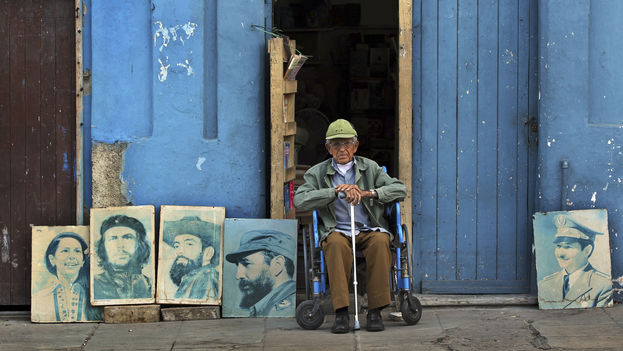
An old man poses next to a series of portraits of Cuban leaders. Left to right: Celia Sanchez, Ernesto ‘Che’ Guevara, Camilo Cienfuegos, Fidel Castro. Far right, Raul Castro. (EFE)

14ymedio bigger14ymedio, Reinaldo Escobar, Havana, 25 February 2017 — Many of those who experienced the first moments of the Revolution when they were between the ages of 14 and 20, became literacy teachers, young rebels, militiamen, cederistas (supporters of the Committees for the Defense of the Revolution) and federadas ( ‘federated’, i.e. supporters and activists of the Revolution). They overachieved every challenge and climbing five peaks or walking 62 kilometers ended up being credentials of high social value.

It was common to see them with a pistol at their belts bragging about their exploits at the Bay of Pigs or cleaning up the Revolution’s opponents in the Escambray Mountains. It was the time of the Schools of Revolutionary Instruction, of a Marxism manual tucked under one arm and simplified atheism. In those prodigious years of the 1960s they embodied the true fervor of youth and, consequently, an ideological prejudice against the elderly took root. continue reading

A poet, then (and still) unknown, would write fiery verses under the provocative title of If the old woman in front took power where he described in the purest colloquial style the retrograde measures that would be dictated by this hypothetical lady, probably bourgeois and resentful, in a word: a gusana, a worm. In fact the term “old worm” already seemed a redundancy in the mouth of those tropical Red Guards… But time passed and many vultures flew over monument in the Plaza of the Revolution.

A new generation, with very different goals, today launches its prejudicial darts against anyone over 70

A new generation, with very different goals, today launches its prejudicial darts against anyone over 70. But they no longer use the expletive “old worm,” instead they choose its diametrical opposite: “little old communist.”

A diminutive, as any good linguist knows, can be loaded with tenderness or contempt. It is not the same to say “granny” as it is to say “little teacher.” And this epithet of “little old man,” or woman, wrapped in a false commiseration falls with its full weight of impairment on the line of retirees who get in line early in the morning to buy the newspaper Granma, or on any gray-haired person always ready to utter some admonition to the teenagers who saunter out of the high schools with their shirts untucked.

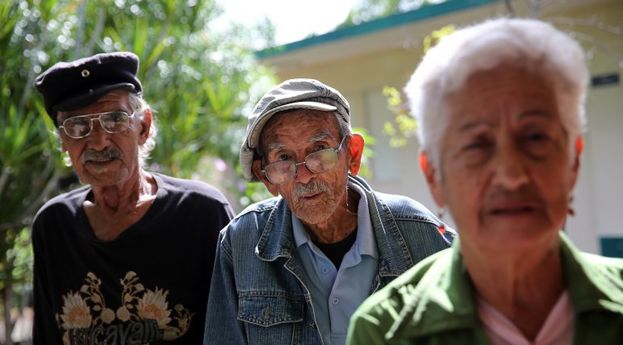
Old people in an old age center in the city of Cienfuegos. (EFE)

Destiny has these intrinsic twists. For a boy who spends most of his day thinking about how to leave the country, anyone who passed up a historic opportunity to leave this shipwrecked island must be an accomplice, if not the one personally responsibly for all his angst.

If there is a space for a smile after the macabre grimace of death, those “old worms” must be amusing themselves in the face of the painful spectacle offered by their former dentists, who no longer dread the future, but rather ruminate on a defeat they do not want to recognize.

The Countdown Begins For Raul Castro’s Departure From Power / 14ymedio

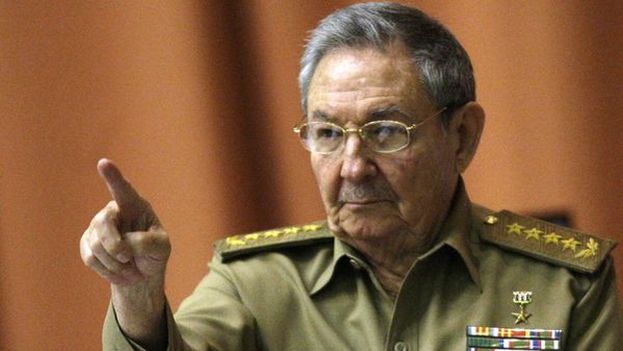
Raúl Castro announced that he would leave power in 2018, ten years after assuming it. (EFE)

14ymedio bigger14ymedio, Havana, 24 February 2017 — On February 24 of next year Raul Castro must leave the presidency of Cuba if he is to fulfill the promise he has made several times. His announced departure from power is looked on with suspicion by some and seen as an inescapable fact by others, but hardly anyone argues that his departure will put an end to six decades of the so-called historical generation.

For the first time, the political process begun in January 1959 will have a leader who did not participate in the struggle against the dictatorship of Fulgencio Batista. Nevertheless, Raul Castro can maintain the control of the Communist Party until 2021, a position with powers higher than the executive’s and enshrined in the Constitution of the Republic. continue reading

In the 365 days that remain in his position as president of the Councils of State and of Ministers, the 85-year-old ruler is expected to push several measures forward. Among them is the Electoral Law, which he announced two years ago and that will determine the political landscape he leaves behind after his retirement.

In the 365 days that remain in his position as president of the Councils of State and of Ministers, the 85-year-old ruler is expected to push several measures forward. Among them is the Electoral Law

In the coming months the relations between Havana and Washington will be defined in the context of the new presidency of Donald Trump and, in internal terms, by the economy. Low wages, the dual currency system, housing shortages and shortages of products are some of the most pressing problems for which Cubans expects solutions.

Raul Castro formally assumed the presidency in February of 2008, although in mid-2006 he took over Fidel Castro’s responsibilities on a provisional basis due to a health crisis affecting his older brother that forced him from public life. And now, given the proximity of the date he set for himself to leave the presidency, the leader is obliged to accelerate the progress of his decisions and define the succession.

In 2013 Castro was confirmed as president for a second term. At that time he limited the political positions to a maximum of ten years and emphasized the need to give space to younger figures. One of those faces was Miguel Díaz-Canel, a 56-year-old politician who climbed through the party structure and now holds the vice presidency.

In the second tier of power in the Party is Jose Ramon Machado Ventura, an octogenarian with a reputation as an orthodox who in recent months has featured prominently in the national media. A division of power between Díaz-Canel and Machado Ventura (one as president of the Councils of State and of Ministers and the other as secretary general of the Party) would be an unprecedented situation for millions of Cubans who only know the authority being concentrated in a single man.

However, many suspect that behind the faces that hold public office, the family clan will continue to manipulate through pulling the strings of Alejandro Castro Espín. But the president’s son, promoted to national security adviser, is not yet a member of the Party Central Committee, the Council of State or even a Member of Parliament.

Many suspect that behind the faces that hold public office, the family clan will continue to manipulate the strings of Alejandro Castro Espín

For Dagoberto Valdés, director of the Center for Coexistence Studies, Raúl Castro leaves without doing his work. “There were many promises, many pauses and little haste,” he summarizes. He said that many hoped that the “much-announced reforms would move from the superficial to the depth of the model, the only way to update the Cuban economy, politics and society.”

Raul Castro should “at least, push until the National Assembly passes an Electoral Law” that allows “plural participation of citizens,” says Valdés. He also believes that he should give “legal status to private companies” and “also give legal status to other organizations of civil society.”

The American academic Ted Henken does not believe that the current president will leave his position at the head of the Party. For Henken,a professor of sociology and Latin American studies at Baruch College in New York, Castro’s management has been successful in “maintaining the power of historic [generation] of the Revolution under the authoritarian and vertical model installed more than half a century ago” and “having established a potentially more beneficial new relationship with the US and embarking on some significant economic reforms. ”

However, Henken sees as “a great irony that the government has been more willing to sit down and talk with the supposed enemy than with its own people” and points out “the lack of fundamental political rights and basic civil liberties” as “a black stain on the legacy of the Castro brothers.”

Blogger Regina Coyula, who worked from 1972 to 1989 for the Counterintelligence Directorate of the Interior Ministry, predicts that Raul Castro will be remembered as someone “who could and did not dare.” At first she saw him as “a man more sensible than the brother and much more pragmatic” but over time “by not doing what he had to do, nothing turned out as it should have turned out.”

Perhaps “he came with certain ideas and when it came to reality he realized that introducing certain changes would inevitably bring a transformation of the country’s political system,” says Coyula

Perhaps “he came with certain ideas and when it came to reality he realized that introducing certain changes would inevitably bring a transformation of the country’s political system,” says Coyula. That is something he “is not willing to assume. He does not want to be the one who goes down in history with that note in his biography.”

Independent journalist Miriam Celaya recalls that “the glass of milk he promised is still pending” and also “all the impetus he wanted to give to the self-employment sector.” She says that in the last year there has been “a step back, a retreat, an excess of control” for the private sector.

With the death of Fidel Castro, his brother “has his hands untied to be to total reformist that some believed he was going to be,” Celaya reflects. “In this last year he should release a little what the Marxists call the productive forces,” although she is “convinced… he won’t do it.”

As for a successor, Celaya believes that the Cuban system is “very cryptic and everything arrives in a sign language, we must be focusing on every important public act to see who is who and who is not.”

“The worst thing in the whole panorama is the uncertainty, the worst legacy that Raul Castro leaves us is the magnification of the uncertainty,” she points out. “There is no direction, there is no horizon, there is nothing.” He will be remembered as “the man who lost the opportunity to amend the course of the Revolution.”

“He will not be seen as the man who knew, in the midst of turbulence, how to redirect the nation,” laments Manuel Cuesta Morua. Cuesta Morua, a regime opponent, who belongs to the Democratic Action Roundtable (MUAD) and to the citizen platform #Otro18 (Another 2018), reproaches Raúl Castro for not having made the “political reforms that the country needs to advance economically: he neither opens or closes [the country] to capital and is unable to articulate another response to the autonomy of society other than flight or repression.”

Iliana Hernández, director of the independent Cuban Lens, acknowledges that in recent years Raúl Castro has returned to Cubans “some rights” such as “buying and selling houses, cars, increasing private business and the right to travel.” The activist believes that this year the president should “call a free election, legalize [multiple] parties and stop repressing the population.”

As for the opposition, Hernandez believes that he is “doing things that were not done before and were unthinkable to do.”

Dissident Martha Beatriz Roque Cabello is very critical of Raul Castro’s management and says she did not even fulfill his promise of ending the dual currency system. “He spoke of a new Constitution, a new economic system, which aren’t even mentioned in the Party Guidelines,” he says.

“To try to make up for the bad they’ve done, in the first place he should release all those who are imprisoned simply for thinking differently under different types of sanctions”

“To try to make up for the bad they’ve done, in the first place he should release all those who are imprisoned simply for thinking differently under different types of sanctions,” reflects Roque Cabello. She also suggests that he sit down and talk to the opposition so that it can tell him “how to run the country’s economy, which is distorted.”

Although she sees differences between Fidel’s and Raul Castro’s styles of government, “he is as dictator like his brother,” she said. The dissident, convicted during the Black Spring of 2003, does not consider Diaz-Canel as the successor. “He is a person who has been used, I do not think he’s the relief,” and points to Alejandro Castro Espín or Raul Castro’s former son-in-law, Luis Alberto Rodríguez López-Callejas, as possible substitutes.

This newspaper tried to contact people close to the ruling party to obtain their opinion about Raúl Castro’s legacy, his succession and the challenges he faces for the future, but all refused to respond. Rafael Hernández, director of the magazine Temas, told the Diario de las Américas in an interview: “There must be a renewal that includes all those who have spent time like that [10 years].” However, not all members of the Council of State have been there 10 years, not even all the ministers have been there 10 years.”

This is the most that the supporters of the Government dare to say.
Qatar Complains About Cuban Care Providers With HIV / Juan Juan Almeida

Juan Juan Almeida, 22 February 2017 — Qatar authorities presented an official complaint before Eumelio Caballero Rodríguez, Ambassador Extraordinary and Plenipotentiary of the Republic of Cuba, because during the obligatory health exam of the Cuban health workers they detected some cases of Cuban doctors infected with HIV.

This was expressed in an email from the Embassy of Cuba in the State of Qatar, which landed like a tsunami in the office of the Minister of Public Health of Cuba. Here are a few fragments:

“Beginning now, all [Cuban] care providers who leave for Qatar must bring a certificate from the Provincial Center of Hygiene and Epidemiology that shows the results of an HIV test.” continue reading

“Urgent,” says the message. “These 15 cases listed here arrived in Qatar the past month of January without said document, and three of them tested positive in the required check for entry to the country, and now we are requesting an explanation for this.”

“Gentlemen,” continues the missive, “This must not happen again. It is required that you take disciplinary measures against the provinces of the implicated care providers.”

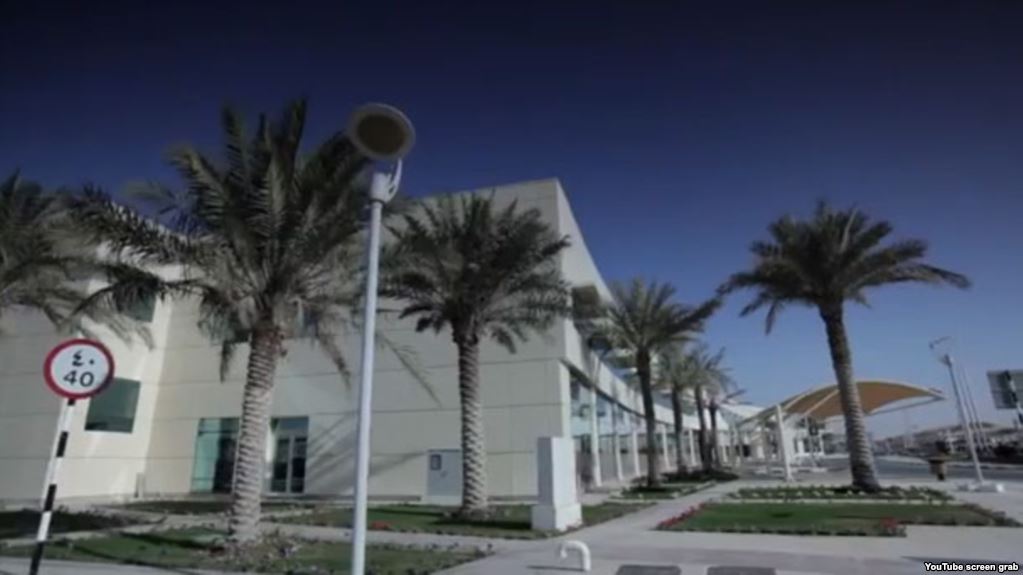
It should be pointed out that Qatar is a State mediator and negotiator in Middle Eastern conflicts, and its principal interest in Cuba is concentrated in medical services, considered the backbone of relations between both countries. This is why, in January of 2012, the Hospital of Dukhan was created, which today has more than 400 Cuban professionals, including doctors, nurses and technicians in the fields of rehabilitation, odontology, medical laboratories, bio-medicine and radiology.

Furthermore, the incident puts at risk the confidence of the Arab Emirates, which, with the third largest world reserve of natural gas and the largest income per capita on the planet, has shown interest, in addition to health, in exploring other spheres of business, for example: financing the extraction and commercialization of Cuban marble, the construction of five-star hotels on the island and the implementation of an airlines operation between Qatar Airways and Cubana de Aviación.

Of course, I’m convinced that we won’t read anything about this disagreeable incident, absolutely nothing, in the official Cuban press.

Translated by Regina Anavy

The Cuban Regime Has Redoubled Its Assault On The Private Sector / Iván García

Police raids against private vendors are common in Havana.

Ivan Garcia, 24 February 2017 — Marino Murillo, the presumptive tsar of economic reforms in Cuba, a prime minister with broad powers, passed up a seat in the first row next to the senior staff of a long-lived revolution governed by an exclusive club of elders who, as a group, have lived almost 500 years, to take a seat in the third row, far from the spotlight and the cameras.

In closed societies, where rumors are more truthful than the information offered by the State press, you have to learn to read between the lines. Lacking a government office that offers public information to its citizens, academics, journalists and political scientists, you must look with a magnifying glass at the most insignificant signs. continue reading

That morning in December 2015, when the autocrat Raúl Castro feigned indignation before the more than 600 deputies of the monotone national parliament about the abusive prices of agricultural products, was the beginning of the end for Marino Murillo.

Castro II requested that measures be applied. And not very consistently, alleging the law of supply and demand that governs the produce markets, Murillo mumbled that he would try to implement different regulations to try to curb the increase in prices.

Apparently this wasn’t sufficient. The previous super-minister fell into disgrace, and now not even his photo appears in the official media, although theoretically he continues at the front of the agenda, charged with implementing the economic guidelines, a kind of commandment that moves at a snail’s pace and with serious delays: In six years, only a little more than 20 percent of the guidelines have been implemented.

With the fading-out of fatso Murillo, the dynamic of timid economic reforms — together with openings in the obsessive defense of Fidel Castro, who transformed Cubans into third-class citizens — the game began to be directed by the most rancid and conservative of the military leadership.

It was essential to open to the world and repeal the feudal exit permit needed to travel outside the island, to permit Cubans to rent hotel rooms and to buy or sell houses, among other normal regulations in any country in the 21st century.

There is no doubt that this was a leap forward, with barriers, absurd prices and spite for people who make money. Yes, in Cuba they sell cars, but a Peugeot 508 is worth more than a Ferrari, and you must pay cash.

The Internet and cell phones are not exactly tools of science fiction, but the price for service is insane for a country where the average salary is 25 dollars a month.

The supposed reforms were always incomplete. They were left halfway. Cubans cannot invest in large businesses; professionals don’t have authorization to work for themselves, and the State claims the right to establish a ridiculous list of jobs that are or are not permitted.

Of the 201 authorized jobs, there are at least 10 or 15 enterprises where, with creativity and effort, you can make large sums of money, always taking into account the Cuban context, where anyone who earns 10,000 Cuban pesos a month (about $400) is considered “rich.” This is a country where for almost 60 years, the average citizen is sponsored by the State.

Of course the regulations, excessive taxes, harassment by State inspectors and a deadly clause in the Government’s economic bible, which prohibits persons or groups from accumulating large sums of capital, hinder prosperity and the boom in private work.

In a nation where the Government has been in charge of clothing, shoeing, rewarding or punishing its citizens, a margin of liberalism, as small as it is, was an oasis for a half million entrepreneurs who now live on the margins of the State.

The starting shot that would put the handbrake on the reforms began on December 17, 2014, when President Barack Obama and General Raúl Castro, of mutual accord, put an end to the incredible Cold War between Cuba and the United States.

Once out of the trenches, Obama began to launch packets of measures with the marked intention of favoring private workers. The Regime didn’t like that.

They wanted to do business with the gringos but with their own State enterprises, not to empower the private ones. Then, progressively, the Castro autocracy started to slow down the dynamic sector, probably the only one that was growing on the Island, that paid salaries from three to five times more than the State, and which gave employment to some 20 percent of the work force.

In autumn of 2015, a negative dynamic began. Presently only 30 percent of the supply-and-demand produce markets are functioning. The State harasses and penalizes the cart vendors who sell meat, fruit and vegetables, and they have declined by 50 percent. The State closed the largest produce market in Trigal, south of Havana, and the Taliban juggernaut expects to increase with regulations and taxes on all the buoyant businesses in gastronomy, transport and hotel services.

What’s this new “revolutionary offensive” about? I don’t think it has the reach of the confiscations of french fry stands and shoeshine stalls of 1968, or the counter-reforms for certain openings in the 1980s and ’90s.

But it’s undeniable that the Regime doesn’t want the train to derail. Presently there’s a small segment of Cubans, between 60,000 and 100,000 persons, who have amassed small fortunes thanks to their taste and talent for business.

We’re talking about 100,000 dollars going forward, an insignificant figure in any First World country, but extraordinary in a country impoverished by the poor management of the Castro brothers.

In addition to pleasure and social status, money engenders power. While Castroism functions in Cuba, private businesses will not be able to prosper. This is the reason for the brakes put on the private owners.

A word of advice to the olive green Regime: Be careful with excesses. In December 2010, an abusive fine on the owner of a food stand, Mohammed Buazisi, who out of contempt immolated himself, put a final end to the Tunisian dictatorship of Ben Ali and unchained the Arab Spring.

In its present offensive against the private taxi drivers, the Cuban authorities shouldn’t forget what happened in Tunisia a little more than six years ago. In societies of order and control, the devil is always in the details.


Translated by Regina Anavy