Illustrious Men Unknown in Cuba / Miguel Iturria Savón

Clement Rosset

In Paris, Madrid, Bucharest and other European capitals the philosopher Emil Cioran (Romania, 1911-Paris, 1995) was honored months ago, his books were reissued to mark the centenary of the “howling philosopher” who influenced generations of young people. Cioran was evoked by Clément Rosset, Gallic philosopher of Hispanic origin, and by Fernando Savater, his Spanish translator and disciple.

Cioran and Rosset passed through the sharpest areas of reality and made a tragic diagnosis of the human condition, but Rosset, born in Paris in 1939, celebrates the joy of life, the joy of sexuality, the decisiveness of the illusions in humans, the importance of laughter and the weight of randomness in events; while Cioran “part of the smallness of man”, subscribing in his day to the phrase of the Catalan writer Josep Pla, “We are nothing, but it’s hard to admit it.”

Like the books of Emil Cioran, exiled in Paris, Clément Rosset and Fernando Savater, are ignored by the Cuban publishing houses, clinging to Marxism for half a century, sharing data and statements about these illustrious thinkers, unknown on the island.
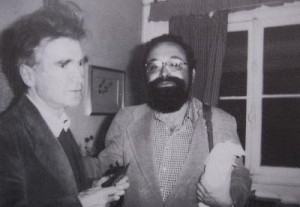
Cioran and Savater

Speaking of Cioran, Rosset said: “His pessimism is triggered by finding that the paradox of existence is to be something and at the same time, not to count for nothing. It is an atypical pessimism … resulting from knowing the ephemeral nature of man, the smallness of man. “

Rosset claimed the “tragic thinking” in the face of perfectionism and opposed the radical of Cioran, while acknowledging the lucidity of his arguments and reasons for his skepticism. For Rosset “There is no good in the world but that lucid examination ultimately makes it seem laughable and contemptible.”

The work of both essayists, of unusual originality, was released in France, Spain and other nations of Europe and America. Among the books published in Spain by Clément Rosset are The anti-nature (Taurus, 1974), The logic of the worst (S. Barral, 1976) Reality and its double (Jonathan Cape, 1983), The principle of cruelty (Pre-Texts , 1994), and Force majeure (2000).

We will not dwell on the texts Rosset, defined by Emil Cioran as “… a bon vivant who philosophy has not spoiled.” Now, however, some considerations of Fernando Savater on Cioran, expressed in his article “A man surprised … and surprising.

The Spanish essayist recalls that Cioran “became a great French writer, but remained stateless. Spain was his second spiritual home, the native land of disenchantment, where he was sometimes more popular than in France. His readers were young from the anti-Franco left, but for him “the left was a hotbed of vacuous illusions and unfounded optimism.”

He notes that “the wonder approached us. There was a feeling of implacable hostility to any mobilizing belief and absolute rejection of the promise of future … “

He describes his encounters with the Romanian philosopher and warns: “… I could never convince him nor trick him … we accepted the pragmatic: are trying to live better, not to reach paradise. After the fall of Ceausescu, Cioran was inclined to a kind of skeptical pragmatism, I saw him celebrate historical events, without triumphant outbursts. “

Savater calls him “incurably skeptical in theory but capable at times of an almost childlike wonder at the effective mechanisms of the world and the miracles of friendship. Cioran remained in the land of wonder … he was amazed especially in that in life the marvelous coexisted with the horror …”

Some titles of his works have their own voice. We can extract the following: In the heights of despair (1936), Breviary of putrefaction (1949), Syllogisms of Bitterness (1952), The temptation to exist (1956), Falling in time (1966), The inconvenience of having been born (1973) and the last book dating from 1983, My damned self.

Cioran with his hands around his neck

The Spanish thinker evoked the grave of the master, “a blue-gray stone, sober and minimalist” in the Montparnasse cemetery, like a great unknown; close to authors such as Sartre and Simone de Beauvoir, Julio Cortazar and Baudelaire.

In the end, Savater offered a collection of the “swipes” of Cioran. O share with Cuban readers some of those phrases about life, God, time, death or philosophy. Perhaps they will contribute to our spiritual enrichment.

“We do not always move attracted to light: sometimes it is the shadow that drives us …”

“A walk through the cemetery is an almost automatic lesson in wisdom.”

“The fact that life has no meaning is a reason to live, the only one, the reality.”

“To love your neighbor is unthinkable. Perhaps you would ask one virus to love another virus? “

“God is a disease we imagine to be cured because no one dies of it today.”

“Nature, seeking a formula to satisfy everyone, finally chose death, which, unsurprisingly, has not satisfied anyone.”

Literature. “The literature begins with praise and ends with exercises.”

“What would become of our tragedies if an insect presented us with his?”

“To glimpse the essence should not be exercised by any trade. We must remain lying down all day, and moan.”

“A people is not so much an accumulation of ideas and theories as of obsessions.”

October 13 2011

Stumbles / Regina Coyula

A well-known director, with the successful underground saga of Nicanor and numerous jobs as a scriptwriter, Eduardo del Llano had lit expectations with his first feature film. Thus a preview of the news that his film had not been admitted to the competition at the Festival de Cine de la Habana aroused interest. He speculated that the overlapping of the renaissance plot with today’s reality was the reason he was banned from the festival. The phrase “make no mistake, my film is great,” that I read on the blog of Del Llano did nothing but spur my curiosity.

My curiosity, coincidentally, was satisfied the day I read Eduardo del Llano’s response* to a critique from Orlando Luis Pardo. I looked up the review, I searched the counter-criticism, and as it was so hyper-critical, I was disposed to see Vinci.

Eduardo del Llano decides to respond with heavy artillery to the criticism of Orlando Luis Pardo Lazo. Were it me, I wouldn’t have cared for Orlando’s criticism. But after turning red, and green, taking a deep breath, and taking a diazepam to sleep that nights, as a creator I would be grateful there are people who look beyond what we saw, who point out defects where we imagine only virtues, because an artist without criticism is like a plant without water, if I may use a somewhat exaggerated and kitsch image.

To appeal, in response, to personal allusions that have nothing to do with Pardo’s text, neither improves Vinci nor leaves a good impression of Del Llano. When a work is made public, a part of it ceases to belong to its creator. Eduardo del Llano should draw lessons from this incident, and not stumble for a third time.

*Translator’s note:
Orlando Luis Pardo Lazo’s film critique of
Vinci is still being translated and will appear on this site; in short it panned the film. Eduardo del Llano wrote a lengthy response in which he suggested that the initials of Orlando’s name stand for an organization of “Latin American Pedophiles” and repeatedly addressed Orlando as “Pederast”; this response was printed in Jiribilla, the official magazine of Cuban culture.

February 24 2012

Country of Pixels / Marcos García Rodríguez

We work for efficiency and economy


”]
We have the solution to your problem


Toilet


Revolution: Change, Equality, Full Freedom, To be treated and to treat others as human beings


Don't touch


Smoking Prohibited Explosive


"Hope" butcher shop


Fight, resist and conquer. CDR= Committee for the Defense of the Revolution


Esta obra ha sido debidamente registrada en el Centro Nacional de Derechos de Autor y pertenece por entero al autor. Queda prohibido utilizarla en parte o en su conjunto por cualquier medio, soporte o forma de comunicación sin permiso expreso del autor.

[Photos may not be used in any way without express permission of author]

When / Rafael León Rodríguez

When a country is forced to live in a history, revised and corrected according to the interests of an undemocratic regime beyond its fiftieth anniversary, events crowd and overlap each other.

February 24th is primarily remembered as the beginning of the 1895 War of Independence, led by José Martí. More recently by the failed Cuban Council and the shooting down, in 1996, of two Brothers to the Rescue planes.

It is also the day that Orlando Zapata Tamayo died in prison of a hunger strike, two years ago. And this latest commemoration provokes, right now, one of the acts of repudiation — reprehensible — so notable in these time. This time the headquarters of the Ladies in White in the capital, where a significant number of them have gathered to honor the memory of fallen of February 23, 2010, whose funeral the political opposition was prevented from participating in.

Again, repression, arbitrary arrests and intimidation. The question continues to be when will we commemorate the end of this dark period of our nation. When will we celebrate the arrival of civil liberties. When will respect for the basic human rights of Cuban citizens once again be part of the Law of Laws of the Republic of Cuba.

26 February 2012

Some Yes, Others No / Yoani Sánchez

Miriam Celaya is second from right in the right hand photo. Images taken from www.europapress.es y cambiosencuba.blogspot.com/

I turned on the TV, in one of those fits of credulity which now and then assail me. I wanted to hear the evening news, to know some news, to feel closer to the reality of Syria, so distant and so near. But here information is not measured by its importance in the rest of the world… so, patience, great patience. First came a report about some agricultural crops whose growth we have not noticed on our plates; a story about the increase in beans, bananas or quarts of milk that are still playing hide and seek with our mouths. I endured it. I wouldn’t take my eyes from the screen until I had heard about the deaths in Homs, the declarations of the Arab League, and the deaths of two journalists resulting from a bombing.

The minutes passed, uninformed and anxious. Suddenly I see a photo in which the blogger Miriam Celaya and other acquaintances appear, surrounded with epithets such as “mercenaries” and “traitors.” The reason was their participation in a workshop on digital media, held at the home of an official from the United States Interest Section. Outside a group of restless official paparazzi were taking photographs of the event to illustrate their later telling of it, in their own way, on national television. Whenever something like this happens, I wonder why the Cuban government keeps open a representation of the United States on the Island if — as they say — it is a “nest of provocation.” The answer is contained within the question itself: they would not be able to govern without putting the blame for the growing discontent on someone else. And, in addition, if the thousands of people who line up each week outside this diplomatic site to emigrate felt that there was no other outlet for their frustration, most likely they would take to our streets, to our plazas. In short, the Foreign Ministry suffers a visible conflict of avoidance-approach, love-hate, get away from me-I need you.

I would also love to know what happens to American citizens who visit the corresponding Cuban office on the soil of our neighbor to the north. Are their faces also broadcast on the news, accompanied by insults? Diplomacy, despite what many think, occurs not at the level of governments or presidential palaces, but person to person. So every Cuban should have the sovereign right to visit the embassies of Iran or Israel, Bolivia or Chile, Russia or Germany. Given that these contacts are not a crime under the penal code, they should be allowed and encouraged. The job of the government would be to protect these exchanges, not to dynamite them.

Even more surprising, the next day on the same boring news show, I see images of Raul Castro meeting with two important United States senators. But in his case they do not present him as a “traitor” or a “worm,” but as the First Secretary of the Communist Party. I know that many will try to explain to me that “he can because he is a leader.” In response to which, allow me to remind them, the president of a nation is just a public servant, he cannot engage in an action that is prohibited or demonized to his fellow citizens. If he is empowered to do it, why is Miriam Celaya not. Why not invite this woman, an anthropologist and magnificent citizen journalist who was born in 1959, the year of the Revolution itself, to some public center to relate her experience in working in the digital press, rather than relegate her to some locale provided to her by “others.” Why not dare to allow her one minute — even if it is only in the worst hour in the middle of the night — to speak on the official television that censors and stigmatizes her?

The saddest thing is that the answer to all these questions will never appear in this dull newscast at one in the afternoon, nor in the morning, nor at eight o’clock at night, nor at…

26 February 2012

Gorki Freed / El Sexto – Danilo Maldonado Machado

I just spoke with Gorki. He, El Sexto and Ciro were going to do a performance last night at G and 23rd Street. When they were around 23rd and F around 11:00 PM they were rushed by a mob.
“There were a lot of them,” Gorki said.
As Ciro was already at G Street, he didn’t see them taken away.
Now, around noon, they let them leave the police station near Porvenir Ave. in Lawton, which they got out of with a lot of trouble (public transport is the worst, as we all know).
The reason for the detention was to prevent their putting on the performance at all costs… and NO, it had not been announced ahead of time.
Danilo will write a full account of what happened shortly.
Translator’s note: The last few entries in El Sexto’s blog have clearly been written by a friend, but no name is given.


El Sexto Released / El Sexto – Danilo Maldonado

Danilo is now home, they brought him early. He spent the night in the Zapata police station, without knowing where they had taken Gorki. He said that yesterday 30 plainclothes State Security officials attacked him and Gorki at G and 23rd. As of right now he knows nothing of Gorki.

Translator’s note: In Tweets, it was reported that Gorki’s arrest was particularly violent and he was slammed against a wall.

For breaking the silence they called her "hard line" / Miguel Iturria Savón

Ladies in White and of Iron… "The Streets Belong to the Nation"

The divorce between the management of information and the Cuban reality is repeatedly striking, at least in the official press, a specialist in softening the country’s situation, exalting the allies of the regime, disparaging perceived enemies internal and external, repeating the hallelujahs of the government on reforms, blowing foreign correspondents out of proportion, as if there were a pact between the rules of Press Center in Havana and the agencies represented on the island.

Sometimes we see on television the face of some peaceful opponents, especially the Ladies in White, who from now on parade without the presence of Laura — alma mater of the movement; the blogger Yoani Sanchez, independent journalist Guillermo Fariñas Hernández, lay communicator Dagoberto Valdes and other Democrats demonized as “agents of empire.” Such a reduction masks the repressors, protected by impunity, the tradition of terror and the indolence of the majority with regards to national events.

As if it were too little for a nation disconnected from the free flow of information and essential freedoms that encourage individual and collective development, not just that the government denies the emerging sectors of civil society, however minor, if not the accredited correspondents in Havana and even a sector of exile they associate with the “reaction of Miami,” as if such “reaction” was not the result of exclusion and intolerance of those who have, for half a century, been leading Cuba against wind or tide.

They speak contemptuously of the opponents as “hard line,” of “the crossroads of dissent,” the efforts of the Ladies in White marching in the streets despite “having no cause and without some of its best-known characters” as a result of the release of the prisoners in the spring of 2003. From Miami they comment, of course, on the increase in and continuing brief detentions, evidenced by the comprehensive report of Elizardo Sanchez Santa Cruz, leader of the Commission on Human Rights and National Reconciliation.

Independent of respect for opposing views, validated in the right to freedom of expression, as vilified in Cuba as freedom of press, association and others with they violate daily, I think those who speak of the hardline opposition within the island exaggerate.

There is nothing hard in insisting on meeting, celebrating the anniversary of certain events, demanding an end to police harassment, marching peacefully through the streets, giving interviews to Radio Martí and Cubanet and disseminating documents or proposals to the government. What happens is that the we have finally breached the “pact of silence” with which we are infected by the machinery of terror. Is the language hard? Perhaps, but less rabid than the campaigns in the newspaper Granma against the United States.

Since Batista’s coup in 1952, Cuban policy is marked by the hard-line. The struggle between the despot and the opposition ended with the flight of the tyrant on December 31, 1958, before the lawlessness caused by the bombs, the urban “executions,” and the guerrilla actions in the Escambray and Sierra Maestra.

The revolutionaries of the time came to power through violence, shot thousands of people and imposed terror within their own ranks. Thanks to the terror and the alliance with the Soviet Union they eliminated republican institutions and wiped out those who confronted the new dictatorship of the Castros, which is still playing hardball to preserve the revolutionary pipe dream.

To play hardball means to engage in violence, at least for the government. The opponents know that after half a century of “revolutionary” rhetoric, economic involution and demoralization of the population, violence has no horizon. They do not confuse the media declarations with possible actions.

October 21 2011

The Tale of Despereaux / Lilianne Ruz

On February 15 I did an experiment. In the elevator I told my neighbors Robinson and Romualdo, “Gentlemen, it’s a shame you can not hear Radio Martí because yesterday I gave an interview talking about Love.”

Silences, glances … “Well,” says Robinson-but you were speaking of Love”

“If it was not only of love, it is my right to express my opinion,” I said.

What I want to show, although we all know it, is that in the minds of Cubans, adults over 50 years, the threat of punishment for expressing free opinion with which we have been educated through the Black Spring of 2003 and the 75 political prisoners, weighs heavily on them. Tell if me if that is right.

A lawyer friend, a very decent women whom I respect and love, told me as a part of her overview of existential possibilities: “In all countries there are laws that must be met.”

“Well, but what about,” I said to her, “if is is the State that is violating my rights? Can I punish the State. It’s true I don’t have the methods to do so because they are not contemplated in the Law. Is that justice? I do not steal. I do not bear false witness against a man who dies on hunger strike without any attention to his demands or to the deterioration of his health. Can I sue the prison guards, the entire apparatus and the prison doctors, the latter for willful neglect? Because even if it was imposed by force of an order that they be negligent, the decision is left to their own conscience even if they have to suffer the consequences of this chain of injustices.”

I go with my daughter to see the film “The Tale of Despereaux” …

“Think about this: What happens when you do something illegal that is a natural part of the world?, Could they make flies illegal, or sweat, or Sunday mornings?”

And the princess: “Have you ever talked about a book? … The story said she was a prisoner, but that was not entirely true because she had hope, and when there is hope you’re not really anyone’s prisoner.”

What use are so many fables to feed the hearts of children, and now we teach our children, where good always triumphs and courage and hope are rewarded?

This is not politics, this is more serious, it is about living or dying.

“It is good to live, horrible to live dead,” Martí used to say. Nothing and nobody can steal the possibility that we have in life to seek the light, to have a star that guides us, a sense, an answer, the company unsurpassed, as Lezama said.

And that is only reached when we do not just dream but when we begin to respond. For what do we need poetry, the Gospels, the Tao Te Ching, meditation, if not to throw the light and be blessed by it, taking part. I do not want any of those things to be burrows because I am not a mouse.

February 25 2012

Route P2 or 2 Feet / Anddy Sierra Alvarez

These "buses" are called "camels" because of the humps. They have a "crush load" capacity of 300 people.

Transport has once again become an unbearable nightmare. It seems that public transport in the Cuban capital will never stop being a problem for society.

The truth is that after the fall of the socialist bloc, Cuba entered the Special Period and little by little this service was affected, until it became an inconvenience for citizens. Although there was a small improvement after the arrival of the Chinese buses assigned to routes identified with the letter “P.”

Today in the year 2012, the deterioration of the main streets, the little concern for people, lack of maintenance of these buses, or their incredible overuse because of the huge demands in the capital, we “still don’t know what will be the outcome,” with transport in the capital taken to the limit.

Three years ago you never saw it, but today you see the lines to get into the private cars (called boteros) and they even have a kind of “piquera” (a sort of carpooling stand), on 21st street between L and M in Vedado, the street leading to the entrance of the Hotel Nacional.

Jose is one of the drivers who travels the route from Vibora to Vedado, and he said the increase in the number of people who choose the service while waiting for the bus. The sacrifice of spending 10 pesos in national money, is essential for some because otherwise they won’t get to work on time.

February 20 2012

Gorki and El Sexto Arrested in Havana Saturday 11:00 PM / Orlando Luis Pardo Lazo

mobile.twitter.com/OLPL
Translated Tweets

Orlando Luis Pardo
OLPL State Security HATE me for tweeting this but never arrested me: they have prepared another more terrible end for me, like an accident or of health!
about 1 hour ago

Orlando Luis Pardo
OLPL State Security HATE Ismael de Diego but fear the international scandal because of his powerful family of Cuban poet Eliseo Diego …
about 1 hour ago

Orlando Luis Pardo
OLPL ALERT! It could happen violent revenge against Gorki Aguila and graffiti artist, prisoners to an unknown destination …!
about 1 hour ago

Orlando Luis Pardo
OLPL State Security HATE Gorki and Porno Para Ricardo because every day more and more they mock their system and leaders
about 1 hour ago

Orlando Luis Pardo
OLPL State Security HATE El Sexto because he tattooed @ Ladies in White Laura Pollan on his chest. They would have to burn off his skin to erase it …!
about 1 hour ago

Orlando Luis Pardo
OLPL Gorki Aguila is MISSING somewhere, fears they are beating him or he is a prisoner because today he defended himself with shouts against an agent without identification
about 1 hour ago

Orlando Luis Pardo
OLPL Danilo Maldonado (graffiti artist El Sexto) is held incommunicado at police station near Cerro, without perspective what they are doing with him.
about 1 hour ago

Orlando Luis Pardo
OLPL Ismael de Diego, resident in Cuba and abroad, was interviewed at police station and they released him without explanation …
about 1 hour ago

Orlando Luis Pardo
OLPL The missing from on a public street are Gorki, El Sexto, and musician-actor and film-maker Ismael de Diego, a grandson of the poet Eliseo Diego
about 1 hour ago

Orlando Luis Pardo
OLPL twenty paramilitary thugs attacked at 23 and F, 11pm, Vedado, Havana, Cuba against 3 free citizens and arrested them!
about 1 hour ago

Orlando Luis Pardo
OLPL Gorki and El Sexto arrested in Havana Saturday 11pm twitpic.com/8ouo0h
about 2 hours ago

Orlando Luis Pardo
OLPL Gorky resisted the attack of treason and wanted to fight back in self-defense and offended his attacker in plain clothes and shouted: DOWN WITH THE SNITCHES, DOWN WITH FIDEL
about 2 hours ago

Orlando Luis Pardo
OLPL A man assaulted Gorky in his building today and warned that if he was still filming provocations they would FUCK HIM UP. Gorky resisted …
about 2 hours ago

Orlando Luis Pardo
OLPL Porno Para Ricardo suffered 25 threats all Saturday and assaults to stop the provocations, at the home of musicians Renay and Gorky.
about 3 hours ago

Orlando Luis Pardo
OLPL URGENT! Gorki Aguila of Porno Para Ricardo and graffiti artist El Sexto arrested in G street, Vedado, about 11pm by mob @idolidiadarias
about 3 hours ago


February 26 2012

Cuba: For 53 years the paper supports everything they write / Angel Santiesteban

The most official newspaper, the voice of the only political party in Cuba, is cynical enough to publish an article entitled: “The dark side of democracy,” by the “journalist” and Bolivian university “professor,” national “Senator” for the Socialist Movement party (MAS), “former director”of the weekly “Here” and former candidate in 2002 for vice president of Bolivia with coca grower Evo Morales, Antonio Peredo Leigue, who begins by quoting the dictionary of the Royal Spanish Language Academy, in its two meanings of the word “democracy.”

Then, ignoring our geographical position, because by saying: “I will not mention any examples of Our America, where everyone feels acutely the critical need to dissect what happens in each of our countries,” he loses the social sense of what happens in Cuba.

So we infer that he Olympically ignores Cubans who for over fifty years have not the least rights (according to the dictionary) to comment, disagree, criticize or complain, about what happens in our country, for what the “journalist” shows a total ignorance of the circumstances in which we live the on this island. And if his intention was to include us in the continent, we who do not really have our place in the Western Hemisphere, than any of the residents in Cuba who provides critical testimony to the system sinks into the most extreme of the absurd circumstances overcoming, even, the Kafkaesque occurrences, we have only neighbors, on this imaginary and marginal planet, in North Korea and China. So, definitely, Mr. Journalist who published that article in the newspaper Granma, you did not take us into account.

But all this, according to the journalist, is to make a scapegoat of the European Union, hence the publication of the communist libel, although it’s clear that the regime’s censors did not read line by line, or perhaps their attitude reaffirms what we have known for a long time: that faced with such a disadvantage in international public opinion, they have lost all shame, and the only thing that matters is trying to manipulate the people of Cuba, although they don’t manage it, because the silence of its citizens is the response of fear, and the officialdom is committed to that.

Later, the columnist says, “The Universal Declaration of Human Rights states, clearly and promptly, the right to life and decent work for all people in all countries. This is the foundation of democracy. In some countries it is more problematic than in others to fulfill that statement. “

If the journalist had written this piece in Cuba, they certainly would not have published it in any media, because it is too ambiguous, too close to the demands of Cuban dissidents. It would have certainly suffered censorship and ideological position would have been challenged, as all are obliged to think uniformly, and although they do not, most of them fake it.

For us, if demand the same, we are branded as traitors, spies, we are in collusion with the enemy they choose, they fabricate. Surely, such a journalist, with his ideas, would be part of those persecuted by and inquisitive government machinery of the Castro brothers.

With pleasure we would explain this to all those foreigners who distort the Cuban reality; although I still doubt that they can be as innocent, or simply bought off with some with a benefit paid to them by the Cuban regime, not always with money; the most common bribes to intellectuals and journalists, those of the “Left”, are often invitations to the island with all expenses paid.

February 25 2012

Sexuality Equals Diversity / Wendy Iriepa and Ignacio Estrada

In 1974 the American Psychiatric Association eliminated from its Manual of Mental Disorders, homosexuality and bisexuality, meanwhile numerous scientific institutions and associations in the world took the same position. But it was not until May 17, 1990 that the World Health Organization (WHO) unanimously approved it.

When May 17 was introduced as the international day of struggle against homophobia, it became a date the celebration of which brings together a large number of countries including Cuba, but unlike what happens in other countries, in Cuba the festival has political connotation under the current government of Raul Castro Ruz and everything on this day is orchestrated by his daughter Mariela Castro Espin, current director of the National Center for Sex Education (CENESEX).

To understand the homo and bisexuality as variations of healthy sexual life, like heterosexuality, it is necessary to understand the processes that influence its formation and development:

Sex:

Is the set of biological attributes of a sexual nature that distinguish humans physically into two groups: men and women.

Gender:

It is the socio-cultural, historic construction which defines the set of attributes, qualities, traits, attitudes and modes of behavior assigned and expected by every society of men and women, that guide and shape rigidly all behavioral expressions in one’s personal life, as a couple, family and society.

Sexuality:

Is the dimension of personality that is constructed and expressed from birth and throughout life through the process of development of masculinity or femininity, to learn to be a man or a woman, which transcends the relationship of a couple to manifest in all that the person “is” and “does” in his personal life, family and society.

It is experienced or expressed through gender identity and sexual orientation in thoughts, fantasies, desires, beliefs, attitudes and values. Practical activities in all human relationships. Sexuality is the result of the interaction of biological, psychological, socioeconomic, environmental, cultural, ethical and religious factors.

Sexual Orientation:

Sexual orientation refers to erotic attraction, which also includes bonding to another person of the same sex, the other sex, or both. It can manifest as behaviors, thoughts, fantasy or sexual desires, or a combination thereof.

People are considered “HOMOSEXUAL” if they are attracted to others of their own sex, but also used is the English term “GAY” to refer to men who are attracted to other men and to lesbians when it comes to the attraction between the women. Although it is valid to clarify that in the case of Cuba the lesbian community does not like being called by the term “GAY”. If erotic desire is directed towards both persons of the same and different gender, we consider this person “BISEXUAL”.

However, the dominant cultures have favored only the erotic attraction between people of different sexes and what’s more the formalization of their ties through marriage whether in a civil or church ceremony and the guaranteeing of reproduction. With this logic imposed throughout history, “HETEROSEXUAL” people enjoy greater rights under the law, being considered the standard and reference for all human beings.

Gender Identity:

It is the consciousness and feeling, that is turned into the conviction of being a man or a woman, male or female. The identity originates and develops from birth to five or eight years. When the child understands that sex is not going to change and evolve throughout life.

Gender Role:

It is the particular way in which each person interprets, constructs and expresses, in their everyday behavior, models of male and female established in the society in which he or she lives. It is the public expression of gender identity, mediated by stereotypical models of masculinity and femininity.

Models of Gender that stereotype and distort the masculinity and femininity often prevent girls and boys, women and men from expressing their sexuality and each of its components (identity, gender role and sexual orientation) in a genuine, free, pleasant and responsible way.

Homophobia:

It is the general hostility, psychological and social, towards people with sexual orientation different from heterosexuality (Gay and Bisexual), so specific and including Gayphobia and Lesbophobia. Transphobia is general hostility, psychological and social, towards people whose gender identity does not match their biological sex (transsexuals).

The transsexual person is characterized by a gender identity that does not correspond with their sex. It is a biological female who identifies as a man or a biological man who identifies as a woman. Sexual orientation (sex-erotic) may be heterosexual, homosexual or bisexual.

The TRANSVESTITE person feels complacency in integrating into their self image attributes, attitudes, gestures, costumes and accessories that culture assigns, as stereotypes, to the opposite sex. This feature does not imply conflicts with their gender identity, so the person is not a transsexual. Sexual orientation (sex-erotic) may be heterosexual, homosexual, or bisexual.

TRANSFORMISTS are those who in the performance of a role, mainly artistic, uses attributes, gestures, costumes and accessories normalized by the dominant culture, as those of the opposite sex. This feature does not imply conflicts with their gender identity, so this person is not a transsexual, but there is no contradiction with self-image, so the person not a transvestite. Sexual orientation (sex-erotic) may be heterosexual, homosexual or bisexual.

Homophobia is characterized by the acceptance and valuing of people who reproduce the socially established gender stereotype for women and men, which is reduced to a heterosexual sexuality, marriage and reproductive health, in contempt, discrimination, devaluation and even violence against all those who deviate from this rigid pattern.

Homophobia and Transphobia follow the same trend of undervaluation and discrimination imposed by ideology that is macho, sexist, racist, classist, anti-Semitic, xenophobic, among others, pursuing the same objective, the dehumanization of the other, inexorably making him or her different and inferior.

Homophobia is prejudice, ignorance, violence. It threatens the values of equity, solidarity, social justice and respect for sexual diversity as one of the greatest assets available to mankind.

January 30 2012