Fruit and Vegetable Carts: Progress or Regression? / Rebeca Monzo

For the last few months, since the new apertures from the government, the city has been filled with carts selling various agricultural products. They differ from the existing agricultural markets, precisely because of the variety and presentation offered. Many people have called this progress but it is, in my humble opinion, quite the opposite.

It is true that they are solving a problem of the people, and they are themselves opting for a job that until now was practically underground, and which was almost lost — street vendor – which allows them to be self-employed and to make a living for them and their families. What’s more, in most cases these are young men and even women who did not continue their studies, perhaps due to lack of support.

This profession of peddling with carts flourished in the forties, but already by the early fifties, due to social progress, it was disappearing, giving way to establishments where what was offered was more stable and pleasant, with all these agricultural products both local fruits and imported. What we have now is that the former stores of this type are closed and vacant, and in their doorways, without any kind of hygiene, piled up in old dirty drawers, are the products, leaving the sidewalks and streets full of their red dirt, once they’ve finished selling, making the city even dirtier than it already is.

With the emergence and proliferation of supermarkets, these carts disappeared permanently from the big city, and were found only in some neighborhoods on the outskirts, but in smaller numbers.

Now, in the 21st century, in 2012, they are resurfacing as on Fenix Street. Most people consider it an achievement, as they see agricultural products and some fruits reappearing, clean and well presented, with better quality and prices than in state shops, where they sell them with soil, roots and leaves included, and where you have to be alert not to be fooled by the prices, because the weight includes all of the above waste.On the one hand, it is nice to see this new activity reappear, but on the other hand it is a sad fact that all the young labor force that could be working in a large and pleasant supermarket, with good working conditions, as required by progress, rather than having to push these carts from sunrise to sunset in different neighborhoods, and to endure nasty comments from some retrograde or official-like people, who tend to criticize, not realizing that they too are part of the same suffering people, and they are trying to defend a system that has only made us all regress.

It is said that soon the authorities will prohibit all this once again. Is there any foundation in that? Because they enrich and offer products that do not exist in the state agricultural markets. If it were not so tragic, it would be laughable. The real reason for their possible elimination is that every day, they are a public demonstration of the government’s inability to solve the most pressing problems.

February 26 2012

For a Culture Without Custodians / Miguel Iturria Savón

Alfredo Guevara

In Cuba we barely acknowledge the discovery of America by Christopher Columbus, on October 12, 1492, and his arrival on our shores on the 24th, as if the conquest and colonization by Spain were an outstanding bill and not an event from the past of historical and cultural significance. Officially, National Culture Day celebrates the start of the war of Independence — October 10, 1868 — and the entrance of the patriots into Bayamo on the 20th in that same month and year.

Such a bellicose perception distorts the country’s cultural heritage, burdened by the bureaucracy of the State, political ideology and the creation of a system of stars, subject to the network of monopolies that control artistic and literary production.

In the culture that preceded the Revolutionary destructuring process of 1959, influenced by the redesign of relations with the United States starting in 1902, and the migratory waves of Spanish and Caribbean who came in search of jobs and boosted the production and trade of the island , turned into one of the most prosperous nations of the continent.

In the mid-twentieth century Cuba faced socioeconomic changes that bankrupted traditional values: the advance of the so-called mass culture, based on the expansion of radio, TV, film, in education and the media. Urban architecture was driven by public and private, mainly in Havana and Varadero, investing in tourism sites, where the hotel industry and real estate took the lead, which generated jobs and alternative collateral.

With the socio-political changes spontaneous manifestations of culture were interrupted. The affiliation with the socialist model in Eastern Europe led to the system of government agencies that monopolized the areas of artistic creation. The Cuban Book Institute, the National Music Center, the Institute of Cinematographic Art and Industry (ICAIC), the Council for the Performing Arts, the Institute of Radio and Television, the Center for Art and Design and groups like the National Ballet , Contemporary Dance or the Folk Assembly directed artistic production based on political and governmental interests.

The ICAIC, founded in March 1959, exemplifies the ideological control over the culture. Its founder, Alfredo Guevara, castrated the creative intellect of Cuban filmmakers. This character was essential in the long film industry of the tyranny, in whose controversial way statism was imposed and the critics of the New Cinema excluded, within which Gutierrez Alea, Humberto Solás and others survived.

The bureaucratization required creators to conform to the network of state centers. The officials issued rules, instituted censorship and stressed submission through the award system, including editions of books, recordings and foreign travel, which favored the opportunism and unleashed persecution upon and the exodus of those who challenged the canons of power. In this context, the affiliation to the Union of Journalists of Cuba (UPEC) or UNEAC (Union of Writers and Artists of Cuba), became collateral, as artists and writers are legally deprived of personality and tied to the schema.

From the colloquialism of the poetic we turned to poetry of the slogan, the narrative of violence, socialist realism and scriptural grayness that mythologized the Leader and his legion of “heroes.” Purges, epiphanies, trading in praise and even a National Movement for the Nueva Trova to reject the troubadour tradition begun by Pepe Sanchez in the nineteenth century and continued by Sindo Garay and Miguel Matamoros.

You had to march or dance in tune to the rules and precepts of the Leader and his party, at least until 1990, when the lack of economic resources caused by the fall of the Soviet bloc accelerated the crisis of the monopolistic institutions and the exodus of artists to other nations.

Alfredo Guevara, founder and former head of the ICAIC, receiving an award from Raul Castro

Perhaps the best of the official culture is the art education system, as it favored the education of trainers and arts schools tripled. The promotion of community culture and festivals of fans encouraged the emergence of cultural centers, museums, galleries and public libraries, installed in old cinemas, closed schools and new locations.

The imposition of rules and the bowing to the power affected musicians and actors, dancers and visual artists, writers and journalists. The dependence is emphasized in the media and provincial and community institutions also subject to local government bodies.

By submitting intellectuality to the rules of power through punishments and rewards that encourage opportunism and degrade the privileged, a market in perks was created based on dogmas and affiliations. The interplay extends to the new technologies and the shares of power allocated to the National Union of Writers and Artists of Cuba, whose subsidiaries determine the feasibility of projects, editions and travel abroad with very little subtlety.

Despite the passage of time, the exodus of artists and involution of the country, the regime insists on imposing limits on the culture, converting its elites in appendages to the state bureaucracy. Silence and complicity favor the supposed unanimity to the detriment of the differences and freedom that characterize the expressions of art.

October 31 2011

Tool Box / Yoani Sánchez

Several months ago a friend gave me this magnificent manual entitled “Toolbox for citizen control of corruption.” Accompanied by a CD with numerous practical examples, I have read it in search of answers to a scourge that hits us harder every day. Right now we are surrounded by calls to eliminate the diversion of resources and theft in State enterprises. Thus, I have immersed myself in the pages of this book to learn what we, as individuals, can do in the face of such occurrences. Not surprisingly, I discover a word repeated over and over throughout every chapter: transparency. An effective anti-corruption campaign must be tied to exposure and denunciations in the national media. For every misappropriation a news report must offer the details, each embezzlement must face the most intense public criticism.

The calls made by the General-President at the recent conference of the Cuban Communist Party to eliminate secrecy, however, do not seem directed to throw all the necessary light on acts of this nature. There is an obvious selection of what can be said and what cannot be said, a clear line between what is publicly permitted and what is not. For example, still today, they have given us no details in the national press about the corruption in the Institute of Civil Aeronautics, which led to the dismissal of its president, Rogelio Acevedo. Nor a single word yet about the latest scandal in the banking system which has led to the investigation of several of its employees, although it still hasn’t “touched” anyone in senior management. And what about the fiber optic cable between Cuba and Venezuela, which hasn’t brought us Internet but rather rumors about functionaries ousted for having stolen a part of its budget. And these are not just whispers: it’s enough to travel through the recently repaired Linea Street tunnel to see that a good share of the materials destined for its restoration didn’t end up being used in it. Why doesn’t television talk about ALL of that?

It falls back into the same mistake: verticality. The fight against corruption is not only the task of a State or of the Comptroller General of the Republic. We citizens must all become involved, with the certainty that anyone can be called out for putting their hands in the national till. If the impression that there are “untouchables” continues to rule, thieves no one can judge because of their political history or their ideological fealty, then we cannot move forward. The day when we see one of these untouchables criticized on TV for diverting goods, adulterating prices, or lying about production figures, then we will begin to believe we are on the way to eliminating such a widespread problem. Meanwhile, I look at the manual I now have in my hands and it seems like nothing more than a list of improbable actions, a reservoir of illusions impractical here.

28 February 2012

WORDS AND THINGS / Lilianne Ruíz

When I was 17, in the midst of blackouts of the “special period”, I found a happiness in my heart. (I know what I’ve said but with a little patience you who read me will see where I’m going with this.)

It is only possible to speak of this in a language that resists time. Inherited. For a long time I tried to name my experience and lost, so I thought to share it with Rimbaud: “One evening I sat Beauty on my knees, and I found her bitter, and I reviled her,” from his second poem in “A Season in Hell,” a different reading, quieter and less iconoclastic. I think we both regretted not having known Beauty’s name. Temptations of language that kill us or give us life. It established a perfect parallel between “The Drunken Boat” and “The Dark Night,” and in this foolishness I passed many years.

To me the experience of the resurrection happened in front of a book that I think I have said before was the fourth Gospel, and through these words the locks were opened on my heart or my mind or my soul, and I only knew that I was saved from a very sad adolescence marked by family separations.

Then life was a feast overflowing with wine. Not even communism could take my freedom. In this moment I recovered my joy, my sense, I felt changed, loved and capable of love, from then I saw a life ahead of me.
What I cannot understand is why I wasn’t capable of recognizing what was happening in my country, perhaps I was very young, but meanwhile the world was like an open book and love was a fact — like a Let There Be Light. On the Malecon, in the year 1994, people were attacked by the Castro hordes. And I wondered what kind of thing was Nirvana. Smells like teen spirit.

That has been the most important experience of my life, and being a mother, the two have rescued me. So I do not see myself as a brace person in and of myself, I think I am only to the extent that I believe in God. But I believe in God not because a priest told me to, nor a preacher. I liked reading the Spanish mystics, because I believe in God in a vital way, and also for the poetry that unwittingly I can write.

I do not believe that Saint John of the Cross in writing the Dark Night of the Soul has done anything more than a navigation log, a Baroque blog. I wanted to talk about all this to explain why fearing the violence of the totalitarian Cuban State, I have no fear.

February 28 2012

STORIES OF THE THOUSAND AND ONE PERIOD, Part One / Mario Barroso

By K. Barth

When we thought we had it all resolved and the Bolshevik godfather would guarantee life for ever and ever, the beginning of the end came. The old and apparently well-formed USSR fell apart; that happens with giants with feet of clay.

I remember well the day I internalized the collapse of European socialism, personally I was also in process of transition, from high school to college and in the midst of this atmosphere of insecurity and a poor future prognosis, a feeling of uncertainty nearly strangled me; it was the uncertainty of a nation that was facing one of the major economic, political and spiritual crises in its history, although not the first, and much less the last of these crises; Cubans have learned to survive the declines of the totalitarian system that makes decisions like the tide flows, self-contradictory ones, all in its stubborn battle to prevail and not release the power and voice of command.

What would we do without the collaboration of the hammer and sickle? The Special Period, an unforgettable and traumatic step for those of us who live at the bottom, brought this question in red capital letters, but in any case the government — once the magic lamp was broken and the genie who had sustained it in the first decades of its existence disappeared — would have to take certain steps, openings or changes, even if they were not congenial to the Marxist and socialist ideology that we’d been introduced to in mind-blowing speeches full of slogans and mottoes.

Who knew a few years before the collapse that it would be the hard currency of the capitalist enemy that would give us some oxygen and revive us from our economic coma, the serious prognosis of which remains, even today. What’s more, who would have said that we would agree to foreign investment and, in consequence, the creation of a mixed economy, although it would be, and still is, the capitalist side that lifts us up, keeps us on our feet.

It was from this hard time, whose primary specialty was hunger and many shortages, that my antipathy toward the regime began to flourish, a regime whose only obsession was to prevail regardless of any consequence, always justifying its countless mistakes and defeats, the most significant of them, the economic and as our famous Karl Marx knew, after an economic injury a hopelessly maladjusted society arises, with the regrettable loss of moral and spiritual values, because man must feed his body first and then cultivate his spirit.

Despite all the misfortunes that the nineties brought us, in the fullness of my youth, I could still see things around me like the color of roses, and I think the decade of suffering also marked my life with countless emotions, the university, film festivals and huge lines to see the films on display, often trying to outsmart the doorkeepers and the police to enter the film for free because our pockets were completely empty and our desires to see good films huge.

Blackouts on the Malecon, the only way to see the stars from the city, with friends singing, filling the night with the sound of guitars and voices. That’s when I knew the reality of drugs in Cuba, especially in Havana, an issue that it was forbidden to touch on in the official media until it was too obvious; a troubadour friend singing lyrics that said, in one of his verses: “Furrows on the roof, energy restricted…” and then I understood through him that the furrows were of marijuana, and boys and girls my age were smoking to distance themselves from the hard conditions they faced; even today I can hardly explain how hard that reality was.

Although Christian and provincial, almost completely naive about stories, I could live with those young people in Havana filled with concerns about life and eager to escape the misery around them.

I also had friends in the center of the island, my best friend was from Santa Clara, a poet, together we created the rock of poetry where we invited all our troubadour acquaintances, then unknown in both domestic and foreign music.

Our favorite was Fernando Becquer with his wonderful deep voice and his restless figure, we sang, read poetry, drank tea, if only a tepid, watery concoction that could be called so, but nevertheless we were happy and had dreams.

We went every Friday to the home of the culture in Alamar, the rock of The Bicycle, where Pedro Luis Ferrer often sang. We would go despite our hunger and our growling stomachs with just a few coins to return to our student residence in Vedado.

One night after enjoying a banquetazo with Pedro Luis, we walked to the stop to catch a bus; during the special period at any hour or the day you could wait three or four hours, whether it was morning, afternoon, or midnight.

I preferred to walk rather than wait for the buses and the wait was so long that time that we decided to walk from Alamar to Vedado, but we only made it as far as the tunnel under the bay and they stopped us and wouldn’t let us continue with our long nocturnal trek and made us go to a nearby bus stop, exhausted and with a hunger greater than I’ve ever felt in my entire life.

From so much walking and so little eating, I had gotten down to only ninety-six pounds and was so underweight and malnourished, and not only my body began to suffer the ravages of that terrible period, but my shoes as well, my white sneakers that I’d bought at one of the many pawn shops the government had opened so people could exchange jewelry, clothes and utensils of gold, silver, platinum and other valuable materials for trinkets, taking advantage of the need that we had to have clothes to wear.

For these tennis shoes and a couple of blouses and some jeans I had exchanged a small gold ring I’d inherited from my father’s childhood, another one, of the same metal and very beautiful, belonging to my mother, and some small earrings, the first I ever owned.

But the shoes were the only ones I had and they had began to come apart at the soles and had two holes, so you can imagine how the soles of my feet hurt walking on the hot asphalt, and I still have the marks of that today, two large calluses on the bottom of each foot.

Those were my tennis shoes for all occasions. One night while listening to the sermon at the Methodist Church in Vedado, I crossed my feet and a sister told me not to because she could see the holes in my shoes. Smiling I told her that I wasn’t ashamed to show my poverty and that God loved me and in very special way. That answer brought me, like a prize, a pair of sandals that the sister got from the congregation, one of the happiest moments of my life.

Between the trips around town in the packed “buses” we called Camels, the terrible food in the student residence, and the scanty garments and shoes to clothe me, the little money I possessed came from my parents who would send me something from time to time and the miserable student stipend.

There were long and stinking journeys by train to see my family during vacations. Unbearable and endless blackouts that prevented me from sleeping at night. And so passed the end of my adolescence and my youth, during the Special Period, the nineties. My relentless pursuit of God and finding His presence in every step of the way, helped me to survive the times of most intense crisis.

When I remember this stage in my life and in the life of my nation, what I remember more than the personal pain is the social pain. We Cubans emerged from this time of total misery terrified. The anecdotes about the lack of soap and hygiene articles and other basic needs persist to this day Soups invented with the few available ingredients, rice, a few beans, plantains or some other vegetable, used to be the only meal of the day in many homes and people would beat their chests because other days would pass with no food at all.

Since then Cubans are so used to sharing with others that we habitually advise friends or relatives when we are coming to visit and arrive loaded down with supplies so as not to create havoc in the family with whom we share them.

One of the most cruel and deepest marks of this black decade was the rafter crisis, the great migratory stampede that came as a result of our material, economic and spiritual drowning. Like every other inhabitant of the island I have my own experiences of this, friends who left and managed to achieve their dream of prosperity and freedom. Others who ended up in the waters of the Straits of Florida.

Tragic stories that are also a scar that won’t stop bleeding. The country is divided, by the force of so many blows that still remain in our saddened land and those who left, whom we never forget, day after day, year after year, so many who departed. But these experiences I will speak of in a future post. Certainly I could write a thousand articles and not come to the end of the terrible nightmare of that night still without end, which can be summarized with a single name: The Cuban Socialist Model.

January 21 2012

Velazquez and the Stations of the Cross for a Cuban Family / Iván García

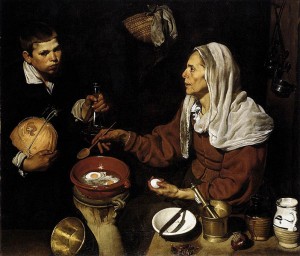
“Old Woman Cooking Eggs” is the title of this painting by Diego Velázquez (1599-1660), oil on canvas painted in Seville in 1618. This scene reminded me, 394 years later and thousands of miles away from the National Gallery of Scotland in Edinburgh, United Kingdom, where it is hung, of the precarious and colorless life of a Cuban family, the interior of a narrow kitchen illuminated with strong contrasts of light and shadow.

They make only one meal a day, breakfast is coffee without milk and a tasteless 80 gram biscuit without butter. And not always that. “Sometimes we eat the rationed bread at night, because we are often still hungry after eating. When this happens, the next morning, before going to work or school, we have a sip of coffee, nothing more,” says Zenaida Pena, 72 and the head of her family.

In an old house in the Havana neighborhood of Lawton, screaming for a coat of paint and a complete restoration, the Peña family lives. It consists of 7 people and they are part of that 40% of Cubans who receive neither dollars nor euros.

Three different generations under one roof. Four now, clarifies Zenaida, because a month ago the grandson of Yosbel, her youngest son, was born.

Leiden, the eldest daughter, twelve years ago divorced the father of her two children. Yara, 15, attends the ninth grade and you thinks that her future is to marry a foreigner and leave the country. Leinier, 19, is on track to be the guest of some prison for the repeated warnings of dangerousness piling up in his pre-criminal record.

Leida, the mother of Leinier, believes that the chief of police sector ’is fucking with her son.’ “Yes it is true that he rum almost every night and no work attracts him. Imagine it, with the salaries they pay, he wants to dress in the latest fashion and go nightclubbing. With my office work I can not satisfy his tastes. Even though I want him to change, I understand the reasons my son and other boys in the neighborhood take refuge in drink.”

The problem is that Leinier not only drinks rum. Like a high percentage of young people from Havana, for whom the future feels like a bad word, they will also try stronger emotions. And on the weekends they take up a collection from friends and acquire marijuana, pills of Parkisonil, or any other hallucinogen to put them ’in the clouds’.

Leinier has two passions, baseball and computers. Following baseball ball is easy. As his afternoons are idle, he takes the P-6 bus and goes to the old Cerro Stadium to enjoy a game of Industriales. But ’tinkering’ with a computer is not so easy. Nobody in his family has one. “Sometimes I play or learn things on the computer of a friend,” he says.

Zenaida, the grandmother, is retired and earns a pension of 197 pesos (8 dollars) which is spent to buy rice and vegetables. She is also in charge of cooking the only hot meal of the day.

Yosbel, the youngest son, sells slushies on 10 de October Avenue. On average earns 60 pesos a day. “All I do is look for food. My concern is that now I have a newborn kid. Thanks to neighbors down the street he sleeps in a crib. I would like to raise money to buy new clothes and a stroller. I try not to worry about tomorrow. But I am seriously concerned about the future of my son, my wife and family. I do not see how we can improve our situation,” he says.

Zenaida has her own theory about the shortcomings and difficulties. “The poor shall never cease to be fucked. But I want the Cuban leaders to know that there are families who never received a penny. What little they earn evaporates buying rice and we can barely feed ourselves as God intended. So, because I have no solution to our problems, from 11 in the morning I put on the radio and listen to the soap operas and do cábalas to see if I can come up with a number and I put it on the lottery and earn money help me overcome some hardships,” she says.

For her it’s a real pain on a daily basis what happens to put six plates of food on the table, soon to be seven when the grandson starts eating. Zenaida sits in a faded armchair in the room on paper with a stubby pencil, makes notes.

“Look my boy, this is not easy. The rice they give us on the ration lasts us two weeks. When that’s finished, every day I have to buy two pounds, it’s sold for 5 pesos a pound so 10 pesos in total. Throw in 18 pesos for three pounds of tomatoes, 6 pesos a pound. Two bunches of lettuce, 5 pesos each bunch, and 9 pesos for 6 eggs, at 1.50 each. All this makes a total of 47 pesos. But I don’t always that much. And I don’t have to tell you that you can’t cook without oil and tomato paste, which must be purchased in the ’shopping’ or hard currency stores. Beans and pork we eat once or twice a month when we can. I swear that I have wanted to kill myself,” she confesses.

Zenaida believes that a solution for poor families like yours, would be for the church or state to open dining rooms to offer free lunch to the homeless, the place to eat in or take away. “In Havana the lines that would form would be miles long,” she says.

The Pena family is no exception on the island. Some 40% of Cubans do not receive remittances from abroad. Or not earn and convertible pesos as a perk on their salary.

General Raul Castro often repeats that in Cuba beans are more important than cannons. But in his five-year term, he has failed to ensure that basic food prices are affordable for everyone. Nor has he stopped being a thief, who with a slash devours almost 90% of family income. Just to eat more or less well.

Nor has Castro II fulfilled his promise to put a glass of milk on the breakfast table of every Cuban. And his promises to improve the nutrition of the citizenry has not met expectations. If he has forgotten, the Peña family remembers.

February 26 2012

The Potato Came / Anddy Sierra Alvarez

It’s heard in the streets from several people selling potatoes, before the arrival of this product in the farmers markets, at the elevated price of 20 Cuban pesos, “a bag with four potatoes.”
“Until when,” says Sofia, a lady of 58, “it’s true that this is a bunch of crap we have to go through,” she continues indignantly. After the loss of production this tuber continues to be scarce over the full season.

After a week, it started to show up in the farmers markets, “desired by the citizens,” but then another challenge begins, how to buy it? The lines in some of the markets in the capital are stunning (and not all the markets are selling this product), with arguments, debates, fights, scams, and diversion of goods, all increasing the desperation to get home with a few potatoes to enjoy the lost flavor from a year ago.

“Even when” a woman said Stephanie, 58, “it is true that this is crap so you have to go” continues to express the indignant lady. After the loss of production is brought about by the shortage of potatoes in a full season.

For Cubans, the potato is the savior of many families, with a scrap of chicken and a lot of vegetables you can feed an army, hence the expression, “the potato helps.”

Translator’s note: The word for potato in Spanish, papa, and the word for pope, Papa, are the same. That nuance is not captured in this translation.

27 February 2012

Bad Handwriting in La Joven Cuba (28) / Regina Coyula

This is not in response to a post, but arises from the comments area. For better understanding I have copied Osmany’s words in italics; he is one of the administrators http://lajovencuba.wordpress.com, a blog developed at the University of Matanzas on which I comment regularly.

Dear Osmany: You were very helpful in responding to my comment, which leads to the exchange.

Osmany: You say that nothing has demonstrated the benefits of one-party system, but to me nothing has demonstrated the benefits of a multiparty system, where the opposition party does all it can to torpedo whatever drives the policy of the ruling party even if it is the best for the majority. Then comes the “punishment vote,” changes in the party in power, and the poor remain poor and the rich get richer, don’t you see?

Regina: I do not know why you are so pessimistic. I imagine a non-bipartisan, transparent, inclusive process. Empowered citizens, far from pressured, vote for the best terms of capacity, design and integrity. I am interested in a system where people like you and me are not seen as enemies (as we are not), an open system where the law is for everyone equally, in which the elections are accomplished by direct and secret vote.

Osmany: …you don’t doubt that those who ruled Cuba in 1958 will rule it again.

Regina: The vast majority of Cubans belong to the twenty-first century, I do not know about you, but I have confidence in young people. Could you point me a one-party government that combines prosperity and democracy?

Osmany: On other occasions you have referred to your “basement.” Do you think in a “free” Cuba they will take you into account. Now you are useful for thinking contrary to the government. But after?

Regina: A free Cuba doesn’t have to take me into account as an individual. Do you think I won’t continue to be critical of those who come after? The lack of criticism has done and continues to do great damage. In writing, I can be wrong or right, but I don’t do it on anyone’s orders. I plan to continue my personal blog as long as my cousin in Germany allows me to [by helping me to manage the blog].

Osmany: In your blog you promote whatever cause arises that is against Cuba, Zapata Tamayo for example. Do you think the future owners of Cuba will care about these people. Did you see what happened to Reina Luisa [Zapato Tamayo’s mother]?

Regina: Against Cuba, Osmany? Since when is a government Cuba? I want a nation without an owner, I don’t believe in the story of the wolf. Embrace the cause you believe in, but don’t identify with the concept of a nation, which should be inclusive, plural, open, “wide, democratic… finally, the sea.” [From a poem by Nicolas Guillen.]

Osmany: You refer to the blockade as an “embargo” which contradicts the image you want to give because you know well the difference between the one and the other, but fine, it’s your choice. Greetings to you too.

Regina: I refer to the blockade as an embargo, in the first place because the law that defines it is called the “Embargo Law” and, in the second place, to speak of a blockade has great political impact, but we are not subject to a blockade. And, be careful, you vote with both hands for its repeal and it seems to me detrimental to the sovereignty of third parties, the extraterritorial character of the Helms Burton and Torricelli acts.

I hope we can maintain this exchange, especially now that the pagination allows me to access the blog better. I hope for your feedback. Greetings to others and especially to you and your newly growing family.

February 27 2012

One More Wildcard / Fernando Dámaso

Photo: Rebeca

The term “national security” is fashionable in the world: in Mexico violence is an issue of national security; in Columbia it’s the narco-guerrillas; in the U.S. it’s illegal immigration. But here, not to be left out, we talk about it too. Issues of national security are important for countries, and so their governments dedicate preferential and serious attention to them.

However, when national security is used as a wildcard to encompass any problems, expand the base the conflict and resolution, suppress divergent views and support of political intolerance, it is vulgarized and is no longer taken seriously.

Recently, we often hear that food production, updating immigration regulations, access to Internet, electrical power generation, possession of satellite dishes, the transportation problem and even eradicating the marabou weed are national security issues. Much of what affects us seems to fit in this sack and that makes our lives a real hodgepodge.

We are apt to get attached to words, phrases, projects and programs, thinking they can serve to pull together different tasks that would otherwise be difficult to meet. For example, not long ago, within the program called Battle of Ideas, were included not only political and ideological activities themselves, but also others such as the repair of a hospital or a school, patching a street, the remodeling of a bakery or putting four benches in a park, etc., with the result that ordinary citizens made a joke of the whole thing (Enough of ideas already, they said), detracting from its seriousness and significance.

Something similar happened with the so-called Energy Revolution that inundated the country with generators and energy saving light bulbs, replacement of old electrical appliances (they brought you a new one and took away your old one and you had to start paying all over again), including refrigerators and air conditioners, along with rice cookers, water heaters, portable electric burners, and multipurpose pots (the so-called “Queen“) and then, over the months, it was diluted and the responsibility for maintaining it transferred to the shoulders and pockets of the population.

It might be convenient to take ourselves a little more seriously, give each case its real importance, without minimizing and also without broadening or manipulating it for some alleged advantages, more cyclical than real.

If now we were to think things through carefully before acting on them, and then to act calmly, deeply and without unnecessary haste, to focus responsibly on national security, stripping it of all the trash that has been tacked on it it, it would be a good decision.

February 26 2012

Paupers / Miguel Iturria Savón

At dawn last Monday, across 23rd street, between 10 and 12, Vedado, a lady very thin, poorly dressed, half blind and with a cane, begged me to lead her to the next block, that is to the corner of 12 and 21, where she had coffee every morning because she has no kitchen in the room she shares with her son, who goes back and forth from the asylum to the neighborhood. While accompanying her I asked her some things; on leaving her in the cafe I gave her ten pesos to have breakfast; I assumed for lunch she would eat in one of those destitute meal programs for indigents.

It is not pleasant to encounter people who walk out displaying their misery without any intention to do so. They carry it in their faces, dirty and disheveled clothes, shoes, hairstyle and even the soul. With few exceptions, they seem like unburied zombies, ghosts in the sun on the streets of our cities. No one more than they reveals the crisis and lack of opportunities in the country.

Poverty is greater than we suppose. Just look at the gray presence of people walking aimlessly. In that legion of beings alienated by famine, victims of the disparity between wages and prices of commodities, not only beggars belong, but also madmen without state support, the drunks who wander between home to the bar and the old people whose monthly check lasts a week.

Every day, the estimate of number of poor grows. There are the very poor, the totally, partial and circumstantial homeless. All interacting in an association, an association without legal representatives, whose presence belies the official slogans and raises questions about the statistics, so supportive on paper and so limited in their application.

While the beggars, alcoholics, the insane and the elderly who wander through the day and vanish at night, make up the most representative list, the squadron of extreme poverty is compounded by old ladies in the neighborhood, those who count their pesetas and curse the young clerk who alters their balance. The old ladies are followed by unemployed daughters-in-law and daughters, almost all housewives with husbands “can bring home the bacon” and force them to sell anything or to exchange their favors with the grocer, the butcher or the seller at an agricultural kiosk.

Add to the non-exclusive club of paupers the thousands of people who accustom themselves to surviving through devalued work and a symbolic checkbook; beggars of all kinds, thieves of trifles, those who shelter in bus and train terminals, visitors of stinking bars, cheap whorehouses, prohibited gambling houses, the tenements of aggressive people and thieves of storehouses and cafes, who take the risk for a little sugar or rice, a piece of bologna or a box of cigars.

It is true that despite everyday stresses, the pariahs of Cuba still enjoy “perks” in pharmacies, clinics and funeral homes; burials are still free but the mourners pay for the flowers, coffee and cars accompanying the deceased on his last walk; but the panorama of people who survive in the precariousness of Havana and other cities of the island is growing.

October 10 2011

Cubans and the Lessons from Myanmar / Ernesto Morales Licea

If a disturbing phrase from Milan Kundera affirms that man can never know how to deal the challenges of each day because life is a performance with no rehearsals, a painting without a sketch, a game played without training, then it is also true that there is a generally useful method for us to try to anticipate events, as fortune tellers sniff out the future in the palms of our hands.

It is this: to be attentive to history. Not the History in capital letters that we learn from our school books, but the history that is happening in this second all around us and of which we are an indivisible part.

We can say that for all Cubans, and in particular for the millions spread across the four corners of the earth, this is a method highly recommended for these times. Let’s look at it.

If the exiles from Myanmar — democratic citizens whom a fierce military junta forced to flee from their land over decades — had been told years ago that in 2012 there would be nothing stranger than the current situation of their country, they surely would not have believed it.

Burmese activists founded hundreds of organizations in exile, groups that served, especially starting in the ’90s, as the only sources of information about a country where it was impossible for observers and journalists to enter or leave.

In Thailand alone, Myanmar exiles created 200 associations to denounce and fight politically, receiving substantial funding and help from the international community. They were respected, and their demands for changes in a gagged and repressed country were heard.

But unexpected events rearranged the chessboard, changed the positions of the pieces. Some were even taken off the board. And those turned out to be none other than the ones who had historically played the harshest roles.

The military junta that ruled the destiny of the Buddhist nation since 1962 was dissolved in 2011. Free elections were called. Hundreds of prisoners of conscience were released, including those who had been rotting in the frozen dungeons — such as the comedian U Maung Thura, sentenced in 2008 to 45 years for criticizing the government’s management during the terrible Nargis hurricane — and those who had suffered house arrest — such as the famous Aung San Suu Kyi, winner of the Nobel Peace Prize. And so with each passing day it became more difficult for the exiled Burmese to sustain their confrontational positions toward the diluted dictatorship of modern times.

Or at least to do it without seeming like rebels without a cause.

According to the New York Times, organizations such as the Vahu Development Institute, founded in 1980 by Burmese students exiled in Thailand, suddenly lost their sponsorships, their financial and political support, for one basic reason: the NGOs previously backing their work now believed that if the activists wanted to continue printing banners with Aung San Suu Kyi, now freed and nominated for the Burmese Parliament, and to demand free elections which had already been called, they should do it with their own resources.

Some have returned to the changing Myanmar. The vast majority have not. Rooted in their lives in exile, they have built their families, their businesses, their political doctrines, on a base that has suddenly started to crumble: the enemy has not totally evaporated, but almost. Myanmar has changed before their eyes, and they are no longer in the game.

With their poorly healed loves, wearing their hearts on their sleeves, they don’t see they have ceased to be anachronistic fighters facing the reality they sought, dreamed of, fought for. The tragedy now is that they can’t stop seeing it, and they cannot adapt themselves to the new circumstances.

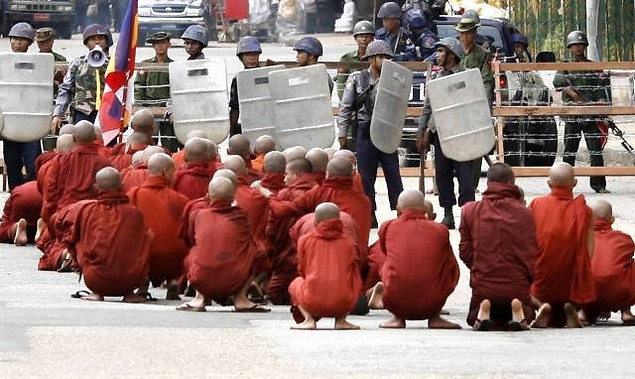
I don’t believe there is a more suggestive and instructive example for us, Cubans of the diaspora, than this logical course taken by a country where, since 2007, the monks — is there an image more peaceful than that of a Buddhist monk? — were met with bullets in their marches in opposition.

To compare the lethargic moves of the military junta leading Cuba with the process implemented in Myanmar would be hasty and inexact. But to ignore the fact that a journey of a thousand miles always begins with a single step, is to make the mistake that this example of the Buddhist nation alerts us to: to close our eyes and remain in our entrenched positions. To fail to pay attention.

The government of Raul Castro has generated no political change of real weight. But to refuse to admit that in the last four years Cuban society has experienced more alterations than in the last two decades of Fidel’s mandate, would be naive, as well as damaging to winning strategies.

The more superficial and insufficient, the more elementary we assume these changes to be, and above all — after a wait of five plus decades — to deny their existence, does no harm to the government in Havana, nor does it do any favors to the democratic exiles. Rather, it is the first step along this treacherous road of disconnect that many Burmese exiles are now experiencing.

Success against an entrenched enemy, one that has been barely damaged by the techniques of the siege, lies in taking advantage of its timid, trembling, cautious, cowardly, and at times imperceptible maneuvers of surrender.

I could not say that the release of the 75 prisoners of the Black Spring, the respect for religious freedom (which even Secretary of State Hillary Clinton acknowledged in 2010), the sale and purchase of houses and cars, or the implementation of lines of credit to support the businesses of entrepreneurs, are the trumpets that announce the cataclysm. But taken all together, looked at under an objective prism, they can only point toward changes in survival that, if the millions of Cuban exiles know how to take advantage of them, could imply much more than that.

The half century of antagonistic positions do not leave us at the margin of a Cuban reality that is inevitably dialectical, and that at this very minute could be living its death rattle in an atmosphere of misleading passivity. As it has always been. So be it. Minutes before their collapse, all the buildings stood proudly.

Those who have committed their lives in body and soul to reclaiming a nation, “For all and for the good of all,” from an exile never desired, have a challenge of precise intelligence this time, of precious calculation: to not allow the democratization of Cuba to begin with them out of the game. Myanmar leaves her lesson in our hands.

(Published originally in Spanish in Martí Noticias)

February 27 2012

Mr. Lázaro Fariñas / Angel Santiesteban

“A Miami-based Cuban journalist” is the same one who, a while ago, was complaining, as usual, because in Miami they permitted for only 24 hours a billboardshowing the five spies sentenced by the United States. We should thank him in some way for teaching us that there, in “enemy” territory, at least they can engage in political criticism and disagree with the government. By contrast, in Cuba you can’t even think differently. And I congratulated him for having fled with his family to a land, if not of absolute freedom, at least of limited freedom, as he wanted to explain in his column.

And now this man once again has the nerve to say in a Cuban newspaper, “Cuba is making progress, despite the doomsayers” (29-11-2011), without specifying which way is forward, it may be the abyss, and he states that “I had a friend in Miami who was a radio commentator; heconducted interviews and made comments on that city. He defended Cuba (meaning the dictatorship) to the hilt and attacked the extreme right-wing Cuban Americans with a sarcasm and intellectual ability that few can imagine.”

I wonder if the author hadone lobe of his brainremovedso that he doesn’t mindlooking ridiculous, clumsily trying to manipulate the Cuban opinion. Or ishe just another propagandist, supposedly a journalist, since the paper supports everything they put in it. In short, he is complying with the regime and continuing to receive benefits that are granted in return for the services he provides.

Howcan this guy play with the intelligence of Cubans in such aclumsy and inconsistent way? Or is he laughing cynically about the people of Cuba? I’ll never understandhow someone who left the countryto improvehis professional and private life now defends the cause that made him flee. Because it’s impossible to be an envoy of Castro in Miami, a member of another “Wasp Network” that operates without prejudice in the media there, and thatsurvives olympically under the noses of its enemies.

The fact that someone in Miami had a radio program where he judged, criticized and ridiculed the samepeople who aresuffering deeply fromthedistance from their land, without anyone shutting downhis program, or taking revengewith their own hands, seems to me an act of stoicism on the part of those who had to endure it.

I refuse to believe that Mr. Lazarus Fariña has forgotten the fierce repression and censorship that exists in Cuba,now for over50 years, where we never were permitted to havea personal, private and independent media that would provide free speech. Not even the ability to print something, nor the right to write reviews, newspaper articles, radio spots, not to mention accessing the Internet. How canhe defend a process that punishes, with years in prison, those who voice a thought critical of Fidel Castro?

Characters like Lazarus Fariñas are thosewe sadly see in a future democratic Cuba, also defending the politicians in power.

Later he continueshis contradictory writing, wanting to protect whathe criticizes. Since criticizing censorship in order to defend the Cuban government has put him in a bind. Mr. Fariña talks nonsense by saying that this radio commentator, now deceased, named Álvaro Sánchez Cifuentes, “belonged to the revolutionary militias at the time of the Bay of Pigs invasion.” However, clearly his destiny became twisted, and he ended up living in Miami, with thosehe fought in order to avoid being forced to emigrate years later. And he survived in the city where his enemies live, thosehe provoked tirelessly, according to reports, when he asserts that”I let myself go,gave them nicknames and laughed at the stupidity of thesetragicomic characters of thelocal theater that make up the so-called Cuban exile community of Miami.”

Where Fariñas reaches new levels of cynicism is when he says “I’ve never liked participating in programs run by people who hold my own opinion. I prefer debate and discussion.” I infer that the place referred to is Cubadebate, the space of least possibility of discerningthat exists and in which the official, registered “journalists” publish, like Fariñahimself. Even more contradictory is the fact that his article is published in a country where not even a remote chance exists of challenging an official opinion, and in a newspaper where all opinions go in one direction.

Mr. Fariñas enjoys the benefits of being on both sides. He lives his “fierce” capitalism, which he doesn’t abandon, and he defends the system that doesn’t accompany it. From a short distance the story is different, and he knows it better than anyone. He survives in Miami andtakes his vacationsin Cuba. These peoplewho don’t knowthe meaning of the word”dignity” are the allies that the Cuban government deserves.

WhatI most wish for Mr. Fariñas is that his U.S. citizenship berevoked and he is returned to his Committee for the Defense of the Revolution, that they make him President of his block, and that he experience the stark reality of the Cuban people.

Then we’ll see what he says.

Translated by Regina Anavy

February 17 2012

Brevity / Reinaldo Escobar

Brevity refers to a temporal dimension which, although not quantified in precise terms (minutes, weeks, years), is identified by the relatively short duration of an action, a process, a phenomenon. Brief is the time that a lightning illuminates the night and also brief is the presence of the human species on the planet.

Over the course of the last years, which are already baptized “Raulism,” there has been a great increase in the repressive method that has come to be called “brief detentions.” It is a taking advantage of a legal loophole by which a citizen is deprived of his liberty without a formal accusation nor evidence of a crime having been committed.

You’re walking down the street, coming out of the house of a friend, sitting in a park, or planning to travel outside your home province, and some individuals dressed in plain clothes (rarely in uniforms) pounce on you and throw you headfirst into a car. If you’re lucky what looks to be an ID card is quickly flashed in front of your eyes, and you’re then taken to a station where you will spend the next 24 hours, more or less. Sometimes they’ll have you sit in the lobby of a police station, or they may put you in a cell with a drunk who broke the window of a bar, an exhibitionist picked up in front of a junior high school, or a drug dealer caught red-handed.

The only diversion is listening to the stories with which your cell mates explain their complete innocence, unless the situation calls for a higher dose of adrenalin and things end with a few well-placed blows to your throat or one of those interrogations where “they” know everything, conducted by an affable fat guy and some tall skinny Lombrosian, a natural-born thug.

When, the following morning, the new duty officer leans into the bars shouting your name and telling you to grab your things and get out of there, you will feel like one of the lucky ones. It’s possible they won’t have written anything down, probable that you weren’t entered into the list of detainees, and hence you couldn’t call your family nor have the right to a lawyer, you’re dismissed as if nothing at all happened there, as if it had all been a misunderstanding. Apologies? Don’t exaggerate.

Once on the street you yourself say that the detention was brief and not worth denouncing.

27 February 2012

Could the dissidence become a valid interlocutor for the Cuban regime? / Iván García

In politics, all isn’t what it seems. Considering that there is no way out, a solution always looms. Above all and more than ever, dictators desire power. But when this isn’t possible, they negotiate the future.

Not so much for love of their country or her people. Simply to preserve their lives and their perks. Augusto Pinochet killed thousands of dissidents in Chile, but in the end, he had to open the doors to change.

The despicable racist government of Pretoria imprisoned Nelson Mandela in a tiny, narrow cell on Robbin Island for 27 years. But before the clamor of the majority of the South African people, then-President Frederik De Klerk had no option other than to negotiate a political exit with the mythical Mandela.

Those who persist in power with a knife between their teeth know the game they’re playing. The masses are unpredictable. They are capable of applauding a six-hour long speech under a fiery sun, or of unleashing their ire and furiously bludgeoning the politicians whom they consider their oppressors.

Remember Mussolini. Or the Rumanian Ceaucescu. If the revolts in North Africa and the Middle East leave us any clear lesson, it is that autocrats are no longer in fashion. Farewell to Ben Ali and Mubarak, Gaddafi and Saleh. Another tough guy, Bashar Al-Assad, has his days numbered in Syria. While the more violently they act, the worse is the fury of the governed.

Have no doubt, Fidel Castro has taken note. He is a student of modern history and every now and then he likes to remind us of it in his somber reflections.

The Castro brothers know that the economic situation in Cuba is very serious and worrying. They must have some contingency plan up their sleeve.

The system has shown itself to be lethally useless to bring food to the table and to produce quality items. We go to work to steal. Efficiency and production are at rock bottom, as are wages.

The future for many Cubans is to leave the country. Those without a future have come to be unpredictable. A time bomb. The present situation is like the sandpaper on a box of matches, at the slightest contact it can burst into flames.

The Castro brothers are maneuvering in a difficult terrain. And if the internal situation in Cuba squeezes them, it might be that they could negotiate with the dissidence. Not for all, just for a part — that which they consider convertible to their interests.

According to some veteran opposition members, it’s very probable that Cuban intelligence has designed a parallel opposition which, in some convenient moment, will serve as a wild card and political actor in a future without the Castros.

It might be paranoia. In totalitarian states, suspicion and the absurd become habit. But it isn’t insane to think that to give the dissidents a space if circumstances force their hand, could become a part of the island’s mandarin’s calculus.

Supposedly, they’re not going to hand over anything, they will have to continue dealing as they are accustomed to, using denunciations, street marches, and – above all – doing a better job with the citizenry.

If the opposition dedicates itself to work in search of its community, does proselytizing work among its neighbors, and doesn’t only offer a discourse to foreigners, it will have a part of the struggle won.

It’s important to increase the denunciations of mistreatment and lack of freedoms to the European Union, the United States, and to the international organizations that watch over human rights. But now is the time to write fewer documents, which almost no one in Cuba reads, owing to the repressive character of the regime and the low access of the populace to the internet.

It’s also time to combine all the points that unite the dissidents and to obviate the discrepancies between the different political factions. The goal of the peaceful opposition must be dialog with its counterparts, as has happened in the old Burma with Aung San Suu Kyi at its head.

To push a regime that has despised and mistreated its opponents into negotiations, there has to be a 180 degree turn away from the old tactics and strategies.

Cuba’s fate worries everyone. The destiny of our motherland will be decided in the next ten years. Or less. For that matter, the opposition could turn into a valid player.

If it is proposed, it will come about. The dissidence has points in its favor. A leaky economy, an inefficient government, and the discontent of a majority of Cubans over the state of things.

In the short term, if the chore is done well, the regime will sit down to negotiate with the opposition. Believe me, the Castro brothers don’t have many cards to play, although they’d like to make it appear otherwise. And dialog is the best option for them — perhaps the only one.

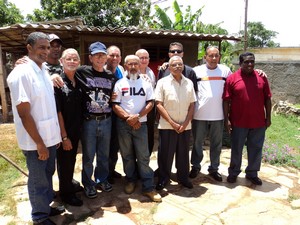
Photo: Taken from the blog Uncommon Sense. From left to right, the ex-political prisoners of the Group of 75: Oscar Elías Biscet, Ángel Moya Acosta, Guido Sigler Amaya, Héctor Maseda Gutiérrez, Diosdado González Marrero, Eduardo Díaz Fleitas, Félix Navarro Rodríguez, Arnaldo Ramos Lauzurique, Librado Linares García (in dark glasses), Pedro Argelles Morán and Iván Hernández Carrillo. José Daniel Ferrer García could not be present. The meeting was held on 4 June 2011, in the Matanzas village of El Roque.

Share on Facebook

Translated by: JT

February 24 2012