Inflation and the rising cost of living are forcing more and more elderly Cubans to work or part with their belongings.
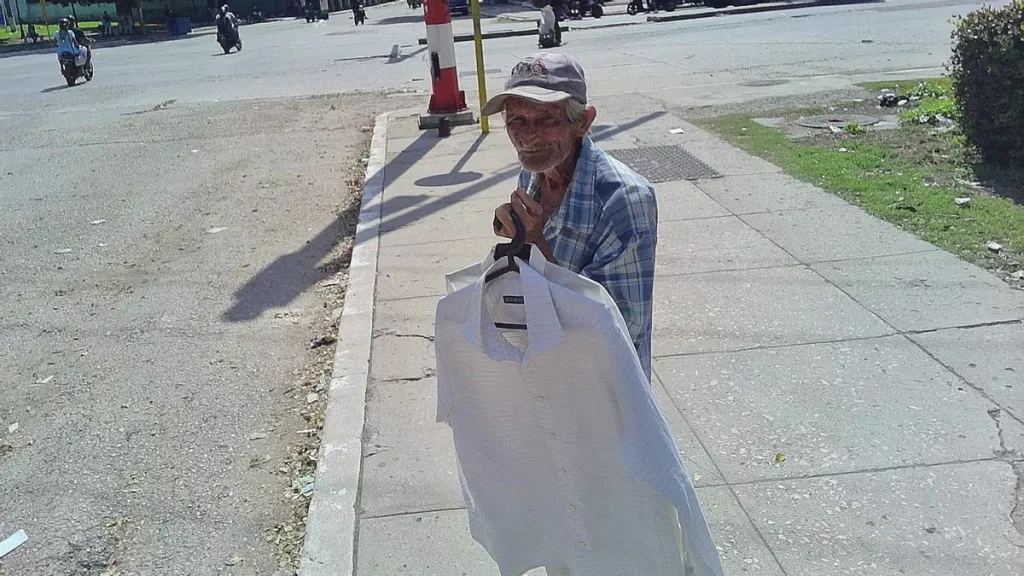
 14ymedio, Havana, Juan Diego Rodríguez, October 23, 2026 / Norbert Galland doesn’t have a shop, a counter, or even a rack to display his merchandise. The corner of Vía Blanca and Diez de Octubre in Havana is all he needs to try and earn a few pesos. His small business can be counted in two hands: a white shirt, a dark one, and a few other items he takes from his own wardrobe. He’s not renovating his wardrobe or making room in the whop window; he’s selling what little he has to be able to eat.
Wearing a worn cap, his face gouged with wrinkles, and a thinness that seems to have diminished even his shadow, Galland stands by the sidewalk and holds up the shirts for passersby to examine. In his hands he holds a white garment, neatly buttoned and still on its hanger; also two shirts, one dark and one light, as if offering an assortment capable of satisfying any customer’s taste.
Motorcycles, tricycles, and trucks pass by. The traffic in this Havana neighborhood continues its course, indifferent to the elderly man who has turned the sidewalk into an improvised commercial establishment. A few meters away, potholes, puddles, and trash complete a scene that perfectly encapsulates the Cuba in which this impromptu vendor lives.
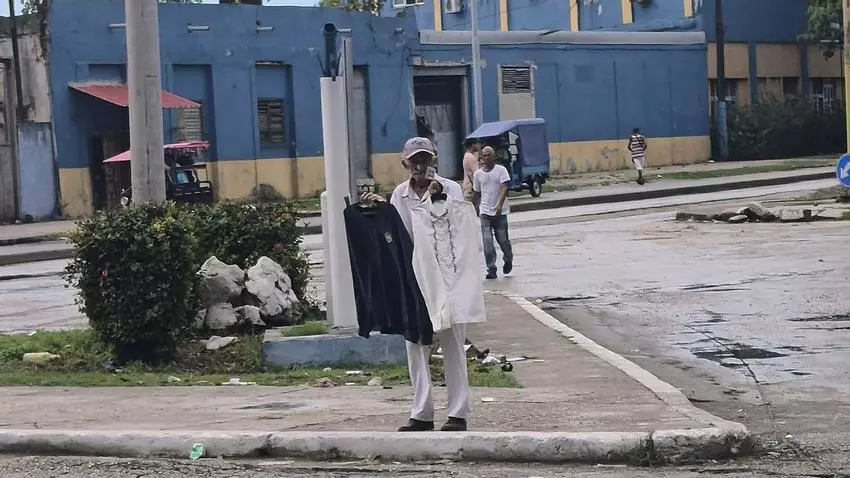
Galland receives neither a pension nor state assistance, as he told 14ymedio. His situation is especially hard in a country that for decades boasted of having guaranteed social protection to all its citizens, from cradle to grave. Now, for many elderly people, that promise seems to have fallen short, precisely when they most need someone to uphold the other part of the bargain.
The streets of the island have become increasingly crowded in recent years with elderly people selling anything they can to supplement their income. Some offer candy, nylon bags, or single cigarettes; others collect cans, scavenge for food in the trash, or try to earn a few bills using skills learned decades ago. Old age, which should bring some rest, has become for many a workday with no set hours and no vacation time.
Their situation is especially difficult in a country that for decades boasted of having guaranteed social protection to all its citizens, from cradle to grave.
Inflation has eroded the purchasing power of pensions, while the dollar continues its climb on the black market, driving up food prices. Family support isn’t always an option either: children and grandchildren have emigrated, and not all of them can send remittances. Relatives who remain on the island are often just as financially strapped as their parents and grandparents.
In this geography of survival, Galland parts with his belongings to solve the problem of daily food.
The white shirt looks clean, intact, almost elegant. It could be worn for a celebration, an important visit, or a special occasion. But in the old man’s hands, it’s just a small financial reserve that dwindles with each passing hour, and no one buys it.
In Cuba, even the last Sunday best can end up as Monday’s lunch.
_______________________
COLLABORATE WITH OUR WORK: The 14ymedio team is committed to practicing serious journalism that reflects Cuba’s reality in all its depth. Thank you for joining us on this long journey. We invite you to continue supporting us by becoming a member of 14ymedio now. Together we can continue transforming journalism in Cuba.