Abel Prieto announces that his podcast will be “anti-fascist, anti-colonial, anti-imperialist, Latin Americanist, Caribbean and ‘Lezamian’.”
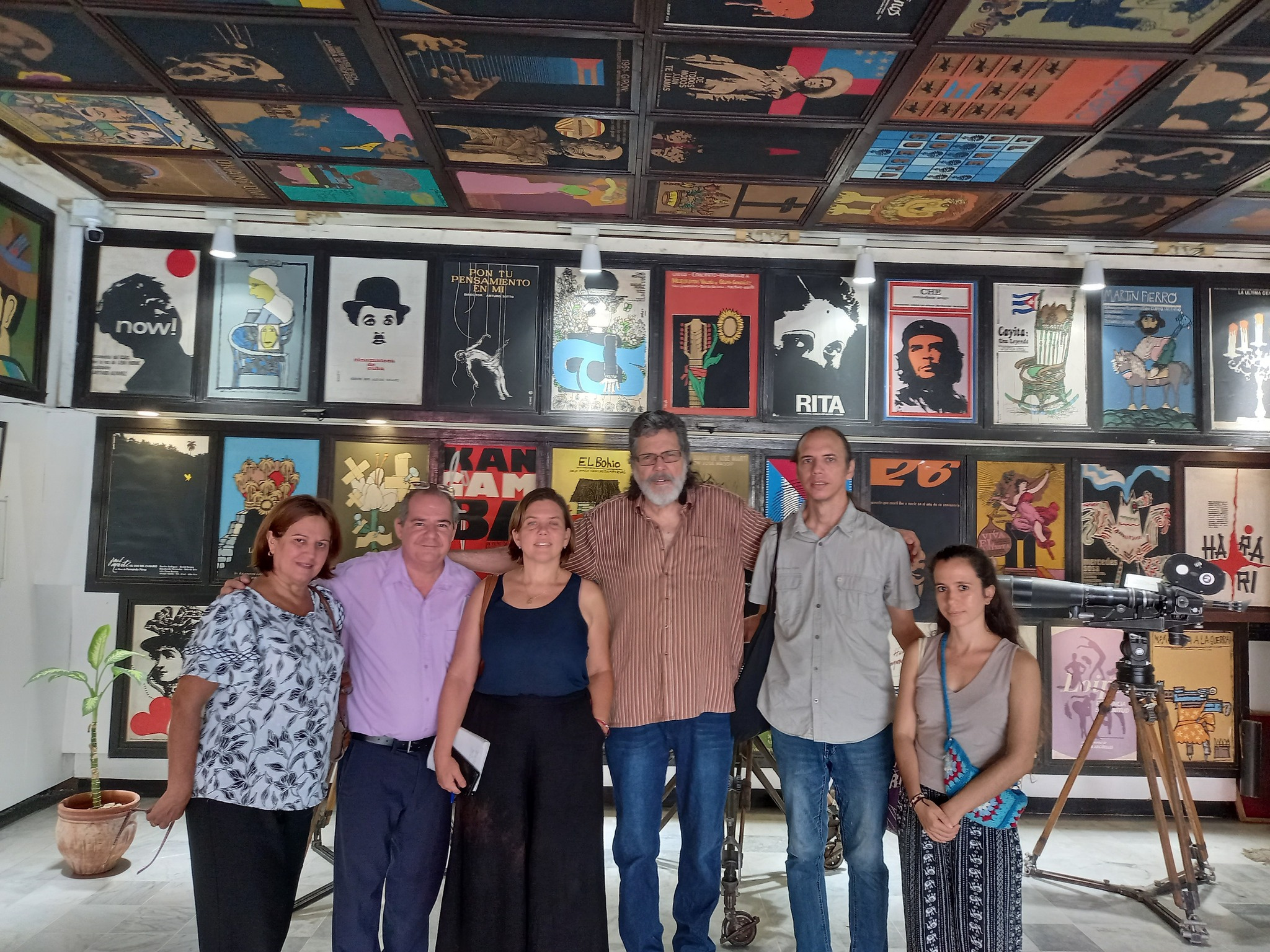
 14ymedio, Yunior García Aguilera, Madrid, 20 August 2025 — La Casa de las Américas has decided to join the podcast craze in Cuba. On its X and Facebook profiles, the institution’s president, Abel Prieto Jiménez, announced that they will begin publishing a biweekly program, with an “anti-fascist, anti-colonial, anti-imperialist, Latin Americanist, Caribbean, and Lezamian*” approach. What the former Minister of Culture didn’t explain is how they plan to fit all of this together without the whole mess exploding in their listeners’ stomachs.
The Cuban regime maintained a monopoly on information for decades. The arrival of the internet—albeit late—began to break its grip on the narrative. Aware of their defeat in the so-called “communications battle,” the single-party strategists launched an offensive: anonymous profiles, the so-called cyber-clarias [catfishers], weren’t enough. It was necessary to create creators of revolutionary content, Castro influencers, hammer-and-sickle YouTubers and tropical communism podcasters.
The hand-picked president himself took on his role with Desde la Presidencia. With effort—it must be admitted—Miguel Díaz-Canel managed to read the teleprompter without looking like a primitive version of artificial intelligence. He hid his cards from the camera’s frame and rehearsed sentences while biting a pencil to hide his poor diction.
He is not a millennial dictator. He would never take a selfie at the UN, like Salvadoran President Bukele did. Díaz-Canel is an old-school bureaucrat.
He is not a millennial dictator. He would never take a selfie at the UN, like Salvadoran President Bukele did. Díaz-Canel is an old-school bureaucrat, even though his wife, Liz Cuesta, introduced him to the art of botox. In his podcast, he promised a July “without blackouts,” a ‘family basket’ with “better prospects,” [from the ration store] and “greater stability” in the water supply. Reality shows that, just as paper can withstand anything, a microphone can also withstand any lie spewed into it.
It is no surprise that Prieto’s podcast claims to be Lezama-esque. Cynicism and hypocrisy are organic characteristics of the model inherited from the Soviets. The young people recruited by Casa de las Américas may only use Lezama to boast about their difficult readings, without remembering that his Paradiso was dismissed as “incomprehensible” and “elitist,” “foreign to revolutionary morality,” and “art useless for the people.” The man whom El Caimán Barbudo called “bourgeois extravagance” now inspires the cultural commissars’ podcasts .
The headlines and presentations of pro-government communicators always seek to break, to slash, to tear. Con Filo promises to “tear the seams of media manipulation,” Arleen Rodríguez Deribet’s Chapeando Bajito (“Weeding Low”), although more than grass, she seems to want to uproot all dissenting opinions. Prieto, for his part, attempts to use the Lezamian “scratch in the stone,” without making it clear whether this rocky mass refers to the site where Fidel Castro’s ashes were buried.
The official menu is ample, but with a fairly uniform flavor: elegies to the institution, political analyses from a single perspective, and news summaries filtered through various ideological filters. On YouTube, iVoox, or Spreaker, the results are not good. Desde la Presidencia rarely exceeds a few hundred views, except for temporary peaks. The same is true of Chapeando. They depend more on the official machinery than a loyal community.
On the other hand, critical podcasts have built strong and engaged audiences.
On the other hand, critical podcasts have built strong and engaged audiences. In terms of public metrics—followers, playbacks, community—independent podcasts lead the way. State-run podcasts have the machinery, but are failing to retain audiences. Critical podcasts, despite facing censorship and with their audiences inside Cuba forced to use VPNs, are building active communities.
Prieto’s announcement received only 12 comments on Facebook, half of them negative. The Cuban intellectual who signs on from Madrid under the pseudonym Fermín Gabor predicts that the podcast will be more like “a stone in the sand.” At least the production of memes is guaranteed.
________
*Translator’s note (copied from AI on-line source): “Lezamian refers to something connected to José Lezama Lima (1910–1976), a renowned Cuban novelist and poet known for his unique writing style characterized by Baroque syntax and complex imagery. A ‘Lezamian feast,’ for example, would be a massive, extravagant meal, referencing a scene in his novel Paradiso.”
____________
COLLABORATE WITH OUR WORK: The 14ymedio team is committed to practicing serious journalism that reflects Cuba’s reality in all its depth. Thank you for joining us on this long journey. We invite you to continue supporting us by becoming a member of 14ymedio now. Together we can continue transforming journalism in Cuba.