At the same time, official data indicates that this year Cuba has imported this material from the United States.
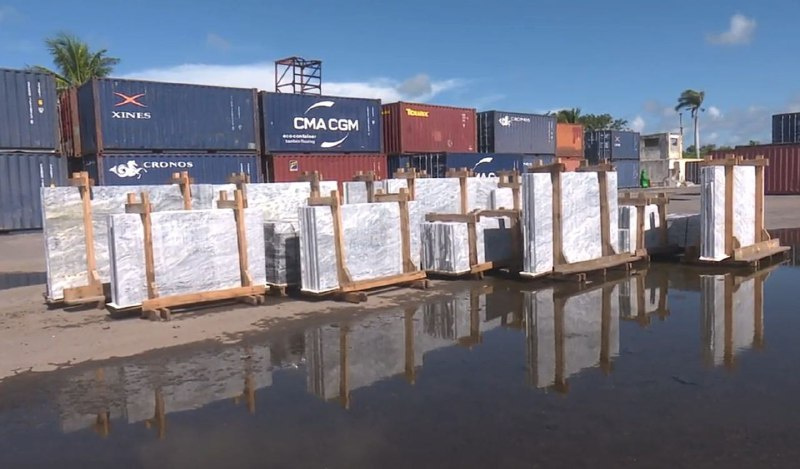
 14ymedio, Madrid, 12 August 2025 — Desperate to export its marble, a company on the Isle of Youth is facing serious difficulties. Year after year, state media publishes bombastic articles praising the “efforts of workers” and “the commitment of production companies.” However, it is proving very difficult for this company to achieve its dream of extracting a few dollars from the so-called “gray gold” given the firm’s obsolete machinery, the nation-wide exodus of skilled labor and inept attempts by officials to transport the marble to Havana.
Four- to five-hundred tons of marble lie stranded between the factory and the port, causing construction delays and undermining the company’s reputation. In a July report on the local television channel Islavisión, journalist Dagoberto Consuegra bemoaned the abandonment of the marble at the port of Nueva Gerona. The consignment has been waiting to be transported to the capital, without success, since May. Radio Caribe confirmed on Monday that the situation remains unchanged.
In the Islavisión report, the director of Mármoles Isla (Island Marbles) expressed his frustration. “We are losing credibility with the customer. They feel like they received the invoice, paid it but haven’t received the merchandise. I think that’s not good for the company’s reputation or for employee morale,” he said.
“We are losing credibility with the customer. They feel like they received the invoice, paid it but haven’t received the merchandise. I think that’s not good for the company’s reputation or for employee morale”
Radio Caribe adds that the company was planning on using the money from the sale to update its 40-year-old machinery, buy a new cutter and polisher, and raise employees’ salaries. “The Isle of Youth is setting a bad precedent,” the radio outlet stated “How do we expect to turn this entity into an export hub on the national level, with a major customer like Russia, when it cannot currently ship its output from the local port?”
The island’s gray hills hide a geological treasure which has given form and beauty to monuments such as the Havana Tunnel, the José Martí Civic Plaza (now known as Plaza of the Revolution) and buildings in Varadero. It was discovered in 1834 by a Frenchman with the last name of Chateaux in the Sierra de Caballos when he was searching for gold, never imagining the rocky fortune he would find there.
The first attempts at commercial exploitation date back to 1845, with the arrival of the first steam engines on the banks of the Brazo Fuerte. In the following decades, marble became part of the local landscape — used in parks, sculptures, trails, and buildings — and a symbol of identity and permanence. Its weather resistance and mirror-like surface make it especially prized as a material for building construction and artistic expression.
The local industry got a boost in the 1980s with the opening of the Nelson Marrero Mine, marking a leap forward in the production of this resource. In 2020, reserves of Siboney Gray marble were estimated to exceed 348,000 cubic meters, with those of Perla adding another 210,000, enough to last for decades.
However, excessive decorative use of the stone in cemeteries and government buildings gave it a bad reputation. It came to be known as “funeral home marble.” A 2011 article in the newspaper Juventud Rebelde tried to blame stone masons for giving it a bad rap. “Isle of Youth marble is gray (Pearl or Siboney). Many people do not like it because they see it in hospitals, police stations and cemeteries. . . But the problem is not with the stone but rather with the way it is placed. The mason typically lays the slabs like a bricklayer and does not approach the work like an artist would,” the article stated.
Excessive decorative use of the stone in cemeteries and government buildings gave it a bad reputation. It came to be known as “funeral home marble”
It has fallen out of favor with Cuba’s nouveau riche, so it comes as no surprise that, in the first half of this year, $23,521 worth of materials, including marble, were imported from the U.S. A more popular option these days is porcelain tile, which can be made to look like any material. The fact that it can also be purchased in large slabs, is more manageable and weighs less has given it a significant edge over the local marble.
In 2020 the local office of UEB sent out a shipment of coarse-grained slabs, to be marketed under the trade name Roca Real, for evaluation. It was not thinking about the domestic market. Instead, it had its sights on potential customers in the Caribbean, Europe and North America. It had also made commercial overtures to Russia and Slovakia.
A tangible breakthrough occurred in 2021 when the company made its first international sale, in this case to Trinidad and Tobago. The hope was this would allow it to expand production in 2022 but reality shattered the those plans. “Whoever is in charge of loading or not loading the truck should rethink how they do things and gradually create conditions for the marble to get from the port of Pinar del Río to Batabanó,” the local radio station complained. Until the logistical, bureaucratic, and technological hurdles are overcome, exporting will remain a promise, trapped in crates that never reach the sea.
Site manager’s note: LOVELY TRANSLATION! Thank you.
____________
COLLABORATE WITH OUR WORK: The 14ymedio team is committed to practicing serious journalism that reflects Cuba’s reality in all its depth. Thank you for joining us on this long journey. We invite you to continue supporting us by becoming a member of 14ymedio now. Together we can continue transforming journalism in Cuba.