Beijing “is making maximum efforts to help” the island, says Hua Xin: “Now, we are building 15 solar parks of 85 MW and materials have arrived for 200 MW photovoltaic energy storage”
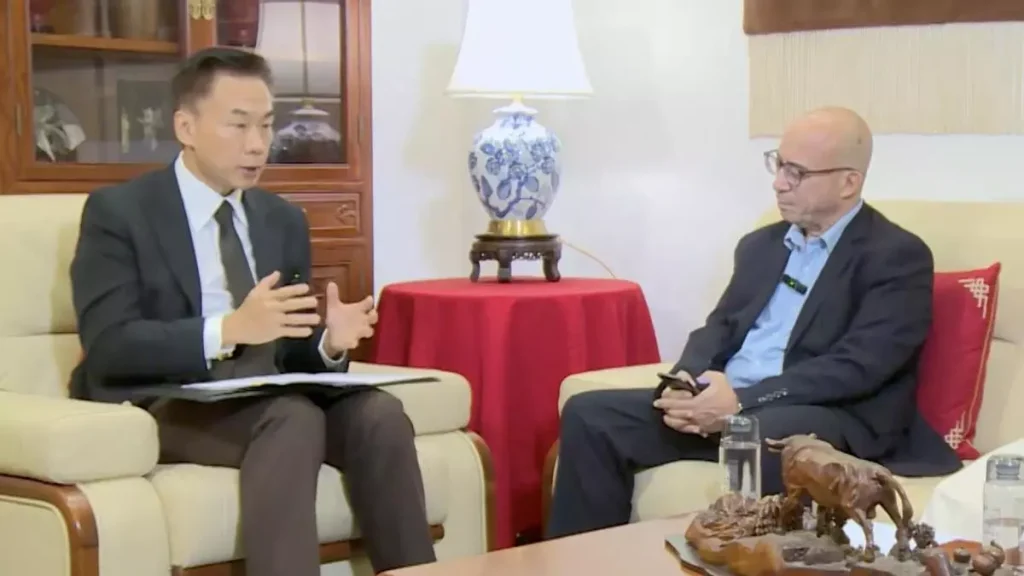
 14ymedio, Madrid, September 30, 2026 / The second season of the podcast Es la idea [It’s the Idea], hosted by Randy Alonso, premiered this Tuesday with the participation of the Chinese ambassador to Cuba, Hua Xin. The program, an interview show with politicians, academics and diplomats, has already featured former Spanish Deputy Prime Minister Pablo Iglesias, Cuban political scientist Rafael Hernández and The People’s Forum activist Manolo de los Santos.
The conversation covered a whole constellation of topics, ranging from the BRICS group to climate change, touching on China’s trade relations with Latin America and Beijing’s solidarity with Cuba, with the unavoidable mentions of Fidel Castro along the way. But what Randy Alonso tried hardest to get out of it was how a country ruled with an iron hand by a Communist Party has achieved China’s levels of development.
Hua did not hold back. There are three pillars: leadership belongs to the CPC, international opening is unavoidable and the economy must be a market economy. All of it, mind you, in its own way. As far as the first point is concerned, the diplomat stressed that each communist party must adapt to the peculiarities of the country in which it operates. “President Xi said that the wind of the October Revolution blew through China, but the Communist Party of China did not become a Soviet party,” he argued.
Hua noted that it is imperative “to give full play to the decisive role of the market, always combining socialism with the market economy”
On the second point, Hua highlighted the importance of being open to the world, which represents – he stressed – a general benefit for the Global South. “China is Cuba’s main trading partner and we are also the main trading partner of many countries in the region. Now many countries in Latin America and the Caribbean are exporting their typical products and their resources to China and, at the same time, Chinese products such as industrial goods, household appliances and machinery are more welcome every day among the people of the region,” he explained.
More weight was carried by the brief statement he made regarding the economy, key to the Cuban case. Hua noted that it is imperative “to give full play to the decisive role of the market, always combining socialism with the market economy and establishing and perfecting the socialist market economy system, fully respecting the initiative of the people so that they become the protagonists of the reform.”
It was Alonso who pointed out that China had made food production the cornerstone of its transformations – something that has not been a priority for the Cuban regime beyond words, as shown by the meager investment allocated to this sector. However, China has now become one of the foremost leaders in technology. Hua then had the opportunity to expound on robots, artificial intelligence, robotics and medicines, the only area – the last one – in which it collaborates with Cuba, for which the rest of these matters are still a pipe dream.
The program was already past the halfway mark when Randy Alonso began to be more direct: how does Havana-Beijing cooperation materialize? Hua spoke of storm-resistant royal palms at the Cuban embassy in his country as a symbol of the union between the two countries and from there moved on to Fidel Castro and Mao Zedong. However much he tried to be specific, rambling on about the Belt and Road Initiative – of which Cuba is a part – sports or ballet, the question remained unanswered.
What was already in port is “the first batch of materials for the 200 MW photovoltaic energy generation and storage project”
Hua came down to more tangible ground when he began to talk about energy, the sector in which the Chinese presence in Cuba is most genuinely felt. “China is making maximum efforts to help Cuba. Last year, the 35 megawatt (MW) photovoltaic park project with Chinese assistance was synchronized, and now we are building the 85 MW photovoltaic energy project, which is divided into 15 solar parks, each of 5 MW,” he summarized. The diplomat then announced that this phase should be completed by October and that what was already in port is “the first batch of materials for the 200 MW photovoltaic energy generation and storage project”; with that, he assured, results will be seen.
In addition, the ambassador referred to the 5,000 solar systems that arrived last week to be installed in social centers, senior day-care centers and polyclinics, and to the 60,000 tons of rice promised months ago, the last batch of which has already arrived. “Cuban families have surely tried the Chinese rice,” he joked.
Randy Alonso, however, wanted to press the ambassador further, since China has not gone beyond verbally supporting Havana – and Hua repeated it on the program – against US sanctions. “How does China assess this US blockade against Cuba, and what other cooperation initiatives could be developed to confront it?” he insisted. The diplomat could not offer more than what China has offered all year: rejecting, demanding, asserting and condemning interference. No real measure that would set it against the US Government, with which it has shown great harmony in recent days.
As Cuba’s Deputy Minister of Foreign Affairs, Carlos Fernández de Cossío, stated in an interview in the US last Sunday: “We are aware that we are alone. If we have to face foreign aggression, we must bear in mind that perhaps no country will come to our aid.”
______________________
COLLABORATE WITH OUR WORK: The 14ymedio team is committed to practicing serious journalism that reflects Cuba’s reality in all its depth. Thank you for joining us on this long journey. We invite you to continue supporting us by becoming a member of 14ymedio now. Together we can continue transforming journalism in Cuba.
Translated by GH.
______________________
COLLABORATE WITH OUR WORK: The 14ymedio team is committed to practicing serious journalism that reflects Cuba’s reality in all its depth. Thank you for joining us on this long journey. We invite you to continue supporting us by becoming a member of 14ymedio now. Together we can continue transforming journalism in Cuba.