China is helping keep the island afloat, but does not seem willing to become its financial lifeline
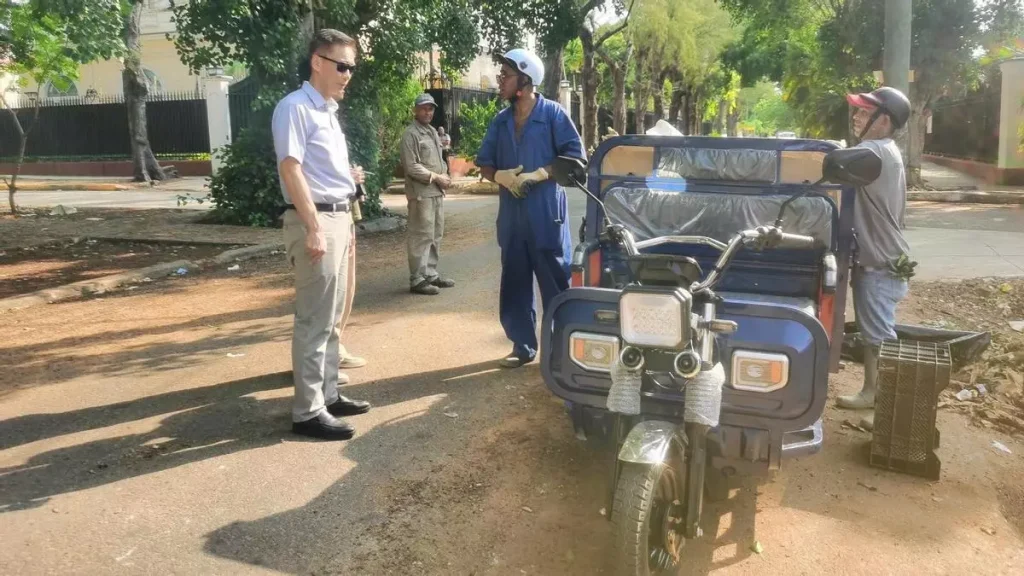
 14ymedio, Madrid, August 25, 2026 / The hyperactive Chinese ambassador to Cuba, Hua Xin, highlighted on Monday the use of Chinese-made electric tricycles for collecting trash in Havana and stated that products from his country are contributing both to public services and to the island’s energy transition. The diplomat joined trash collection efforts in Vedado.
“Chinese electric tricycles are helping clean up Havana,” Hua wrote on social media. Chinese cooperation is reaching vital sectors at a time when fuel shortages, blackouts, and the economic crisis have left the capital’s basic services on the verge of collapse.
Hua also noted that he has visited other assembly and welding projects for trucks dedicated to urban sanitation. “Chinese products are contributing to Cuba’s public services and energy transition,” the diplomat said.
The aid has taken on great importance for an economy facing an unprecedented energy crisis and growing ever more dependent on foreign support. Havana and Beijing maintain close political and economic ties – a closeness both governments have repeatedly sought to emphasize in their recent statements. The Asian country has established itself as one of the few allies the island has left.
“Chinese electric tricycles are helping clean up Havana”
Cuba’s energy crisis combines the deterioration of aging infrastructure and decades of low investment with the difficulty of importing fuel, worsened this year by Washington’s pressure measures. China has responded with a series of donations. This month, a new shipment of 15,000 tons of rice arrived in Cuba, part of a 60,000-ton donation. Days earlier, the second phase of a donation of 5,000 photovoltaic solar systems had begun.
The Asian country has also committed to a program to install 92 solar parks in Cuba, with a combined capacity of nearly 2,000 megawatts, and Xi Jinping approved assistance in January that includes 80 million dollars for the island.
Beijing has turned solar energy into the main instrument of its cooperation with Havana. Cuban imports of Chinese solar panels rose from about five million dollars in 2023 to 117 million in 2025. By the middle of this year, at least 49 solar parks built with Chinese technology were connected to the national power grid.
But Cuba’s power grid remains deteriorated, storage capacity is insufficient, and most of the energy generated by the solar panels is lost before reaching consumers. Even with the solar rollout, Cuba continues to face blackouts of more than 20 hours a day.
An analysis warns that China does not need Cuba to thrive: it is enough to keep it standing and maintain a relationship that is strategic and manageable for China
A BBC Mundo analysis published in May concluded that, despite the donations and Beijing’s growing role in renewable energy, its support for Havana remains limited. Experts consulted by the BBC noted that China is more cautious than Cuba’s other historic allies and does not intend to take on the role the Soviet Union once played as the island’s almost unlimited financier.
Another analysis from The Diplomat argues that every gap created by US sanctions – from fuel to energy infrastructure – offers Beijing an opportunity to increase its presence on the island. But the same analysis warns that China does not need Cuba to thrive: it is enough to keep it standing and maintain a relationship that is strategic and manageable for China. It sends rice when food is scarce, panels when electricity is scarce, tricycles when fuel is scarce, and assistance when infrastructure is at its limit, but it does not cover the enormous financial hole the island would need to fill to get out of the crisis.
The relationship with Cuba is part of the broader dispute between China and the US for economic and strategic influence in the region
The relationship with Cuba is no longer solely a bilateral matter between Havana and Beijing: it is also part of the broader dispute between China and the US for economic and strategic influence in the region.
Beijing has reasons to keep Cuba on its side. The island occupies a strategic position facing the US and constitutes one of China’s main political footholds in the Caribbean. That geopolitical component has gained more importance as relations between Cuba and the US deteriorate. In the round of sanctions Washington imposed on August 6 against Cuban officials and companies linked to military cooperation with other countries, it specifically singled out the Cuban military attaché in Beijing, whom it accused of taking part in acquiring military equipment from China.
Beijing responded to the sanctions on August 10, which, according to Washington, were related to Cuba’s military cooperation with China and Russia. Chinese Foreign Ministry spokesman Guo Jiakun called Chinese-Cuban cooperation “legitimate and transparent” and called on the US to lift its sanctions and the embargo.
Translated by GH
______________________
COLLABORATE WITH OUR WORK: The 14ymedio team is committed to practicing serious journalism that reflects Cuba’s reality in all its depth. Thank you for joining us on this long journey. We invite you to continue supporting us by becoming a member of 14ymedio now. Together we can continue transforming journalism in Cuba.