The official press in Holguín, where 28 cases have been reported, calls these acts an “epidemic” and calls for a firm hand
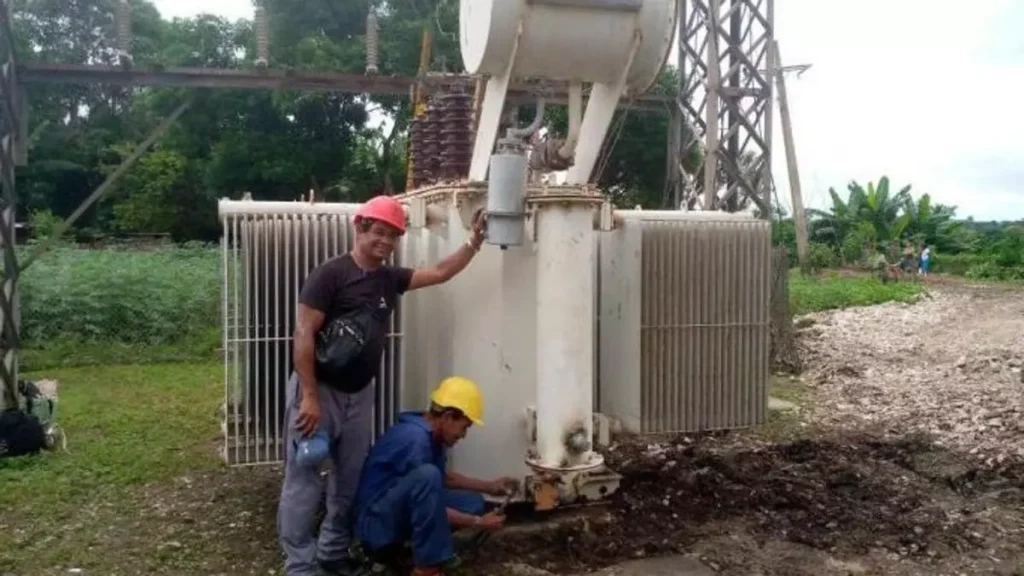
 14ymedio, Madrid, August 25, 2026 / However much the Cuban regime has toughened penalties for the theft of dielectric oil, the thefts have not let up. In Holguín alone, according to a note published this Monday in the official press, 28 cases have been reported so far, although it is not made clear since when. These incidents, laments ¡Ahora!, “have become a kind of epidemic spread across the entire country, with apparent impunity, given the slowness with which the judicial proceedings opened against those who commit these serious crimes unfold.”
The provincial newspaper cites the most recent cases as examples, which have taken place, for instance, in the town of Levisa (in Mayarí), in the Las Torres neighborhood of the municipality of Urbano Noris, in Moa, and at the Farallones substation, which supplies Cayo Grande. In Levisa, the theft of this oil – which functions as an insulator and coolant and prevents equipment from overheating – affected not only that community but also Nicaro and Cabonico, and in Las Torres, according to ¡Ahora!, it left 69 homes without power.
From a substation in Moa, 3,000 liters of oil were stolen, which harmed 2,000 people “unable to enjoy the mere three hours of electricity that the national electrical system (SEN) can guarantee, as a consequence of the energy siege imposed by the bad neighbor to the North,” the official newspaper stated, referring to the crisis worsened by the energy blockade that the US has been carrying out since the beginning of the year.
Moa is, precisely, where the most cases have been recorded (7), followed by Mayarí (6), Urbano Noris (4) and Cueto (4)
Moa is, precisely, where the most cases have been recorded (7), followed by Mayarí (6), Urbano Noris (4) and Cueto (4). “Generally the wrongdoers operate in areas far from the towns, which makes their misdeeds easier, but all the territories report this type of impact,” says the official newspaper’s note, which laments that the remedies put in place by the authorities are not producing results.
“Restoring damaged perimeter fences, installing padlocks where warranted, sealing transformer valves, and increasing patrols and inspections of substations are among the measures established by the National Electric Union to prevent these acts of vandalism, which warrant a greater and more coordinated popular rejection given their impact,” they proclaim.
The note recalls that the theft of dielectric oil is classified in the Penal Code as the crime of sabotage and can carry sentences of between 7 and 15 years in prison, and up to 30 years or life imprisonment “if the sabotage causes serious damage or accidents.” In fact, ¡Ahora! notes, citing figures from the Electric Union, “one hundred percent of those convicted of crimes against the SEN received sentences of more than 10 years in prison.”
“The slowness with which the proceedings against the accused unfold, due to adherence to regulations, creates the illusion of impunity”
However, even this is not enough, the Holguín newspaper also acknowledges, stating: “The slowness with which the proceedings against the accused unfold, due to adherence to regulations, creates the illusion of impunity, which encourages the criminal and causes a sense of powerlessness among the population and discredits the police and judicial institutions.”
Two of the trials that have come to light, indeed, show the lengthy sentences. Last May 23, the Prosecutor’s Office sought 12 years in prison against a 36-year-old man accused of stealing 70 liters from a substation in Cayajabos, Artemisa. In July, another sentence of 12 years became known for the theft of oil in Bungo 2 (Contramaestre, Santiago de Cuba), which caused about 48 hours of power outages. But neither the threat of lengthy sentences nor the calls by Prime Minister Manuel Marrero to apply a “firm hand” seem to stop the phenomenon.
In Santiago de Cuba, the theft of dielectric oil from a transformer supplying Molecular Medicine last week not only left the facility affected but also forced the transfer of samples all the way to Granma for a patient in serious condition who needed urgent tests.
It was the most recent incident in the long series of similar thefts that has affected the entire island in recent months. The product, which functions as an insulator and coolant and prevents equipment from overheating, can be used as fuel, in place of diesel, and as a lubricant, which is why it has become prized on the street.
Translated by GH.
______________________
COLLABORATE WITH OUR WORK: The 14ymedio team is committed to practicing serious journalism that reflects Cuba’s reality in all its depth. Thank you for joining us on this long journey. We invite you to continue supporting us by becoming a member of 14ymedio now. Together we can continue transforming journalism in Cuba.