“The fans aren’t functioning, but they are for sale so you can take your chances,” says an employee of Plaza del Calzado, which will soon be selling in dollars.
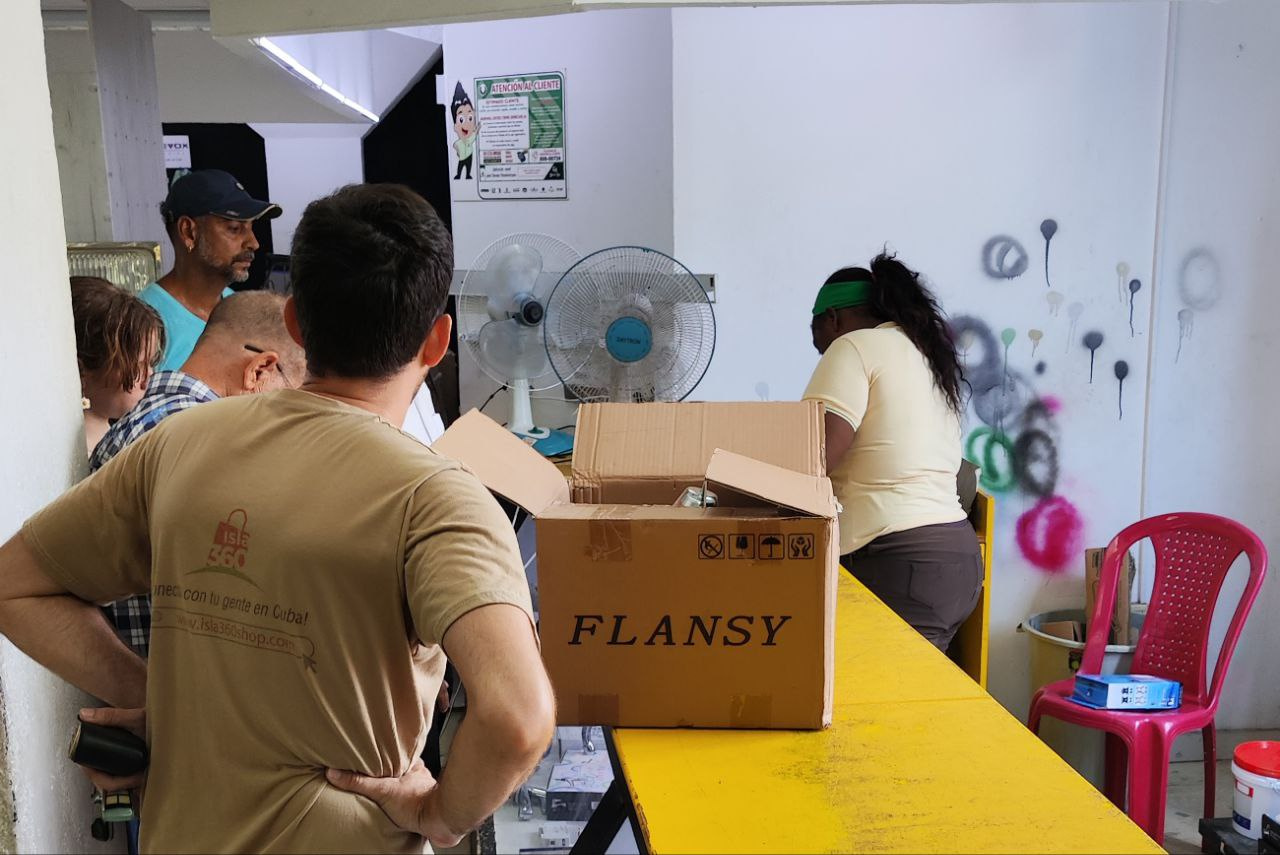
 14ymedio, Juan Diego Rodríguez, Havana, July 9, 2025 — At El Taller, a hardware store nestled in the Carlos III shopping center, a saleswoman fans herself vigorously on Wednesday morning, not so much to cool off as to shoo away the stifling steam filling the shop. Nearby are two fans, one in better shape than the other, but the weak breeze they produce is barely noticeable if you move even slightly away from the counter.
One floor below, at the Sport store, employees and customers enjoy air conditioning. The difference between one place and another mirrors the divide among Cubans in countless aspects of daily life: whether it’s food, clothing or air-conditioned spaces, in Cuba only those who pay in fulas (US dollars) can access such privileges.
“This is like a pot for steaming people,” complains a customer at Casa Nueva, another store in the shopping center that has not yet undergone dollarization and therefore lacks air conditioning. Painted a bright lime green that seems to amplify the heat, the store is supplied by Italsav, the same Italian company that stocks Casalinda, at Galiano and San Rafael. Yet this sibling relationship hasn’t ensured equal conditions: one enjoys a steady 26ºC (79ºF) while the other remains “a revolutionary oven.”
In order to survive the summer days, the employee at Casa Nueva relies on a rickety fan that “seems to be older than she is,” a customer quips. With its scorched plastic and missing grille, the fan creaks loudly every time the blades turn and seems ready to give its “last gasp.”

The employees are well aware of the state’s favoritism toward dollar stores. At Plaza del Calzado or “the affordable shoe store” as customers call it – comparing it to pricier dollar shops like Sport – salespeople are eagerly awaiting the day they can escape the sauna the store becomes when the sun starts blazing.
“The ACs are broken, and the ones they’ve put in are ’for where it’s needed.’ Our turn will come,” a saleswoman whispers to 14ymedio, hopeful that soon their cash register will take only foreign currency, and the air conditioning will be magically repaired. The store has even begun to clear out some of its merchandise. “They’re selling off the old and ugly stuff, and some sandals are going for as little as 4 MLC* [‘freely convertible currency’]. But besides being hideous, they’re made of plastic and look uncomfortable,” says a woman.
The discomfort and sweat that come with summer in Cuba are part and parcel of shopping in any MLC* store, or in the near-extinct peso shops. This is true not only at Carlos III, but in any non-dollarized store in Havana.” After coming here I need a proper shower,” said a customer at Isla de Cuba, on Monte Street. “With this heat, you don’t feel like buying fabric; you feel like walking around naked,” joked another shopper at Belinda Modes on the San Rafael pedestrian boulevard.

In the dollar stores, on the other hand, customers seem to be in better spirits. At least until it’s time to pay. “I can’t afford to buy anything, but I like to stand near the door of these stores to feel the cold air coming out. Nor am I the only one. People gather around, and you see them sighing. God knows how long it’s been since they last felt air conditioning,” confesses Yasel, a young Havana resident who repeats this trick every time he finds an air-conditioned space.
Compared to the lavish coolness of dollar stores, the government’s energy-saving appeals seem like a bad joke.”Its not enough to ask people to endure blackouts; they also want workers in banks, hospitals and other essential services to go without air conditioning, even when they’re stuck in offices without windows,” says Yasel.
Also, they don’t seem to care about the consequences of running air conditioners all day at very low temperatures, which affects not only electricity consumption but also increases the emission of harmful gases. The same pattern plays out in hotels and tourist facilities, highlighting the government’s overriding priority: to attract hard currency above all else.
Translated by Regina Anavy
_____________
*Note to TranslatingCuba readers: We could not constrain ourselves from sharing this completely idiotic explanation of what/why MLC is, offered by a company that operates ‘Cuban tours’. We had no idea it is simply a “hygiene” measure.
____________
COLLABORATE WITH OUR WORK: The 14ymedio team is committed to practicing serious journalism that reflects Cuba’s reality in all its depth. Thank you for joining us on this long journey. We invite you to continue supporting us by becoming a member of 14ymedio now. Together we can continue transforming journalism in Cuba.