Indifference prevails, especially among young people, and the cult of personality no longer works as an ideological cement.
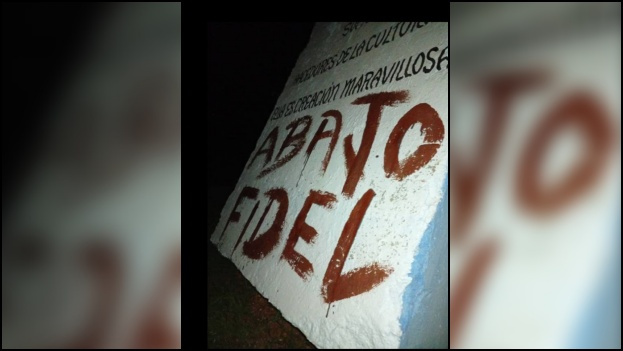
 14ymedio, Yunior García Aguilera, Madrid, August 13, 2025 — On this 13th of August, in the streets of San Antonio de los Baños, several posters appeared that read “Abajo Fidel,” “Martí no es comunismo,””Patria y Vida” and “Libertad.” It is no coincidence that, in the same place where the spark that originated the social outburst of July 11, 2021 was ignited, the 99th anniversary of Fidel Castro’s birth was thus received.
The Cuban government, aware of the low popularity of the current leaders, has tried to dust off Castro’s figure. In a calculated maneuver, the electricity deficit was reduced for at least a few days, ensuring that almost two-thirds of the population were exempt from the usual blackouts. In addition, youth camps, book presentations, photo exhibitions and other activities were organized to revive an admiration that no longer exists beyond official circles.
What abound are photomontages of Castro in ridiculous situations and mocking comments about his legacy.
In New York, an enormous luminous sign with the image of the bearded man adorned a central street. It was not a spontaneous initiative of nostalgic emigrants, but a service paid for by The People’s Forum, an organization run by pro-Castro activists Claudia de la Cruz and Manolo de los Santos. Already known for their photos with the president-elect Miguel Díaz-Canel, and for campaigns to support Team Asere, the Cuban baseball team, both have been singled out for receiving funding from billionaire Neville Roy Singham, resident in Shanghai and linked to the Chinese propaganda apparatus. The operation, rather than a tribute, is more like an expensive reminder that the official Cuban story should not be forgotten abroad.
However, the celebration has not aroused enthusiasm on the island. Most Cubans reacted with sarcasm on social media, turning the event into a festival of memes. Instead of tears and veneration, what abounds are photomontages of Castro in ridiculous situations and mocking comments about his legacy.
None of the major international media dedicated relevant space to the anniversary.
Confusion was evident among the very ranks of officialism. Some activists believed that it was already the centenary of his birth, not the 99th year. The error reveals the historical ignorance even within the militancy and the overload of activities with which the regime saturated its bases. More than one official suggested, in a low voice, that something should be left for 2026, when the anniversary will actually happen.
Outside the Island, silence has been prominent. None of the major international media devoted significant space to the anniversary. In similar countries such as Venezuela and Nicaragua, laudatory notes were published but without much resonance. Even when asked by several artificial intelligences about the most influential figure born on August 13, “Alfred Hitchcock” was the most frequent answer.
Citizens stopped seeing him as the “uniformed and threatening leader” and perceived him as a frail old man, poorly dressed and obsessed with moringa.
The island’s own recent political history helps to explain the disinterest. During the period when Raul Castro took over, he strove to turn away from orthodox faithfulness, betting on an image of greater pragmatism. The thaw with Barack Obama and the timid economic opening required a symbolic break with his big brother’s intransigent speech. The Reflections that Fidel published in the press became anachronistic and often uncomfortable for the new course. Citizens stopped seeing him as the “uniformed and threatening leader” and perceived him as a frail old man, poorly dressed and obsessed with moringa.
The result was a gradual substitution of symbols, perhaps traced from Raúl’s own office. Presenting Fidel as a foolish and delusional grandfather served to smooth the transition and to justify the idea that the future depended on a change of style, not system. In contrast, Raul Castro has striven to be much more vital–at 94–than the last images we saw of his haggard brother. And this remarkable difference between the two nonagenarians is not a coincidence for a regime with so many communicative filters.
But the Raulist experiment also failed miserably. The Ordering Task, conceived as a decisive economic adjustment, further eroded purchasing power and public confidence. This failure gave new life to loyalist sectors that had remained in the shadows. Figures like Iroel Sánchez and other defenders of a more rigid Marxism returned to occupy media spaces, insisting that Fidel’s orthodoxy was the only way.
In contrast, Raúl Castro has striven to be shown as much more vital–at age 94–than the last images we saw of his haggard brother.
In this ideological vacuum, Miguel Díaz-Canel clung to the slogan of “continuity,” but without a clear plan or enough charisma to sustain it. Mass access to the internet has eroded information control. Authorities, who for decades boasted of “winning the battle of ideas,” publicly admitted that they were losing it.
The attempt to use the 99th anniversary as an act of political reaffirmation has come up against a reality that can no longer be reversed. The figure of Fidel Castro has been emptied of content for a large part of the Cuban population. The new generations know him more by familiar accounts of deprivation and repression than by fiery speeches about sovereignty. For many, he is the symbol of immobility, endless pronouncements and the cause of the problems that continue to suffocate the country.
The anniversary, far from strengthening the official narrative, has served to measure the distance between myth and reality. The personality cult that once served as ideological cement is now perceived as a liability. Propaganda fails to reverse accumulated fatigue and the increasingly widespread conviction that the country needs radical change.
Translated by Regina Anavy
____________
COLLABORATE WITH OUR WORK: The 14ymedio team is committed to practicing serious journalism that reflects Cuba’s reality in all its depth. Thank you for joining us on this long journey. We invite you to continue supporting us by becoming a member of 14ymedio now. Together we can continue transforming journalism in Cuba.