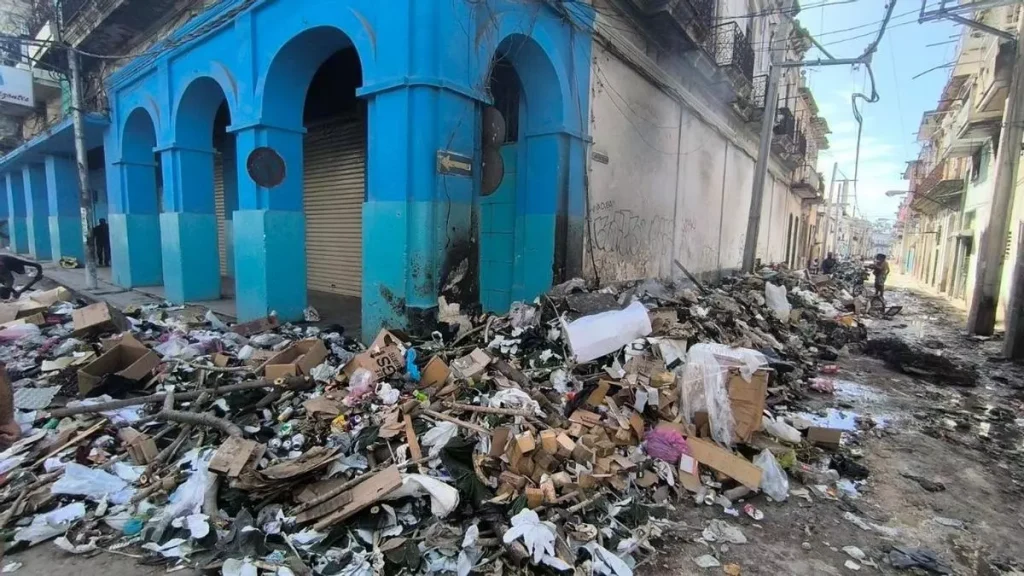
 14ymedio, Madrid, September 27, 2026 / The Ministry of Public Health acknowledged concerns surrounding the epidemiological situation in Cuba and pointed to an increase in cases of various diseases, which it attributed to deficiencies in sanitation, water treatment, and waste collection, amid the serious water and health crisis affecting the Island.
Deputy Minister of Public Health Carilda Peña García admitted this Friday on Cuban television that there has been an increase in acute respiratory infections, diarrheal diseases, and hepatitis, as well as a notable rise in arboviruses, including dengue and chikungunya. She also acknowledged the relationship between the deterioration of sanitary conditions and the increase in diseases, linking it to poor hygienic conditions and problems with water supply and treatment.
Regarding respiratory diseases, the official explained that endemic coronaviruses are circulating in the country, in addition to SARS-CoV-2 –with a predominance of Omicron subvariants–, as well as the influenza virus and other agents. The vice minister noted, however, that no severity comparable to that of the COVID-19 pandemic is being observed, although she also did not provide precise figures.
Endemic coronaviruses are circulating in the country, in addition to SARS-CoV-2 –with a predominance of Omicron subvariants–, as well as the influenza virus and other agents
The greatest cause for alarm, however, is arboviruses. Peña García confirmed the circulation of chikungunya, although she rejected the idea that there is an “excessive” increase in the disease and specifically denied the unofficial reports circulating on social media, again without providing precise data to contradict them. According to the vice minister, cases are concentrated mainly in territories where the incidence of the disease was lower during the previous period, while those who became ill then now have lower susceptibility.
Regarding dengue, the vice minister confirmed that all four serotypes of the virus are circulating, with serotype 2 predominating. She attributed the increase in the vector population to “high temperatures, rainfall, and humidity,” but acknowledged that these factors are joined by “other avoidable and controllable factors, fundamentally linked to existing conditions inside and around homes.”
Peña García said that the increase in dengue cases “corresponds to the seasonal rise also being recorded in other countries in the region,” but the Ministry of Public Health has not publicly updated its data on the disease since June. At that time, it had reported 298 cases, while the Global Dengue Observatory estimated 2,173 infections in July and 3,214 in August.
The organization, which gathers information from government sources and international health organizations, estimated that as of September 18 there had been 7,133 cumulative cases in Cuba, about 7.4 times more than expected for this date, thus placing the Island among the countries in the region with the highest relative incidence. The figure is concerning because October is usually the month with the highest incidence of dengue in Cuba.
The situation is occurring in a “context marked by limitations in environmental sanitation systems, water treatment, and wastewater collection”
Another concern acknowledged by the Ministry of Public Health is the increase in acute diarrheal diseases and hepatitis. “Various microorganisms associated with these conditions are circulating, including viruses and bacteria,” said the vice minister, who added that the situation is occurring in a “context marked by limitations in environmental sanitation systems, water treatment, and wastewater collection.”
At the beginning of September, the U.S. Embassy in Havana issued a health alert over the increase in diarrheal diseases and recommended taking extra precautions with water, food, and ice.
The Spanish Government also currently maintains a health warning for Cuba and notes that outbreaks of hepatitis A are occurring on the Island.
A report published this week by the U.S. Centers for Disease Control and Prevention added another warning sign: between June 2024 and February 2026, 249 cases of hepatitis A were recorded in Florida, 76 of which were associated with recent travel to Cuba. Among the cases genetically studied, 15 of 18 shared the same strain, consistent with a common origin.
In May, the Ministry of Public Health had ruled out the existence of an epidemic of this disease, but acknowledged a “very complex” health situation and cases in several provinces.
While difficulties in guaranteeing water, sanitation, and waste collection persist, the deterioration of health services is also doing little to contain the diseases. According to testimonies collected by 14ymedio, some Havana residents with suspicious symptoms have chosen not to go to health centers and instead self-medicate with drugs purchased on the informal market, making it even more difficult to record official figures.
Translated by Regina Anavy
__________________
COLLABORATE WITH OUR WORK: The 14ymedio team is committed to practicing serious journalism that reflects Cuba’s reality in all its depth. Thank you for joining us on this long journey. We invite you to continue supporting us by becoming a member of 14ymedio now. Together we can continue transforming journalism in Cuba.