First part of a text about the Argentine writer’s trip to Havana in the 1960s
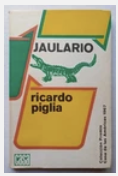
 14ymedio, Xavier Carbonell, Salamanca, 7 September 2025 — I am the proud owner of the first edition of Jaulario by Ricardo Piglia, published in 1967 by Casa de las Américas*. Why repress my vanity? The tiny copy looks like it’s fresh off the press—a sign that it’s been read little in six decades—the green outline of the alligator designed by Umberto Peña is intact, and the note by the forgotten Antonio Benítez Rojo provides a good definition of Piglia’s style: “to pound words a little in the Chinese way but to write effectively, with rigor; to go back, to move forward, to swing like a pendulum seeking balance, to situate oneself between yin and yang .”
Piglia never won the Casa de las Américas short story prize—it was Benítez Rojo who won it for the formidable Tute de reyes —but the publishing house also published the aforementioned authors. The Argentine was 27 years old at the time. In 1999, already one of the great Spanish-language authors, Valoración múltiple was published in Havana. His novel Blanco nocturno won the José María Arguedas Prize in 2012, I don’t know under what terms, and Formas breves was sold in Santa Clara that year , a must-have for anyone starting out in writing.
Jaulario contains nine short stories, in the style of Salinger. Some of them are anthological, such as Tierna es la noche and Mata-Hari 55. For a Piglia fan, owning one of the 4,000 copies of that collection is a luxury, because his biographers often mistakenly consider La invasión his first work. For me, the twists and turns of Jaulario reveal Piglia’s ambiguous and discontinuous relationship with Cuba.
The first time Piglia mentions the island in his diaries is in 1960. News of Fidel Castro reached young Argentinians, who were quickly enthusiastic about los barbudos, the bearded ones. On July 9, he noted: “Russia announces it will support Cuba with its rockets.” He had previously written that the country lived in perpetual “pressure, difficulties, conflicts.”
To twist a phrase of Piglia’s, that was an extraordinary discount in the supermarket of history: the romantic idea of a revolution
The Cuban historical drama will continue to be the subject of various marginal notes. The writers invited by Castro to Havana return to Argentina with a message: “They are not communists, they’re humanists.” Piglia himself will assess the phenomenon with skepticism: “If it is true that they are humanists, they will last three months,” he whispers to a girlfriend. Upon hearing the news of the executions of former Batista supporters, he has another enigmatic reaction: “Justice equals power,” he says in a group of friends.
But Cuba offered them too strong a temptation. To twist Piglia’s phrase, this was an extraordinary discount in the supermarket of history: the romantic idea of a revolution.
In 1961, Guevara appeared in Uruguay, and all the students were dazzled by his speech at the OAS. They were impressed by “his sparse beard and the five-pointed star on his beret, which seemed to be a third eye on his very Argentine face.” In a famous essay, years later, Piglia would speak of Guevara as the reader who resolved the contradiction between life and literature, because he is the guerrilla-who-reads, or as Michel H. Miranda writes, the killer reader.
The news of Guevara’s death in Bolivia—just as the seven typewritten copies of Jaulario are on their way to the Havana competition—is Piglia’s first major doubt about Fidel Castro. “If it’s true that Che Guevara was killed in Bolivia, something has changed forever in the lives of my friends, and in mine as well. A turbulent week, with confusing news,” he writes on a Friday the 13th.
For Piglia, Guevara is a decent writer and Fidel an effective speaker; one takes books to the bush to read in silence, the other is an imposing talker.
The “confusing news” can be summed up in one question: “Why didn’t the Cubans rescue him from the field?” The key lies—Piglia puts it in police terms—in Castro. “Fidel Castro confirmed the death of Che Guevara. The question now is why Guevara left Cuba and why he went to the Congo and then, without support, embarked on a guerrilla war in Bolivia.” The explanation offered among Guevara’s Argentine admirers was that “his criticism of the Soviets and, therefore, of certain lines of the Cuban revolution” had caused disagreements with the regime.
In El último lector [The Last Reader] , the dichotomy between Guevara and Castro is presented with a vengeful tone. For Piglia, Guevara is a decent writer and Fidel a showy orator; one takes books into the bush to read in silence, the other is an overbearing talker; one is hairy like hippies and Beat Generation writers, the other pursues Elvis-like behavior. Of course, this idealistic tension could only be posed by an Argentine, who sees double where a Cuban would see the same thing.
However, the contrast between Castro and Guevara is important to understand Piglia’s relationship with Cuba, the almost total silence about his trip to the island in his famous diaries, and his distrust of Cuban institutions that begins with spite (“my book was first until the end but then they awarded the Cuban Benítez”) and ends with his resounding “Me caí de la mata” [The penny dropped**], just before the Padilla Case.
Translator’s notes:
*Online searches as of this date show the book selling for close to $500.
**Literally “I fell out of the bush”
____________
COLLABORATE WITH OUR WORK: The 14ymedio team is committed to practicing serious journalism that reflects Cuba’s reality in all its depth. Thank you for joining us on this long journey. We invite you to continue supporting us by becoming a member of 14ymedio now. Together we can continue transforming journalism in Cuba.