Spain, the current tournament champion, has seven Cuban players among its ranks
Ernesto Martínez Jr. joins the roster of France (Facebook)
14ymedio, Havana, September 22, 2025 —
The European Baseball Championship, which began last Saturday in Italy, Belgium and the Netherlands, has a strong presence of Cuban players. Ten players born on the island represent four different teams, including Spain, the current champion of the event, whose roster is more than 50% Cuban.
The Spanish team, which won 15-0 against Sweden last Saturday, has seven players in its ranks: catcher Omar Hernández, outfielders Frank Hernández and Félix Stevens, and pitchers Pablo Luis Guillén, Carlos Sierra, Royd Hernández and Rubén Menes. In addition, there is William Escala, born in Miami but with a Cuban father. Also, on the coaching team is Néstor Pérez Jr. from Matanzas, who played seven seasons in the minor leagues with Tampa Bay.
Spain, which seeks to defend the title won two years ago in the Czech Republic, lost its second game 9-1 this Sunday, precisely against the Czechs. William Escala, whose father is Cuban, played in this game. In Spain’s last game this Monday, they won 2-1 against Germany and are waiting to know their future, once all the games have concluded. continue reading
Noel González is on the Italian team, which began with a resounding 18-0 victory against Switzerland
Noel González, from Holguín, is on the Italian team, which began with a resounding 18-0 victory against Switzerland; he will play his second European tournament with them. After finishing ninth in the disputed edition two years ago, the Italians intend to return to the podium, something they have not achieved since 2021, which is an outstanding debt for the second team to win more times in the history of the competition with 10 championships, only behind the Netherlands, which has 24.
Another Holguín player will be part of the contest, but with the colors of France. Ernesto Martínez Jr. leads the roster and will have his second participation in a European tournament with that team. In the past, in the Czech Republic, he hit .286, with a home run and three RBIs. He is also the only player of his team with a contract in the major leagues, since the rest of the players are part of teams from the Netherlands, Italy and France.
Finally, Raxon Martínez Miranda from Pinar del Río is playing with Belgium and experiencing his first international event with that country. He was not in his team’s debut on Saturday, which lost 16-8 to Austria, although he played on Sunday against Hungary (19-9 victory) and is playing this Monday against Croatia (game in progress).
Raxon Martínez Miranda, from Pinar del Río, is playing with Belgium, experiencing his first international event with that country
Raxon left Cuba after marrying a Belgian citizen about five years ago. He has played for Belgium in the first division of baseball in the 2022 to 2025 seasons (in the first three championships with the club Brasschaat Braves and in the last one with Deurne Spartans). The 29-year-old pitcher played in Cuba’s U23 National Championship in the 2019 sixth edition and had 60 turns at bat; he scored 10, with 11 hits, two triples and four RBIs.
If Spain manages to win, it would be the third European Baseball Championship in their showcase. For this edition, the tournament — which opened in 1954 — has the participation of 16 countries. The final round will be played from September 25 to 27 in Rotterdam. The semi-finals are scheduled for Friday, September 26, followed by the bronze medal match and the final next Saturday.
Translated by Regina Anavy
____________
COLLABORATE WITH OUR WORK: The 14ymedio team is committed to practicing serious journalism that reflects Cuba’s reality in all its depth. Thank you for joining us on this long journey. We invite you to continue supporting us by becoming a member of 14ymedio now. Together we can continue transforming journalism in Cuba.
Thousands of Cuban refugees passed through this Miami building, which is now being reopened as a museum of the exodus.
The Freedom Tower, located on Biscayne Boulevard in Miami. / 14ymedio
14ymedio, María Casas, Miami, 21 September 2035 — A food delivery robot passes by the imposing facade. Around it, skyscrapers and cranes dominate the landscape. Much has changed in Miami since 1925 when the building that houses the Freedom Tower was completed, a structure that opened its doors to thousands of Cuban refugees and is now reopening as a museum commemorating an exodus that has continued unabated for six decades.
Zenaida and Manuel arrived this Saturday afternoon at the gate through which, without having met yet, they had passed as children. The news of the reopening of the Freedom Tower last week reached the ears of these two septuagenarians and, wearing a white dress for her and an impeccably ironed shirt for him, they decided to return to the place where “they gave me the first hug when I arrived here,” Zenaida tells 14ymedio. “They handed out bags of powdered milk that were a blessing,” Manuel adds.
Located on Biscayne Boulevard, the Freedom Tower underwent a profound renovation that took two-years and cost $25 million. The project included significant structural repairs but, above all, a redesign of its collections, adding extensive audiovisual material, voices, testimonies, and the ability to interact with some of the exhibits, creating a museum tailored to each visitor.
With a deep sigh, Zenaida and Manuel begin their tour. About twenty people have gathered for a guided tour, which will end with a tasty cortadito or a glass of champagne, according to their taste. In October, the tower will reopen to regular visitors, but for now, these groups, who tour its spacious halls, enjoy a more intimate and serene experience.
The project included significant structural repairs but, above all, a redesign of its collections, including the addition of extensive audiovisual material. / 14ymedio
Closed since 2023 and declared a National Historic Landmark 15 years earlier, the building retains many of the architectural elements from its original function as the headquarters and printing plant of The Miami News. Most visitors this Saturday opt for the stairs instead of the elevator and end up in a vast hall with columns and large windows. Zenaida and Manuel clasp hands; the place is familiar but much changed.
“I was very little, but I remember my mother was very distressed,” recalls the native of Manzanillo who came to the United States in 1965. Meanwhile, the guide shows several replicas of the tower placed throughout the room, which function as information stations with videos and holograms that review the most important moments of the building. “They helped my aunt fix a tooth here,” adds Zenaida.
The group is diverse. There are a couple of tourists who look like they’ve just stepped off one of the cruise ships that arrive weekly at the port of Miami, several Americans, and many Cubans, most of them over 65. The city Manuel arrived at in 1963 “wasn’t like anything here; it’s another world,” reflects the exile from Luyanó, Havana. There are also some refugees who have joined the tour with their children, who have probably never set foot on the island and whose primary language is English.
“Look, look, she looks like your grandmother,” says a woman dressed in green, accompanied by a teenager who looks up from his phone to look at one of the photos. In the image, a very thin woman with a sad expression stares directly into the lens. The young man responds with a brief “OK” and returns to a TikTok video. The group moves to another room with books full of illustrations about Florida, its original inhabitants, and the multiple cultures that have shaped the Miami that many today call the City of the Sun or the capital of Latin America.
On one of the walls, a text clarifies that to be at a “crossroads” is to find oneself at a “connective node that acts as a meeting point.” This is what the city has become, a place that in official Cuban propaganda continues to be the target of the most virulent adjectives and the most irate accusations. The island in flight has nurtured and shaped a city where all kinds of accents are now heard, and where people eat yuca with mojo sauce and arepas, fried plantains, and tacos.
“We were going to have all this in Havana,” the woman dressed in green reiterates, trying to draw the teenager away from the screen. Through the window, a huge skyscraper occupies a large part of the landscape. The guide quickens her pace and enters another room with a large screen showing a video of faces and testimonies from exile. The past in black and white, the present in color.
The group is diverse. There are a couple of tourists who look like they’ve just gotten off one of the cruise ships that arrive weekly at the port of Miami, several Americans, and many Cubans. / 14ymedio
Objects pile up in the following rooms. There are suitcases, bags, travel documents, children’s clothes, and a doll, as well as photographs of balseros, rafters. Dozens of Cubans crowded onto a flimsy boat, and others perched on a truck converted into a vessel. Also visible are shirts, a wedding dress, books, and a fan. These were the few belongings the exiles were able to take with them. Most arrived with only the clothes on their backs.
“They took everything from my father: the apartment building he rented, the pharmacy, and the cars,” Manuel tells this newspaper. “My mother even had to leave her wedding ring behind because at the Havana airport they told her she couldn’t take it out.” A prosperous businessman in Cuba, Manuel’s father arrived in the United States penniless. “He had to start from scratch, but he had a flair for business, so in less than ten years he was running several car repair shops,” Manuel says.
The most moving moment for the couple is the room that recreates the registration office of the Emergency Center for Cuban refugees, which was founded in the 1960s in the tower. The office was used to process and document exiles and provide them with medical and dental services. The chairs arranged in rows, the signs in English and Spanish, and the old telephone in the corner bring a wave of emotions to Zenaida.
“It was like that, there were a lot of women with children,” she says. “They gave my family a few dollars to start, and with that, we were able to rent an apartment that was a tiny thimble; there was barely enough room for all of us to fit in.” Within a few years, they moved to Kansas City, where shortly after, her father started a photo development and printing business. “We made good money, and when we had enough to buy a house, we returned to Miami because this was the place we liked and that reminded us of Cuba.”
Zenaida and Manuel have never returned to the island. “We’ve been gradually removing the family we had left there; the last one we brought back was a great-niece with her two children.” From Manzanillo and Luyanó, they receive snatches of stories. “My family’s house is an office used to recruit young men for military service,” she says. “The place where I spent my childhood in Havana fell into ruin,” he laments.
Many of those who left in the 1960s and 1970s never returned to the island. / 14ymedio
In one room of the museum, a Singer sewing machine draws the group’s attention. Even the teenager leaves TikTok and tries to decipher the purpose of the object that, in a display case, seems so important. Sewing was a source of employment for many of the Cuban emigrants who came to the US. “My mother paid for our studies by making everything on her machine and ended up opening a shop selling elegant dresses,” another elderly woman explains, responding to the guide’s comments.
A large wall filled with faces offers another moving experience. Visitors can choose to listen to the testimony of any of the hundreds of people who look down on them from the walls. The voice of writer Luis Felipe Rojas speaks of living without fear and the importance of telling the truth. The exile, harshly repressed in Cuba for his work as an independent journalist, maintains that his children will be better human beings because they have grown up in an environment where they do not have to pretend or feign an ideology.
Zenaida’s eyes are red, and Manuel’s pace is slower. The tour is over, and she opts for a coffee, while he enjoys champagne. Outside, it is starting to rain.
____________
COLLABORATE WITH OUR WORK: The 14ymedio team is committed to practicing serious journalism that reflects Cuba’s reality in all its depth. Thank you for joining us on this long journey. We invite you to continue supporting us by becoming a member of 14ymedio now. Together we can continue transforming journalism in Cuba.
The suspect was arrested in Remedios with a knife and the victim’s service pistol, allegedly used to commit the crime.
Images of the captain’s funeral circulated on social media. / Facebook/Henry Omar Pérez
14ymedio, Havana, September 21, 2025 — The Cuban police have captured in record time the alleged murderer of Captain Leonel Mesa Rodríguez, chief of sector in Caibarién, Villa Clara, who was found dead on a road on Friday morning. The arrest occurred just one day after the crime, at 4:45 pm on Saturday in the city of Remedios, as confirmed by the Ministry of the Interior in a post on social networks. It was also reported that the detainee was carrying the officer’s pistol and a knife, both used in the murder.
The authorities did not give details about the detainee’s identity. Initially it was said that he was a “butcher and trafficker of cattle,” which generated suspicion among citizens. “They don’t give his name and surname like they usually do, it’s very strange,” one reader wrote in the comments at the foot of the official post on Facebook. Other users expressed their bewilderment at the speed of the process: “How fast! And for the ordinary Cuban they spend years, and nothing.”
Many of the comments called for a severe penalty or even capital punishment for the aggressor, an expectation that the authorities have shown themselves willing to meet. “The detainee will be subjected to the appropriate criminal proceedings, with the rigor established by revolutionary justice and according to the magnitude and gravity of the act committed,” said the ministry in its official note.
The rapid and severe justice for the murderer contrasts with the slowness and indifference of the authorities when confronting less conspicuous crimes against ordinary citizens. The disparity did not go unnoticed: “I am shocked to see how quickly they arrested this guy when there are other crimes that are just as cruel that are still unresolved.” “What a surprise!” another internet user mocked. continue reading
The death of the captain has been an opportunity for the regime to close ranks around its police forces
The death of the captain has been an opportunity for the regime to close ranks around its police forces and send a message of unity and strength. Mesa’s coffin, aboard a military vehicle, travelled the streets of his hometown, Taguasco (Sancti Spíritus) with a guard of honor, in a solemn ceremony that is interpreted as a warning to the internal enemy.
Numerous photos of the funeral circulated on social media. A Cuban flag was draped on the coffin, and each floral offering had the name of someone with ties to Army General Raúl Castro and President Miguel Díaz-Canel.
Senior officials from the Communist Party of Villa Clara and Sancti Spíritus, as well as from the Ministry of the Interior, also attended the funeral.
The official spokesman Henry Omar Perez, of Villa Clara, who has been one of the most active in disseminating information about the murdered policeman, as well as one of the most “combative” in his messages, described Mesa as a “colossus” of public order, a man who “day and night traveled to the most remote parts of the city of Caibarién in the effort to effectively fulfill the missions assigned to him.”
Mesa, who joined the Ministry of the Interior in 2004, was recognized with multiple distinctions; 12 medals were displayed at the funeral. Among them were the “Internationalist Fighter in Ethiopia” and more recently, the “Praise of Virtue,” awarded last June. At 62, he was still patroling his assigned area without relief, the official press points out. According to Colonel Eddy Sierra Arias, head of the General Directorate of the National Revolutionary Police Force, Mesa was an “example of values, commitment, sense of belonging, hours of wakefulness and the tireless fight against crime.”
“There is no doubt: if he were not a police officer, he would not have moved a finger,” said a reader in the face of the flood of praise that officialdom has dedicated to the captain. Just hours after the crime, the official narrative was already clear: it was a “vile act, an infamous outrage,” as Henry Omar Perez, known for having access to insider information from the police, wrote in a second publication, where he described the killer as “a coward unable to face the greatness of Leonel.”
However, unofficial reports have also emerged that offer different nuances and refer to him with the nickname “Quick Lime,” alluding to his alleged abusive methods as head of sector.
Leonel Mesa Rodríguez was found on the morning of Friday “with six stab wounds and a shot in the head,” allegedly with his own firearm, at the Popular Council La Reforma of the municipality of Caibarién. Videos circulating on social media showed his body lying on the road, while several officers diverted traffic.
Within a few hours, his death generated an avalanche of reactions between those who ask for a tough hand on the aggressor and those who fear that the murder of a police officer will return Cuba to the dark times of the executions. The tension of the case is concentrated in a sentence by Raúl Castro that supporters of the regime have revived on social networks: “He who kills by the sword, dies by the sword.”
Translated by Regina Anavy
____________
COLLABORATE WITH OUR WORK: The 14ymedio team is committed to practicing serious journalism that reflects Cuba’s reality in all its depth. Thank you for joining us on this long journey. We invite you to continue supporting us by becoming a member of 14ymedio now. Together we can continue transforming journalism in Cuba.
The measure is renewed because food and commodity shortages “persist”
The regulation entered into force in 2021 and has since been postponed several times. / Cubadebate
14ymedio /EFE, Havana, September 20, 2025 — The Cuban government extended for another four months, until January 31, the duty exemption on food, medicines, toiletries and power generators that enter the country without commercial purposes, the official press reported this Saturday. The regulation had already been extended once this year, in April.
According to the Gaceta Oficial, “limitations in the supply of food and other goods in the country persist.” This initially led to exemption from customs duties on basic necessities. However, the text blames the “hardening of the economic, financial and commercial blockade and the impact on the economic sphere of the measures taken during the Covid-19 pandemic for the gradual recovery of the country.”
The customs value limit of $200 to $500 is maintained for imports made by people through shipments
The regulation entered into force in 2021 and has since been postponed several times. It maintains the limit of the Customs value from 200 to 500 US dollars for imports made by people through shipments. As for those brought to the Island by travelers themselves, the authorities state that the articles must be presented to customs by natural persons in packages separated from personal baggage in order to receive the tariff benefit.
According to an official press report published at the beginning of the year, in 2024 there were 118 violations by “people who use these benefits for profit and not to satisfy personal and family consumption,” a warning that Customs released again this Friday. At the end of the first quarter of 2025, the figure was already 104 violations, and the confiscation of 8,978 kilograms of medications, food and toiletries .
The importation of food and medication without tariff limits was a measure adopted following the Island-wide anti-government protests of July 11, 2021 (’11J’), which had among its main causes the shortage of basic products and the prolonged electricity cuts.
Translated by Regina Anavy
____________
COLLABORATE WITH OUR WORK: The 14ymedio team is committed to practicing serious journalism that reflects Cuba’s reality in all its depth. Thank you for joining us on this long journey. We invite you to continue supporting us by becoming a member of 14ymedio now. Together we can continue transforming journalism in Cuba.
When the artist sang “when the revolution comes down,” shouts of “hopefully” were heard in the audience
The concert, which began with Ala de colibrí (Wing of the Hummingbird), was followed by a medley of the musician’s classics. / 14ymedio
14ymedio, Darío Hernández, Havana, September 20, 2025 — Silvio Rodríguez returned to the steps of the University of Havana this Friday afternoon after more than 20 years without singing in that emblematic place, and he did it with a concert full of emotion, uncomfortable silences and a display of lights that crudely contrasted with the reality of the country’s blackouts. The opening of his new Latin American tour ended in a deployment of police, who guarded, in addition to the tense tranquility of the public, Cuban President Miguel Díaz-Canel and his wife, Lis Cuesta.
From early on it was clear that this would not be just any night. “There was a lot of security for an audience of young university students. Everyone was checked at the entrance before they could go in.”
The president went up on a side of the stage and greeted the audience two or three times. Very few returned the greeting. On the rooftops of adjacent buildings, agents were present within a wide cordon of security.
Díaz-Canel and Cuesta were at one side of the stage, protected by security agents. / 14ymedio
Dressed in blue and olive green, agents of the Ministry of the Interior hovered around the entire perimeter of the university. They were also among the public dressed in civilian clothes, in keeping with the regime’s tradition of infiltrating its agents, which did not prevent some shouts of disagreement with the authorities of the country.
Some of them booed Díaz-Canel, and when the time came for Silvio to play El necio (The Fool), one of his most emblematic songs, tension reappeared and some daring cries of “hopefully” were heard in response to “when the revolution comes down.”
The whole family of actor Jorge Perugorría and several musicians like López Gavilán were seated in the VIP area, including Carlos Alberto Cremata, director of La Colmenita (The Little Beehive, a Cuban children’s theater company), among many others.
Along with the students, who enjoyed the music that is part of the DNA soundtrack of several generations, there were also those who could not resist the temptation to turn the concert into a political act. Among the stands were several Palestinian flags and, near the end, Silvio himself sang with a Palestinian scarf around his neck, placed by his daughter Malva. This was before singing La era está pariendo un corazón (The Age is Giving Birth to a Heart), another of his most famous themes. He used the moment to harshly criticize Israel for its actions in Gaza: “I think about you and fail to understand how you have so soon forgotten the breath of hell,”he said quoting the Cuban poet Luis Rogelio Nogueras.
Silvio sang with a Palestinian scarf around his neck, placed by his daughter Malva. / Cubadebate
There were Latin American tourists on the steps, attracted by the music and the tumult of students, and in the center of the crowd, a small group of spectators waved a July 26 flag.
The concert began with Ala de colibrí, followed by a medley of the musician’s classics. The crowd sang along, despite the fact that most were born when the New Trova movement was already history. Many 50-year-olds were also seen in the audience.
In an interview with EFE days before the concert, Rodríguez, now 78, explained that he wanted to start the tour in Cuba, and specifically at the University of Havana, because the students had given him hope: “They gave me hope when I saw their attitude,” he said in reference to the protests against the tarifazo [massive of rate increases] of Etecsa, the State telecommunications company, at the end of May.
The university was, without a doubt, a mirage of light and music last night, from which one then returned to the darkness of Havana. / 14ymedio
Also present was the memory of the national blackout just a week ago, from which much of the country still hasn’t recovered, especially when the play of lights dazzled the staircase thanks to two gigantic generators placed carefully hours before. Interviewed briefly by 14ymedio before the concert began, a neighbor said sarcastically: “That’s so you can see the blue color of the unicorn.” (Silvio has a song entitled Blue Unicorn.)
Last night the university was, without a doubt, a mirage of light and music that later was returned to the darkness of Havana. When the concert ended, people started running in the streets looking for a bus to return to their homes and the blackouts.
Police and Interior Ministry agents were stationed around the entire perimeter of the university. / 14ymedio
Translated by Regina Anavy
____________
COLLABORATE WITH OUR WORK: The 14ymedio team is committed to practicing serious journalism that reflects Cuba’s reality in all its depth. Thank you for joining us on this long journey. We invite you to continue supporting us by becoming a member of 14ymedio now. Together we can continue transforming journalism in Cuba.
In the midst of blackouts affecting the entire country, the artist will have his island of light tonight at the University of Havana
Cuba expects a deficit of 1,760 megawatts today. / 14ymedio
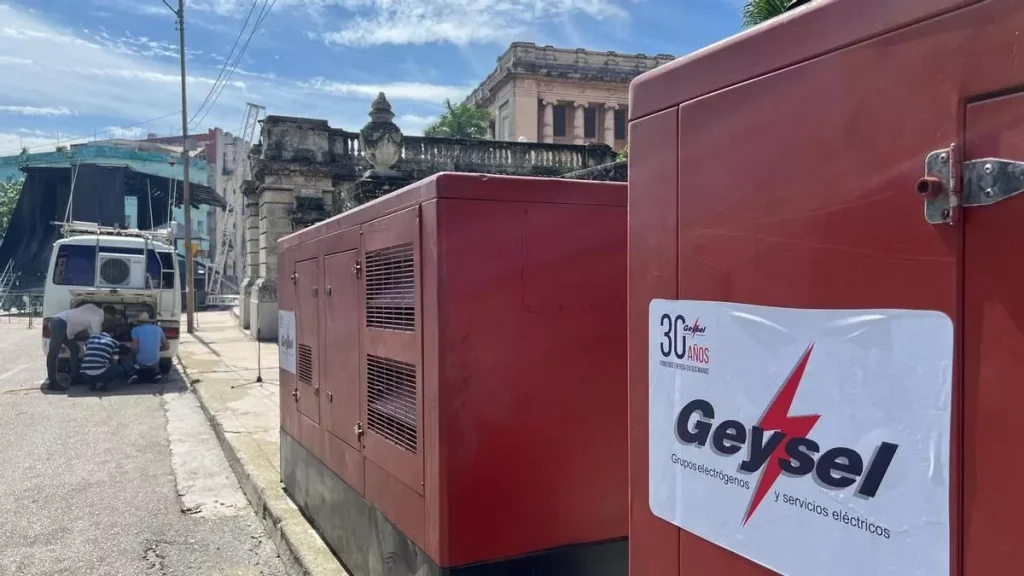
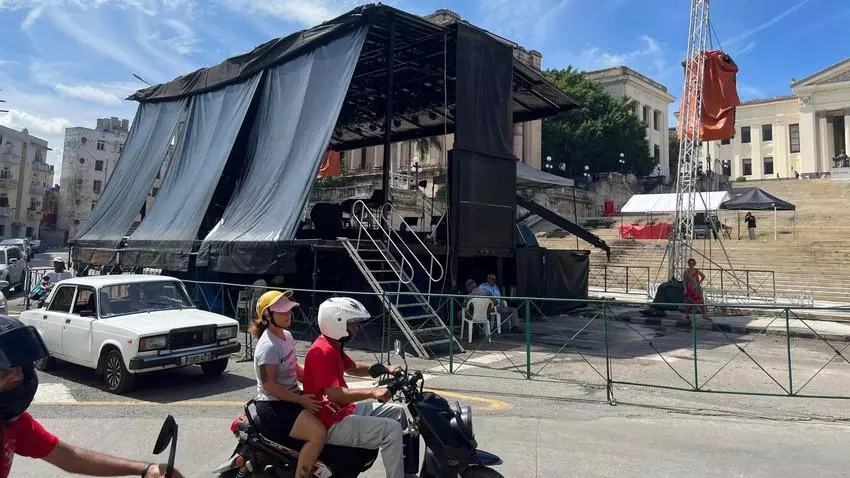
Havana, Darío Hernández, September 19, 2025 — Two red mastodons stand out in front of the University of Havana this Friday. Although the stage for the concert that Silvio Rodríguez will offer tonight is visually more striking, passers-by only have eyes for the generators that will prevent the show from being interrupted due to the lack of electricity. With a greedy look, some with gestures of bewilderment, others with resignation, and the great majority, those who approach, cannot help but say something about the robust power plants.
“This is so you can see the blue color of the unicorn,” said a woman with a bag of groceries who crossed the street just to read the signs on the devices. “Geysel, 30 years of putting energy in your hands,” stands out in a poster on the generators, which are remarkably well-kept compared to the rust-eaten and often broken devices that you see outside some polyclinics and public offices. “It seems that these are the ones they have for political events,” pointed out a woman who joined the visual inspection.
The singer-songwriter claims he chose the place because he recently saw “very positive attitudes” among the students. / 14ymedio
In a city that since last week has suffered the longest blackouts, when the national energy system collapsed and left the entire nation in darkness, a generator sets off a frenzy of desire. “With one of those I could sleep several full nights without having to scare off the mosquitoes,” speculated a young man who, laughing, agreed to meet up with his friends later to try to get continue reading
into the performance. A few meters away, most of the lights, scaffolding and sound equipment were now placed at the foot of the wide staircase of La Colina.
Rodriguez started to sing amidst the glow of lamps that are a strong symbolic charge in a country where even baseball games must be suspended for lack of power. Cuba expects a deficit of 1,760 megawatts today, so it is unlikely that El Vedado and the surroundings of the concert will not be affected. “If the light goes off I’ll come here,” said an elderly woman who was waiting for the bus a few meters away.
The singer-songwriter says he chose the place because he recently saw “very positive attitudes” among students of the Federación Estudiantil Universitaria in their protest against the increase in State telecommunications company Etecsa’s massive rate increased, known as the tarifazo. But his intention to approach the younger generations, consumers of other musical styles away from the New Trova, could include a very contradictory message. Used to doing their homework by the light of a candle while fanning themselves in the heat, these boys will see before them a display of lights and generators that only the powerful can enjoy in Cuba. The composer of Ojalá will create an island of electricity within the Island of shadows.
Translated by Regina Anavy
____________
COLLABORATE WITH OUR WORK: The 14ymedio team is committed to practicing serious journalism that reflects Cuba’s reality in all its depth. Thank you for joining us on this long journey. We invite you to continue supporting us by becoming a member of 14ymedio now. Together we can continue transforming journalism in Cuba.
Idael returns to the café he’s known all his life and finds, to his indignation, that all they have to offer are toilets with no water, and even that costs 20 pesos
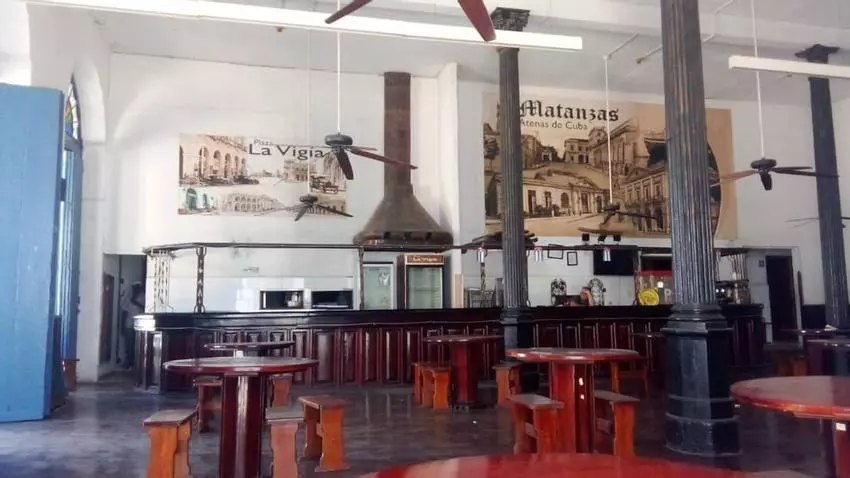
Plaza de la Vigía, where the café is situated, suffers from constant power cuts and the clientele has diminished. / Facebook / Fotos de Matanzas
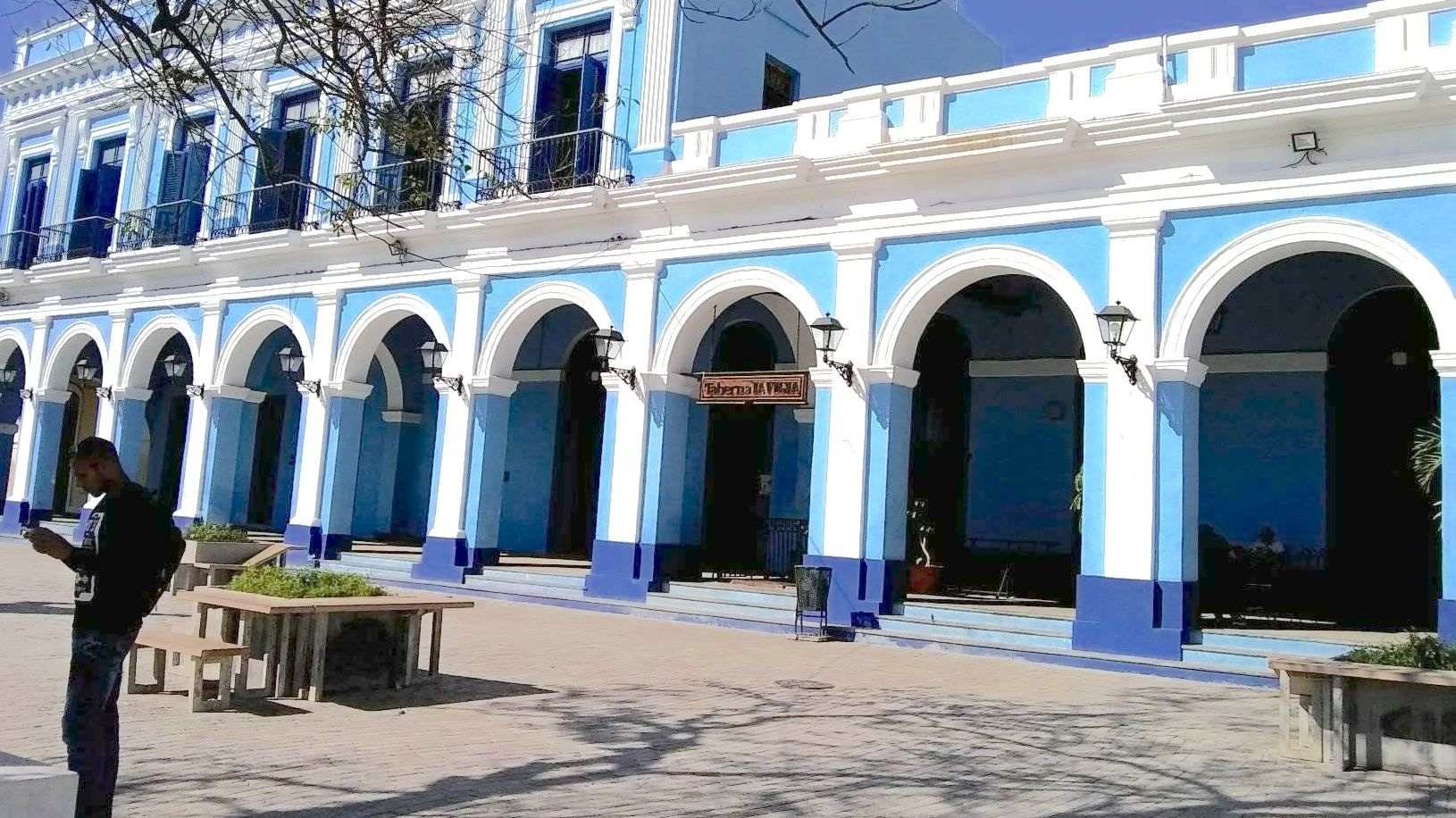
14ymedio, Julio César Contreras, Matanzas, 23 August 2025 – Until he emigrated to Spain seven years ago Idael used to meet up with friends at the Vigía café on the square of the same name in Matanzas. That colonial building, with its wide entrance way and tall pillars was a refuge of shared beers and nighttime meals – which avoided the need to switch on the cooker at home. Today, visiting his native city, the IT engineer was hoping to relive these scenes but the half open doors of the establishment seem to indicate that time has not been merciful.
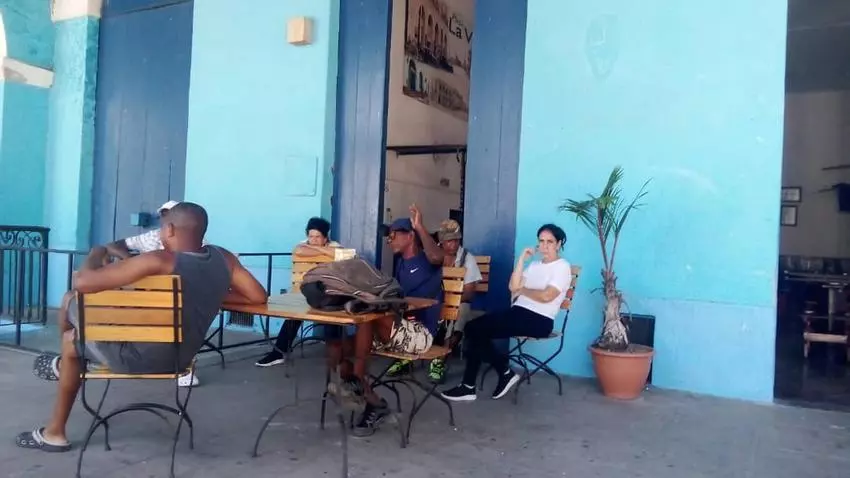
“My parents helped me to learn to walk right here on this wooden lounge floor, and later I used to lift my own son up onto one of the toy horses here”, he remembers, as he observes the staff members in the doorway, distracted, talking about anything but work. One of them asks him, almost with indifference, if he would like anything, as though he was speaking to a stranger, an intruder. No chalkboard here showing special offers of the day, nor any hustle and bustle of clientele: only tables occupied by people taking advantage of the shade, with nothing available to eat.
Looking inside, Idael sees a man seated in the half light of the lounge. “I asked him if I could use the toilets and he told me it would cost me 20 pesos”, he says. And then he realized that all that the Vigía had to offer had been reduced to a toilet and a washbasin with no water. Shortly after, another employee explained that there was no beer, because the place had been without power since the early hours. The coffee machine was broken and all they had were a few fruit juices past their sell by date: an interminable list of what used to be and now no longer is.
No chalkboard here showing special offers of the day, nor any hustle and bustle of clientele: only tables occupied by people taking advantage of the shade, with nothing available to eat. / 14ymedio
The scene infuriates the visitor. “The government ought to give these places over to private ownership who would make them productive”, he complains. “Here you have a bunch of workers who don’t produce anything, earning a miserable wage for opening up at nine and shutting at four. continue reading
Where’s the economical purpose in that? Are they just waiting for the roof to fall in so they can close it down for good?” His questions resound around the cracked walls and the empty tables.
The area around Plaza de la Vigía, where the café is located, doesn’t help either: there are frequent power cuts, a lack of nighttime security and an overall ambience that has been deteriorated by the theft of such things as sound systems and general decoration. The surroundings themselves scare off any potential visitor as much as does the general inertia of a place that seems condemned to be forgotten.
For Idael, what remains is barely even a faded postcard. The Vigía is no longer the meeting place that brought together locals from any profession or salary: “The 20 pesos that used to be enough to get you a Mayabe beer will only be enough to use the toilet today”, he says bitterly. “There’s no Congrí rice or roast chicken anymore. Only silence, a silence that hurts”.
And perhaps what hurts the most is that all the friends are gone. All of them, like himself, have gone.
The Vigía is no longer the meeting place that brought together locals from any profession or salary. / 14ymedio
La Vigía ya no es el punto de encuentro que reunía a vecinos de cualquier oficio o salario. / 14ymedio[/caption]
Translated by Ricardo Recluso
____________
COLLABORATE WITH OUR WORK: The 14ymedio team is committed to practicing serious journalism that reflects Cuba’s reality in all its depth. Thank you for joining us on this long journey. We invite you to continue supporting us by becoming a member of 14ymedio now. Together we can continue transforming journalism in Cuba.
“We have identified 20,000 Cubans, 1,038 with names and contracts,” said Ukrainian military intelligence spokesman Andriy Yusov in an audience with U.S. congress members.
The names of the 40 supposedly identified combat deaths are not provided, nor are the logistical details from the Island to the war front.
Images released in 2023 of Cubans recruited to fight in Russia. / Facebook
14ymedio, Madrid, 19 September 2025 — Giovani Gómez Basulto began working at the Camagüey geomining company in July 2023, but at the beginning of this September his eldest son announced his death, somewhere between Russia and Ukraine, according to the published images. Something must have happened in the meantime for Gómez Basulto to exchange his job in a relatively prosperous state-owned company for a rifle more than 9,000 kilometers away, and that something is probably the 2,000 euro salary promised by Putin that has led to the deaths of a number of Cubans that is difficult to quantify.
According to Andriy Yusov, a spokesman for Ukrainian military intelligence who appeared at a virtual hearing in the US Congress this Thursday, the death toll is “40 confirmed by name,” although the list has not been released. He also lacked concrete data on the 20,000 who, he said, are fighting on the Russian side against Ukraine, along with 250 whose contracts have expired but who remain in Russian units.
“We have identified at least 20,000 Cubans recruited by Russia. More than 1,000 have been verified by name and contract. Many of them died without their families receiving compensation,” he stated. The data would place the island as the largest supplier of foreign fighters in Putin’s camp, after North Korea, he maintained. However, and although it is unknown how many troops Pyongyang has sent to Moscow, Seoul has estimated two waves: one of 10,000 soldiers to Kursk in 2024 and another of 6,000 more this spring.
“We have identified at least 20,000 Cubans recruited by Russia. More than 1,000 have been verified by name and contract. Many of them died without their families receiving compensation.”
The hearing, convened by Cuban-American Congressman Mario Díaz-Balart, also included the participation of his colleagues María Elvira Salazar continue reading
and Carlos Giménez, as well as several Zelensky collaborators not named by Martí Noticias, which provided the information. Also participating was the secretary general of the Cuban Resistance Assembly, Orlando Gutiérrez Boronat, who was in Ukraine in 2023 and, since then, has been actively denouncing the alleged involvement of the Cuban government in sending combatants to Russia.
After that hearing, the Cuban Resistance Assembly revealed the name of a Cuban, Ernesto Míchel Pérez Alvelaes, 26, a native of Trinidad, recruited by Moscow and detained by the Ukrainian Armed Forces. The young man, reports Mario J. Pentón, joined the Russian army on August 1 with the promise of “reconstruction work,” when in fact he was sent to the front. He surrendered, the journalist continues, “after seeing 10 Cubans from his unit and dozens of Russians killed.”
In September 2023 , the regime announced that it had arrested several individuals linked to a network recruiting mercenaries to Russia and warned that they would be tried in a criminal case, of which nothing has been heard since. In July 2025, it was also learned that at least eleven soldiers from Matanzas had been arrested in early 2024 for the same reason, after allegedly being recruited by an officer. The authorities claim that they act in accordance with international treaties and that they firmly oppose such acts, which are punishable by up to 30 years in prison under the criminal code.
Most of the recruits who have spoken claim to have been seduced by the Russian offer and later regretted it, especially after realizing that beyond the logistical tasks used to attract them, they were sent to the front without the slightest consideration for their military experience, limited in the majority of these volunteers to military service performed on the Island.
However, Gutiérrez Boronat’s thesis, supported by other speakers this Thursday, is that in a state with such a high level of surveillance as Cuba’s, it is impossible for something like this to escape the government’s notice. If the regime doesn’t cooperate secretly—unlike Pyongyang, which has admitted it and is bound by a treaty—it at least turns a blind eye, Florida lawmakers maintain.
Among the testimonies documented yesterday were letters from relatives sent to Moscow asking for information about their loved ones who had disappeared at the front, the contract and passport of the supposedly first woman recruited, and the case of Yelena Smirnova, who admitted to having stolen the wages of between 300 and 400 Cubans in Russia and, after being detained in her country, gave the Russian authorities the names of some 6,000 or 7,000 Cubans who had expressed their willingness to be hired.
Another piece of information that came to light this Thursday is that the death of Cubans usually occurs between 140 and 150 days after signing the contract, while some only survive a week, although it is unknown how the statistics have been established.
Another piece of information that came to light this Thursday is that the death of Cubans usually occurs between 140 and 150 days after signing the contract, while some only survive a week, although it is unknown how the statistics have been established.
The chairman of the Ukrainian Parliament’s Foreign Affairs Committee, Oleksandr Merezhko, who spoke at the event, said that Castroism is “Russia’s greatest arm in Latin America,” not only because of its fighters but also because of the pro-Russian propaganda it spreads and the money laundering it facilitates. “The Cuban regime must be recognized in Europe for what it is: a terrorist state,” he said.
Congressman Carlos Giménez warned at the hearing: “You’re either with Ukraine or against Ukraine. There’s no gray area.” However, Republicans have strongly opposed sending aid to Ukraine in the past, even putting the 2023 budget in jeopardy when this item had to be partially sacrificed to save the government from a last-minute shutdown. In recent months, their stance has softened and according to a survey published this summer by the Chicago Council on Global Affairs, the number of Republicans who support continued financial support for Kyiv has risen from 41% to 51%.
____________
COLLABORATE WITH OUR WORK: The 14ymedio team is committed to practicing serious journalism that reflects Cuba’s reality in all its depth. Thank you for joining us on this long journey. We invite you to continue supporting us by becoming a member of 14ymedio now. Together we can continue transforming journalism in Cuba.
An official profile describes the attacker as “a criminal, specifically a butcher and cattle trafficker.”
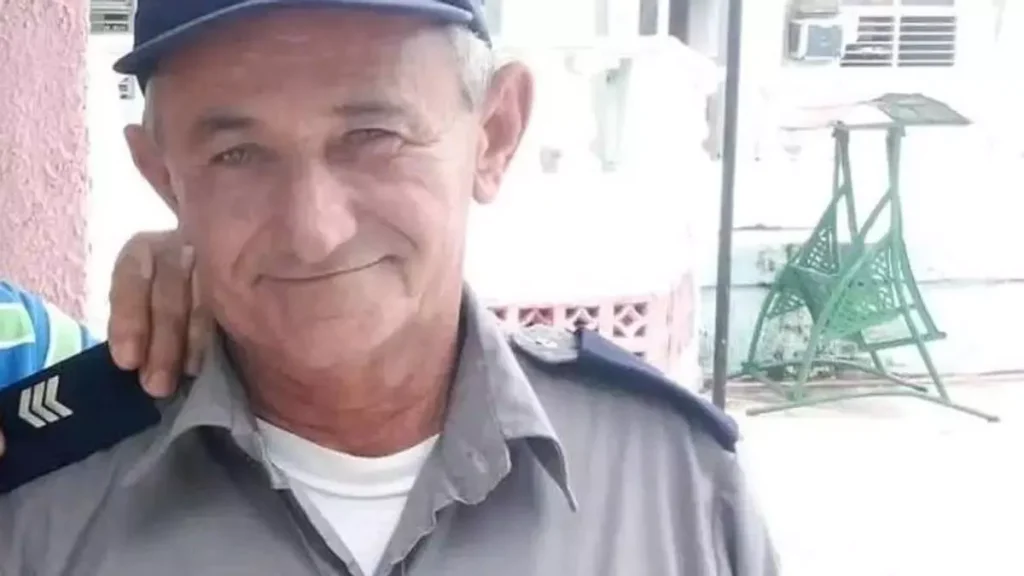
Captain Leonel Mesa Rodríguez, in an image posted on social media. / Facebook
14ymedio, Havana, 20 September 2025 — The Ministry of the Interior quickly confirmed what was spreading like wildfire on social media: National Revolutionary Police Captain Leonel Mesa Rodríguez was found “early Friday morning” with “six stab wounds and a gunshot wound to the head” in the La Reforma People’s Council of the municipality of Caibarién, in the province of Villa Clara.
According to the brief report published in the State newspaper Granma, the officer, who was a sector chief, “was traveling in full uniform” between Remedios and Caibarién “on the assigned motorcycle,” which was found next to his body. Among the few details provided about the police officer are his age, which indicates that he was 62 years old and that “with almost 24 years of service, he was always on the front lines of the fight against crime and a faithful defender of internal order.”
The article also promises “a resounding response of revolutionary laws and the unanimous condemnation of our people, who will never allow impunity or encouragement of violence.”
The authorities are “investigating the incident to fully clarify it and are further investigating initial information.”
“The alleged perpetrator of the atrocious and vile murder used three means to carry it out.”
The extensive Facebook post by Ignacio Ramiro Hernández Crombet, one of the first government officials to confirm the news previously reported by independent journalists, elaborates on the continue reading
incident, saying that the attacker was “a criminal, specifically a butcher and cattle trafficker.”
“The alleged perpetrator of the atrocious and vile murder – which has shaken and shocked the Batey Reforma and CAI Marcelo Salado Lastra community and all of Villa Blanca – used three means to carry it out: a knife, a machete and Captain Mesa’s own service weapon, inflicting countless wounds on his body, especially in the neck area,” the post says.
And Hernández Crombet suggests that the shot came from the police officer’s own weapon, a Soviet Makarov pistol, which was used to shoot him in the head before the attacker fled. “He hunted him down, taking advantage of the fact that he was alone and that the sun hadn’t yet risen,” he laments. “He left him lying, covered in blood, in the middle of the road.”
The security forces, he continued, are carrying out “significant search and capture operations for the criminal and alleged murderer.”
In his post, Hernández Crombet varies the officer’s age and years of service from the Ministry of the Interior’s statement—he is 64 years old and has “more than 25 years of uninterrupted service”—and adds that “his brilliant record of service to the country and his excellent results in combating crime and delinquency” earned him numerous distinctions from the Ministry, including the “Elogio a la Virtud” [Tribute for Virtue]. He specifies: “Captain Mesa was considered by his people to be an all-encompassing police officer.”
“That man was an abuser, a disgraceful man,” said a message signed by a “teacher” who asked that her name not be revealed.
However, a statement received by Cuban journalist Mario J. Pentón , living in the United States and made public before the Ministry of the Interior issued its statement, contradicts those words. “That man was an abuser, a disgraceful man,” read a message signed by a “teacher” who asked not to be named. The message read: “Today, a police officer was killed on the Remedios exit toward Caibarién. They shot him and took his pistol. The body is still lying on the road, awaiting forensic examination.”
According to Pentón, some residents nicknamed Mesa “Cal Viva” and remember him for his excessive behavior as a sector chief.
In any case, the speed with which the authorities confirmed the incident is unusual. The death of a police officer in Calabazar (Havana) in June 2020, in an attack in which two other officers were also injured, was first reported by the independent press. This angered the government, which blamed “anti-Cuban media” for “manipulating” the incident.
The attacker on that occasion, Yusniel Tirado Aldama, age 27, described by the official press as “an individual of terrible social conduct and a criminal record,” was sentenced to life in prison. For whoever is found guilty of Friday’s murder, the official profiles are directly demanding the death penalty.
Attacking a police officer, once unthinkable, is no longer so uncommon in Cuba. Last May, a female police officer was stabbed in the back and seriously injured in Camagüey, in the middle of the street, by an individual who “was walking around the area drinking alcoholic beverages.” According to the Ministry of the Interior, he was immediately arrested.
____________
COLLABORATE WITH OUR WORK: The 14ymedio team is committed to practicing serious journalism that reflects Cuba’s reality in all its depth. Thank you for joining us on this long journey. We invite you to continue supporting us by becoming a member of 14ymedio now. Together we can continue transforming journalism in Cuba.
It coincides with the announcement by the Embassy of Grenada to hire workers for $800 a month.
File photo of the port of Mariel. / OnCuba
14ymedio, Havana, 18 September 2025 — The state-owned company Servicios Logísticos Mariel S.A. (SLM), located in the Mariel Special Development Zone (ZEDM), is seeking employees. According to Trabajadores, which published the call, the company needs to fill 33 positions and offers salaries starting at 12,000 pesos and up to 28,206 pesos, depending on the position and the applicants’ level of education.
The job offer is being published at a time of a massive flight of workers from the state sector, hit by devalued wages, poor conditions, and a constant exodus, both abroad and to the private sector, where salaries are better. It also coincides with the announcement of the hiring of bricklayers and carpenters by the Embassy of Grenada, which begins reviewing applications this Thursday from thousands of Cubans to work in that country, attracted by salaries of $800 per month plus accommodation and transportation.
SLM, considered the main logistics operator in the ZEDM, is seeking drivers, maintenance workers, automotive electricians, secretaries, legal advisors, energy conservation and human resources management technicians, as well as security guards, storekeepers, and mechanics. To make its offer attractive—and because its operation in the island’s most important economic hub allows it to secure certain benefits—the company is also offering food, transportation, quarterly utility bills, and the “possibility” of housing after five years, said Human Resources Specialist Yanara Disotuar Díaz.
SLM’s conditions are very difficult to find in other state entities, but they do not free Cubans from having to be paid in pesos in a dollarized economy.
SLM’s conditions are very difficult to find in other state-run entities, but they don’t free Cubans from having to be paid in pesos in a dollarized economy, being exposed to blackouts, and suffering from the lack of basic services. continue reading
In light of inflation, the benefits are also losing appeal. In August, the National Office of Statistics and Information (ONEI) published a report placing the island’s average salary at 6,649 pesos per month. At the time, the official press celebrated it as a “significant increase,” but the truth is that inflation—14.37% year-on-year as of the end of July—and the constant depreciation of the national currency against the dollar are eroding these gains. In the informal market, the dollar has reached 420 pesos, meaning the average salary is now equivalent to just 16 dollars per month.
SLM salaries, much higher, range from $28 to $67, a not inconsiderable amount on the Island, but figures that pales in comparison to the job offers published by the Embassy of Grenada .
The small Caribbean country has promised a weekly salary of $200 (close to the average wage), with accommodation, transportation, and immigration procedures fully covered. Selected workers will also have round-trip tickets guaranteed. In other words, a Cuban in Grenada could earn in one week what they barely earn in a year in their own country, not including basic expenses.
Granada’s proposal has the added advantage of offering an escape—at least temporarily—from the country and the resulting escape from the blackouts and other difficulties that hamper the daily lives of island residents, as well as perhaps serving as a springboard for embarking on a journey of no return.
Aware that Cubans are finding increasingly fewer solutions in working for the state, the government has resorted to desperate measures: distributing the salaries of vacant positions among active employees as an incentive. However, this measure does not solve the problem of low incomes; rather, it masks it while the workforce continues to seek opportunities, even if it is outside the country.
The Granada case itself demonstrates this. According to the country’s embassy, thousands have applied, and its staff is unable to cope with all the requests.
____________
COLLABORATE WITH OUR WORK: The 14ymedio team is committed to practicing serious journalism that reflects Cuba’s reality in all its depth. Thank you for joining us on this long journey. We invite you to continue supporting us by becoming a member of 14ymedio now. Together we can continue transforming journalism in Cuba.
Requirements include knowledge of English and availability for one year
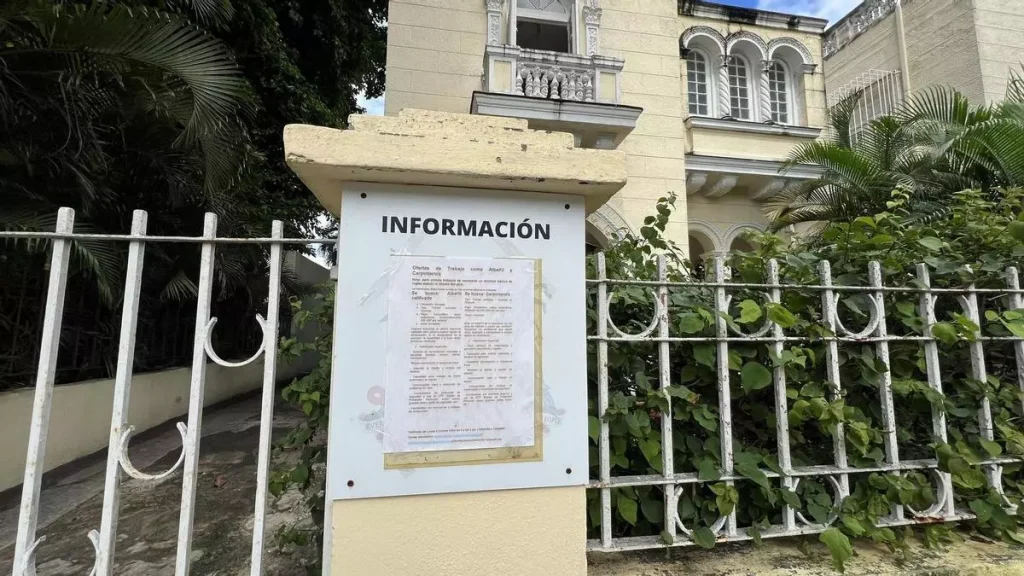
Job offers posted outside the Embassy of Granada in Havana / 14ymedio
14ymedio, Havana, September 17, 2025 — The response to Grenada’s recent offer of masonry and carpentry jobs for Cubans has been overwhelming. According to the offer spread by the Embassy of Granada through Instagram, the project offers a weekly salary of 200 dollars for one year. “We can’t respond,” acknowledged the diplomatic headquarters, which asks the thousands of interested parties to consult its list of requirements and send an email.
The offer is attractive when the average monthly salary on the island is $16. Participants are required to have a certain command of the English language in order to facilitate communication at their workplace. In return, Grenada promises those chosen an “immediate start” and coverage of the costs of paperwork and work permits.
The selected participants will be provided with accommodation and transport throughout their stay. Return tickets are also provided by the small island.
The selected participants will be provided with accommodation and transport throughout their stay. Return tickets are also provided by the small island
Without being a compulsory requirement, it is preferred that the bricklayers have some knowledge of finishes. The tasks to be carried out involve the construction of walls, columns, insulation and waterproofing, as well as a knowledge of plans.
Carpenters must have skills for the manufacture and assembly of wood infrastructure in constructions, the development of continue reading
“furniture, doors, windows” and a knowledge of roofing and wall planking.
Between this Thursday and next Thursday, interviews will be held at the Embassy of Granada in Havana, located on Quinta Avenida 2006 between 20 and 22, in Miramar.
Diplomatic relations between Cuba and Grenada were formalized on April 14, 1979, one month after the triumph of the revolution led by the Granadian Maurice Bishop.
Both countries have agreements on environmental protection, education, aquaculture and fisheries, and especially in the area of health, with the presence of 300 Cuban specialists in Granada and the granting of scholarships to students from Granada.
The present call brings to mind the Cuban presence in Granada at the time of the American invasion on October 25, 1983
During the so-called Operation Urgent Fury, “the invading forces confronted 1,500 Granadian soldiers and 700 Cubans, who were listed as construction workers, engineers and some military personnel,” the Miami-based media Café Fuerte recalled on the 40th anniversary of the event.
The Cuban builders were working mainly on the construction of a new airport. Grenada’s official media announced that with the arrival of the U.S. military, and after engaging in difficult battle, the last Cuban fighters “immolated themselves wrapped in the flag.” The truth is that most were made prisoners, and colonel Pedro Tortoló Comás, at the head of the Cuban troops, sought asylum with other officers at the Soviet Union embassy.
Translated by Regina Anavy
____________
COLLABORATE WITH OUR WORK: The 14ymedio team is committed to practicing serious journalism that reflects Cuba’s reality in all its depth. Thank you for joining us on this long journey. We invite you to continue supporting us by becoming a member of 14ymedio now. Together we can continue transforming journalism in Cuba.
The first store in Cuba in freely convertible currency for tools and supplies opens for tobacco producers
The store is located on Carretera Las Ovas. / Tabacuba/Facebook
14ymedio, Havana, September 19, 2025 –The first freely convertible currency (MLC) tobacco supply store opened this Thursday in Pînar del Río. The store, which the authorities presented as just one of many that they want to open so tobacco producers can use the virtual currency they get as a stimulus after harvest, comes six years after the implementation of the MLC and at a time when its value has plummeted.
Marino Murillo, president of Tabacuba, inaugurated the store, which the official press says has more than “100 tools and products necessary to guarantee tobacco production and improve the producers’ living conditions.” The shared images mostly show common hardware items such as brushes, hammers and screwdrivers, more useful for the machinery than for the harvest itself, and that easily fill a list of 100 products.
The most attractive offers, for which users who saw the publication on social networks now begin to show interest, are water turbines and, above all, power generators – almost essential in Cuba if you want to have electricity most of the day. However, the models on display are diesel, a fuel that is very difficult to obtain, rather than being rechargeable with solar panels. continue reading
The official press also mentioned that kits of solar panels, cement and household appliances that were previously sold in another location will also be marketed.
Located in the Tobacco Logistics Base Business Unit on Las Ovas Road, the shop is almost exclusively stocked with products from the Chinese brand Total Tools, including the power generators. However, it is unclear whether they have been donated by Beijing or purchased by the island.
The store opens at a time when tension has risen among farmers over the devaluation of the MLC, which barely buys anything in an economy now turned to the dollar. The inconveniences in a sector that produces so much income is precisely the reason behind the opening, according to Murillo himself: “It is a way for them to reinvest in their land as long as they do not have debts with the company, and to ensure that the MLC paid has purchasing power.”
The company president also assured that there are plans to open similar shops in the municipalities of San Luis and San Juan y Martínez, tobacco producers par excellence, as well as in Vuelta Arriba, in the central provinces that also produce cigars.
The authorities did not clarify prices either, although they claimed that they are “between 25% and 30% less expensive than in the current domestic market as a result of negotiating directly with the supplier while avoiding intermediaries.”They also stressed that “after-sales” service and “transport facilities” will be provided to customers if necessary.
It is not the first time that Tabacuba offers tobacco growers a way to use the MLC, which is losing value
It is not the first time that Tabacuba offers tobacco growers a way to use the MLC, which is losing value, now worth only 205 pesos, compared to the record of 310 in May 2024. At the end of August, the company delivered six modern Mercedes-Benz to Cuban farmers to “encourage tobacco production.”
According to what a tobacco dealer from Pinar del Río told 14ymedio, the offer to manage the purchase of vehicles – paid for in MLC by the farmers themselves – was made to about 300 producers, six of whom chose a Mercedes-Benz. Some 15 opted for Chinese tillers of the Foton brand and semi-trailers.
Tabacuba, he then explained, offered to pay for the cars in dollars abroad and charge the farmers the amount at the exchange rate of one MLC to a dollar, while in the informal market the American currency is worth two times more than the virtual one. For farmers, the business initially appears to be beneficial, especially given the dizzying devaluation of the MLC. But there is a catch: although it is a sector that generates many currencies and profits for the State, producers are still forced to manage their crops in the devalued MLC, without access to the dollars they generate.
Translated by Regina Anavy
____________
COLLABORATE WITH OUR WORK: The 14ymedio team is committed to practicing serious journalism that reflects Cuba’s reality in all its depth. Thank you for joining us on this long journey. We invite you to continue supporting us by becoming a member of 14ymedio now. Together we can continue transforming journalism in Cuba.
The rapper is one of the voices of the anthem ‘Patria y Vida’, along with Maykel Castillo ‘Osorbo’, imprisoned on the Island.
“Thanks to God and to everyone who contributed their part,” the musician concluded his message. / Screenshot / Facebook
14ymedio, Havana, September 18, 2025 — Cuban rapper Eliécer Márquez Duany, known as El Funky, confirmed this Thursday that he has obtained permanent residency in the United States, following an appeals process that reversed an initial denial he received from immigration authorities.
“We’re celebrating our residency after so much effort and hard work; I’m a US resident, super happy with today,” the musician said in a video posted on his social media, in which he appeared alongside his lawyer, Miguel Inda-Romero.
The lawyer explained that the case was complex because El Funky’s file included alleged criminal records in Cuba that prevented him from resolving his immigration status. “They fabricated charges that hindered his residency, but we were able to prove they were fabricated,” he said in an interview with Telemundo 51. “We had to appeal, reopen the case, and request a pardon, which was ultimately approved.”
Cuban-American Congresswoman María Elvira Salazar celebrated the news and stated that her office intervened in the process.
The outcome puts an end to months of uncertainty. In May, the artist himself warned that he had “barely a month” left to resolve his situation and avoid deportation. The United States Citizenship and Immigration Services (USCIS) had initially rejected his application continue reading
under the Cuban Adjustment Act, but his defense successfully reopened the case, allowing him to remain legally in the country while his case was reviewed.
Cuban-American Congresswoman María Elvira Salazar celebrated the news and stated that her office was involved in the process.
“Congratulations on obtaining US residency. We knew that if El Funky was deported to Cuba, he would end up like the other two who wrote Patria y Vida with him,” she said, referring to rapper Maykel Osorbo and artist Luis Manuel Otero Alcántara, who did not participate in the song’s creation but was part of the same group.
Exiled in the United States since 2021, El Funky is one of the voices behind the song Patria y Vida — Homeland and Life — which became an anthem of the 11 July Island-wide protests of that year and won two Latin Grammys. Since then, the rapper has repeatedly denounced the repression against artists and opponents in Cuba.
“Thanks to God and to all those who contributed their part,” the musician concluded his message, assuring us that he will remain committed to the cause of Cuban freedom.
____________
COLLABORATE WITH OUR WORK: The 14ymedio team is committed to practicing serious journalism that reflects Cuba’s reality in all its depth. Thank you for joining us on this long journey. We invite you to continue supporting us by becoming a member of 14ymedio now. Together we can continue transforming journalism in Cuba.
“My life is in danger in Cuba,” says Eliexer Márquez “El Funky”
“I have 30 days to leave the country or I’ll be deported,” El Funky wrote on social media. / Facebook/El Funky.
14ymedio, Luz Escobar / Yaiza Santos, Madrid, May 9, 2025 (delayed translation) — Eliexer Márquez “El Funky,” one of the authors of Patria y Vida, the anthem of the 11 July 2021 protests, winner of two Grammy Awards, persecuted in Cuba for his dissenting songs, and exiled in the United States for three and a half years, has a deportation order. He announced it himself on Thursday, with three lines posted on his Facebook wall.
“I have 30 days to leave the country or I will be deported,” the rapper wrote, while asking for support “from all my Cuban brothers and sisters who know about my anti-communist history and from the members of Congress of this country.” As he explained to 14ymedio by phone, the US denied him residency due to the one-year-and-three-month prison sentence he served on the island for marijuana possession more than eight years ago.
He never concealed this background from the US authorities, and they requested more details about it while he was processing his permanent residency under the Cuban Adjustment Act. This, he admits, was a mistake. “I should have requested political asylum upon arrival, but I trusted the lawyer they assigned me,” says El Funky about the lawyer recommended to him by his colleague and co-author of Patria y Vida, Yotuel Romero. The man was a professional with a track record, he says, but he always disagreed with him. continue reading
“I always told him: Brother, my case is for political asylum, but he insisted on the Adjustment Act.”
“I always told him: Brother, my case is for political asylum, but he insisted on the Adjustment Act.” The lawyer’s decision was not without logic. Since its passage in 1996, this law has been the fastest way for Cubans to obtain permanent residency in the United States—between 10 and 35 months, compared to the several years it can take to be granted asylum. With an added advantage: it allows individuals to return to Cuba, something that is prohibited for political asylum seekers, under penalty of losing their status and, therefore, their residency.
But traveling to the island isn’t something El Funky can contemplate. “It would be suicide to return; my life is worthless in Cuba. Everyone who knows my career knows that,” says the musician, who arrived in the United States in November 2021 with a special invitation to the Latin Grammy Awards, where Patria y Vida was crowned Best Song of the Year and Best Urban Song .
“There were two six-month visas, one for me and one for Maykel. They didn’t let Maykel out, but they did let me out,” he says, referring to his friend Maykel Castillo Osorbo, who at that time had already been in prison for six months and who would end up being sentenced to nine years in prison, a sentence he is still serving in Pinar del Río.
“My departure was practically an exile; those people took me to the airport.”
El Funky continues, alluding to State Security: “My departure was practically an exile; those people took me to the airport.” With threats disguised as congratulations: “Have a good trip, but don’t come back just yet. You know we can make content for you that you can live with for up to 20 years.”
After Patria y Vida was released in February 2021 and immediately became a social phenomenon, the regime’s siege against El Funky and Osorbo, the authors who lived on the island – and also Luis Manuel Otero Alcántara, leader of the San Isidro Movement, who also appeared in the video clip – intensified. El Funky, in particular, was arrested on several occasions, and on one of them, precautionary measures were imposed on him to restrict his freedom of movement .
For all these reasons, he sees the regime’s hand in denying his residency: “I’m absolutely sure.” The reason he gives is that the criminal record that arrived from the island, with the sentence completed in 2017, no longer stated “possession” but rather “drug trafficking.” The sentence, El Funky points out, “makes it very clear: it was for half a marijuana cigarette. I served one year and three months, and trafficking in Cuba is punishable by five to ten years. You realize that a crime was fabricated there, especially in a case like mine.”
The rapper asserts that this was also fabricated. “In 2016, I was already making protest music with Maykel,” he recalls. “Maykel had already been imprisoned because he had made a song against Fidel [Por ti, señor]. In the sentence, you can read the neighbors’ opinions: my good behavior, that I wasn’t a criminal, that I’d never had any problems in the neighborhood, but nothing. They had to come up with a way to find me out of line.”
He trusts that his new lawyer can resolve his case so he won’t be deported.
He understands, of course, that the United States, based on his drug convictions, treats him “like a criminal,” but he trusts his new lawyer can resolve his case so he won’t be deported. “They’re taking away a case I served in Cuba, and it’s known that that dictatorship expelled me for all my actions and activism. You have to realize that this is something fabricated by the dictatorship,” he insists. “My life is in danger in Cuba.”
The artist claims he never delayed completing any immigration procedures in the United States to update his status. “Since I arrived, I started working with that lawyer, but everything kept getting delayed.” That same year, he says, they conducted the interview and began asking for more documents.
He also details his life in Miami, more as Eliexer Márquez than El Funky, working as a maintenance man at an elementary school ten minutes from his home. “I’m the head of a family, married to an American citizen who has a daughter. I have a work permit, social security, a driver’s license, all my papers are up to date, none of them expired. I have no criminal record here, I’ve never committed a single offense, not a traffic violation or anything, I’m clean. In fact, for my job at the school, with children, which is extremely sensitive, they had to conduct an in-depth investigation to find out who I was.”
Caught between a dictatorship that would immediately imprison him and a legalistic society more xenophobic than ever, Márquez’s case is reminiscent of the “scum of the earth” of 1940s Europe, as defined by Arthur Koestler: persecuted in Germany as Jews and in France for lacking a job. Far removed from music or the stage, however, his lyrics in Patria y Vida continue to resonate: “You are no longer necessary, you have nothing left, you are already going down, the people are tired of enduring, we are waiting for a new dawn.”
____________
COLLABORATE WITH OUR WORK: The 14ymedio team is committed to practicing serious journalism that reflects Cuba’s reality in all its depth. Thank you for joining us on this long journey. We invite you to continue supporting us by becoming a member of 14ymedio now. Together we can continue transforming journalism in Cuba.
In Chiapas, 1,024 documents have been issued, but nearly 13,000 migrants from the island remain stranded.
14ymedio, Angel Salinas, Mexico City, 18 September 2025 — In the first half of this year, the Mexican Commission for Refugee Assistance (Comar) has issued a total of 3,342 humanitarian visitor cards to Cuban citizens. According to data provided to 14ymedio by the Ministry of the Interior, 1,024 documents were issued in the state of Chiapas between January and June, allowing migrants a regular residence, as well as “access to health, education, and employment services.”
However, in Tapachula, a city on the border with Guatemala, nearly 13,000 Cubans remain stranded without this benefit. “I don’t see an end. Everyone asks for dollars. At Comar, to give you the interview, the lawyers, to speed up the process. I handed over money, and I still don’t have any documents,” Matanzas resident Yaniel tells this newspaper.
“I don’t see the end. Everyone is asking for dollars. At Comar, to give you the interview, the lawyers, to speed up the process,” Matanzas resident Yaniel tells ’14ymedio’.
The migrant, who entered the country last February, claims that the procedures in Mexico City are faster. A Venezuelan with whom he shared a home told him he gave 1,000 pesos ($54) to an agent and “they gave him the visa.” In Tapachula, he claims people have spent 40,000 pesos ($2,179).
Official figures indicate that 254 Cubans received humanitarian cards in the country’s capital, while in Puebla, out of 189 applications submitted to immigration offices, 186 Cubans, only two Venezuelans, and one migrant from the Netherlands were granted humanitarian cards. continue reading
Puebla immigration agent Marco López told 14ymedio that most of the Cubans’ applications were submitted last March, “just as rumors of mass deportations from the United States under Donald Trump’s orders began to gain traction.”
López stated that nationwide there are 8,114 Cubans in an irregular situation. Of these, 7,118 “have already met the requirements and are awaiting resolution of their cases,” but another 996 have initiated the process.
Attorney José Luis Pérez asserts that the Comar figures are from completed records, but in reality there are more than 20,000 Cubans in Mexico seeking opportunities to regularize their status.
____________
COLLABORATE WITH OUR WORK: The 14ymedio team is committed to practicing serious journalism that reflects Cuba’s reality in all its depth. Thank you for joining us on this long journey. We invite you to continue supporting us by becoming a member of 14ymedio now. Together we can continue transforming journalism in Cuba.

 14ymedio, Havana, September 22, 2025 —