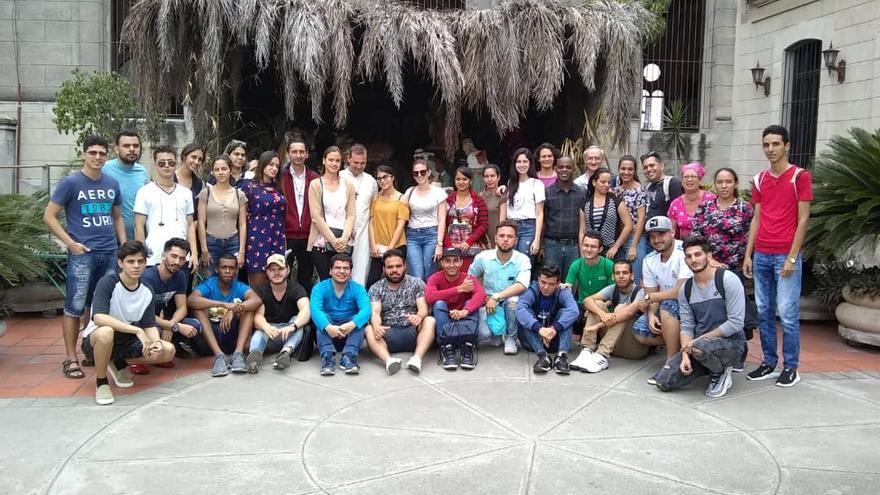
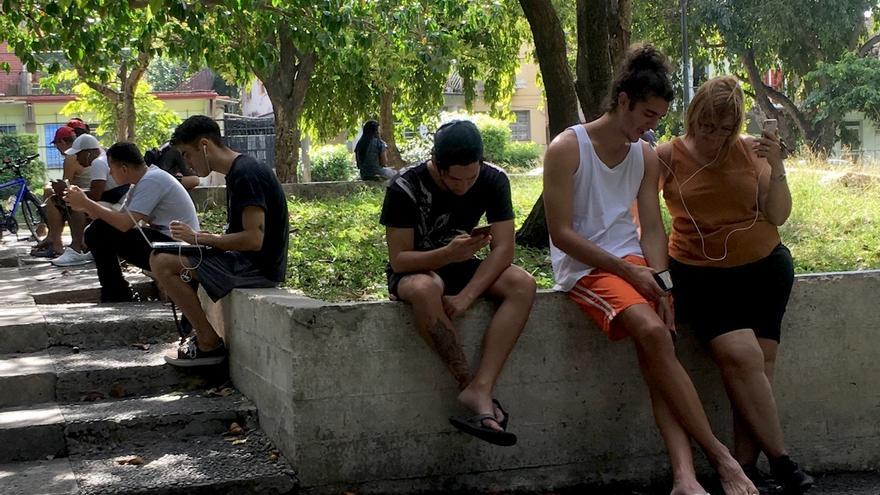
The commercialization of Nauta Home is part of a government strategy seeking to close the technology gap with the rest of the world. (14ymedio)
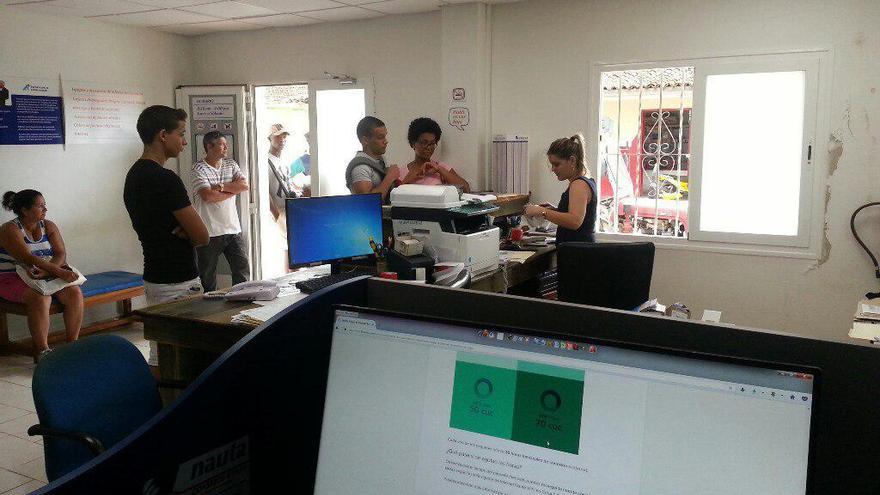
EFE/14ymedio, Havana, January 19, 2019 — Only some 70,400 Cubans — out of a population of more than 11 million — are today connected to the internet from their homes, a service that has grown timidly since its beginning in 2017, compared to the popularity of the recent activation of mobile data with 3G technology, which has exceeded 1.8 million customers in a little more than a month.
Cuba, one of the most disconnected nations on earth, offers the Nauta Home service for individuals in 115 of the 168 municipalities of the country, according to information received from the state telecommunications monopoly Etecsa, published this Saturday by the official newspaper Juventud Rebelde (Rebel Youth). continue reading
95% of Nauta Home users use a 1 megabit connection, the cheapest of the four available packages, which cost from 15 to 70 CUC, high prices compared with national salaries, the average of which doesn’t exceed 35 CUC per month.
Until two years ago, connection from home was a privilege only granted to officials linked with the Government, and professionals such as doctors, journalists, and university professors. The service had subsidized prices but very slow speeds when it came to sending and receiving data.
At first, the commercialization of Nauta Home was seen by customers as an alternative to browsing from the wifi zones with wireless connections that began to be installed on the Island in 2015. However, the slow expansion of the domestic service frustrated those early hopes.
The breaks and cuts in service have also been frequent in Nauta Home, which on January 14 was out of service for more than six hours because of technical problems that affected the entire country.
The arrival of internet to mobile phones on December 6 has caused many to place their hopes in the possible technical improvement and the price reduction of the service from cellphones. Currently browsing packages for 3G technology cost between 7 and 30 CUC, a price much criticized by users.
Until the appearance of mobile data, 60% of the 5.9 Cuban internet users accessed the net from their workplaces or schools.
In Cuba, with 11.1 million inhabitants, there are more than 5.3 million cellphone users.
In December, the Cuban Minister of Communications, Jorge Luis Perdomo, announced before Parliament that this year they would begin to test the mobile service with 4G technology in large cities, although he did not specify official activation dates.
Translated by: Sheilagh Carey
___________________________
The 14ymedio team is committed to serious journalism that reflects the reality of deep Cuba. Thank you for joining us on this long road. We invite you to continue supporting us, but this time by becoming a member of 14ymedio. Together we can continue to transform journalism in Cuba.
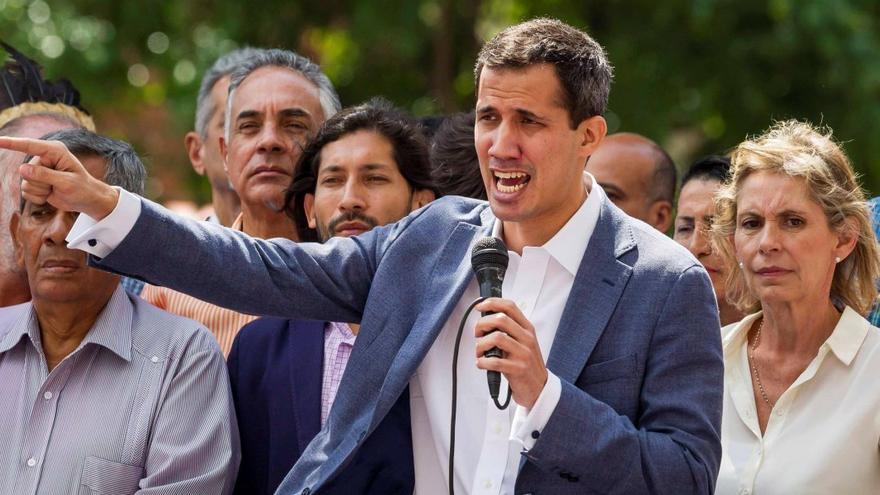
Caption: Juan Guaidó is part of a brilliant group of self-sacrificing ex-student leaders. (EFE)
14ymedio, Carlos A. Montaner, January 20, 2019 — The destiny of Venezuela is probably in the hands of Juan Guaidó. It involves a young representative of 35, linked to Voluntad Popular (Popular Will), a party founded by Leopoldo López. The presidency of the National Assembly came to him, which is something like winning a tiger in a raffle. As President of the Assembly he has turned into, de facto, the acting president of the country in the face of the total illegitimacy of Nicolás Maduro.
Venezuela, then, has two presidents. One legitimate and constitutional, which is Juan Guaidó, and the other absolutely fraudulent: Nicolás Maduro. In any case, in the fourteenth century the Catholic Church had three popes simultaneously. Two were declared antipopes. By that measure, in the future Maduro will be declared antipresident. continue reading
Those who know Guaidó tell me that he has the maturity and the common sense necessary for that job. By means of television he projects a good image. He is endorsed by Luis Almagro, Secretary General of the OAS, 13 of the 14 countries of the Lima Group (excepting the ineffable AMLO’s Mexico), María Corina Machado, Antonio Ledezma, and the US State Department. He has his back well covered.
On the table is even the possibility that Donald Trump’s administration continues buying the 500,000 barrels of petroleum daily from Venezuela, the only influx of fresh cash coming into the country, but with the condition that that money be deposited in an escrow account that only the National Assembly can access through its president. What sense would it make to pay it to an illegitimate government?
But who is this young politician? Guaidó is a graduate in industrial engineering from the Universidad Católica Andrés Bello, with postgraduate studies in public policy at George Washington University and IESA, a management school accredited in several countries.
Engineers have an advantage over lawyers: they’re used to incorporating the factor of time into the work they plan. They’re usually the best in “management by objectives,” something that is urgently needed in a country that has been thrown into such chaos as this one.
Guaidó, in short, has sufficient training and information to straighten out his country. At the end of the day, Venezuela has been devastated by Chavism ($300 billion was stolen) and, recently, by a half-idiot individual who talks to birds and doesn’t know where his right hand is. (Especially the right).
Guaidó is part of a brilliant group of self-sacrificing ex-student leaders that includes Yon Goicoechea, Juan Requesens, a political prisoner, Stalin González, and Freddy Guevara, protected since six months ago in the Chilean embassy in Caracas. They are the new generation. In 2017 the National Guard filled their backs and necks with shot. That is to say: they have risked their lives in the streets, something that is important in a society in which heroic gestures are valued.
Guaidó’s immediate task is about precisely that. He must assume the role of acting president. He must call on the people to demonstrate in the streets. He is also the natural chief of those in uniform. In theory, general Vladimir Padrino López, Minister of Defense, must stand at attention in front of him and accept his orders. Soldiers and minor officials are desperate for this to happen.
According to what viceadmiral Mario Iván Carratú told the Venezuelan journalist Carla Angola, the Armed Forces are demoralized, like the Portuguese army was when the Carnation Revolution happened in 1974. Soldiers are hungry and lacking medicines just like the rest of the country. If Maduro gives the order to attack the demonstrators, Carratú thinks that they wouldn’t comply.
And what would the Cuban Government do? Of course, it would recommend resistance to any change toward democracy and liberty, but the regime of Havana doesn’t have the power to rescue and sustain the dictatorship. It suffers from its own weakness. It would recall its troops and its personnel, much hated in Venezuela, and they would clear off for Cuba, perhaps offering asylum to a handful of their Venezuelan servants.
Can Guaidó promise Chavism something that gets the game unstuck? He cannot promise anything that the Constitution doesn’t allow for. Perhaps a referendum for the country to decide on a law that decrees an amnesty for crimes committed during these years of abuse and vile acts. Only that, but not as his own agreement or that of the National Assembly, but of the whole society.
Translated by: Sheilagh Carey
____________________________
The 14ymedio team is committed to serious journalism that reflects the reality of deep Cuba. Thank you for joining us on this long road. We invite you to continue supporting us, but this time by becoming a member of 14ymedio. Together we can continue to transform journalism in Cuba.
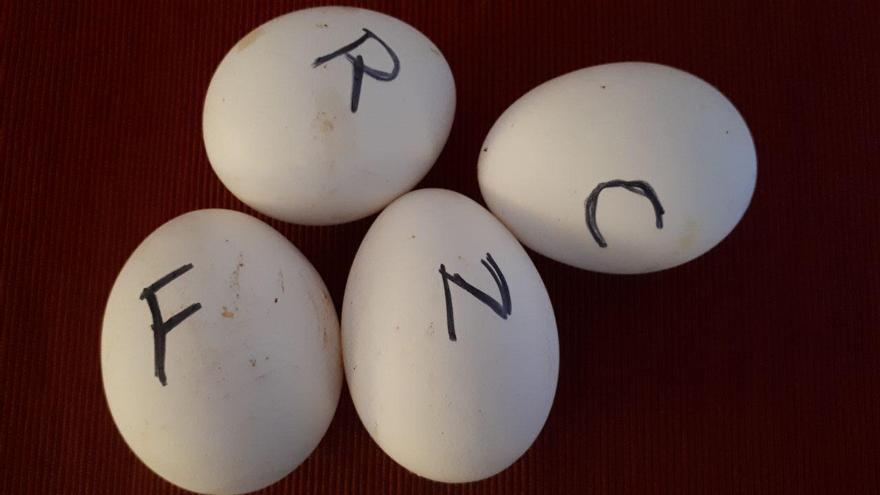
Two retirees have written initials on their eggs to handle the shortage that affects the whole country and to avoid disputes at home. (14ymedio)
14ymedio, Marcelo Hernandez, Havana, 16 January 2019 — In Norma and Francisco’s refrigerator only four eggs remain. In order to handle the shortage that affects the whole country and avoid disputes at home, the retirees have written on the shells the initial of each member of the family.
At the end of last year, authorities attributed poultry production deficiencies to damages from Hurricane Irma in September of 2017 and the sub-tropical storm Alberto in May of 2018. In Havana, where 28 million eggs are consumed each month, only five million came to market in December, according to the official press. continue reading
This shortage coincided with the lack of flour in stores, which caused a fall in the production of sweets in the state and private sectors. With the passage of weeks, the flour shortage has let up slightly, but the egg shortage is unrelieved.
Cubans receive five eggs a month at a rationed price of 0.15 Cuban peso (CUP) each, and they have the right to five more for 0.90 CUP each. On the free market an egg costs 1 CUP, but it has been more than a month since one could be had.
“This month eggs are not in the ration booklet, and anyone who still has one it’s because they kept it since December,” Pascual, an employee of an egg warehouse belonging to the Interior Commerce Ministry, confirms to 14ymedio. “Right now we are waiting for them to arrive, but they have not,” he says.
Added to the deterioration of the poultry infrastructure is the problem of feed for the laying hens. “We haven’t gotten any feed, and we are improvising with the little that is left, trying to stretch it or selling the hens as chickens for consumption,” complains an employee of a state farm near the community of Las Terrazas in Artemisa.
Powdered eggs, a product that a couple of years ago began to enter the country as a substitute for freshly laid eggs, has also disappeared from the market. A kilogram of this product was selling for 65 CUP and came mainly from Brazil.
But last December it was announced that the Government of that nation had stopped exports to Cuba and frozen its credit because, of the 10 million dollars the Island was supposed to pay in June, it only paid 4 million. This measure has already led to a reduction of Brazilian products in national markets.
“With Hurricane Irma we lost the roof, but little by little we were replacing it; what is impeding us right now from establishing production is the lack of food for the birds,” laments the Artemisa worker. “We have had to sacrifice many hens for lack of food, and recovering from that takes time.”
The poultry farms, all under state management, are governed by the traditional concept of keeping the birds caged. An intensive practice that in Latin America is being substituted little by little for another in which the well-being of the animals is taken into account and they are not confined inside of a small space.
The so-called “happy hen egg” is found in Cuba only in domestic production carried out on home patios or on small farms, but all the commercial product in the state network comes from caged hens.
“When our cages or warehouse roofs are damaged we cannot continue producing,” says another employee of a farm in San Antonio de los Banos. “This is very fragile and when the wind blows a little strongly we always have impacts but also when it’s very hot because the interior of the warehouses gets quite hot and many animals die on us.”
Researchers Nadia Baez Quinones and Onailis Oramas Santos, from the Animal Science Institute and the University of Havana School of Economics, respectively, carried out a study of the sector’s problems. The shortage of incubators, deterioration of the refrigeration equipment, deficiencies in the treatment of wastes and constant water pump breakdowns are some of them.
The experts assert that, if there is an investment to air condition the damaged farms and modernize their production, the supply to the population could rise to 39 eggs per month per resident, instead of the ten that they can currently acquire through the ration market.
But some producers, like Ramon Luaces, 72, who worked more than three decades with egg layers, say that more is needed than resources and investments. “We must resume production on a smaller scale, too, and motivate the farmers to produce eggs,” he tells this daily.
“The private egg producer prefers selling them on the black market because they have no incentive to sell to the state,” explains Lucas. “If they would let us sell directly to the people and the hotels, ’another rooster would crow’,” he says, using the Cuban expression equivalent to ’it would be a whole different story.’
Translated by Mary Lou Keel
___________________________
The 14ymedio team is committed to serious journalism that reflects the reality of deep Cuba. Thank you for joining us on this long road. We invite you to continue supporting us, but this time by becoming a member of 14ymedio. Together we can continue to transform journalism in Cuba.
Fernando Dámaso, 14 January 2019: Cuba’s history runs from 1492 to the present day, and men and women have contributed to it, for good or ill, throughout this period.
Because of that, I have never understood why they talk and write about science, art and sport, to name but three examples, as being pre-January 1st 1959, and post that date. This absurd and unnatural division, motivated purely by political considerations, splits up our national history into little compartments. As if the earlier people have nothing to do with present day people, and vice versa. continue reading
This phenomenon is most deeply rooted in sport and music, maybe because of their widespread appeal. So, in the first one, there are baseball players from before and after, and also boxers, volleyball players, swimmers, athletes, chess players, etc., as if all of them weren’t Cubans. The baseball players Orestes Miñoso, Conrado Marrero, Adrián Zabala and Willy Miranda are just as Cuban as José Antonio Huelga, Braudilio Vinent, Armando Capiró or Agustín Marquetti, to name but a few. Also Orlando “Duke” Hernández, José Ariel Contreras, Kendry Morales, Yasiel Puig and Aroldis Chapman as much as Alfredo Despaigne, Yurisbel Gracial, Frederich Cepeda and Yordanis Samón. And, in the boxing ring, Kid Chocolate, Kid Gavilán and Puppy García as much as Teófilo Stevenson, Roberto Balado or Félix Savón.
If we look at music, we have a right old mongrel stew, composed of Brindis de Salas, García Caturla, Ernesto Lecuona, Gonzalo Roig, Rita Montaner, Martha Pérez, Esther Borja, Rosita Fornés, Meme Solís, Miriam Ramos, Pablo Milanés, Benny Moré, Pacho Alonso, Silvio Rodríguez, Beatriz Márquez, Maggie Carlés, Celia Cruz, Olga Guillot, Willy Chirino, David Calzado, Juan Formell, and others.
All of them play their part in forming the national identity, never mind where they come from, or their political and ideological points of view or belief, and nobody has the right or the power to deny them that.
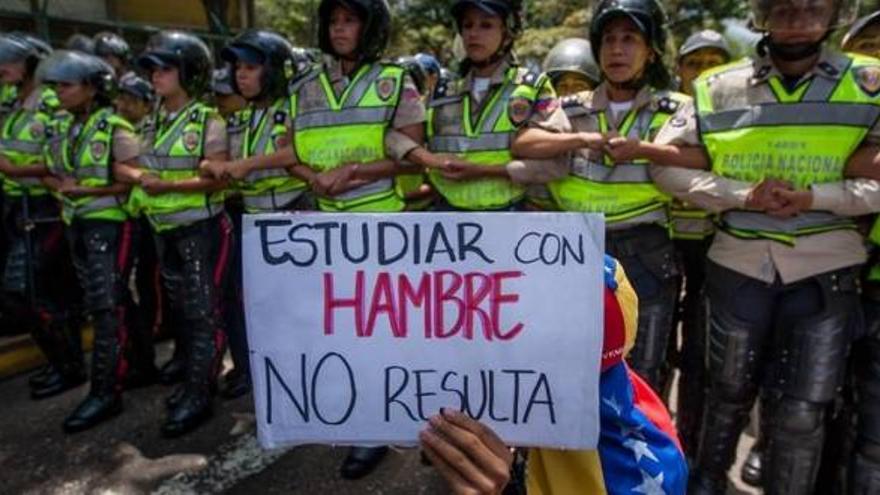
Sign: “Studying While Hungry Doesn’t Work.” The author argues that “induced hunger has an advantage: it kills slowly without its victims joining the statistics of violent deaths.” (EFE)
14ymedio, Miguel Henrique Otero, Madrid, 19 January 2019 — The regime headed by Nicolás Maduro kills without a timetable. It does so throughout the national territory, during the day or at night. The process that consists in depriving Venezuelans of their lives is permanent. And for this it makes use of the most diverse methods, whose results are confirmed at distinct rates.
The method that reaches the greatest number of victims is undoubtedly induced hunger. Over two decades, Chávez first and then Maduro built an economic model, now in full swing, that operates on two premises: hunger and hyperinflation. continue reading
Simultaneously, they liquidated the value of the currency–reduced its purchasing power to nothing–and spread among millions of Venezuelan families the practice of eating less and less, progressively worse, progressively more sporadically. In the design of this perverse, gigantic operation, which has among its glorious antecedents the famines caused by Stalin and Mao, it has counted on the participation of advisors of Castroism and the political party Podemos.
From the plan to turn Venezuela into a State of Hunger, nothing has escaped: the School Food Program ended, productive farms and companies in the agroindustrial sector were expropriated to ruin them, entities have been created one after the other to make the acquisition and distribution of food impossible, the budgets that, until 1998, allowed the operation of soup kitchens and food services in hospitals, orphanages, centers for the elderly, prisons and other institutions have been devastated. A reality that is yet to be reported and photographed: the thousands of industrial kitchens that, throughout the country, are now in useless, rusty and filthy.
The most significant achievement of the “Bolivarian Revolution” in its intent of imposing a dictatorship is expressed in the politicization of the right to eat: the national identity card and the Local Supply and Production Committees (CLAP) that, in particular, act under the most implacable logic of extortion: access to bags of food in exchange for political loyalty. The CLAP system is the most widespread method of humiliation and submission of the Venezuelan society.
Induced famine has an advantage: it kills slowly without its victims adding to the statistics of violent deaths. People — especially children and the elderly — lose weight, lose their body mass, weaken, fall ill and die. The structure of death works perfectly: when the afflicted citizen seeks the help of health services, he does not find it. Thus, the sick person becomes a kind of shipwrecked person: alone, lost, orphaned by the health care to which he is entitled.
To contribute to this politics of death, the regime first undertook one of its most impeccable operations: it destroyed the healthcare system. A perspective view of what happened, shows the multiple factors that were put into play: politicized the performance and operations of the hospitals, persecuted doctors and paramedics, who by thousands and thousands chose to flee the country; took the right measures to create situations of extreme shortage of medicines and hospital supplies; imported from Cuba, not professionals but pirates of the exercise of medicine; and stimulated the return of diseases that had been eradicated and that have acquired epidemic proportions.
They concentrated the purchasing systems in such a manner that it turned them into effective methods for corruption, acquired billion-dollar amounts of bad-quality medicines or counterfeit drugs, destroyed or stole the fleet of ambulances.
They ransacked the dispensaries of the health centers, created their own factory of incompetents under the name of community doctors, allowed the hospitals to become haunts for mafias and criminal gangs; and, if my count is correct, in two decades the so-called Ministry of Popular Power for Health has had, read closely, 17 ministers, one of the biggest posters for an executive power specializing in naming ignorants and thieves as ministers.
To double this process, insatiable and regularly sustained, of killing by hunger and disease, dozens and dozens of other methods are added, more apparent and occurring daily. They kill thousands of defenseless citizens, between 25,000 and 30,000 a year, at the hands of criminals who keep the cities and towns of the Venezuelan territory under control.
Drivers and passengers of vehicles die on highways full of potholes, without illumination nor road signs, in fatal and incapacitating accidents. Hungry people die after eating poisonous food — like bitter yucca — in their starving desperation.
Patients die in operating rooms and intensive care rooms as a result of the extensive and repeated failures of the electrical service. People die due to the lack of ambulance services and emergency care. Entire families die, dragged under by the mud and waters, on rainy days. Thousands and thousands of people die due to lack of medicines and supplies for chronic diseases such as diabetes, blood pressure, heart disease, cancer, HIV and others.
Venezuelan indigenous people die, struck by epidemics. Innocents who live in the neighborhoods of the country die, killed by gang fights or by police operatives or military bodies that shoot indiscriminately. Victims die by hired assassins in charge of the operations. Citizens such as Fernando Albán are killed in torture sessions. Political prisoners die who are denied medical attention. Thousands and thousands of Venezuelans die under the yoke of a regime that hates life.
Translated by Wilfredo Díaz Echevarria
Editor’s note: Miguel Henrique Otero is Editor-in-Chief of the Venezuelan newspaper El Nacional.
________________________
The 14ymedio team is committed to serious journalism that reflects the reality of deep Cuba. Thank you for joining us on this long road. We invite you to continue supporting us, but this time by becoming a member of 14ymedio. Together we can continue to transform journalism in Cuba.
The authorities of Cienfuegos wanted to prevent the poor from “wandering” in the city during the visit of Miguel Díaz-Canel. (14ymedio)
14ymedio, Justo Mora / Mario J. Pentón, Cienfuegos / Miami, 19 January 2019 – More than twenty beggars and elderly people were picked up by the police in the streets of Cienfuegos and sent to the Psychiatric Hospital. The authorities wanted to prevent those poor people from “wandering” in the city during Thursday’s visit by the Head of State, Miguel Díaz-Canel.
Various testimonies collected by 14ymedio in Cienfuegos gave an account of the “cleaning” done by the forces of order with a bus that picked up the elderly who were on the Boulevard and other central zones of the city.
“My aunt was picked up on Wednesday, they manhandled and beat her, she still has a bandage on her leg and bruises on her face and mouth. Osniel Gómez, a policeman on the Boulevard, told me that the round up was due to the arrival of Díaz-Canel,” Martha Galán Cañizares, niece of Natividad Cañizares, reported by telephone. continue reading
Galán said her aunt appeared drugged when she picked her up at the psychiatric hospital in Cienfuegos. According to her, nobody could tell her who was responsible for the old woman’s injuries.
“My aunt raised me since I was a baby. Imagine the amount of medication they gave her that she did not even recognize me. When I told these things to the police they wanted to arrest me,” the woman added.
Although she thought about staying in front of the headquarters of the Communist Party to show Diaz-Canel what had happened to her aunt, Galán feared for the consequences.
“My fear is that afterwards they will continue harassing her. My aunt does not get involved with anyone. She is well mentally, the only thing is that she likes to walk around the city and while she is healthy I think she should do it,” she said.
Díaz-Canel visited Cienfuegos last Thursday as part of a tour that has taken him to several provinces in the country. The media presence of the president, appointed by Raúl Castro in April 2018, has grown exponentially. He visited the glucose factory, the university, the provincial hospital and the amusement park, as well as holding a meeting with the principal leaders of the region.
The social networks publish more and more photos and videos of Diaz-Canel strolling through the streets of the major cities and small peasant villages, where people approach him to pose problems of all kinds.
“Every time a high-level visit comes, the police and the Ministry of Public Health pick up the dirty-looking people who roam the streets and take them to the Psychiatric Hospital,” says a source at the Municipal Social Security Directorate who requested anonymity for fear of reprisals.
“The worst of it all is that they pick them up for a few days and then release them again on the streets without any type of asistance,” he added.
According to the same source, during Díaz-Canel’s visit at least twenty beggars and “wanderers” were picked up.
Arelys Silva, who lives in the vicinity of the Calzada de Dolores, one of the city’s main arteries, is “outraged” by the abuse of the beggars.
“Everybody knows that they take advantage of the fact those people have no one to defend them and they commit all sorts of injustices against them.” Since the arrival of Díaz-Canel, the entire scene was set up to show that things are all wonderful. These people live in a lie,” she said.
Silva says she is still waiting for Díaz-Canel to “bring back the quality” of the flour with which they are making bread or to change the filters of the city aqueduct so that the water does not arrive “with a chocolate color”.
“We have lived through decades of promises and calls for resistance but we continue with the ration book and ’eating chicken for fish’*,” she lamented.
Odalis Acea, a self-employed worker, recognized that with the arrival of Díaz-Canel, transportation and garbage collection had improved. “Even bus route 5 to Tulipán is passing by regularly, but when the president gets on his helicopter, all will revert to how it was before.”
*Translator’s note: “Eating chicken for fish” is a widespread complaint about the rationing system. Cubans can buy limited foods through their ration booklets at very low prices. The allocation is supposed to include fish but, as it almost never does, chicken is substituted. There is no explanation for why, on an island surrounded by water, fish is never available.
Translated by Wilfredo Díaz Echevarria
________________________
The 14ymedio team is committed to serious journalism that reflects the reality of deep Cuba. Thank you for joining us on this long road. We invite you to continue supporting us, but this time by becoming a member of 14ymedio. Together we can continue to transform journalism in Cuba.
The more than two million residents of the capital city can seldom enjoy peace and silence. (14ymedio)
14ymedio, Luz Escobar, Havana, 11 January 2019 — The music in the bus is deafening, the screeching noises from an illegal autorepair shop leak out through the windows of one building, and in another block the screams from a kids’ playground don’t leave the neighbors any peace. Havana is a shrill city and not even the complaints of the victims or the legal regulations manage to put the breaks on so much noice.
Despite legislation that prohibits “producing sounds, noises, smells, vibrations and other physical factors that affect or may affect human health,” the more than two million residents of the capital can seldom enjoy peace and the silence. The noise pollution is everywhere. continue reading
“When I want some quiet I leave the city because here, when it’s not cars, it’s loud music or shouting,” 14ymedio hears from Manuel, 44, who lives in Havana and has a small yoga studio in his home. “Sometimes I can not concentrate and I have to go to the Botanical Garden to be calmer.”
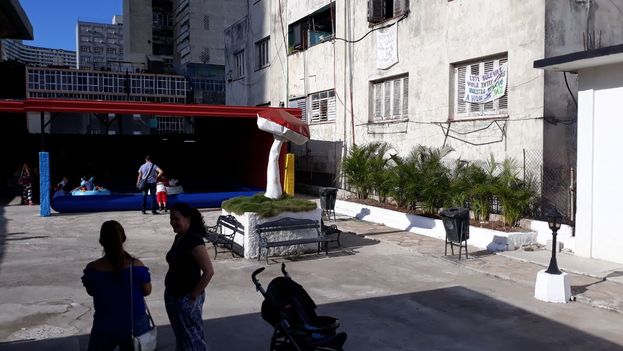
Manuel feels “fortunate” that his building on Marino Street, in the Plaza de la Revolución municipality, “is not one of the noisiest.” Luck that is not shared by the residents of N Street between 23 and 25, who have been engaged in a tough legal battle for years to move an amusement park which is right under their windows.
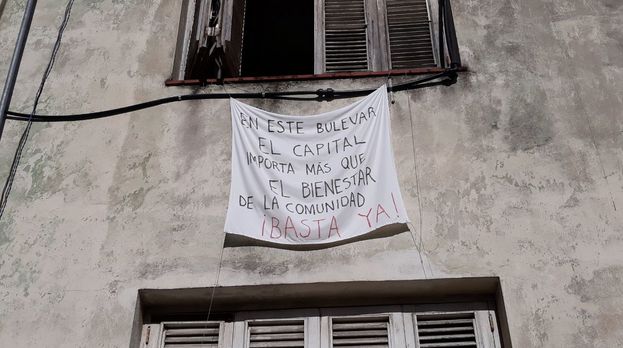
After several complaints at different times and reporting the din from the play area on social networks, the neighbors of that building decided to make their anger visible and hung a cloth outside one or the windows where their demand can be read: “On this Boulevard, capital [i.e. money] matters more than the welfare of the community, enough is enough!” says the message that is visible from the street.
“On this Boulevard, capital [i.e. money] matters more than the welfare of the community, enough is enough!” (14ymedio)
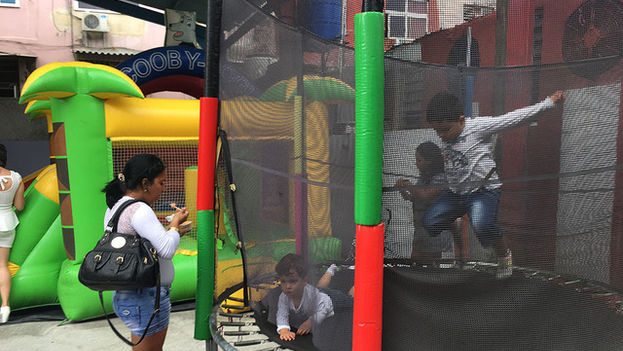
The building adjoins the so-called Boulevard D’25, an old state parking structure for vehicles converted into an area for renting spaces to self-employed workers. The building houses cafes, restaurants and craft shops, but the main attraction is an area with huge inflatable devices for children.
The area fills up on weekends, due to the few recreational options for small children in the area. “That’s when the problems begin because there is very little distance between the games and the nearest building,” a neighbor from the area who preferred anonymity told this newspaper. “It was a bad idea to install that amusement park there,” she says.
In the official press the problem of noise in the streets and buildings is frequently addressed, but most of the time citizens are held responsible. Criticisms of state entities that generate this type of environmental pollution are rarely addressed in newspapers or on national television.
The neighbors of N Street between 23 and 25 have been engaged in a tough legal battle for years to move a children’s amusement park installed next to their windows. (14ymedio)
Liane Cossío, one of the neighbors of the building, reported on the Facebook page for Neighbors of La Rampa — specifically created to denounce this type of situation — that about a year ago, “after much waiting in vain for an answer from the Government,” the neighbors of the building affected by the noise went to the management of the Department of Supervision and Control to complain.
The person they spoke to was direct: “If that park were in the courtyard of a house, we would have removed owner’s license after the first complaint from the neighbors,” but “is there with a permit from the Government and we do not have any way of telling the Government that is badly located.”
However, the insistence of those affected was almost about to pay off. An employee of the playground told 14ymedio that last June “the order to came to collect all the apparatuses for children.” Something she regretted because it is the time of the year when the most profits are made, however, as of December it is open again.
Elsewhere in the city, a park in the Playa municipality near the Casa de la Música, means the closest residents suffer the same sound attacks. A Wi-Fi hotspot has been operating in the park for a couple of years and now dozens of customers come every day to connect to the internet.
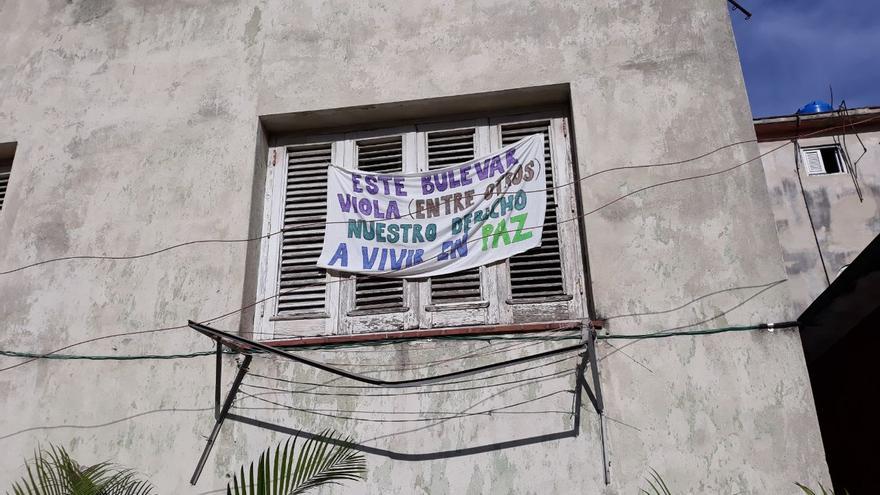
“This boulevard violates (among other things) our right to live in peace” (14ymedio)
“Even very late at night there are people who come with portable speakers and turn them on at full volume,” says Rosendo, a retiree who lives across from the once “quiet park.” “Sometimes people also come out with a few drinks from the Casa de la Música and sit on a bench to sing and shout all night.”
Such behavior can result in the offenders being fined up to 200 pesos, but Rosendo complains that when the police number is called to report shouting or the volume of a loudspeaker “they rarely send a patrol out to control the situation.”
Between January and March of last year more than 13,700 “noise promoters” were fined as part of a government strategy to reduce the high levels of noise pollution, but the problem is so widespread that it barely served to lessen it.
The residents of Rosendo have devised a strategy to get the police to come when they call for noise: they complain that some individuals are shouting slogans against the Government. “When we say that, they immediately send several police officers.” But most of the time “the speakers blare until dawn,” he laments.
Experts say that the human ear is prepared to “receive sounds from nature which are rarely recorded any louder than 60 decibels,” but in Havana noise levels are reached that not only affect the auditory system, but can also be the cause other diseases.
Excessive noise is associated with an increased risk of heart attack, as well as with other symptoms such as ringing in the ears, hearing fatigue, dizziness and stress. The World Health Organization reports that noise above 80 dB increases the aggressive behavior of individuals.
Although Havana resonates in all corners at almost at any time of the day, the most frequent schedule for these infractions is “the evening and late night, and on Fridays, Saturdays and Sundays, consistent with people’s times of rest,” according to a official report. Rosendo knows this well: “Here you can not sleep through the night,” he says.
During the day, the pensioner gives a nod from the doorway of his house, while a few yards away some teenagers hum the latest reggaeton accompanied by a powerful wireless speaker about 15 inches high.
___________________________
The 14ymedio team is committed to serious journalism that reflects the reality of deep Cuba. Thank you for joining us on this long road. We invite you to continue supporting us, but this time by becoming a member of 14ymedio. Together we can continue to transform journalism in Cuba.
The Cubans who are departing for Panama World Youth Day are children of a generation that, for decades, could not show their faith in public. (14ymedio)
14ymedio, Bertha K. Guillén, Candelaria, 18 January 2019 — This Saturday is the day that Jorge has waited for months. Tomorrow he leaves for Panama along with 470 other Cuban Catholics to attend along with Pope Francis the triennial meeting of the World Youth Day (WYD).
It is the island’s largest delegation in the history of the event, which takes place between January 22 and 27, and for the first time, Cuban pilgrims are assuming their own transportation and lodging expenses. In the past, the parishes of the Island covered those expenses and that is why the Cuban delegations were small. continue reading
Jorge sold an electronic tablet and some household goods to gather the $640 that the trip costs. He has also received help from his parents, who make their living renting a house to tourists. With this amount, the youth can buy a packet of accommodation, food and insurance (at a cost of $250), while the other $390 will defray the cost of the plane ticket.
“I was a minor when the Pope visited Brazil in 2013 and I could not travel at that time, in addition there weren’t any meetings in the parishes so that those interested could pay for the trip,” Jorge tells 14ymedio.
The interest expressed by young people to attend the World Youth Day was so wide, according to parishioners from several parishes of Artemisa and Pinar del Río, that the ecclesiastical authorities decided to make a call for self-financing of the trip to all those who would like to participate.
The consular paperwork was handled through the diocesan board of Pastoral Youth. “That helped a lot because the Panamanian embassy in Havana is very complicated, the line is long and the resellers (Cubans who travel to other countries to buy goods and then resell them back in Cuba) offer more than 300 CUC (Cuban convertible pesos, roughly $300 US) for a place in the line in the informal market,” says Ismael, another pilgrim who has joined the trip.
Ismael’s parents look forward to the presence of their son in Panama. Growing up under the strict atheism of the 70s in Cuba, both professionals began to show their religious faith in public when, in 1991, the Communist Party allowed membership to believers. “They dreamed of something that now I can finally do,” says the son.
Many of those who travel to Panama this Saturday are children of a generation “that could not be baptized or married by the Church,” says Ismael. “Those people had to hide the crucifix and religious images and that is why now they have encouraged and supported the young people so they do not let their religion be taken away and carry it with pride”.
To join the delegation it was necessary to fulfill the requirements of the parish, such as having an active and sacramental life and providing a letter of approval from the parish priest or another religious figure of the community.
In all the parishes of the country, young people were advised to count on having additional funds for any unforeseen event. More than 60% of those interested in the trip arranged for private funds or received help from the religious community and from parishioners who collected money so they could fulfill their dream.
“Paying for our tickets has been a challenge, in which our priest have had the principal role. Most of us are students, so we have appealed to the generosity of priests, nuns and people of good will who live outside of Cuba.” explained to this newspaper a young man from Candelaria, in the province of Artemisa.
The Candelarian has many expectations for World Youth Day, an event founded in 1985 by Pope John Paul II that has become the biggest celebration of young Catholics. “It is also a place to compare our realities, to learn other ways of living the faith and above all to fill ourselves with hope,” he says.
In Panama, they will participate in meetings with Pope Francis. “Since last October we have had formative meetings in the parishes to be in tune with the world’s youth,” explains Mónica Rodríguez, a young woman from Santiago. “It is a great responsibility to represent Cubans who are unable to go on the journey and convey the true reality of our country.”
In Cuba there will also be a digital broadcast via Facebook. “We are enabling sites in order to experience the most important moments of the journey via the Internet”, explains David Yanes. “It is the first time that we are directly connected and we are going to take advantage of it”.
Translated by Wilfredo Díaz Echevarria
_______________________
The 14ymedio team is committed to serious journalism that reflects the reality of deep Cuba. Thank you for joining us on this long road. We invite you to continue supporting us, but this time by becoming a member of 14ymedio. Together we can continue to transform journalism in Cuba.
Parents regret that their children must try to get through the entire school day without relieving themselves because of the filth in the bathrooms. (14ymedio)
14ymedio, Havana, 18 January 2019 — Tired of raising the problem year after year, parents of students enrolled in the José Luis Arruñada school, in Havana, decided to report on social networks and other channels the unfortunate situation of the bathrooms. Clogged, without water, filthy and broken, the sanitary services are one of the many problems of the educational center.
For years the principal of La Arruñada, as the school is popularly known, asked for patience and a vote of confidence to repair the breaks that had toilets, sinks and urinals. But the justifications and promises accumulated without the solution appearing and the parents have had to finance cleanings and quick repairs, without the situation improving in the long term. continue reading
The school, which serves elementary and secondary students, has been deteriorating in the last six decades. It went from being a school run by the Catholic Brothers of La Salle to being part of the state network administered by the Ministry of Education. In all this time the large property, which occupies an entire block, has barely benefited from some paint and new school furniture. Two years ago they replaced the old pipes with new plastic ones, but that did not solve the problem either and the problems of clogged plumbing continued.
“How am I going to demand that my son wash his hands before eating if there is no water in the bathrooms and the sinks are all broken?” a mother asked at the last parent meeting held at the school last Tuesday. The question floated in the air, until another voice complained that her daughter “gets home every day of the school bursting” with the desire to urinate because during the eight hours that she spends in the classroom she does not dare to go to the toilets.
“Here there is always a story to justify things, but in the meantime the children are the ones who have to endure all day with the desire to relieve themselves because of the filth in those bathrooms,” the voice said with a hint of weariness, after waiting for many years an improvement.
Of the two bathrooms available for fourth, fifth and sixth grade, there is only one that works, and that badly. In the others, the colors of the old tiles of the floor can barely be made out because of the dirt, the toilets are clogged, and the doors of each cubicle were long ago were torn out and stolen.
Now, for the first time in decades, the images of deterioration and neglect come to light in social networks, but at least three generations of students have endured the stench that accumulates between those walls.
___________________
The 14ymedio team is committed to serious journalism that reflects the reality of deep Cuba. Thank you for joining us on this long road. We invite you to continue supporting us, but this time by becoming a member of 14ymedio. Together we can continue to transform journalism in Cuba.
From early hours of Monday, the Wi-Fi zones and the connection from Nauta Hogar throughout the country are out of service. (14ymedio)
14ymedio, Havana, 14 January 2019 — After an interruption that lasted more than six hours and affected the entire country, the Telecommunications Company of Cuba (Etecsa) restored the Wi-Fi service in public areas as well as “Nauta Hogar,” the company’s home internet service.
From the early hours of Monday, the Wi-Fi zones and Nauta Hogar connections throughout the country were out of service due to a technical “interruption.” Internet users could not access web browsing from their homes or in the public wireless areas, as confirmed by an Etecsa operator. continue reading
“Our specialists are already working to solve this problem,” added the employee of the state telecommunications monopoly, but she did not specify when the service will be restored. Internet access from mobile phones is not affected by the breakdown.
“There is no electricity, no Wi-Fi in the parks, no Nauta Hogar,” activist Iliana Hernández reported on her Facebook account. Similar testimonies have been published on social networks by users from other areas of the country.
Although customers can manage to capture the Wi-Fi signal distributed by Etecsa antennas in the wireless navigation zones, they can not sign on from the service’s user portal.
This time Etecsa did not issue a statement on its website or on its social networks to explain to its customers the nature of the problem.
This newspaper was able to verify that there were also difficulties when it came to reloading credit on cell phone or Nauta accounts through the Transfermovil application.
In 2015, the first Wi-Fi zones began to be installed in squares and parks on the Island and, by the end of 2018, there were 830. In addition, some 40,000 users (out of a population of over 11 million) are connected to the Internet in their homes, through Nauta Hogar.
_____________________________
The 14ymedio team is committed to serious journalism that reflects the reality of deep Cuba. Thank you for joining us on this long road. We invite you to continue supporting us, but this time by becoming a member of 14ymedio. Together we can continue to transform journalism in Cuba.
The vehicles from the Chinese company Yutong are hybrids, which allows the reduction of polluting emissions. (ACN)
EFE via 14ymedio, 17 January 2019 — A batch of 89 buses from China arrived in Havana on Wednesday to reinforce public transport in the capital, which has been running a chronic deficit for many years, state media reported.
The buses from the Chinese company Yutong, were acquired through an agreement between the Ministries of Transport and the Economy and Planning and their counterparts in China, in order to progressively modernize the passenger transport fleet, according to information reported on the television news. continue reading
The news also reported that transport authorities said that the loan for this investment amounted to 16 million dollars, which is to be paid to the Chinese entities over a period not greater than 24 months.
Of the total of vehicles purchased, 50 are articulated and 39 are hybrids (running on both diesel and electricity), so they reduce the use of fuels.
Four Havana bus terminals will incorporate the new Chinese vehicles in the coming weeks to serve bus routes in Havana, where people take 1.2 million trips a day, 1.1 million of them in 7,600 bus trips, according to data from the provincial company of the sector.
At the end of 2018, Havana had about 700 buses in operation in the public transport system, distributed across 126 routes, a figure well below what is needed to meet the demand.
The alternative has been the private transport companies — mostly owners of almendrones* — but in recent months the licenses of more than 2,000 autonomous drivers of these shared fixed-route taxis have been revoked, according to the authorities, due to technical deficiencies, which has reduced the number of these vehicles in service.
*Translator’s note: “Almendrones” is a reference to the “almond” shape of the classic American cars of the 1950s (or even earlier) which are commonly used for this service. The drivers operate shared fixed route service, and fares are based on a zone system. See also: If you strike we will confiscate your car.
_______________
The 14ymedio team is committed to serious journalism that reflects the reality of deep Cuba. Thank you for joining us on this long road. We invite you to continue supporting us, but this time by becoming a member of 14ymedio. Together we can continue to transform journalism in Cuba.
Cuban professionals arriving in Brazil at the beginning of the Mais Médicos program.
14ymedio, Havana, January 16, 2019 — Yury Leydi Durán Sánchez, a Cuban doctor who worked in the Mais Médicos program in Brazil and decided to remain in the country after Havana’s break with its agreement with Brasilia, has written an open letter to president Jair Bolsonaro to ask that he permit the return of her and her colleagues to the health system pending the validation exam.
“I believe that we have sufficient training to fulfill the ’more health’ program, this time with a just remuneration and without chains or bonds of slavery, until the relevant exams are done,” she argues in the missive. continue reading
The doctor, who says she speaks in the name of more than 2,000 doctors who decided not to return to Cuba, reminds that the Island’s professionals who have participated in Mais Médicos since 2013 have fulfilled the requirements that were asked of them upon joining.
These, she reviews in the letter, were to be certified in comprehensive general medicine, have international experience in two countries, basic knowledge of two courses of Portuguese, complete the welcome program, and proven knowledge of Brazilian health protocols, in addition to participating in a specialization course with a thesis and final exam. Added to this, she highlights, they had to be residents of Cuba, something that excluded “deserters” (as Havana describes them) from previous missions.
Durán Sánchez asks that, based on fulfillment of these requirements and the experience they accumulated serving in the remotest areas of the Amazon, they be permitted to continue working as before and refers to the norms of other countries that facilitate similar situations.
One such situation is that of Chile and Peru, “which agree to the authorized doctors working for a year under supervision until the validation exam is carried out.” Another case is that of Spain, which allows doctors who are pending authorization in their specialties to work in primary care.
The doctor appeals in her missive to the Brazilian people and to Bolsonaro himself, whom she personally flatters on several occasions. “Never before has a people, and much less a president, had the courage, like you and your people had, to defend our rights. And for that reason we are eternally grateful,” she maintains.
Additionally, she accuses the Government of Havana of taking away their certifications to punish them. “The Ministry of Health which once validated and authorized our documents, recognizes that…we are denied any certificate of our profession, to keep us that way, our hands muzzled and our freedom taken away.”
The letter has been shared on the Facebook page of the Associação de Cubanos Livres no Brasil (Association of Free Cubans in Brazil), which has worked since October 2017 to demand the rights it considers violated by the Cuban Government.
The doctors who did not return to the Island after the official call are sanctioned with the loss of their salary in national currency (CUP) that was accumulating in a bank account in Cuba and additionally with a penalty of eight years without being able to enter Cuba.
According to statements from Cuban president Miguel Díaz-Canel, 836 doctors did not return to Cuba out of the 8,471 professionals who were in Brazil participating in the Mais Médicos program.
Translated by: Sheilagh Carey
_________________________
The 14ymedio team is committed to serious journalism that reflects the reality of deep Cuba. Thank you for joining us on this long road. We invite you to continue supporting us, but this time by becoming a member of 14ymedio. Together we can continue to transform journalism in Cuba.
At this point it’s still not clear in what conditions voters who are abroad will be able to vote, or even if they will be able to. (EFE)
14ymedio, Reinaldo Escobar, Havana, January 17, 2019 — In a country with a high number of emigrants who have a vital influence in the support of their families on the Island, it’s inevitable to ask if Cubans who live or are temporarily abroad will have the right to vote in the February 24 referendum, a question that official institutions have not yet cleared up.
Per the effects of the country’s current migratory policy, there are three forms in which Cubans can find themselves abroad: those fulfilling an official mission, those who find themselves outside on a temporary basis for personal reasons, or those who, after remaining more than 24 months abroad, are no longer considered permanent residents of national territory. continue reading
The current Electoral Law only mentions the possibility of opening polling places abroad regarding referendums, but it doesn’t specify who will have the right to vote. The issue is a law preceding the migratory changes of 2013 that doesn’t consider the current diversity because it was conceived at a moment in which there were only two forms of being abroad: as “scum” with a permanent departure, without the right to vote, or on an official mission (athlete, merchant marine, and diplomatic).
Faced with the questions arising in the new circumstances, authorities have not helped to clear up what procedure will be followed in this case. Recently Ernesto Soberón, director of Consular Affairs and Cuban Residents Abroad of the Ministry of Foreign Affairs, published on his Twitter account a “clarification” that, instead of providing answers, has sown greater confusion.
The official assured that “all Cuban citizens above age 16 — in full enjoyment of their political rights and who are not included in the exceptions anticipated by the Constitution and the Law — who find themselves abroad, will be able to exercise their right to vote in #Cuba this February 24.” But his statement violates the laws of physics, since if those individuals are abroad it is impossible that they be “in” Cuba for the date of the referendum.
All Cuban citizens above age 16 — in full enjoyment of their political rights and who are not included in the exceptions anticipated by the Constitution and the Law — who find themselves abroad, will be able to exercise their right to vote in #Cuba this February 24 #SomosCuba (#WeAreCuba) pic.twitter.com/1fwnvwrzds
-Ernesto Soberón (@SoberonGuzman) January 15, 2019
The question is greater with those citizens who are temporarily and for personal reasons outside the Island, a figure that could reach hundreds of thousands of individuals if those who left the country after February 24, 2017 and haven’t yet returned are counted. In the case of those who have been abroad for more than 24 months, the current electoral law does not recognize their right to vote in any circumstance and it is unlikely that the Government will make short-term changes to expand their rights.
So far, Cubans who have been temporarily abroad have not been able to cast a vote to elect their district representative. Something that is understandable, since it would be necessary for consulates to handle hundreds of different ballots representing all the districts of those voters. Something similar happens with the elections for members of Parliament, given that the list of around 600 candidates is broken up into municipalities and electoral colleges from all over the country.
However, with the referendum everything changes, while it is the same question for the participants. Additionally, article 164 of the Electoral Law establishes that the National Electoral Commission, in coordination with the Ministry of Foreign Affairs, must arrange “what is necessary to guarantee the casting of votes by voters who find themselves outside of national territory” the day that the election is held.
Precedents of Cubans participating in the constitutional referendum of 1976 only include, without a lot of precision in numbers, the votes that were cast in Angola, organized by the respective political sections of the military units which, at that time, were fulfilling “international missions.” They even ended up opening special ballot boxes on February 15, 1976 on the ships filled with soldiers headed for Africa.
This week the Government has announced that it will carry out a similar process with Cubans who are fulfilling medical and professional missions in Venezuela and one can hope that the initiative will be repeated in those countries where there are numerous delegations of nationals sent by the Government.
But authorities still haven’t publicized the procedure that those other Cubans who do not belong to official missions will have to fulfill in order to participate in the referendum without being bodily present in the national territory. If the Plaza of the Revolution intends for the process to enjoy a greater legitimacy, it must promote and facilitate that participation, especially that of those who have been abroad for less than 24 months.
The Ministry of Foreign Affairs must avoid spreading confusing information that tends to discourage participation, and must detail, without ambiguity, how the rights of those Cubans who are temporarily outside the country will be recognized. Time is passing, and at almost a month until the referendum, any hold-up conspires against their participation and any delay is a violation of the Electoral Law.
Translated by: Sheilagh Carey
__________________________
The 14ymedio team is committed to serious journalism that reflects the reality of deep Cuba. Thank you for joining us on this long road. We invite you to continue supporting us, but this time by becoming a member of 14ymedio. Together we can continue to transform journalism in Cuba.
The definitive text of the new Constitution of the Republic of Cuba will go to a referendum on February 24. (14ymedio)
14ymedio, Luis Tornés Aguililla, Fort Worth | January 17, 2019 — Deep down, this Cuba will have been an intellectual aberration. I say that thinking about my long conversations in Berlin with German friends who lived 40 years of bitterness in the forever defunct German Democratic Republic (GDR).
They spent those four decades asking the only question that at that time seemed rational: “How is it possible that we can stand so much humiliation?” When the Wall fell, the odious mask of the freedom destroyers also fell, along with the pathetic mask of those who accommodated them, some more and others less, in order to survive in that inquisitorial hell. That collapsed in the blink of an eye. continue reading
In Cuba, ’the armed band’, ’the firm’, ’the little group’ or whatever they want to call themselves, at the end, will be defeated because it failed in every order and because the dialectic of any absolute power slides it toward the abyss by its own weight.
Cubans must take advantage of the referendum that the regime is organizing in February to send a clear message, even though we already know that the trap is set and well set. In such a way that “the inflamed majority of the revolutionary people will vote Yes.”
A massive No will be a strong signal to the terrified halberdiers who, within the same Castroist system, understand that the country is sinking at the hands of a small group of individuals intending not to answer for themselves in the face of that history that will absorb and forget them in a mix of hate and horror.
We know, it always happens that way, that practically all of the personal destinies of the vitrified pontiffs of the Soviet bloc countries disappeared from the world without weapons nor ammunition, if there were exceptions, they were those who were able to sell something to the enemy.
Cubans, vote NO! in the February referendum.
Translated by: Sheilagh Carey
______________________________
The 14ymedio team is committed to serious journalism that reflects the reality of deep Cuba. Thank you for joining us on this long road. We invite you to continue supporting us, but this time by becoming a member of 14ymedio. Together we can continue to transform journalism in Cuba.
Several organizations of Cubans living in other countries have decided to embrace the call to protest at the diplomatic offices in the countries where they live. (Youtube)
14ymedio, Havana, January 16, 2019 — A group of Cuban opponents, including Eliécer Ávila, have convened a march for Saturday, January 26, in front of the Cuban embassy in Washington to request a No vote in the constitutional referendum of this coming February 24th. Several organizations of Cubans living in other countries have decided to embrace the call to protest at the diplomatic offices of the countries where they live.
The organizers believe that it is important to “send a loud and clear message (…) with sufficient time in advance about the need to vote No in the upcoming constitutional referendum” Ávila explains to 14ymedio. continue reading
It is not the only demand of the call for a public protest with the motto Protest for all the prohibitions, which attempts to reclaim the freedom of entry and exit to/from the Island “without restrictions, nor black lists.” In addition, the organizers demand “having a passport at an accessible price for all,” dignified treatment in the ports and airports, and the right of Cubans to invest in Cuba with full legal guarantees. Under current law foreigners can invest in Cuba but Cubans cannot.
Added to this list are the petitions for several political rights such as the right of Cubans abroad to vote in all elections and popular consultations that take place in Cuba, the direct vote for the Presidency of the Republic and the claim for a plural and democratic constituent process, in which a Constitution is written that represents, protects and inspires all Cubans.
The call to gather was created by Lucio Enriquez Nodarse and, according to Ávila, has two fundamental slogans: #YoVotoNo (IVoteNo)and #NoMásProhibidos (NoMoreProhibitions). Although the day chosen for the rally was January 28, the anniversary of José Martí’s birth, it was moved to the 26th which is on the weekend. “The birth of the Cuban apostle who dedicated his life to uniting his people seemed inspiring to us to conduct the protest,” he explained.
Some Cubans living in Europe have organized an encounter at the Cuban Consulate in Madrid and another in front of the UN Human Rights Commission in Geneva. Eliécer Ávila introduced on his Facebook profile two of the young Cubans who will be “volunteers” organizing the marches: Osneir Fonseca in Santiago de Chile in South America, and Grette León in Europe.
Ávila points out that the invitation is aimed above all to Cubans themselves in order to “gain self-confidence and raise morale in a struggle that sometimes requires injections of energy.” The event can be, in his eyes, a “very powerful” message for their families in Cuba and “to the dictatorial government that does not believe we are capable of organizing and acting together.”
However, the lack of wherewithal means the march depends on the will and efforts of those involved. “The modest sums that we receive as personal donations only cover 15% of the preparations in other areas. So we spoke very clearly and, to our surprise, personal initiative has been the main protagonist of this call to action. Each individual has given a bit of themselves and we already have hundreds of confirmations of travel by bus, train, family cars, plane, etc. The total opposite of a May 1 in Havana. Here it is not the State nor the Party that is responsible for the expenses, each citizen takes action via his own ideas and resources,” explains Ávila, who foresees a four-hour duration for the event.
Among the organizers of the march in the United States are, among others, the presenter Alex Otaola, the exiled Amaury Almaguer and Siro Cuartel, author of the political satire blog El Lumpen. In addition, Ávila adds that several artists have confirmed their presence, such as Michel Marichal, Randy Berlanga, Dayana Elías and Erich Concepción.
Eliécer Ávila has resided in the United States for more than a year, but has not yet exceeded 24 months abroad, after which Cuba requires additional formalities from its citizens wishing to return to the Island. However, he considers that he must mobilize as if he were affected by the problem. “They have forbidden too many things to me, too many rights. And to my family as well. So that one prohibition more or less does not make a difference,” he argues.
On the day of the march those present will include “many people who habitually travel to Cuba, but can’t invest, vote, nor have reasonable costs and treatment for their paperwork. The motives are many and each Cuban has them to some extent.”
Translated by Wilfredo Díaz Echevarria
_____________________________
The 14ymedio team is committed to serious journalism that reflects the reality of deep Cuba. Thank you for joining us on this long road. We invite you to continue supporting us, but this time by becoming a member of 14ymedio. Together we can continue to transform journalism in Cuba.
 EFE/14ymedio, Havana, January 19, 2019 — Only some 70,400 Cubans — out of a population of more than 11 million — are today connected to the internet from their homes, a service that has grown timidly since its beginning in 2017, compared to the popularity of the recent activation of mobile data with 3G technology, which has exceeded 1.8 million customers in a little more than a month.