A Mexican Ferry Arrives in Cuba To Serve the Isla de la Juventud

The V2V Empress will replace the catamaran Perseverancia, which needs extensive maintenance


The V2V Empress arrived in Cuba this Saturday and will start operating on Monday / Facebook]

14ymedio bigger14ymedio, Havana, September 28, 2025 — Finally there will be some rest for the ferry Perseverancia, overused in recent months, which covered the circuit of Batabanó-Nueva Gerona-Cayo Largo del Sur. The catamaran V2V Empress, with the flag of Belize and coming from Yucatán, arrived in Cuba this Saturday to take Perseverancia’s place. No details were given on the type of contract signed with the Mexican owner of the ship, the company Naviyuc, which is already present in Cuba and has participated in numerous maritime projects of the oil company Pemex.

The Minister of Transport, Eduardo Rodríguez Dávila, made the announcement through his social networks. In his message, the official said that the new vessel “marks a change in the operation of this vital crossing for the connection between La Isla de la Juventud and the western region of the country.”

According to Rodríguez Dávila, the commissioning of the V2V Empress is linked to the “scheduled departure for maintenance” of the Perseverancia, which “will have a necessary pause to renew itself with a full maintenance. This replacement promises to keep the vital connection between the two islands alive.” continue reading

According to Rodríguez Dávila, the commissioning of the V2V Empress is linked to the “scheduled departure for maintenance” of the Perseverancia

The new catamaran, meanwhile, will follow a schedule of daily routes starting next Monday, and will alternate between Batabanó and Cayo Largo, “including one day a week dedicated to the maintenance of the boat to ensure safety standards.”

The V2V Empress, before arriving in Batabanó, left on September 25 from the port of Yukalpetén (Progreso), in Yucatán, according to the Vessel Tracker platform. It is owned by Naviyuc, a “100% Mexican private capital firm” based in Mérida, the capital of Yucatán, which acquired the ferry from a Canadian company in January 2023.

This company is no stranger to Cuba. It has had maintenance and repair contracts since 1999 with the Asticar shipyard, in Havana. In addition, in October 2022, it announced the development in Cuba of “the first multimodal port for rolling cargo, passengers and cruises in the province of Pinar del Río, in the Gulf of Guanahacabibes, the point closest to Mexico,” along with “the 100% Cuban-owned commercial company, Coral Marítima S.A.”

The information was announced during the International Transport and Logistics Fair, held in Havana that year. Without going into detail, it was also indicated that it would seek to encourage the development of tourism and the creation of a cruise port, which could be inserted in the Cozumel-Mahahual-Cuba triangle. At that event, on the last day, Minister Rodríguez Dávila was present.

This company is no stranger to the Island. It has had maintenance and repair contracts since 1999 with the Asticar shipyard

Despite the fact that the company has a website and a contact phone in the records of the Secretariat of Communications and Transport of Mexico, it is not possible to contact them to find details of the agreements with Havana, because their website does not work and their phone is out of service.

As for the history of the V2V Empress, Naviyuc has already licensed it to other governments, although it is unknown whether this is the type of deal that it made with Havana or if it is a donation or purchase. Months after acquiring it, in October 2023, the company signed a contract with the Administration of the Caribbean island of Montserrat to provide a passenger ferry service between Montserrat and Antigua beginning in November of that year.

The agreement stipulated that the term was for five months, until March 31, 2024. It operated five days a week during the period of low demand and six days during the periods of high demand, between December 2023 and March 2024. “The schedule will also include several day trips to Antigua and Nevis, with the option of traveling from Antigua to Nevis or from Nevis to Antigua, with a short stopover in Montserrat,” it added.

As for the history of the V2V Empress, Naviyuc has already licensed it to other governments

The contract was signed by Daphne Cassell, permanent secretary of the Office of the Prime Minister of the Government of Montserrat, and the representative of Naviyuc, Roberto Chami Lizárraga. However, the gamble lasted for a shorter time than expected, as despite the promised renewal of the contract for another year, the end of the agreement was announced in May last year.

The vessel, built in 1995, was designed as a high-end service vessel. Its history began in 2017, when it launched a premium cruise service in British Columbia, Canada. It connected the city of Vancouver with Victoria, the provincial capital; however, this was not successful. The company that operated it announced in 2020 – before the COVID pandemic began – that it would shut down operations. The catamaran with 242 seats “remained practically abandoned for almost three years,” until the sale to Naviyuc.

Translated by Regina Anavy

____________

COLLABORATE WITH OUR WORK: The 14ymedio team is committed to practicing serious journalism that reflects Cuba’s reality in all its depth. Thank you for joining us on this long journey. We invite you to continue supporting us by becoming a member of 14ymedio now. Together we can continue transforming journalism in Cuba.

“Instead of Looking for Oil, Cuba Should Bet on Biomass and Import Liquefied Gas”

Expert Jorge Piñón believes that the support of China and Russia will not be enough to rescue the national electricity system

The biomass plant of Ciego de Ávila, with Chinese technology, was opened in 2020. / Granma

14ymedio bigger14ymedio, Madrid, September 29, 2025 — The Cuban government’s strategy to recover the national electricity system (SEN) is completely wrong, explains University of Texas researcher Jorge Piñón in an interview published on Monday by Bloomberg Linea. The expert is clear that, in the short term, it is impossible to have a solution by betting on a radical change through the use of liquefied natural gas and biomass – the latter especially, because it would regenerate, in parallel, the sugar industry.

“If you say to me tomorrow: ‘Hey, here’s a $20 bill, where are you going to invest it?’ I will tell you in biomass, because it gives me sugar, electricity and ethanol, which, as fuel, can reduce the need to import gasoline,” Piñón tells the economic media. In his opinion, the Island has a huge potential in sugar as an energy generator, a model that follows Brazil. However, the condition of the sugar mills and an ever shrinking sugar harvest act against it. “I would forget drilling for oil and bet on the Cuban countryside to repair the sugar mills and increase cane production.”

In the face of the usual announcements by the Cuban authorities, above all about the small solar installations, which generate only 21 megawatts (MW) each, the specialist rejects the national source of crude oil as energy, due to its high sulphur content, which has contributed to the deterioration of the currently declining thermoelectric plants due to overuse. Pìñón qualifies the national crude oil as “harmful, very harmful” for the thermoelectric plants. “It is a vicious circle: they repair the plants, but they break again because of the crude oil used for fuel.” continue reading

“It is a vicious circle: they repair the plants, but they break again because of the crude oil used for fuel”

Piñón admits that the U.S. sanctions weigh on the “recapitalization” of the Cuban system, but denies that they are the main cause of the SEN’s deterioration. “There are several projects that Cuba could not complete, such as a wind farm in La Herradura, Las Tunas, a project 100% financed by China. Another example is Ciro Redondo, a biomass plant that cost 186 million dollars, also financed by China, to generate 62 MW, which is inactive due to the lack of sugarcane biomass,” he states.

Other foreign actors cited by the specialist are the companies Total (France) and Siemens (Germany), which in 2018 were considering the construction of a power plant in Cuba with natural gas, without success. “It was going to take three to five years and there was no money to build it, nor financing,” he says, recalling that neither the Cubans with their pesos, nor the bankrupt State can pay, nor are there international organizations that can or want to loan money to the Island. “As you can see, the only thing is for the Russians and the Chinese to give Cuba new power generation plants. I don’t envision a solution in the short term,” he admits.

Piñón also refers to the contribution of China with solar energy, which, in his opinion, cannot be the only solution, especially with the small installations, which generate only 21 MW each. “I support renewable energies, such as solar, wind and biomass that this plan includes, but you can’t put all the eggs in one basket,” he says. The lack of batteries, which do not store the energy generated, is a burden at the moment, he adds, and gives as an example a park that has just been built in Texas – where he lives – by a French company that provides 720 MW with 225 MW storage.

The expert is also very skeptical about the support of China and Russia and believes that, beyond political support, in practice it is not the Island that interests Beijing and Moscow. “Cuba is like a chess pawn, a small piece. For Russia and China, Venezuela and Guyana are more important. They want to show their political support for Cuba, but not an economic support that guarantees a long-term income,” he argues.

“Cuba is like a chess pawn, a small piece. For Russia and China, Venezuela and Guyana are more important. They want to show their political support for Cuba, but not an economic support that guarantees a long-term income”

Among the errors of the Cuban strategy, Piñón points out again and again, is that the national oil is a hindrance. Distributed generation, which he describes as a “carbon copy of the thermoelectric plants,” requires very expensive maintenance, which Cuba cannot afford, as happened with the floating power plants from Turkey. “The Island leased all the equipment but also had to supply the fuel, and since it did not have cash available to pay the rent, only two remain out of the eight that they originally had. The others have gone to Ecuador, Guyana and the Dominican Republic.”

In the midst of this desolate panorama and the certainty that solving the problem of the moribund thermoelectric plants requires years and huge amounts of money that do not exist – “starting from the generation of 60% energy with plants using 100% natural gas, which would require between $8 billion and $10 billion and three to five years of work” – the expert is blunt.

“We applaud the target of 37% renewable energy, but what about the rest? It should be liquefied natural gas, following in the footsteps of the Dominican Republic, Puerto Rico and Panama. Liquefied natural gas can be brought from Trinidad and Tobago, from a future Venezuela, from Angola, from countless markets, to supply the thermoelectric plants instead of using oil with high sulphur content,” he concludes.

Translated by Regina Anavy

____________

COLLABORATE WITH OUR WORK: The 14ymedio team is committed to practicing serious journalism that reflects Cuba’s reality in all its depth. Thank you for joining us on this long journey. We invite you to continue supporting us by becoming a member of 14ymedio now. Together we can continue transforming journalism in Cuba.

Tropical Storm Imelda Leaves One Dead and 18,000 Displaced in Eastern Cuba

Classes are suspended in Santiago de Cuba and Guantánamo this Monday, when lighter rains are expected

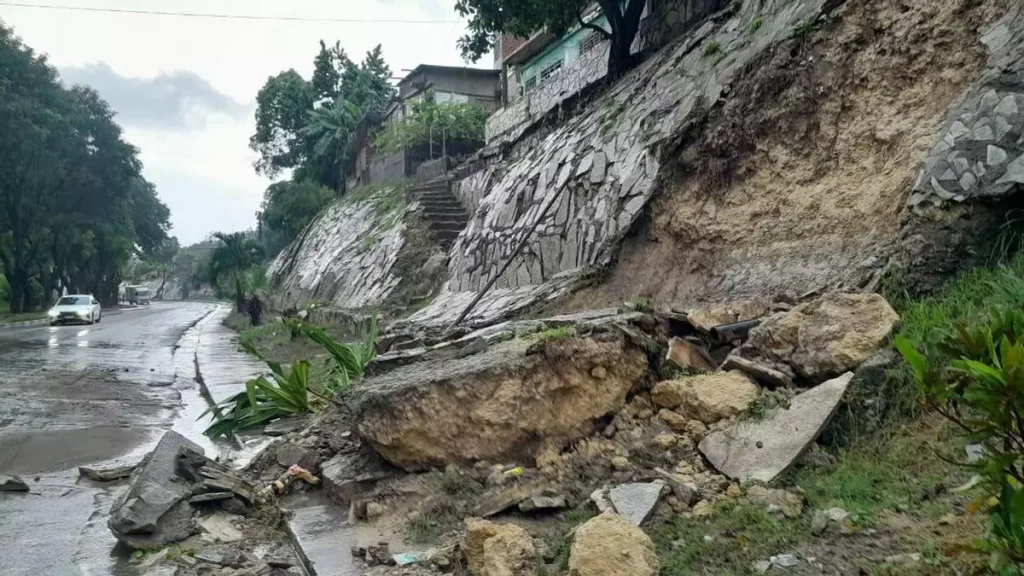
Landslides in Santiago de Cuba this weekend / Santiago press office

14ymedio bigger14ymedio, Madrid, September 29, 2025 — The intense rains that tropical storm Imelda left in Santiago de Cuba have resulted in one fatality: Luis Mario Pérez Coiterio, a 60-year-old man whose house collapsed early in the morning while he was sleeping, due to a landslide.

The house was located on a hillside of the Veguita de Galo division, in Santiago de Cuba, and according to the official version published by TV Santiago, it was not a suitable place to live. “Close relatives present at the site informed the authorities that while he was living with them, Luis Mario was happy and had a safe home but unfortunately decided to return. They even asked him to stay with them during the storm because his home wasn’t safe,” said the report.

From the hundreds of comments that followed the publication, it is clear that the deceased was a vulnerable person. “What painful news. Great person, he was my neighbor. A person who because of his physical situation was able to go out day by day to fight like a warrior, selling mops, brooms, look for wood to cook his food, how sad. Rest in peace, my friend. May God hold you in glory, fly very high,” wrote one user.

The official information highlighted that the body was recovered by rescue teams, but the deceased’s sister posted several messages in the comments thanking everyone for the condolences but asking to tell “the truth” and denying that Beatriz Johnson Urrutia, first Party secretary in the province, was present on the spot. “From 1:00 am my brother was under the rubble, continue reading

and a neighbor warned us at 1:00 pm. My eldest son along with neighbors took him out; before the firefighters arrived they had already taken him out,” said Nivia Pérez, who also pointed out that her brother was not married, contrary to what the publication claimed.

“Don’t write lies, respect the pain of others. My brother lived alone in that house in bad condition,” she said.

https://www.facebook.com/TurquinoTeVe/posts/1363430218902042?ref=embed_post

A neighbor also referred to the insecurity of the area. “My mom has a ceiba tree next to her house; these rains knocked down a wall and nobody does anything. As much as the need for pruning was reported, they didn’t say anything except that have no gas or no crane that can get there. It’s always something. And the life and integrity of the home is at risk. It rains inside the house because a wall has collapsed and is open, and the ceiba stands as the new wall, and in Santiago there is no one to respond. They wait for the worst to happen to act,” she lamented.

The force of the rain has also caused significant structural damage to the Cañizo bridge in the municipality of Guamá. “The weather phenomenon undermined one of the corners of the infrastructure, leaving exposed the concrete base that supports the passage.”

“Currently, the only visible and functional part of the bridge is the top slab, which poses a potential risk to vehicles and pedestrians. Any additional weight on the structure could compromise its stability, so extreme caution is required when transiting through the area,” official sources have noted.

The Cañizo bridge connects several rural communities with the center of the municipality and is used daily by residents, trucks and basic services, the report indicates. However, the road has not been completely cut off, although there are calls for “traffic limitations and safety measures to prevent accidents.”

Another damaged infrastructure has been the already weakened electricity grid. The provincial manager, Javier Calero Román, indicated that there are fallen poles and faults in distribution lines, especially in the area of Guamá and the capital city of Santiago. The general manager of the Provincial Electric Company stated that the main incidents are due to fallen poles and the deterioration of distribution lines.

“We are giving priority to circuits that feed vital centers such as hospitals, pumping stations and areas of high population concentration. Coordination with the Provincial Temporary Working Group has been key to organizing response actions and ensuring access to affected areas,” said Calero Román. The damage is not great, he says, but recovery also depends on how the storm develops.

Imelda has left more than 18,000 evacuees in Guantánamo. According to the latest report of the Institute of Meteorology (INSMET), it is expected that the rains will continue to be strong, at least in the south and the mountainous areas of the east. The center may suffer some showers, while in the western area, which will be cloudy, isolated rains are expected.

Given the current situation, local authorities have suspended classes at all levels of education in Santiago and Guantanámo, although childcare centers will be open.

The hydraulic company of Santiago de Cuba said that 8.2 million cubic meters [2,166.2 million liquid gallons] have currently been collected in the province’s 16 reservoirs, which until now suffered from a long drought.

Translated by Regina Anavy

____________

COLLABORATE WITH OUR WORK: The 14ymedio team is committed to practicing serious journalism that reflects Cuba’s reality in all its depth. Thank you for joining us on this long journey. We invite you to continue supporting us by becoming a member of 14ymedio now. Together we can continue transforming journalism in Cuba.
An Elderly Man Dies in a Building Collapse in Old Havana

A neighbor explained that the three metal beams holding up the roof were rotten from moisture.

The rubble left by the collapse still obscured part of the entrance to the building on Sol Street in Old Havana this afternoon. / 14ymedio

14ymedio bigger14ymedio, Havana, September 28, 2025 – A collapse that occurred this Sunday in Old Havana claimed the life of an elderly man. The partial collapse of a building, located at 466 Sol Street between Egido and Villegas Streets, occurred around 9:00 a.m., reported the Municipal Administration Council.

According to the official statement, the building “was not in good condition for several years” and people were staying inside “illegally, and were often offered transfers to other locations, which they did not accept in a timely manner.” The statement added: “We regret the loss of one person killed in the incident. The local authorities responded immediately and are assisting the remaining victims.”

The debris left by the collapse was still blocking part of the building’s entrance this afternoon, according to 14ymedio. A police officer guarding the area to prevent entry told this newspaper that “things are still falling.” A neighbor explained that “the three metal beams holding the roof were rotten from moisture,” which contributed to its fall. The wooden posts supporting the roof failed to stop the structure from collapsing.

The tragedy occurred just hours after a balcony collapsed on San Lázaro Street on Saturday, injuring a passerby.

The tragedy occurred just hours after a balcony collapsed on San Lázaro Street, between Hospital and Espada Streets in Centro Habana, injuring a passerby on Saturday. “The girl was about 40 years old. A piece of the balcony came loose, and a rock fell on her, knocking her to the edge of the continue reading

sidewalk,” a neighborhood resident told 14ymedio. The resident claims debris still remains on the road.

San Lázaro Avenue, like so many others, reflects the deterioration of the capital: neglect, salt water, and a lack of resources have turned its buildings into examples of architecture that is practically beyond repair. Outside the restored historic center and far from the more modern Vedado neighborhood, the buildings that line the waterfront are on the verge of collapse.

On social media, residents near the scene reported Saturday’s collapse, generating strong criticism of the government for its lack of investment in large areas of the Cuban capital. “At any moment, Old Havana will be left like a desert, nothing but dust, except for the Capitol and the hotels, which are the only things they repair annually,” wrote one internet user.

Other comments described what happened as part of a growing number of daily problems in the capital. “The situation we have here in Havana is deplorable. The filth eating away at us everywhere, the desperation, the lack of electricity, the hunger, the misery, people dying, children without food, and the elderly yearning for a little attention and help.”

These are not isolated incidents. Last August, an elderly woman was injured after a building partially collapsed on Reina Street, between Manrique and San Nicolás, also in Central Havana. Some 15 families lost their homes and spent the night on the streets, surrounded by furniture and appliances. One of those affected told this newspaper that on that first day, “no one came” from the government to inquire about her situation.

Weeks earlier, another collapse at the corner of San Rafael and Galiano streets killed a worker at Café Boulevard, located on the ground floor of the building. The collapse of part of the roof trapped several people. Neighbors explained that the upper floor houses a boarding house with serious infrastructure and overcrowding problems. The collapse buried one of the employees under the rubble. The entire block where the building stands shows alarming signs of deterioration and neglect.

_______________

COLLABORATE WITH OUR WORK: The 14ymedio team is committed to practicing serious journalism that reflects Cuba’s reality in all its depth. Thank you for joining us on this long journey. We invite you to continue supporting us by becoming a member of 14ymedio now. Together we can continue transforming journalism in Cuba.

The “Fight Against Illegalities” Leaves Cuban Regime With Millions of Pesos in Fines and the Self-Employed With Confiscations

This week alone, more than 7,500 fines were imposed nationwide.

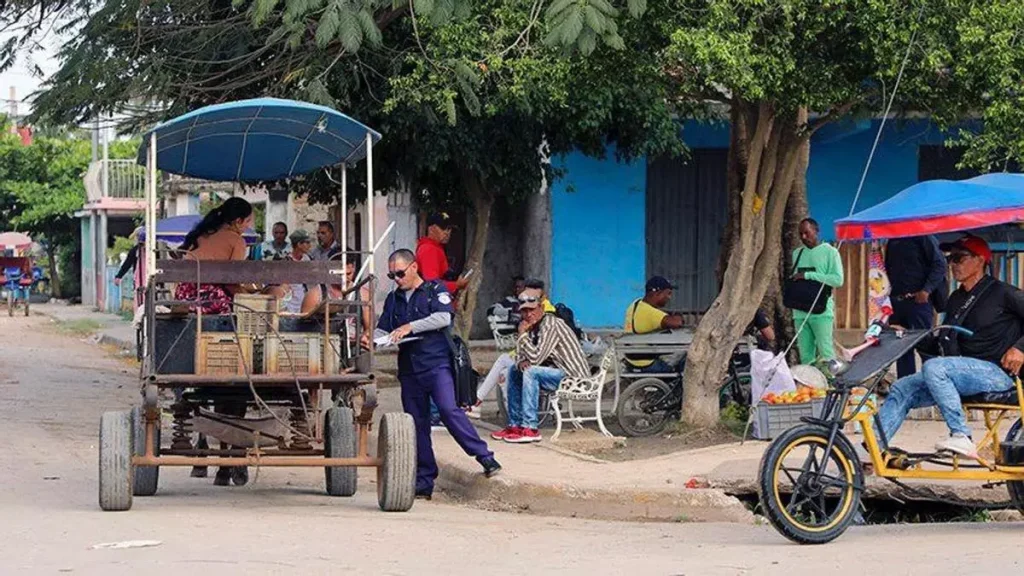
Stock photo of an inspector collecting a fine from a street vendor / Invasor

14ymedio bigger14ymedio, Havana, September 28, 2025 — The recent deployment of inspectors in Sancti Spíritus province, described with pomposity by the official media Escambray, is nothing more than a new assault against the few commercial spaces where food and basic products can still be bought, although at high prices. More than 800 inspections, nearly 190 fines, business closures and seizure of goods are part of what the authorities celebrate as an achievement in the so-called “fight against corruption and economic crime.”

In the province, irregularities such as illegal chalkboards, “abusive prices” and “improper” use of electronic payment gateways were penalized. The sanctions were mainly imposed on self-employed workers and private businesses, who handed over more than a million pesos in fines. The products with the most price violations were rice, cooking oil, detergent, powdered milk and sausages, all more or less staples in Cuban homes.

Those who didn’t have their goods confiscated were again warned to sell at capped prices, which, as sellers have complained in several cases, sometimes do not even cover the cost of acquisition.

What is in theory a matter of ensuring “legality” and “consumer protection,” has in practice become a witch hunt by the Government that occurs more and more frequently. The situation is also not unique to Sancti Spíritus. In Havana, the “Fourth National Exercise for Preventing and Combating Crime” has also resulted in surprise inspections, millions of pesos in fines and business closures. continue reading

In Metropolitan Park, reported the Havana authorities, the private business Salsa Rio was sanctioned for not properly facilitating payments by digital gateways

In Metropolitan Park, reported the Havana authorities, the private business Salsa Rio was sanctioned for not properly facilitating payments by digital gateways. In the municipality of Plaza de la Revolución, “90 control actions were carried out with fines amounting to more than 1.2 million pesos, and the temporary immobilization of 20 actors for hygiene violations along with the detection of 11 illegal vendors. Documents on three projects were inspected and non-performing activities halted,” the official press reported.

At the national level, according to a report on the site Cadena Agramonte, this week alone more than 7,500 fines were imposed nationwide, the result of more than 12,000 inspections. The sanctions amounted to almost 24 million pesos collected. A blow not only for those who try to survive with their business, but for a whole population that depends, in many cases, on the informal market to find products that the State is unable to put on the counters. However, the official press proudly declared that not a single province was freed of fines for “illegalities.”

The emblematic example has been that of La Cuevita, temporarily closed by the government of Havana with the excuse of carrying out repairs, but this week it is still crowded. “This is what the people live on; they can’t shut it down,” a seller told 14ymedio.

La Cuevita, temporarily closed by the government of Havana with the excuse of carrying out repairs and this week still crowded

At the beginning of the year, in April, something similar happened on Holguín’s 13th Street. After a “control operation” an informal market was closed; fines were imposed, and there were confiscations and detentions. The sellers pretended for a few days to respect the capped prices, but the candonga [deception] soon returned to its usual rhythm.

On more than one occasion the sellers themselves have denounced the arbitrariness of the Government, which not only imposes prices that do not match the demand and cost of acquiring the products, but also sends hordes of inspectors who, record book in hand, seek more to collect money in fines than to control illegalities.

Osmel Ramírez, a self-employed man from Mayarí, was summoned by the police this week after denouncing an inspector for her abusive behavior. According to Ramírez, the official frequently visits him, and when she finds the slightest infringement, she imposes the maximum fine possible. “People like her hurt more than the blackouts,” he wrote on social media.

The inspector, he said, had already fined him 45,000 pesos when he started his business, and now wanted to collect another 16,000 “for some cigarettes I had in my pocket. That’s the way they stimulate the private sector: encourage us to go bankrupt.”

Translated by Regina Anavy

____________

COLLABORATE WITH OUR WORK: The 14ymedio team is committed to practicing serious journalism that reflects Cuba’s reality in all its depth. Thank you for joining us on this long journey. We invite you to continue supporting us by becoming a member of 14ymedio now. Together we can continue transforming journalism in Cuba.
A Cuban Player Returns to the Island After His Attempt To Play in the Major Leagues Was Thwarted

Enyer Fernández spent several months stranded in the Dominican Republic for lack of money.

Enyer Fernández returned last Friday to Cuba. / Swing Completo

14ymedio bigger14ymedio/Swing Completo, Havana, September 28, 2025 — Baseball player Enyer Fernández returned to Cuba last Friday after his attempt to be picked up by a professional team in the Dominican Republic failed. After leaving the national sport last November, the 24-year-old from Guantánamo hopes that the Island’s National Baseball Commission will welcome him with open arms.

Fernández returned after spending ten months in the Dominican Republic and not getting a contract. “At the time it was a possible starting point for new personal goals. However, it became a personal ordeal,” highlighted the specialized medium Swing Completo. Without money or prospects of a contract, he was stranded with no chance to return. His case even prompted a collection, intended for paying his return ticket to Cuba, but the initiative failed.

The left-hander arrived preceded by a National Series in which, with 70 strikeouts, he placed third with an average of 3.96 ERA (allowed clean runs), and a pitching speed between 90-92 miles per hour. In addition, he was in the pre-selection of the national team of the Premier 12 tournament and participated in the Caribbean Cup. Before, in 2022, he joined the U23 representation.

Fernández tried out for Major League organizations with pitches between 89-91 miles per hour (mph), below his personal mark

Fernández’ characteristics placed him as an ideal prospect for the talent scouts. The power of his arm, according to journalist Francys Romero, opened up the possibility of “commanding the strike zone and aspiring to a contract with a professional team.” continue reading

During his stay in the Dominican Republic, the lefty perfected his skills at the TBT Baseball Academy under the tutelage of Julio Estrada, a center where other Cubans have also trained, like Andey Garrido, Pedro Pablo Revilla and Daniel Reyes, whom he met.

Last July 7, Fernández appeared before Major League organizations, but it was not the best day for him: he recorded pitches of 89-91 mph, below his personal mark, and a 76-79 mph slider.

His chances were slim after “the franchises of Major League teams concentrated during the last months of the international period on pitchers. Of the 75 players signed in May, 53 were pitchers,” said journalist Francys Romero.

Translated by Regina Anavy
____________

COLLABORATE WITH OUR WORK: The 14ymedio team is committed to practicing serious journalism that reflects Cuba’s reality in all its depth. Thank you for joining us on this long journey. We invite you to continue supporting us by becoming a member of 14ymedio now. Together we can continue transforming journalism in Cuba.
Five People Rescued in Santiago De Cuba After Rain Caused a River To Overflow

Several municipalities in the province, including the capital city, have been affected by floods

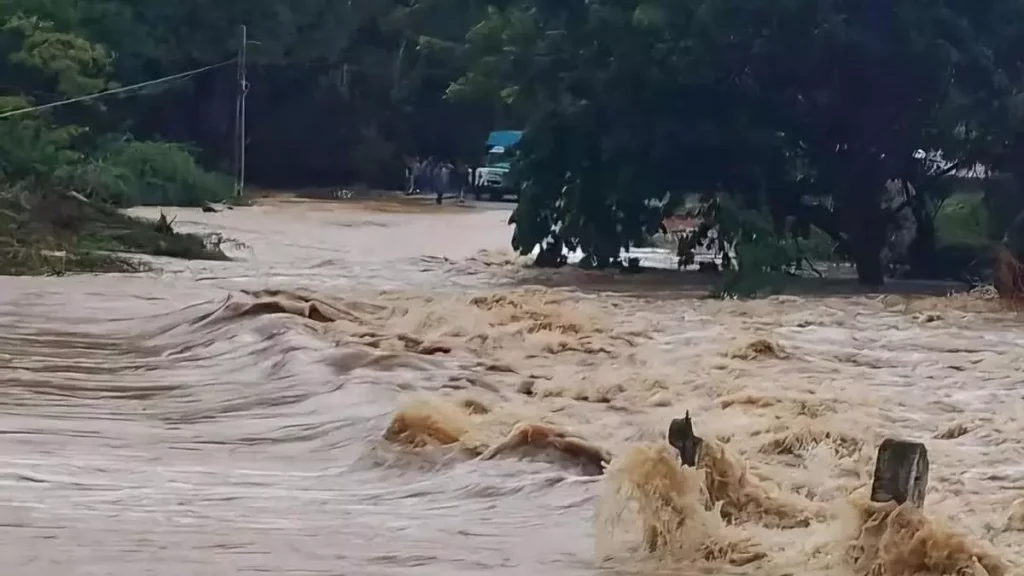
Baconao road in Santiago de Cuba, flooded by the river Sigua / Facebook/Cuscó Tarrade

14ymedio bigger14ymedio, Havana, September 28, 2025 — During Saturday afternoon and evening, both the official press and residents in Santiago de Cuba posted photos and videos showing flooded houses and villages. In some areas the residents had to take refuge on the roofs because the water was over three feet high.

An almost stationary tropical depression north of Holguín has brought heavy rains to all the eastern provinces and Camagüey. Granma and Santiago seem to be the most affected at the moment. According to the Institute of Meteorology of the Island (INSMET), there will be rain in this region on Sunday morning, which will intensify in the afternoon, “become strong in some localities and extend until late at night.”

According to the latest INSMET report, the morning tropical depression “over the past hours has remained with little change. In the night and early morning this Sunday, areas of heavy rain were concentrated in eastern Cuba, mainly in the provinces of Guantánamo and Santiago de Cuba. This produced showers, rain and electrical storms that became strong and locally intense, with significant rain accumulated.”

The depression threatens to become a hurricane. “For the next few hours this system will remain on a similar trajectory increasing its speed [currently 6.8 miles per hour], as it continues to gain in organization and intensity, becoming during the next 12 to 24 hours a tropical storm,” said the Institute, which added that the rain can be very intense in the East, especially in mountainous areas. continue reading

The depression threatens to become a hurricane. “For the next few hours this system will remain on a similar trajectory, increasing its speed”

On social networks, residents of Santiago have reported floods in the municipality. “Hundreds of completely flooded streets keep residents on alert. The dawn has given way to day, and many families continue to have water coming into their homes,” official journalist Cuscó Tarradell wrote on Facebook.

There are also “more than 80 reports of failures in primary and secondary circuits of the municipality of Santiago de Cuba, according to confirmations of workers on duty at the Provincial Electrical Office,” which have caused power outages in several areas of the city. “In the municipality of Guamá, the villages of Aserradero and Uvero are among the most affected by electrical contingencies and floods,” added Tarradell.

In Baconao, where the Sigua River overflowed, five people were trapped on the roofs of facilities at Parque de la Fantasía. According to Cubadebate, two were rescued by Cuban Red Cross personnel in Santiago and the rest were assisted by local lifeguards.

“It should be noted that to reach this location you have to cross several dangerous rivers whose banks have overflowed,” said Aris Arias Batalla, provincial head of Aquatic Security Operations and Relief in Santiago de Cuba.

According to the rescue team, the village of Los Mamoncillos in Playa Verraco was also isolated due to the storm. “Homes were destroyed by its passage, and this was reported on Messenger by families living in rubble and brick houses with metal roofs,” he wrote.

In Granma, where the situation was more critical on Saturday, the consequences of the storm are still being felt. “The settlement of Hatibonico, in the municipality of Caimanera, has recorded the largest accumulated rainfall in the country in the last 24 hours,” reported Radio Bahia.

Translated by Regina Anavy
____________

COLLABORATE WITH OUR WORK: The 14ymedio team is committed to practicing serious journalism that reflects Cuba’s reality in all its depth. Thank you for joining us on this long journey. We invite you to continue supporting us by becoming a member of 14ymedio now. Together we can continue transforming journalism in Cuba.

“It’s a Pity She’s So Ugly,” Wrote ‘Che’ Guevara About the Woman Who Would Become His First Wife.

An Argentine film aims to rescue the figure of Hilda Gadea, who has been erased from official history.

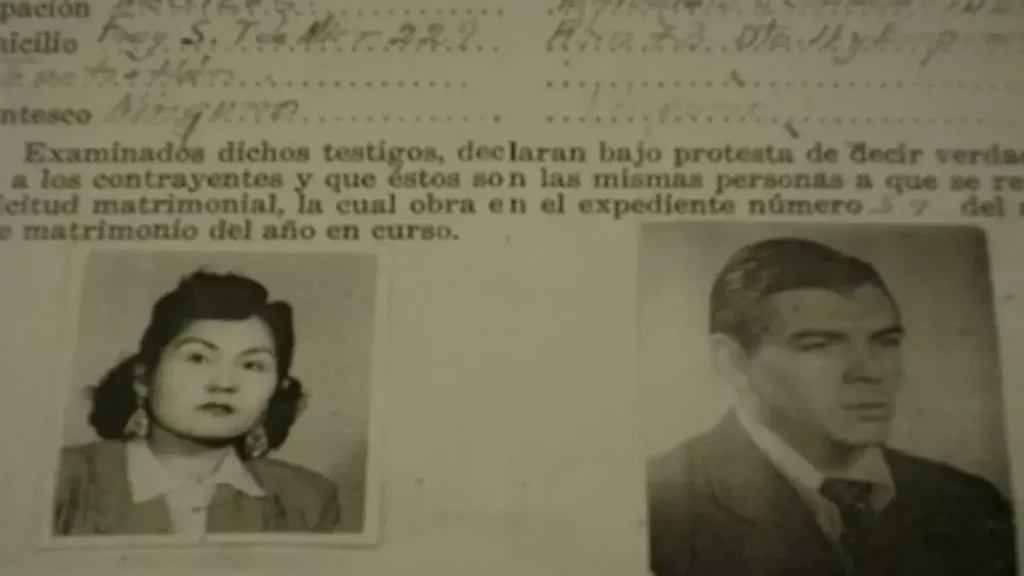
Image of the marriage certificate between Hilda Gadea and Ernesto ‘Che’ Guevara / Special

14ymedio bigger14ymedio, Havana, 23 September 2025 — The life of Hilda Gadea, Ernesto Che Guevara’s first wife, is being adapted into a filmVariety magazine revealed this Monday that filming is underway, based on the Peruvian economist’s memoirs.

Silvina Estévez, the film’s Argentine director, explained in an interview with the outlet that the film will focus on Gadea because she is a “woman whose influence was fundamental in shaping the political vision of one of the most important icons of the 20th century, but whose voice is largely lost in the narrative of her life. She wasn’t just Che’s wife. She was a woman of strong ideas, a professional, an activist, and a mother.”

The film is set in the 1950s, the period in which the two met in Guatemala. Gadea, an economist by profession and a woman who was forward-thinking for her time, gained followers from a young age in a male-dominated environment. She was the first woman to serve on the National Executive Committee of the Apra (American Popular Revolutionary Alliance). After the 1948 coup d’état in Peru, and due to her political activism, she went into exile .

Shortly afterwards, she arrived in Central America, where she quickly joined the progressive government of Guatemalan President Jacobo Arbenz. In December 1953, she met Guevara, a defining moment for the Argentine, as he learned to use weapons and became close to Castro’s Cuban followers for the first time. Although the film “delves into their romantic relationship,” the relationship between the two was not, at first, reciprocal. “Hilda Gadea declared her love for me both in letter form and in practice. I had quite a bit of asthma; otherwise, I might have caught it. I warned her that all I could offer her was a casual contact, nothing definitive. She seemed very embarrassed. The little letter she gave me when she left is very good; it’s a pity she’s so ugly,” Guevara wrote at the time. continue reading

Gadea separated from Guevara, but remained in Cuba until her death in 1974.

Their relationship eventually strengthened. Two years later they married, in August 1955, in Tepotzotlán, State of Mexico (in the center of the country). By then, Gadea was already pregnant with their first child, Hilda Beatriz Guevara Gadea.

The union barely lasted four years, as Che, following Fulgencio Batista’s departure from power on the island, had already found a new partner in Aleida March. Gadea separated from Guevara but remained in Cuba until her death in 1974.

“Interpreting Hilda Gadea is a privilege and an enormous responsibility,” Mexican actress Adriana Paz told Variety. “Her story reminds us that behind every historical figure there are voices that deserve to be heard, especially the voices of women who influenced and transformed their era.” She also confesses: “Being part of this film is a way to revive that memory and question how history is told. Furthermore, being part of a Latin American production that unites us through Spanish and our shared roots is deeply meaningful to me.”

Agustín Pardella, who will play Che Guevara in the film, celebrated the fact that this “is a project narrated by women. I firmly believe there are ways of seeing the world that only exist if we have the opportunity to capture them on screen. Just as Hilda understood that the economy was a tool of power, so too is cinema.”

The project, the magazine explained, is currently in development and is seeking international production partners to help bring to life a story that “weaves the personal and the political into a powerful, globally resonant narrative.”

See also: ‘Book by Che’s Grandson Dissects Bowels of Cuban Reality

____________

COLLABORATE WITH OUR WORK: The 14ymedio team is committed to practicing serious journalism that reflects Cuba’s reality in all its depth. Thank you for joining us on this long journey. We invite you to continue supporting us by becoming a member of 14ymedio now. Together we can continue transforming journalism in Cuba.

A Balcony Collapse in Central Havana Leaves One Woman Injured

“A piece of the balcony came loose and a stone fell on her, sending her rolling to the edge of the sidewalk,” says a neighbor.

File photo of San Lázaro Street. / 14ymedio

14ymedio bigger14ymedio, Havana, 28 September 2025 — A balcony on San Lázaro Street, between Hospital and Espada streets in Central Havana, collapsed this Saturday and fell on a woman who was passing by the block at the time. “The girl was about 40 years old. A piece of the balcony came loose, and a rock fell on her, knocking her to the edge of the sidewalk,” a neighborhood resident told 14ymedio, adding that the debris is still visible in the street.

“A friend helped her up and left with her. Rumors spread that she was dead, but then the police came and said she was alive and in the hospital. It was learned that she lives on Infanta and is from this area, but I don’t know who she is,” the resident adds. She explains that the residents of San Lázaro are alarmed by the condition of the buildings on the street, which periodically collapse.

“Where the stones fell, many elderly people are always sitting, but this time it was a miracle they didn’t die. They were already gone when the balcony collapsed,” she says, although she fears that the next time a balcony or part of a facade collapses, the residents won’t be so lucky.

“At any moment, Old Havana will be like a desert, nothing but dust, except for the Capitol and the hotels, which are the only things that are repaired annually.”

The neglect, the salt air, and lack of resources of the residents of San Lázaro have turned the avenue into an example of the capital’s already unsalvageable architecture. Untouched by the restoration of the historic center and somewhat removed from the more modern neighborhood of El Vedado, the buildings along the artery that runs parallel to the sea are clearly beyond repair. continue reading

On social media, some residents also reported the collapse, sparking criticism of the government, which has abandoned the neighborhood and other areas of the capital to their fate. “At any moment, Old Havana will be left like a desert, nothing but dust, except for the Capitol and the hotels, which are the only things they repair annually.”

Other commentators described the problem as just another of the daily hardships Havana residents face. “The situation we have here in Havana is deplorable. The filth eating away at us from all sides, the desperation, the lack of electricity, the hunger, the misery, people dying, children without food, and the elderly yearning for a little attention and help.”

“Where the stones fell, there are always many old people sitting, who this time did not die thanks to miracle.”

Last August, another elderly woman was injured after a building partially collapsed on Reina Street , between Manrique and San Nicolás, also in Central Havana. The woman was hospitalized, and nearly 15 families were left homeless, with their furniture and appliances scattered in the street.

That night, most of them had to spend it outdoors, and, according to one of those affected, who spoke to this newspaper, on that first day, “no one came” from the government to check on their situation.

A few weeks earlier, a building on the corner of San Rafael and Galiano streets in the same municipality partially collapsed, killing an employee of the Café Boulevard, located on the ground floor. The collapse of part of the roof trapped several people. According to neighbors who spoke to 14ymedio at the time , the building has a tenement apartment on its upper floor, which suffers from infrastructure problems and overcrowding. Part of the roof collapsed on the employees, and one of them died beneath the rubble. The entire block where the building is located shows alarming signs of deterioration and lack of maintenance.

____________

COLLABORATE WITH OUR WORK: The 14ymedio team is committed to practicing serious journalism that reflects Cuba’s reality in all its depth. Thank you for joining us on this long journey. We invite you to continue supporting us by becoming a member of 14ymedio now. Together we can continue transforming journalism in Cuba.
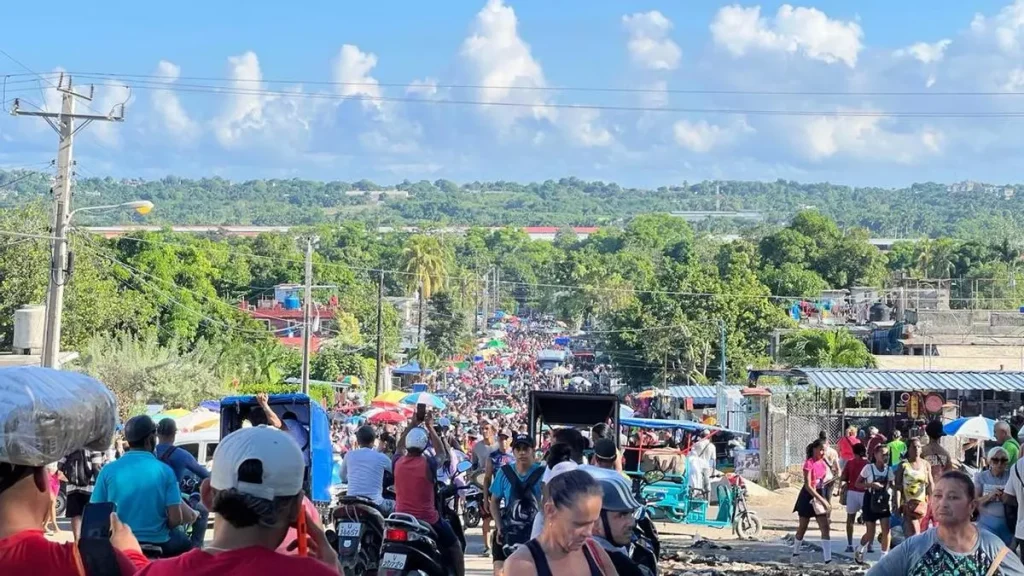
The Case of William Morales Reopens the Debate on Asylum for Terrorists in Cuba

Fernández de Cossío, Cuban deputy foreign minister, denied knowing this case in an interview

Morales, who was sentenced in the U.S. to 89 years in prison for possession of weapons and explosives, has been protected by the Havana regime since 1988. / latinamericanstudies.org

14ymedio bigger Madrid, Yunior García Aguilero, September 27, 2025 — William Guillermo Morales is a name that sums up several decades of tensions between Washington and Havana. His case is one of the most cited when there is talk about fugitives sought by American justice who found asylum on the Island, and it returns to relevance after the recent interview that the Cuban Deputy Foreign Minister, Carlos Fernández de Cossío, granted to journalist Mehdi Hasan. The diplomat rejected the accusations that Cuba is supporting terrorists, but there are elements in Morales’ story that hardly fit this official version.

Morales, a Puerto Rican-born New York engineer, was a member of the Armed Forces of National Liberation (FALN), a clandestine group that carried out dozens of bombings in the U.S. in the 1970s to demand Puerto Rico’s independence. The FALN’s bloodiest action occurred in January 1975, when a device exploded at the Fraunces Tavern restaurant in Manhattan, killing four people and injuring dozens.

Although Morales was not directly convicted of the attack, he was arrested in 1978 after an accidental explosion at a bomb factory in Queens. The blast left him severely mutilated, with his hands shattered and face disfigured. In the apartment, police found explosives and documents linking him to the FALN network and the Fraunces Tavern bombing.

Morales was sentenced to 89 years in prison for possession of weapons and explosives. He was hospitalized at the Bellevue Hospital Center in New York to receive prostheses when, in May 1979, he participated in a breakout worthy of a documentary. The terrorist used an improvised rope made with bandages to hang from the bathroom window, aided by supporters of the underground movement. He fled to Mexico, where in 1983 he was arrested after a shoot-out with police that left an officer dead. He spent five years in prison in that country and, upon his release in 1988, was able to travel to continue reading

Cuba where he obtained political asylum. Since then he has been living in Havana, free and protected by the Cuban government, despite U.S. extradition demands.

The families of the deceased at Fraunces Tavern have repeatedly asked that Morales be extradited and serve the sentence he evaded

The case of Morales shows how the Cuban regime has served as a refuge for individuals accused of terrorism or serious crimes in the U.S. The best-known example is Joanne Chesimard, aka Assata Shakur, a former member of the Black Liberation Army who was convicted of murdering a New Jersey police officer in 1973 and has been on the run since 1979. Shakur died in Havana this September 25, due to health problems and her advanced age.

Charles Hill is also mentioned, implicated in the murder of a policeman in New Mexico in 1971 and living in Cuba since the 1970s. For the U.S. authorities, these cases are proof that Havana is violating international agreements on judicial cooperation and combating terrorism. For the Cuban government, they are political fighters who faced persecution and deserve asylum.

Fernández de Cossío, in his dialogue with Mehdi Hasan, denied knowing the case of Morales. He argued that Cuba does not protect terrorists and said that Washington’s accusations are part of a political pressure campaign. However, the argument does not solve the dilemma of the victims, who continue to demand justice half a century after the events. The families of the deceased at Fraunces Tavern have repeatedly asked that Morales be extradited and serve the sentence he evaded. For them, the decision of Havana is an affront that prolongs the pain.

The asylum granted to Morales has implications that go beyond the legal. The Cuban regime’s refusal to cooperate with the U.S. justice system in cases of civilian killings raises an ethical problem. Morales is a kind of political ghost in Havana: he does not appear in the official press and does not participate in public events, but he is a symbol of the old alliance between armed independence activists and the Cuban government. At a time when Havana is desperately seeking to improve its international image and normalize relations with Washington, protecting fugitives from violent crimes on the Island is a burden that fuels mistrust and provides arguments for maintaining sanctions.

The case of William Morales is a reminder that historical debts do not expire and that political refuge, when extended to perpetrators of attacks against civilians, ceases to be a humanitarian gesture and becomes a political decision with consequences.

Translated by Regina Anavy

____________

COLLABORATE WITH OUR WORK: The 14ymedio team is committed to practicing serious journalism that reflects Cuba’s reality in all its depth. Thank you for joining us on this long journey. We invite you to continue supporting us by becoming a member of 14ymedio now. Together we can continue transforming journalism in Cuba.

Cuban Police Close La Cuevita, Vendors and Customers Reopen It

At this mecca of popular commerce in Havana, you can find everything, including the buying and selling of dollars.

The vendors relocated to nearby streets and in the doorways of neighboring houses. / 14ymedio

14ymedio bigger14ymedio, Darío Hernández, Havana, 26 September 2025 — “Water!” was heard with unusual frequency this Wednesday at La Cuevita, among a crowd of self-employed workers, clandestine vendors, and desperate customers. It wasn’t a shout announcing drinks or a storm warning, but rather the code word used all over Cuba to let people know that the police are on the move. Authorities, who usually turn a blind eye to irregularities in these spaces, decided this time to close the place for a month. The official reason: “to carry out repairs,” some residents told this newspaper.

La Cuevita is the mecca of popular commerce in San Miguel del Padrón, Havana. There, you can find everything from food, hygiene products, clothing, and household appliances to toys, medicines, and currency exchange. Merchandise arrives via a variety of channels, including mules, middlemen, or diversions from state channels, generating income for both self-employed workers and those operating without a license.

So, despite the closure order, few people were willing to leave. Vendors relocated to nearby streets and in the doorways of neighboring houses.

So, despite the closure order, few people were willing to leave. The vendors relocated to nearby streets and the doorways of neighboring houses. “We need to eat,” exclaimed an undocumented vendor as she hurriedly gathered her wares as the uniformed officers passed by. Minutes later, she set up her stall again in the same place.

The history of La Cuevita dates back to the Special Period and has been strengthened by the economic reforms of recent years. It emerged as a response to chronic shortages and the need to obtain goods in foreign currency, and so became a crucial supply point for Havana residents and buyers from other provinces.

This Wednesday, however, the place looked more chaotic than ever. Stalls crowded in front of homes, food vendors stood right next to stinking garbage dumps, open sacks of rice mingled with the mud, and a chorus of shouts from anxiousv endors
continue reading

This Wednesday, La Cuevita looked more chaotic than ever. / 14ymedio

The closure coincides with the 4th National Crime Prevention and Response Exercise, which includes patrols, “prophylactic” meetings with so-called “potential offenders,” and social control measures. In addition to the police, students, workers, and Party activists are participating. Previous exercises have not restored order to the streets, but they have swelled the state coffers with money from fines and confiscations.

“There aren’t enough police to get so many people out,” said a vender selling stockings and underwear, who ran for cover upon hearing the alarm. Minutes later, seeing the officer riding away on his motorcycle, he returned to his stall and added: “This is what the town lives on; they can’t close it down.”

Some call these informal markets that exist throughout the island “candonga,” a term that came from Angola with the Cubans who went to war in the 1970s and 1980s. But today’s battle is different: putting food on the table, shoes on children’s feet, and earning enough money to survive for a month, something no state salary guarantees.

The police close La Cuevita, but vendors and customers reopen it.

____________

COLLABORATE WITH OUR WORK: The 14ymedio team is committed to practicing serious journalism that reflects Cuba’s reality in all its depth. Thank you for joining us on this long journey. We invite you to continue supporting us by becoming a member of 14ymedio now. Together we can continue transforming journalism in Cuba.

“My Mother Hasn’t Received a Centavo Since May,” Says a Cuban Doctor Stationed in Angola

With delays in payments and vacations postponed, the situation of the Cuban personnel has worsened since the protests against Antex

Stock photo of Cuban doctors together with the Minister of Public Health, José Ángel Portal Miranda, in Angola / Minrex

14ymedio bigger14ymedio, Havana, Natalia López Moya, September 27, 2025 — Discontent continues to grow among Cuban doctors in Angola. To the discomfort caused by the official decision to transfer part of their savings to a Classic card [a prepaid card for payments in foreign currency], instead of paying them in dollars, is added the delay in payments to their families in Cuba and the postponement of vacations on the Island. “My mother hasn’t received a penny since May,” a specialist reports to 14ymedio.

In addition to the payment in kwanzas, equivalent to about 200 dollars, which she collects each month in Angola to cover her daily expenses, she accumulates the rest of the money, about 1,200 dollars, in Cuba, waiting to be able to collect it when the mission ends; this is a way to prevent her from fleeing. In addition, her family should receive a small monthly amount during that time, but the arrears in these payments complicate the livelihoods of her mother and her teenage son.

These irregularities caused a group of employees to prepare, “on behalf of all, a letter to the Public Prosecutor’s Office demanding payment in foreign currency and the improvement of the economic conditions in which we work,” explains the doctor who has been working for almost three years in a clinic in Luanda. The letter was prepared after a meeting held by the employees with the managers of Antex (Corporación Antillana Exportadora S.A.), owned by the military conglomerate Gaesa, which manages the stay of the specialists in Angola.

At that meeting, the employees expressed their discomfort and demanded direct receipt of the dollars that the Angolan government pays to Antex for each Cuban hired through them. In addition to doctors, there are also continue reading

builders, sports coaches and a wide range of health personnel, all under similar conditions.

Cuban professionals have been demanding for years that they be given the money accumulated on the Island in foreign currency

Cuban professionals have been demanding for years that they be given the money accumulated on the Island in foreign currency, but the government’s recent response has been to announce that from next January they will have a Classic card to use, although they will still not receive cash. After the tense meeting last August, the managers of Antex tried to calm tempers by assuring that they would the start payment with the Classic card sooner, as of this September.

The commitment has not been fulfilled and now adds instability in the schedule of payments to relatives. Also, Antex has not bought tickets for the specialists to spend their vacations on the Island. “They give us a runaround, which is a breach of contract because we are supposed to be able to return to our country when we have a break from work. Last August I had to stay here for my vacation,” she says with regret.

“Several commercial flights of the airline TAAG left but Antex did not buy tickets, except for exceptional cases, so many who planned to take vacations couldn’t do it,” says the specialist. These trips are used by Cuban workers to bring goods to the Island, which they then resell, one of the few material incentives they have in the midst of their strained economic situation.

Emilio, a Cuban doctor whose name has been changed for this report and who works at the Hospital Materno Infantil do Camama Dr. Manuel Pedro Azancot de Menezes in Luanda, feels like he is “about to explode.” In his opinion, since the recent announcement of the use of the Classic card, “nothing has improved, and the attention we receive from Antex has gotten worse.”

“They have not reversed the decision to pay us with the Classic card, and to top it off we suffer months of delay in bank deposits that they should be making to our relatives in Cuba,” he says. “Nor have they received payment in freely convertible currency (MLC),” increasingly devalued on the informal exchange market and currently traded at 205 pesos per dollar.

Last July, the professionals sent a letter to Miguel Díaz-Canel in which they denounced the “breach of payment form established in the contract”

Last July, the professionals sent a letter to Miguel Díaz-Canel in which they denounced the “breach of payment form established in the contract” and demanded that they be allowed to collect in dollars the amount accumulated during years of stay in Angola in their bank accounts on the Island. The president has not yet replied to that letter.

Emilio also complains that “now without warning or explanation here in Angola they started paying us monthly the equivalent of only 100 dollars, instead of the 200 agreed.” He shows this newspaper the report of a transfer to his bank account in the amount of 93,000 kwanzas, equivalent to 100 dollars. “No one has told us why they made this cut.”

On other occasions, Cuban professionals have suffered this type of monetary hardship that complicates their lives in the African country. “Sometimes I have to borrow a mobile phone from my Angolan colleagues to make a call or browse the Internet because I don’t earn enough to buy a data package, cover fuel and eat.” Emilio considers Cuban doctors to be “the fifth wheel of the car for Antex.”

Similar opinions had already been heard at the tense meeting in Luanda. “I do not want to buy food, I do not want to buy appliances, I want to buy a home,” insisted a doctor who objected to receiving pay for service in MLC or the Classic card. “Are they going to force us to commit crimes, to resort to the black market in order to have real dollars? These are the plans of entire lives, of whole families that you are destroying,” he told he Antex representative.

The Antex Corporation, sanctioned by the U.S. Office of Foreign Assets Control, manages a wide range of businesses in Angola

The Antex Corporation, sanctioned by the U.S. Office of Foreign Assets Control (OFAC), manages a wide range of businesses in Angola, ranging from road construction and airport repair to the management of travel agencies. Between 2013 and 2017 alone, Antex received more than $1 billion from that country, according to El Toque. Through Antex and other companies, Cuba participated — financed by the USSR — in the Angolan civil war (1975-1991) with more than 300,000 soldiers. In 2015, the Portuguese press reported that 70% of health workers in Angola were of Cuban origin.

Now, Emilio concludes that the denunciations and complaints at meetings are of little use. “What we should do is refuse to work under these conditions but, of course, they know that they can always hire some naive person in Cuba who is willing to accept these humiliating conditions just to get out of there.”

Translated by Regina Anavy

____________

COLLABORATE WITH OUR WORK: The 14ymedio team is committed to practicing serious journalism that reflects Cuba’s reality in all its depth. Thank you for joining us on this long journey. We invite you to continue supporting us by becoming a member of 14ymedio now. Together we can continue transforming journalism in Cuba.

Mariana Fernandez, Who Fled to the U.S. After the ’11J’ Protests, Passes the “Credible Fear” Interview

Her sister, Yaneris Redondo, now expects the courts to summon her for the same process, which will allow her to proceed with her political asylum application

Fernández was arrested and sentenced to four years of house arrest in Cuba. /Stock photo/Telemundo 51

14ymedio bigger14ymedio, Havana, September 27, 2025 — Mariana Fernández León, after being sentenced for participating in the ’11J’ protests of 11 July 2021, fled to the U.S. on a raft. She was approved this week in the “credible fear” interview given by U.S. immigration authorities. Relieved by the recognition, which is rarely given to rafters, the Cuban woman explained to the local press that she is still waiting for the interview with her sister, Yaneris Redondo León, who arrived with her in Florida.

Last June, both had expressed fear on social media after their political asylum case was dismissed. “Today we are afraid that we will be denied this protection,” said Fernández on social networks, because “returning [to Cuba] could amount — without exaggeration — to being sent directly to death.”

The young woman gave few details about the legal process she and her sister face in the U.S. but suggested that her case was one of many that have been closed or hindered with the new policies of Donald Trump, which has happened in recent months with several of the routes opened by the previous administration for migrants to apply for asylum.

Receiving recognition of “credible fear” is therefore a step forward in her case for political asylum, she told Telemundo 51. According to a lawyer consulted by the media, her case had been closed by the U.S. Citizenship and Immigration Service (USCIS), which “did not have jurisdiction to adjudicate that asylum case,” because the interview of “credible fear” had not been conducted. Shortly afterwards they managed to reopen it.

The family is now waiting for the immigration courts to summon Redondo to conduct the same interview and continue with both women’s asylum continue reading

applications.

At ages 18 and 30 respectively, Fernández and Redondo participated in the massive protests that took place in the neighborhood of Mantilla

At ages 18 and 30 respectively, Fernández and Redondo participated in the protests that took place in their neighborhood of Mantilla, in Havana — and across the Island — in July 2021. During the demonstration, they were pepper-sprayed, beaten and detained. “I was locked up with my sister for 15 days without a court order. During detention we suffered psychological abuse, death threats and medical neglect,” she has reported on previous occasions.

Both were released from prison after their family paid bail of 2,000 pesos, and during more than a year awaiting trial, they were obliged to report regularly to the police and sign documents under threat of being sent back to prison if they were involved in any act of dissent.

In July 2022, they were finally taken to court for contempt, attack and public disorder, crimes that, according to Fernandez, were “fabricated” by State Security. Both were found guilty. Redondo was sentenced to seven years in prison and Fernández to five, later reduced to four years of house arrest.

They were notified that they had 72 hours to voluntarily surrender to the authorities and process their return to prison. “In the face of imminent repression and well-founded fear of what awaited us, we made the most difficult decision of our lives: to flee our country. On November 13, 2022, after a journey of more than 16 hours by sea, we arrived at an uninhabitable island, exhausted and without clear direction, but with hope intact. We managed to survive that dangerous crossing [with 40 other Cubans] and finally reach U.S. territory, where we requested political asylum,” she said after arriving.

Now in the country, Fernández even had to be hospitalized “as a result of extreme physical exhaustion during the flight.” The young woman has continued to spread her case on social networks in hopes of obtaining asylum and not being deported with her sister to Cuba, where they could suffer reprisals for escaping.

Translated by Regina Anavy

____________

COLLABORATE WITH OUR WORK: The 14ymedio team is committed to practicing serious journalism that reflects Cuba’s reality in all its depth. Thank you for joining us on this long journey. We invite you to continue supporting us by becoming a member of 14ymedio now. Together we can continue transforming journalism in Cuba.
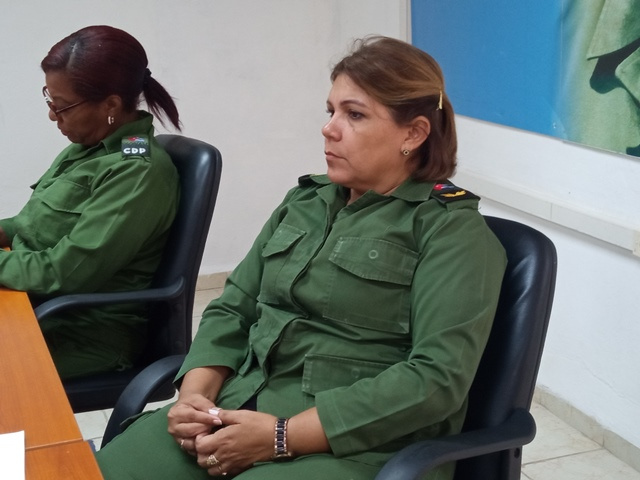
After 10 Months Without a Leader, the Cuban Communist Party Appoints an Apparatchik To Head Its Ideological Department

The arrival of Yuniasky Crespo Baquero, successor to Rogelio Polanco, comes at the same time as the change in management at Granma and Juventud Rebelde.

Her education studies, specializing in Marxism-Leninism and History, don’t seem to have landed her a job as a teacher. / Radio Mayabeque

14ymedio bigger14ymedio, Madrid, September 26, 2025 — Yuniasky Crespo Baquero, who is just 48 years old and has already served 13 years on the Central Committee of the Cuban Communist Party [PCC], is the new head of the Ideological Department as of Thursday, a position that was apparently vacant since Rogelio Polanco left as ambassador to Vietnam in November 2024. Ten months have passed without the PCC announcing a replacement, and it is unknown who assumed the role of guardian of the essence of the PCC and its media during that long interim.

Until now, Crespo had been the head of the Department of Social Sector Assistance, a position she held concurrently with her position as a member of the National Assembly since 2013. From that same year until 2018, under the presidency of Raúl Castro’s, she was a member of the Council of State.

The leader has had a brilliant career to where she is today in the party. As a child, she was a class representative in both primary and secondary school, and in that capacity attended the Second Pioneers Congress and was invited to the Third. Later, in high school, she became president of the Federation of Secondary School Students and, as a member of the University Student Federation (FEU), participated in the organization of the Sixth Congress, where she was appointed a professional member of the national secretariat.

Until now, Crespo had been in charge of the Department of Social Sector Care, a position she held simultaneously with her position as a deputy in the National Assembly since 2013.

She also has an extensive career in the Union of Young Communists (UJC), holding positions on the municipal and provincial committees of Las Tunas, working for the Vanguard of the Education Workers’ Union in 2009 and 2010, and holding countless other positions within the organization and its branches.

On the professional front, her studies in Education, specializing in Marxism-Leninism and History, don’t seem to have landed her a job as a teacher, but they do provide her with exactly the training she needs for continue reading

her new position, a highly relevant position for the fight prioritized by the regime.

The exact date of her appointment is unknown, but on her Facebook profile, where she is very active, she posted about the graduation—last Wednesday—of the first class of the Doctoral Training Program in Political Direction of Society at the Ñico López Party University, where she was previously mentioned as attending in that capacity. At the same ceremony, the “Declaration of the Revolutionary Government in support of the Bolivarian Republic of Venezuela” was signed.

This signature drive in support of Maduro at a time of escalating tensions with Washington over military operations in the Caribbean is being carried out across the island, including in schools and all types of centers, and is likely the first major propaganda effort of Crespo’s leadership.

Moves like those realized by the Party’s main press outlets, Granma and Juventud Rebelde, could also be motivated by the new ideological chief. The announcement of the new directors of both outlets was made on Wednesday, when Yoerky Sánchez Cuellar’s appointment to the top post at Granma was announced . Also a member of the Central Committee, a deputy in the National Assembly, and a member of the Council of State, his profile is very similar to Crespo’s and he rises directly from Juventud Rebelde.

He joined the newspaper after graduating in 2007 with a degree in journalism and working for the newspaper Vanguardia in Villa Clara and the magazine Alma Mater. Since 2014, he has been with Juventud Rebelde, where he quickly rose to become director in 2017.

He is succeeded by Yuniel Labacena Romero, 36 years old—just five years younger than Sánchez—who holds a degree in Journalism and is a member of the UJC National Committee. His career has been fully developed in the media outlet he now directs.

Crespo’s succession, meanwhile, has also been finalized. Rolando Ernesto Yero Travieso is now the new head of the Department of Social Sector Care, where he arrives from his position leading the Office of Care for the Youth Civic Union (UJC). A physician by training, specializing in internal medicine, his experience is almost exclusively in the political sphere, and the closest he has come to the sector in which he trained was when he managed “Health, Science, and the Pharmaceutical Industry” in the province of Havana.

While waiting to come to know the substance and methods of the new leader, she already has the enthusiastic support of a Pinar del Río militant on social media, who has praised her to the detriment of her predecessor. “For me, this is some of the best news I can read right now, after many years of neglect and deterioration of one of the most important tasks of the PCC. I have actually been denouncing for several years the lack of political and ideological work of the PCC and the UJC, a department that is fundamental to sustaining our revolutionary process and that practically disappeared under the ‘leadership,’ or rather the lack of direction, motivation, and disinterest in the activity of Rogelio Polanco Fuentes,” the user wrote.

“I truly don’t know why he was secretly and covertly appointed Cuban ambassador to Vietnam, when what he really wanted was to be removed from all party and government positions and return to being a journalist. I’m pleased that we now have a leader in the Ideological Department, but I’m even more pleased to know that its head is a woman with several years of experience in party work. I’m convinced that from now on, this department will return to what it was before Polanco,” the Pinar del Río native concluded.

____________

COLLABORATE WITH OUR WORK: The 14ymedio team is committed to practicing serious journalism that reflects Cuba’s reality in all its depth. Thank you for joining us on this long journey. We invite you to continue supporting us by becoming a member of 14ymedio now. Together we can continue transforming journalism in Cuba.
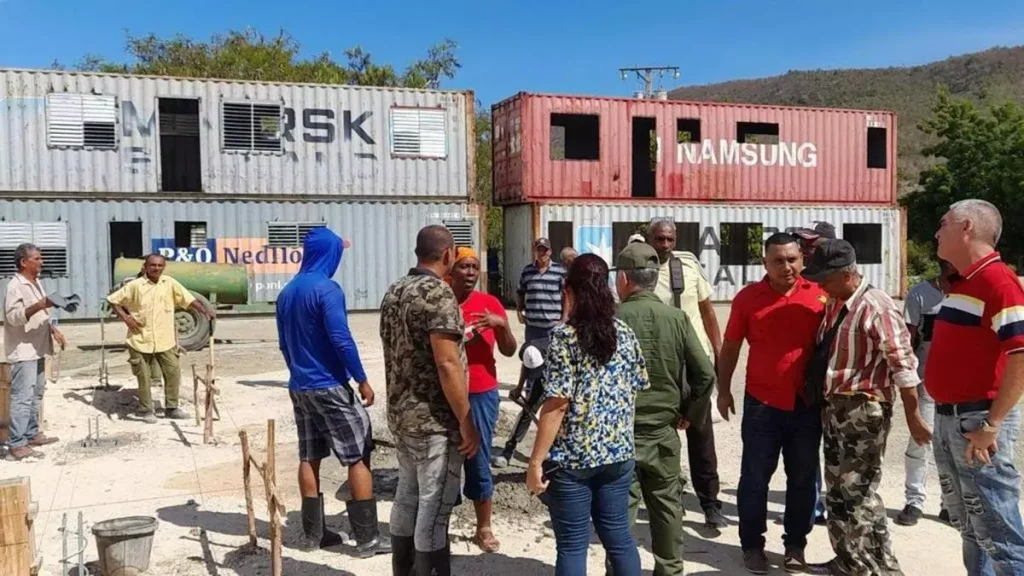
Instead of Homes, the Victims of Hurricane Oscar in Cuba Receive Recycled Containers

Metal boxes are “an alternative to the shortage of essential materials” to alleviate the housing crisis

Image of the containers that are being installed in Guantánamo / Facebook/Abraham Gamboa Fontanal

14ymedio biggerHavana, September 26, 2025 — In a country without cement, bricks and steel bars, the State has taken containers and converted them into housing. If before the boxes were used only for company annexes and temporary premises, now the country has a comprehensive plan for them to be inhabited by dozens of families throughout the Island. The main problem, and what worries future tenants most, is the incompatibility between tropical heat and a house made entirely of metal.

In Sancti Spíritus, areas have already been located in eight municipalities where 133 containers will be installed, “reaching the end of their useful life after freight operations,”  which in this case was transporting the solar panels that arrive on the Island. The project, which has been launched in other provinces such as Las Tunas and Guantánamo, aims to be “an alternative to the deficit of essential materials for construction, such as cement, steel and aggregates.”

The authorities have insisted that recycling containers are a resource used around the world for housing. However, they overlook the fact that these are usually well-equipped tourist facilities with all-day air conditioning and other amenities. They are rarely used in the construction of permanent dwellings for the population without air conditioning.

Even so, the official press stresses that the containers are fitted with “anti-thermal coatings on interior walls and additional ceilings,” which make them suitable for use as a home. Reinforced concrete piles are also included to prevent corrosion and moisture, and, as a bonus, the authorities mention a “proper aesthetic finish.” continue reading

“This is a very new development, but given the scarcity of resources, the housing construction plan rests on this modality”

“This is a very new development, but given the scarcity of resources, the housing construction plan rests on this modality. Hence the majority of them will go to those affected by meteorological events, mainly in Yaguajay, as well as to mothers with more than three minor children, among others,” Néstor Borroto González, director of Housing in the province, explained to Escambray.

In the face of the reluctance of the population, who see containers as a half-hearted solution to the housing crisis and whose disadvantages will soon begin to be noticed, both the State press and the authorities assure that it is a win-win solution.

“These houses will have different dimensions, depending on the size of the structure, and will include a kitchen, bathroom, dining room, bedrooms, doors, and single and double windows made from raw materials and local products that will be offset by some of the national balance sheet.”

The measure is already being implemented at a national level by the Mariel Architectural and Engineering Project Company, and in each province it is the local authorities who are responsible for “the foundations and housing developments.”

Last Monday, the officials in Guantánamo directed part of the 14 containers from the installation to Buena Vista, a village in the municipality of Yateras. The makeshift homes will be used for those affected by Hurricane Oscar, who have been waiting for the aid promised by the State for a year.

Last Monday the officials in Guantánamo directed some of the 14 containers to Buena Vista, a village in the municipality of Yateras

Earlier, at the beginning of August, Las Tunas was also chosen for the project. Héctor Rodríguez Espinosa, provincial director of Housing, announced with optimism that the first containers would be installed in the municipalities of Manatí, Puerto Padre and Majibacoa. Among the advantages allocated to them are strength, durability and low environmental impact.

“At present, the province has 46, and 18 of them are assigned to the Electric Company for the construction of nine houses for its workers, and 28 to be delivered through the popular councils by the delegates, community groups and government in each territory,” said the director.

According to the National Office of Statistics and Information, although in 2024 the investment in housing was 54,553 million pesos (14% more than a year before), the completed buildings cost only 7,427 million (53% less than in 2023). To top it all off, 62 per cent of the homes were self-built.

Translated by Regina Anavy

____________

COLLABORATE WITH OUR WORK: The 14ymedio team is committed to practicing serious journalism that reflects Cuba’s reality in all its depth. Thank you for joining us on this long journey. We invite you to continue supporting us by becoming a member of 14ymedio now. Together we can continue transforming journalism in Cuba.