Almost a hundred people were waiting to connect their mobile phones to the electricity at the Inglaterra hotel. (14ymedio)
14ymedio, Juan Diego Rodríguez, Havana, 28 September 2022 — One of the main urgencies of Cubans this Wednesday, after the passage of Hurricane Ian, which has devastated the western end of the island and has caused the collapse of the already precarious national electrical system, is to get electricity by any means.
In Havana, the crowds in the corridors of hospitals, such as Calixto García or Hermanos Ameijeiras, whose current was maintained thanks to generators, were striking. People were not there to visit sick relatives but to connect their phones and keep them working.
Similarly, almost a hundred people gathered at the entrance of the building adjacent to the Inglaterra Hotel, in Centro Habana, with their cell phones connected to numerous extensions. These, in turn, were connected by means of a flip-flop to the electricty of the hotel, which has also continued to work with its own generators.
As the minutes passed, those waiting began to get nervous. “This doesn’t work. They say it’s free, but the solutions of socialism are always problematic,” a young man was heard saying as he gave up waiting for his turn in the long line.
____________
COLLABORATE WITH OUR WORK: The 14ymedio team is committed to practicing serious journalism that reflects Cuba’s reality in all its depth. Thank you for joining us on this long journey. We invite you to continue supporting us by becoming a member of 14ymedio now. Together we can continue transforming journalism in Cuba.
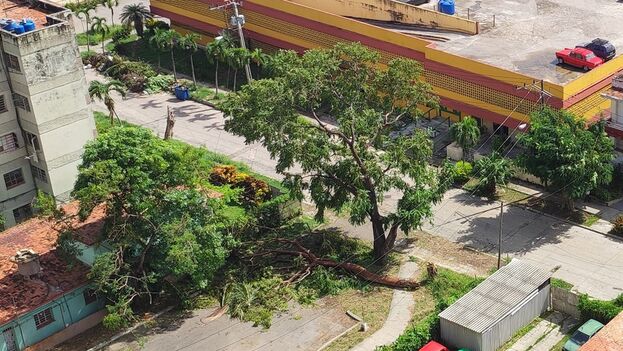
The almácigo tree (bursera simaruba) at the entrance to the parking lot of our building that did not withstand the winds of Hurricane Ian has been lying there since Tuesday. (Yoani Sanchez)
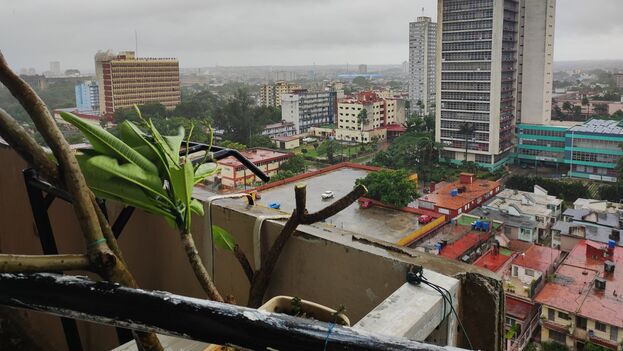
14ymedio, Yoani Sánchez, Havana, 29 September 2022 — Soon we will complete 48 hours without electricity in our neighborhood. The problem is not only the lack of power, but also that this area has many tall buildings and the water tanks — normally filled with pumped water — in people’s apartments have already been emptied. Carrying the water up the stairs 10, 12, 14 or 18 floors is very difficult, especially for the elderly.
The few food reserves that people had been able to store are also gone and I know families with convalescent elderly people who have not been able to wash or eat something hot for several hours. Meanwhile, the hum of the Ministry of Agriculture’s generator floods the neighborhood and one wonders why an entity that can’t even make Cuban fields produce food needs an electric plant to provide us with fruits, tubers and vegetables at a price in line with wages.
A friend has called me to ask if the freely convertible currency markets will auction off merchandise that needs refrigeration before it spoils, or if they will deliver free food to those families who have been left with an empty refrigerator, or the food spoiled by heat. I think my friend is watching a lot of foreign documentaries.
____________
COLLABORATE WITH OUR WORK: The 14ymedio team is committed to practicing serious journalism that reflects Cuba’s reality in all its depth. Thank you for joining us on this long journey. We invite you to continue supporting us by becoming a member of 14ymedio now. Together we can continue transforming journalism in Cuba.
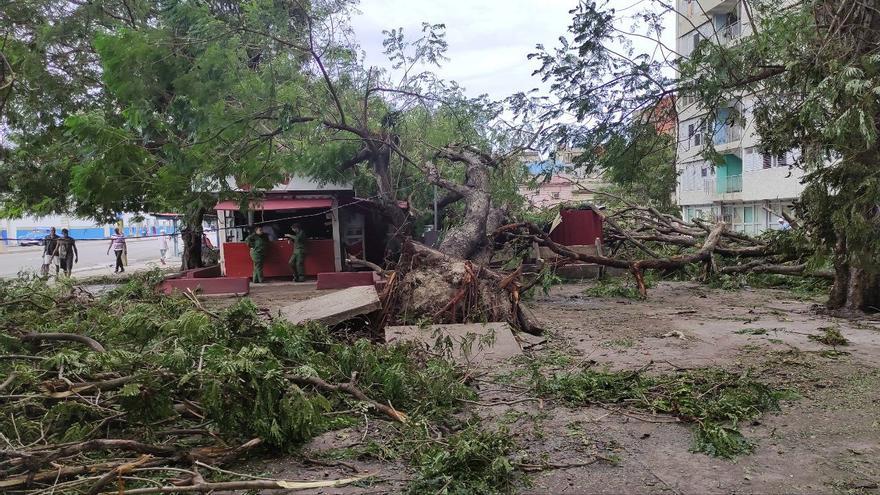
Dozens of large trees, uprooted by Hurricane Ian, remain strewn on the street in Havana on Wednesday. (14ymedio)
14ymedio, Juan Diego Rodríguez, Havana, 28 September 2022 — In La Coloma (Pinar del Río), where Hurricane Ian reached its maximum strength on Tuesday as it passed over the Island, people just want to leave. “If my family comes out of this one, they won’t stay more than six months in Cuba,” bemoans a Miami-based Cuban woman whose parents and brother live in the Pinar del Río municipality.
The woman lost communication with them yesterday, but during their last phone call they told her that the roof of their house had torn off and the flood waters were knee high. The family has animals and crops. “I’ve spent years insisting they leave, but my father would say to me that he didn’t want to leave his little farm, but now everything is destroyed and it will be cheaper for me to pay their exit through Nicaragua than to rebuild their lives in La Coloma.”
They all fear that the day after the storm will arrive with greater scarcity and with it an increasing exodus, which has already reached unprecedented levels for Cuba.
On Wednesday Havana was a city operating at half steam. Most neighborhoods in the capital city awoke without electricity, the water supply shut down due to the lack of electricity and the winds from Ian seem to have given flight to inflation and increasing food prices.
“A bag of six rolls reached 250 pesos yesterday afternoon and 300 by night,” said one of the residents of Los Sitios, who said that today, “vendors have not passed and in the neighborhood they speculate that when they return, it will cost even more.” continue reading
During a trip through Centro Habana, La Habana Vieja and Nuevo Vedado, we witnessed dozens of giant trees uprooted by the powerful winds and strewn across the streets. “And the storm didn’t even pass through here,” remarked an old woman at the Parque Central.
Furthermore, several street lights had also fallen.
The anxiety over searching for missing food, even before the hurricane, had once again became a tonic in the streets of the capital, where several businesses tried to sell what was left at their doorsteps, before it spoiled due to the lack of electricity following the collapse of the National Electric System (SEN).
Pushcart salesmen here and there were some of the few options to purchase food.
The windows of Plaza de Carlos III were all shuttered, and not for the hurricane’s passing. On Monday, the eve of Ian, they were not covered but on Wednesday they were protected, in all likelihood to prevent thefts and destruction amid the widespread blackout.
On the corner of Campanario and Condesa, in Centro Habana, a car had been destroyed by the remains of the old building which once stood in that location, now an enormous parking lot. “Luckily it did not fall on anyone’s head,” said the resigned owner of the vehicle.
In Nuevo Vedado, residents of some of the buildings cleared their surroundings of fallen branches and shrubery, but one of them complained, “the large trees remain strewn there, because they need machinery and we have not seen the State appear anywhere.”
One of the urgent needs was charging telephones, a fundamental communication tool not only for their family and friends, but the world. Thus, it was interesting to see many people charging their mobile phones in hospital hallways, such as Calixto García or Hermanos Ameijeiras, as well as in hotel doorways.
Another worry among Havana residents today was water. Some buildings have pumps but they stopped working when SEN went down this afternoon. Although in many apartments people have water tanks, as the time goes on, these are depleted.
For higher floors it is crazy to try to carry water up the stairs, which in addition are wet and dirty, some for lack of windows for many years now.
Meanwhile, in that same area, the Ministry of Agriculture’s generator has been running for over 24 hours and its humming fills the area. “At least when we stop hearing it we’ll know the power is back on,” one resident said ironically.
On September 28th, the day officials traditionally celebrate the anniversary of the founding of the Committees for the Defense of the Revolution (CDR), there’s been no time for revelry nor for slogans of triumph.
In Nuevo Vedado, an enthusiastic CDR member shouted to her neighbors for several long minutes from a 12 story building for them to collaborate in making the traditional stew.
“Let’s go, give some taro, some yucca, a yam for the stew! Or a bit of money to go buy at the market!” she shouted for a good while; a man with a booming voice joined her, “Let’s go to the CDR stew!” The lack of enthusiasm and the discomfort for lack of electricity weighed down the collaborations and finally the enthusiastic organizers canceled the initiative.
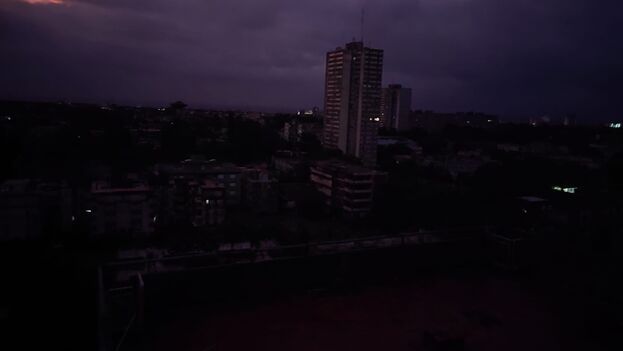
On Tuesday night, after the winds of Hurricane Ian died down, in Havana only the fires were alight. Ironically, in the largest Cuban city, one of the only illuminated areas was Turkey’s floating power plant anchored at the port, a power plant full of light in a city of darkness.
Translated by: Silvia Suárez
____________
COLLABORATE WITH OUR WORK: The 14ymedio team is committed to practicing serious journalism that reflects Cuba’s reality in all its depth. Thank you for joining us on this long journey. We invite you to continue supporting us by becoming a member of 14ymedio now. Together we can continue transforming journalism in Cuba.
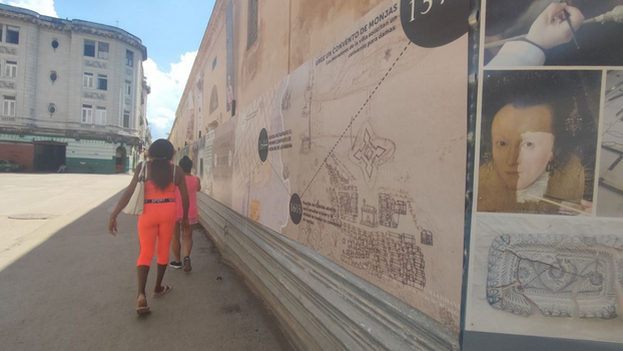
The imposing structure of the convent occupies a huge block outlined by the emblematic streets Habana, Cuba, Sol and Luz of Old Havana. (14ymedio)
14ymedio, Natalia López Moya, Havana, 21 September 2022 — Julita is 57 years old and sells avocados next to the Santa Clara de Asís Convent, the oldest cloister in Havana which is in the middle of a capital restoration to return it to its former splendor. A few meters from its painted yellow walls the residents of the area dream that the investment will be enough to also renovate a neighborhood sunk in housing deterioration and crisis.
“Until now, they haven’t told us anything that they’re also going to repair some nearby houses, not even the potholed streets that are quite cracked,” a resident of Calle Sol, who was born in the tenement where she and about twenty families now live, with explains to 14ymedio. “Since 1965, when my mother brought me into this world, the people on this lot have been waiting for their little dwellings to be fixed up.”
Across the entrance where Julita offers her avocados – “some are ready to be eaten today and others tomorrow” – rises the imposing structure of the convent that occupies a huge block outlined by the emblematic Old Havana streets: Habana, Cuba, Sol and Luz. The wall that surrounds the garden and the rest of the facades offer little information about the works that are taking place inside. continue reading
Only one entrance for vehicles allows you to browse and talk with an animated custodian who declares that the works “are already halfway through” and that they are in the hands of a Cuban cooperative, whose name he avoids giving. The view from that location does not help much to get an idea of the repair process, since there are no workers, no hustle and bustle of trucks with materials, and, other than the bored security employee in his booth, no other people can be seen.
There was “a lot of movement in the neighborhood” a few days ago when the future headquarters of the College of Arts and Crafts of Santa Clara was visited by the ambassador of the European Union in Cuba
“It is going to be a school and it will be ready in 2024,” explains the man at the top of his voice several meters from a fence that encloses the entrance to the place. But a walk around the block is enough to conclude that the prognosis may be rather optimistic, because only the part of the building that faces Havana Street shows signs of being restored. The rest still shows the scars that time, laziness and the natural elements left on the convent.
Julita and her neighbors saw “a lot of movement in the neighborhood” a few days ago when the future headquarters of the College of Arts and Crafts of Santa Clara was visited by the ambassador of the European Union in Cuba, Isabel Brilhante, according to the Spanish agency EFE. “We realized that someone important was coming because the area was filled with policemen and they even picked up the garbage. Then the diplomatic cars left and everything went back to the way it was before.”
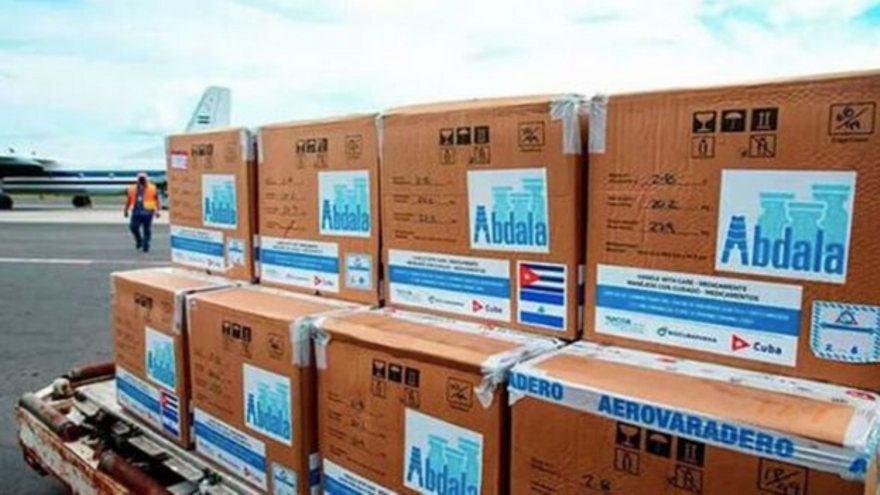
According to Confidencial, the unit cost of each Cuban vaccine was seven dollars, if the amount of a loan requested by the Ortega government from the World Bank is taken as a reference. (TeleSur)
14ymedio, Havana, 27 September 2022 — Nicaragua has received only half of the COVID-19 vaccines promised by the governments of Cuba and Russia since 2021. A monitoring by the independent Nicaraguan newspaper Confidencial revealed that, although Daniel Ortega paid his allies the joint figure of $102 million for 11.2 million doses, double what the British vaccine AstraZeneca would have cost, not all of the planned batches reached the country.
The shortage refutes the promise made by Rosario Murillo, Ortega’s partner and the vice president of Nicaragua, that Cuban vaccines would be received and used by December 2021.
Russia had to provide the Central American country with 1.9 million doses of Sputnik V, while Cuba had negotiated the sale of 7 million of Sovereign 02, Sovereign Plus and Abdala. Although both nations have sold or donated these drugs, none of them have the authorization of the World Health Organization (WHO).
However, the Confidencial report, documented with the official press releases, found that between October and December only 3,162,970 doses were received from the Island, just 45.1% of the amount that Ortega bought to immunize the children and teenagers of Nicaragua. continue reading
As for Russia, of the almost 2 million expected injections, only 726 thousand were received, 38% of the stipulated amount.
During 2021 and the first months of 2022, government information on the purchase of medicines became more murky. The thank you notes that Daniel Ortega usually published also ceased to appear. According to Confidencial, it’s unknown, since the beginning of the year, whether Cuba intends to comply with its part of the agreement.
From the Island it’s also not possible to calculate how much has been sent to Nicaragua and whether the export of any other lot is planned. In January 2022, the Finlay Vaccine Institute said it had sent a new shipment to Ortega, but without revealing how many doses.
According to Confidencial, the unit cost of each vaccine was seven dollars if the amount of a loan requested by the Ortega Government from the World Bank for payment to Havana is taken as a reference.
For its part, the price of Sputnik V was almost ten dollars, and the total amount received by Russia amounted to 5.4 million, although Ortega knew that other buyers of the drug had filed complaints about Moscow’s delays in delivering the orders.
The deficit of vaccines and the impact it has caused on children, who were unable to complete their immunization schedules, has forced Ortega to accept donations. This was the case last July, when the United States sent a batch of the Pfizer vaccine. The Confidencial report adds that children from three to eleven years old are receiving the Chinese Sinopharm vaccine.
In total, about ten types of vaccine have come into circulation in the Central American country, and it’s estimated that 85% of the population has already completed the vaccination schedule.
For Ortega and his allies, including the Havana regime, the purchase and sale of vaccines during the COVID-19 pandemic has had a high geopolitical importance. For Cuba, the sale of its drugs reached regional governments such as Venezuela, Mexico and Argentina, but it also served to strengthen relations with Russia and Iran.
In addition, the sale or donation of Abdala, Mambisa and the different ranges of Sovereign led to an international medical propaganda campaign, on the part of the Government, which has tried, in the midst of the pandemic, to whitewash the regime after the repression of the demonstrators in the July 11 protests.
Translated by Regina Anavy
____________
COLLABORATE WITH OUR WORK: The 14ymedio team is committed to practicing serious journalism that reflects Cuba’s reality in all its depth. Thank you for joining us on this long journey. We invite you to continue supporting us by becoming a member of 14ymedio now. Together we can continue transforming journalism in Cuba.
“So far, the causes are unknown and are being investigated to work immediately on their solution,” says the official press. (EFE)
14ymedio, Havana, 27 September 2022 — A power outage throughout Cuba was recorded around 6:00 p.m., and the country remains in darkness. Official media reported the collapse of the National Electroenergetic System (SEN) from provinces such as Holguín, Las Tunas, Granma, Guantánamo, Villa Clara, Sancti Spíritus and Cienfuegos.
“At the moment there is a breakdown in the National Electroenergetic System, confirmed by the Technical Directorate of the Guantánamo Electrical Company. The circuits of the province are turned off, similar to what is happening in other provinces of the country,” the newspaper Venceremos published on its social networks. “So far, the causes are unknown and are being investigated to work immediately on their solution.”
“There’s an impact on the networks of the central region of the country, which has caused a lack of service throughout the territory. Work is being done to restore it gradually. We are waiting for official information for more details,” the Perlavisión telecenter published.
Translated by Regina Anavy
____________
COLLABORATE WITH OUR WORK: The 14ymedio team is committed to practicing serious journalism that reflects Cuba’s reality in all its depth. Thank you for joining us on this long journey. We invite you to continue supporting us by becoming a member of 14ymedio now. Together we can continue transforming journalism in Cuba.
14ymedio, Elías Amor Bravo, Economist, 26 September 2022 — The goal of this blog is to focus on economic matters in Cuba. But from time to time, it’s necessary to pay attention to events that arise in reality, due to their immediate impact on the economy.
The first one is called Ian. A hurricane that has worried the Civil Defense authorities and the Institute of Meteorology, because they haven’t yet been able to anticipate its hitherto erratic evolution in the national territory. It’s known that Cuba will be hit from south to north, but it’s not clear where, and that is why, this Monday, there will be a report on State TV’s Roundtable program on Ian’s impact on the national territory and the preparation in each of the affected provinces to face it.
And by the way, in an informative note from the State’s official newspaper Granma, they say that the same program will offer information about the official closure of the referendum on the family code, as if it were a matter of little importance. As if the result hasn’t already been on a shelf in some office of Díaz Canel’s for days. It’s announced that all the communist state press — Cubavisión, Cubavisión Internacional, Canal Caribe, Radio Rebelde, Radio Habana Cuba, the YouTube channels of the Roundtable and the Presidency and the Facebook pages of the Roundtable, Cubadebate and the Presidency — will cover the program live at 6:30 pm. continue reading
So we have to wait until that time to know what result the communist regime has made up for the referendum vote, which, in advance, will show the support of the population, although with doubt about the exact number. Making a fool of yourself has some costs.
In any case, one has the impression that the result of the referendum will concern Cubans much less than Ian’s evolution. As it should. Depending on where Ian hits, it can lead to the destruction of the productive base, the housing and the infrastructure, which then won’t receive any attention because there’s no money for it. And worst of all, the crops may be lost, so there will be even less food for the population.
Ian could be a serious threat to the regime. The referendum on the family code will go to a better life as soon as the focus of attention is on the hurricane, and above all, the ones that may come later. There’s nothing to rejoice about, but plenty to worry about and take care of, especially the latter, which will be a task for the communist leaders in the very short term.
But there’s another hurricane that has just arrived and is at the gates of the Communist Island. I’m referring to the result of the democratic elections held this Sunday in Italy, which have had a winner in the far right of Mrs. Meloni, whom Díaz-Canel has not yet congratulated for her success. And we are very afraid that he will not do so, which is political clumsiness on the part of the Cuban communists that can lead to a progressive cooling in the economic, commercial, tourist and investment relationship of Italy with Cuba.
Let no one believe that a defiance of Díaz-Canel, however inconsequential it may seem, will be left unanswered. But there is something that should worry Díaz-Canel and his regime about this result in Italy, which won’t be understood in Cuba because they lack a sense of democracy. But it can be explained to them.
It’s simple: 44% of Italians aligned themselves politically with a party or coalition of parties that is at the antipodes of the Cuban communist regime, and those that are closest didn’t reach even a quarter of the electorate. The Italian earthquake supposes that the society of this country has turned politically in a direction that feels, in a majority way, disgust with Cuba’s ideological communist positions. That is, Italy has turned its back on the left, and if Cuba vindicates that position, at the global level, it will suffer the consequences.
The Italian hurricane is going to be felt in Cuba. That’s for sure. Italy represents for the Island, in the trade of goods, about 8% of the total, and in terms of tourists, 3%, although this has seen better times. Cuba recognizes that Italian foreign investment, although no official information is available, is important. There was even a commercial transaction by Cuban doctors recently. Let’s see how all this continues in the face of the next legislature if, as expected, Mrs. Meloni and, in a broad sense, the new Italian society that emerges from these elections, will not be in favor of Italians or the investment capital of their country going to the communist Island. They are warned.
Translated by Regina Anavy
____________
COLLABORATE WITH OUR WORK: The 14ymedio team is committed to practicing serious journalism that reflects Cuba’s reality in all its depth. Thank you for joining us on this long journey. We invite you to continue supporting us by becoming a member of 14ymedio now. Together we can continue transforming journalism in Cuba.
On the afternoon of Tuesday, September 27, there were many fallen trees in the capital. (14ymedio)
14ymedio, Juan Diego Rodríguez, Havana, September 27, 2022 — Havana woke up this Tuesday with the rains and winds that Ian had been leaving in the Cuban territory for hours, but people on the street seemed not to have heard that the hurricane that was coming and was of considerable intensity.
The food shortage in the capital was worse than the threat of the hurricane. “Nothing prevents people from going out to stand in line for bread in any event,” said an old woman from Central Havana, who hadn’t been able to buy a single piece the day before.
In this same neighborhood of the capital and in the rain, street vendors were still promoting a few goods, mainly cart-pushers, who remained on the corners dispatching some fruits and vegetables before leaving.
In other areas such as the Plaza de la Revolución, the howl of the wind frightened residents, especially when, in addition to the shocking noise caused by the force of the hurricane, they began to see zinc tiles, palm leaves, pieces of plastic and some trees falling to the ground.
“There was such a strong and sustained gust that all of us, humans and pets, ran to hide and take shelter under a table,” says a young man from Nuevo Vedado. continue reading
Power outages began early in the morning and still keep much of the capital in the dark. There was also the sound of sirens heading to Central Havana and Old Havana, two of the most populated municipalities with a lot of housing deterioration. “I hear a siren, they’re firefighters, I just saw them go to Reina Street. There must be a collapse,” a woman told this newspaper by phone.
And before the sound of the sirens and the wind, many took note of the severe economic crisis that plagues the island, worse than a hurricane like Ian: “There is nothing here for these events: no tape to protect glass windows, no rechargeable lamps, no kerosene for ’gossiping,’ stovetops or candles,” complained a man in Havana. “Well, we’re plagued by dengue, and there aren’t even any mosquito nets, so what could we expect!?”
In the afternoon, when the water and air finally made a truce, the disaster in the city could be witnessed. Tree after fallen tree, as well as ceilings, facades and some furniture that flew away were the general picture.
In this part of western Cuba, “people are very upset about the delays in preparation and also in the caution of the first forecasts of the hurricane,” some reproached. “Yesterday, several residents of El Vedado were surprised when we warned them of Ian.”
While in Florida, where Ian is heading on Tuesday night with intense growth, the authorities have been preparing the population about the possible ravages of the storm since last week on the Island, where the hurricane left Pinar del Río in a disaster zone. The Government’s messages in recent days were exclusively focused on the referendum for the Family Code, which came into force on Wednesday. “A law passed by water,” Cubans ironize on the street.
Translated by Regina Anavy
____________
COLLABORATE WITH OUR WORK: The 14ymedio team is committed to practicing serious journalism that reflects Cuba’s reality in all its depth. Thank you for joining us on this long journey. We invite you to continue supporting us by becoming a member of 14ymedio now. Together we can continue transforming journalism in Cuba.
A polling station in Havana where Cubans voted on Sunday, September 25 on whether or not to adopt the Family Code. (14ymedio)
14ymedio, Reinaldo Escobar, Havana, 26 September 2022 — Cuba’s Family Code referendum has provided important signals beyond whether or not the electorate has accepted what was being proposed. The most notable is that 26% of voters chose to abstain, a record high for an election conducted by the Communist regime.
The electoral law stipulates that only valid ballots may be considered in the final results. Those who abstained or canceled their ballots or left them blank are not taken into account. That is why the currrent tally indicates a 66.87% approval (the lowest ever for a government proposal). But if the entire electorate is included in the tally, the figure falls to less than 47%. The will of those who abstained as well as those who canceled their ballots or left them blank are not taken into consideration
If President Miguel Diaz-Canel had not said that a vote in favor of the Family Code is a vote for the revolution and for socialism, no one would be able to now claim there is legal evidence that supporters of the system are in the minority for the first time.
Furthermore, we are talking about an electorate that has been denied the chance to hear from those with differing opinions. No matter how much intelligence and political acumen one might want to attribute to those who have the right to vote in Cuba, informed pubic consent lacks a key component: awareness of opposing arguments. continue reading
Even if the measure is approved by more than the 70% minimum predicted by official sources, it is reasonable to assume that, had there been public debate between one side and another, the results would have been different.
As has already been said, the most controversial items (marriage equality, gestational surrogacy, a shift from parental authority to parental responsibility) were the ones that most shifted votes from one side to the other in this contest. And, of course, anti-government feelings led many to abstain while others voted “no” as a form of political punishment.
There were many homophobes who felt compelled to check the “yes” box out of party loyalty while many members of the LGBTQ community chose “no” simply as a protest against the system.* We already know how Evangelicals and a large subset of Catholics voted, as well as every member of the Communist Party.
Was there fraud? Technically, this would have been difficult to pull off given the large number of reliable accomplices it would have required. But those who assume that the government is capable of anything, given its ethical shortcomings, tend to be suspicious of the results.
Some will benefit and some will feel negatively impacted but by the results but, more importantly, there are many “up there” who are concerned that citizens are tired of saying yes to everything that comes there way.
*Translator’s note: The new code legalizes same-sex marriage.
____________
COLLABORATE WITH OUR WORK: The 14ymedio team is committed to practicing serious journalism that reflects Cuba’s reality in all its depth. Thank you for joining us on this long journey. We invite you to continue supporting us by becoming a member of 14ymedio now. Together we can continue transforming journalism in Cuba.
Most irregular migrants to Honduras have been Cuban. (INM Honduras)
14ymedio/EFE, Tegucigalpa (Honduras), 27 September 2022 — About 80,000 irregular migrants traveling to the United States have arrived in Honduras so far this year, mostly of Cuban nationality, according to figures from the National Institute of Migration (INM), consulted this Friday by EFE.
Between January and August 19, 79,667 migrants entered the Central American country, trying to advance north with the aim of reaching the United States, according to official data.
The report didn’t give details about the approximately 400 migrants of various nationalities, mainly Cubans and Venezuelans, who gathered this Saturday at one of Guatemala’s borders to try to enter the Central American country from Honduras.
Nor was the complaint made in recent days by Cubans, who accused Honduran Migration agents of demanding payments of 20 dollars, regardless of whether the migrants have an official safe conduct pass.
The INM detailed that this year, 44,535 Cuban migrants, 19,222 Venezuelans, 4,795 Ecuadorians and 3,051 Haitians have entered Honduras irregularly. continue reading
They follow, in order, 642 from India, 636 from Colombia, 592 from Senegal, 569 from Angola, 470 from Bangladesh, 478 from the Dominican Republic, 446 from Brazil, 423 from Ghana, 423 from Nicaragua, 329 from Cameroon, 278 from Somalia, 256 from China, 239 from Nepal, 209 from Eritrea and 2,094 from other nations, it adds.
According to INM statistics for January through August 19, 2021, a total of 10,032 irregular migrants entered Honduras. Of these, 4,294 were from Haiti and 3,622 from Cuba, the predominant nationalities in this group.
Of these immigrants, 54.8% (46,676) are men, 28.5% (22,728) are women and 16.6% (13,263) are children and teenagers, the INM added.
Of the total number of irregular migrants this year, 52.5% (41,847) were between 1 and 30 years old, and 47.5% (37,820) were over 30.
The INM also indicated that 77.3% (61,556) of the migrants entered Honduras through the municipalities of Danlí and Trojes, department of El Paraíso, on the border with Nicaragua.
In recent months, El Paraíso has become a new route that migrants, mainly from Cuba, Venezuela and Haiti, are using to get to the United States.
At the beginning of August, a legislative decree entered into force exonerating irregular migrants passing through Honduras from the payment of an administrative fine of more than $200.
The immigration amnesty was published on August 3 in the official newspaper, LaGaceta, three months after its approval by the Honduran Parliament.
Most irregular immigrants who enter Honduras are transported through “blind spots” by human traffickers, known as “coyotes,” who don’t always take them to the border with Guatemala.
Translated by Regina Anavy
____________
COLLABORATE WITH OUR WORK: The 14ymedio team is committed to practicing serious journalism that reflects Cuba’s reality in all its depth. Thank you for joining us on this long journey. We invite you to continue supporting us by becoming a member of 14ymedio now. Together we can continue transforming journalism in Cuba.
Our Plumeria Rubra, “natural weather vane” on this 14th floor, lost several branches, its flowers and many leaves. (Yoani Sánchez)
Thanks to everyone who worried about us. We are fine. It has been hard: part of our house was flooded, we suffered very intense gusts of wind and we felt a lot of fear, but now the rain and the wind are decreasing. Our Newsroom has only suffered minor damage and in our neighborhood we can see fallen trees, branches and objects in the streets.
Others, especially in Pinar del Río, have not had the same luck. What a hug of solidarity for all of them in this difficult time!
We can only begin to know the extent of the damage starting tomorrow. Here in the Cuban capital we have heard firefighter’s sirens on several occasions, we have friends without telephone coverage and a good part of the city is without electricity. Wound upon wound, damage upon damage.
Our Plumeria Rubra, a “natural weather vane” on this 14th floor, lost several branches, its flowers and many leaves. Its location in a large flowerbed prevents it from being taken in when a cyclone hits, but it is strong and will be reborn… so will we.
____________
COLLABORATE WITH OUR WORK: The 14ymedio team is committed to practicing serious journalism that reflects Cuba’s reality in all its depth. Thank you for joining us on this long journey. We invite you to continue supporting us by becoming a member of 14ymedio now. Together we can continue transforming journalism in Cuba.
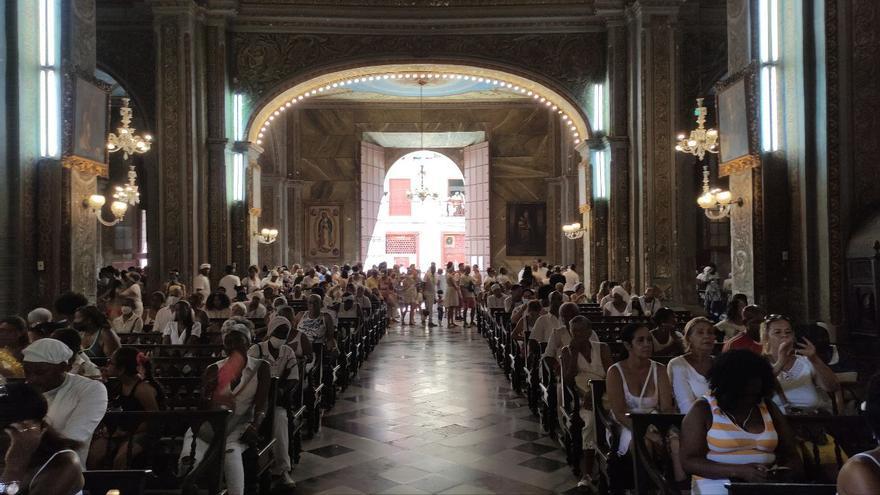
The priest, who accompanied the prayer in the Church of the Virgin of Mercy in Havana, asked for a plea “for the future of the Cuban homeland and the children.” (14ymedio)
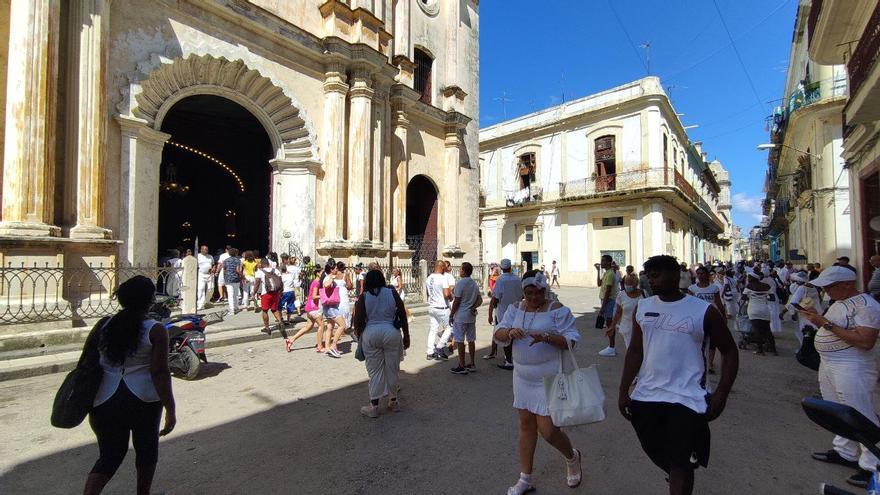
14ymedio, Juan Diego Rodríguez, Havana, 24 September 2022 — On an island with more than a thousand political prisoners, the patron saint of prisoners has become the image before which countless Cuban families pray. On September 24, the patron saint of inmates received flowers and candles in her parish on Cuba Street, in Old Havana, under the watchful eye of a police operation with uniformed and civilian agents.
Dressed mostly in white, in honor of the Virgin and the great orisha Obbatalá, with whom the Virgin is syncretized in the Santeria religion, residents from the vicinity arrived throughout the day and also others who traveled from distant municipalities. Most of them were united by a special reason: to pray for people locked up in prison, in a country with more than 90,000 prisoners.
From early in the morning, several tables were placed outside the temple for the private sale of prints, religious accessories, flowers and other offerings dedicated to the Virgin. But inflation hurt the enthusiasm of buyers, who widened their eyes when they heard that each candle cost 50 pesos. Many decided to retrace their steps and enter the temple empty-handed.
Dressed mostly in white, in honor of the Virgin and the great orisha Obbatalá, with whom the Virgin is syncretized in Santeria, they arrived throughout the day at the temple. (14ymedio)
The flowers also were more expensive, and the small bouquets, with only a few butterflies, cost 100 pesos, while others a little more elaborate and with more variety cost about 400. For residents of the poor neighborhood of San Isidro, where the church of Nuestra Señora de la Merced is located, paying such prices means a choice between putting something on the table and spending a good part of their salary on stems and petals. continue reading
The priest who accompanied the prayer requested a plea “for the future of the Cuban homeland and the children.” The request was followed by entreaties and hands that came together to pray. There was also no shortage of those who brought an image of a relative sentenced to prison to accompany them inside the church and at the time of approaching the altar with the image of the Virgin.
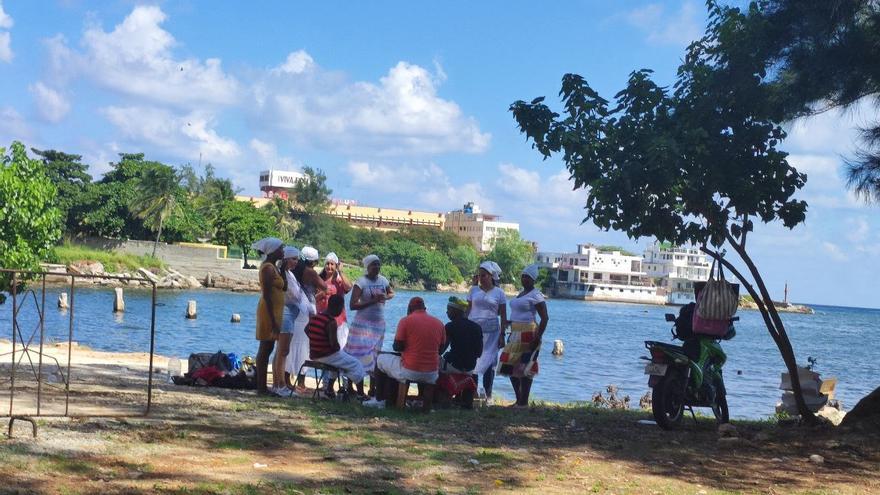
In other parts of Havana, such as the mouth of the Almendares River, a group of practitioners of Santeria also joined in a ceremony to remember the orisha as the “creator of the earth and sculptor of being.” White clothes were more common in the city throughout the day, and there was no shortage of domestic ceremonies with prayers for Cubans imprisoned in the hands of traffickers and coyotes during their migratory route.
In other parts of Havana, such as the mouth of the Almendares River, a group of practitioners of Santería also joined in a ceremony for Obattalá. (14ymedio)
The numerous Cuban women, especially those over 50, who were named “Mercedes” or “Mercy,” in honor of the Virgin, also celebrated, although on this occasion white meringue cakes — so characteristic of these syncretic celebrations — were scarce due to the lack of flour and eggs. The economic crisis forced Cubans to celebrate more modestly but just as emotionally as in other years.
Translated by Regina Anavy
____________
COLLABORATE WITH OUR WORK: The 14ymedio team is committed to practicing serious journalism that reflects Cuba’s reality in all its depth. Thank you for joining us on this long journey. We invite you to continue supporting us by becoming a member of 14ymedio now. Together we can continue transforming journalism in Cuba.
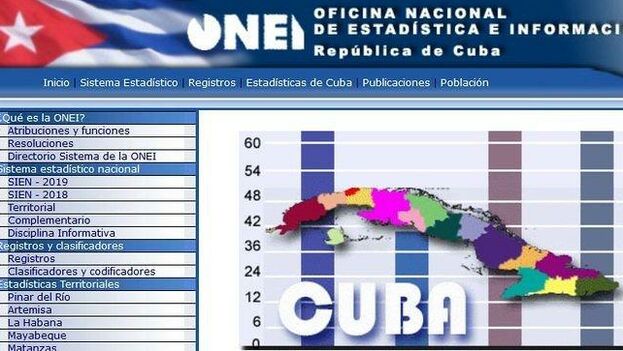
Like the false villages that Gregorio Potemkin raised along the river to make Catherine the Great believe a fiction of prosperity, Cuban statistics are formed by a daring of lies and exaggeration. (ONEI)
14ymedio, Elías Amor Bravo, Economist, 25 September 2022 — The recent publication of the Cuban National Office of Statistics and Information (ONEI) entitled “Investments, selected indicators” in the first half of 2022 concludes that investments reached 31,726.2 million pesos, an increase of 41% compared to the same period in 2021, when investments stood at 21,823.2 million pesos.
This significant growth, however, has to be pondered and discussed, which is the purpose of this post. It should be borne in mind that the “ordering task” of 2021 disrupted monetary variables with the disappearance of the CUC, the unification of the Cuban peso and the corresponding price and wage adjustments. This means that the ONEI publication is the first one that allows a comparison of the two periods and the various issues that deserve to be analyzed.
For example, with the inflation that has shaken the Cuban economy in recent years, monetary amounts have to be deflated, that is, corrected, to show the effect on prices, in order to determine their real value. Before 2021, inflation in the Cuban economy was low, but the Ordering Task* increased the rate that year by 77.2%, something unknown in the historical records.
This means that 2021 pesos didn’t have the same value as those of 2022, if annual inflation in the first half of 2022 stood at the CPI indicator (the only available) at 30%. Therefore, in order to obtain the real value of investment growth in the first half of 2022, the nominal growth, 41%, has to be divided by the increase in prices, 30%, so then investments increase compared to the previous year, but just over 10%. That is still a significant number, but lower than that offered by ONEI, and of course, insufficient to meet the needs of the Cuban economy. continue reading
Failure to provide the real value without the corresponding deflation is a mistake. ONEI should include nominal and real data in its estimates, as other statistical services do in countries affected by high inflation.
Taking into account this 30% increase in consumer prices, as a measure of the conversion of the nominal variables into real, when comparing the evolution of investment in different components, such as construction and assembly, equipment and others, it turns out that in the first, the nominal increase was 38% (7% in constant values).
In the second component, the nominal increase was 50%, which, corrected for the effect of inflation, was really 20%; and in the third case, the nominal increase of 48% becomes 18%.
This behavior of the three components of the investment results in their distribution or weight in the total to remain almost stable, with an increase in construction and assembly and other components; but the investment in equipment is reduced in terms of participation in the total. This design doesn’t meet the needs of the Cuban economy.
Another surprise comes from the territorial distribution. The data indicate a notable reduction in Havana’s participation in the total, which fell from 63% in 2021 to 56% in 2022. The significant loss of investments in Havana was channeled to other provinces such as Mayabeque, where investment multiplied by five, or to Santiago de Cuba and Holguín, where the increases were lower, but with higher levels. In general, most of the provinces increased their participation in the total, except Havana, where this adjustment took place. It seems that the authorities have wanted to carry out an investment policy that compensates for the deep territorial mismatches that exist.
The publication also offers investment data by economic activity, and again, concentration is highlighted, but with downward and upward trends. This is the case of business and real estate services, which with 33.8% of the total again occupies first place in the regime’s investment preferences. But as happened in Havana, it presented a downward trend, since in 2021, the percentage reached 40.6% of the total. What business services lost was gained by the manufacturing industry, which went from 13.4% to 18.7% of the total, and investment in electricity, which went from 6.9% to 8.3%.
Investment in mining and quarries decreased from 12.7% to 7.5%. Health and education, culture, administration and defense services seem stable in the two-year comparison, and the same is true of agriculture, which still doesn’t attract investment.
The investment design that emerges from this ONEI report points to a scenario of continuity in which little is innovated and what is reversed follows rigid and bureaucratic formats adapted to the interventionist nature of the regime. There is nothing suitable for what the Cuban economy needs in order to prosper.
*Translator’s note: *The “Ordering Task” [tarea ordenamiento] is a collection of measures that include eliminating the Cuban Convertible Peso (CUC), leaving the Cuban peso (CUP) as the only national currency, raising prices, raising salaries (but not as much as prices), opening stores that take payment only in hard currency, which must be in the form of specially issued pre-paid debit cards, and a broad range of other measures targeted to different elements of the Cuban economy.
Translated by Regina Anavy
____________
COLLABORATE WITH OUR WORK: The 14ymedio team is committed to practicing serious journalism that reflects Cuba’s reality in all its depth. Thank you for joining us on this long journey. We invite you to continue supporting us by becoming a member of 14ymedio now. Together we can continue transforming journalism in Cuba.
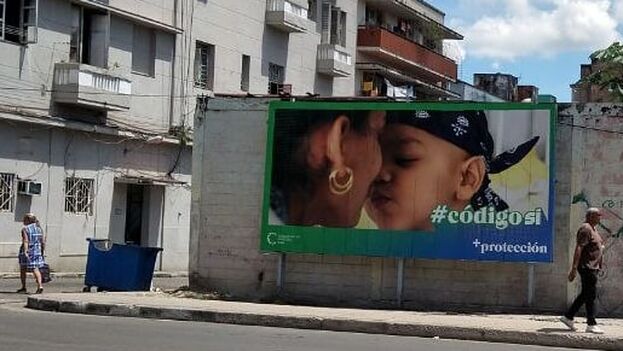
The only propaganda that has taken over public billboards, television spots and newspaper covers is directed at the Yes. (14ymedio)
14ymedio, Yoani Sánchez, Havana, 27 September 2022 — María Julia, a 67-year-old from Camagüey, never read the full text of the Family Code put to a referendum this Sunday in Cuba, but she voted Yes because in the nucleus of the Communist Party of which she is a member called to “support the Revolution and show up at dawn at the polls.” In Havana, Yania, 42, checked the No box even though she has been dreaming of marrying Yesenia for years and this new legislation opens the door to same-sex marriage. She did so because she believes that “under a dictatorship there is no valid election.”
The supporters or opponents of this Family Code, which the experts classify as advanced, and jurists as necessary, are not homogeneous blocks nor are they divided along a clear line. Only the third referendum in Cuba in more than 60 years, this one was much more than a consultation on ‘solidarity gestation’*, the ways of dividing assets between a couple at the time of marriage, or the replacement of the concept of parental authority with that of parental responsibility. For many, this referendum was the only opportunity to send a message, through the polls, of disagreement with the Miguel Díaz-Canel regime.
The victory of Yes, with more than 66% of the valid votes, is not the victory that the ruling party had dreamed of, having bet all its propaganda resources on the approval of the Code without allowing voices to appear in the national media that would question or reject it. With more than 26% abstention, Castroism has come face to face with the lowest turnout at polling stations in its entire history. That figure in a democracy could be a sign of the times, but under a dictatorship – where not going to vote sends a signal and can cause serious individual reprisals – it is a clear gesture of defiance and confrontation. continue reading
Nor did the attendees behave according to the official script, which would have preferred a resounding acceptance of the new legislation. More than 27% of those who came to the polls said No, canceled the ballot or left it blank. In the end, less than 47% of the electoral roll said Yes to the Family Code. This figure shows a fractured society based on an issue, but also a population that has used, to a large extent, abstention and rejection to send a clear message to the Plaza de la Revolución.
If instead of a law to regulate family issues it had been a referendum on the draconian Penal Code, imposed without popular consultation and profoundly repressive, the message of repudiation of the Executive would have been much stronger and more massive. Cuban totalitarianism chose, however, to put to the vote some citizen rights that should have been approved de facto without going through an election. Perhaps Díaz-Canel thought it was going to be an overwhelming success and that he would wash his face before the international community, but he ended up reaping bitter spoils.
The Friday before the referendum, Díaz-Canel called for support for Yes also “for our socialism.” This Sunday he found his ability to convene has been significantly reduced, that the mobilization mechanisms no longer achieve the same effect as they did a few years ago, and that more than half of Cuban voters have punished, in one way or another, the system that he represents.
*Translator’s note: “Solidarity gestation” refers to legalizing methods to have children beyond a male/female couple conceiving and gestating their own child.
________________________
Editor’s Note: This text was originally published in Deutsche Welle in Spanish.
____________
COLLABORATE WITH OUR WORK: The 14ymedio team is committed to practicing serious journalism that reflects Cuba’s reality in all its depth. Thank you for joining us on this long journey. We invite you to continue supporting us by becoming a member of 14ymedio now. Together we can continue transforming journalism in Cuba.
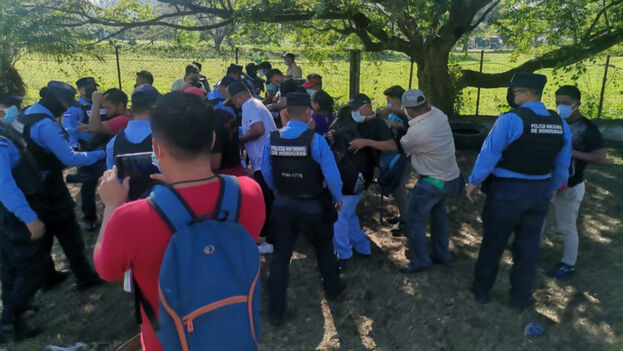
Migration agents and the Honduran police have been accused by several Cubans of extorting them. (Twitter-Honduras National Police)
14ymedio, Havana, September 22, 2022 — On their journey through Honduras to the United States, Cubans are extorted by agents of the National Institute of Migration (INM). Migrants, regardless of whether they have an official safe conduct pass that authorizes them to lawfully transit, are forced to pay $20 at each checkpoint, according to a report by El Heraldode Honduras.
A journalist from the Honduran newspaper infiltrated himself among the migrant groups and witnessed the abuses committed by the Migration authorities. The bus on which they were traveling was arrested, the agents came on, and the warning was direct: “Be quick, this is a checkpoint, each one of you is going to give 20 dollars, put it here,” said one of the uniformed personnel as he brought them a tray.
Another of the Cubans told the same Honduran journalist that at the Choluteca control station the police randomly selected their victims. He and two other compatriots were pointed to: “Pam, pam, pam. You, you and you. They took us to an office and said that every Cuban who passes by that checkpoint must leave 20 dollars even if he has a safe conduct pass,” he said.
This type of extortion had already been reported to 14ymedio last January by Arnaldo Rodríguez, a native of Artemisa. At that time, the Honduran police took away his passport and forced him to pay a fine of $218 to the INM. This sanction, which is established in article 104, paragraph 1, of the Migration and Aliens Law, was suspended as a form of amnesty last August. continue reading
Anselmo Mayedo, who left the island in 2021 and is currently in Mexico waiting for his brother and nephew to join him, told 14ymedio on Thursday that he took the Managua route and crossed through Honduras, where he was “threatened by the police” and suffered the theft of $400. The entry from Nicaragua to Honduras, he says, is made from Danlí, Trojes, Guasaule, La Bucana or El Porvenir.
“The group of six Cubans took a bus to get to El Porvenir. We got off and walked through the woods until we reached Trojes, where the police took us and confiscated our passports,” says Mayedo.
The INM reported that this year 50,059 Cuban migrants, 30,374 Venezuelans, 6,444 Ecuadorians and 3,918 Haitians have entered Honduras irregularly. They followed, in order, 1,000 from Colombia, 811 from India, 806 from the Dominican Republic, 720 from Senegal and 647 from Angola, among others, for a total of 101,392 irregular migrants.
Some 77.3% of migrants entered Honduras through the municipalities of Danlí and Trojes, department of El Paraíso, bordering Nicaragua. In recent months, El Paraíso has become a new route that migrants, mainly from Cuba, Venezuela and Haiti, are using to continue toward the United States.
Honduran authorities claim that the majority of migrants who enter the country do so irregularly, at “blind spots” through human traffickers, known as coyotes, who don’t always take them to the border with Guatemala.
Translated by Regina Anavy
____________
COLLABORATE WITH OUR WORK: The 14ymedio team is committed to practicing serious journalism that reflects Cuba’s reality in all its depth. Thank you for joining us on this long journey. We invite you to continue supporting us by becoming a member of 14ymedio now. Together we can continue transforming journalism in Cuba.

 14ymedio, Juan Diego Rodríguez, Havana, 28 September 2022 — One of the main urgencies of Cubans this Wednesday, after the passage of Hurricane Ian, which has devastated the western end of the island and has caused the collapse of the already precarious national electrical system, is to get electricity by any means.