Heredia Project: Choices as a Good Omen / Ernesto Morales Licea


I would dare to suggest that few initiatives in the history of the Cuban opposition have been as inspiring, thoughtful, and complicated for the government of the Island to avoid, as the new project that takes the name of Heredia; an area of civil society has been set in motion.

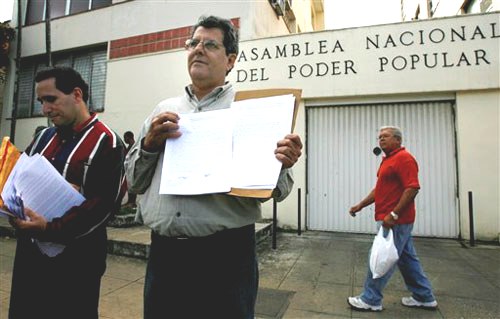
The Heredia Project — named as a way to honor our great and tortured poet José María Heredia, one of the most famous exiles in national history — arises again with Oswaldo Payá Sardiñas at its head, exploding for the second time, after the beautiful but failed Varela Project, on the most complex and fruitful terrain for peaceful struggle: The law.

Payá Sardiñas — an opponent who with his austerity as proof against blackmail has never been deposed as they would desire — has become a learned scholar of the Constitution of the Republic, and as we say in “good Cuban”: He has chosen to “stew it in his salsa.” And he has done it well.

This time, his Titanic enterprise takes the name “Heredia Project: Law of National Reunification,” and in essence is focused on promulgating a law that guarantees rights recognized in our Constitution, but violated with impunity in practice by those who rule over us. Above all, one in particular: The sacred right of Cubans to enter and leave their country, with complete freedom.

The seven points set out at the beginning of the proposal, and that serve to justify it, are in many ways irrefutable. Among these, I’ll take two: 1. The clear prohibition in Article 42 of the Constitution of the Republic on discrimination based on race, color, sex, national origin, religious belief or any other offense against human dignity, and 2. The resolution proposed by Cuba in 1998, sponsored and signed at the United Nations under the title “Respect for the right of universal freedom to travel and the importance of family reunification.

Henceforth, this legislative initiative fully develops its ideas, which can be summarized in a superficial way in four key areas, a portion of the many articles and paragraphs present:

1. Citizenship: All Cubans, wherever they live, and their natural children, should have the right to choose their citizenship and to enjoy the rights implied by it, without being denied because of the political interests of the country’s government.

Fundamental question: Unlike the rest of the world’s citizens who emigrate to another country, we Cubans are the only ones who suffer the total loss of our property and rights when we decide to reside elsewhere in the world. We are the only ones who must go through the humiliating process of giving the State an accounting of all our possessions, and in most cases, losing them all after choosing the category of “Final Exit,” a term that the Heredia Project specifically classifies as exclusive and ominous.

2. Equality: All Cubans, living in Cuba or abroad, enjoy all the rights of citizens enshrined in the Constitution, so the practices of discriminating based on their condition as political dissidents or emigrants will cease.

Within these discriminatory practices, legislative initiatives have not forgotten the fundamental issue of equality of Cubans and foreigners in terms of Internet access, cable television and similar amenities.

3. Mobility: All Cubans can move freely within their country and have the right to travel abroad. End the requirement to submit a Letter of Invitation to visit another country, require only submission of an updated passport. In addition, eliminate the Exit Permit, and the Letter of Release required by immigration authorities from one’s workplace, and end the requirement for Cubans living abroad to present a visa to enter their own country.

This being the essential chapter of the Act, it is not surprising that it covers a remarkably rich range of violations and practices that Cubans suffer today under the theme of emigration and international visitors, from the need to be able to pay for the cumbersome procedures in Cuban pesos, the currency in which wages are paid on the island, to the habit of punishing certain professionals who apply to leave the country (mostly doctors), by sending them to work in the most complex and difficult locations in the country.

4. Property: All Cubans have a legitimate right to continue to live in their homes without anyone depriving them of their property.

And here the “National Reunification Law” plays one of its most serious cards, astute and, in my estimation, the boldest of the whole proposal: If it were to be approved, Cubans living outside the country would have no right to reclaim their properties that were expropriated before the law went into effect.

Why is this section fundamental, even vital, to achieve mass support in Cuba? Very simple: Because the first thing that would make Cubans on the Island oppose a deal would be allowing the exiles to return to their land, which would mean that displacement of hundreds of thousands of Cubans who today live in homes formerly belonging to other owners.

And not just homes: The Law of National Reconciliation understands the impossibility of returning to those previous owners properties that are today, in Cuba, schools, daycare centers, hospitals, and an endless list of other uses.

The importance of this aspect is absolutely fundamental: One of the fears that the government of the Island has intentionally spread among nationals, regarding the possible return of the exiles, is that they would lose their homes: “If those who left return, the first thing they will do is take your house where you have lived for 30 years, because in the 1960s it was their property.” A brilliant manipulation to short-circuit the momentum of popular justice.

Thus, Project Heredia begins the year going from door to door, circulating from hand to hand, quietly and fearfully, in the hopes of another 10 thousand signatures to enable them to present it to the National Assembly as a popular initiative, which they would then be obligated to pay attention to.

Without any kind of ingenuousness: Whether this bovine Parliament, unanimous to the point of absurdity, will reject the project with the same shameful attitude with which they dismissed the earlier Varela Project, time will tell. In fact, this same Law of National Reconciliation was presented to the National Assembly in 2007 by two citizens, and they are still waiting for a response from the members of parliament.

But I think the context in which this initiative arises, the spread of technology in Cuban society, and the growing popular discontent that will undoubtedly begin to develop as half a million people lose their jobs, will, this time, be the principal partners of a project in which, I confess, I have limited faith, but faith nonetheless.

According to the wise words of a lawyer and friend — who, precisely because he is a friend, I protect with anonymity — “This Law project is impeccably constructed, and begins to resolve one of the outstanding issues of the Cuban legal system: Implementing a Citizenship Law that up until now does not exist.”

One can only endure, and sharpen the perception: The Heredia Project, with tens of thousands of signatures one can almost guarantee they will obtain, will be the perfect gauge to test how much truth and how much magician’s illusion are contained in the official words, when they speak today of redirecting the destiny of a nation.

January 6 2011

A Well-Deserved Award / Rebeca Monzo

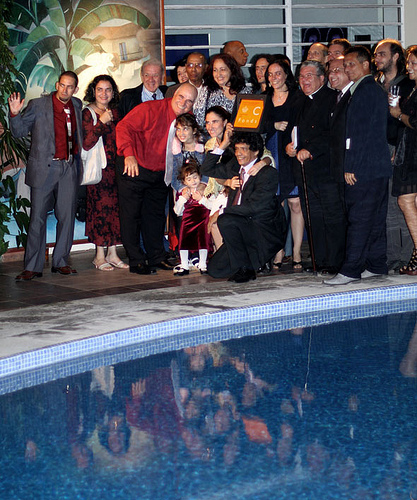
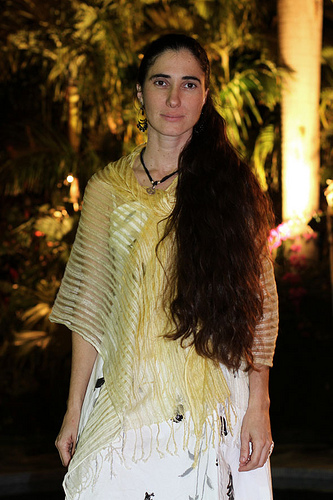
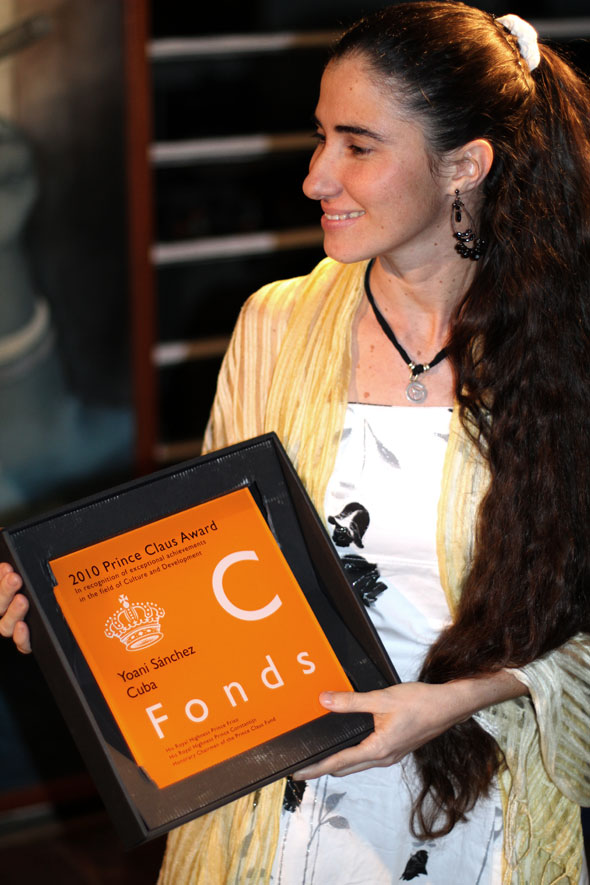
The evening was cool. Since the early hours we were preparing for what would happen that afternoon. We were to pick up the poet and Regina in order to go together to the Dutch ambassador’s residence, where there would be a reception to present the Prince Claus award officially to Yoani Sánchez.

Upon arriving at the appointed place, we were able to observe that there was already a large group of bloggers on the corner of the residence, waiting for the hour stated on the invitation. A mysterious white pickup truck with darkened windows was parked right in front of the place. On the other corner, a cyclist on his motorcycle, with his helmet on and not moving, seemed to have turned into a sculpture. There was also a couple who pretended to be checking an address. None of them were moving.

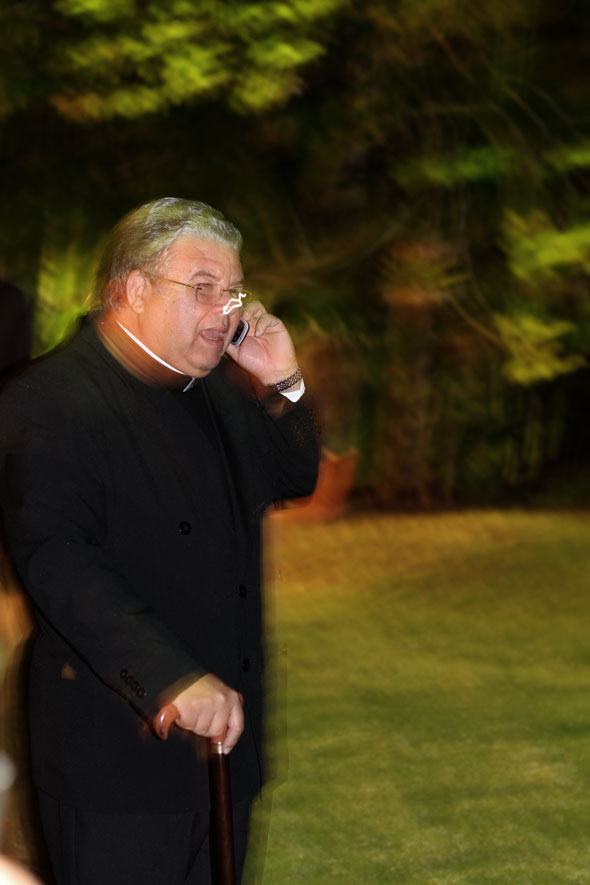
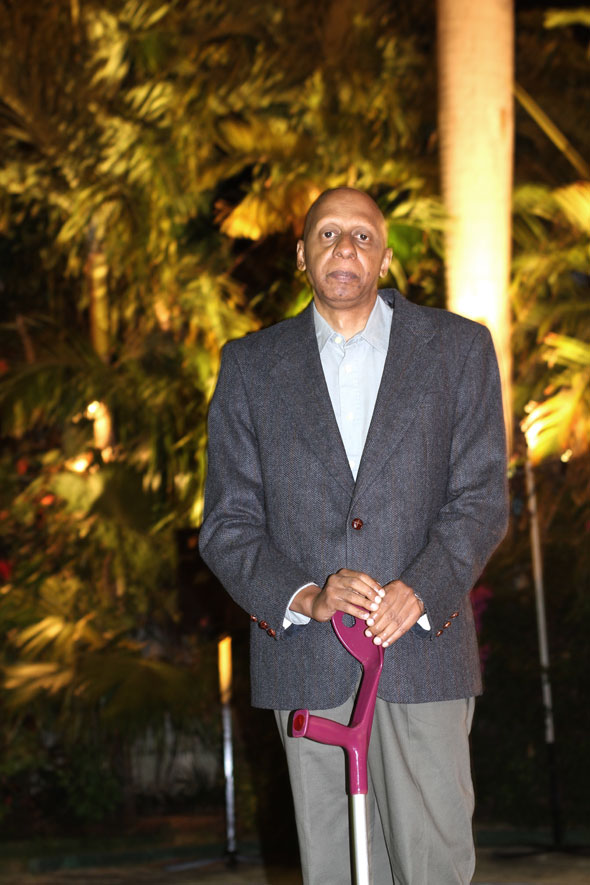
Among the last to arrive were Coco Fariñas, Father José Conrado and Dagoberto Valdés. After exchanging greetings, the whole group of us headed for the site of the event. Fortunately no one bothered us. But, since we knew what it was all about, before we went in we directed a big smile towards the parked white pickup, as well as the couple that was not moving from its place and the motorcyclist.

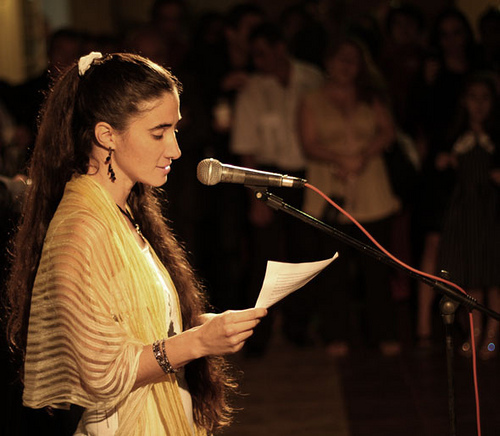
The ceremony was truly moving. We were all there to support and accompany Yoani. She, with the wise and simple words that are her hallmark, gave thanks for the well-deserved award. With great applause, the award ceremony was closed. Then a varied and delicious buffet was served. We had a truly charming evening.

Translated by: Espirituana

January 8 2011

SOS from Rita and Bola / Laritza Diversent

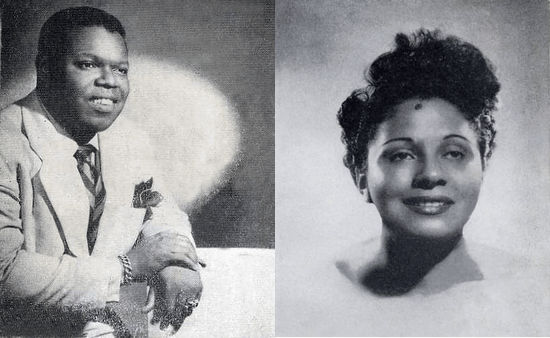
How neglected and abandoned! In Guanabacoa, the houses where masters of Cuban art and music, Rita Montaner and Bola de Nieve, were born are about to fall down.

Neighbours from this area in La Habana have told to Rafael Egües Velázquez, from the Web of Community Communicators, who could not take photos because State Security confiscated his camera.

Magalys Loza Rodríguez showed Egües the state in of the house where she lives and in which Rita Montaner came into the world in 1900, on Cruz Verde number 18, between Amargura Street and Duarte Street, Guanabacoa.

“The household is shored up, the roof is in danger of falling in. I wrote to the City Historian Eusebio Leal and he has not had courtesy to send someone to evaluate the damage. Even though this house is our National Heritage.”

“No one at the Ministry of Culture is interested. Nor is anyone at the Assembly of Peoples Power. And I am not going to waste my time proposing it. It seems to be a lie that they will pay attention to the site where one of the glories of the Cuban culture was born. They’re waiting for it to collapse and then they’ll whine about it later.”

For her part, Odalis Fonseca Jiménez, went to the ombudsman to confirm the heavy damage to her abode in which Bola de Nieve was born in 1911, in Máximo Gómez Street number 101 between Enrique Valenzuela Street and Quintín Banderas Street, Guanacabacoa.

“It is in danger of collapse and nobody in the town office has paid it the attention it deserves. Ten months ago I wrote to Eusebio leal and he has not responded to me. The town historian wanted to put a plaque on the house and I refused. The architects from the district have presented themselves, warning me it is not habitable and proposing I go to a shelter, I’ve also refused that.”

“They should give materials to repair the house little by little Office of the City Historian should undertake the restoration, because Bola de Nieve meant a lot to the music and culture of this country.”

Via this blog, we send out SOS to all Cuban artists and musicians, living outside or inside Cuba, to save the two houses and turn them into the museums Rita and Bola deserve.

Iván García, Laritza Diversent and Tania Quintero

Translated by Ivana Recmanova

Originally posted: January 7 2011

Baptism in Guantanamo / Luis Felipe Rojas

Several days after my previous detention in that Eastern Cuban city, we were finally able to make it there without the usual “security” obstacles. Although they did require identification of all the men at the Point of Control at the entrance of the city, my family and I were able to pass through without difficulties. In what seemed to be a wholesome ambiance, without the presence (at least it was not visible) of the police, Rolando Rodriguez Lobaina’s kids received the holy water which consecrates them as baptized children of the Christian faith. The event took place at 3 pm on Sunday, November 19.

Was there some reason for obstructing us a few weeks ago? What order came from Villa Marista or from the general barracks of Guantanamo which demanded that my family be sent back to San German while I was taken to a dark and wretched cell? Should we believe that it was “just an error”, as they told Rolando Lobaina?

What is certain is that an attitude such as the one in the city of Guaso continues making that area one of the most repressive zones in the entire island.

Every single human action serves as an experience. This one served to reaffirm my faith in Jesus Christ and in the day that freedom arrives in Cuba. I would once again go through all the fiery doorways, all the cells, and the corporal punishments if that meant I will be a free man. It is my belief and it is my faith, just as it is the belief and faith of many others. That day in the principal Catholic church of Guantanamo, it seemed as it was the day after the fall of the dictatorship. It was a sign of the days soon to come.

Translated by Raul. G.

January 9 2011

Of Ostracism and Sanctification / Miguel Iturria Savón

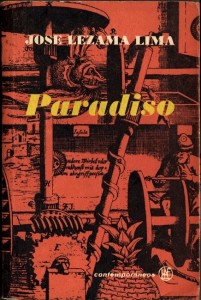
I suspect that somewhere from the island firmament, the writer José Lezama Lima (Havana, 1910-1976) is smiling at his supporters, or winking at the editor who introduced the latest edition of his Collected Works. Our literary rhino should be happy with so many celebrations. “Seeing is believing”, he would say at one of the gatherings for his Centennial, nearly four decades after his death, which was preceded by ostracism and suspicion because of his “detachment from reality.”
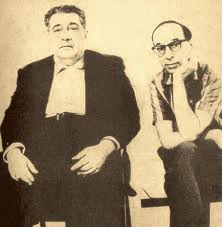
The sanctification of the author of Death of Narcissus (1937) and the controversial Paradiso (1966), represents the triumph over the censorship imposed at the time of revolutionary change, more suited to the aesthetics of violence and socialist realism. Censorship is still standing, but dead authors do not frighten the curators of the culture, who reprinted the poems, essays and novels of Lezama Lima, in addition to his letters, interviews and lost texts reborn in anthologies, in seminars, conferences , documentaries and even feature films.

Those who think that behind the exaltation of Lezama Lima there are ulterior motives, are right — particularly in this year of his centennial, a year marked by crisis and despair generated by the same dictatorship that buried in silence so many writers and artists. Lezama himself, decades ago, recognizing the adverse historical circumstances, said that “a country frustrated in political essentials can achieve virtues and expressions by other more royal hunting grounds.”

For him, art and literature were more enduring royal preserves; centers of gravity in his life and his work, dedicated to jumping beyond the immediate and transcending the political roughness and daily gossip. Thus, his creative fertility did not take the path of social protest, but the inclusive tradition that rescues the Cuban essence and merges with other legacies through a long artistic language.

The great Lezama Lima’s unique poetic corpus and controversial theory of the image should be like an engine of history. For him, “poetry is like the dream of a doctrine.” His enormous talent and erudition confirmed the riddle in poems of rupture such as Death of Narcissus (1937), Enemy rumor (1941), Concealed Adventures (1945), Persistance (1949) and Giver (1960), complemented by essays that offer new critical perspective and the novel Paradiso, published by the UNEAC in 1966 and reissued by Letras Cubanas in 1989, with an indispensable foreword by Cintio Vitier.

The Death of Narcissus and Paradiso represent his ticket to literary immortality. The imaginative display, linguistic input and the way he retells the myths of the past and beings them closer to the island horizon, caused critics to see in Lezama Lima our Luis de Góngora.

Paradiso, described as secretive and scandalous, recreates the family and personal guts of Lezama Lima himself, who submitted to the reader the geometry of words, but he gives away his arsenal of parables, cultural associations, metaphors, dreams and unexpected visions. We should search the work and recreate ourselvs in it as a cathedral of history, friendship and culture far from the melodramatic thrillers and detective novels.

It is also possible to read the essays, Analecta (1953), The American expression (1957), Treaties in Havana (1958), The bewitched (1970) and the compilation Image and Possibility of 1981. In 2010 studies on cultural dissemination undertaken by Lezama Lima resurfaced in magazines that identified his generation, consisting of figures that, with him, enriched the spiritual heritage of Cuba. From Verbum (1937) to Origens (1944-1956), past Silver Spur (1939-1941), Poet, Clavileño, Nadie Parecía and Fray Junipero (1943).

Origins, with 40 issues in a decade, was compared with the Revista de Occidente (Spain), with the River Platte South and the Mexican Contemporáneos e Hijo Prodigo. In Origins, Lezama and his colleagues structured the first literary movement that made poetry its essential form of knowledge, aesthetic enjoyment and understanding of the world. Here are the voices of our poetic transcendentalism, who include, in addition to Lezama, Gastón Baquero, Eliseo Diego, Cintio Vitier and Fina García Marruz.

A hundred years after his birth Lezama Lima is still more talked about than read, but he is also reborn as a paradigm of the creator outside the socio-political reality of the country, where the calm waters and the daily hardship stimulate the search for other estates of greater royalty.

Share

December 28 2010

First Anniversary / Rebeca Monzo

Patchwork, by Rebeca

It’s been just over a year since, visiting the home of our friend the poet, his wife told me about some Yoani and an Academy for bloggers she was wanting to open. At that time, it seemed to me my friend was speaking Chinese.

I’d heard something about Yoani. From time to time she was on the news on the shortwave. I never imagined I’d meet her, much less have the privilege of being accepted as a student. But, days later, I joined an enthusiastic group that made me feel young again.

My first post, Wil wild Centro Habana, came out on the blog Bad Handwriting, thanks to the generosity of its owner. I didn’t have my own until early January of last year, when I appeared for the first time on the home page of Cuban Voices. I can assure you it moved me very much.

When I launched my second piece, El valle de los caídos, on my own blog, I never imagined the year to come and how much satisfaction it would give me. I won’t deny that at first I had to overcome a lot of fear, but it was worth the payback.

To Yoani, Reinaldo, Miriam, Claudia and Dr. Vallín, who taught us such excellent classes and workshops, to all who supported us, and to you my readers, I offer my most sincere thanks for helping me to arrive at my first anniversary in the alternative blogosphere of my beloved planet.

January 5 2011

My Ration Book and Me / Regina Coyula

In the years when I believed in the government, I also believed that the ration book was a necessary evil that would disappear as the supply available to consumers’ wallets increased. In that era I felt almost homesick: Red meat every nine days, to cite the most memorable luxury, aside from tomato puree and condensed milk among other things. Despite “Dad’s” subsidies, I wanted to get to that time when abundance would make the indispensable booklet obsolete.

Well contrary to my fantasy predictions, the booklet will disappear but not for the reasons I’d hoped, quite the opposite. The economy is so precarious they can barely manage the so-called subsidies. “Daddy” forgot to give me at those prices the products I need for barely half a month; the rest I have to acquire on the free market in national money, not to mention that, if it’s not acquired in the shops selling in foreign currency, forget it. Things like milk, something over a pound a month of chicken for each person, deodorant or shampoo, not to mention caviar and French perfume.

The new booklet, as my friend says, is a waste of raw materials, as a postage stamp size format would be sufficient to keep track of what we get now.

Although I’ve never lived it, I know the time will come when, on his salary, a worker can buy what he needs without thanking “Dad.”

January 7 2011

A Story from Peru / Juan Juan Almeida

1 – Yesenia Álvarez, young intelligent, successful….strange combination. Tell me about yourself, this organization over which you preside, your professional and family education, and when and why you had this passion for Cuba.

If in our countries we let our talents flourish in freedom we would not talk about a strange combination. I am sure that many young people in Peru take this path; however, there are a lot of reasons the youth of Peru and Latin America are able to fully enjoy the possibility of being successful if we express our talents without any populist, authoritarian or interventionist State appropriating the product of our work. Freedom, once you achieve it, should be constantly guarded. There is no way of assuring it will last forever. That’s the price of taking it: taking care of it. For this reason, in the IPL, the organization over which I preside, we are committed to spreading and demonstrating the benefits of living in freedom.

I studied law, and since the university, in the first years with my study of the origin of constitutional law, I remained captivated by liberal ideas, so always the situation of freedom and human rights in a long-lived dictatorship like the Cuban one has been my preoccupation since those years. I should add that in Peru as in other Latin American countries, the myth has been created that Cuba, rather the Cuban government, should be a model to imitate for our countries.

When I discovered liberal thought, I felt that I had always been liberal and am now committed to spreading it as a philosophy of life. I wanted to help demystify the supposed “social accomplishments of the Cuban government” that make many people, some certainly intelligent and well-intentioned, be condescending with one of the most perverse dictatorships of the continent.

2 – “Freedom is important to achieve development” is an interesting phrase that is attributed to you on the Internet, and it has generated comments. Aren’t you excluding those who don’t have something so relative and that many call “freedom”?

It doesn’t make it exclusive precisely because the phrase seeks to encourage countries that don’t have freedom to take this path, since where there is freedom there are conditions for each individual to construct his own destiny, there is the possibility of development, opportunities to generate wealth, to be successful, to improve your quality of life, and to accomplish your dreams. When you let someone else choose your future or destiny, which is what the populists and the “welfarists” want, you are condemned to what they elect to give you, and of course experience clearly shows that the life they want to give you is very poor.

What the Cuban government does is for me an example of this. There are many cases, I shall focus on one that ought to merit the indignation of anything called democracy, that is, they say that in Cuba they have the best quality education, but I ask myself, Can you call it education and even more one of quality if the students don’t decide what to study? If in order to study they have to affiliate themselves with thought that is only revolutionary? Can it be the best education if the student can’t decide what to do with that education, if the student can’t improve his quality of life because of an economic system that exploits him? There is nothing like self-development in Cuba from education. Can you call it education if once educated the student cannot read or say what he wants?

I’m speaking of the people, not those privileged ones who are close to power. The ones who exclude are those authoritarian members of government who exclude the citizens from the advantages of freedom. It’s easier to ask for revolution, socialism, a welfare state, the sacrifice of freedom when this sacrifice is for others. I say this in relation to all those who support the regime from outside, saying that “it’s worth sacrificing civil liberties in exchange for social accomplishments” but who are not capable of living in that dictatorship, like those people who are not privileged with power.

The freedom is the absence of those privileges acquired at the cost of the individual people who live in oppression. Freedom is a value and should not be sacrificed in exchange for other values. When it happens it soon becomes noticeable that freedom has been lost and also those values in exchange for which liberty was removed. In the name of a supposed better education those in Cuba who dare to think differently from the government are punished.

3 – In 1980, a small group of Cubans – in my opinion desperate, and on board a bus – broke into the Peruvian embassy. And although many Cubans have forgotten, this one event marked a “before and after” in my country’s history. Tell me, Yesenia, what you know about this, and relate to me, please, how they are now living, these Cuban families who generated the Mariel Boatlift and who remained stranded in Lima; people to whom more than 120,000 Cubans, instead of ignoring them, should owe them eternal gratitude?

There’s a strong bond between Peru and Cuba. I have heard many stories, and all are sad. No one deserves the mistreatment and abuse that those people suffered in their attempt to leave the country. There you can see the evidence of how the Cuban government has been the main separator of families. I don’t understand how people as sensitive as Silvio Rodríguez, García Márquez and others can be so condescending with a dictatorship that has separated Cuban families during all these years. It’s the symbolic story of Cuba, fathers, sons, brothers, families who want to be together and have been separated for years, because many people in exile can’t return.

The desire to flee of thousands of Cubans in 1980 should make us think. According to a recent report, hundreds of people came to Peru and after 30 years there are something like 60 left in Villa El Salvador. You would have to look at these stories, I am very interested in this, of how they managed in those years, those who left Lima, others who did well in Lima and also those who did poorly. Thirty years have passed and are not important.

Today Peru is not the same as then, Today they breathe the air of freedom but with certain barriers that we have to conquer so that we citizens can successfully build our future. We should value the fact that we have freedom of expression, of denouncing corruption, of opposing the abuses that citizens suffer with commercialism, to ask what they do with our taxes and above all the possibility of conquering poverty with our creativity. We should take care of the freedoms that we now enjoy and fight for more freedoms.

“Cuba and the Elephants” seemed to me to be a critical work, demystifying, respectful and real. You are a lover of peace, justice, and a defender of so many noble causes that, unfortunately, as I understand it, are partially lost today. Tell me, why did they expel someone like you from my country, and even more, prohibit you from entering?

For something that doesn’t happen in the middle of the 21st century in an open society. Together with four other Peruvian women I visited the Ladies in White in a public place, at the Church of Santa Rita in Havana. We did it in December 2007, on the eve of the International Day of Human Rights, to express out solidarity with their valiant and heroic effort against the dictatorship.

Even now I remember the fear and the uncertainty of our fate that day, first persecuted by Havana and then interrogated and detained at the hotel, forbidden from leaving and stripped of our passports. If there is something that works well in Cuba, it’s the repressive apparatus. Paradoxically, there we were without rights on the International Day of Human Rights.

5 – It’s been an honor to know you, and I’m pleased to be your friend, Before ending, and because someone like you always arouses the passion of my readers, I would like to ask, are you married or single? Do you know how to sing? Do you like to dance?

It’s also an honor for me to know you, Juan. I admire your work and your bravery which is why I very much appreciate beginning this friendship, which I predict will be long-lasting. I am single, I don’t know how to sing but I enjoy this talent in others. I have been told that I dance very well, although I’m a little old for that. One of my passions is basketball, and I adore movies and television series. Since my childhood I’ve liked to read a lot and to listen to thrilling stories about life. Thank you very much.

Translated by Regina Anavy

January 3 2011

What Happened with Fidel Castro’s Protegé? / Laritza Diversent

“The Arms of Yesterday” is the title of the book of memoirs by the Chilean businessman Max Marambio, 63. In his presentation during the 2008 Havana Book Fair, Marambio said, “In Cuban I found my model of society.”

Two years after its launch, I wonder if Marambio will the same after the Cuban Ministry of the Interior releases an arrest order for him.

What armor with the Chilean use to defend himself against accusations from the government he defended? How will he feel after his fall?

The Fat Man, the nickname he’s known by, came to Cuba in the mid ’60s. He contacted Fidel Castro and started to live the romantic dream if the bearded guerrillas, under the command of Manuel Piñeiro, alias Redbeard.

The same Revolutionary project that yesterday inspired in him an ethical commitment for life, now accuses him of crimes of bribery, acts to the detriment of economic activity or recruitment, embezzlement, forgery of bank documents and fraud.

In 1973, Cuba was the perfect place for his self-exile, today it is a place quite dangerous for his freedom and personal security. If he returns to the island, he’s likely to end up in jail.

Marambio did not return the call of the prosecutor from the Ministry of the Interior, Lieutenant Colonel Francisco Estrada, who summoned and questioned him on 19 July and 23 August. The Fat Man knew the Cuban judicial system well. He particularly knows the few safeguards offered to the accused.

The criminal proceedings against him are in the preparatory phase, when the diligence previous to the opening of the oral arguments is performed, such as pre-trial detention for the offenders.

The Chilean also knows that few can work with their lawyers long distance. They need to appear and apply a precautionary measure on the part of the process, and so be legally represented.

So what will he do then? What all prudent men would do.  Stay in his country and forget about the land that dazzled him in his youth.

The Fat Man is also aware that the publication of the summons and charges, in the Cuban Republic Official Gazette, is a formal requirement. The Cuban government is not going to go after him internationally.

But neither are they going to pardon him. It won’t be like in 1989, when he survived a political scandal that ended with the firing squad for General Arnaldo Ochoa and Colonel Tony de la Guardia.

Surely, to Marambio they will declare him in default and try him in absentia. A very subtle form of expulsion. He can’t return and he will lose everything he has in Cuba. The only country in the world where a foreigner and close friend of Fidel Castro has the chance to become a millionaire. However, no one now with save him from the confiscation of his property.

Mystery surrounds the case. What happened to the protegé of the elder Castro? Inconvenient for the younger brother? Evidently the arms of yesterday don’t serve Max Marambio today.

September 3, 2010

Acceptance Speech for Prince Claus Award / Yoani Sánchez

Good afternoon everyone:

To the Dutch ambassador who has kindly offered his home for the ceremony, to the members of the Prince Claus Foundation who organized the presentation of this award, to the diplomatic corps, to my family, my friends, to the bloggers present here and also to the readers, commentators and translators of my blog who join in this moment from cyberspace. A special greeting to the other 2010 winners of this important award. In short, to everyone, I thank you for your physical, virtual or spiritual presence on this day.

The words I say to you this afternoon are imbued — in part — with the experiences I have had in the last three years, since April 2007, when I started to write my blog, Generation Y. I could dedicate long minutes of this speech to emphasizing the scenes that make up what I call “my path of pain”; this tortuous trail I’ve traveled, determined to live freely in a country full of masks. I could also tell a pitiful tale of stigmatization, of constantly being watched, of pressure on my family and demonization of my community, of police citations and even physical attack.

But I will not focus on those obstacles, but on the other path, that of the gratification and the gift of personal fulfillment, and on future projects. This beautiful part of the journey that begins when I go out into the street and someone — overcoming their fear — approaches me and says, “I read you,” “keep going,” “resist.”

I also have the gratification, every day, of a growing number of my fellow citizens who seek my opinions, debate with me, or sympathize with my point of view. And now, more and more, they use the tool of a blog to express, in the virtual Cuba, the differences of opinion still penalized in the real Cuba. This path of professional and civic growth is one I want to share with others.

The Prince Claus Award is an award that looks forward, a stimulus that invites dreams and the setting of higher goals. This year, 2011, could be the stage to realize some journalistic challenges that I have fantasized about for a long time.

Our Island is desperate for arguments, debates and information. We cannot simply denounce intolerance, describe what doesn’t work, or point fingers at what we don’t like. It is time to begin to change. For those of us who reject another cycle of frustration and tension, who reject the mistrust looming over us, it is also time to do something, however small.

I like to work with the written word and with news and I feel my place is appropriately in kilobytes, pages of newspapers, a mouse and a keyboard. This does not mean I am going to lock myself in the ivory tower and write, quite the opposite.

Words do not always behave like barricades or like thrown paving stones; fortunately words also behave like an effective balsam on a distressed nation. I believe in the medicine of free information, and in the imperfect democracy we Cubans will, one day, manage to put into practice in our country. I am a dreamer, I know, but so are all of you here… and we are not alone.

This year new cracks will appear in the state monopoly on information. Any provincial blogger armed with a mobile phone could jeopardize official newspapers and could transmit his words, photos, audio and video direct to the Web. I like to say — half joking, half seriously — that if Cubans can invent ground beef with no beef in it, as we did during the most difficult years of the Special Period when banana skins became meat, we can invent an Internet without the Internet.

With those little cellular gadgets, we have learned to send and receive the total spectrum of information from this Island. I feel I am also a missionary of the creed of spreading knowledge and tools that make us free throughout the whole Island. Because each one of us can become our own press agency, without bosses or censors.

I have dedicated recent months to this, through the magnificent experience of an academy with 27 students, five professors, workshops, thematic conferences, and advice and support for those who have recently opened a space on the web. In the coming months, I intend to extend the reach of these courses. The blogger virus will ultimately infect thousands of Cubans.

A more difficult dream — and so a more recurring one — is the creation of a new media outlet. Many who are here today, though they may not know it, are the future editors, photographers and correspondents of this newspaper. Without all of you, it will not be possible. Without the talent and energy that can infuse the pages of this planned information space, it will all remain the fantasy of one small blogger.

So these few words are also to say to you: Help me, join me in this unpredictable adventure of empowering ourselves as citizens, of behaving as free people in a country full of fear, without losing our way on the path of differences that feed our pluralism, and avoiding the known error of unanimity. There is room for everyone in this project. What’s more, without you I could not  accomplish it.

Thank you very much,

Yoani Sánchez
Havana, January 7, 2011

AN EXPERIMENT… / Orlando Luis Pardo Lazo

Please try to search on my name (Orlando Luis Pardo Lazo) in the (ophidian) official site http://www.cubaliteraria.com.

At this point all I am to the rancid bureaucracy of my country Cubita: a malicious code…!!!

It’s audacity made law. Illiterates who work for a wage. Erasing memory with an impunity they will pay dearly for, sooner or later, we are taking names, do you understand? Unless you desert on your first little jaunt out of the country, like so many hypocritical censors do.

For this we haven’t advanced in 50 years, abusers. Tell me something, Lagarde! Varela, embolden yourself and throw me a caricature with this national atrocity. Let’s see, Abel, are you still in office…? Barnet, please let me know. Iroel Sánchez, was it you? Jorge Ángel Hernández Pérez, do you have anything to declare besides your own talent? Bladimir Zamora, jump! Chang…, nothing, man.

You blotted out Tomás Piard’s documentary TROCADERO 162, BAJOS just because I show up and photograph well and speak with humanity. Now you shit on the prestige of the CUBALITERARIA site by censoring its search engine so nobody knows I’m a writer and that, before the hysterical tantrum you’ve thrown against me, you published a thousand things by me there in http://www.cubaliteraria.com.

Translator’s note: Searching on OLPL’s name at this website yields: Intento de envío de código malicioso. It means “Attempt to send malicious code.” Thus, conveniently erasing Orlando Luis from one source of Cuban literary history.

January 7 2011