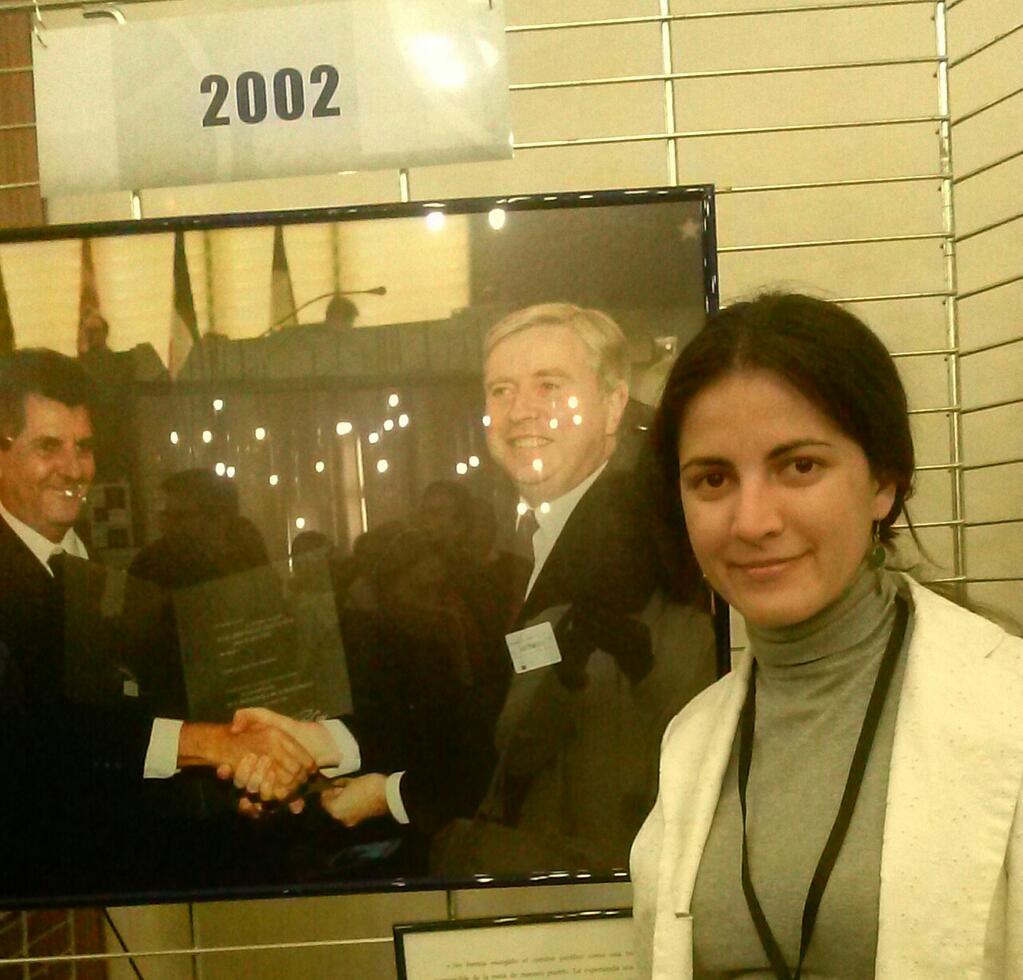
 Rosa Maria Payá at the European Union’s Sakharov Prize for Freedom of Thought award ceremony in Strasbourg, France, in front of a photo of her father, Oswaldo Payá, receiving the prize in 2002.
OLPL in Alaska… Next Week… Be There or Be Square / Orlando Luis Pardo Lazo
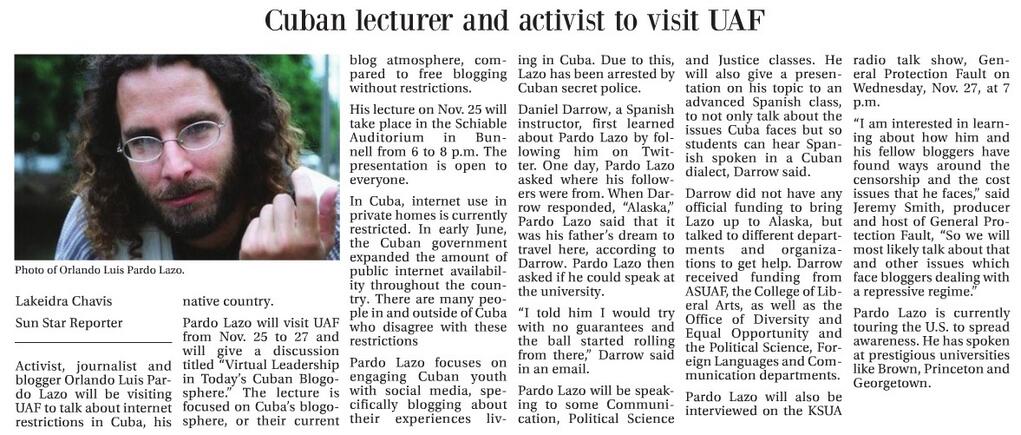
The Truth in the Gaze / Orlando Luis Pardo Lazo

Poster: Rolando Pulido
Luis Leonel León: The Black Eyes of Rosa María Payá
From El Nuevo Herald
The magazine “People en Español” chose her as one of the 25 most powerful Latin women. On a list that includes Jennifer López, Sofía Vergara, Kate del Castillo, Lupita Jones, Paulina Rubio, Doctor Polo and other celebrities across the entertainment industry, this young woman stands out. She doesn’t design jewelry, isn’t a business woman, doesn’t star in reality television, nor does she scream or cry in soap operas. On the contrary, she contains her immense tears that television would love to scoop up. Many have tried, from Bayly to María Elvira, but she keeps her black eyes still, shaking from within. They only cry in private. And that may be their greatest power.
Paradox of fate, her image became popular for a terrible event that marked her life and her gaze, perhaps forever: on July 22nd her father, Oswaldo Paya Sardinas, leader of the Christian Liberation Movement, and his colleague Harold Cepero, lost their lives on a lonely rural road.
The Cuban authorities say that it was a “traffic accident,” where these two Cubans died and the two foreigners that accompanied them were saved: Swedish politician Jens Aron Modig (who was asleep at the time of impact and then lived eight days of Kafkaesque prison in Havana) and the Spaniard Angel Carromero (who in Cuba was convicted of vehicular manslaughter and who in his own country demanded an international inquiry into what her considers a State crime).
The two foreigners were isolated and coerced by the State Security. There are witnesses who saw these four people enter the hospital alive, but the only “investigations” permitted are those of the same dictatorship that more than once threatened to kill Payá, whose version is validated by the Spanish government. Rosa María, like many others, we are convinced that it was a shadowy operation still pending, like so many other manufactured horrors, for the Castro government will never admit the answer.
For many, Payá was a prominent international figure of dissent on the island. Founder of the Varela Project, he is to date the only man who has gathered thousands of signatures from Cubans (with names and identity numbers) requesting an opposition to the dictatorship.
Never in 54 years, has anyone gone so far in a peaceful confrontation to totalitarianism, to the point that the island autocracy was forced to change its constitution, to contain the purpose of the signatures with not only manipulations and state terror, but also with chains legislated to force people to vote for the irony of a single party, damaging free elections, Payá and his followers still claim, risking everything, even death.
No wonder he won the European Parliament’s Andrei Sakharov Human Rights Prize in 2002 and was an official candidate for the Nobel Peace Prize several times. The official version crumbles before the darkness of the facts and background, as an answer blowing in the wind: it was eliminated because it would not agree with the false reforms that the Cuban government sells the world and its own citizens, cementing the power of new leaders with consumer checkbooks fattened on behalf of that hypocritical melodrama called socialism.
Despite daily violations of the most elementary freedoms, Cuba has once again joined the United Nations Human Rights Council.
Rosa Maria Payá has not stopped speaking before this or other international forums to denounce the reality, to ask for help to speed up democracy and to ask for a serious investigation that would show the true reason for the death of her father and her friend Harold.
Also under death threat by the agents of the regime, for some months she has lived in Florida with her mother. As a good daughter and tenacious disciple, she continues fighting for the holding of a plebiscite that would provide the basis for authentic democracy in Cuba.
Opposing the great hoax called “cosmetic change” which will make the leaders of the Communist Party (or whatever they come up with) legally richer, while making poorer those who asphyxiate every day and that luckily are losing their fear of protesting publicly in the streets. For many this is a chimera. For her it is a desire. Her faith. Another inheritance from her father.
Thanks to People the image of this 24-year-old Cuban (the youngest on the list) is repeated in news and signs, newspapers and social media along with other popular Latinas, powerful (even millionaires), talented and beautiful. Her message, unknown to millions, will be transmitted through other channels a lot more popular to keep attempting to break the blindfold that has covered the eyes of a people for more than half of century, and also the eyes of a good portion of the world.
Neither sad, nor happy, it is Rosa Maria who looks at us from this snapshot by Orlando Luis Pardo Lazo, taken in Lawton, Havana, a few months after her father’s death. The collapsing building where she appears, between reality and a metaphor: the wall of Cuba.
And her black eyes, deep and sincere, through which we can see the horror and the hope, the persistence and the tenderness, and that reward with another nuance, this kind of almanac of successful women. Vagaries of fate. From there, again overcoming again the invading eye of the press, she sustains her fixed look at the kidnapped island.
Translated by: Boston College Cuban American Student Association (CASA) and LYD
15 November 2013
The First Cuban Doctors Requested by Correa Will Arrive in Ecuador / HemosOido
The first Cuban doctors, of the 1,000 requested by the government of Rafael Correa, will arrive in Ecuado in December, according to a report from Cuba’s Foreign Ministry, reported by AFP.
The decision is supported in a series of agreements signed in Quito during a recent visit by the Cuban Health Minister, Roberto Morales, according to a brief statement published on the official site cubaminrex.cu.
“The new agreements cover the level of primary, epidemiological and physical medicine anticipated, starting this coming December, when the Cuban specialists who will start to arrive in the country will contribute to strengthening the capacity of Ecuador’s Ministry of Health in this area,” said the Foreign Minister.
The request for the doctors was made to Raul Castro by Correa during his visit to Havana on September 21.
The announcement raised concerns in the Ecuadorian medical associations, which was expressed publicly.
“The Cubans coming will cost 30 million dollars, when, for this price, we could hire Ecuadorian doctors and train them in comprehensive care and family medicine,” Alberto Navraez, president of the Ecuador Medical Federation told the local paper Expreso, in September.
In addition to the tens of thousands of doctors and health personnel that Havana maintains in Venezuela, this year 4,000 doctors will be sent to Brazil for the first time.
Although it continues to maintain free medical collaborations with some of the poor countries like Haiti, Raul Castro’s government has medical services in some 60 countries as one of his main sources of hard currency.
The professionals sent to serve the “missions,” receive a fraction of the money charged by Havana.
The export of services, mainly doctors, is the principal activity of the Cuban economy, with some 8 billion dollars annually, second to tourism, with 2.5 billion.
From Diario de Cuba, 20 November 2013
Shrinking of Farm Products / Rosa Maria Rodriguez
The farm products we consume today in Havana, whether those offered by the self-employed itinerants — carters — or those sold by the State at the farmers markets, have a characteristic in common: they are all shrinking. So I see at different points in the city where I go.
I wonder why, if even two years ago, residents in some areas of the capital had the alternative to buy in two kinds of farmers markets, now we are forced to only one option. For example, in Vibora we residents could buy fruit at the Monoco markets — more expensive — or the one on Sevillano, where there Youth Labor Army (EJT), conscripts serving their obligatory military service who work for the State for a salary, and whose products are cheaper and supposedly smaller and of lower quality.
A few years ago they closed Monoco plaza because they said there were collateral businesses and irregularities there. They delayed — as always happens in Cuba – around four or five years before re-opening it,with a visible reduction in the sale area and a distinctive feature that now all goods are as famished as praise of the EJT was in the past.
That is, the “fix things” to break them? There is no doubt that the people always suffer, because for more than fifty years, they’ve suffered a permanent blockade put in place by their own government.
19 November 2013
Crushing Cans / Luzbely Escobar
Collecting Cans / Luzbely Escobar


Estado de Sats Presents “Notebooks for the Transition” in the Midst of a Police Operation
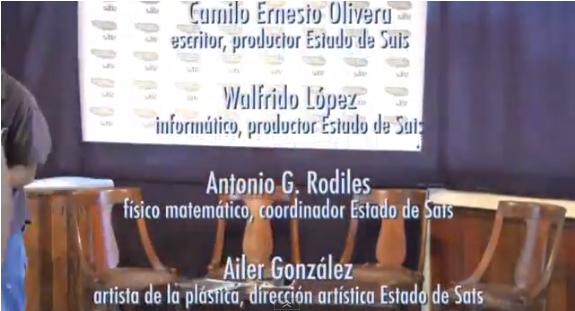
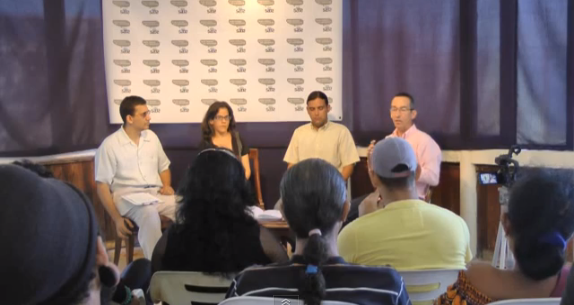 Saturday morning Estado de Sats presented the first issue of their magazine “Handbooks for the Transition” despite a political operation to prevent the audience from arriving; several activists were detained, Antonio Rodiles, director of the independent project, informed Diario de Cuba
According to Rodiles, Gabriel Barrenechea, a member of the magazine’s editorial board, and Andrés Pérez were besieged in their homes. Meanwhile, the artist Luis Trápaga was arrested on his way to the presentation, as was José Díaz Silva, who was beaten and held at least six hours.
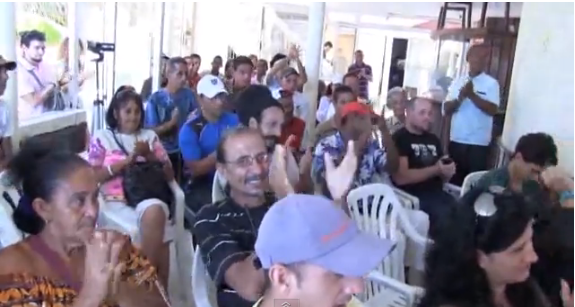 However, about 60 people managed to attend the event. Rodiles said that some participants were arrested by regime’s agents on leaving, to take copies of the magazine from them.
“Despite arrests, violations, pressures, we presented ‘Handbooks for the Transition.” SATS will continue because the desire for freedom us unstoppable,” insisted the director of the independent project.
The monthly magazine, in print and digital editions, “has as its objective to address different themes about the future transition to democracy on the Island, with authors from within and outside the country,” Rodiles told Diario de Cuba this week.
The first volume includes articles by Walfrido Lopez (The Internet in Cuba-US Relations), Emilio Morales (Remittances have become an engine of the Cuban economy), Juan Antonio Blanco (Civilizational and migration change), and Antonio Rodiles and Alexis Jardines (Notes for the transition), among others.
Future issues will address topics such as economic liberalization and legality.
“We must begin to discuss these issues openly. We need to debate them, without fear,” said Rodiles.
Diario de Cuba | 2 November 2013
Food Withdrawn from Political Prisoner Ramon Alejandro / Augusto Cesar San Martin
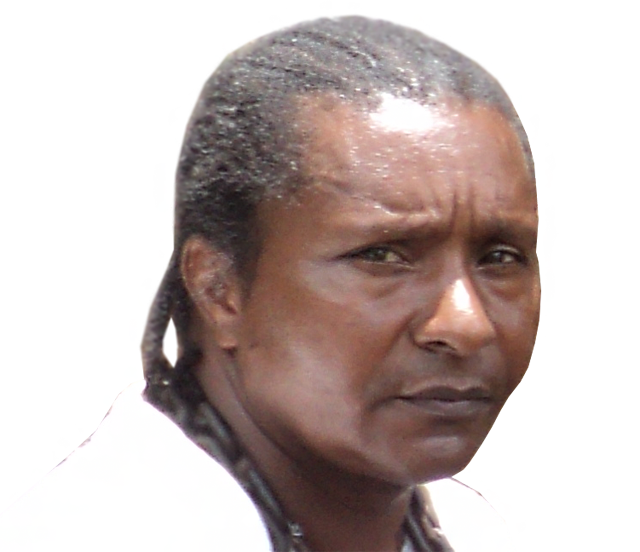
HAVANA, Cuba, November 18, 2013, Augusto César San Martín Albistur / www.cubanet.org.- Ramon Alejandro Muñoz González, husband of Sonia Garro remained without food for three days in the punishment cell of the Combinado del Este prison.
On the telephone call this morning, from prison, Ramon explained that he was confined to the punishment cell for 10 days.
“They took away the food… Forced me not to eat… The guards told me they had to wait for orders from above to give me food,” the political prisoner said.
According to him, he doesn’t accept the prison food. For three days he was deprived of the food his family brings: biscuits and powdered drinks.
Ramón Alejandro explained that when he was incommunicado in the punishment cell he was ill.
“I had a bad flu with a fever over 102. My blood pressure was 180/100 and I had a kidney infection. These papers (medical certificates) I have because, being in the cell, they had to take me to the hospital emergency room,” he said.
The husband of Sonia Garro, also a political prisoner, blames the political prisoner and the prison authorities for the deterioration of his health and the future consequences.
“I am mainly accusing the political police, and the Combinado del Este Prison authorities, led by Rogelio Osorio, Major Miguel, chief of building number 3, captain Emilio, deputy chief of the unit, and René, chief of re-education, and the chief of Internal Order, known as ’Captain Boxing’.”
Ramón Alejandro announced that he intends to send letters of complaint to the United Nations, the vice president of the U.S., the European Union embassies in Havana, so that they will know the risks run by the political prisoners run.
The measurement of confinement in the punishment cell was taken after he read, in the visiting area, in front of other prisoners, an anti-government communication.
Ramon Alejandro Muñoz González was arrested along with his wife the, Lady in White Sonia Garro. Both have been awaiting trial for a year and 8 months, accused, among other crimes, of public disorder and attempted murder.
Ramón Alejandro was demonstrating, from the roof of his house, with proclamations addressed to the government. An assault brigade violently carried out the capture of both. Sonia Garro was hit by rubber bullets and still suffers the effects in prison.
A few days ago, it was announced that there would be a trail, but then suddenly it was cancelled.
Augusto Cesar San Martin
Cubanet, 18 November 2013
Initiating Improvements in the Ministry of Foreign Affairs / Victor Ariel Gonzalez, CID
 On October 30th the newspaper Granma published,
Beginning improvements in the Ministry of Foreign Affairs: The approved proposals were aimed at shaping a modern revolutionary Foreign Ministry to ensure more efficient performance of the organization and the concentration of the resources and efforts in the priorities of Cuban foreign policy.”
Commentary:
Under the slogan of “Combating the blockade as our principal mission” in the diplomatic sphere, lies perhaps in the modification of the existing legal mechanisms, which allow Cubans (especially the most powerful Cubans, who are those of the Government of Havana) to interact with foreigners (governments or companies) interested in the new direction that Cuban political economy seems to be taking.
Should this be the case, then the Ministry of Foreign Affairs (MINREX) would be undergoing a transformation similar to that of other State agencies and entities: to accommodate the game at the convenience of the ruling class, who want to economically restructure the country while still having absolute power over it.
All this can also be related to the winks that come from the leadership of the country to the prosperous Cuban community in the US. They have made declarations (onthe part of Antonio Castro, son of Fidel Castro and the true “owner” of the Cuban baseball team) that it would be good if the Cuban ballplayers in the U.S. major leagues returned to play under their flag: which was denied to them the day they “deserted” and were called “traitors.”
Certainly, with the changes within the country there will also come changes toward the exterior. MINREX will not be the exception.
Víctor Ariel González
14 November 2013
Cuba Tweetup for #FreeSonia and Freedom of Cuba / Luis Felipe Rojas

Poster, courtey Rolando Pulido
Tweet a tweet this Monday on the social networks, Facebook, Twitter and the others for solidarity with #FreeSonia, #FreeElCritico and all the other Cuban political prisoners.
17 November 2013
A Hospital Under Repair / Rebeca Monzo

In “my planet” when a hospital goes under repair, it stops being a health center and it becomes a construction zone. It has been approximately three years that the Hospital Docente Gral. Calixto Garcia has been under repair. Some of the hospital’s pavilions have already been restored, but the work has been very slow and there are also many uncontrollable diversions of resources. So much so that when they finish the last pavilion, they should start all over again with the first pavilions.
I have a friend who after negotiating and waiting, was finally admitted to the hospital. He told me that when he arrived at his room with his assigned bed number, they told him that the bed was already occupied. Fortunately, the doctor that had attended him was still with him and explained that was not possible, that the bed had been reserved in advance. They then apologized and the health workers themselves explained that the men with the stretchers were too tired to take the other patient to another floor so they decided to put the patient in that bed.
Last night, visiting my friend, he told me that he found out that when the hospital director was inspecting the floor above hours before the ceremony, there were very surprised when they checked the bathrooms to realize that the plumbing had disappeared.
During the investigations, they confirmed that their own employees, who had participated in the remodeling, had stolen the plumbing. They stole the water faucets, the flushing systems, as well as other pieces of plumbing which they tied to a rope and dropped down through the back windows of the building, where an accomplice picked them up and took them away.
However, this was not the only incident that had occurred in his first day of hospitalization. He told me that after settling in his bed, the nurses passed by to ask those who accompanies him and some patients who were in a condition to do so to come out to the entrance because the new director was going to visit and they needed to clean the room. After, my friend, looking into this with one of the employees, was told that “cleanings” were only done on very special occasions like that day, because they were paid a pittance and they didn’t even have adequate tools to clean, so “they didn’t stress about” hygiene.
Translated by Lourdes Talavera, Boston College Cuban American Student Association (CASA)
18 November 2013
The Longest Roadway / Fernando Damaso
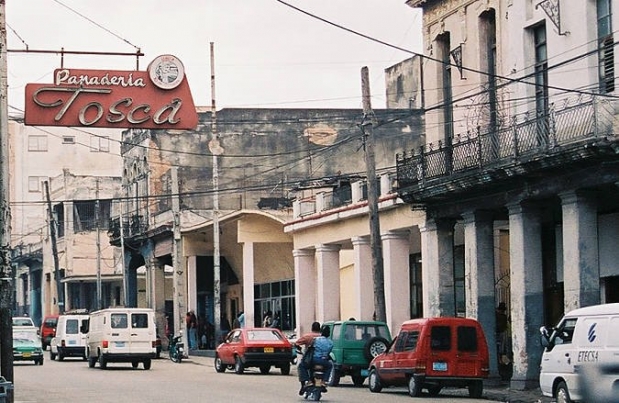
The Calzada de Jesús del Monte (Jesus of the Mountain Roadway), now known as the Calzada de Diez de Octubre (Tenth of October Roadway), begins at Esquina de Tejas (Texas Corner) as an extension of Calzada de Infanta (Princess Roadway). It extends to Entroque de La Palma (La Palma Link), where it splits into Calzada de Managua and Calzada de Bejucal, crossing, connecting or bordering in its path the neighborhoods or districts of Cerro, Santos Suárez, La Víbora, Luyanó, Lawton, Sevillano, Santa Amalia, Apolo, Víbora Park and Barrio Azul.
Immortalized by the poet Eliseo Diego, it is still one of the most extensive roadways in the city. In the 1950s numerous bus routes ran along it and it saw a great deal of vehicular traffic, though by then the streetcars were already gone as were their tracks and overhead electrical lines.
It was adorned with movie theaters, stores of all kind, bakeries, pastry shops, bookstores, pubs, restaurants, coffee houses, pharmacies, jewelry stores, a major hospital (Purísima Concepción, more commonly known as Quinta de Dependientes), police stations and the constant hustle and bustle through its doorways and over its sidewalks of students from numerous schools located nearby, who visited its bookstores in search of school supplies and classical textbooks published by Editorial Thor, which were offered for sale at low prices.
The cinemas Florida, Moderno (side-by-side with Police Station no. 11), Apolo, Tosca, Gran Cinema and Marta (which faced Station no. 14) satisfied the needs of several generations of movie-goers.
The Toyo bakery and pastry shop, as well as a pub with the same name — located on the lower floors of the Civil Registry building — became synonymous with one of the busiest and noisiest street corners in Havana. It served as the crossroad for those buses that changed course, heading in the direction of Calzada de Luyanó, and those that continued, one way or another, along Calzada de Jesús del Monte.
The ever-present aroma of freshly baked bread left its distinctive imprint on the site, as did the desserts and pastries from from shop next door and the magnificent sandwiches from the pub. At the entryway there was a newsstand. Hidden behind the authorized newspapers and magazines, as though they were winking, one could see portions of the covers of small notebooks and erotic or pornographic photos, which were printed on low-quality paper by unidentified publishers. This is also where the shoeshine stand was located.
Several blocks away, near calle Tamarindo (Tamarind Street), the characteristic aroma from the coffee roaster permeated the surrounding area, reaching as far away as the pharmacy, as well as the small shoe store and its workshop across the street, beyond calle Municipal (Municipal Street).
Further along, from left to right, there was a series of stores until you got to Loma de la Luz, which everyone associated with the roadway of the same name. After that there was the parish church Jesús del Monte (Jesus of the Mountain) and the high, thick wall that still obscures it, leading to the multiple commerce established in the space between the Loma de Chaple (Hillock of Chaple), at the end of the Lacret Street and beginning of the Avenida de Dolores (Avenue of Pains). Hundreds of meters away, the Avenue de Santa Catalian has taverns, coffee shops and a bakery. In between other types of bread served at the bakery, they offer a Galician bread known as “bonete”, as well as cookies, breadsticks, pork crackling and pastries of cheese, ham, or meat.
On the opposite side of the street was the Tosca movie theater, where we children over twelve years old would go, motivated by the French and Italian movies, which showed light nudity, something unusual in the United States at the time.
Then appeared the residences of the middle-class, more rich and progressive, that had large portals with columns and were always uphill. The “Paradero de La Vibora”was where the tramcars ended their travels and entered the maintenance area in order to start their routes again.
Then, with the disappearance of tramcars,the maintenance area became the modern bus stop, which were called “nurses” due to their white and blue color. This place was suitable for trade since it was the beginning of Route 38 that led to Batabano. Batabano and had a conglomerate of restaurants, inns, cafes, french fry stands and shops. It also had a beautiful house with the figure of a “black boy with the lantern”, dressed with blue pants and a red shirt, in the large front garden. Opposite the house was the Tropicream, the house of one of the first settlers in the city, and the square of the Church of the Passionists.
Next to this this was the street that led to the Institutes of the La Vibora and Edison.
Beyond this there was a train station, which was home to the legendary Cafe Colon and across the street was the Cheesemonger Santa Beatriz, a modern milk pasteurization plant. Then there were scattered homes, some with patios, fruit trees and gardens, which marked the end of the cramped city with the houses up against each other and the beginning of the country environment, which extended to the “La Palma” Crossroads, which had a famous ice factory, and continued to Bejucal and Managua Roadways. At that time, after the Avenida de Acosta, the paved road was narrow with large flowerbeds and trees on both sides.
Today, unfortunately, all the cinemas have disappeared with the exception of the “Marta”, renamed Joy and turned into a party room, as have the bread shops, bakeries, restaurants, taverns, inns, bookstores, shops, stands, shoeshine chairs, and many other shops. They converted these premises into housing, with horrendous architectural adaptations or low cost. They also transformed the former “Calzada de Jesus del Monte” into a sad Museum of buildings in decline, totally damaged or collapsed by cave-ins.
One could offer many reasons to try to explain the inexplicable, even dip into the broken argument of the U.S. “blockade” or embargo, but the only real cause of what happened is the incompetence of the authorities and the tax system, both with regards to protecting what was created by previous generations of Cubans, and creating something new and valuable.
The street “Calzada de Jesus del Monte” or “Tenth of October”, as it is called, has had the same terrible fate of other roads, avenues, and streets of the city of Havana.
But in recent months, with the increase in self-employment, some of its sections are home to small private businesses. They even used local buildings, which were previously establishments that became precarious dwellings. Even still, the vast majority of major facilities are in the hands of the unproductive State-owned enterprises, with demonstrated inability to offer quality services to the citizens.
Perhaps these facilities, if they are privately rented or sold, will serve as a real spur for the rapid revival of the once important road, which will never be achieved with the stunted measures adopted so far. For instance, the government only authorised to revive these facilities with a few services where there are fewer than five employees. This means, ultimately, they continue betting on the “bonsai” or “pinching” commercial activity, which actually solves very little.
Anyway, the “Calzada de Jesus del Monte”, due to its importance as a means of communication towards the southeast of the city, should truly liberate the productive forces and the Cuban people can develop their initiative, returning to be what it was was, and then become modernized and in keeping with the time.
Fernando Damaso | Havana
Diario de Cuba | 10 November 2013
Translated by: Carolina Rojas, Boston College, Cuban American Student Association (C.A.S.A.)
Occasional photos… / Silvia Corbelle

Occasional photos… / Silvia Corbelle
