David González has turned his home into “a cultural refuge for many young people in Havana who may not have anywhere else to go.”
 14ymedio, Havana, August 16, 2026 – In a city where power outages have lasted more than 20 hours a day for months, a space has emerged where people can enjoy concerts, film screenings, exhibitions, parties and other cultural initiatives even when the national electricity system (SEN) is in total collapse. Admission costs just 300 pesos (about 50 cents at the current exchange rate) because, according to its founder, David González, who spoke to 14ymedio, the intention is not to turn it into a lucrative business, but to create a self-sustaining refuge amid the severe crisis facing the Island.
El Proyecto is the name of this space for cultural gatherings and respite from political persecution. It operates in González’s own home, a colonial mansion belonging to his family that has now been converted into an independent cultural center. The venue, located at the corner of 11th and 14th Streets in Havana’s El Vedado neighborhood, has gained popularity, especially among young people, as a meeting place for culture, partying, freedom and resistance.
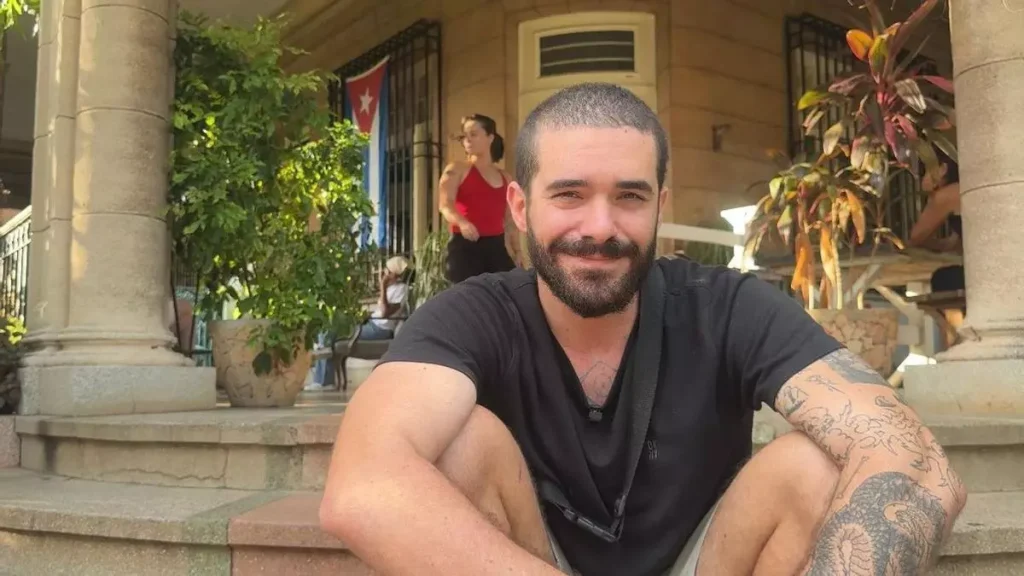
The young David González, founder of El Proyecto, on the stairs of his home, which has been converted into a cultural center.
“There is no dictatorship here, there is no SEN here, there are no problems with electricity or water here, and everyone is welcome,” said the 29-year-old González in a conversation with this newspaper, sitting naturally on the stairs in front of the doors to the cultural space. With signs on its walls such as “How much longer?” and “The feeling of collapse,” and decorative details such as a fan paying tribute to the young people imprisoned from the independent platform El4tico, El Proyecto has also become a space for freedom of expression and inspiration for “a change toward a better future” in Cuba.

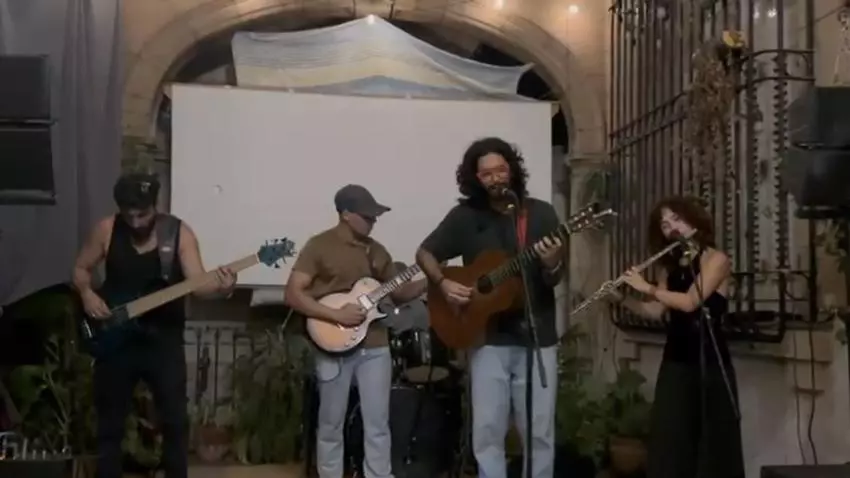
“El Proyecto emerged out of a need, as a kind of alternative to the chaos we are living through,” González says. The young man, a graduate in Social Communication and a former Chevening scholar in the British program, explains that the initiative began with film screenings and then expanded to parties and alternative music concerts in different genres, such as jazz, folk and rock. At first, the activities were free, but the growing audience led them to begin charging admission in order to sustain them. To keep the center operating during prolonged power outages, it has batteries and EcoFlow power stations.

In addition to concerts, which mainly feature young artists, El Proyecto has also organized visual arts exhibitions, such as the one held last July 10 in tribute to 11J, “an extremely important anniversary for us as young Cubans,” González told 14ymedio, referring to the massive citizen protests of July 11, 2021, which ended in severe repression and more than a thousand protesters being imprisoned.
For González, the 11J exhibition was “our declaration of intentions in a peaceful way” and, he added, it sought “to encourage reflection on what we are doing as Cubans in present-day Cuba.” “It was a tribute to everyone who is imprisoned, to everyone who shouted for their survival, for their freedom, and who also shouted for us, representing us as young people, as the people of Cuba.”
González spoke about how El Proyecto positions itself as an act of resistance against the discouragement that can be caused by “all the things you see around you: the garbage that is in front of you, the electricity going out, the lack of water, rising prices, insecurity in the streets….” For the young man, it is about “reconverting the chaos,” using it as a catalyst rather than an obstacle and “understanding what our role is in the midst of that chaos.”
“I feel a responsibility as a young Cuban with regard to the future of Cuba,” González says about El Proyecto’s intentions. “I don’t believe that we have the solution here to all the structural problems that we have been suffering from for some time because of our current political system, but I do believe that, in some way, we are implementing changes.”
“I believe that the sum, the progression of small gestures like the ones we are bringing to fruition is precisely what can lead us to achieve that great change that we are all dreaming of,” González continues.
“There is a very harmful obsession in the social fabric that only one group of people is going to implement the great change we need, and I think it has to be viewed differently: in a more horizontal, more humble way, where we create from our own corner, from the humility of these resources.”
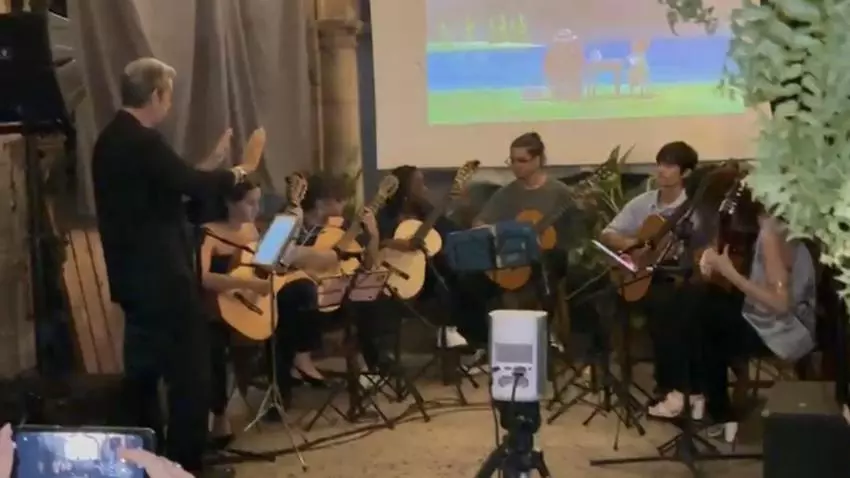
Creating a refuge where young people feel free to express themselves artistically, without obstacles caused by a lack of resources or government censorship, is, for González, an act of “resistance” in the face of the alarming situation affecting the Island. “And I think that, in some way, we have achieved it, which makes me extremely proud,” González says, “Having turned my home into a cultural refuge for many young people in the city of Havana who perhaps have nowhere else to go.”
“I believe that precisely in that creation lies our greatest achievement, in managing to ensure that people, without turning their backs on Cuba, without turning their backs on their reality, can rethink things and can also find hope in connecting with other human beings,” he adds.
El Proyecto seeks to be accessible to all types of audiences “with the intention that everyone can be welcome, regardless of their financial means, ideology, or way of thinking.” David González insists that the space is not intended to become a lucrative business: “it is not set up with the intention of taking money from people; it is set up with the intention that you can feel that it is an affordable space, that you can come with 500 pesos, 1,000 pesos and have a wonderful time.”

“And this is our way of supporting that change, this is our way of saying that we are here, that we dream of a better Cuba, that we dream of a future,” the young communicator confesses.
El Proyecto also plans to soon host stage performances, such as dance and theater, thereby expanding its programming to other artistic expressions. Sitting on the stairs while greeting neighborhood residents, González says he would like to achieve having “people see us as a beacon, as a light shining in the middle of darkness,” although he is not referring literally to electricity, “but rather from the point of view of the message.”
“For me, the important thing is that people associate us with resistance, and with the fact that although everything may be turned off in the city, we are going to continue being here, even if the SEN collapses three times in a row.”
Translated by Regina Anavy
______________________
COLLABORATE WITH OUR WORK: The 14ymedio team is committed to practicing serious journalism that reflects Cuba’s reality in all its depth. Thank you for joining us on this long journey. We invite you to continue supporting us by becoming a member of 14ymedio now. Together we can continue transforming journalism in Cuba.