Customers complain about “paying for a service they cannot use” because of the blackouts and because the monopoly has not modernized its infrastructure.
 14ymedio, Havana, September 25, 2026 – On July 15, 2025, Prime Minister Manuel Marrero reported before the National Assembly that the new measures generated by Etecsa — Cuba’s State Telecommunications Company — had generated $24,839,000 in just 46 days, about $540,000 a day, compared with approximately $10,000 it had previously taken in. The head of government said at the time that those resources would be allocated to infrastructure recovery, new investments, and the expansion and development of services using new technologies.
Fourteen months later, Etecsa acknowledges that it cannot guarantee the stability of a large portion of those services and that it has had to reorganize its investments in an attempt to keep the infrastructure it already has operating. The explanation, published Thursday by Cubadebate, triggered a cascade of comments from customers who returned to a question Etecsa did not answer: what is happening to the money of those who pay for a service they cannot use?
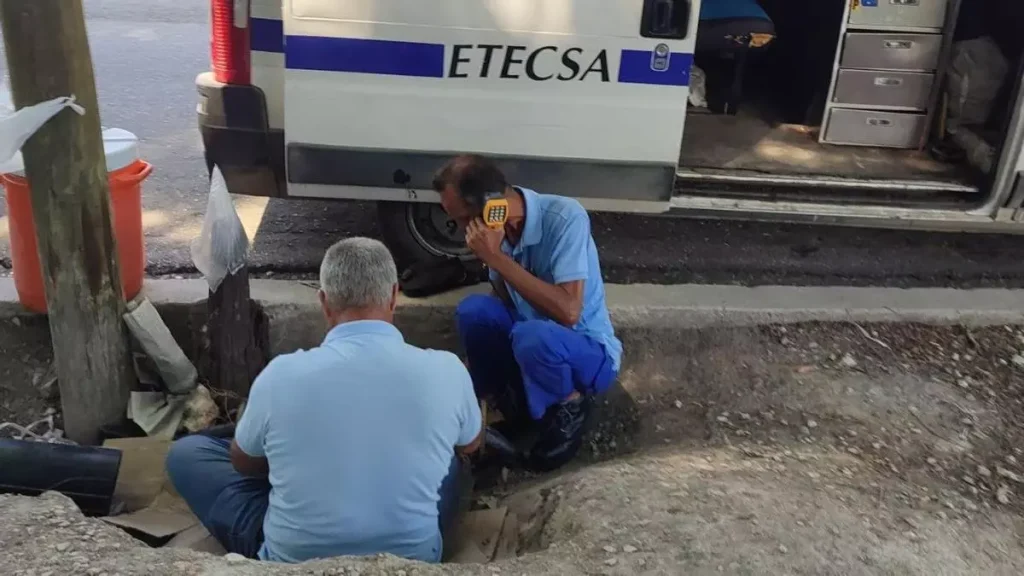
The state monopoly acknowledged that during the latest nationwide blackout, more than 80% of radio base station sites and nearly 70% of the cabinets – telecommunications equipment installed at various points throughout the network – were out of operation. Internet traffic plunged by as much as 58%. In addition, Etecsa has accumulated around 77,000 reports of interrupted fixed-line services, which it attributes both to the shortage of resources and to the high cost of maintaining technology that the company itself describes as obsolete.
Although the infrastructure that makes it possible to use data plans remains out of service, the package clock keeps running
“We are paying for a service we cannot use. Money the customer loses,” summarized Omar Peña Ávila among the comments published by Cubadebate. The user recognizes the severity of the crisis facing the country, but points out that both fixed-line and mobile telephone services remain affected while subscribers must continue paying to keep their lines. “It isn’t reasonable,” he protests.
Leonardo Ruz Revilla raises the same problem with data packages. The customer says that the previous month he stopped using more than one gigabyte because of the lack of access to the network and that, despite this, the package expired when it reached its expiration date. “I am paying for a service I am not fully receiving,” he wrote, before asking that megabytes not used because of interruptions be allowed to accumulate.
The additional data plans established by Etecsa are valid for 35 days. The contradiction is particularly evident during prolonged blackouts, because although the infrastructure that makes it possible to use them remains out of service, the package clock keeps running.
The company, however, does provide adjustments when other services are interrupted. Last February, Etecsa’s Consumer Protection Department acknowledged the case of a customer who had been without fixed-line telephone service and Nauta Hogar since November 2024. After verifying that she had generated no traffic for six months, the company credited her 1,800 pesos for the internet service she had not received.
In addition, the Nauta Hogar postpaid option introduced in December 2025 allows up to 1,080 unused hours to accumulate and provides for adjustments to the bill when service interruptions occur. Etecsa therefore has compensation mechanisms for some products, while users of mobile packages are demanding that a similar principle be applied when blackouts prevent them from connecting.
The complaints published by Cubadebate also show that the problem predates the latest electrical collapse. A resident of Marianao says she has been without a fixed-line telephone for nearly a year, despite having to continue paying and keeping Nauta Hogar active. Another customer responds that he has also gone more than three years without fixed-line telephone service and must continue paying for the service so as not to lose the line.
The company maintains that it is not viable to continue expanding the access network – radio base stations, cabinets, and Wi-Fi zones – without first guaranteeing electrical backup for that infrastructure
Even more serious is the testimony of a reader from Entronque de Herradura, in Consolación del Sur, Pinar del Río. According to his account, following a traffic accident two weeks earlier in which a driver was in critical condition, there were no communications available to request an ambulance. A neighbor had to drive to the municipal center to request one in person. The commenter wondered what would happen in similar circumstances in the event of a heart attack or a fire.
In response to the deterioration, Etecsa has decided to change its priorities. The company maintains that it is not viable to continue expanding the access network – radio base stations, cabinets, and Wi-Fi zones – without first guaranteeing electrical backup for that infrastructure. So far, it has equipped the main centers in 64 municipal capitals with photovoltaic systems, although it admits that the installed capacity does not always allow services to be maintained around the clock. Some generators have had to operate for more than 20 consecutive hours.
Etecsa also says that the recovery of its revenues since the second half of 2025 has allowed it to pay part of its overdue debts and international services, install more than 140 radio base stations, expand frequencies to enable 4G in more than a hundred locations, and acquire licenses to increase the capacity of another 300.
Customers, however, remember the promise made when the new rates were imposed. From San José de las Lajas, one reader says that during the day mobile data speeds do not reach 500 kbps and asks what portion of those millions reached his municipality.
One final comment recalls that the increase in revenue was presented precisely as the means to purchase radio base stations, batteries, and other parts. After now reading that some of the money was used to pay accumulated debts and that the network still cannot be expanded, he leaves Etecsa with a simple warning: “Do the math, because the people are doing their own.”
Translated by Regina Anavy
*See also articles reporting on the “tarifazo” — huge price increases for telecommunications services.
______________________
COLLABORATE WITH OUR WORK: The 14ymedio team is committed to practicing serious journalism that reflects Cuba’s reality in all its depth. Thank you for joining us on this long journey. We invite you to continue supporting us by becoming a member of 14ymedio now. Together we can continue transforming journalism in Cuba.