The intelligence operations would have been of special value to the US because of the close relationship between Canada and Cuba
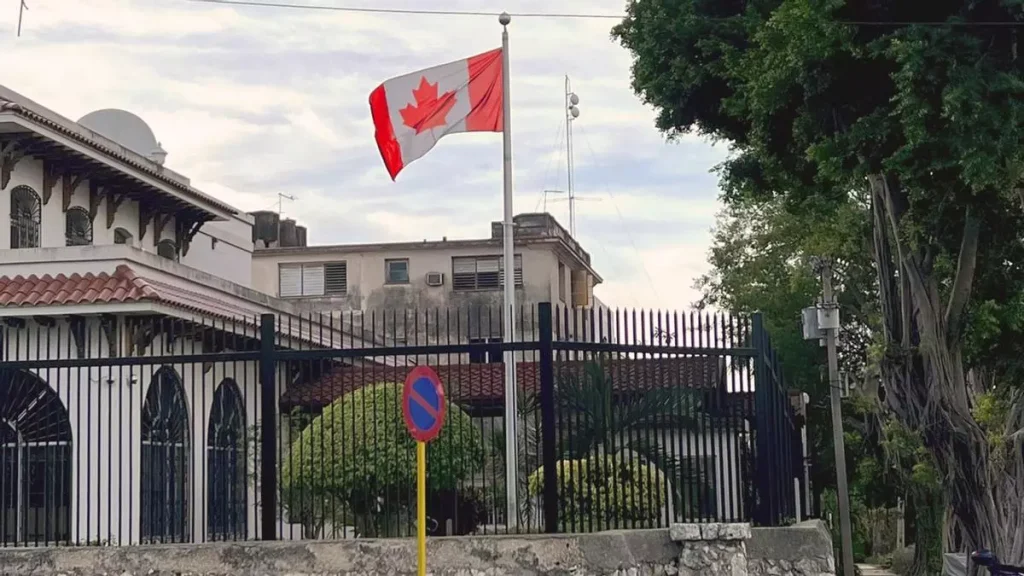
 14ymedio, Madrid, September 26, 2026 – When the mysterious symptoms of the so-called “Havana syndrome” began to appear among US and Canadian diplomats in Cuba, between 2016 and 2018, officials from both countries were collaborating on intelligence operations, the Canadian outlet The Globe and Mail revealed this Saturday.
A Canadian diplomat was sharing information with US agents, and Canada was using satellite equipment smuggled onto the island by the US, according to two sources close to the operations, who are not identified by The Globe since they could face serious charges for revealing government secrets.
One of the sources said that a diplomat assigned to the Global Security Reporting Program (GSRP) at the Canadian embassy in Havana gathered information for Canada and its allies. The data were sent to the security and intelligence division of Canada’s Ministry of Foreign Affairs, to the Canadian Security Intelligence Service (CSIS) and to Canada’s partners in the Five Eyes alliance: the United States, the United Kingdom, Australia and New Zealand.
“At times they could be asked to send the information directly” to a CIA agent at the US embassy, the source told The Globe.
“At times they could be asked to send the information directly” to a CIA agent at the US embassy
The information gathering would have been of special value to the US because of the close relationship between Canada and Cuba. Canadian diplomats had better access to Cuban officials and could travel outside Havana, while the US mission was then headed by a chargé d’affaires rather than an ambassador.
The second source revealed that the US sent satellite equipment to the Canadian embassy in Cuba in diplomatic containers by sea at the end of 2016. As these were diplomatic pouches, the Cuban authorities could not open the containers under the Vienna Convention on Diplomatic Relations.
According to this source, the equipment was installed on the roof of the Canadian embassy and in the homes of some of that country’s diplomats. The antennas, the source explained, “could be used for anything: you could use them to access the internet, you could use them for whatever you wanted.”
A former senior official of the Ministry of Foreign Affairs said there was a conviction within the department that Russia was behind the sonic attacks
This situation began precisely during the so-called “thaw,” after US President Barack Obama began in 2015 to restore diplomatic relations with Cuba, broken off since 1961. In early 2017, Canadian and US diplomats in Havana began to present a set of unexplained symptoms – nosebleeds, nausea, migraines, blurred vision and memory loss. The exact causes of these ailments have not been determined to this day, despite multiple investigative efforts in different countries – mostly in the US – and have been a source of controversy for years.
A former senior official of Canada’s Ministry of Foreign Affairs cited by The Globe said there was a conviction within the department that Russia was behind the sonic attacks, although Ottawa could not say so publicly because it lacked evidence. According to this source, some Canadian officials believed that Russia sought to obstruct the rapprochement between the US and Cuba, in which Canada had played a role. The targets, according to this interpretation, would have been Americans and Canadians linked to intelligence-gathering activities.
The hypothesis coincides with investigations in the US that have pointed to a Russian military intelligence unit as possibly responsible for some of the so-called “anomalous health incidents.” But this explanation has not been unanimously accepted.
The GSRP, for which the Canadian diplomat in Havana worked between 2016 and 2018, is a specialized unit of the Ministry of Foreign Affairs officially tasked with obtaining open-source information on political and security matters. The Ministry denied to The Globe that the diplomats in Cuba shared information with US spies.
The department also denied that the GSRP is an intelligence-gathering program. According to the official version, the officials in that program are accredited diplomats who carry out their activities openly and legally and comply with the Vienna Convention.
However, a Canadian parliamentary investigation cited by The Globe had pointed to problems with the program’s oversight. A 2023 report by the body responsible for reviewing Canada’s security and intelligence activities described the GSRP as sitting in a “clearly gray zone.” The report noted that some of its officials had maintained contacts with foreign intelligence agencies and appeared to have obtained classified information from certain sources.
The revelations by ‘The Globe’ coincide with a legal battle between the Canadian Government and diplomats who were working in Havana when the symptoms began
The revelations by The Globe coincide with a legal battle between the Canadian Government and diplomats who were working in Havana when the symptoms began, which has been kept secret since last year, when new information was submitted in the proceedings.
This Friday, Canada’s Department of Justice confirmed to The Globe that the Government invoked a rule restricting the disclosure of information whose publication could harm national security, national defense or international relations. The Government has not explained what information it seeks to keep secret because the case is still before the courts.
The lawsuit was initially filed in 2019 by ten diplomats and their family members. The plaintiffs accused the Canadian Government of failing to provide them with sufficiently advanced medical care, withholding relevant information from them and minimizing the severity of the brain injuries they attributed to the attacks.
In a statement released on Friday, Canada’s Ministry of Foreign Affairs insisted that there is no “definitive common cause” for the illnesses that affected officials posted at its embassy in Havana and declined to comment further on the litigation because it is before the courts.
In a report published in February 2024, the Ministry of Foreign Affairs concluded that its officials’ unexplained ailments were not the result of a malicious act by a foreign power. For its part, the Royal Canadian Mounted Police investigated the cases after Canadian officials began reporting symptoms in 2017. Six years later, the police force published a heavily redacted report that did not reach definitive conclusions.
Translated by GH
______________________
COLLABORATE WITH OUR WORK: The 14ymedio team is committed to practicing serious journalism that reflects Cuba’s reality in all its depth. Thank you for joining us on this long journey. We invite you to continue supporting us by becoming a member of 14ymedio now. Together we can continue transforming journalism in Cuba.