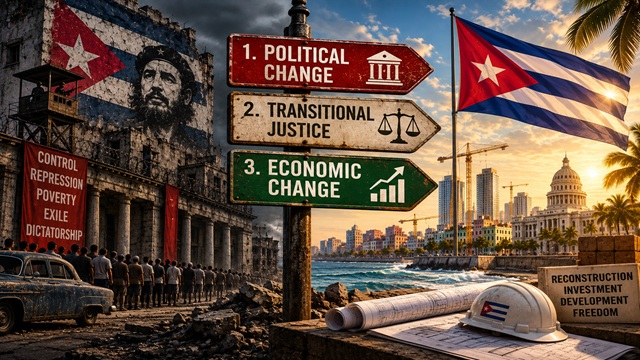
The CubanAmerican Voice, Julio M. Shiling , September 25, 2026 / For more than six decades the Castro-Communist dictatorship has survived by weaponizing scarcity, fear, and the patient calculation that democratic nations eventually tire of principle. That calculation is now under pressure. American foreign policy continues to treat the removal of this regime as a matter of national security for the United States, for the West, and for Latin America itself.
Recent evidence is plain: President Trump’s direct indictment at the United Nations of Havana’s role in fostering communist subversion; the Army Reserve’s quiet examination of whether it can supply Southern Command with police, medical, and support units on short notice; and the State Department’s continuous round of sanctions targeting Cuba’s elites, financial channels, and resource-extraction apparatus. These are not gestures. They are the concrete instruments of a long-held strategic judgment.
Cuban exiles have answered in kind. In Miami—the second-largest Cuban city after Havana—an impressive coalition of Cuban-American business leaders has convened to announce the creation of the Cuban-American National Chamber of Commerce and to declare readiness to underwrite the island’s post-communist reconstruction. Their message is clear and welcome: the exiled nation is prepared to foot the bill for a free Cuba. Washington notices. Regime change suddenly looks more fiscally attractive.
Yet attraction is not the same as wisdom. The central truth that both the American government and the Cuban-American community must keep in mind is this: in Cuba, political change must come before economic change. Under a totalitarian system, the two cannot safely proceed in tandem during the opening phase of transition. A market order does not create democracy; it operates under the political order that already exists. China, Vietnam, and post-Soviet Russia stand as enduring reminders. Capital can flow, private enterprise can flourish, and the same dictatorial structures—or their recycled successors—can remain firmly in control.
Castroism is not merely a set of inefficient policies. It is an institutional, epistemic, and hegemonic system that has colonized every formal and informal structure of Cuban life. Courts, universities, security organs, media, labor organizations, and even the language of daily discourse have been shaped to preserve the regime’s monopoly. Opening investment coffers while those structures remain intact would not liberate Cubans; it would subsidize the very apparatus that has kept them captive. The result would not be a democratic market economy but a hybrid despotism—capitalism without liberty, enrichment without accountability, and a new generation of nomenklatura wearing different suits.
What is required first is a deliberate period of transitional justice. This is essential. It is the systematic uprooting of the toxicity that totalitarianism leaves behind: the purging of compromised institutions, the recovery of historical truth, the dismantling of networks of privilege and surveillance, and the establishment of the rule of law as something more than a slogan. Only after that cleansing can genuine economic reconstruction begin without the risk of communism returning in recycled form. Emergency humanitarian aid and basic measures to alleviate suffering must arrive immediately. But the larger capital flows—the reconstruction that Cuban-American wealth, as well as foreign investors, is prepared to finance—should cautiously wait until the political foundations have been secured.
The belief that capitalism by itself will automatically produce democracy is a comforting illusion that history has repeatedly refuted. Markets are instruments. They amplify the purposes of the political order that directs them. When that order remains totalitarian or even a soft authoritarian variant, markets become tools of elite enrichment and regime longevity rather than engines of popular freedom. The Soviet collapse itself demonstrated the cost of premature economic liberalization without parallel political and institutional purification: the emergence of oligarchic and dictatorial successors that still menace the region.
Cuban exiles have preserved, across generations of departure, the best of the nation’s history, culture, and democratic aspirations. That inheritance now places upon them a dual responsibility: to support the material reconstruction of the homeland and, more urgently, to insist that reconstruction not become the mechanism by which Castroism survives under another name. The American government, for its part, must resist the temptation to treat capital as a substitute for the harder work of supporting genuine political rupture and transitional justice.
The sequence is non-negotiable. Political change first. Institutional cleansing next. Only then the full force of Cuban-American capital and Western engagement. Reverse that order, and Cuba risks exchanging one form of captivity for another—more prosperous for a few, still unfree for the many, and still a strategic liability for the hemisphere. The opportunity before us is historic. Squandering it by confusing investment with liberation would be a tragedy of our making.
© The CubanAmerican Voice. All rights reserved.