The Ministry of Foreign Affairs and Foreign Trade assures that since last July, it started reaching out to the Island and hasn’t received a response
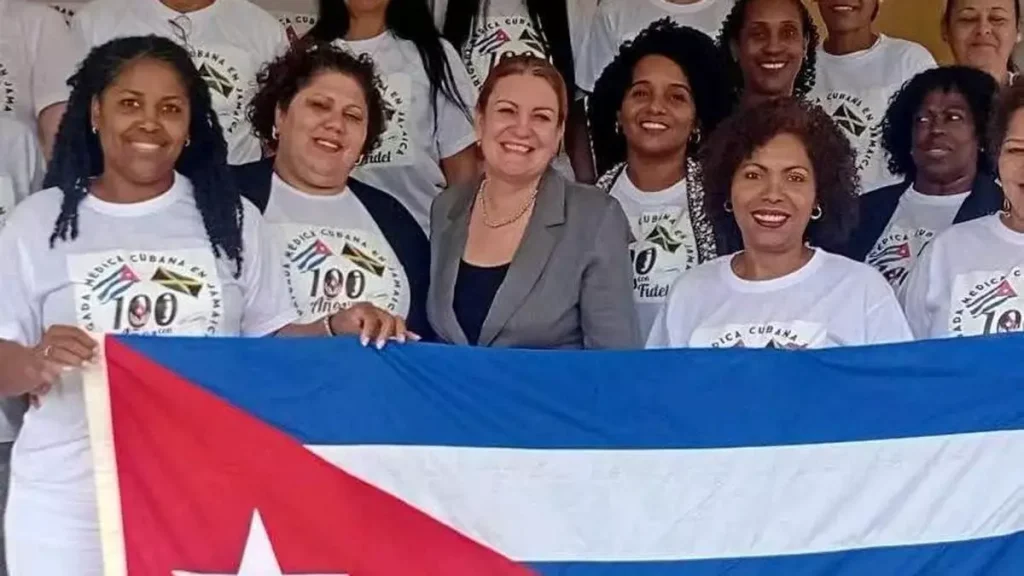
 14ymedio, Havana, March 9, 2026 – While the Cuban government accused Jamaica of caving in to pressure from the United States to pull the medical mission, the Caribbean island’s side of the story is different. The regime didn’t even respond to Kingston’s proposal, which suggested keeping the deal if they made direct payments to the specialists and let them hold onto their passports—conditions that they did accept in other countries.
According to a statement from the Ministry of Foreign Affairs and Foreign Trade, the Jamaican government “is disappointed” with Havana, which chose to withdraw 277 specialists rather than accept the terms laid out.
“We value the contribution of the medical personnel, respect the Cuban people, and maintain our commitment to cooperation. However, no program operating in Jamaica can continue under conditions that contradict Jamaican legislation and international conventions,” emphasized the Ministry of Foreign Affairs and Foreign Trade.
In the document, the authorities say they realized “that other Caribbean countries had arrangements under which direct payments were made to the Cuban medical personnel. This makes it even clearer that a lawful and transparent alternative was possible.”
Jamaica acknowledges that the review of the agreements on the medical missions proceeded after the US stated that this program constitutes a form of forced labor and following the revocation of visas for officials from several countries last June.
Jamaica acknowledges that the review of the agreements on the medical missions proceeded after the US stated that this program constitutes a form of forced labor.
“The so-called ‘medical missions’ aren’t humanitarian aid. They’re a multibillion-dollar business of forced labor, where the regime pockets up to 90% of the doctors’ salaries,” the Cuban-American legislator from Florida, María Elvira Salazar, pointed out on her social media,
Kingston noticed that the doctors weren’t carrying passports, so they took immediate steps to fix it. “The matter was raised with the Passport, Immigration and Citizenship Agency, as well as with the local Cuban authorities, to ensure that all personnel could carry their passports,” the statement notes.
Another concern was the salaries: “although they were calculated at the same level as those of their Jamaican counterparts, they were being paid by Jamaica to the Cuban authorities in US dollars,” without specifying the amounts.
The only payment the Cuban doctors got, according to the bulletin, was “overtime payments,” but there’s “no contractual provision” that specifies what portion of those payments should go to the workers.
Kingston initiated talks with the Cuban government last July to restructure the agreement.
“That agreement raised serious concerns under Jamaica’s labor and tax laws, as well as international labor conventions,” the official document states.
Kingston initiated talks with the Cuban government last July to restructure the agreement. From that point, they brought up the issues with payments and documents.
The topic made it to the Cabinet in October, and after discussion, they came up with a formal proposal. “Unfortunately, the continued lack of response had the practical effect of preserving an agreement that Jamaica could not justify,” the statement says.
Kingston’s decision joins the ones recently taken by other countries in the region that have modified or canceled similar agreements with Havana. Among them are Honduras, Guatemala, Antigua and Barbuda, Dominica, Guyana, and Saint Vincent and the Grenadines.
Translated by GH
___________________
COLLABORATE WITH OUR WORK: The 14ymedio team is committed to practicing serious journalism that reflects Cuba’s reality in all its depth. Thank you for joining us on this long journey. We invite you to continue supporting us by becoming a member of 14ymedio now. Together we can continue transforming journalism in Cuba.