The official newspaper ‘Granma’ presents this and other measures the province has had to adopt due to the crisis as an “environmental success.”
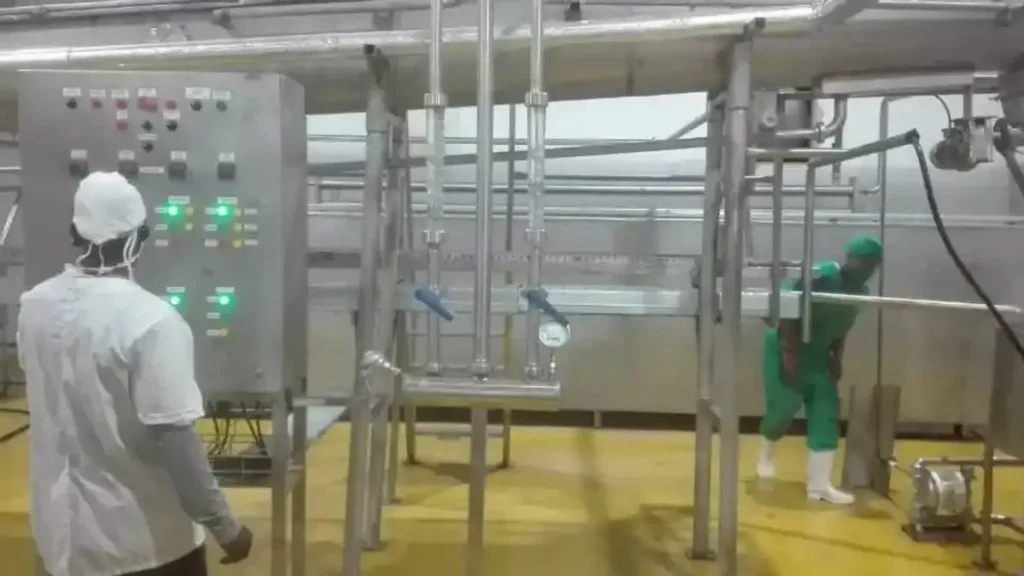
 14ymedio, Havana, March 10, 2026 – Faced with the severe fuel shortage, Villa Clara has decided to send most of its milk directly to neighborhood ration stores in the municipalities without passing through pasteurization, with the exception of Santa Clara, where the process is carried out using solar panels. The information appeared this Monday in the official newspaper Granma, which considers that the measure resolves the “waste” that previously meant using 2,200 liters of diesel per day to collect and transport the milk to the processing company. Today, only 259 liters are used for direct delivery.
The measure is part of a longer list of decisions adopted by the Villa Clara Dairy Company to cut costs, which the newspaper describes as an “achievement of innovation” and an example of “turning challenge into opportunity.” Thus, it mentions alternatives used in services for workers, such as cooking with firewood or transportation by tricycles, examples of “creativity in times of crisis.”
“As the grandparents used to say, it’s never too late to start; solutions and initiatives have begun to appear everywhere,” states Granma, which insists that there has been waste of “human and material resources in most sectors, as if this were a rich country or one functioning in a normal context.”
“As the grandparents used to say, it’s never too late to start; solutions and initiatives have begun to appear everywhere.”
The official newspaper resorts to several quotes attributed—most of them incorrectly—to Albert Einstein to argue that the crisis forces the search for new solutions and alternatives and emphasizes that “solutions and initiatives have begun to appear everywhere, demonstrating the existing potential in the nation to resist the imperial assault.” One example is pasteurization using 400 solar panels that, last year, allowed savings of 47 tons of diesel as well as 131 tons of carbon dioxide emissions into the atmosphere.
The process, now limited only to the provincial capital, serves to eliminate potentially dangerous bacteria through heat and is one of the basic methods for guaranteeing the sanitary safety of milk. Its absence reduces the possibility of preserving the product, which would then need to be kept under proper refrigeration conditions, something that can hardly be guaranteed in a country affected by prolonged blackouts.
For this year, the number of panels is expected to reach 1,364, guaranteeing 10% of the total energy needed by the complex. “And since the Villa Clara dairy thinks big,” according to Granma, the company is already working on acquiring 18 electric tricycles to transport all the milk that moves within Santa Clara, leaving trucks only to move the remaining milk in the municipalities.
Solar panels will also be the solution for the La Purísima dairy products factory, whose production of mayonnaise and other dressings had been in doubt until 60% of the systems that will allow operations to continue were installed, as well as for the Chichi Padrón slaughterhouse, which is also joining the energy-saving measures by planning the installation of 272 solar panels that will provide about 300 kilowatts. Otoniel González Ruiz, director of the entity, says that now they will be able to carry out all their work and adds that they will also apply the “very well thought-out” measure of replacing the employees’ bus with tricycles in order to minimize fuel consumption.
The Agustín Rodríguez Mena rum distillery in Santo Domingo also has 2,752 panels with which it generates the energy it needs and sends the surplus to the National Electric System, although in its case they were more forward-looking and did not have to wait for the crisis to tighten the screws, since their systems were installed in 2016.
“He who overcomes the crisis overcomes himself without being overcome,” Granma quotes—again incorrectly attributing it to Einstein—to conclude the list of solutions that, like the rum distillery, could have been adopted earlier without waiting for them to become unavoidable.
Translated by Regina Anavy
______________________
COLLABORATE WITH OUR WORK: The 14ymedio team is committed to practicing serious journalism that reflects Cuba’s reality in all its depth. Thank you for joining us on this long journey. We invite you to continue supporting us by becoming a member of 14ymedio now. Together we can continue transforming journalism in Cuba.