In and around the old Shell station in Guanabacoa, three types of transactions coexist: legal ones, ‘underground’ business, and street vendors.
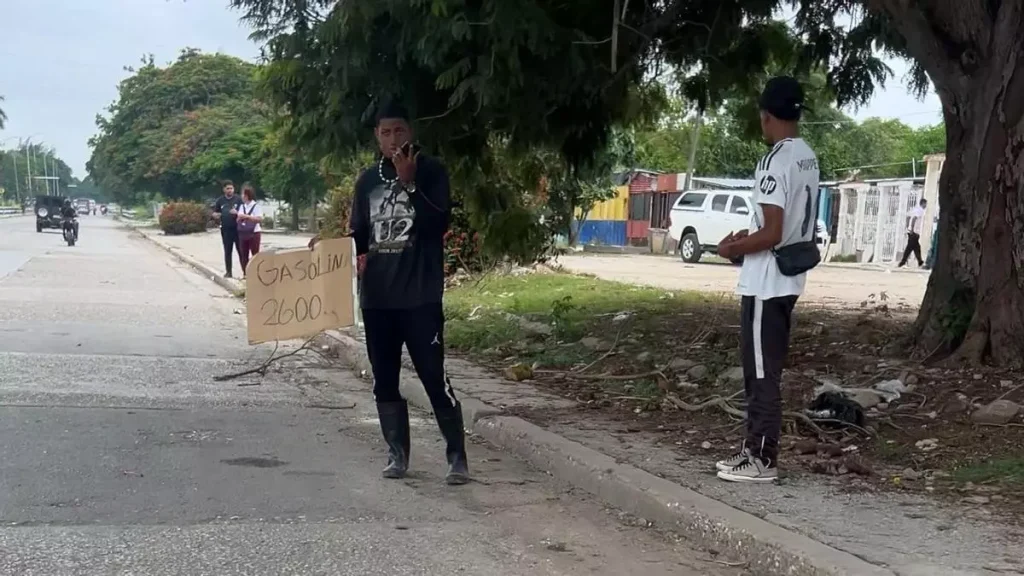
 14ymedio, Dario Hernandez, Havana, August 8, 2026 / The gas station at the Roundabout of the former Shell station, in Guanabacoa, has become a hub for the fuel business where three options compete: legal sales managed by a micro-enterprise, which rents the pumps to Cupet; black market sales, which depend on another company; and the newest variant, which consists of placing young people with one-liter bottles of gasoline in the vicinity of the gas station.
“Gasoline 2,600,” reads the sign held by a vendor standing by the Vía Blanca, like someone advertising mangoes or avocados. A few meters ahead, three bottles filled with a yellowish liquid are offered for 2,800 pesos each. Here, the product is sold in Mexican pesos, unlike at the gas station itself, where transactions are in dollars, but only by contract and with prepayment.
The legal practice is no longer entirely legitimate, as there is a noticeable presence of state vehicles refueling in violation of the authorization granted by the US solely to the private sector , both for import and sale. The name of the micro, small, or medium-sized enterprise (MSME) managing the gas station is unknown, but an investigation by 14ymedio has established that the company selling fuel illegally belongs to the YES Group.
“You get there and pay three dollars per liter. They tell you to go to the Shell roundabout, but I don’t know if they have other service stations as well.”
Like other micro, small, and medium-sized enterprises (MSMEs) that have ventured into the lucrative fuel business , doubts arise about their ties to the state and whether they are genuinely private companies or government fronts. In this case, the numerous investments of the Y.E.S. Group are noteworthy, including an appliance store on Galiano Street, a restaurant in the same area of Central Havana, a beauty salon in the La Copa shopping center, and a “coastal estate” 20 minutes from the capital.
The group has no activity linked to the energy sector, and yet customers can go to one of its offices in Playa to buy fuel. This newspaper spoke with Ernesto, a regular user of this service. “The process begins in a building with rather tangled hallways,” he explains. “You get there and pay three dollars per liter. They tell you to go to the Shell Roundabout, but I don’t know if they have other service stations as well. You have to ask for someone named A. He has a list. You arrive, they verify that you’re on it, and you practically go straight in to fill up.”
While dozens of vehicles, including PedroCars buses, yellow taxis, and Transmed vans, wait their turn, the customers on the YES Group list access the pump without much delay. “I saw people taking ten liters and others filling up huge tanks. One guy left with a thousand liters. I took fifty,” he recounts.
The description matches the pattern that 14ymedio has been documenting in recent months. Since April, several investigations have revealed that the state has begun leasing Cupet gas stations to private companies that import and sell fuel, allowing them to use state infrastructure to serve their own customers.
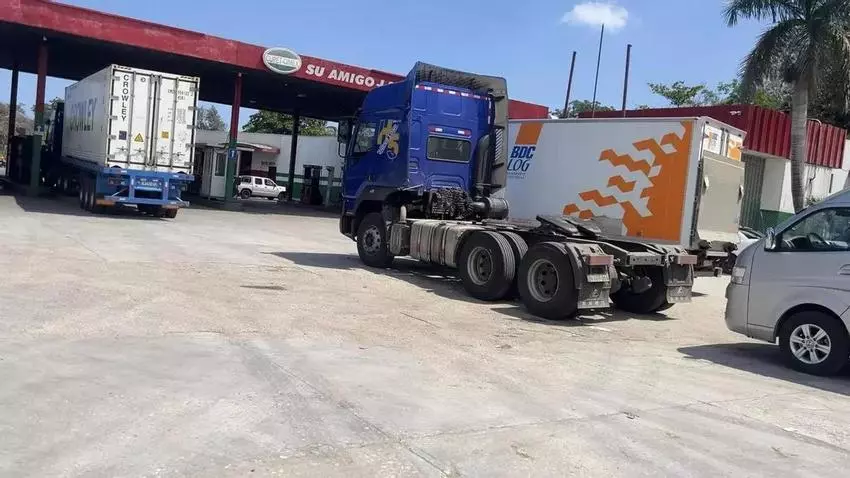
Those operations had already drawn criticism because they coexisted with the official rationing system. Now, according to several testimonies gathered by this newspaper, the business appears to have evolved into a much more organized mechanism.
“I was afraid it was gasoline mixed with water or something weird that would ruin the engine,” the driver admits. “But it smells exactly like Cupet gas. The car hasn’t given me any problem.”
Meanwhile, the street market continues to grow around the service station. Vendors display handwritten price signs and wait for customers along the roadside.
“If you don’t want to go through offices or pay in dollars, you buy it from them,” commented a motorcyclist watching the coming and going of buyers. “Everyone knows where they are.”
The 2,600 pesos advertised on the sign even represents a decrease compared to prices just a few weeks ago, when some resellers were asking up to 3,500 pesos per liter. The drop could indicate greater fuel availability in the informal market or increasing competition among the intermediaries themselves.
______________________
COLLABORATE WITH OUR WORK: The 14ymedio team is committed to practicing serious journalism that reflects Cuba’s reality in all its depth. Thank you for joining us on this long journey. We invite you to continue supporting us by becoming a member of 14ymedio now. Together we can continue transforming journalism in Cuba.