How to Lose Friends / Angel Santiesteban

Angel Santiesteban, Havana, 23 December 2015 — These days I’m immersed in the culmination of my next novel, which I should deliver in February for its possible publication; for this reason, I have dedicated the last two months, in a tireless way, to improving the prose, born from the heat and emotion of the most recent creation. I’ve barely taken time for cultural recreation, repressing — now that it’s possible — going to the theater, movies, ballet, among other spaces of my personal consumption, after having yearned for it for two and a half years, because the dictatorship that considers thinking differently to be dangerous, especially if it involves an artist, decided to send me to prison.

It’s indisputable — and the reason for this post — that I haven’t been able to visit and comply with the demands of some friends, brother masons and political activists, who would like to see me more frequently. continue reading

The rigor with which I apply myself to writing totally absorbs me, to the point that sometimes I lose track of the time that I take up dreaming which I should be using for this final revision; however, some of those important friends are insulted by my absence, thinking I’m distancing myself from their devotion.

Likewise, I’ve received by email complaints from other friends, asking for more warmth from me, which I consider as personal pride; but I’m not lying if I confess to them and explain that when I write short stories, in general, they’re created by a breath, a hit of a chisel that sculpts them with a minimum of blows.

It’s not like that with novels: Then this breath is converted into a persistent state while its realization lasts. I’m possessed for months; an ecstasy keeps me transported to the actual time of the plot in question. It’s the most effective way, particularly for me, to advance and master the characters and their conflicts.

Of course at this rate I’m afraid of being alone and without a social life, and I question whether I work well or badly by remaining isolated, like being expelled from the real world, delivered to the profession of writing.

But what other quality of life could I assume if it’s the only way I know of feeling useful, to breathe in peace, to bring to my dear friends themselves, brother masons and brothers in the struggle, through my texts, that reflection on justice and nobility for the society where we come together? I write for my time, and my spaces of struggle and longings converge: friendship, fraternity and unity in political activism.

Although I appear to be absent, I am, through literature, very close to each one of you and to the national problems that I try to reflect in my books. And very soon — between this writing and the next — I will appear to receive your hugs with the same zeal with which I profess to you that I hold your friendship, in order to then celebrate together a new birth of that literary son that I bring into the world, that I humbly bring to the national culture, our struggle and our shared dreams.

But God makes me lower my head and return every day to ask all of you: If I didn’t have you, then why am I creating literature? For whom would I write?

I wish you a Merry Christmas, although we are aware that it won’t be as we would like while the dictatorship exists.

Big hugs.

Ángel Santiesteban-Prats

Havana, December 2015, under conditional “liberty.”

Translated by Regina Anavy

Padura and the Face of Cultural Context / Angel Santiesteban

Angel Santiesteban, 18 November 2015 — On October 31, in the Museo Napoleónico de La Habana, the book, “The Faces of Padura: Work and Life of a Writer, ” a compilation of texts about Leonardo Padura, was presented. Padura was recently awarded the Princesa de Asturias de las Letras Prize.

At the event, Padura shared the thank-you speech that was read in Oviedo before Spain’s royal family; words that should have been published by the Cuban press. But not only did they not publish them, but also in the official media it was completely ignored that for the first time a Cuban writer was given credit for such a prestigious award. continue reading

This attitude of the Castro press is one more mockery of the Cuban people’s intellect, caused by that “cult of secrecy” so many were talking about in the last Congress of the Union of Journalists of Cuba (UPEC), where it was treated as something from the past, blaming the journalists themselves for unnecessary self-censorship, now that politics is not interfering in the news and its opinions.

Which is to say that suddenly we had overcome the dictatorship and that we found ourselves in a State where there is free thought.

But returning to the question at hand: the book about Padura could have been one more release for the world of the many that the distinguished Cuban writer completed; only this one was special because it happened on his terrain, surrounded by family, friends and his natural readers, and it was delightful because it was presented by colleagues from his generation, among them the writer Francisco López Sacha.

But they couldn’t stop mentioning some irregularities around this event, like the rejection of eight cultural institutions which didn’t celebrate Padura, which is very alarming; of course, behind that was the sinister hairy hand of the Government, which has exhausted without success all its misleading strategies, praising him moderately in order to buy his silence and stop him from telling his truths and offering his critical evaluations about the reality of the Cuban people.

That Leonardo Padura — actually the most distinguished Cuban writer on the international scene — shares his books with readers at home is a deference that makes us grateful; however, that the Regime tries to make him pay the price for not being a writer who kneels before the manipulations of those who direct the cultural politics on the archipelago is an immense immorality, a brutal insensitivity, characteristics that are endemic to Caribbean totalitarianism.

That his books, awards and presentations aren’t promoted as they should be with a National Prize of Literature shows a lack of delicacy and transparency of the cultural politics and the Government, which discredits itself even more (if that’s possible, given the shameful and repeated practice of this and other dirty tricks), ignoring and trying to “invisiblize” a writer who, in spite of not coming out directly against the system, still doesn’t accept gifts or pampering, as do most of the intellectuals and artists on the island.

They at first tried to manipulate him with an open cynicism, through publications, national fairs, a homage in the Casa del las Américas, or with that final power of cultural officials, accepting that a jury award him the National Literature Prize, the greatest award for the work of a Cuban writer residing on the island. But, since Padura didn’t react before such “magnanimous” tokens — because here it’s only important that you have won, not that they decide whether or not you win — now the same cultural officials, who once called themselves his friends, are cold and distant in response.

I also know that the filming of the movies based on his detective novels that have his character Mario Conde as the protagonist, has received negative responses to official requests from foreign filmmakers to use some sets, the same that are used daily to film short police programs for national television.

The dictatorship thus holds a grudge against those who don’t bow their heads, against those who don’t permit the humiliation of being treated like objects, against those who refuse to be manipulated in order to abide by the designs of government power; all because they still try to ignore an irrefutable truth: art expands, endures and always wins against political power.

Ángel Santiesteban-Prats

Havana, November 16, under conditional “liberty” [on parole]

Note from Angel’s editor: The compilation, in the charge of Agustín García, includes his texts, those of Francisco López Sacha, María del Carmen Muzio, Dulce María Sotolongo, Lorenzo Lunar, Rafael Grillo, Michel Encinosa, Enrique Saínz, Rafael Acosta, Rebeca Murga, Elizabeth Mirabal and Gustavo Vega, the filmmaker Lucía López, Leonardo’s wife and one from Padura himself.

Translated by Regina Anavy

No Other Country Has Treated us Like Costa Rica / Ivan Garcia

Sanitarios-de-la-Cruz-Roja-costarricense-atienden-a-una-cubana-_ab-620x330Iván García, Costa Rica, 29 November 2015 — In the last two weeks, the authorities in Costa Rica have been forced to open new shelters to care for the more than 3,000 Cubans trying to reach the U.S. who are stranded on the border with Nicaragua.

Since November 15, thousands of Cubans have been sleeping in temporary shelters because of the decision by Daniel Ortega’s government to deny passage to Cubans, after an outbreak of violence between the Cuban “land rafters” and riot forces from Nicaragua.

In spite of this measure, the number of Cubans arriving in Costa Rica through Panama continues to increase. In general they arrive at night, in groups of 50 or 100 people, in a village named Paso Canoas, more than 600 kilometers south of San José. continue reading

There they stay in hostels that charge between 5 and 50 dollars a night. Those who don’t have money, after being fleeced by coyotes and traffickers in Colombia, sleep on a boarding platform used by interprovincial buses.

The number of Cubans who have entered Costa Rica by Paso Canoas now exceeds 3,000, and it’s said that more than 300 would be waiting in Panama to cross the border. The shelters in the towns of La Cruz, Peñas Blancas and San Ramon are spilling over with emigrants from the Island.

Days earlier, Costa Rican authorities, in cooperation with the Catholic Church in San Ramon, an hour’s drive from San Jose, decided to open another shelter with the capacity of 280 people.

Cubans arriving by bus from Paso Canoas must pay 15 dollars for the ticket. But at least three dozen migrants find themselves sleeping on cardboard on the floor of the bus station. The uncertainty is the biggest worry for the Cubans.

After 2:30 in the afternoon, an Immigration official returned passports to the Cubans who wanted to go to one of the shelters, where the authorities are guaranteeing them three hot meals a day. While some wait in hostels or outdoors for a decision that is out of their hands, others, who now are counting their money in pennies, decided to stay in a shelter set up in the parish of La Pastoral, in the county of San Ramón.

During the six-hour journey, through steep hills and a mountainous landscape crowned by dormant volcanoes, many of the Cubans were snoozing, listening to music on their cell phones or talking with family members in Cuba using the Internet from the telephone lines they access locally.

Halfway there, the bus was stopped at a checkpoint. A Costa Rican policeman reviewed the passports and, in a respectful tone, warned the group not to try to enter Nicaragua illegally.

The other bus stop was at a business on the side of the road. This allowed the immigrants to stretch their legs and look at the merchandise that few could buy because of the high cost.

Around 10:00 at night, local time, the group of Cubans arrived at the hostel. There, some 30 volunteers from the church, the Red Cross and the priest, Gravin Hidalgo, were waiting to take care of them and offer them a dinner (soup, white rice, scrambled eggs, salad, bananas, bread and orange juice). Then they were shown to rooms with four individual beds in each.

According to Father Hidalgo, they “want famlies and groups of friends to stay together.” But the unstoppable influx of Cubans escaping the Castros’ “tropical socialism” worries the Costa Rican pastor.

“We already have more than 280 people here. We’ve had to set up bunk beds in a room to be able to take care of them.” The exquisite treatment and the detail of locating an image of the Virgen de la Caridad, the patron saint of Cuba, brought congratulations on the part of the emigrants.

“Some, moved, have commented to me that they made the crossing with necklaces of the Virgen de la Caridad as amulets. One of the Cubans gave me a stone chosen by him in the Santuario del Cobre, in Santiago de Cuba. A very valuable gift for me. We hope to take care of them the whole time they stay in San Ramón. The civil society of the city, the Church and the authorities are happy to give this help,” the priest pointed out.

But good will can flood humanitarian assistance in a small country, which doesn’t count on an army and has limited financial resources at its disposal.

Meanwhile, in Paso Canoas, Cubans continue arriving.

Iván García, from Costa Rica

Translated by Regina Anavy

My Cable and I. Fiber Optics in My Town? / Somos+


SOMOS+, Frank Rojas Torres, 24 November 2015 — It was October 15, 2015, and a success that should be transcendental for all my compatriots turns out to be nothing more than a false alarm, one more of so many expectations that remains only that. Another promise to be fulfilled in the long-term, only because “the steps taken should be well thought-out in order to not commit errors.”

It’s true that weeks before the news spread by word of mouth, growing or shrinking according to what one brought to it or took from it, showing this writer that we all believed it would be a reality weeks later.

The so-much announced, glorified, dreamed-of and awaited fiber optic cable called ALBA-1 finally made its brilliant entrance onto the terrain of my little country town, opening a passage between the solid rocks that make up its subsoil, pushing us a little more while we try to shorten the tremendous gap, which on this subject as on almost all, separates us from a large part of the outside world. continue reading

And yes, here I was so proud telling people about the immense amount of information that can run through its veins. I became majestic making a show of what it could do and having it rubbed it in my face that in the matters of information and informatization we are, as a good Cuban says, “more backward than the ampalla” (i.e. extremely backward) or light years from even the century in which we live.

I can’t deny that I was inundated with emotion, feeling the privilege of remembering that I’m human.

From Venezuela swam the cable, which would connect us with civilization, with our fellow men, leaving behind the primitive life of ignorant cave-dwellers. Now it seemed I finally would belong to the modern era. I already felt better located in time and space. It made me think about the idea of having nearby the key of traveling “to the infinite and beyond.”

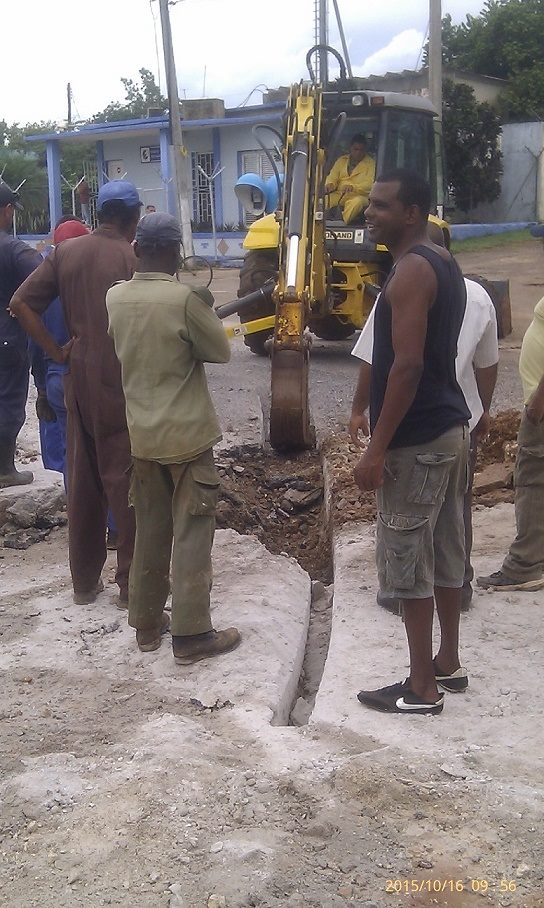
In front of me, the brigade of workers and machinery from the army — something already suspicious, hmmm — charged with creating the conditions pertinent to the good functioning of the new technology, were hard at work opening a trench where the aforementioned cable would extend to the terminals, while the curious — like me — little by little were gathering around the work area, asking questions and exchanging opinions about something that also was novel for them, seeing who could pick out the next stone that they would fling away.

Well, it’s not that I like gossip, but I couldn’t avoid being pushed by curiosity to see up close how they were connecting the cable to the terminals. Who would be the object of the test? Because everything that’s done here is submitted to a meticulous test before using it for more people, to avoid a “false” step. Because of this we function so “well.” Because of this our country is in the “vanguard” of “everything.” We can’t give ourselves the luxury of committing “errors.” We can’t give the “enemy” even the least opportunity to criticize us.

Well, who is our enemy now? Caramba, we have to fabricate another now that the Americans suddenly became our friends. Well, now someone will have to appear who wants to “blockade” us and put us on some black list.

Well, as I was saying, an irresistible force pushed me onto Street 3, to follow “Mr. Cable” as in his time Theseus did, following Ariadne’s thread that was leading him to the exit of the Minotaur’s labyrinth.

While I walk I wonder about who has been chosen for such an experiment. Finally I turn the corner and follow my cable, if indeed it’s mine. At this height and with all the joy that seizes me, I already feel it’s mine, a part of me and my family. Okay, it’s not a guy or a girl, nor will it be in the bakery or the grocery store. It’s logical that it should be in the library. Nor is Frank here.* I miss him, but I follow my cable. Where will it take me?

I almost run into a gentleman on a bicycle while I walk down the street, already connected with my friends, investigating things, looking for information, rediscovering my country and its rich history, especially the one not told, exploring a new world and perhaps finding a new girl to conquer in cyberspace.

I come to another corner and look up to calculate how many more were left before I saw where my cable would be placed, and I finally see its destination. No, it can’t be! This has to be a joke in very poor taste! I almost fall on my ass when, before my thunderstruck eyes, my cable, my friend the cable, like a fish in water, is being hooked up at the PNR (National Revolutionary Police) headquarters.

What was it doing there? It recently had come to my humble little town, and now they were surely warning the cable that it wouldn’t be like we thought, no sir, without first having to pass through this place before entering the life of all of us, because here all is done with “order.” This would be its Customshouse, where surely they would remove from it many things it was bringing to me and my people. I suppose they left the cable very clear about what it could or could not say, and what it could or could not let us see.

I felt newly brutalized and regressed again in time, moving away more and more from my friends and from the enormous universe that minutes before told me it was waiting for me. I was on the point of screaming from so much rage and frustration. I can’t deny that I almost cried.

Soon came to mind the image of a large filter through which would pass the information traffic that would travel in all possible ways through my cable. At once I realized it was an illusion to believe that everything would be so easy beneath this Regime of “total” totalitarianism. My naivety betrayed me at thinking during my detective run that this innovation would come to me just like that. Automatically I began to link together the latest stories about the building where the PNR is located, subjected for a couple of months to changes in its structure and some other remodeling.

Of course, conditions must be created in order to better adapt oneself to the new area of work. I had to change many things so that I felt comfortable with their listening in when I spoke with the “worms**,” my brothers in struggle.

Today is November 7, 2015, and for me it was going to be a big date in my little rural town. It ended up adding to that long list of things that today move me to continue looking for a different Cuba. I continue dreaming, awake, about something that arrived but continued on, like the waiter that passes in front of you with a succulent plate, leaving behind the smell of what you would like to eat but can’t because your money doesn’t stretch far enough to allow yourself that luxury.

Today November 7, 2015, and it’s almost a month since the arrival in the land of Limonar of the fiber optic cable. My buddy, my brother, I remain with the desire to touch you and a strange, bitter taste that reminds me where I am. I still see in the streets the open wounds made by those machines of doubtful origin, now infested with garbage and dirty water as unequivocal marks of a system that only leaves us that: open wounds full of filth.

Today I want to laugh at myself for being so stupid and for having converted this real-life story into one of those scenes from the fairy tale, “Little Red Riding Hood.” In the distribution of roles, the PNR is the wolf that waits for me in bed after swallowing my grandmother – my cable. I am the tender and innocent Little Red Riding Hood, who arrives at her grandmother’s house and sees her in bed with the face of a wolf:

“Yo! Little Red Riding Hood.” “But grandmother, what big ears you have!”

PNR, the wolf: “Ah, the better to hear you with my dear!”

Translator’s notes:
*Reference to a movie about a band leader. 
** “Gusanos” — worms — is one of Fidel Castro’s epithets for people who leave Cuba for the U.S.

Translated by Regina Anavy

A Night in Paso Canoas on the Border with Panama / Ivan Garcia

Cubans at the Panama/Costa Rica border

Ivan Garcia, Costa Rica, 25 November 2015 — When Alex Sigler, 22, landed in the Quito airport in an African heat with thunderclouds that presaged a tropical shower this past November 11, he began his own journey to achieve the American dream.

In five days of passing through the Colombian jungle, Alex encountered hitmen of few words and with twitchy trigger fingers.

“The police, who supposedly are there to preserve citizen order, are the first to rob us. Almost all Cubans have been fleeced at Colombian checkpoints. The coyotes are frightening. They traffic cocaine the same as people. They talk about their criminal exploits like a group of friends in the neighborhood commenting on football and a penalty,” explains Alex, lying on top of some tattered cardboard in an inter-provincial bus terminal in the Costa Rican town of Paso Canoas, a stone’s throw from the border with Panama. continue reading

On the platform about 30 Cubans are sleeping, having been robbed or conned by drug traffickers in Colombia. They have lost everything.

They find themselves without money, waiting for some relative or friend in Miami to urgently spin a few hundred dollars their way so they can pay for the rest of the crossing, if the authorities in Nicaragua will finally let them pass through their territory.

They burned all their bridges. On the Island, they sold everything. Or almost everything. The hazardous journey through eight countries to reach the U.S. is much harder than they thought.

But they’re not sorry. “I was already worn out. In Cuba we’re just a number. People count only for voting in the elections or supporting the Government. Maybe things will be bad for me in la Yuma (the US), but at least I’ll be a free man,” says Alex, who in Caibarién, some 350 kilometers east of Havana, left his wife and a four-month-old daughter.

The village of Paso Canoas is a township of one-story houses and ambulatory stalls where they sell every possible commodity. At night it’s deserted. The more than 300 Cubans who arrive in unstoppable dribbles from Panama have several options at hand for lodging. Those who arrive without a cent sleep in the old Canoas bus terminal.

Others pay five dollars a night, the lowest price for lodging, in a sweltering hostel without windows that is run by Pepe Restoi, a Catalán, who says with two raised hands that he is voting for Catalán independence.

“Man, it’s not that I’m uncaring; obviously I’m aware of the drama of the Cuban emigrants. But I’m a businessman. In Paso Canoas, between hotels and guest houses, there are about twenty. What you have to do is keep your property occupied,” says Restoi in the door of the El Azteca pension.

It would be very pretentious to call “hotels” a chain of houses adapted for guests or enlarged to be rented to the more than 3,125 Cubans who, since November 15, have walked through Paso Canoas.

Prices are expensive for a segment of terrestrial balseros (rafters) who, in tune with the closing of the Nicaraguan border, have to dig out bills and scratch their heads to stretch their money after having spent between three and four thousand dollars on their trip through Ecuador, Colombia and Panama.

“You have to be very farsighted with your money. You have to hide it in unsuspected places so that the Colombian hitmen don’t fleece you. You still have to cross four countries before reaching the U.S., and the dough is going to run out,” says Alfredo Ávila, 28, an electrical engineer who lives in the eastern province of Holguín.

Among the island emigrants there are different hierarchies. Those of extreme poverty are the ones who spend the night on the unpolished cement floor in the bus terminal and, for lack of a bathroom, urinate in a garbage dump site.

“This is hard. The majority eat only once a day. They only have their clothing left from their baggage. On the road, to lighten up, they left their belongings or sold them to be able to eat,” indicates Alex.

Gabriel, a young man who recently left military service in Cuba, says that while crossing Colombia a compatriot had to improvise a fishing rod to be able to eat.

The emigrants who have a more substantial economy spend the night in third- or fourth-class hotels, which in Costa Rica rent at first-class prices. The El Descanso hostel doesn’t calculate how many it’s received. A large grocery store is sometimes a restaurant, a bar and, occasionally, the Cubans who wait to cross the border drink beer without too much moderation.

One night, in a monumentally drunken episode in the swimming pool, some Costa Rican guests were wounded.

“They had to call the police. Many Cubans behaved inappropriately. Particularly those from Havana, who believe they deserve everything. They steal the towels, destroy the electrical outlets and are always complaining, even though the hotel management decided to reduce the tariff for them to nine dollars a night,” says Rey Guzmán, the manager of the El Descanso.

The lack of money has caused several girls to prostitute themselves or ask for money from the ticos (Costa Ricans). “In the Peñas Blancas encampment, two or three girls offered me sex in exchange for 20 dollars. Another asked me for two dollars to buy cigarettes,” says Jorge, a Costa Rican taxi driver.

Past midnight, Yadira, a willowy morena (brown-skinned woman) of 22 years, a native of Las Tunas, some 600 kilometers from the capital, was dancing a Dominican merengue surrounded by a chorus of drunken men who were whistling at her.

“She’s happy. If she’s looking for a man to save her (offer her money) she’ll do well. All the Cubans who are here have had trouble crossing, but for women it’s been worse. I have a friend who was raped seven times in Colombia,” says Magda, a blond who, in Cuba, owned a small manicure business.

Among the wandering emigrants from the Island there are those with sufficient money to stay in the best hotel in Paso Canoas, a two-floor building, painted an ivory color, that rents for 50 dollars a night.

Where are some Cubans getting so much money that they can pay between 10 and 12 thousand dollars in a country with an average salary of 23 dollars/month? I asked the engineer, Alfredo, at the entrance of the El Azteca pension.

“Many sold their car, their house or gold. Others earned money thanks to private business. Or they receive enough money from their relatives in the U.S. But most travel with their own money, which a family member abroad sends them, little by little, after a reunion, so they can come. It’s not recommended to travel with so much cash,” he answers.

Gabriel made an agreement with a sister who lives in Miami. “She offered me a loan and when I get to the U.S. I will pay her back,” he confesses, worried. He has spent the three thousand dollars and is still stranded in Paso Canoas.

Even far from Cuba, not a few emigrants are panicked at the thought of talking before the cameras or answering questions from journalists. “If I talk more, in case they send me back, I wouldn’t even be able to belong to the CDR (Committee for the Defense of the Revolution),” says a shirtless young man in the bus terminal.

On the contrary, a black man with a rugged complexion unloads his frustration, blaming the government of the Castros. “It’s their fault that people have to leave their country. Not even dead will I return.”

That’s the perception of the Cubans stranded in Puerto Canoas. There’s no way back.

Iván García, from Costa Rica

Translated by Regina Anavy

Bucanero-Cristal Exploits Ties to Self-Employed and Palco and Habaguanex Executives / Juan Juan Almeida

Juan Juan Almeida, 24 November 2015 — Just as the proceedings surpassed the scandalous total of 42 people indicted, the General Vice-Prosecutor of the Republic of Cuba, Carlos Raúl Concepción Rangel, imposed a gag order on the case and hid it underneath the trite mantle of “secret character,” because — according to sources in the Prosecutor’s office — he’s expecting the number of those involved to increase.

The investigation filtered down, and some of the people implicated hardened themselves and beat it out of the country. Others are hiding out; there is a border alert for them, and an order of search and capture.

Before such an emergency, and even without finishing the trial, they’re taking the accused out of the investigation center at 100 and Aldabó — the women to the western prison, El Guatao (known as Manto Negro), the men to Valle Grande or the Combinado del Este. The VIP accomplices, owing to their natural status as first-class citizens, were sent home and asked to be “low profile” until their names could be pulled from the file or, at least, their complicity silenced in a case that could paint them as crooks. continue reading

Certainly the population’s complaints will increase due to the absence of the country’s beer in Cuban markets. There hasn’t been any of the national beer available in any restaurant or State establishment, nor in the TRD shops, the so-called Rápidos, or Ditú*.

The Minister of Foreign Trade faces lawsuits from international distributors for frequent non-compliance with contractual commitments.

The litigants claim that there was no delivery of Cristal and Bucanero; but the headquarters, Cervecería Bucanero S.A., says it fulfilled its production plans and satisfied requests without reporting anything stolen or lost.

Everyone’s asking the same question: “Where did that beer mysteriously go, once it left the factory, was paid for and didn’t show up in the State system?”

Indications point in only one direction: the private restaurants, private bars and other establishments of the self-employment initiative.

The investigation started at the end of last August, when a couple of inspectors, as lethal and accurate as good snipers, targeted a truck from Cervecería Bucanero S.A., which each week unloaded merchandise in a private restaurant located on the Pinar del Río-Havana highway.

Inconsistent but true because — although the Government says it’s boosting private initiative and the press repeats the lie and many who are misled believe it — there is a regulation that prohibits the self-employed from buying what they sell privately directly from the companies (whether national or foreign), that is, wholesale; they can only buy goods in ordinary consumer stores or shops.

Ministry of the Interior (MININT forces), as part of the process of compiling data and evidence to document the investigation’s case, and make citizens uncomfortable, are examining the house of one of the managers of the Bucanero warehouse, and — according to the investigative file: “In one room (Fambá’s**), inside a safe, the police confiscated 82,000 CUC and three lists: one with the names of sellers to whom they must pay a commission, another of Palco and Habaguanex officials, and the other with directions for distributing merchandise.”

They’re adding prisoners to the list; the investigation is expanding; and the anger of those organizing the case is growing, even when those implicated find themselves facing an “accomplished fact” with no defense. It’s difficult to imagine, because they managed to use methods of buying and selling that are not even conventional enough to qualify as criminal acts.

The private business owners delivered money to the officers of State companies, Palco and Habaguanex; and the officers issued, to Cervecería Bucanero S.A., a bill of payment (not falsified) with the amount of the merchandise, together with an official order.

Bucanero had to deliver, and it did deliver. So sellers and buyers were violating the regulations, yes, but not the law. And in place of being judged for an act of corruption, they should be awarded for their ingenious solution.

Translator’s notes:
*TRD is the Spanish initials for “Hard Currency Collection Store” — which the regime uses to ’collect’ people’s remittances from abroad by selling them overpriced products not available in Cuban pesos; El Rápido is a fast-food chain; Ditú is a chain of coffee shops.
**In the African-Caribbean religion, Abakua, the Fambá is a room where rituals are performed.

Translated by Regina Anavy

Press Workshop with Raul Rivero / Ivan Garcia

Photo: Raúl Rivero in his house in Havana.

Ivan Garcia, 23 November 2015 — On these hot nights in Havana, when nostalgia, that silent thief that robs you of strength, strikes without warning, Raúl Rivero, the poet, sneaks through my window and offers me a workshop specifically on the latest news from modern journalism.

The art of teaching still doesn’t accept journalistic lectures by telepathy. But I confess that I have grown as a reporter by brushing up on the lessons of the poet from Morón, Ciego de Ávila.

I met him one day before Christmas in 1995. There was an unusual cold spell in Havana. The sun didn’t poke out, and the greyness made the streets simmer with grime. continue reading

Raúl lived with his wife, Blanca Reyes, in an apartment building surrounded by tenements and braced-up houses in the La Victoria district, just in the heart of the capital.

A complicated district. Formerly a zone of pleasure and whorehouses and, after the olive-green Revolution, the cradle of prostitution, drugs and cheating by the deformed “New Man” that Fidel Castro intended to mold.

Spanish is reinvented in La Victoria, sprinkled with jargon that sounds like the Buenos Aires lunfardo. At the foot of the staircase, in the building where Rivero lived, they offer you bath soap and detergent, stolen the night before from the shops in Sabatéss, or a leg of homemade ham.

In that itinerant market, among mothers who gossiped about soap operas and husbands, resided the best living poet in Cuba. I had just turned 30, and journalism wasn’t alien to me.

When I was a kid, my mother — who since 2003 has been living in Switzerland as a political refugee — took me around the whole country while she prepared reports for Bohemia magazine or the Points of View program on national television.

A journalist friend of my mother told us: “That fat guy, Rivero, is organizing an independent press agency. Go there.” On September 23, 1955, the poet founded Cuba Press.

On the day I went to see him, Rivero received me in shorts and without a shirt, smoking one cigarette after another. Absorbed, he heard my proposal and spit out, laconically: “Write something, then we’ll see.”

Cuba Press was pure journalistic abstraction, but it had a marked intent of telling stories in another way. It would be very pretentious to call it a press agency, when the writing took place in a kind of office in the living room of Blanca and Raúl’s house.

There were no computers or teletypes. Only a fixed telephone and an Olivetti Lettera typewriter. There were times when the journalistic texts were read over the phone, and the Internet sounded like a fable.

Cuba Press was a factory for journalists, in particular for those who dreamed of doing it the best — riskier in the case of autocratic countries — in service to the world.

Together with reporters who were disenchanted with State journalism, like Rivero himself, Ana Luisa López Baeza, Iria González Rodiles, Tania Quintero Antúnez, José Rivero García and Ricardo González Alfonso, I learned how to be an independent journalist.

The Black Spring came later, in March 2003. And by Fidel Castro’s express order, 75 peaceful dissidents went to prison. Raúl Rivero was one of them. In 1999, when the Cuban Regime approved a gag law that harshly restricted freedom of expression and condemned whoever violated it to up to 20 years of prison, he wrote an anthology piece, Monologue of the Guilty:

“No one, no law could make me assume the mentality of a gangster or a delinquent because I report the arrest of a dissident or give the prices of basic food products in Cuba, or write an article where I say that it seems a disaster to me that more than 20,000 Cubans go into exile every year to the U.S., and hundreds more are trying to leave to go anywhere. No one can make me feel like a criminal, an enemy agent or unpatriotic by any of those idiocies that the Government uses to degrade and humiliate. I’m only a man who writes. And I write in the country where I was born, and where my great-grandparents were born.”

His imprisonment provoked a resounding international disgust. On April 1, 2005, he went to Madrid with his mother and wife as a political exile from the Castro Regime. One more.

Now Raúl publishes his weekly articles in the daily newspaper El Mundo, and friends say he sleeps with Cuba underneath his pillow.

Over here, on this side of the Malecón, when I get together with Luis Cino, Jorge Olivera and Victor Manuel Domínguez, we remember anecdotes about Rivera (they could fill a book). Or those press workshops that he taught, shooting words at us from an old armchair. And every time, we review his poetry and dissect our newspaper articles.

Some are authentic and masterful for professionals of the word. Read the introduction of this chronicle after the death of Gabo [Gabriel García Márquez]:

“For me the death that hurts is that of Gabriel García, that old reporter from Aracataca who let his mustache grow to resemble the singer, Bienvenido Granda. A man who liked to dream and write novels, clever and generous, who discovered beauty whenever he saw a woman for the first time, treated you to words and to whom life gave all the literary glory of the world — even a Nobel Prize — but let him die without permitting him to write the lyrics of a bolero.”

Or more recently, when in “None appeared to go to Cuba” he says: “None of those famous media people have been to Cuba. That zone in the Caribbean where they were and where others went to stay and photograph isn’t a country. It’s a reality imposed by a group in power who reclaim the money from foreign investment to leave their heirs in the Palace in command of that entelechy.

On November 23, Raúl Rivero will be 70 years old. We, his friends, are going to toast him with a drink of rum. Meanwhile, on an old turntable, we will listen to “Gray Rain,” the Spanish version of “Stormy Weather,” which launched Olga Guillot to fame in 1945.

Iván García

Translated by Regina Anavy

The Stampede Continues / Rebeca Monzo

Rebeca Monzo, 20 November 2015  — One year after initiating conversations to reestablish relations with the U.S., the Cuban Government continues its immobile posture, without taking a step forward.

The raised expectations, with which the immense majority of the Cuban population gave itself illusions, have stagnated, and the stampede of Cubans, most of them young, continues making news in all the foreign newspapers.

A new Mariel Boatlift, but this time by land, is happening. So far this year, the alarming number of national emigrants by different routes and countries, with Miami the final destination, has risen to 43,169, surpassing the massive emigration of 1994. continue reading

The loss of faith in the Cuban Government and the lack of those so-awaited changes have caused a large part of the Cuban people to opt for escape, in search of a better future for them and their families, in other latitudes. Even people who have the privilege of working in successful private establishments, like some private restaurants, realized that the options of expanding and becoming independent, and offering a better education to their children, were each time more unreachable.

Others, still clinging to what they call “change,” for lack of knowledge — for example, being able to travel, buy a car or an apartment, or sell their house —  ignore that these so-called changes are nothing more than the return of some rights usurped by their own government, for which they don’t need to be so grateful.

While a real opening isn’t happening and the Government continues clinging and demanding nothing intelligent, and continues paying wages of poverty to professionals and preventing them from having their own business, everything will continue the same.

This makes me think that really they don’t want change that would make their ancient governmental structure totter, or the irremediable loss of power, which would cause the failure of their politics to be discovered.

As long as the higher-ups don’t have the courage to renounce and admit their own errors, and continue to entrench themselves behind demands and absurd accusations directed at our neighbor to the north, the migratory stampede will be unstoppable.

Translated by Regina Anavy

The Shipwreck of Havana / Ivan Garcia

Darth-Vader-en-La-Habana-Juan-Antonio-Madrazo1-_ab-620x330

Ivan Garcia, 19 November 2015 — One hour before noon, the bus stops on Calzada 10 de Octubre are flooded with irritated people who want to transfer to other neighborhoods in the capital.

Hundreds of old cars reconverted into collective taxis full of passengers roll in the direction of Vedado or Centro Habana. The autumn heat and sense of urgency cause those waiting to despair.

Public transport continues to be a popular subject in a magical and flirtatious  city, which, in spite of its grime and ruins, will be 496 years old on November 16.

Orestes, a bus inspector, receives a spout of critical resentment from citizens who are disgusted with the precarious urban transport. continue reading

“I’m the one who has to take the ass-kicking. The directors travel in cars. But I’m on the street having to put up with people’s complaints. The worst part isn’t the poor management of the transport, it’s that you can’t see a short- or long-term solution,” he says.

In a city of two and a half million people, where only one percent own a private auto, there is no Metro and the suburban trains barely function, public bus service is vitally important.

Yoel, an employ of the sector, says that “the demand is double the number of passengers transported every day. The ideal would be to have an allotment of 1,700 to 2,000 buses. But there are barely 670 in circulation. There is a master plan out to 2020 to improve service, but I don’t think it will solve very much. In addition to the deficit in buses, there is the problem of the poor state of the streets and avenues, which cause breakdowns in the city bus service. And the vandalism of Havanans who shred the buses, destroy the seats or break the windows with stones. Ninety-eight buses were out of service because of acts of vandalism.”

Traveling at rush hour on a bus in the capital is an Indiana Jones adventure. Fights, pickpockets and deranged sexual advances. People with their nerves on the point of exploding at the least touch.

Some day they’ll have to erect a monument to the old cars that serve as taxis in the city. For the average worker, making a round trip by taxi costs one day’s wages.

But the cyclical crisis of urban transport has converted the taxis into a remedy. They carry 200,000 people daily, although not always under good conditions. Of the more than 12,000 private cars for rent in Havana, half of them don’t have the required technical specifications.

“The owners put them to work even without painting them or covering the roof. With what they earn they improve them,” says Renán, who owns an old 1955 Ford.

And yes, they all have disk players that they keep on high volume, which assault the passengers with timba or reggaeton music.

But the talkative Cubanos convert them into a permanent chronicle and a rostrum where people unload their disappointment at the state of things and the appalling government management.

Transportation is only one among many problems suffered by Havanans. The list of things that cause stress is long, and solutions are nowhere to be seen. There is a clamorous need for housing.

Just ask Zaida. She’s 23 years old and lives in a state hostel in the department of Miraflores, at the south of the city. “My house fell down after a hurricane. I lost count of the letters and futile steps I took to have access to housing. Everything remained only as promises and lies on the part of the State agencies. Staying in a hostel means living at the limit; it’s like a prison. They give you a rough time for anything. Here a simple discussion can become a matter of blood.”

In Havana, more than 3,000 nuclear families live in propped up buildings in danger of collapse. According to figures from the last Census of Population and Housing, more than 40,000 domiciles in the province are evaluated as being in grave condition. Seventy percent of these houses require total demolition.

Add to this the precarious living situation in more than 10,000 tenements of different types, the existence of 109 “transient communities” — that is, homeless shelters — where 3,285 nuclear families who have lost their homes or fear a collapse are sheltering, as well as 20,644 housing units in unhealthy neighborhoods and precarious places.

Before Fidel Castro came to power, there were two unhealthy neighborhoods in the capital: Las Yaguas y Llega y Pon. [ed. note: notorious shantytowns in Havana]. Now there are around 60. To maintain and repair housing in the capital, the Government dedicates only 86 million pesos ($3.5 million US).

This figure contrasts with the more than one billion dollars that is being invested in the construction of eight golf courses.

While a large segment of people must live under the same roof with three and even four different generations, more than 50 percent of the potable water is lost through breaks in the hydraulic system.

The Regime only refurbishes or constructs buildings in the tourist sector or the State institutions. Like the repairs of the Theater of Havana and the National Capitol: according to engineers in charge of the works, the cost will exceed 200 million dollars.

In the ancient Chamber, where the political representatives of the Republic debate, the monotone Communist parliament is expected to begin its session at the end of 2016, if it is ready on time.

Visually, some 90 percent of Havana has an architectural platform similar to the one of 1959. Only older and more neglected. It’s not hard to figure out who’s guilty.

Iván García

Translated by Regina Anavy

What Can the Opposition Offer to Cubans? / Juan Juan Almeida

Cuba’s National Assembly of People’s Power, voting unanimously, as it virtually always does.

Juan Juan Almeida, 9 November 2015 — Cuba is a country where polemics or its relative, debate, is the daily bread of artists, private entrepreneurs and intellectuals; an island where the majority of the young population are assured of being poor or having no possibility of fulfilling their dreams; a nation where the average professional suffers from a ridiculous salary; and a State where discontent between the politicians and the military is worrisome. Still, the opposition, which works for freedom and the right to establish a democratic government, has been incapable of building a plausible alternative.

Where exactly does our opposition find itself in relation to the other components of the Regime? continue reading

The truth sometimes hurts; but hiding it can bring sorrow. I understand that being marginalized and repressed for so long without pity makes it difficult for many in the opposition to accept that this isn’t the moment to exclude those who have been excluded, but to reconcile and try to cooperate with all the social groups.

I don’t doubt the eagerness or the day-to-day need for mass actions, but being the fact of seeing “securities” (State Security agents) everywhere and having to constantly be ready to defend yourself from being infiltrated by State Security makes them easily fall prey to doubt, internal disputes, the political sin of disconnecting from the people, and the clear lack of the power to put out calls for action.

In the present circumstances, being a dissident and not fighting to be in the National Assembly of People Power, they allege that they “don’t want to play the Government’s game.” I acknowledge that many may like this expression; it arouses curiosity and fascination. But today, it’s a weak statement.

We know that antagonism, in times when anything other than what is voted on is considered violence, is more difficult than war and demands new strategies.

Obviously, social pressure on the Government will increase in parallel to economic growth for Cubans. So instead of predicting both the collapse or the overthrow of the present authoritarian regime, it’s preferable to think about a gradual process of erosion, and to have an accurate and objective analysis of the growing deterioration of relationships inside the governing clan.

Let’s be realistic. What can the internal Cuban opposition offer to those inside Cuba, besides political debate, the need to improve working conditions, schools, housing, health, etc.?

Only confidence. And for that it’s essential to fight to occupy spaces in society and in the parliament, in order to, from the inside, be able to dispute the legitimacy of the governing group.

In addition, among other things, to try, to come and approach the leaders of stone; participate in the debates organized by young, fashionable teachers (in principle, free from suspicion) in places like “El Hueco del Instituto de Periodismo,* about which a well-known professor at the Higher Art Institute says:

“They are important meetings because you hear the judgment of the son who counsels the father, the suggestions of the young who claim to know more than the old, and the incredible proposals of one sparkling part of the people who, by being irreverent, allow themselves to condemn even the ruler himself.

* “El Hueco” (the hole) is a space at the Havana International Institute of Journalism. It’s surrounded by trees on a patio at the back of the school. Every 15 days a group of young trova musicians get together with Ireno Garcia, a Cuban singer, to promote trova music.

Translated by Regina Anavy

The Havana Fair: Hookers, Heat and Beer / Ivan Garcia

Cuba-Feria-de-La-Habana-_ab-620x330Iván García, 12 November 2015 — Liudmila and Sheila are prostitutes and they don’t know about business or cutting-edge technology. But a colleague sent them a text message telling them, “Come here, the yumas (foreigners) are wild.”

They put on stunning high heels, tight clothing and perfume with an anesthetizing fragrance. Their plan was simple: to prowl around the stands for Canada, South Korea, France and Germany, and see how the fishing was at the International Fair of Havana.

“I can speak pretty good English. Let’s go to each pavilion and ask about the products on display or the possibility of working in a company. When we see some foreigner checking us out, we can go on the attack,” says Sheila, who has seven years of experience in prostitution. continue reading

They were in luck. Two Spanish businessmen invited them for drinks and disco dancing that night in Miramar.  “At the least the romance will be only a joke. But it could end in a courtship and a definitive exit from the country,” reflects Liudmila, while she drinks a Bucanero beer in a temporary bar at the recently-concluded Havana International Trade Fair (FIHAV) of November 2015.

Of course prostitutes are a minority among those who visited Expocuba, the site of commercial fairs since 1989 (the first one was celebrated in 1982 with a few exhibits from Spain, Panama and Cuba).

At the end of the ’80s, just as the almost-perpetual economic crisis was beginning, you might think it wasn’t a good idea to waste millions of dollars building a space for a fair 25 kilometers southeast of the center of the capital.

Excited by what he had seen on his trip to Pyongyang in 1986, Fidel Castro wanted Cuba to also have a permanent exposition, where it could exhibit the “achievements of the Revolutionary Process.” And on January 4, 1989, Castro inaugurated Expocuba, a space much too large for an economy that was shrinking.

The disintegration of the USSR caused the loss of millions in subsidies, which pointed out the deficiencies in local industry. Ricardo Ortiz, a retiree who for 10 years worked in a food import business, says that Expocuba was transformed into a children’s amusement park and a place where, in the hard years of the Special Period, people could find products.

“As transport was scarce, you had to go on bicycle, and when you got to Expocuba, they gave you the right to buy two packages of fried chicken, 10 breadfruits and flavored yogurt. This was in the same epoch when, for lack of fuel, oxen were used for plowing instead of tractors,” remembers Ortiz.

In the Cuban autumn of 2015, Expocuba shows an obvious deterioration. On one afternoon, a strong downpour obliged hundreds of people to seek refuge under the pavilion roofing. “It rained more inside than outside,” said a Spanish tourist. Visitors to the Fair complained about the lack of informative posters.

“Everything had been organized in a slapdash way. You walked around disoriented, not knowing where the exhibit you wanted to see was located,”  says Juliana, an English professor, who was looking for the South Korean stand to find the latest version of the Samsung Galaxy.

When the Havana Fair opened its doors to the public on Friday, throughout the neighborhood dozens of private and collective taxis were calling out their services. For Cubans, a round trip could cost 40 CUC (roughly $40 US).

“For a foreigner, 60 CUC or more,” points out Reinerio, the owner of a ramshackle Lada 2105 from the Soviet era. “But I offer a price of 20 CUC, since my car has a gas engine. Fewer people came to this fair than before.”

The suffocating heat invited people to drink cold beer in the bars, cafeterias and restaurants located in Expocuba. At a glance, it was apparent that a lot of attendees were lunching on Creole food or drinking beer, which ran through the pavilions.

According to Marcia, a Fair employee, “the most happening stands were those of South Korea, Canada and Japan. A few businessmen and book publishers from the U.S. exhibited their wares. For 2016 we expect an avalanche of American businessmen.” When you inquire from foreign businessmen about business prospects in Cuba, opinions go from optimism to prudence.

An official from a Swiss tourist agency explained that they now have a permanent office in Havana. “We might not make a big profit right now. But you have to open a way, occupy a space. I’m afraid that when the Americans arrive, the businesses of other countries are going to have to pack their bags.” An investor, also Swiss, is even more bold and claims he’s building a high-class hotel in the Cojimar district.

With more doubts than enthusiasm, Fabian Koppel and Jakub Brzokoupil, from the German firm Optimum, which specializes in industrial machinery, say that in 2012 they did business on the Island. “But because of various difficulties we had to leave. In Cuba everything is very complicated. But our company thinks that now there are better possibilities,” says Fabian.

The perception among businessmen is that 2016 could be a decisive year. A manager of Egyptian origin from Mercedes Benz hasn’t lost hope. In 2014 they sold only 30 multi-purpose trucks to Cuban companies, and in 2015 that went up to 110. As for luxury cars, from 25 in 2014, they hope to sell 200 in 2016.

This is timid growth, but unofficial calculations show that when the State floodgates open, sales can shoot up. Although a Cuban with an average monthly salary of 23 dollars could never buy a car valued at 70 or 80 thousand dollars.

Liudmila and Sheila, the prostitutes from Havana, didn’t lose the opportunity to take a selfie in front of three Mercedez Benz, as if they think it’s possible. “But we would never buy a car in Cuba,” they say, smiling.

Text and photo: Iván García

Translated by Regina Anavy

Cuba: Waiting and Hoping for the Cruise Ships / Ivan Garcia

Crucero-académico-M.V-_ab-620x330Iván García, 9 November 2015 — One warm evening in September, a scrapping brigade arrived from Habaguanex* and, in a little more than two hours, dismantled the aluminum tubes and awnings of three open-air bars on the Avenida del Puerto, where Havanans and tourists drank beer or ate fried chicken among the ambling musicians and prostitutes on the hunt.

The smell of fritanga** combined with the street-sellers’ cries and the nauseating odors from the contaminated Havana Bay. The spillage of waste matter was the pretext for the mandarins, who control the strongbox in the old part of the city, to disassemble the gastronomic shed, a couple of outhouses and, in passing, put some three dozen workers out of work. But the real reasons were something else. continue reading

Let’s call him “Mario,” a bureaucrat from the Habaguanex corporation, and he says: “The businesses adjacent to the port are controlled by military companies, who receive rent and fees from the old warehouse of San José, which has been converted into a handicraft market and even hostels, cafes, restaurants and shops. There is a master plan*** for converting the port into a tourist plaza that would offer recreation facilities and services for the cruise ships.”

In 2014, another old market in the port zone was transformed into a beer hall. And the inauguration of a maritime esplanade just in front of the Alameda de Paula is imminent.

They also have repaired and expanded sections of the road, planted palm trees and put up modern lighting on the street median. The area where the mobile bars were has been cleared to have more space for future tourists.

“They’re going to relocate them to other sites. They don’t want the view of the Bay entrance and the Christ of Casablanca to be obscured. By 2016 they hope to have more than 70,000 tourists from the cruise ships,” pointed out Mario.

The Regime is betting a lot on cruise-ship tourism in Cuba. President Obama, according to his roadmap, is interested in empowering private entrepreneurs and regular Cubans. But to the autocracy, only those businesses where the State is the manager are important.

Or to be more exact, the military businesses. Luis Alberto Rodríguez López-Callejas, Raúl Castro’s son-in-law (although some rumors indicate that he separated from Raúl’s daughter, Deborah), is a kind of tropical Martin Bormann, who handles the treasure of the business network of the Army, which controls the holding company GAESA****.

There is no way to probe into or know the volume of money they handle and how these funds are used: It’s a State secret. The generals, now converted into businessmen, have substituted white guayaberas for their uniforms. Eighty percent of the Council of State and the principal posts in the national economy are controlled by the Armed Forces.

After the U.S. Department of Treasury granted licenses to authorized cruise companies so they can go into Cuban ports, the falcons rubbed their hands together.

Raúl Castro is an expert at camouflaging his intentions. He also has been clever in dismantling, stone by stone, his brother’s pernicious voluntarism. He has changed the furniture, but he keeps up the décor.

Like Fidel Castro, he has boosted parallel mechanisms in the economy and the private reserves where the budgets are not discussed in the docile local parliament.

Castro the First was a staunch enemy of cruise ships, and he prohibited them in 2005. He argued that a horde of drunken tourists with little money would dirty up the Bay (even more than it is) with beer bottles and other garbage.

But Commando Raúl Castro thinks differently. The mid-term plan is for U.S. tourists to become an engine of growth that will catapult Cuba into the greatest tourist spot in the Caribbean.

But the present hotel infrastructure isn’t satisfying demand. “Every time a cruise ship comes into port, the beer, rum and mineral water disappear from the shops in Old Havana. We’re hallucinating if we think that four or five million Americans will come to the island, when we haven’t invested enough in lodging or services,” points out Fernando, a tourism officer.

December 17, 2015 — the day the United States and Cuba announced a resumption of relations — left in shreds Castro’s propaganda apparatus. For decades, it sold the narrative that the Revolution was of the people, by the people and for the people.

But a group of measures dictated by Raúl Castro put it into question. If anyone has been the big loser from the timid economic reforms of the last eight years it’s been the most poor, especially the elderly.

Without blushing, the olive-green autocracy has implemented unpopular measures that harm the population.

The Customs tax rates, the stratospheric assessments on commodities sold in the dollar stores and the favoring of cruise-ship tourism over ferry transport between Havana and Florida, which would permit a large transfer of assets and alleviate the poverty of many Cuban families, are evidence that the Regime governs only by thinking about its corporate benefits.

The White House has issued more than 15 “specific licenses” for passenger ferry service to Cuba, but they can’t operate immediately because of a lack of infrastructure on the island, sources from the Ministry of Transport confirmed at the beginning of October.

In a clear stalling tactic, the authorities allege that they need time to create an adequate infrastructure to receive ferries. José Ignacio, an expert in port services, thinks differently.

“It’s a contradiction that the Government says it doesn’t have the infrastructure to receive ferries and jumps for joy at the future arrival of cruise ships. The reality is simple: the cruise ships constantly leave behind dollars in cash. The ferries, to be more economical and transport up to 200 pounds per passenger, would boost trips for Cubans located in Miami, who would benefit their relatives with their packages. The official strategy is that they send all the money they want, so that people are obligated to buy in the State shops,” says José Ignacio.

Quietly, a State mercantilism is being built in Cuba, governed by silence and the lack of transparency. The worst possible capitalism.

Photo: Academic cruise ship M.V. Explorer from the United States. After a journey through 17 countries, the final destination for the 624 students coming from 248 U.S. universities was the Port of Havana. Taken from Martí News.

Translated by Regina Anavy

Cuban Journalists are in No-Man’s Land / Ivan Garcia

Foto-de-Elaine-Díaz-tomada-de-Periodismo-de-Barrio-_ab-620x330Ivan Garcia, 31 October 2015 — It seems much time has passed since the ’80s, when a stern official from State Security, dressed in civilian clothing, solemnly intimidated us, a group of fresh youngsters, who were studying at La Vibora’s pre-university.

I was 16 years old. I don’t remember having felt more fear in my life than that afternoon, when the agent showed us his document with a red stamp and green lettering: DSE. The initials of the feared Department of State Security.

The guy manipulated our youthful fear like an expert. Perhaps he learned that in a KGB counterintelligence academy, or in the STASI of Marcus Wolf. continue reading

He asked for discretion from the school director, known as “the Fly,” more intransigent than an Afghani Taliban. And he led us half-dozen kids with intellectual airs like a submissive flock toward the school library.

Our crime was watching movies and documentaries not shown in Cuba on Betamax videos, reading the prohibited books of Mario Vargas Llosa and Jorge Luis Borges and brushing up on Herberto Padilla’s poems.

The severe reprimands still resound in my ears. Some of us were crying and others were begging for forgiveness for their “sins.” The man, like someone all-powerful, waited to hear my plea for clemency.

I don’t know how I armed myself with valor before such authority, but with a trembling voice I let out a tirade about personal liberty and reading what one wanted.

“Can you imagine what would happen if your mother heard about this?” (She was an official journalist.)* What you’re reading is counter-revolutionary, and in Borges’ case leans toward Pinochet’s dictatorship,” the political policeman told me.

Before the “evidence” and, fearing that my mother would know, I also called up a mea culpa. Some years later, in 1991, I was detained for 15 days in a walled cell in Villa Marista**. Probably my libertarian sedition cost my mother her job at the Cuban Institute of Radio and Television (ICRT) and in 1995, she left official journalism to write for Cuba Press, an alternative press agency.

She had a catharsis: after 20 years of being an independent journalist in Havana, she knew about the pressure that all those who disagree with the Regime’s narrative suffer.

There are two paths to take: suffer or shut up. And two ways out: continue living in your country like a zombie or scurry off to another nation. One is free to choose. No one has to be a martyr.

In Cuba there are laws that sentence you to 20 or more years in prison for writing without permission. But the times are different, even if the same people are in power.

The Castros’ autocracy has passed from being a totalitarian system, where the State controlled the flow of information, cinema, literature and any other intellectual facet with an iron fist, to an authoritarian nation that is opening slowly, with one foot anchored behind the door.

The Soviet paranoia, the acts of repudiation — veritable verbal lynchings — the wacky accusations and the shameful spewing of insults directed at someone’s integrity still continue.

But the desire of many communicators to express their way of thinking through a blog, a website or a digital newspaper has grown thanks to the new technologies.

When, at the end of the ’80s, ex-State reporters like Rolando Cartaya and Tania Díaz Castro started spreading the news generated by pro-human rights groups, they defined a road that Indamiro Restano, Rafael Solano and Raúl Rivero would follow later.

In an error of calculation, Fidel Castro’s government thought that incarcerating 27 free journalists in March 2003 would curtail the independent press. What happened was the opposite: it multiplied.

Now there are dozens who, on their own and at daily risk, report from every province. Furthermore, official journalists have to take into account the fact that these reporters collaborate with the foreign media. Or they are like Elaine Díaz, who has founded her own weekly, Journalism from the Barrio.

The difference between writing freely and editing boring news about supposed economic growth is abysmal. In their eagerness to head off the alternative bloggers who were led by Yoani Sánchez, the Regime authorized official and professional journalists to open blogs.

The plan was to create on the Internet a sphere for the Battle of Ideas***. It generated a full network of bloggers. There are those who are trained and vitriolic. Others are respectfully obstinate and convinced about the oliive-green Revolution. Or they are critical about the state of things, although their intent is to perfect the System.

But autonomy and liberal thinking engender distrust in a country where the orientation always comes from a central command post. The Government lost focus again.

There is no guided freedom or half-freedom. Binary education of “revolutionaries” against “dissident mercenaries” is very simple. But in the actual panorama of the Island, the “enemy” isn’t the dissident movement. It’s the discontent of a large segment of Cubans because of inefficient institutions, a crazy economy and corruption.

So journalists who are honest take their own pulse on reality. They aren’t official or independent. They work for the people.

Iván García

Photo of Elaine Díaz taken from “Fear of the Rain,” one of the articles with which Journalism from the Barrio had its debut, on October 18, 2015.

Translator’s notes:
*Tania Quintero Antúnez, who has lived in Switzerland as a political refugee since 2003.
**Formerly a Catholic schools for boys, under the Revolution it became (and remains) a prison, known for detaining political prisoners.
***Fidel Castro’s effort to reinforce his ideology and power.

Translated by Regina Anavy

Reimbursement is Important / Fernando Damaso

Fernando Dámaso, 23 October 2015 — In Cuba, unlike other countries, public services are totally centralized by the State through its different companies: electricity, gas, telephone, water and sewer, municipal and other.

Being part of the same thing, these entities are considered untouchable, and they do things and undo them at their own whim, without considering the effect on citizens and businesses, State as well as private. Thus, they connect and disconnect the electricity according to their interests. The same thing happens with the gas service, telephones and drinking water. continue reading

Furthermore, in order to do maintenance and make repairs, they break up the streets and sidewalks; they interrupt transit and create multiple nuisances. Repairing what’s destroyed takes a long time to execute, and, in general, it’s bad quality. All of this causes economic loss to all types of businesses, for which no one answers.

It would be good if these consequences, when they aren’t caused by natural phenomena, were reimbursed economically by the companies causing them, by handing over a sum for the harm inflicted on a factory or a business: the value of what they lost when they had to stop producing or selling.

In addition to being just, this would oblige these companies to be more efficient in their work. Presumably, where they presently take 10 or 12 hours to repair a breakdown, with a brigade in which few work and many talk or lounge about, if they had to make reimbursements, they would see themselves obligated to do the work in less time and with only the minimum, necessary personnel. Furthermore, the result of the work would be better quality, since doing it poorly would affect the companies economically.

It’s something to think about; although, personally, I think that many of these services could be leased out, with less cost, better quality, less time and more efficiency, by private companies that contract for them, a general practice with magnificent results in many countries.

Translated by Regina Anavy

U.S.-Cuba: Obama 3, Castro 0 / Ivan Garcia

Castro-y-Obama-en-Nueva-York-_ab-620x330Ivan Garcia, 7 October 2015 — According to Francisco Valido González, 47, a dissident who works in a transit bus cooperative, his association, in theory, can ask for credit from a U.S. bank in order to acquire new buses.

His cooperative’s buses have more than 200,000 kilometers on them, and 15 years of use. In his narrow apartment, a stone’s throw from Calzada de Güines, in the municipality of San Miguel del Patrón in the southeast of Havana, he keeps the auto parts he bought in the informal market under the bed where he sleeps.

From overuse of the buses, breakdowns are constant. “Almost always, between 10 to 12 days a month, I have to stop because of a breakdown,” he told me in December 2014. continue reading

Taking a page from Barack Obama’s book on “empowering small businesses and private workers,” Validio wrote a missive to the Minister of Transport soliciting authorization for his cooperative to obtain credit, which would permit it to buy 50 new microbuses.

Nine months later, he’s received silence for an answer. Since 17 December 2014, when both nations surprised the world with the reestablishment of diplomatic relations, the opinions of Cubans on the street have gone from exaggerated expectation to lassitude and pessimism.

Hundreds of business owners rubbed their hands in anticipation of the new panorama that was approaching. Noelvis, a mechanic in a bus cooperative on Avenue Santa Catalina, made grandiose plans.

His cooperative had been visited by Thomas Donohue, president of the U.S. Chamber of Commerce. “If the Government approves, our cooperative can request credit from a U.S. bank and buy a couple of car washes and modern tools,” he commented last March.

Six months later, Noelvis isn’t so optimistic. “The game of dominoes is stalled. Up above (the Government), they’re not getting off their high horse. They don’t even answer our questions. Total silence.”

Francisco Valido drives a collective taxi 12 hours a day, and in spite of earning 2,500 Cuban pesos a month (a little more than 100 CUCs — equal to about the same in US dollars), to make ends meet at the end of the month he repairs footwear for the residents of the neighborhood.

In the cooperative, Noelvis earns a salary of 2,000 Cuban pesos (about 80 CUCs). “But it’s not enough. Because of the high cost of living in Cuba, you need at least 400 CUCs a month to be able to have two meals a day and pay the rent, light and telephone.” Outside work hours, he fixes old American and Soviet cars. This extra money allows him to live without big worries.

David, a computer specialist, has been embroiled for the last three months in bureaucratic procedures to open a private cybercafe in Havana.

“My project was to buy 12 computers with credit that my family in Miami was going to arrange with a computer company in the U.S. In the cafe there would be a bar. Everything would be air-conditioned with a space for nightly downloads of jazz and trova music. It would have Wi-Fi, and I’m sure that the people who connected sitting on the sunny sidewalk would appreciate it.”

If you walk around Havana and chat with private entrepreneurs, you will hear more or less the same stories. Even the cooperatives, legal entities that appeared under the mantle of the State and which theoretically can invest with foreign companies, are under the governmental magnifying glass.

Marino Murillo, the obese czar of the island economy, has expressed caution in the approval of new cooperatives. “In fact, the Government put the hand brake on,” says a cooperative member in Havana.

On two occasions, December 17, 2014, and September 18, 2015, Obama released a range of measures to dismantle, brick by brick, the codified financial and commercial embargo toward the government of Havana.

Washington emphasizes the spread of Internet service, telephone calls, construction materials, and sea and air travel. The White House is interested in favoring small businessmen, and in allowing Cubans access to new technologies.

But the Palace of the Revolution is not opening its mouth. The shifty ancients in the Government observe the course of events without opening a door or a window.

The Communist regime is interested only in transactions with State companies, 75 percent of which are administered by the military. After nine and a half months of the new agreement between the two countries, which live their particular Cold War, the harvest is meager.

IDT, a U.S. telecommunications company, negotiates with ETECSA, its Cuban State-owned counterpart; Airbnb allows the rental of houses in Cuba from the U.S., and this has increased the number of flights and American visitors to the Island.

But General Raúl Castro keeps the ramparts fortified. There is no Government strategy for private workers to get credit or buy food and foodstuffs from the neighbor to the north.

On the financial terrain, the field continues clogged with the bizarre double currency system, which complicates any commercial transaction. In an arbitrary manner, the Regime implements an artificial exchange rate with the dollar, which makes it more expensive for travelers from the U.S.

The only move on the chess board that the military Government has is giving bombastic speeches and asking for something without offering anything in return.

Up to now, neither Obama nor Pope Francis has been able to handle it.

PHOTO: Raúl Castro and Barack Obama, during their meeting on Tuesday, September 29, in New York. Photo by Doug Mills, The New York Times.

Translated by Regina Anavy