State Security fears a Cuban Snowden / Somos+, Javier Cabrera

Somos+, Javier Cabrera, 1 April 2016 — Yesterday the news came out in various media: Ultra-secret information has been stolen from the Cuban Ministry of the Interior. The poor proclamation “Raúl’s Sovereign Technology” showed itself more focused on censorship of content and limiting communication than on constructing a true plan of security in the service of the nation.

It’s not the first theft of confidential information, although the previous ones were by citizens and not directly by people in the military, like the surveillance videos in Havana or the telephone directory of the state phone company ETECSA. The absurd pledge of reinventing technology has ended up being, as expected, manipulation. continue reading

State Security, formerly considered one of the most efficient bodies, has succumbed to ridicule. The absence of generational relief to conserve jobs and benefits, the government secrecy and the absurd plan of creating technologies that are dedicated only to counteracting the bad reputation of the “Revolution” in the digital world, such as in this blog, have produced fruits, although they aren’t the ones hoped for.

The Internet and technology are not re-inventable. It’s not necessary to adapt technology to Cuba, but for Cuba to enter with full force into technology. It’s not a matter of creating professionals to work in offline businesses, repair computers or traffic in movies, but of forming true leaders in digital businesses that generate quality employment at all levels.

While this change in mentality doesn’t happen, it’s more than probable that this isn’t the only case that scares the analog government of Havana. I’m very curious to know if Raúl will defend the rights of a “Cuban Snowden” when he’s presented to public opinion with the same arguments as the North American analyst.

Mr. President, permit me to welcome you, on behalf of all computer engineers, to the Twenty-First Century.

Translated by Regina Anavy

Cuban Education through the Keyhole / Somos+

Somos+, Amelia Albernas, 26 February 2016 — In my time, professors were proud of being what they were: a living gospel. We students were instructed by them and, furthermore, educated. The values and principles I have are thanks to my parents — one a psychologist and the other a history teacher — and to those teachers who had a true love for their profession.

Sadly, the new generations of Cubans don’t count and won’t be able to count on this. Material deficiencies and — why not? — spiritual ones, also, have wrecked the education that many of us received in past decades. The social and economic deterioration of the country has destroyed educational teaching. The exodus of teachers to other professions with better salaries is a reality that is striking but perfectly understandable. Our teachers lack great commitment, but it’s hard to ask for that commitment if salaries are low. continue reading

So it’s urgent and necessary that a profound change be produced in Cuban society and in the system of government, because a generation of sad, ignorant and lazy people will inherit this island, which José Martí defended with so much impetuous reason*.

It’s because of this that, today, I will share some ideas about what path our social project of Somos + should take in order to stop this disastrous process of demoralization in such an important sector as education. The nation owes an enormous debt to its teachers, and the general opinion is that there should be a more effective way to pay them.

The profession of teaching deserves respect and consideration.

Education, by necessity, should continue to be subsidized; this is an unavoidable principle for every nation and a human right. Apparently it’s not a way to earn money, but only apparently. In reality, school is the beginning of everything. Without an integral and convincing education it’s impossible to count on good professionals and technicians. But it’s to be noted that there should be no indoctrination and, much less, a personality cult of any man.

Education, for most of the dictatorial governments, means trying to direct children in order to reproduce the typical behaviors of the society they represent. For Somos+, education means making creators, inventors and innovators, not conformists. And because we have been and are witness to the enormous loss of values in the young generations that live today in our Cuban society, we champion an education where the maxim is to “drink from all sources, taking as a base the spring of our nationality**.”

Educating for creativity is educating for change and shaping people who are rich in originality, flexibility, future vision, initiative, confidence, risk-taking and readiness to confront the obstacles and problems that are presented to them in their lives as students and in everyday life, in addition to offering them tools for innovation.

Creativity can be developed through the educative process, favoring potentialities and making major use of individual and group resources inside the teaching and learning process.

Continuing with these ideas, we can’t speak of creative education without mentioning the importance of a creative atmosphere that fosters reflective and creative thought in the classroom.

The concept of creative education begins with the approach that creativity is linked to all spheres of human activity and is the product of a determined historical social evolution.

On the other hand, creative education implies a love for change. Creativity must be fostered in an atmosphere of psychological freedom and profound humanism, so that students feel capable of confronting what is new and giving it respect, teaching them to not fear change, but rather to feel at ease with it and enjoy it.

Based on our reasoning for a freer country, we state our principles:

“The best way to defend our rights is to know them; thus we keep faith and strength. Every nation will be unhappy as long as they don’t educate their children. A town of educated men will always be a town of free men. Education is the only way to free oneself from slavery.”

*Martí, José. Complete Works. Volume XVII.

**Taken from Ideas and Principles of the Movement Somos+.

Translated by Regina Anavy

Crisis in Agriculture: Land for Those Who Work It / Dimas Castellanos

By Dimas Castellano, 9 February 2016

Property and crisis

Once the Cuban Government arrived in power, imbued by an exacerbated voluntarism, it ignored the laws that govern the economy and subordinated them to ideology. From this moment on, the loss of the autonomy that is required by economic processes was converted into a factor of poverty.

In 1959, with the first agrarian reform law, the Government handed over property titles to 100,000 farmers but concentrated in its own hands some 40.2 percent of cultivable land. In 1963, with the second agrarian reform law, the 1,000 farms that had more than five horses swelled the fund of State lands, which grew to almost 70 percent.

In 1976, with the objective of decreasing the numbers of small owners, the Government initiated a project of “cooperativization,” through which it created the Cooperatives of Agricultural Production (CPA), thereby raising the share of land that was State property to 75 percent. The result was inefficiency, scarcity of products and high prices, which obliged the Government in 1993 to convert continue reading

a part of unused State land into the Basic Units of Production Cooperative (UBPC), while retaining the property ownership for itself.

Fourteen years later, on July 26, 2007, in his speech in Camagüey, General Raúl Castro recognized the deficiencies, errors and bureaucratic or indolent attitudes reflected in the fields infected with the marabú weed, and he announced the decision to “change everything that should be changed.’

And in 2007, he promulgated Decree Law 259, through which he began the handing over of idle land to private individuals. However, the measure sidestepped the declaration of changing everything that should be changed and was limited to transferring — through a form of leasing known as ’usufruct’, which is the right to use the land without actually owning title to it — a part of the land that the State wasn’t able to make productive. The poor result obtained from this measure did not achieve what was proposed.

Of the 420,000 acres held by the 1,989 existing UBPCs, almost 40 percent remained idle; their expanse, although comprising 27 percent of the agricultural area of the country, produced only 12 percent of the grain, food and vegetables, and 17 percent of the milk, and only 27 percent had satisfactory results. In 2010, 15 percent of the UBPCs closed with losses, and another 6 percent didn’t even submit a balance sheet.

In order to stop the deterioration, in August 2012, the Council of Ministers issued a package of 17 measures and a new General Regulation for the UBPCs that recognized what before had been denied: the capacity to acquire rights and to contract obligations; that is, juridicial personality [a legal term meaning an entity that has a distinct identity, with rights and obligations].

In December 2012, without altering the structure of the property, Decree-Law 300 was substituted for Decree-Law 259. It alleviated some restrictions, but it kept others and implemented new ones. Article 11 said that lands in usufruct could integrate with a State farm with a juridicial personality, to a UBPC or a CPA, for which “the usufruct cedes the right of usufruct over the lands and the improvements to the entity with which it integrates.”

In May, 2013, at the meeting of the Council of Ministers, Marino Murillo Jorge, Vice President of the Council of State, recognized that the measures, which for decades had been put into practice for managing the land, hadn’t led to the necessary growth in production. Finally, in 2014, Decree-Law 300 was modified with Decree-Law 311.

The loss of autonomy — which is to the economy what oxygen is to living bodies — together with voluntarism, the methods of command and control, the centralized planning, the inability of the bosses and administrators, and the diminished interest of the producers, shaped the agricultural inefficiency that has characterized Cuban agriculture for several decades.

The process described shows the impossibility of resolving the crisis in agriculture with the monopoly of State property and leads to the analysis of usufruct and the cooperatives in Cuba.

The cooperatives and usufruct 

As far as cooperatives are concerned, the Declaration of the International Cooperative Alliance (ACI), adopted in 1995, defines cooperatives as autonomous associations of persons who unite voluntarily to cope with their needs and their common economic, social and cultural aspirations, through an enterprise of conjoined and democratically controlled property.

In agreement with this definition, the ones created in Cuba — with the exception of the Cooperatives of Credits and Services, where, although without juridicial personality, the farmers conserved ownership of the land and the means of production — are not classified as such.

The Sugar Cane Cooperatives, created in March 1960 in areas that formerly belonged to private sugar mill owners, almost immediately were converted into State enterprises. The emergence of the CPAs in 1976 with the purpose of reducing, even more, the quantity of land in private hands, was also a State decision. And the UBPCs, organized in 1993, didn’t result from a true socialism but from the crisis in State agriculture.

If the cooperatives in Cuba are created by the will of the State; if the Council of Ministers  regulates them; if the entity that authorizes their constitution is the entity that controls, evaluates their functioning and defines when the “members” can contract with salaried workers; if the activities and tasks that the “partners” can assume are created in places decided by the State and “deal with segments of the market that are not competitive with the State”; and, on top of this, if the State retains ownership over the fundamental means of production, then they are not true cooperatives, but State cooperatives in usufruct.

A convincing proof of this false cooperativism was the report published in the newspaper, Granma, on Friday, January 25, 2013, which announced the decision of the National Association of Small Farmers to replace or remove from their positions 632 presidents of agricultural cooperatives.

For its part, usufruct consists of the use and enjoyment of a good belonging to others. If there had been consistency with the principle of changing everything that should be changed, the idle lands, infected with marabú, would have been handed over to those who work the land.

Nothing justifies making private producers — who have demonstrated they can be efficient — owners in usufruct, and giving ownership to the State, which is responsible for the inefficiency. The question sends us to one of the reasons declared by the 1959 Revolution: to return the land to the farmers. Why now does the land not belong to those who work it?

Neither the State lands, nor the cooperatives created by the State, nor the 17 measures of 2012, nor the successive decrees that handed over land in usufruct have managed to pull Cuban agriculture out of the crisis created by the State monopoly of property.

On the contrary, the crisis has worsened.

Such a result, like it or not, places on the agenda the need for a new reform directed at eliminating the large State land holdings, converting the present owners in usufruct to owners in title and transforming the rest of State property into private property and large cooperative enterprises.

Therefore, what is needed is to determine what are the most effective forms of property in each moment and place for personal and social development, which will make the institution of property a foundation of personal and social order.

Not recognizing this need explains how the administrators of cooperatives can be separated, not by the members, but by a para-State institution like the National Association of Small Farmers, or that the Second Secretary of the Communist Party of Cuba threatens the owners in usufruct with the emphatic declaration: “The land belongs to the State. Without discussion.” The obvious question is: And what is the State going to do with land that it never managed to make productive?

The answer is requires the democratization of economic relations, so that parallel to the State, Cubans participate like subjects with institutionalized rights.

From Diario de Cuba

Translated by Regina Anavy

Discrimination Against the Poor, an Injustice in Present-day Cuba / Juan Juan Almeida

Juan Juan Almeida, 11 January 2016 — Racial and gender designations were fundamental in the dynamics of international politics, basically dominated by white men; but, fortunately, and like the rough action of a Russian-made Aurika washing machine, there are cycles with an expiration date.

Several penal codes in the world sanction racism, homophobia and whatever other ways to exclude human beings; and, disgracefully, there are people and groups that, clinging to outworn concepts, tarnish themselves by raising flags, at least in Cuba, that are shameful and unrestrained. continue reading

It’s clear that bad news is always the most fascinating, and segregation of whatever type is an image that, by being unpleasant, seduces the media and certain politicized groups. But I don’t think that Cubans who live on the island are racist or homophobic; it’s more a matter of being “classist.”

Discrimination, whether racial, sexual, religious, ideological or by social condition, is a phenomenon that came to our hemisphere long before Columbus. Fidel Castro didn’t invent it, nor did the so-called Revolution create it, although, without doubt, in a purposeful moment they used it. This “divide and conquer” stimulated resentment and generated a cruel individuality that, paradoxically, ended up dynamiting the essence of an “egalitarian nation.”

Demonizing wealth had the opposite effect to the one desired by the Revolutionary leaders. It ridiculed the “way of acting that had been established as the way of the proletariat” and created a negative image of the working class. They started to disrespect the sacrifices of the journalist, the soldier, the housewife, the engineer, the builder, the street sweeper and everyone who was working. Thus, the work of those who were able criminals was glorified.

The pyramid inverted itself, and the persistent spectacle of indoctrination saturated everyone. By force of repetition, the echo of the word “discrimination” contaminated all of us and converted us into a transmitter of a thought that, I’m not saying is a lie, but yes, truth was exaggerated so much that today I consider it worthy of study.

It’s true, Cuba is a dictatorship where the consumption of any hallucinogen is better than Raúl Castro for social health. We don’t have a multiparty system, much less a free press, and it’s shameful to see how every day the percentage of the population that finds a solution by fleeing the island is growing. But to say that apartheid and homophobia are growing is a mistake or a very studied manipulation of those who analyze the phenomenon from a single side of society, and identify it as a generality.

It’s a serious fault, I think, the fact of seeing things in a provincial way, clearly biased, and not taking personally our social responsibility; but this appears to be a subject that is as interesting as the problem of mating between a drone and a queen bee.

No one can deny that there exist racists, homophobes and a pack of people who feel superior or with the right to exclude others in Cuba, but this isn’t the majority. It’s a shame that the Communist Party of Cuba (PCC), the National Center of Sexual Education (CENESEX), and even some opposition organizations seem to be pushing strategies that, instead of helping, are stimulating the fracture of Cuban society.

The reality is that today in Cuba, with rare exceptions, Cubans don’t discriminate by black, woman, old, gay nor religious; they discriminate against the poor, and more so when the underdog shares the aforementioned conditions. Without a doubt, the rejection, marginalization and differentiation by social status is frightening.

Translated by Regina Anavy

It is Better to Run a Risk than to Shut Up / Angel Santiesteban

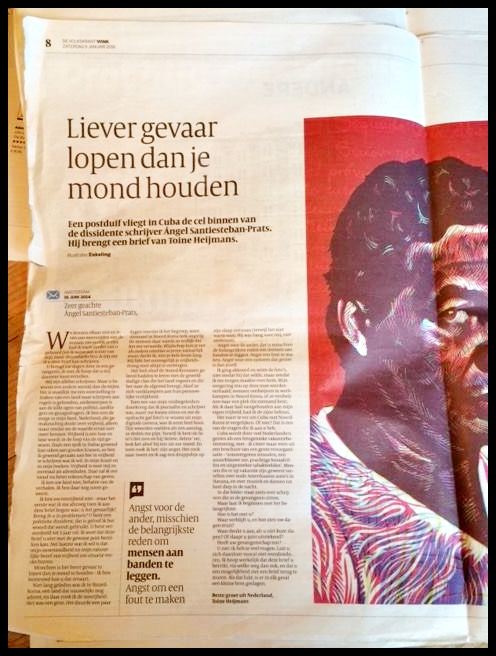
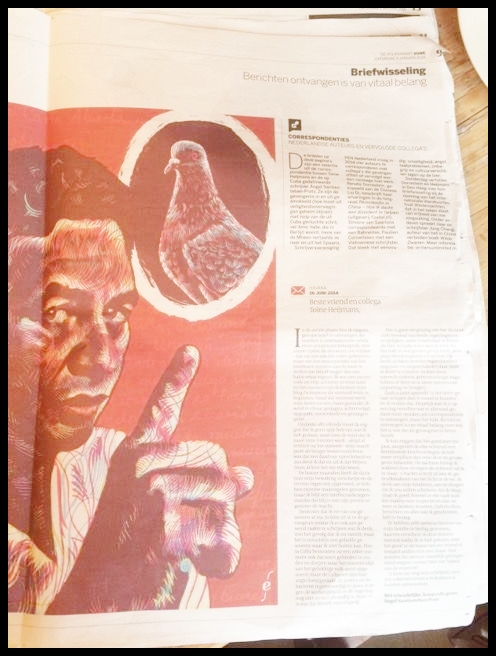
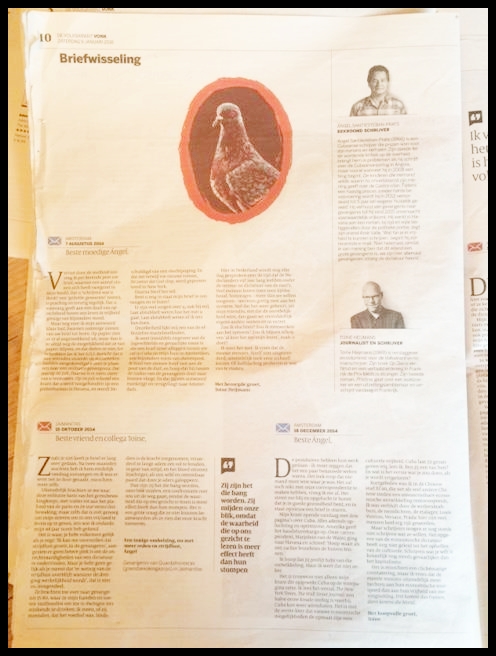
Correspondence between Toine Heijmans and Ángel Santiesteban-Prats

The renown Dutch writer and journalist, Toine Heijmans, a regular columnist for the national Dutch newspaper De Volkskrant, and who sponsored Ángel Santiesteban during his political imprisonment, published the correspondence they maintained during those two and a half years. He has dedicated four pages to it in the prestigious medium. continue reading

We reproduce here the photos of the printed version.

Angel’s Editor, 10 January 2015

Translated by Regina Anavy

Higher Education in Cuba: A Vision (Part 2) / Somos+

Somos+, Rolby Milian, 6 January 2016 — So I begin this second part of my comments remembering the announcement, this past September 6, 7 and 8, through the media of propaganda and creation of the Roundtable excitement, of new “innovative measures” in higher education.

The measures were announced and explained by the Minister himself, Rodolfo Alarcón Ortiz and a government team. It’s worth pointing out, that among other ideas presented by these gentlemen, is the legal reestablishment for the continuing training of professionals, the creation of a new educational level (“non-university higher education”), the requirement of English in order to graduate and the gradual reduction of the length of degree courses to four years.
continue reading

Now, to questions raised with respect to this, they had treasures of linguistic escapism, like: “…these measures are very novel, and right now we can’t exactly explain all the changes they imply….” or “…we still haven’t had meetings to decide how we are going to organize access to the courses.”

What I particularly think is that these measures are a propaganda spectacle about a project that is still in a beginning phase. A typical strategy of the Government to alleviate pressure, deflect attention and pretend that it’s doing something before a crisis of great proportions, like higher education in Cuba (for example, the touted Law of State Businesses, that supposedly will come out in 2017).

From the foregoing I can deduce that right now the Government has no truly solid, concise and intelligent plan to begin solving the multiple problems of higher education in our country.

On the other hand, none of these “measures” match up with the supposed present politics of the Government with respect to the creation of businesses and the increase in private initiatives, in the sense of not mentioning adjustments in the matters of marketing and business management in the related courses of study nor the creation of new disciplines for the training of professionals specializing in this sector (business administration, for example).

With all this it’s difficult not to ask: Are our youth really prepared for a future of economic opening and the creation and development of businesses, with all the logistic and structural support that implies?

My present opinion is no. Youth in Cuba are not ready to efficiently confront an economic opening to the world. Nor does the Government intend to facilitate improvement in the educational system in this sense; in fact, it seems to not even be contemplating this scenario (nor one in which citizens freely participate in any constructive project for the country).

Having arrived at this point, one can look with horror at the future of Cuba, given that the present Government doesn’t offer objective solutions, nor do they listen to proposals that don’t come from their own fiefdom. Which makes me sure that they have no real interest in the education of Cubans. They don’t take it into account or they pretend to ignore reality with respect to the preparation of our professionals, and they ignore the opinions of the student body for creation of their “plans and measures.”

We believe that a packet of emergency measures for the recovery and restructuring of our higher education should be passed, first for the realistic identification of absolutely all the problems, including opinions and proposals from our students.

In addition, there should be no restrictions on absolute freedom of teaching and learning in every one of the institutions and for students, presenting real opportunities for all citizens to have access to higher studies, through an efficient system of vocational training, admission and retention.

Translated by Regina Anavy

Higher education in Cuba: A Vision (Part 1) / Somos+

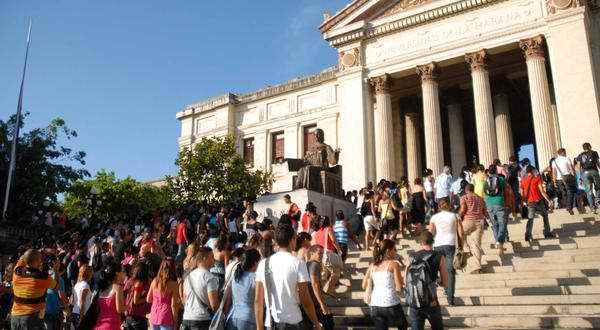
Students at the University of Havana

Somos+, Rolby Milian, 5 January 2016 — Education has always been one of the propaganda bulwarks that the Havana regime has used to sell the image of Cuba as a perfect, paradise society. Like so many others, this has resulted in a lie of gigantic dimensions. But it’s no secret that lately the profound crisis in which the Cuban educational system is plunged has become more and more evident. Fraud, the selling of exams, poor academic results and the critical shortage of professors are some of the reasons that the system of Cuban education, so acclaimed, free and promoted, is in trouble.

Each one of the levels of teaching, by its intrinsic characteristics, suffers decadence in its own way. This time I propose to explain my vision of the problems that presently afflict higher education in our country. Articulating problems and blowing off steam is something that’s been done for more than 50 years; many of us Cubans know very well how to do it — some freely and where they like, and others in the context they consider convenient and comfortable. continue reading

So I’m going to comment similarly about the general proposals that our movement, Somos+, has put forth, for the education reforms, which, we are convinced, will take place when we finally have the freedom to implement a system of informed assessments, with our vision fixed on prosperity for the country and freedom for each citizen.

One of the main problems of higher education in Cuba is that our students can’t gain access to all the information generated in the world about the different subjects of study. They have to learn generally from already out-dated books with retrograde visions and/or prejudiced material, where each paragraph is totally politicized. This fully puts the brakes on the possibility of continually modernizing the study programs, and, of course, it circumvents the professors.

The consequence is that in more than 50 years of isolation, our teaching plans are invalid, and many of our professionals, at the same instant they graduate, aren’t able to compete in the world labor market, which has become more demanding and specialized.

Another visibly problematic situation is the increasing absence of professors able to give classes with the level of excellence that a university requires. The potential recent graduate prefers to look for a way to emigrate (scholarship to study abroad, marriage to a foreigner, jumping on a raft or a flying carpet), and the indices of retention are almost null in the principal faculties. Also, the best professors we once had are now retired, and others have taken the path of emigration or have gone to more profitable jobs: working in hotels or tourism.

These points make it obvious that our educational system needs a radical change; our movement proposes, above all, that education continue to be an inalienable human right of greatest priority, and that the educational process be thought-out in a universal way and that all the information that humanity has generated be put within reach of all students. We reject all the indoctrination, loyalties, myths and personality cults.

For us, education will be a vehicle for the liberation and growth of man, materially as well as spiritually, consumed from all sources, taking as the base the spring of our nationality.

Another question is of the greatest importance: it’s that young people have less motivation to take university courses, which is understandable: for them it means investing five years of their lives in study without earning anything in order to later present their skills in exchange for salaries that don’t even cover basic necessities.

Now, faced with the dichotomy between Engineer or Culinary Worker, our adolescents clearly know that serving in a restaurant brings them closer to their daily bread than does a day designing bridges. Consequently, there has been a considerable reduction in university graduations these last years. This, added to the massive exodus of professionals, is, short of alarming, an urgent call to action for the future of our country.

Our movement proposes, in the interest of minimizing the flight of qualified personnel, that the remuneration for professors be in accord with the importance of education in any society. This is a moral duty of the Nation.

The Cuban Government hasn’t been able to remain blind to the crisis of higher education, and in one of its propaganda strategies, on September 6, 7 and 8 of 2015, it announced a series of “innovative measures.”

In the next post about the subject, I’ll expose the essence of these measures and give my opinion about their effectiveness. I’ll continue to comment on some of the problems and will try to shed a little light on the debate about the preparation of our youth to assume the challenge of bringing clarity and growth to the new Cuba, which we seek, and the need to include them in decisions about the future of education in our country.

Translated by Regina Anavy

Clandestine Fight Clubs are Booming in Cuba / Juan Juan Almeida

Two officers of the People’s Revolutionary Police (PNR) in Cuba in a patrol car.

Juan Juan Almeida, 7 January 2016 — Tired of family conflicts, without a future, restless by today and without a better model for living, clandestine fights become a place where hundreds of Cuban adolescents believe they can fulfill the dream of becoming famous and earning “a lot” of money. It’s a shame that they receive little interest from the State and no sensitivity.

The phenomenon is already part of the underworld, a jungle that seems to combine sports, barbarity and human decadence; something that for the time being can’t be confronted, because it’s impossible to put the brakes on those who have nothing to lose.

A trainer and former member of the Cuban team that participated in the Sydney Olympics explained to me that “with only 5 CUCs (or its equivalent in national money) and the appropriate contacts, anyone can come to those closed and shady places to witness an interesting spectacle. continue reading

“The boxers are young people from the slums who dream of having the money and fame that a professional boxer gets. They’re bored with looking in the mirror of family frustration or of the retired glories of the amateur sport, the national flag having been raised for a gold medal at the Olympics. They don’t have enough money to consume anything, not even in the cheapest makeshift shop.”

“To attend these clandestine coliseums you only have to pay, put yourself on a list and wait; the response arrives by SMS message, which almost always originates from a cell phone with a blocked identity, where they tell you the day, the time, the place and the program.”

The rookies begin charging, depending on whether they win or lose, from 25 to 100 CUC for fights of 4, 6 or 8 rounds, performed in boxing rings built in such an artisanal way that, instead of a ring, they look like cages. And, as in the movies, before starting the fight, the employees register all the bets.

The fighters wear gloves, boxing shorts, mouthpieces and almost never a shirt; and, in spite of looking like outlaws, the support team consists of trainers, ex-martial arts sportsmen, chiropractors, nurses, doctors, sports and health professionals with connections in clinics and hospitals in case of emergency, for any injured boy who needs it.

The PNR (National Revolutionary Police) pursues them.

It’s known that these “illegal circuses,” almost all located in the Havana municipality of Cerro, take place in private gyms and with a business license as “instructor of sports practices,” which, by being designed for a Cuban clientele, would have had to close if they hadn’t struck this vein.

They’re easy to detect, and because of that, there are periods of frequent raids. Although many guess that the earnings from this type of business are impressive, those arrested can’t be indicted because — according to an expert in reliable gossip — it’s not an illegal game but a sports exercise with certain legal guarantees, and there doesn’t exist, as far as I know, a legal description in the penal code that conceptualizes the crime.

Surely the Cuban authorities, moralist and complicated, are thinking about legislation; but the solution is simple and can be found behind that door that still resists opening: authorizing and supporting professional boxing.

Translated by Regina Anavy

Discontent is Growing on the Island / Somos+, Sandy Perez

Somos+, Sandy Pérez, 7 January 2015 — Every day that passes, the Castro dictatorship loses more followers, which was demonstrated in the past elections for delegates to the Municipal Peoples Power Assemblies. The official press supervised by the regime published the results of the polling stations on April 25, in the Juventud Rebelde paper. It’s clear that the figures are made up but, even so, they reflect the growing popular discontent of the now-exhausted Cuban people.

Some 11.22 percent of the electorate didn’t bother to pass through the colleges where they were supposed to vote; that is to say, there are 850,314 people who don’t believe in the political system that has reigned in Cuba since 1959. If you add to that the 343,430 voters who left their ballots blank, and the 372,351 who made them invalid, there are now 1,566,095* non-conformist Cubans, a figure that should worry Castro.

There are several motives for the disinterest showed by the electorate: the very low salaries for workers and pensioners; the lack of housing for young couples and the impossibility of renting, which provokes instability in marriages; the deficiency of the basic basket (ration book) and the low purchasing power.

In the case of young Cubans, most of them are obliged to vote by their parents, who have been indoctrinated since they were little and implant the same fear in their kids. These days you hear things like: “You have to go vote or I’ll be fired from my job!” That’s the sad reality for Cuban youth.

*Translator’s note: The 2013 voting age population in Cuba was reported to be about 8.87 million, with about 8.66 million registered to vote.

Translated by Regina Anavy

Closed Game / Fernando Damaso

Fernando Dámaso, 29 December 2015 — The year 2015 ends, and stagnation seems to have sat squarely on the Cuban authorities. Entrenched in dogma and their absurd demands to the U.S. Government, shielded in the supposed defense of sovereignty and independence, something they forgot when they delivered the country to the Soviets for 32 years, they aren’t moving any political domino tiles, closing the game with the double nine.

The 12th Plenary Session of the Central Committee of the Cuban Communist Party and the work in the commissions, prior to the sessions of the National Assembly, not for the first time repeated the existence of the same problems presented in similar, previous activities, without the appearance of real solutions that would improve the country’s situation or that of its citizens. The talk is of multiple pretenses in all the sectors of production and services, which now form an habitual part of the content of these meetings, where the deputies unanimously approve all agreements without the least disagreement, giving an irrefutable demonstration of totalitarian unity.

The year 2016 is gloomy, with little hope for important changes, at least while the current historical leadership holds power.

Translated by Regina Anavy

A Glance at Cuba in 2015 / Ivan Garcia

Reading_Newspaper_Gerry_Pacher-_ab-620x330Ivan Garcia, 2 January 2016 — Joel Castillo, 19, passed from expectation to frustration in 12 months. After graduating in 2014 in electronics from a technology school south of Havana, he still hasn’t been able to work in his specialty.

“With the reestablishment of diplomatic relations between Cuba and the United States, I thought there would be better options for people. But things remain the same. And I haven’t gotten a job that fits my profile,” says Castillo.

It’s precisely the youngest who are the most disillusioned with the inertia of the olive-green Regime. A government with almost six decades in power and an executive faction whose combined age adds up to more than 300 years should have better policies for its youth. continue reading

Above all, it should take into account that Cuban society is rapidly aging and that in the fiscal year which just finished, in an irregular way, 43,059 compatriots left the Island, an increase of 77 percent in relation to 2014.

Among the irregular emigrants are the terrestrial rafters who, leaving from Ecuador, cross eight countries and different time zones, in order to try to get to the border of the U.S. with Mexico, and those who throw themselves into the sea in precarious embarkations.

If to this quantity we add the more than 20,000 visas for family reunification that the U.S. embassy in Havana grants, in 2015, around 65,000 Cubans abandoned their country in one form or another to go to the U.S.

Other thousands leave for any country. Spain, Germany, Italy, Russia, Alaska, Kazakhstan….Cuba is emptying of young and talented people. In almost all the branches of knowledge, jobs, sports or culture there exists a worrisome deficit.

For many residents on the Island, the future is to “jump the fence.” Ask a Cuban between 15 and 40 years old what his life goal is. Planning an illegal exit or finding a way to emigrate has become a national sport.

Why are Cubans leaving? It’s obvious: The economy continues to be down. It’s not a situation or a period of thin cows. It’s a stationary crisis that has extended for 25 years.

The “Special Period,” that war without the roar of tanks which began in 1990, still hasn’t ended. The inflation is more mundane, but it continues to devour the worker’s salary, and the dual currency is a liability for productivity and economic reasoning.

Economic logic in Cuba is a headache. Whoever works for the State does it eight hours a day, from Monday to Friday, and earns a salary that doesn’t exceed 23 dollars a month. And to have a dignified life, with breakfast and two decent meals, at a minimum you need 250 dollars a month.

Thanks to the taxes, the exaggerated assessments on private entrepreneurs and the poverty wages, the State pays for public health (going downhill) and a highly doctrinaire education.

But no one can repair a house or buy a car. A fundamental repair of a dwelling costs no less than 8,000 dollars. And a Peugeot 508 is worth 300,000 dollars at a State agency. Which is six lifetimes of work for a professional.

With the ration book, every citizen receives monthly, at subsidized prices, seven pounds of rice, 20 ounces of black beans, five pounds of sugar, a pound of chicken and half a pound of soy picadillo. And daily, an insipid bread roll of 80 grams.

These meager rations last for 10 days. The rest of the month you have to take out money and rack your brains. According to the autocrats’ optimistic predictions, in 2015 the Cuban economy grew 4.0 percent, but this growth hasn’t landed on the family table.

On the contrary. Pork, cheese, yogurt, milk, vegetables and fruits went up in price in the State peso markets and in the convertible money shops.

If you have only coffee for breakfast and one hot meal a day, you can understand why more than 65,000 Cubans abandoned their country in 2015. But the economic crisis can’t be summed up by the alimentary arrangement.

Every day life is more uncomfortable. Public transport is a calamity. The streets are torn up, dark and full of water. Garbage accumulates on the corners. Any personal matter occupies several hours or months owing to the lethal bureaucracy.

The hospitals have deteriorated. It’s easier to find a Martian that a medical specialist. In the primary, secondary and high schools, the low quality of teaching is alarming.

The loss of values, family violence, machismo and homophobia are reaching worrisome levels. An important segment of the population barely reads or informs itself. They master around 500 words; when they speak it sounds like they’re barking, and they gesticulate like apes.

They talk by screaming, as if people were deaf, and they listen to loud music. The lack of education has taken root with many Cubans. The most harmful thing isn’t the disorder, the precariousness and the ruins. The worst is living in a nation where you can’t plan for the future.

If you try to change the status quo by political channels, you run risks. Being a dissident in Cuba is illegal. Political parties are prohibited, except the Communist Party, and the institutions of civil society are rigorously controlled by the State.

In 2015, short-term detentions of dissidents multiplied. The beatings of the Ladies in White and peaceful opponents in a park in the neighborhood of Miramar are repeated Sunday after Sunday.

Not even moderate political tendencies are accepted, nor those that flirt with autocracy. Nor alternative press media. The economic and political situations have pushed thousands of Cubans to pack their suitcases and get far away from their country.

Despite the socialized poverty and the lack of freedoms, beginning with December 17, 2014, when Barack Obama and Raúl Castro announced the reestablishment of relations, Cuba became fashionable.

More than 50,000 Americans and famous Anglo-Saxons visited the Island. Among them Conan O’Brien, Rosario Dawson, Paris Hilton, Naomi Campbell, Rihanna, Mick Jagger, Katy Perry, Anne Leibovitz, Frank Gehry, Floyd Mayweather and sports groups from the NBA and the MLB.

Also, representatives from the Democratic and Republican parties, among them Nancy Pelosi, leader of the Democratic minority in the House of Representatives, and delegations of governors from the States of New York, Arkansas, Texas, North Carolina and Missouri, all accompanied by entrepreneurs and businessmen.

The thaw, a much-used work in the international press, has brought to Cuba tourists and people who want to take a selfie in a Havana full of propped-up houses, to ride in an almendron (old American car) and eat in a paladar (private restaurant). Ordinary Cubans see them coming and going. They form part of a thaw that is foreign to them.

Fed up with the hardships and limitations, devoid of hope for a change with the reestablishment of relations between Cuban and the U.S., and noting that in 12 months except for wifi connections in parks and public spaces barely nothing has changed, thousands of Cubans have opted to leave. For any other country.

Iván García

Photo: The photographer, Gerry Pacher, named it “Reading Newspaper,” but of the thousands of images on the Internet that are taken in Havana, we selected it to reflect the decadence of one of the most cosmopolitan cities that existed in the western hemisphere prior to 1959. Taken from the graphic report, “From the Malecón until Ernest Hemingway,” published on Taringa.net.

Translated by Regina Anavy

The Dollar Gains Strength in Cuba / Ivan Garcia

Photo: A branch of Western Union on Obispo Street, Old Havana. According to a manager of this company, 62 percent of Cuban homes receive remittances from the United States. Western Union has offices in 140 of the 158 municipalities in Cuba.

Ivan Garcia, 4 January 2016 — José Manual Cordoví keeps his savings in a rusty cookie tin. He runs a business forging windows, doors and iron in a suburb of low hovels in Arroyo Naranjo, a municipality 40 minutes by car from the heart of Havana.

Cordoví has no relatives or friends who are close to the olive-green mandarins who could give him information. But incessant rumors have encouraged him to change his savings in convertible pesos (CUCs) into U.S. dollars.

“I think that in December or January, those people (the Government) will unify the money and the Cuban convertible will disppear into thin air. They say they’ll respect the money that people have deposited in the bank. But those of us who do business under the table or keep our money under our mattresses could be screwed with a unification of money if it’s accompanied by a depreciation of the CUC,” says José Manuel. continue reading

In Havana, those who have legal or clandestine businesses prefer to bet on the dollar. While the State’s official rate is 87 cents per dollar in face of the convertible peso, people like Obdulio, an illegal jobber, say: “The green bills from 50 to 100 dollars get 95 or 96 cents. I bought others at 93 or 94.”

Every morning, six days a week, Obdulio prowls around the State exchange houses (CADECAs) in hunt of dollars.

“We independent money changers quote a higher price than the Government. Cubans who live in Miami and those who cooperate in Venezuela or Ecuador prefer to sell them to guys like me. Every day I buy 2,000 or 3,000 dollars that I sell later to a buyer at one to one against the chavito (the CUC). Since a month ago, I’ve increased the buying of dollars. Now few want to sell and many want to buy. It seems they smell something in the air,” said Obdulio, seated in a cafe on a central Havana avenue.

Doctors, engineers and sports trainers who render services in Ecuador, Venezuela or Brazil buy important amounts of dollars to get trashy goods, smart phones and home appliances that they later resell on the Island.

Also, occasional “mules” who live in Cuba and travel to the duty-free zone of Colón in Panama or a flea market in Peru or Miami buy dollars by the thousands.

But is there any foundation for the popular intuition of a coming monetary unification and devaluation of the convertible peso (which now is redeemed at one convertible peso for 24 Cuban pesos)? I asked an economist and university professor.

“In 2013, Raúl Castro’s government planned to implement the unification of the two currencies over a term of 18 months. But they haven’t accomplished it. The double monetary system creates distortions in the finances and future business deals with foreign businessmen. There are at least three exchange rates in Cuba. Certain businesses and cooperatives value the CUC at 10 pesos. Others change the CUC at one versus a dollar. And the private businesses and State exchange houses evaluate the CUC at one for 24 or 25 pesos,” says the economist.

And he adds: “Cuban finances are trapped in an unreal bubble. Our two currencies, the Cuban peso (CUP) and the convertible peso (CUC) don’t float on the international exchange market. Their appreciation is artificial, an extremely harmful State policy, since it doesn’t motivate tourists who bring dollars to change a lot of money because of the tax that Fidel Castro placed on the dollar in 2005. The low salaries in Cuba are a brake on the consumer. The unification of the money is not a caprice; it’s a measure that shouldn’t be delayed any more.”

“What could happen when the money is unified?” I asked him.

“There can be three possible scenarios. One: It could cause inflation. Two: And this is already happening, many people would change their savings or find refuge in the dollar due to little confidence in the national currencies. Three: If the unification doesn’t come preceded by a significant devaluation of the convertible peso against the peso, the monetary union would resolve little. They have taken some measures, like issuing bills of high denomination, and sectors like Public Health and ETECSA raising the salaries of their employees. But 1,500 or 1,600 pesos (65 or 70 dollars) continues to be an insignificant salary in proportion to the actual cost of living,” emphasizes the economist.

The expert considers that simultaneously with the monetary unification, they should reduce the inflated mark-ups of up to 300 percent in the State dollar (CUC) stores.

“But the key is in the low productivity which, combined with the laughable salaries, constitute a brake on the consumer, an important base for emerging from the crisis. While there are no transparent norms, a single currency and an exchange rate that is governed by the international standard, growth in the volume of investments and foreign businesses will not be spectacular,” says the university professor.

In such a closed society as Cuba, where a small group of people issue directives, it’s very complicated to know when and how the monetary unification will be carried out.

But there are interesting indications. A recent declaration by the Republican congressman of Illinois, Rodney Davis, accelerated expectations. Davis recently visited the Island on a trade mission, and he declared that Cuban officials informed him that the monetary reform would occur “within a month.”

This past May, Marino Murillo, the obese czar of the Cuban economy, offered some hints at a conference with students at the University of Havana. He told them that at the end of 2015 or the beginning of 2016, the expected monetary unification could happen.

“Don’t ask me what day because I can’t say anything, but keep everything you save in Cuban pesos,” said Murillo.

Although people like the blacksmith, José Manuel Cordoví, prefer to keep their money in dollars.

Iván García

Translated by Regina Anavy

More “Counterrevolutionary” Artists Speak Out For Their Freedom (Part 3) / Angel Santiesteban

Screen capture — A Cuban filmmaker with the black tape of censorship literally covering his mouth.

Ángel Santiesteban-Prats, Havana, 21 December 2015 — In order to complete my personal impression about the G-20* assembly in the Fresa y Chocolate Cultural Film Center this past November 28, I must recognize the solidarity and support of the filmmakers for their colleague, Juan Carlos Cremata, who, through writing, like Enrique Colina among others, showed their disgust and rejection of the assault dealt by the State against the artist, restricting his thinking and his work.

The abuses and injustices committed by the officers and political police have been the last straw for the patience of the unionized filmmakers who — with new verve — have come together with their claims showing that they have matured as people, a society and artists.

The wolf, who for more than half a century has sunk his teeth into the sheep that don’t abide by the rules of the fold, has paused now to wonder why, for the first time, the job of making them submit has been made difficult, and he waits, hoping that they will show some weakness or divide themselves in order to make his job of the bogeyman scaring the children easy.

The dictatorship prefers us to be alone.

I was amazed at the existing cohesion among the constituents of the G-20*, the clarity of their demands, like the Film Law that is indispensable to them in order to continue creating, but, above all, how well disposed they are to continue struggling until they achieve what they demand.

They are not naive, they know that in the eyes of the dictatorship they have been converted into rebels who should be drowned, and if a crack exists, it would be inside one of the columns that integrate the group; and then, beginning with secret conversations with State Security, it would cede before the pressure and would begin to distort, scare, divide and misconstrue the objectives presented from the outset.

Let’s hope that intelligence reigns over fear and serves to save this force that conveys their demands as artists, converts itself into a national necessity and triggers a new pattern in the country’s history.

Their laudable, noble and courageous abilities are the preamble of a new era in which artists recover the dignity that has been lost for more than five decades, letting them be devoured and beaten by the totalitarian Regime for not receiving their punishment.

It is new times, and democracy is the only system possible for any government; now there’s no space for authoritarian regimes (totalitarian) as, for example, Argentina and Venezuela, countries in which the opposition has just won the elections.

Later will come those that are missing, and of course the Castro clan’s dictatorship will have no other option but to cede. With the arrival of freedom, Juan Carlos Cremata and all Cuban artists will recover the cultural spaces that they should not have lost through censorship and prohibitions. Juan Carlos Cremata deserves that space for his talent, strength and commitment.

Let’s hope that without more delay, the Film Law gets approved for the benefit of the seventh art.

Ángel Santiesteban-Prats

Havana, November 2015, under conditional “liberty.”

*Translator’s note: A group of Cuban filmmakers who demand the approval of a Film Law in Cuba. They defend independent production companies. At this meeting they debated censorship and analyzed the case of Juan Carlos Cremata, whose play “The King is Dying” was censored. Cremata was denied the right to stage another play in Cuba.

Translated by Regina Anavy

Nauta vs. Gmail, and the Stupid Strategy / Somos+, Javier Cabrera

Somos+, Javier Cabrera, 30 December 2015 — As a result of the Paris attacks, many governments have put growing pressure on the technology companies to have “backdoors” in order to access users’ information without needing a judicial order. In the U.S., the debate is at its highest point, openly, with the citizens aware of the fight and the technology companies giving their opinions. Such is the case with Apple and others that have announced they won’t deliver users’ data for an increase in security, and the government isn’t taking it easily.

China also is trying to take advantage of the debate, although with a focus a lot more twisted and behind the backs of its citizens, wanting to compel by law all the technology companies to give them whatever information they request, and threatening grave consequences for the economy and the competition. continue reading

Recently the Cuban trolls attacked us in the article, “The Cuban Government is stealing your digital information,” saying that it’s something that happens in the whole world, forgetting the fact that citizens and companies are aware that backdoors have ended. In Cuba, everything is backdoor, since it’s the Government itself that constructs and manages technology security, preventing the development of independent companies and limiting access to the Internet.

There is a gmail.cu with email service. The Government would have to ask Google through a judge for the emails of a specified person, in a range of closed dates, with a formal accusation that wouldn’t be tied to crimes of thought or fabricated. This would limit much of the control they think they now have, and would leave in evidence the methods of State Security.

For that reason, Cuba spends between 3 and 5 million dollars a month, according to conservative estimates, to maintain Nauta.cu as a way of having total access to the correspondence of Cubans. In spite of the large cost, the service suffers “leaks” thanks to poor management. A gmail.cu is perfectly viable today with today’s infrastructure, at zero cost, and with a service that would never drop, break, be interrupted and would cover or exceed the expectations of a public that wants to use more technology. I repeat: It’s completely viable, but as the New York Times says,”It only lacks political will.”

To this we must add that everyone I know in Cuba has an alternative to Nauta for matters where they don’t want the Government sticking its nose in. This strategy limits the real capacity of State Security’s spying but doesn’t lower the cost of Internet services, so desperate people have to use Nauta at moments of urgency. In the real world this is called “competitive barrier and unfair monopoly.”

The Socialist Government Technology is defined in Cuba by the lack of clarity about who has access to your data, the non-existence of defense mechanisms, the lack of transparency in the system, the very high cost and very poor service…with citizens looking for real alternatives to break the control and to show how stupid and unnecessary the whole system is.

We young Cubans must continue to push. We can’t remain indifferent, conforming to what they give and sell us as technology. We are paying for the service; we can make demands. Let’s fight in 2016 for a REAL INTERNET, independent of the Government. We have the right, as does the rest of the world, to discuss our security and to know who has access to our communications. Let’s demand full respect for our privacy and leave it clear that no captain, lieutenant or mercenary of the University of Informatic Sciences (UCI) can give a damn about what we say with our family or friends.

Translated by Regina Anavy

Cuba, One Year After December 17, 2014 / Ivan Garcia

Mujer-en-balcon-y-banderas-620x330

Ivan Garcia, 14 December 2015 — In a basement blackened by humidity and soot, Leonardo Santizo and two workers make cookies, candy and peanut nougat, as a private enterprise.

At the back of the room, piled up in nylon sacks, are hundreds of kilograms of unroasted peanuts, bottles of vegetable oil and all-purpose flour. On a damaged and dirty table, a thermos of recently-made coffee. While they work, they chain-smoke.

“We’ve been on our feet since five in the morning and we work until four in the afternoon. Every day we make 600 cakes, 100 packages of biscuits and 400 tablets of ground peanuts. The average pay is some 400 pesos daily. Sometimes a little more. We sell the cookies and sweets for the most part to private retail businesses,” says Leonardo. continue reading

As in every private business, they apply a double accounting and buy the raw material on the black market. “There’s a balance sheet that is rigged by ONAT (the institution that manages private work in Cuba) and another that they give the business owner, with the real gains and losses. This is the way that all the independent businesses work.”

On December 17, 2014, remembers Leonardo, “The three of us were eating lunch and listening to salsa music on a portable radio when an announcer said that President Raúl Castro would make an important speech.

“We were left without words. After so many years of rattling on about Yankee imperialism, both presidents squared off on their differences. In the afternoon we took up a collection and bought a bottle of aged Havana Club rum, and we began to make plans. We thought that things would get better and we would be able to get raw material from the North. A year has passed and things are still fucked up,” Leonardo confesses.

After drinking a bit of coffee, he continued unloading. “And we can thank God that in one day we earn what a professional earns in a month. I’m not an optimist. Those guys (the Government) don’t intend for people to live better. They want to run all the businesses themselves.”

December 17 was a watershed moment in the national life. It’s hard for Cubans to not remember what they were doing just at noon when the information bomb exploded.

Luis Carlos, a private taxi driver, was driving one of the thousand hybrid autos that circulate in Havana, with a chassis made in the Detroit factories in the 1940s to 1950s, and now rolling with motors and pieces of modern cars.

“Like everyone in Cuba, I believed certain things. I told myself, damn, now the fuckup is over and the idle talk between the Yankees and the Government. That night at home, I thought that soon fast-food restaurants would arrive; they would lower the airfare to Miami and the shops would overflow with food and rubbish from the U.S. One year later, the domino game is still going on,” says Luis Carlos.

If you chat with Cubans who have only coffee for breakfast, this is more or less the register of opinions. In 12 months they have passed from exaggerated expectations to the worst pessimism.

The balance after one year of diplomatic relations and President Obama’s road map to empower the Cuban people and extend the use of new technologies is thin.

There are 40 public plazas where, for two convertible pesos an hour (two days’ salary for a professional), you can have wireless access to the Internet.

There is a contract between the U.S. telecommunications company IDT and ETECSA (Cuba’s telecommunications company). A flurry of famous Americans have visited Cuba and little more.

For the obstruction, because in one year there hasn’t been a larger commercial interchange, the olive-green Regime blames the economic embargo, the military base of Guantánamo, Radio and TV Martí, the Cuban Adjustment Act or any other wildcard.

In those 12 months, the autocracy on the Island has only known how to complain. Or to listen only to proposals about future business with state groups, almost all of them in the orbit of military companies.

The genesis of Plan Obama, to offer a bridge with private entrepreneurs and other Cubans, has been dynamited by Raúl Castro’s government.

It’s no secret that the Island executive has no sympathy for small family businesses. In one of the first sections of the Regime’s economic bible, the so-called Economic Guidelines, it says that the State would not accept the concentration of capital in the hands of individuals.

From here comes the strategy of not permitting Cubans on the Island to invest in their own country or private workers to establish imports or trade with foreign companies.

While private businesses are perceived as nests of criminals, good intentions after December 17 remain only that.

Most Cubans feel prepared for the framework of an economic reform, access to modern capitalism and market economics.

Yohanna, an engineer, was convinced of the benefits of Marxist socialism, and she believed in the utopias of scientific communism. The night before December 17, she was walking on her knees to the entrance of the sanctuary of San Lázaro (Saint Lazarus), south of Havana, to pay a promise to one of the most popular saints in Cuba.

“I asked him that in addition to health he would bless us, since my husband and I had plans to walk to the U.S. by land from Ecuador. The following morning, after hearing the news of the reestablishment of relations, we postponed our plans thinking that things would get better. But seeing the current scenario, the only door that remains open is to emigrate. How and when I don’t know, but I’m convinced that while the same people govern, I have to get out of Cuba,” Yohanna says.

The divide between popular desire and the official narrative is evident. While the optimistic official news tells us that the country is growing, a wide segment of disillusioned Cubans feel trapped in a dead-end street with no way out.

The economy continues leaking, salaries are a joke and having two hot meals a day is an act of prestidigitization. And the Government doesn’t learn.

Iván García

Translated by Regina Anavy