An Inexplicable Explanation / 14ymedio, Reinaldo Escobar

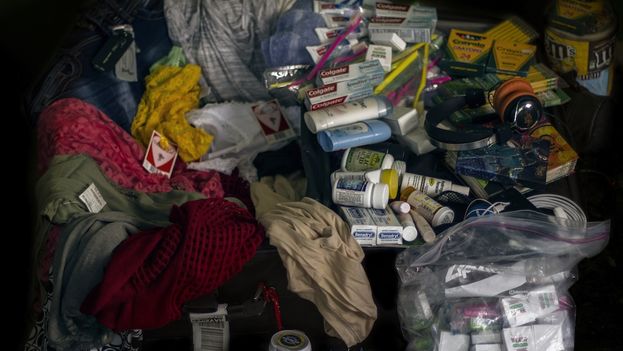
The inside of a traveler's suitcase arriving from Miami (14ymedio)
The inside of a traveler’s suitcase arriving from Miami (14ymedio)

Customs restricts imports even more

Reinaldo Escobar, Havana, 14ymedio | 14 July 2014 — On the occasion of the latest customs regulations that further limit the products that travelers can bring to the island, a group of officials from the General Customs of the Republic of Cuba (AGR) held a press conference to respond to some concerns of the population. Among the pearls exposed there, it’s worth nothing an argument put forward by Idalmis Rosales Milanes, deputy chief of the AGR, where she tried to equate these actions with what happens outside of Cuba. “All countries,” she said, “regulate non-commercial imports to their territory.”

And it’s true. What this official didn’t say is that in all countries there are other regulations for commercial imports to non-state entities. If this weren’t the case, I would have to believe two things: that in the rest of the world all the stores are state-owned, or that the goods for sale in them are produced entirely in the country in which they are located. It gives the impression that this precision is for idiots, because it’s so irrational it’s embarrassing to have to clarify it.

The absurdity is normal only if the entire environment is also absurd. Whoever developed and approved these resolutions was personally persuaded that commerce is a crime unless it is performed by the only state monopoly that they themselves control.

Instead of developing a list detailing how many razors, pairs of shoes or fake nails can be carried in your suitcase, it would be much more useful to allow the importation and sale of whatever merchandise (non-lethal) is produced in the world, and to promote its free trade by private individuals who would be those who would assume the risk of being left with them in their shops if they weren’t able to sell them.

The law should allow the owner of a restaurant to import, in his condition as a private businessperson, the wine, pasta and cheese consumed by his customers. The seamstress should also have the right to bring fabric and dyes from other countries with which she designs her clothes, and the small trader must be able to count on the possibility of bringing the instant glue, the sponges for cleaning, and the hair dye, from other latitudes to the island. All this, backed and supported by commercial permits and import licenses… in the hand of the non-state sector.

That theses commercial imports are on a list of prohibited products, that there is a limit of the number of admissible pieces, that a diversified tax is imposed according to the article… all this would be almost comprehensible and, especially, debatable. What I can’t make heads nor tails of is this “dog in the manger” conduct, which neither eats nor allows others to eat, and in this case neither imports nor allow to be imported; neither trades, nor allows others to trade.

Repaying Debts With Loyalty / 14ymedio, Reinaldo Escobar

14ymedio, Reinaldo Escobar, 4 July 2014 – The Cuban government has sided with Russia on every vote in the United Nations that has concerned Ukraine. It is a surprising outcome in a country that has traditionally defended concepts such as the self-determination of peoples, sovereignty and territorial integrity as key survival issues; a country which now looks kindly on the transfer of immense and rich Ukrainian territories to the control of Moscow.

Also noteworthy is the attention the government has devoted to discrediting its peaceful opponents, labeling them “mercenaries in service to the empire,” given that it has coined the term “independent militias” as a part of its official language, targeted to those who, with the undeniable support of Russia, are leading an authentic operation of imperial expansionism.

But loyalty is profitable and on Friday the lower house of the Russian parliament ratified the cancellation of 90% of Cuba’s debt with the extinct Soviet Union. The gesture will save the Island from a payout of 31.7 billion dollars.

The Russian-Cuban accord, now ratified by the Duma, also provides that the remaining 3.5 billion that makes up the old debt will be paid over ten years and that the amount will be placed in special accounts dedicated exclusively to investments in the Cuban economy.

He who pays with loyalty runs no risks. The one left in a delicate position is he who collects under this concept, because once the debts are settled, the insolvent debtor can suspend his commitments without anyone being able to claim anything.

When Vladimir Putin steps foot on Cuban soil this coming 11 July he will sign the agreements and joint statements, none of which will compel a future commitment to vote for or against Russia in international forums. Clearly I’m speaking of that future we so greatly desire, that future after the change.

4 July 2014

Money Bristles, Yesterday and Today / Miriam Celaya

About the previous post, which -as expected- elicited many well and ill-intentioned comments, I noticed one in particular, a reader commenting about what used to be our digital magazine Consenso, which the commentator himself referred to as having opened a Cuban window on the world. I happen to agree with him and, as part of the management group and the editorial board of that magazine, I thank him for the memories and the praise.

But the truth is that his comment inspired me to search through those articles that were published at the time in Consenso, among which I found one from my friend and colleague Reinaldo Escobar relating to the subject of the debate: money. Because, though some were biased in reading my post and tried to twist the meaning of what I said, attributing it to my personally attacking those “who did not like14ymedio.com”, when read correctly, it shows that what I attack is the vice of envy, questioning other’s finances, exactly the same matter that Reinaldo Escobar discussed in Consenso in 2007.  Contrary to my habit of not posting here articles I have not authored, I reproduce it today, with the previous authorization of the writer. You be the judge about its worth, and I hope you enjoy it.

Money Bristles

Reinaldo Escobar

It seems almost superfluous to explain that any political activity generates costs, from the essential existence of a professional staff, dedicated to party work on a full time basis, to the development and dissemination of documents, including trips involving transportation, food and lodging outside the cities where they reside; organizing seminars, meetings or press conferences, or simply connecting to the Internet. Can you think how it would be possible to carry out politics without these things? continue reading

There isn’t the slightest possibility for an entity in the nascent Cuban civil society to establish anything like a lucrative business to cover the costs of political work. There are no cafeterias, rental rooms, bicycle repair shops or birthday clown entertainers willing or able to meet those expenses. Not even one of the leaders of the internal opposition has his own resources, family assets from before the revolution, or has jewelry to sell or an inheritance to enjoy; most of them do not receive a salary, they are unemployed. However they engage in politics in a professional manner, they secure their own transportation and stays away from home, they undertake conferences, print documents, receive and send emails. Where does the money come from?

The Cuban government’s answer to this question is that the money comes from the US, be it Florida exiles, independent foundations, or the American government itself, which, if there ever was any doubt, has just approved an $80 million budget to this effect. It is known that some EU or Latin American countries also contribute, but it is clear that, according to the official interpretation of the facts, this last source of funds is, when all is said and done, from the US, by way of an extensive and tangled pathway.

Perhaps the most interesting question is not where the money comes from, but under what conditions it is received.

José Martí raised funds for Cuban independence from selfless Tampa cigars manufacturers, but also from wealthy American, Mexican and Cuban philanthropists. There used to be a picture at the Museum of the Revolution, long ago removed, where Fidel Castro was seen sitting at a table in front of a mountain (a small mountain) of dollars. The photo was taken in New York, while raising funds to buy the yacht Granma, plus weapons for the 82 revolutionaries. Were these donations subject to any conditions? Of course they were! The funds were donated, in the first case, to end the humiliating Spanish colony and in the second, on condition to overthrow Batista’s dictatorship. There is no evidence, not even hallway gossip, giving the impression that the money was used for the personal benefit of the apostle [as Cubans call Jose Marti], who always wore the same threadbare black suit, or on luxuries of the foremost leader, who, it is rumored, did not cross his legs in public so none could see the holes on the soles of his shoes.

The triumphant Cuban revolution received lots of aid from the Soviet Union and other socialist countries, and I am speaking just of what is euphemistically called “fair trade between poor and developed countries”. I’m talking about ships full of weapons and other war supplies, about college scholarships, technology transfer, collaboration of police intelligence, even of space travel, which would have never happened if Cuba had not complied with the condition of becoming the first socialist country in the Western Hemisphere. It is a historical fact that when Che Guevara traveled to China, a joint communique was issued on completion of his trip, as is the custom, in which the Chinese, bragging with sincerity, objected to the qualification of “disinterested” made by the Cubans about the support the Asian giant was giving the small island.

In those early years, parallel to the subsidy of the revolution, the financing of the counterrevolution began. It is well documented that at least between 1959 and 1965 almost all the opposition activities were directly funded by the CIA, the Pentagon, and the US State Department. The central characters themselves have stated so, and all of them justified this financing, so obviously stipulated by the fact that the government of Fidel Castro was supported by Communist powers.

Today, Cuban dissidents are imprisoned when it is shown, or when there is a conviction, that they have received money from the US. That was, in every case, the heaviest accusations resulting in disproportionate sentences to which the 75 of the Black Spring of 2003 were subjected. This went as far as to include in the same boat journalists receiving payment in exchange for articles in foreign newspapers. It led, among other consequences, to new divisions among the internal opposition: those not receiving money and receiving it through the U.S. Interests Section, and those who did not receive funds from the US, but from independent institutions in Europe and Latin America.

What almost no one asks is where the money comes from today to publish all those costly national and provincial newspapers, organs of the Communist Party, of the Union of Young Communists, or the Central Cuban Workers Union. How were the open forums financed all this time, the militant marches, the whole material base of the “Battle of Ideas”, the campaigns for the rescue of the five combatants of the Interior Ministry, jailed in the United States, the trips abroad, the foreign guests at political events, billboards on highways, t-shirts with slogans, or the little flags.

Would it be possible to pay all that with the monthly member contributions to these organizations, which isn’t even enough to pay the salaries of thousands of professional cadres scattered throughout the whole country, in every province, in every municipality, occupying premises that do not pay rent, where water and electricity are consumed, where there are phones and secretaries, gas-guzzling cars that include a chauffeur?

Political work involves disbursements, be it from the opposition or the government. If the party in power has at its disposal boxes of public funds to cover  expenses and those in the opposition, besides not having even legal recognition, also don’t have, literally, a place to drop dead, what is the recommendation? To let the government do whatever it wants without offering the slightest resistance, or to limit the action only to within earshot, without even a megaphone to amplify it?

The only option the members of the opposition on the island have been cornered into, in order to be able to exercise their specific political tendency, is that of accepting financing from whomever offers it, unless they are OK with being a “family faction” without the least echo in society.  This is part of the deliberate intention on the part of the government to disallow any alternative of political change in Cuba. This intention stretches from a long series of die-hard slogans (socialism or death, we are ready to shed the last drop of blood, the Island will sink in the sea first…) to the modification of the constitution to enact the immobility of the system. The harder it is to dissent, the better for the government. If the material and legal obstacles aren’t enough, if fear of going to jail is not enough, that’s where the ethical scruples (prejudices?) come in, preventing decent people from accepting funds that automatically turn them into mercenaries of the imperialism.

Ideally, the Cuban media should not be the party’s fiefdom, but a public space for all political persuasions; with the state budget partially allocated to fund the work of civil society and of political parties duly registered under the law. If the state, instead of distributing all these funds and resources in an impartial manner, funds that proceed from the working class, monopolizes them only for the favored party, it loses its moral right to ask where the opposition’s money comes from. Additionally, it should not deny anyone the possibility of becoming a disinterested donor or a calculating investor. The state should protect those citizens who have a political proposal, the right to defend it and have it compete publicly and on equal terms, without being forced to sell their souls to the devil.

Translated by Norma Whiting

Posted 9 June 2014 by Miriam Celaya

The Loneliness of the Tobacco Growers / 14ymedio, Reinaldo Escobar

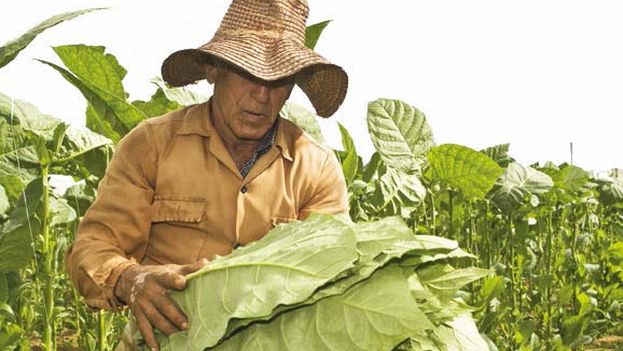
Farmer with tobacco leaves

Reinaldo Escobar, Pinar del Rio, 5 July 2014

The tobacco growers of San Juan y Martinez listened — between astonishment and helplessness – to the National Assembly debates. They expected that their difficulties and the problems of payment would be addressed during the discussions of some committee. They were disappointed.

In the Rafael Morán, cooperative, located in the town of San Juan y Martinez, frustration spread among the farmers. Just weeks earlier, the producers had been visited by a representative of the National Association of Small Farmers (ANAP), representatives of the Communist Party in the town, and several members of the National Tabacuba Business. The tobacco farmers expressed their difficulties and complaints to these officials.

The meeting was part of the government campaign called “We’re going for more …” whose visible face was Vice President Jose Ramon Machado Ventura. The State offensive to improve production led to these meetings between the producers and the authorities of the sector. In the meetings the feeling of many producers emerged, some of which asserted publicly that “If there’s no change in the price of tobacco, it is going to be very difficult.” continue reading

Among the main complaints expressed by the tobacco farmers was the discrepancy between the real costs of producing tobacco and the price that the state companies pay for dried tobacco. According to the official figures, it should cost a farmer 1.255 Cuban pesos (CUP) to produce 100 pounds of tobacco, but in reality the costs far exceed the official estimate.

Even the slightest setback so that leads the tobacco harvest to being considered “affected,” which lowers its price and leaves the producer in arrears. The disagreement with the payments made by State, the only permitted buyer, for the so-called “affected tobacco,” also showed up at the meeting. This supposedly damaged raw material is used industrially in the production of cigarettes. In the case of the plantations of San Juan y Martinez, the “affected leaves” are excellent quality and quality cigars and cigarettes can be made with them.

“It brings in great wealth in hard currency, and yet the peasant loses,” the producer laments.

The State standards establish that tobacco is “affected” if it doesn’t have good colors nor an adequate constitution to be considered high quality. But this doesn’t justify the paltry price of 345 Cuban pesos (CUP) per 100 pounds, established by the official valuation. If a farmer has the least amount affected, then he loses all the economic support that could pay for the crop. For its part, the State gets huge dividends, especially in the international market.

Hence, the concern of these tobacco growers on seeing that the National Assembly hasn’t been informed that there is no review process for the popularly called “purchase law.” The absence of any discussion of this subject made the growers feel cheated and forgotten. In the case of Pinar del Rio the prices are higher than in other provinces, so the dissatisfaction is higher in other tobacco-growing regions of the country.

“We haven’t seen our demands reflected,” claims Néstor Pérez González. “We also discussed the situation of poverty in the area, which is reflected in the farmers’ standard of living and doesn’t reflect the fact that this municipality exceed its tobacco production goals,” the farmer says.

During the conversation Néstor Pérez expressed his concern without restraint.” This year has been critical, so we are predicting a worse economic scenario for the area.” The crop damage has been caused by excessive rainfall during the period. A consequence of this situation is that the farmers have perceived the injustice of low payments for the so-called “affected tobacco” more seriously. “It will be affected, but it brings in great wealth in hard currency, and yet the peasant loses,” the producer laments.

“The so-called ‘cost sheets’ that they are offering us are well below the real costs of production; thus our demand that the prices should be raised,” says Juan Pablo, who combines his tobacco with the growing of lowers and fruit. The problem greatly affects the cooperatives such as the Basic Units of Cooperative Production (UBPC).

The tobacco growers have taken the pulse of the situation and feel that are being left aside. “We had the illusion that the Assembly would reflect and we would glimpse some change.” However, the last parliamentary session has brought more frustration than hope to the tobacco growing area of San Juan y Martinez and the mythical Hoyo de Monterrey.

Perception of Risks / Reinaldo Escobar

There are many who try to imprint their pronouncements with the hallmark of official discourse. To blend in and achieve uniformity with that language, they select certain words, certain phrases and investigate ways to say typical newspaper articles, academic dissertations or legal allegations.

One of the most recent linguistic elements of this nature consists of a curious pairing in which one part is the concept of “risk perception,” and the other part is “vulnerability.” Meteorologists, epidemiologists, traffic safety specialists, economists, don’t hesitate to say that to the point that the perception of risk is higher, one can reduce the vulnerability of the presumed victims of a danger.

I confess my ignorance of the origin of this equation, which not only seems logical to me but even lucid. I suspect that it has been imported from an international academic environment — perhaps from military strategy or scientific language — when some clever member of a Cuban delegation was caught out there sowing it in the fertile ground of lack of originality in the official phraseology. The funny thing is that the verbal combination is not indebted to either Marxist dialectic or the harangues of the barricade. It’s implacably cold, but catchy.

Try it yourself and confirm it. Say, for example, that the lack of information in our press about criminal acts noticeably reduces the perception of risk that a person in the street should have and, as a consequence, increases the vulnerability of a citizen to criminal attacks. The triumphalist tone of the ministerial reports to the Cuban parliament don’t allow an adequate perception of the risks that threaten our society, which leads to greater vulnerability, be it with regards to the economy, education, healthcare, tourism, or anything else.

If we think of all the vulnerabilities that open before us, like cracks on the edge of the abyss, when the lack of perception of risk posed by transparency, secrecy, the verticality of command, the lack of citizen participation in decisions, the absence of political debate, the penalization of dissent, in short, it’s scary.Perceiving the risks, decreases our vulnerability.

27 June 2014

I Am Nothing Else But Cuban / 14ymedio, Reinaldo Escobar, Carlos Alberto Montaner

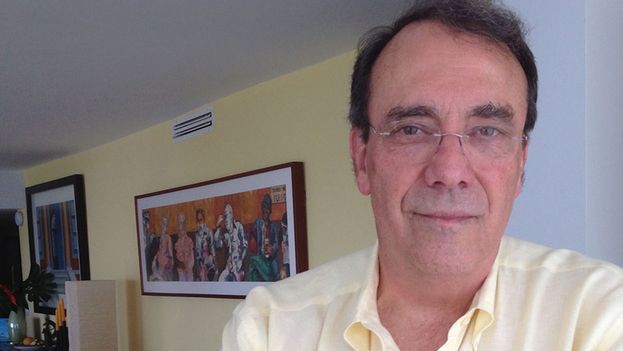
Carlos Alberto Montaner. 14ymedio

Interview with Carlos Alberto Montaner, writer, journalist and political

REINALDO ESCOBAR, Havana, 24 June 2014 — Carlos Alberto Montaner has long been a kind of black beast in the official Cuban government propaganda. Accused of being a terrorist, a CIA agent, an eminence gris in the world counterrevolution, in real life he is an academic and journalist who has been involved in politics without losing his vocation as a writer. In his home in Miami, in front of a window where the bipolar horizon is divided between Cuba and Florida, he responds to 14ymedio’s questions.

Question: You’ve had four passions: teaching, journalism, politics and literature. You’ve alternated between them, although at times some have predominated over others. Will it continue this way?

Answer: For four years I was a professor at a university in Puerto Rico, I enjoyed what I did. I’ve always enjoyed teaching, lecturing, giving classes. But I continue to do journalism, I haven’t renounced politics, and more and more I want to write novels.

Question: Journalism has many dilemmas: fulfill a political assignment, please the readers as if information were one more commodity, and make a commitment to the truth. How do you decide?

Answer: This is greatly debated today. In the United States they want to turn journalists into an objective machine, without a heart or compassion, that can’t make moral judgments, because that’s supposedly discredited. I think that’s a mistake. In these different lives that one has for the different occupations, there are many responsibilities: you have to take care of your family, there is a professional responsibility, and there is a civic responsibility to the wider society in which you live, and this requires making decisions of a moral character which are sometimes at odds with journalism’s too narrow criteria. continue reading

Question: But in any event you have to please the readers?

Answer: The journalist is obliged to interpret what society wants. If you don’t become a person able to summarize and argue what society suspects, then you aren’t going to connect with society, with the readers. One thing I’ve learned over the years is that most people who read you are looking for corroboration of their opinions, the coherent organization of their opinions.

When you’ve managed to bring people’s emotions and beliefs to a comprehensible language, then you’ve become a successful journalist. Authoritarian elements lie when they say that journalists represent the interests of the owners. That’s not true. For the media to function it has to represent the opinions and interests of its readers, to be a spokesperson for a sector of society.

The massacres of Fidel Castro’s early days were repugnant to me and gave me the impression of a detestable person

Question: Were you born a liberal, have you always been a liberal, will you die a liberal?

Answer: I’ve had my evolution. For a very short time I was a revolutionary boy who believed in the Revolution, but almost immediately the massacres of Fidel Castro’s early days were repugnant to me and gave me the impression of a detestable person. No one who talks so many hours straight can be a reliable person at all. Later I felt like a social democrat. That lasted longer. The first lecture I gave I was very young, 18 or 19, it was about the supposed falsity of this affirmation that “the State was a bad administrator.” I had a period until the seventies when I thought the social democratic solution would be better.

When I moved to Spain the in 70s and lived the change intensely and approached the Spanish liberal groups, I discovered something that no one in Cuba knew, that was liberal thinking. It was the time when the triumph of Keynesian ideas, social democracy and all that, were sold.

Question: Do you think that it’s a false dilemma between social justice and freedom?

Answer: There is always a time when we must make decisions confronting this dilemma, but to begin, it’s very difficult for me today to accept that idea that there is an abstract thing that is social justice. I don’t know what that is, and I don’t know because in reality no one knows what that is. There are suppositions that a certain number of benefits correspond to a certain number of people and that there are some officials who arbitrarily are those who know what those benefits are and to whom they’re assigned, and on top of that these officials make decisions in this direction and what they do are atrocities and destroy the possibility of creating wealth.

So, that said, what’s important is that everyone has equal opportunities to compete, and that everyone has the opportunity to study and the best possible health. You can’t ask a malnourished child who comes from a very poor home to compete when his possibilities are limited compared to others. We have to create the conditions where people can achieve their dreams and pursue their objectives, which also change with the evolution of one’s live. Everyone has his projects. There are those who want to be a philosopher, and there are those who want to be an entrepreneur. Nobody has the right to decide what is best for others.

That’s one of the great atrocities of socialism: the existence of a political elite who are the ones who know what happiness is, what should be the price of things, what we should consume, what we should study, what work we should do. Freedom consists precisely of this, the power to make decisions. The more decisions you can make, the freer you are.

I’m interested in participating in whatever change process there is in Cuba, but I believe that (this) process must be in the hands of the young people inside Cuba

Question: All signs indicate that from now on you are going to dedicate more time to literature than to politics. Is this true?

Answer: Literature, writing books of fiction, is an activity more appropriate for seniors than is politics, which is an activity for much younger people.

Question: Does that mean you’ve given up politics?

Answer: No, I never gave up politics in the same way that I never chose it. The political vocation comes naturally. I have a political vocation and I’m interested in participating in whatever change process there is in Cuba, but I believe that any process of this kind must be in the hands of the young people inside Cuba.

Question: You have a clear formulation of the kind of journalist and politician you want to be. Have you defined your style as a novelist?

Answer: I think the language should be used to the benefit of the reader. I don’t believe in baroque literature nor in the value of the phrase that isn’t understood. Gongorism has never interested me. Lezama Lima seems to me to be a very respectable figure, but his writing doesn’t interest me, and I mention this as a paradigm of the kind of literature that takes its quality and academic and literary range as a consequence of its difficulty. What’s important to me is the ability to say things in an elegant, creative but transparent way, with regards to form.

Then there are the technical aspects of the use of grammatical persons, the use precise adjectives, in short, the management of the language. I have published five novels, I have started a sixth. In the first. Perro mundo (Dog World), I related something I experienced and that is basically the story of people who are faced with a terrible choice: either submit or die. There is a character who decides to die rather than submit because his unique ability to act as a human being is to say no, to refuse what they want to impose on him, because to accept it would make him an animal.

From there what has interested me is to tell stories with fictional characters placed in realistic scenarios. La trama (The Plot) plays with the story of the bombing of the Maine, the battleship that exploded in Havana Bay and prompted the intervention of the United States in the War of Independence.

Julio Lobo, the Cuban sugar magnate who collected curious objects and documents – among them the act of the independence of Chile and things like that – had a sworn statement from a group of anarchists in the early twentieth century where they claimed that they were the ones who carried out the explosion. From this data I construct that story, how it was that some anarchists blew up the Maine in April 1898. I use the framework of how they anarchists worked in the U.S. and from there developed the plot.

Years passed dedicated to political and business activities, I picked up the novel again with La mujer del coronel (The Colonel’s Wife), a true story where there was an element of personal challenge. I wanted to explore what is most difficult, which is erotic language, difficult because when people take off their clothes they say things that aren’t very literary and that can be taken as obscene. You move between kitsch and vulgarity. In this case there were two elements, I wanted to tell the story of what seems to me the worst horror of the Cuban Revolution is the affective control of individuals. To decide who you can love and who you can’t, and to punish you when you part from what they believe.

When the government decided in the early 60s that whose who stayed in Cuba shouldn’t have relations with family members who left the country, this was a terrible crime. To give the order that you can’t love your mother, a brother, your friends, this is terrible. I had had that experience in Puerto Rico when a delegation of Cuban athletes came under the direction of José Llanusa, the director of the National Institute of Sports, Physical Education and Recreation, who has been my friend and my basketball coach.

The mother of this man, who became the Minister of Education in Cuba, had been exiled to Puerto Rico and as she was gravely ill she wanted to see her son before she died. But he decided he wouldn’t go see her because he preferred to behave as a revolutionary. This desire to pretend to become the master of human emotions, against which I have always rebelled, is what I wanted to relate in the story of this man, a senior army officer whom they ordered to separate from his wife because there was evidence that she had been unfaithful.

I’d love to have coffee with you at 14ymedio’s offices (but) I think I’ll die without returning to Cuba

The fourth novel is Otra vez adíos (Goodbye Again), which is my favorite. I read once that every ten years Freud arranged to have a portrait done, and this is the story of Freud’s portrait painter, who was Jewish, who had to flee Germany and ended up in Cuba. He ends up having to say goodbye again when the Cuban Revolution comes and he goes to New York.

Tiempo de canallas, which owes a debt to Otra vez adiós, is out of print. It has a chapter about the Cold War, which relates how an anti-communist front was formed on the island with Salvador de Maradiaga and Julian Gorqueno who, in Cuba, counted on Raul Roa. It was the era when Havana celebrated the Congress for Cultural Freedom. I realized that this story of the Battle of Ideas between the Soviet Union and the United States was so extraordinary that it deserved to be addressed as a separate subject in another book.

Tiempo de canallas, is a political thriller set in the time when the Central Intelligence Agency was created. It narrates the nature of those world peace congresses that rested on the propaganda concept with a binary structure where there were good communists and evil capitalists… but it doesn’t tell more because it’s a thriller.

Question. Would you like to go back to Cuba?

Answer. Yes, I would. I am nothing other than Cuban, although I have two other nationalities, the Spanish and American. I left the island at 18 and now I’m 71. I would like to participate in the reconstruction of Cuba, I’d love to have coffee with you at 14ymedio’s offices, stroll through the places of my childhood or the ruins of the places of my childhood. I grew up on Tejadillo street in Old Havana, it was a nice place where you could hear the bells of the Cathedral…

Question. Do you think that will be possible?

Answer. No. I think I will die without returning to Cuba.
“One of the Hallmarks of the Twenty-first Century Will Be Overcoming the Burden of Political Labels” / 14ymedio, Eliecer Avila, Reinaldo Escobar

Eliecer Avila. 14ymedio

We speak with the founder of the political movement Somos+ (We Are More)

Reinaldo Escobar, Havana | May 30, 2014 – Eliécer Ávila launched the website this week of the political movement Somos+ (We Are More), which he created in June 2013. This 29-year-old computer engineer published a letter to young Cubans asking them to participate in “the reconstruction of the country.”

Question: What are the objectives of this movement?

Answer: We call ourselves Somos+ because we believe that every day there are more of us in Cuba dreaming of a different future. Among our objectives is to start talking among ourselves to know how many of us there are who have different ideas about how the country should be managed, from an economic, political, social point of view with regards to rights and freedoms.

Today we are isolated, and thus we have the idea that we are 11 million people thinking the same thing but not talking to each other about it, because there is neither the necessary confidence nor the platform to serve as a loudspeaker for people to express themselves without fear.
We are aware that in this early stage there will not be many people who want to be part of the movement, but we hope that we can count on a vanguard. We don’t expect to be a mass movement, but we can bring together an important number of responsible and thinking young people around a project for Cuba. We believe that it’s not enough to describe and criticize problems, we have to go from complaints to active participation and this participation implies that we need to organize ourselves. continue reading

Q: This has been a significant step in the evolution of your activism. At what point did you decide to found Somos+?

A. In February 2007 a video released on alternative sites showed a discussion I had with Ricardo Alarcón, then president of the National Assembly of People’s Power. From that moment hundreds or thousands of people from across the country approached me.

I noticed that people had huge cravings, cumulative desires, to share ideas, and that there was an enormous overlap in these ideas. I heard very similar things in Guantanamo, Camaguey and Pinar del Río. Then, in the same way that a businessman identifies what is called “market niches,” a politician or an aspiring politician should know how to find the missing link in a certain chain that will make things start to happen.
What we lack are platforms where the greatest possible number of Cubans can come together to talk; for example there are 20,000 of us who support the urgent need to give Cubans open access to the Internet.

“It’s not enough to describe or criticize the problems, we have to shift from complaining to active participation.”

Q. Throughout this half century there have been many initiatives to create political platforms. What differentiates Somos+ from what has happened so far? Is it about continuity or rejection?

A. We can’t ignore these organizations, many of them very respectable like the Varela Project that collected more than 11,000 signatures and presented them to the Parliament. There are precedents in the history of the Cuban opposition that have been developed by talented, serious, hard-working people. All these initiatives deserve respect. But everyone can come up with his own, named, initiative, something with his own history specific to the time the project is undertaken.

Q. One of the issues most discussed currently among the opposition is that of unity. Do you think creating a new movement contributes to or hurts this aspiration?

A. In order to join forces there have to be forces and I think that everyone, on their part, can capitalize on all the energies in their group, and in their generation and this is also a way that in the end we’ll have more forces to unite.

Q. It’s almost inevitable that a political movement is labeled based on classifying it among the known political leanings. Left, center, right, social democrat, liberal, Christian democrat, etc. What do you think would be the label most acceptable to Somos+?

A. The issue of labels, although to our regret it still exists, in the long term will be seen as a remnant of the 20th century. I have the impression that one of hallmarks of the 21st century with regards to political conceptions, will be overcoming the burden of political labels. On some issues we may have opinions leaning to the right, and on others to the left. So those who feel obliged to define us using these old classification tools will have to settle with placing us in the center.

We’re not unaware of the importance of the free market, but we observe with close attention that there has to be social justice. The different tendencies can be expressed like the legs of a table which, when everyone has the same freedom of action, we have to find social equilibrium.

With the Somos+ movement there will never be a single idea. We are open to people who are members of the Communist Party or who have openly declared themselves to the right or left. We want to bring together those who believe in clear goals. There could be many Communists here who are in agreement with us that we need a greater degree of participation, that we lack a democratic parliament, that Cuba needs to be inserted once and for all into the technological globalization to be present in the world. We will not refuse anyone the right to participate because they have a different ideological viewpoint.

“A good strategy for making progress in this field as turbulent as this is to pay less attention to what the adversaries say”

Q. What does a person have to do to join the Somos+ movement? Do you include Cubans living outside the island?

A. We are going to take our ideas everywhere. Already in eight provinces we have been invited to give conferences on the subject. It’s about young people who are eager to do something and don’t know how. Friends, family, neighbors who get together.

Among the founding documents that are posted on our website there is a summary of our ideas and principles, and also a Letter to Young People where I explain our motivation. We have included a form that people can fill out with their particulars, both those living on the Island and those who live anywhere else in the world, provided they share the objectives of our movement.

Q. Presumably that now attacks will come. From official institutions that will accuse you of being another mercenary of the empire and from sectors of the opposition that will say that your movement is a maneuver by Raúl Castro to make people believe he is democratizing. What answers do you have for one or the other?

A. A good strategy for advancement in this very turbulent field is to dedicate less attention to what your adversaries say and more attention to communicating with people. That is what we are going to spend 99.99% of our time on, regardless of what extremists from either sector say.

Q. I’d like it if you would get ahead here of the one question you are going to be asked from all directions and with the worst intentions. How is the movement financed?

A. The members of the movement will make voluntary contributions to help defray costs. That is reflected in our bylaws. It’s impossible to do what we want to do without resources and it would be very irresponsible to try to do it without stable economic support. Our finances will be public and we will prepare a report so our accounts can be audited.

If you sell a pig and you want to bring a part of the profit to our movement you can do so, like Christians do in their churches to maintain the church. This movement is our faith.

Implicit in the bylaws is that any natural or legal person can make donations as long as they comply with certain principles: that the money does not come from illicit sources, that they are not trying to influence the politics of the movement with a donation, that they haven’t participated in violent acts. We don’t believe that the enemy of our adversary is necessarily our friend. We would love to have a public debate with the Communist Party on the topic of how to finance a political organization.

Q. One last question that someone asked Fidel Castro in 1954, when he was your age: Do you plan, at some point, to perpetuate yourself in power if you achieve your purpose?

A. We won’t leave for tomorrow the issue of handover of positions. Internally we have elections and this will be a habit we will continue. I personally disagree with any initiative that can lead to a person remaining in power. The 1940 Cuban constitutions addresses this with great clarity.

A Preview of the Next Cuba / 14ymedio, Manuel Cuesta Morua, Reinaldo Escobar

  • Interview with Manuel Cuesta Morúa from Constitutional Consensus
  • Options under discussion: Change the 1940 Constitution, the 1976 update or create a new constitution
  • The Project involves most of the relevant organizations from the civic and political community, inside and outside Cuba
Manuel Cuesta Morua
Manuel Cuesta Morúa

Reinaldo Escobar, Havana | May 23, 2014

Question. What is the objective of the Constitutional Consensus project?

Response. To convene civil society and citizens to work for constitutional change, and to create a new Cuban constitution that is based on three key realities and requirements: citizen control of the State, which is the premise of democracy; the rule of law, which ensures that no one is above the law; and the limitation of power, without which there is no respect for fundamental freedoms. This is the central objective, seen through three integral and interdependent paths.

    We are still governed by what is probably the last Constitution in the Soviet mold still in existence in the world continue reading

There is another collateral purpose, basic to the consistency of a society and a constitutional state. This purpose is the cultural empowerment of Cubans with regard to laws, citizenship and the rule of law, accompanied by and based on the contributions of the independent organizations of Cuban jurists. As experience shows, the best constitutions sleep the sleep of the righteous if they are not based on a culture of rights and law. And the issue of constitutional culture in Cuba needs to be tackled hard for two main reasons: the first is that as the so-called Revolution has been and is the quintessential source of law, we Cubans are not familiar with the law and its value for coexistence; the second is that we are still governed by what is probably the last Constitution in the Soviet mold still in existence in the world — I do not know if you remember the Russian Constitution of 1936 that became the model for the current Cuban constitution — and as you know, it has nothing to do with our traditions and culture.

Q. What organizations sponsor you?

R. Constitutional Consensus is a horizontal proposal without hierarchies or rigid organizational charts. Participating are the majority of the most relevant organizations of the civic and political community, inside and outside Cuba. At www.consensoconstitucional.com you can see a list of all the sponsors, which I am not mentioning here because the list should continue to grow.

Q. At what stage are you now, and when (not in terms of a date but in signs) will you consider you have fulfilled your purpose?

A. Right now we are preparing Constitutional Initiative Discussions across the country, and we are preparing for the various meetings to be held outside of Cuba. In late May, between 8 and 10 people will meet in each of these Constitutional Initiative Discussions with the purpose of bringing us to a reasonable point for constitutional change: if is it the Reformed Constitution of 1976, if it is the paradigmatic Constitution of 1940, or if it is a new constitution. We first want to find a consensus that focuses on public legitimacy, unfortunately it cannot be among all Cubans, and then start designing a draft that will be drawn up by the Constitutional Initiative Committees, formed by lawyers and specialists in various law-related materials within a constitution.

These meetings will also be held in Madrid and Puerto Rico, and in July multiple organizations will come together in Miami at Florida International University (FIU).

We will have achieved our purpose, and for now I’m being a minimalist, when we have drawn up this draft that reflects the consensus of all participants, when we have collected up a critical mass of citizens’ signatures demanding a new constituent process, and when we have managed to stabilize Constitutional Initiative Discussions in each municipality as permanent spaces for interaction and exchange with citizens throughout the legal process. If we citizens do not set up a monitoring program over the quality of laws, compliance with legality, and the arbitrariness inherent to all immune and unpunished power, it’s worthless to have the best constitution. We had the Constitution of 1940 and Cuba finds itself rating less than zero on constitutional and legal culture.

There is, of course, a maximalist goal: to have a constitutional and legal system that is an expression of our needs, of our rights and of our demands to coexist in a truly civilized way. Uncivil behavior is the deepest reality of our country, from top to bottom. Fromthe powers-that-be to society. The rules of the game require a constitution that includes all Cubans. Inside and out of Cuba.

The Constitutional Consensus is to define the what, not the who. We care more about the nature of power than the individuals who exercise it.

Q. Do you believe that the country’s leadership has an essential quota of good faith that is required for the project not be aborted or even treated as a hostile action intended to overthrow the government?

R. The Cuban government is not characterized by good faith. The logic of power is not born able to understand the rational tie with the rest of the mortals, but is one of pure and hard domination. So there can be no good faith. However, this government shows capacity for pragmatism precisely because it wants to retain power. Reality force, and hopefully in this case, that of the constitutional change, the facts will impose themselves. In Latin America there is a strong movement towards constitutional reform that can and should include Cuba. Moreover, there is always an unspoken consensus, at times explicit, on the need for reforms in the laws.

Promoted from other spaces, albeit with an elitist viewpoint, is the need to reform the current constitution. And the designated President himself has expressed this direction. Our proposal, on the other hand, is not conceived with the mentality of toppling those up above. We care more about the nature of power than the individuals who exercise it. So there is no hostility towards power, but an attempt to define new rules of the game from where it is exercised. If among them citizens decide that the government should be in the hands of the same people who hold it today, I won’t like it but I have to respect those rules that contributed to defining it along the rest of the citizens. The authentic and interesting thing from this constitutional perspective is that the next be of the citizens.

A Cuba where citizen safety and effective control over the uncertainties allow the defense of fundamental freedoms and the creative explosion, in all directions, of Cuban society.

We Were Young / Reinaldo Escobar

Almost 27 years ago the magazine Somos Jóvenes (We Are Young) was born. That edition was historic because of the publication of two investigations, one, The Sandra Case, about prostitution, and the other titled Academic Fraud? In that era we were able to publish a note in the state-owned newspaper Juventude Rebelde (Rebel Youth) announcing the launch of the controversial magazine.

Under the title Academic Fraud? we unmasked one of the negative phenomena of our society, which went far beyond that committed by the students facing their university exams, and manifested itself in other sectors that had nothing to do with the teaching process, at least formally. continue reading

Supported by a wide investigation, where there was a survey of students at different schools, Academic Fraud? renounced the expositive style to immerse itself in analysis, provoking among its readers a wealth of questions and solutions.

27 years later thousands of young Havanans were forced to retake a Mathematics exam to get into the university, because the contents of the exam had been leaked and a still unknown number of students had acquired it, in many cases for pay.

I would like to invite the author of that investigation, Luis Manuel Garcia, to update us on his opinion.

And by the way, I recommend reading what he published in this regard in August of 2009 in his Habaneceres* blog .

*Translator’s note: The lead off to this post (in Spanish) is that 280 students were surveyed and asked if they had ever committed academic fraud (i.e. cheated), and 280 admitted to having done it at least once.

26 May 2014

My Bad Memory / Reinaldo Escobar

Official institutions should do what they promise they will. If this institution is the most official of all and the promises touch on essential matters, then the inescapable obligation is almost solemn.

With the members of its organization and with the people whom it governs by law, the Cuban Communist Party has at least two outstanding obligations, both of them contracted during the First National Conference, held on 28 January 2012.

One of these is already drafted, “the conceptualization of the fundamental theories of the Cuban economic model,” and the other is the renewal of the Party Central Committee by at least 20%. continue reading

This theoretical conceptualization would have to establish the nexus between the Marxist-Leninist doctrine, which charts the course of the socialist system, and the guidelines issued by the Sixth Congress.

It would have to explain that they are not using the rusty arms of capitalism to build socialism, but rather, although what they’re doing now looks like the rules of the market, in reality it is actually central planning and the profits foreign investors will earn, fruits of the labor of Cuban workers, will come not from goodwill, but something that will have to be named in some way.

With regards to the second outstanding debt, “refreshing” the Central Committee, many expect that this 20% renewal includes at least the retiring of the octogenarians and the acceptance of a different code for the new meritocracy, where the participants in the struggle against the prior dictatorship or those present in the heroic tasks for the first years would no longer appear.

Thus there would be Central Committee men and women who never fired at another human being, nor confiscated anyone’s property, nor even risked their own lives for the cause.

I wonder how many PCC militants have raised, among the Party’s core, their concern about this slowness in meeting such elevated commitments. I wonder how many Cubans remember those promises and how many see some kind of hope in their fulfillment.

Some might say I have a good memory. Actually my memory is bad. Very bad.

23 May 2014

Our Terminology / 14ymedio

Screen Shot 2014-05-21 at 4.49.49 PMReinaldo Escobar, 14YMEDIO, Havana | May 21, 2014

The economic restrictions imposed by the United States on the government of Cuba are called “embargo” in one political pole and “blockade” in the other one. The country where such measures originate can be called “the imperialism” (or “the empire”), or by its actual names: United States, USA, and North America. The team of people that makes the main decisions in Cuba is called “the Cuban government,” “the authorities” or the “Castroite regime,” as well as other flattering names such as “the Revolution’s historic generation” or unflattering ones such as “the Castro brothers’ dictatorship.”

The term “revolution” is sometimes written with a capital R, mostly if it has another name attached to it: French Revolution, Industrial Revolution, Cuban Revolution. In the 1980s, in order to refer to the process that Lenin headed in Russia in 1917, it was almost mandatory to use the following formula: “The Great October Socialist Revolution.” In fact, this was the name given to a sugarcane combine factory in Holguín. In our case, one can opt for the most affected formulas, such as “the process initiated in 1959” if one does not want to use the noun “revolution.” continue reading

Those of us dedicated to writing about Cuban topics are constantly subjected to the scrutiny of our critics based on the terminology that we choose. What should I call Fidel Castro Ruz? Should I call him “our invincible commander in chief”? The simple and loving “Fidel,” or the distant “Castro”? Once, in the middle of a brainstorm, someone suggested “the hyena of Birán” and the suggestion stood as a joke. Perhaps it would be appropriate to call him “the Cuban ex-president,” but neither extreme likes it.

Now that we face the prospect of beginning a new journalistic experience with intentions of objectivity and moderation, we find ourselves trapped in the damned circumstance of terminology that, like water to the island, surrounds us everywhere. It is easy for a panel member on the Round Table[1] to use labels such as “the Miami terrorist mafia,” “the media war against Cuba,” and others lacking as much imagination as they lack any sense. They are paid to do that.

Nevertheless, how could we capture in one word the millions of Cubans who for varied reasons have decided to live outside their country? Should we say “exile,” “emigration” or “diaspora”? It is obvious that we will not say “scum” no matter how unexpected (treasonous) was their leaving this oven (melting pot), where we were manipulated (formed) as trash (the New Man).

In this launch, full of mishaps and emotions, we would like to make clear that each author owns his or her own terminology, as long as it does not trespass the most elementary limits of respect. This space can accommodate passion, all passions, but not insult. To the most sensitive, we beg for tolerance, for words can be the material wrappings of thought, but not the prison of ideas.

[1] The Round Table or la Mesa Redonda de Reflexión is a political “orientation” TV program in Cuba.

14ymedio: Neither the First nor the Last / Reinaldo Escobar

14ymedio_logoAs Yoani Sanchez has already announced, midweek this coming week a new digital medium, baptized 14ymedio, will see the light. We have the intention to update it daily and, if possible, more than once a day.

When the Internet becomes, for Cubans, something simple and accessible as it is for every other 21st Century Latin American, perhaps them we’ll be on the list of favorites of housewives who want to make a dessert, of entrepreneurs who want to know where to invest their money, or why not to, of politicians who need to know the trends in public opinion. continue reading

Visiting us will be those who are looking to make plans to amuse themselves on the weekend, and those who want to be up-to-date on the latest theater offerings, the best concerts, the newest releases in the bookstores.

We hope to be a reference for every Cubanologist who needs to check a precise date or submerge themselves in the conceptual complexity of the new social thinking, and a reference as well for the absent-minded tourists hearing the name of the country for the first time in their lives. A window into what is happening, our fingers on every pulse, the re-visitor of history, a messenger from the future, all this is what we want to be.

Just because most people will have Internet we won’t begin to be a people without problems, and so 14ymedio proposes to be the voice of the protestors, those persecuted by whatever power, and, most particularly, the longed for space of all those who have a divergent or convergent opinion but who lack a public platform where they can expound on it and submit it for discussion.

Obviously these are long term intentions, but we are starting now because we don’t want the new and inevitable realities that will come to wait for us. In fact, we are not the first to have such ambitious dreams, nor to work to conquer them. Hopefully we won’t be the last!

16 May 2014

A Dangerous Moment / Reinaldo Escobar

With no desire to be paranoid, I want to warn that the peaceful opposition and civil society in Cuba could be on the eve of a very dangerous moment. I remember the 2003 Black Spring shocked public opinion in the midst of the American military intervention in Iraq. continue reading

Today the Cuban government seems disposed to “loosen” the repression a little to put itself in sync with the European negotiators, but all this could come to a crashing halt if the conflict in Ukraine provokes a confrontation between the NATO member countries and Russia.

When Cuba’s loyalty to Russia becomes an unacceptable insult to Europe, we will remember the era of the European Common Position on Cuba as a honeymoon. Then there will be no one who promises or pretends that human rights are respected on the Island.

The legacy that the “historic generation” wants to leave to its successors will be a very difficult burden to carry, but an even harder one to drop. May the Lord have mercy upon us.

3 May 2014

The Invisible Posters / Reinaldo Escobar

1398697393_plaza-de-la-revolucion-primero-de-mayo-cuba-580x326I haven’t heard that in the last half century someone has managed to bring posters with “politically incorrect” messages to the May Day parade. I don’t doubt it’s been tried; I even believe that with a good dose of ingenuity some brave soul raised a banner with second or third readings. But for this celebration, which has the declared intention of being the largest in the world, I would like to raise (or see) a board where one could read messages like these:

“Raul: the earth isn’t trembling, but we are.

(Appropriate to all employment sectors)

“Millionaires the world over, invest your money in Cuba. We promise not to strike or demand wages.”

(Workers from the Mariel Special Development Zone)

“Doctors had the patience to wait for better wages, we do too.”

(Workers in Education)

“We don’t need independent unions to support the Revolution.”

(Self-employed Cubans)

“No change in the currency will change our attitude to work.”

(Foodworkers Union)

“We don’t need alternative sources of information. What the newspaper Granma tells us is more than enough.”

(Union of Cuban Journalists)

And so on as long as the fantasy lasts us. It wouldn’t be luck, but that texts of this nature would manage to leap the barrier of “Revolutionary vigilance.”

I also doubt–forgive me brave souls–that the necessary dose of courage could be assembled, even to dare subtleties like these.

However, these play-on-words would be harmless jokes, if on the platform they had the gift of reading what is in the minds of those who march (not to mention what those who didn’t attend were thinking). If the invisible posters (by some miracle) soon materialize, then there would be others who would begin to tremble.

28 April 2014

The Economic Opposition / Reinaldo Escobar

I just read an article titled “Shortages and Repression,” published by Alejndro Armengol in his blog Cuaderno de Cuba (Cuban Notebook), where he airs an idea that comes and goes in restless minds, but which has failed to scale the academic pantheon. I am referring to the Economic Opposition.

The first I heard of the expression was from a colleague Julie Aleaga, who mentioned the issue in a meeting organized by Lay Space. I remember Arturo Lopez-Levy, who was present, saying with a slight hint of disgust, that he didn’t recognize the existence of the economic opposition because he didn’t remember there being any academic reference to it.

I want to “contribute” to this new conception the elements that will have ot be considered stemming from the Foreign Investment Law, where there will be everything one can imagine, from money laundering to piñatas. That this is the desired opposition will be another controversy, but we have to reflect deeply on the matter, because the road to a new Cuba may be paved with the worst intentions.

22 April 2014