“This work had such great significance in Cuba in 2009, and unfortunately, the conditions of censorship are repeated throughout time and the world.”
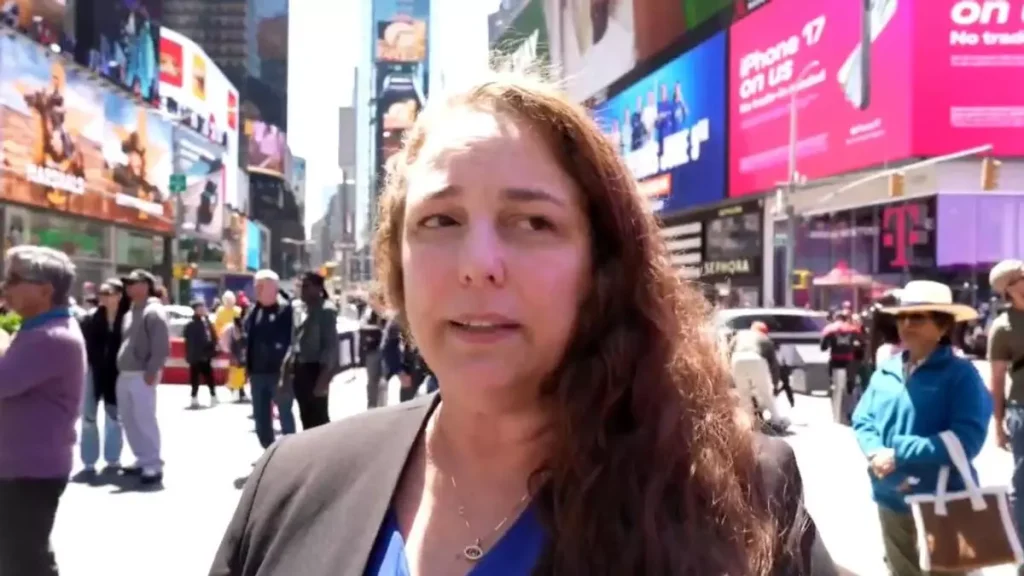
 EFE/Nora Quintanilla (via 14ymedio), New York, May 2, 2026 / Above the hustle and bustle of Times Square, words against authoritarianism, labor exploitation and the mistreatment of immigrants were heard this Friday from an ephemeral stage, the work of Cuban artist Tania Bruguera, who warned EFE of a “freedom of expression in danger.”
Bruguera (b. Havana, 1968) performed at the most famous intersection in the United States a variation of her performance Tatlin’s Whisper #6, in which she offers a platform and a microphone to anyone, on the occasion of May 1st, International Workers’ Day, at a time that worries her.
“This work had such great significance in Cuba in 2009, and unfortunately the conditions of censorship are repeated throughout time and the world,” explained the artist, whose work caused great controversy at the Havana Biennial, where blogger Yoani Sánchez, among other participants, demanded freedom and democracy.
“We are in a time of the rise of autocracies and dictatorships in the world, not only in the United States, where freedom of expression is in danger,” said Bruguera, who observed a rather subdued audience and closed the event by exclaiming “Down with the dictatorship in Cuba.”
Each participant who dared to take the stage received a white dove and could speak for one minute, flanked by two imposing security agents, dressed in black and wearing sunglasses, who, when the time was up, placed their hand on their shoulder in a threatening manner.
Bruguera said she heard someone censoring themselves because the event would be broadcast online.
Throughout the hour-long performance, there were silences in which no one took the microphone, but most respected the times and ways to make complaints of all kinds, although one man went up twice and continued speaking, defiantly in front of his guards, about “the power of the people.”
Another man took the opportunity to promote a Spanish-language comedy event at the World Cup, another sang ” We Shall Overcome” with a guitar, another lamented the persecution of the LGBT community and proclaimed “Free Palestine,” and a woman defended the labor movement and human empathy.
Bruguera said she heard someone self-censor because the event would be broadcast online, and acknowledged that people are “very aware that the internet is a storehouse that always exists and that they can twist things whenever they want,” but reaffirmed the power of speaking out.
She compared the situation to that of Cuba, where recently “a person who wasn’t even a dissident, just a normal person who went out with a sign that said ‘freedom,’ was imprisoned,” and stressed that “art helps to prevent, to make us think before things have happened and become final.”
Sin pelos en la lengua — without mincing words — this artist, famous for her social interventions and as a professor and head of media and performance at Harvard University, also reflected on what it is like to be part of the Cuban community in exile, emphasizing that “the regime is not the people.”
For Bruguera, Cuba is in a “tense moment where people have placed a lot of hope,” because, she maintained, Cuban civil society “is more than prepared to lead that country.”
“It is a distinction that must be made in order to be fair to the entire struggle and the voice of a people who are not heard,” she said, pointing to the protests on social media and in the streets against the propaganda, with mothers who face “empty refrigerators” and remembering their “minor children imprisoned.”
For Bruguera, Cuba is in a “tense moment where people have placed a lot of hope,” because, she argued, Cuban civil society “is more than prepared to lead that country” and make changes, including the thousands of qualified Cubans and workers who are around the world.
“They can return to Cuba and build a Cuba that will definitely be better, because anything they do will be better than the garbage they are doing now, the Cuban regime, which is starving the people to death,” she added.
The initiative was coordinated by Times Square Arts, which manages public art in the square, and Fall of Freedom, an entity that has organized some 300 cultural activities, from museums to theaters and concert halls, to “unite in defiance of the authoritarian forces that are sweeping” the US.
The writer Laura Raicovich, one of the creators of Fall of Freedom, considered Bruguera’s work important today, when “people in the US and around the world are looking for those in power to understand that that power really resides in us, the workers, the ordinary people who do ordinary things.”
______________________
COLLABORATE WITH OUR WORK: The 14ymedio team is committed to practicing serious journalism that reflects Cuba’s reality in all its depth. Thank you for joining us on this long journey. We invite you to continue supporting us by becoming a member of 14ymedio now. Together we can continue transforming journalism in Cuba.