
Without Democratization There is No Guarantee of Cuba’s Independence / 14ymedio, Pedro Campos

The Mariel Special Development Zone. (ZEDM)

14ymedio bigger14ymedio, Havana, Pedro Campos, 6 April 2016 — Politicians, analysts and academics, both socialists and liberals, have addressed the importance of the political and economic democratization of Cuban society as a basis for the desired lift-off towards the development and modernization of the nation.

For a sector of the democratic left and more than a few nationalists, this democratization would also be a strategic guarantee for the independence of Cuba in every sense. continue reading

In the absence of subsidies, the current state-centric political and economic model can only guarantee its survival with a significant increase in foreign capital investment in the joint development of state mega-enterprises or direct investment in support of the plans for its “portfolio of businesses.”

In the belief that foreign capital will save the state companies, the official economic policy prioritizes its alliance with foreign capital, while opposing the full and free development of independent “non-state” forms, whether joint-venture or fully private, because it considers them “enemies of state capital.” Not to mention the dreaded “big bad wolf”: self-management under workers’ control.

In these circumstances, a democratization of the economy that put the bulk of it in the hands of the people – workers in self-managed state enterprises, and medium and small businesses, private or state-associated—is what could cushion the impact, absorbing into the Cuban economy as a whole the expected US investment once the blockade-embargo is fully lifted.

Cuba’s Foreign Minister Bruno Rodriguez told the state website CubaDebate that authorization for US telecommunications companies to operate on the island and financial support the non-state sector by the Obama administration only seeks to build opposition to the government of Raul Castro.

The internet and the development of the non-state sector are seen as “opposed to the government of Raul Castro.” To the bureaucracy it is the same whether the support for these activities comes from the US or from the Moon: the US has always interfered in the free development of”state socialism” in Cuba and wherever it has been tried.

It could not be otherwise for the “new class” generated by the statism that tries to preserve its control-power, which explains the limitations imposed on the internet, on self-employment and on the development of cooperatives, despite approval by the Sixth Congress the Communist Party of Cuba (PCC) itself, to not mention that the term self-management has disappeared from the vocabulary.

The independent development of small and medium-sized private and associated businesses (cooperatives, mutual or stock) in the short and medium term would displace inefficient and anti-worker state enterprises, as is already happening, if the regime does not move quickly to self-management or co-management. Were they to do so, workers would no longer be simply underpaid employees, but can become become effective owners of companies and participate directly in the property, or carry over to full or partial control of domestic or foreign capitalist enterprises.

In the first variant, the current state monopoly savage capitalism, which exploits the workers and impoverishes them, would thus be forced to transfer real economic power to the workers, which it has always refused to do because it would imply a decrease in and/or disappearance of the power of the bureaucracy and the current control exercised on all dividends generated by state enterprises. This is why they have preferred the second variant, an alliance with international capital so that power can continue to support itself, now sharing the exploitation of its employees with foreign capital.

But this involves delivering much of the country’s economy to foreign capital and eventually to the great American capital.

The principal enemy, the limitless capital of the United States, would become the government’s main ally in the joint exploitation of Cuban workers and in a fundamental way would lead to a new socio-economic dependence: a kind of virtual annexation to the United States, where there is no blockade and it costs little more to travel to Miami than it does to go from Havana to Varadero.

The communists who still believe that socialism relies on the salaried state company, where the workers continue to be widgets for which they don’t even have to pay full cost, are making the game into one of virtual annexation.

The fault is not the United States’, but the official policy against free labor. Without democratization and socialization of the economy and politics there will be no guarantees for the future independence of Cuba.
Orlando Marquez Resigns As Spokesman For The Archdiocese Of Havana / 14ymedio

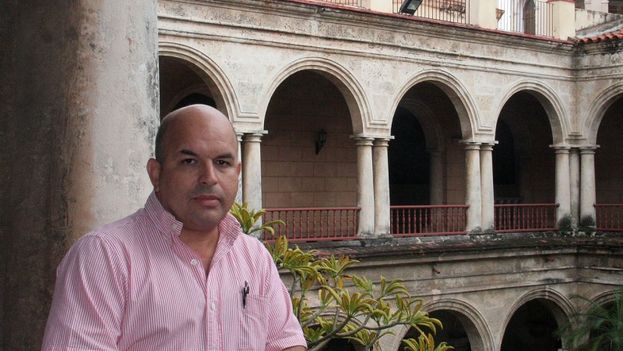
Orlando Marquez has emphasized that his resignation is for "strictly personal reasons". (DC)
Orlando Marquez has emphasized that his resignation is for “strictly personal reasons”. (CC)

14ymedio bigger14ymedio, Havana – The director of Palabra Nueva (New Word) magazine, Orlando Marquez, has resigned his post as spokesperson for the Havana Archdiocese, according to a statement released this Thursday. The spokesperson for Cardinal Jaime Ortega says that he has made the decision “for strictly personal reasons.”

“I believe in the need for change and renewal,” he said. “I believe that the time has come for me to step away so that others can continue the work, according to their abilities, styles and life experiences, confident that it will always be in service to the Church and to readers, from Truth and Charity,” Marquez wrote in a note that circulated to various media and personal friends. continue reading

The resignation was communicated several days earlier to the Cardinal and to the Editorial Board of Palabra Nueva, a publication founded by Marquez. A layperson, Marquez says he has never considered the magazine as something personal, but as a service to the Church and to Cuba. He said that the success it has enjoyed has been due to all those who have collaborated on every issue that has been published.

Marquez emphasizes that “although it does not seem necessary, I prefer to insist that there is no other motivation in this decision. My relations with my Archbishop, Cardinal Jaime Ortega, are excellent.” And he added, “Working with him for 25 years has been a privilege and a constant learning opportunity and, I would add, an authentic human relationship.”

As of Thursday, Marquez resigns from any other “direct responsibility for the publication,” and he says that “it is up to Cardinal Ortega to appoint the new director of Palabra Nueva.”

Last February, Marquez gave a lecture at the Convent of San Juan de Letran in Havana where he was questioned from the audience about the relationship between the Church and the Office of Religious Affairs of the Central Committee of the Communist Party. The speaker acknowledged that “ultimately it is a relationship between the Church and an ideology, and an ideology that sees the Church always under suspicion.”

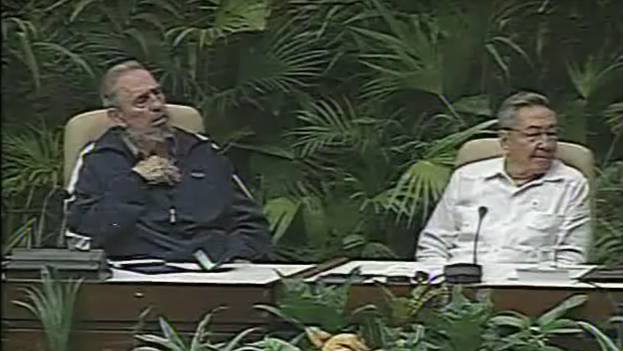
Fidel Castro Reappears In Public During A Tribute To Vilma Espin / 14ymedio

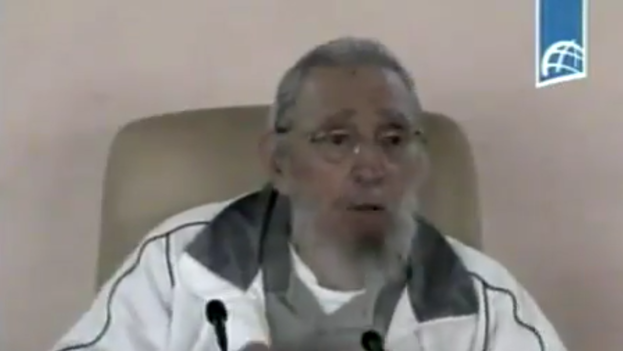
Fidel Castro talks with students and teachers during a tribute to Vilma Espin. (TV)

14ymedio bigger14ymedio, Havana, 7 April 2016 – Former Cuban president Fidel Castro reappeared in public during a tribute to Vilma Espin, the wife of his brother Raul. Primetime television news broadcast images of Castro while he talked to students and teachers of the educational complex in Havana that bears the name of his brother’s deceased wife.

Fidel Castro, who turns 90 in August, participated in the activities of remembrance for the founder of the Federation of Cuban Women (FMC) on the 86th anniversary of her birth. continue reading

Fidel Castro said that “Vilma would be very happy today, because she would see why she sacrificed her life, because he who dies fighting for the Revolution departs leaving their energy on the path and fighting for it.” He added that “for those of us here we consider it a privilege to be in this school today, because this kind of school is approaching a kind of a dream. I tried to remember if I knew of a place where there was a school like this. There is not.”

Vilma Espin Guillois School, in the Havana municipality of Playa, was opened on 9 April 2013, and currently has 43 employees including teachers, assistants and staff. The school has students from nursery school through sixth grade and for the upcoming year is expected to offer secondary education for 60 students.

Fidel Castro has not appeared in public since 9 January 2014, when he visited the studio of artist Alexis Leyva Kcho in the Havana neighborhood of Romerillo for the opening of an exhibition.

A few days after Barack Obama concluded his visit to Cuba, the former Cuban president lambasted him in a “Reflection” titled Brother Obama. The text, often disjointed and nonsensical, was intended as a response to the speech by Obama in Havana’s Gran Teatro, especially against his declaration that he wanted to leave behind “the last vestiges of the Cold War in the Americas.”

Police Prevent Attorney Wilfredo Vallin From Leaving Home / 14ymedio

The lawyer Wilfredo Vallin, President of the Law Association of Cuba. (14ymedio)

14ymedio bigger14ymedio, Havana, 8 April 2016 – On Friday, State Security prevented attorney Wilfredo Vallin from leaving home to participate in a discussion on the Electoral Law. The meeting, to be held at the home of Eliecer Avila, leader of the independent movement Somos+ (We Are More), was hindered by the police who only allowed two of the participants to reach Avila’s home, according to the testimony of Rachell Vazquez, an activist in the group.

From the early hours, the police forces knocked on Vallin’s door in the Diez de Octubre district to warn him that if he left his home he would be arrested. continue reading

The professor was to give the first training course for the promoters of the Otro18 (Another 2018) Democratic Platform, an initiative that is promoting a change in the Cuban electoral system.

Esperanza Rodriguez, the lawyer’s wife and also a member of the Cuban Law Association, told 14ymedio that the police did not allow them to meet their commitment. When they tried to cross the threshold of the building where they live, they found themselves “surrounded by an operation.”

To Vallín it is “obvious” that the authorities want to “prevent opponents participating in the Cuban electoral process.”

The Otro18 campaign, supported by 45 independent organizations within and outside of Cuba, promotes reforms of the laws governing elections, associations and political parties. Represented by government opponent Manuel Cuesta Morua, last week in Madrid the promoters of the initiative requested that the international community monitor the situation on the island because “the reform process undertaken in Cuba must address not only the economy, trade and investment sectors, but also the political sector.”

Coexistence Project Denounces Harassment of its Members / 14ymedio

A gathering organized by Coexistence. (Coexistence)

14ymedio bigger14ymedio, Havana, 7 April 2016 – At least two members of the Coexistence Project have received subpoenas in recent weeks from the Pinar del Rio Immigration Office (DIE), according to a statement made this Thursday. Yoandy Toledo was cited on two occasions to give details about his recent trip to Prague, and Javier Valdes, webmaster of the project’s digital publication, will have to report to the authorities on Friday afternoon.

It is an “explicit violation of the Cuban Immigration Law, which does not establish an interview before or after leaving the country,” complains Toledo, who says that the topics discussed in “the interrogations were never about migration.” continue reading

The young man told 14ymedio that during the second interview the official with a rank of major who identified himself as Pita, “chief of the DIE at the municipal level,” threatened that he would repeat the meeting during the month of April.

Wednesday afternoon, Valdes also received a citation for this Friday at 2:00 PM. Valdez is responsible for the technical issues of the digital site of the magazine of the Coexistence Studies Center. “Right now we are preparing a complaint to deliver to the Provincial Prosecutor where we express the violation of the law and the most basic rights of citizens,” the statement added.

In the afternoon of Wednesday, Valdes also received a citation for this Friday at 2:00 pm. Valdes is responsible for the technical issues of digital site lies the eponymous magazine Coexistence Studies Center. “Right now we are preparing a complaint to deliver at the Provincial Prosecutor’s where we express violation of the law and the most basic rights of citizens,” the statement said.

The publication was founded in February 2008 and bills itself as “a threshold for the citizenry and civil society in Cuba.”

One-Third of Cuba’s PCC Central Committee is Hand Picked With No Process / 14ymedio, Reinaldo Escobar

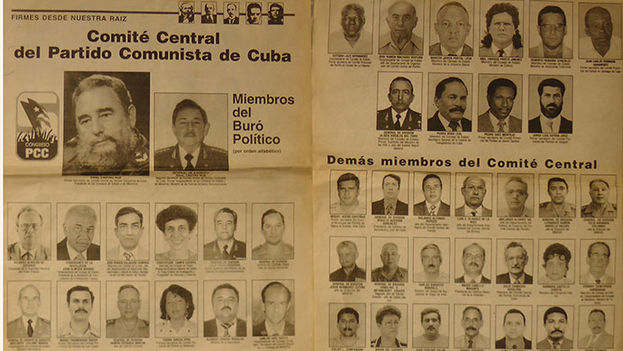
Pages from the newspaper Granma with some members of the Cuban Communist Party Central Committee elected at the 5th Congress

14ymedio, Reinaldo Escobar, Havana, 8 April 2016 — In a country where, under the fifth article of the Constitution, the Communist Party is “the highest leading force of society and the State” members of the Central Committee of that organization should be known by all citizens and, of course, access to the highest authority should not be covered by any veil of mystery.

However, only a few remember the last time there was a formal election of the membership to this group, on 10 October 1997, just before the closing of the 5th Party Congress. At that conclave 150 members were elected. In the slightly more than 18 years since then, there have been 29 deaths and 36 separations, some of these latter as a result of disciplinary sanctions and others because the militant ceased to hold, for different reasons, the administrative or political post that warranted their membership on the Central Committee. Currently, there are only 42 members of that group of 150 remaining. continue reading

But the numbers still do not add up. The data presented here have been amassed by Julio Aleaga Pesant, who has spent years organizing a magnificent collection of names under the ambitious title: Who’s Who in Cuban Society?   The analyst has had the patience to fight against the government’s secrecy and find all references in the national and provincial press which mention a person’s name with his or her position.

Clearly, Aleaga inherits the errors and imprecisions of those official reports. Not all sanctions appear in the press and many die without an obituary. This is why there are 43 doubtful cases without any notices, at least in the last five years. They involve “compañeros” who ascended to the highest partisan level because it was necessary to have the chief of some sugarcane cutting brigade there, or the head of a municipal bureau, or a member of an agricultural contingent. As the media never focuses on their names, it is probable that in some of the cases we don’t know how to respond with exactitude regarding whether or not they are members of the Party Central Committee, if they are still alive, and if they remain in the country.

In these almost 18 years, 51 other Communists have joined the PCC Central Committe, but in that time there has not been a formal process of elections as God commands, i.e. as established in the statutes. Thus names like Miguel Barnet, president of the National Union of Writers and Artists of Cuba; Gladys Bejerano, who heads the Comptroller of the Republic; Joaquin Bernal, newly-appointed Minister of Culture; Guillermo Garcia, a commander of the Revolution who was elected at the First Central Committee in 1965, but was not included in the elections of the 5th Congress.

None of them was proposed from the base; they did not come up from the ranks.

New wine has been filling old wineskins without these nominations involving the Party base, such that now a third of the members of the highest decision-making body has been handpicked from above.

The Seventh Party Congress has before it the task of renewing the Central Committee. Among the other things they will have to discuss the controversial issue of age, as it is not healthy for any organization to have in its membership individuals who do not have the physical ability to spend at least 10 hours a day resolving problems.

Costa Rica Calls Emergency Meeting on New Immigration Crisis On Its Border / 14ymedio, Mario Penton


14ymedio bigger14ymedio, Mario Penton, Miami, 5 April 2106 — The Costa Rican government has called an emergency meeting of the countries involved in the migratory flow that includes that nation as a transit point to the United States. The meeting of foreign ministers and representatives of the different nations involved will be held in the third week of April, with all of the affected nations from the United States to Ecuador.

As reported by the Costa Rican newspaper La Nacion, the Costa Rican meeting will aim to find solutions to the flow of undocumented immigrants coming mainly from Ecuador and Colombia, mostly Cubans, along with Asians and Africans. continue reading

At present, about 2,000 Cubans are stranded in the province of Chiriqui, on the border of Costa Rica and Panama. As reported by Hugo Mendez, governor of the region, 100 Cubans arrive in Paso Canoas every day, on average, coming from the eastern border with Colombia. Colombia is an unavoidable transit country for all Cubans who leave the island for Guyana and Ecuador, countries whose legislation is more flexible in granting tourist visas.

The number of Cuban migrants in Puerto Obaldia and other areas of the isthmus is unknown. So far, the expenses of accommodation and food are being shared between local governments and religious organizations. The difficult conditions in which these migrants live has led to several protests calling for international help in getting them to the United States, their final destination.

“The meeting has raised the hopes of the people here, because people are grasping at straws,” Silvio Enrique Campos, a Cuban stranded in Panama, told 14ymedio. However, he believes that the problem is not exclusive to the islanders, since there are dozens of migrants of other nationalities who also share the fate of the Cubans waiting to continue their journey to the United States. “I think this meeting is just going to serve the fatten the wallets of the coyotes,” Campos said, as he suspects the crisis is more of a business than a expense, and he doesn’t see an early solution.

Meanwhile, Ecuador’s Foreign Ministry denied last week that Cuban citizens are victims of discriminatory treatment by Rafael Correa’s government. An official press release noted that between 2012 and 2016 the country awarded 26,936 non-immigrant (temporary resident) visas, and 16,738 immigrant (permanent resident) visas to Cuban citizens. In addition, during the same period 697 Cubans have been naturalized and are now Ecuadorian citizens.

In a recent statement from the Cuban National Alliance of Ecuador (ANCE) it was announced that, as a result of negotiations with the Ecuadorian government the legalization of all those Cubans who entered the country before December 2015 has begun. The process of accepting applications will run for six months. However, Cuban citizens who entered after that date remain at risk of deportation.

With regard to efforts to achieve an airlift that allows the orderly exit of Cuban migrants from Ecuador to Mexico or the United States, the government made clear that it “does not deny the right of Cubans to emigrate but it cannot take responsibility for any negotiations,” according to comments to this newspaper from Rolando Gallardo, one of the coordinators of ANCE who attended the meeting. According to Gallardo the official response to the creation of a so-called “humanitarian bridge,” is based on the fact that Ecuador has never asked for anything like this for its own citizens who desire to emigrate.

As reported by US immigration authorities, last year 44,159 Cubans arrived at border posts and were automatically welcomed legally into the United States under the “Wet foot/Dry foot” policy. In the first five months of the 2016 fiscal year, some 27,644 Cuban citizens have been beneficiaries of the “Parole Program” after arriving by sea or by land. If the current rate of Cuban arrivals continues, this year the number of applications for political asylum could exceed 60,000, a figure surpassed only by the events of the Mariel Boatlift in 1980.

Cuban Rafters Dressed In Police Uniforms Reach The Coasts Of Florida / 14ymedio, Mario Penton


14ymedio biggerA video posted Monday on the social network Facebook shows the arrival of 26 Cubans to the Florida Keys, aboard a rustic raft. The recording, published by the user Jose Carrera, reflects the moment when the raft touches land with the illegal immigrants on board, among them two men dressed in the uniforms of Cuba’s National Revolutionary Police (PNR).

Hector Joel Carrera, one of the rafters who appears in the video, commented to this newspaper by phone that the group left from Guanabo, on the coast north of Havana, at midnight last Saturday. There were 25 men and one woman on the boat, which was at sea for more than 30 hours, he said. During the crossing they tried to avoid the Cuban and United States Coast Guards, and so they used the engines only at night. continue reading

“The problem is that in Cuba building a boat is a crime, if you are caught taking it the sea you lose everything. That happened to us twice on land,” Carrera explained to 14ymedio, The rafter said that this was the group’s fourth attempt to get to the coast of the United States. On a previous occasion, the raft was intercepted by the US Coast Guard after traveling 75 miles from the island.

With regards to the two supposed police officers in a group of rafters, Carrera explained that the uniformed officers collaborated along with the rest of the migrants on the construction of the craft. One of the policemen was nicknamed “The Captain,” for his rank within the PNR, the rafter explained, and he added that everyone knows very well “the system in Cuba and what is happening, even the police themselves.”

This newspaper has not been able to contact any of the men in uniform.

Carrera says his main motivation to jump into the sea and reach US territory was “economic.” “In Cuba I was a rastero (truck driver), I didn’t live badly, however it wasn’t enough to support my family, to buy shoes for my children,” he adds. Remaining on the island are his four children and his wife.

“Over there, even though I work I can’t buy necessities for the family, because the work is not valued. Here, on the other hand, things are thrown away: clothes, shoes, backpacks,” he said with enthusiasm.

According to the rafter, who is currently living in Tampa with relatives who have taken him in, his main goal is “to learn English to be able to work hard,” and financially help the relatives he left behind.

The fear that the Cuban Adjustment Act will be repealed with the process of the reestablishment of relations between the United States and Cuba, has ignited the flow of migrants from the island. According to the Coast Guard, so far this fiscal year, which began 1 October 2015, 2,562 Cubans have been intercepted in the Florida Straits, including 269 in February.

Cuba’s Communist Youth Union And The Devaluation Of Its Militancy / 14ymedio, Reinaldo Escobar

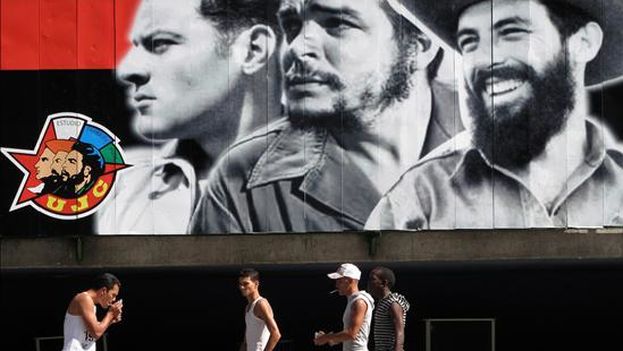
Young people have lost motivation for being activists in the UJC

14ymedio bigger14ymedio, Reinaldo Escobar, Havana, 5 April 2017 — Social stereotypes have their moment. In the Cuba of the 50s, being baptized, making one’s first communion, or being married in the church, were the rites of passage that identified “decent” people. To have a diploma, a university degree, or belong to a Masonic lodge, opened many doors; behaving with urbanity at the table or knowing how to knot a tie denoted good taste and distinction.

A decade later, the important thing was to have participated in the people’s harvests, to have walked 66 kilometers, climbed the five peaks, attended the Schools of Revolutionary Instruction and, especially, to have shot the enemy, whether at the Bay of Pigs or in the Escambray. For a young man of 20 who wanted his reputation to be positively valued social, the top prize was to be a militant of the Young Communist Union (UJC). continue reading

Parents asked their daughters if their boyfriend “belonged to ‘the youth’” and in schools and workplaces carrying the organization’s ID card was a point of pride, to the point that in some spheres it began to generate concern about the emergence of a phenomenon that some called “revolutionary vanity.”

It is difficult to know the precise moment when young Cubans began to show resistance to being captured by the UJC. Educational institutions and administrations of state enterprises almost forced UJC members to become informers and began using this “organized vanguard” to entrap a covert homosexual, sabotage a religious activity or, as in the 80s, to be part of the mob in repudiation rallies.

Now everything is different.  It is no longer possible to identify a militant communist youth by the way they style their hair or the clothes they wear. Boasting about the “merits” one accumulates or heroic tasks performed has irretrievably vanished. In fact, since the return of Cuban troops from Africa in 1991, 25 years have passed and the only opportunity to stand out is getting good grades or exceeding the plan targets at one’s workplace. What today’s parents want to know about the boy who dates their daughter is what business is he engaged in or whether he has a passport with a visa.

When you asked someone between 15 and 30 years if he or she is member of the UJC, the usual response is something like: “Yes, but …” or they raise their eyebrows in a gesture of resignation. Because when a stereotype is past its time, it can be taken as a stigma, or as Cuban-youth speak might say, a corny thing in need of a remake.

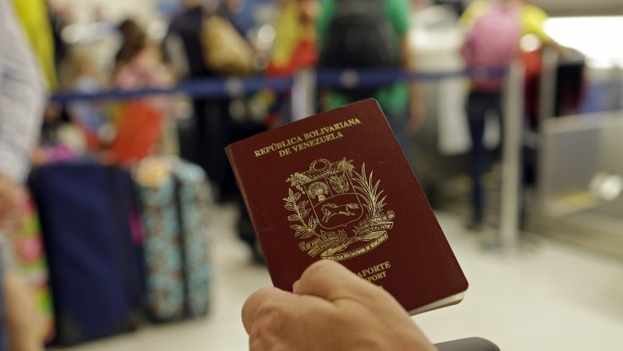
Panama Papers Reveal That Cuba Controls the Passport System in Venezuela / 14ymedio

pasaporte-Venezuela-EFE_CYMIMA20160405_0005_13

14ymedio bigger14ymedio, 5 April 2016 – The Panama Papers have ended up splattering Cuba. The document leak confirms something that has been denounced by former Chavista officials and the opposition in Venezuela. The Cuban government maintains strict control over the system of customizing passports and electronic identity cards in that South American nation.

The Executive of Havana legally maneuvered to gain access to software that contains the data for issuing and updating these documents through the company Albet Ingeniería y Sistemas, as detailed in a contract that has come to light with the Panama Papers. continue reading

The leaked document clarifies that “all licenses for the use of computer applications” which are described as “specifications for the software, the hardware and the licenses,” would be transferred to the Cuban party involved in the contract, in this case Banco Financiero Internacional SA of the Republic of Cuba, known as “Banco de Albet” in the text.

In 2011, the Venezuelan newspaper El Nacional had warned about the access of Cuban intelligence services to the system of preparing the new IDs, “thanks to a secret agreement that excluded Venezuelan technicians from participating in the process,” according to a former adviser of the Ministry of Interior and Justice.

The article revealed that the Cuban side had the ability to “include or delete information from databases and even to issue Venezuelan identity documents to citizens of other countries.” Anthony Daquin, who until 2009 was an adviser to the Venezuelan ministry on electronic documents, reported at the time that “Cubans manage the software and security guidelines, such as how to open the cryptographic box (an encryption mechanism in the electronic chip), how many times, and when the chip is destroyed.”

“These people have the ability to make a Venezuelan passport in Cuba and at the same time to enter that data into the system,” warned Daquin, and the Panama Papers are proving him right. The Cuban government, through “Albet,” acquired “a right of perpetual use, non-exclusive and non-transferable, through the software supplied with the system,” the papers revealed.

Documents from the Panamanian law firm Mossack Fonseca reveal other details of the framework of the Venezuelan passports, which use a German-made technology hidden through various companies owned by the Peruvian Banker Francisco Pardo Mesones.

The technology of the polycarbonate laminates of the Venezuelan documents was fabricated about ten years ago by the German company Bundesdrukerie, which feared that doing business directly with Cuba or Venezuela would damage its reputation. The company used a network whose major beneficiary is Pardo Mesones, recognized for his strong defense of private property but who earned huge sums of money as the owner of Billingsley Global Corp and other offshore companies, which served as a vehicle for Havana to resell the Venezuelan passport technology through Caracas .

In 2005, the Venezuelan Minister of Interior and Justice, Jesse Chacon, located companies to produce the passports and electronic identity cards. After ruling out the US and China, Pardo Mesones prepared in Caracas a triangulation of transfers and contracts through tax havens to hide the real source of the technology.

After several meetings in Venezuela, Peru and Panama, the team Mossack Fonseca designed the network that yielded at least 64 million euros for Pardo Mesones through his company: 40 million for Germany and the other 24 million for his own pocket.

The Voice Of Your Rights / 14ymedio, Generation Y

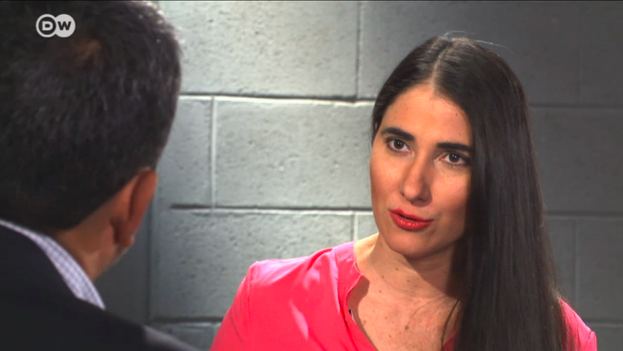
Yoani Sánchez inaugurates a series of interviews on the channel Deutsche Welle Latin America: The Voice of Your Rights. (Video capture)

14ymedio, Yoani Sanchez, Generation Y, 4 April 2016 — What to do when you have a loudspeaker in your hand? Since 2007 when I started my blog Generation Y, this question has haunted me. Often the visibility does not benefit those who need it most and the protective umbrellas provided by access to international organizations only reach a few. To occupy the microphone to broadcast only your own speech is a wastefulness that is a monologue more than an informative work. The Voice of Your Rights, the new interview program I will host on the Deutsche Welle Latin American TV program seeks to bring the megaphone to those who need it most.

With 40 episodes filmed in Panama City, the new space hosts a guest list essential for those who want to know our region and learn about the stories of its people. Environmental activists, women who fight against femicide, human rights organizations that denounce prison overcrowding and groups addressing child labor from all viewpoints are some of the themes that will be addressed by the people with whom I will share the studio in the coming weeks.

My role in this program, which has as its protagonists those who are trying to open a window where the door is closed, is not only for a professional challenge in my career as a journalist, but part of a personal commitment to the most silenced in every society. The cameras and the power of audiovisual media will serve to make their projects more effective and their lives less dangerous.

The Incredible Story Of Sad Gabo And My Beloved Grandmother / 14ymedio, Manuel Pereira

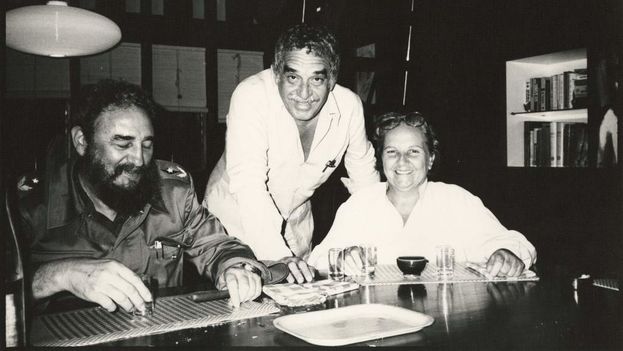
Gabriel García Márquez with Fidel Castro and Carmen Balcells in the ‘80s in Havana. (EFE)

14ymedio bigger14ymedio, Manuel Pereira, Mexico, 3 April 2016 — One day in 1983 I took Gabo to see my grandmother, who lived in a tenement on Old Havana, at No. 105 Aguiar Street at the corner of Cuarteles. She was a Galician who had come to the island in 1926, the year of the devastating cyclone, the year another cyclone was born, named Fidel Castro.

I wanted Gabriel García Márquez to know the poor, to discover the other side of the moon, because I knew he was always entertained in hotels and protocol houses in Miramar, in Cubanacan… continue reading

At the foot of Loma del Ángel, I showed him the butcher shop of one of my grandmother’s countrymen, expropriated and turned into a dive; I also showed him several businesses confiscated years earlier: Cheo’s Juice Bar, turned into a Committee for the Defense of the Revolution; the bodega that had belonged to an Asturian transformed as an accessory to a rooming house, the Catalan bakery closed for good, the Chinese fruit and vegetable stand, transfigured into another hovel. On all sides, makeshift cinderblock walls, unplastered, with anti-poetic bars on the windows. The only picturesque thing left in the neighborhood was the clotheslines on the balconies.

The eyes of my admired writer – well trained by his long profession as a journalist – didn’t miss a single detail. We climbed to the first floor of the apartment building and went to the back, along hallways where in some places there was polychromatic stained glass already half-extinct.

Who was going to say it? A Nobel Prize winner in a Havana solar, a tenement, but my grandmother knew nothing about the Swedish Academy, she didn’t even know where Sweden was. Years ago she confused the famous Cuban writer Carpentier for a carpenter, and Sarte with some famous “sastre” – tailor – who visited the island. She was an almost illiterate villager who, on disembarking in Havana with espadrilles and a headscarf, had to bring up three children cleaning floors and bathrooms in promiscuous tenements.

We entered her home lacking a bathroom: a dining room, bedroom and tiny kitchen. My guest of honor looked at everything. She offered her rickety chairs and a broken wicker armchair. We sat at the table. Embarrassed, I didn’t show Gabo the malodorous toilets and the collective showers, which she never used, preferring to use a basin in her sooty kitchen, behind a plastic curtain.

My grandmother immediately took cold water from the vibrating refrigerator she called the “General Electric,” from ’58, with the white enamel now chipping off. She put on the coffee pot. When the kids upstairs ran across the floor, bits of the ceiling fell on us. Gabo looked at the peeling walls from the corner of his eye. He asked her about her daily life.

My grandmother showed him her ration book, and also her “magic box.” During the frequent periods of tobacco shortages she – like so many others – collected butts from the streets and then stripped them to get the shreds and with them made her “Tupameros.”

“Why Tupamaros?” asked Gabo.

“Because they are illegal,” I replied, and the author of One Hundred Years of Solitude smiled.

She explained the complicated mechanism of the “little machine,” which was like a dominoes box, where she put in the tobacco shreds and then pulled  a little stick that served as a roller toward herself, as if it were a spring, with a rubber tongue that pushed out the freshly rolled cigarette.

Lacking cigarette rolling papers, she used the almost transparent pages of a Map of Spain brochure the embassy sent out. But as these were also limited, she tore pages out of the Bible she couldn’t read, but treasured as a talisman on her altar populated by saints. She smoked verses from Saint John and passages from Ecclesiastes.

When we left and were on the street, Gabo confessed, “I would very much like to write a book about the shortages in Cuba, your grandmother making her Tupameros, the lack of domestic bliss.”

“It would be a magnificent book,” I exclaimed.

He was sad and added, “I would like to write it, talk about the blockade and its consequences, the imagination Cubans bring to overcoming the difficulties, but I don’t want to upset Fidel. I can’t write it, because it is a book that Fidel would consider an attack, I don’t want to cross him.”

After that, I no longer insisted. Each writer chooses his destiny. Above us, as it got dark, my grandmother was smoking a chapter from Leviticus and the biblical smoke wafted from her little balcony to the moon.

“Otro18” Elections Project Presented in Madrid / 14ymedio

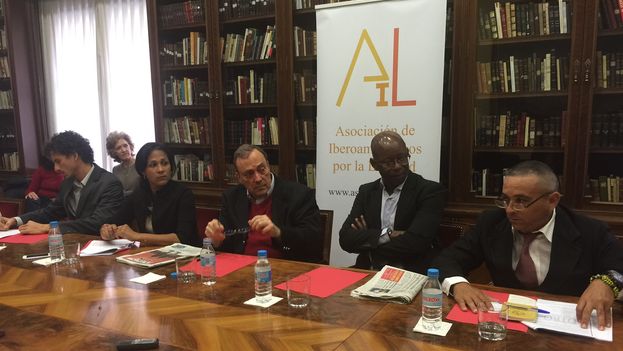
Otro18 (Another 2018) was presented at the Madrid Press Association on Thursday 31 March. (14ymedio)

14ymedio bigger14ymedio, Madrid, 31 Mach 2016 – Like “a small crack in the Cuban political system” from which an opening coming. Thus did the attorney and activist Rolando Ferrer define the Otro18 (Another 2018) project during a meeting with journalists this Thursday at the Madrid Press Association. Four of the promoters of this process travelled from the island to present in Spain this initiative that promotes reforms in laws addressing elections, association, political parties and others.

Opponents are seeking, with their proposals, to influence a democratic opening that would take effect in Cuban with the elections to be held in 2018. This was emphasized by Ferrer, a member of the Anti-totalitarian Forum (FANTU), as well as by historian Boris Gonzales continue reading

, Patriotic Union of Cuba (UNPACU) activist Yusmila Reyna, and opposition leader Manuel Cuesta Morua. All of the participated in the press conference this morning, accompanied by the exiled journalist Carlos Alberto Montaner.

With the support of 45 independent organizations inside and outside of Cuba, the initiative demands that the international community follow the situation on the island. “The process of reforms initiated in Cuba should address not only the economic, trade and investment sector, but also the political sector,” Cuesta Morua declared this Thursday.

“We have included a candidate’s right to campaign,” declared Ferrer, in response to a question from 14ymedio about a possible reform that would allow candidate to campaign for votes. “We want to facilities the candidates having a work plan, proposals that they could take to the citizens, and we also want to insert independent candidates,” he added.

“Currently in Cuba the only access the voter has is to the candidates’ biographies, through their past, and this is not a program,” added Boris Gonzalez. To publicize the proposal among Cubans, Cuesta Morua believes that they have to try to reach the citizenry, so it will be perceived as a citizens’ initiative.

The proposed electoral reform, Reyna noted, “was already presented to the National Assembly” and now they are awaiting a response. Right now they are “training independent candidates, who are nothing more than social activists who have a certain popularity and recognition, in addition to the slanderous campaign that the government has undertaken against them,” he added.

“The Spanish transition [from dictatorship to democracy] was a process that favored going from the law to the law,” said Cuesta Morua, who has asked for Spain’s involvement in the process. Spain “has supported the process of the restoration of democracy in Venezuela and could do the same with Cuba,” he added. The European Union “in its political dialogue with the Cuban authorities should ask that they respect the will of thousands of citizens who are demanding free, fair, democratic, competitive and internationally observed elections.”

Cuesta Morua, the leader of the “Progressive Arc”, has stated that “this is a political proposal” and a “a project directed to the citizenry,” and he distanced himself from the process of electoral changes “made to order by the power,” which the government is pushing. The promoters of Otro18 are seeking that it be possible that “citizens can choose not only vote,” he said.

The opponents also stressed that the three strategic demands of the project are the demands for “an independent national electoral commission; that citizens can choose without the mediation of the national commission nomination; and at the same time that the President of the Republic is directly elected.”

The management group of the project is currently made up of the Patriotic Union of Cuba (UNPACU), Independent and Democratic Cuba (CID), United Anti-totalitarian Forum (FANTU), Cuban Youth Roundtable (MDJC), Progressive Arc Party, Citizens Committee for Racial Integration, Center for Support of the Transition, and the Cuban Law Association, but its promoters say they are open to the “incorporation of other civil society organizations and independent actors.”

Cuesta Morua insisted that this is a political process, not one more a Latin American revolution, and it is intended to allow the citizenry to assume their rights and choose who will be their representatives.

The opponents did not shirk the thorny issue of the unity of the opposition and organizations that have not joined the Otro18 project, such as the Christian Liberation Movement and the Ladies in White. Cuesta Morua said that “the perception of disunity no longer represents the current reality of how the opposition is organized in Cuba” and called the present time a “mature stage.”

“Today more than yesterday, the opposition is working together, coinciding in many respects and has put any irreconcilable differences in the past to work on concrete proposals for democratic change,” said Cuesta Morua.

The opposition denounced pressures, “threats and the confiscation of working tools” against the promoters of the initiative and cited the arrests that occurred around the first Forum of the initiative, held in early March at the home of an activist in the Vedado neighborhood of Havana.

A Battle For Democratization In Cuba / 14ymedio, Pedro Campos

Closure of the Sixth Congress of the Communist Party of Cuba. (Youtube)

14ymedio, Pedro Campos, Havana, 1 April 2016 – Cuban Communist Party (PCC) member Francisco Rodriguez Cruz, a journalist for the newspaper Trabajadores (Workers) and an activist against homophobia and for sexual rights, wrote an open letter to the first secretary of the Party Central Committee, Raul Castro, asking that the 7th Party Congress be postponed to give the organization time to allow the documents that will be approved there to be discussed ahead of time by the party base and all citizens.

This call from “Paquito de Cuba,” as he is know in the media, reflects the feelings of broad sectors of the PCC militancy and of the Cuban population, concerned that this Congress is going to approve specific documents that have a great deal to do with the immediate future of all Cubans. I am referring to the “conceptualization of the Cuban socioeconomic model” and the “prospective development plan for the year 2030.” continue reading

Since Raul Castro has risen to the top leadership of the Party and the Government, processes have been developed for consulting the party training bases, the unions, the Union of Young Communists (UJC) and the People’s Power, with regards to the general problems of the country and especially in relation to the Guidelines of the Sixth Congress of the PCC.

It has been a concern of many Party members and ordinary citizens that the proposals don’t take their concerns sufficiently into account, and that other suggestions appear in a limited and biased way, tied to the old concepts of state and bureaucratic control.

Specifically, it happened with self-employment, cooperatives, independent entrepreneurial self-management independent of state control of the workers, and with the need to democratize the political system with freedom of expression and association and free elections, and strengthening the independence, abilities and autonomies of the local organs of People’s Power. The political and economic essence of a democratic society with broad support from the bases of the PCC, workers and citizens, according to what it has been possible to confirm in the opinions of thousands of Cubans expressed in the media, meetings, official conferences and not only among family and friends.

Recently, the Party leadership acknowledged that a portion of the Guidelines approved at the last Party Congress had not yet been implemented and had played only a small part.

During the five years since the Sixth Congress, hundreds of thousands of critiques have appeared in the Party press and in blogs and leftist alternative pages from the moderate opposition, about the inability, lack of will and even the obstacles evidenced in the leadership of the PCC and the government to implement their own agreements.

Raul Castro invited the Party bases to offer their opinions; the leadership of the Party and the government organized vertical consultations in Santiago to learn what Havanans thought and vice versa, and later the higher bodies reached agreements that bore no resemblance to what people from below had said. And then come the laws and decrees to implement them laden with bureaucratic constraints. Where is democracy?

This “system of participation” has demonstrated its inefficiency, people are dissatisfied with what has been done, including with the agreements of the PCC, and now, on top of that, the thousand or so representatives (a minuscule proportion of the population) who will meet in the Seventh Party Congress, will approve what economic, political and social model that will rule the destiny of 11 million Cubans on the island and another three million of us outside the island, and that will be the development plan for the next 15 years.

All Cubans of good will, Party members or not, inside or outside, should unite their voices and support the request from “Paquito de Cuba” for the postponement of the Seventh Congress and the democratic discussion of its documents so that they are subject to open, horizontal and free debate of the entire Party membership and all the Cuban people.

The streets of Cuba are not free filled with these slogans, but indeed all the official and non-official websites from Granma, Trabajadores, Juventud Rebelde, Cubadebate, and the rest of the social networks.

It is not a battle within the Party, it is the Cuban people’s battle for democratization, and on its outcome will depend, to a great extent, the future of the homeland of all Cubans.

Cleo, An Author Under Suspicion / 14ymedio, Zunilda Mata

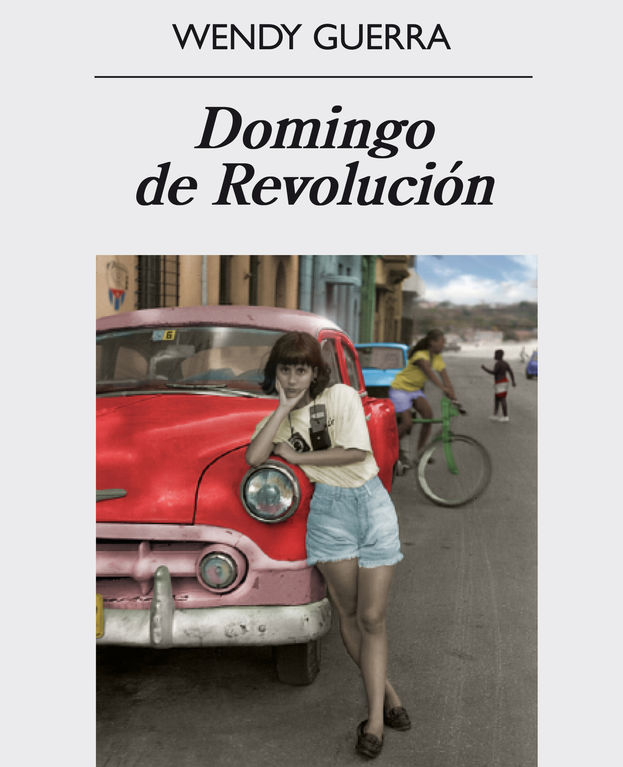
The cover of the book 'Revolution Sunday ' by Wendy Guerra
The cover of the book ‘Revolution Sunday ‘ by Wendy Guerra

14ymedio bigger14ymedio, Zunilda Mata, Havana, 1 April 2016 — With strong autobiographical overtones, Wendy Guerra’s latest book tells the story of Cleo, a young poet and storyteller residing in Havana living under the supervision of the publishing authorities and State Security. With a work published abroad, the protagonist of Revolution Sunday (Anagram, 2016) is charged by the Ministry of Culture with being an author built by “the enemy” and is under permanent suspicion of being “an invention of the CIA.”

Guerra has commented that the character is inspired by a writer of her mother’s generation, the poet Albis Torres, who lived among microphones and ghosts. Many writers on the island “are going to laugh and cry” as they read this novel, the author of this novel told 14ymedio. Guerra is also the author of Everyone Leaves and I Never Was First Lady. Cleo is a compendium of memories of several generations of silenced artists continue reading

“in a closed society,” she says.

In the midst of writing the novel, Guerra found herself surprised by the announcement of the reestablishment of relations between Cuba and the United States. The author incorporated some of these events in the book, which she describes as “a historical novel” given the importance the political environment plays in the plot that runs through the story.

The book explores the conflicts generated by distrust and paranoia that run through a society where, for decades, everyone is afraid of everyone. While Cleo is considered among many intellectuals to be an infiltrator from the United States secret services, for others she is a skillful agent of Cuban intelligence, planted to give the idea that there is publishing tolerance in Cuba.

With a work prohibited and ignored in Cuba, Cleo finds success as a storyteller because her books are published and read outside the island. Her work is translated into several languages ​​and she is seen as a chronicler of the failure of the revolutionary process. The volume explores the Cuban tragedy with sensitivity and humor, confirming Wendy Guerra as an indispensable writer in the panorama of contemporary Cuban literature.