The president of the Italian region, who met this Monday with the U.S. chargé d’affaires in Cuba Mike Hammer, is open to hiring healthcare workers “independently.”
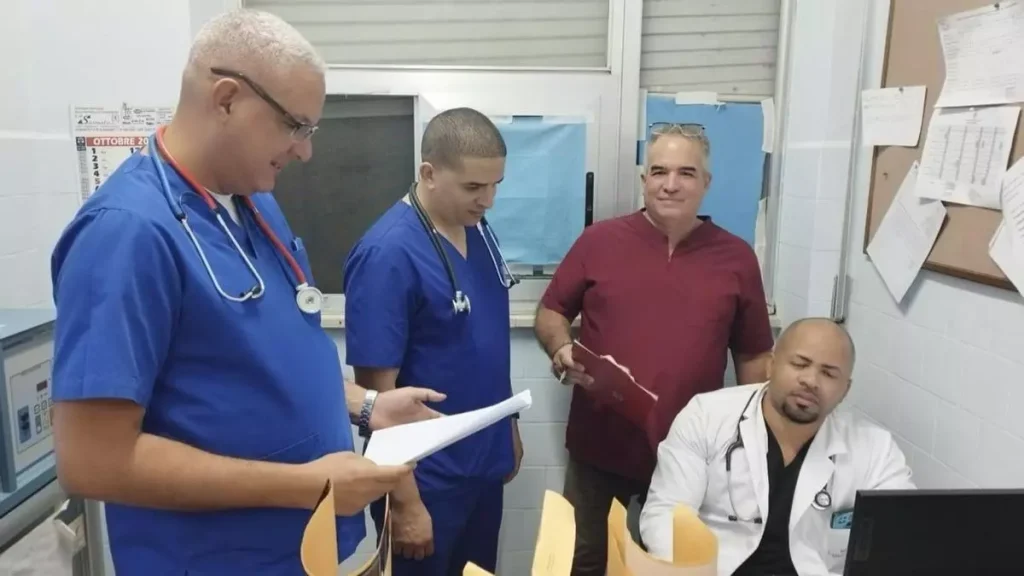
 14ymedio, Madrid, February 24, 2026 –The president of the region of Calabria (Italy) appears determined. Not only does he reject breaking the agreement with Cuba, as the United States wants, so that Cuban doctors can continue providing services in his territory, but he also wants to expand it. “I explained to my counterparts that I had in mind, in 2026, increasing the Cuban medical mission to 1,000 doctors,” said Roberto Occhiuto, who met this Monday with the U.S. chargé d’affaires in Cuba, Mike Hammer.
At the meeting, held in the city of Catanzaro with the presence of the U.S. Consul General in Naples, Terrence Flynn, the parties addressed the thorny issue of Cuban medical brigades, whose termination is a clear objective of the administration of Donald Trump. Since 2025, Secretary of State Marco Rubio himself has been actively involved in suspending all contracts that various countries have signed with the Cuban regime to import healthcare workers, using both negotiation and sanctions.
He has thus managed to have agreements modified or suspended with the Bahamas, Jamaica, Guatemala, Honduras, Antigua and Barbuda, Grenada, Guyana, and Trinidad and Tobago. But Italy is a unique case, as it is the only country in the European Union that has resorted to these agreements to address its severe shortage of doctors. For this reason, Occhiuto has been signaling for days that his answer is No: a position he reaffirmed yesterday after his “long and friendly” meeting with Hammer.
Italy is a unique case, as it is the only country in the European Union that has resorted to these agreements to address its doctor shortage.
“We had a long and cordial meeting, discussing Calabria’s urgent healthcare needs and the complexities surrounding the Cuban doctors’ mission,” he told the Italian press. “I told Hammer that the Cuban doctors, who allow Calabria’s hospitals and emergency rooms to remain open, are still a necessity, because my absolute priority is to guarantee citizens’ right to healthcare, given that our system is already facing great difficulties.”
In fact, the plan is for up to 1,000 doctors to arrive this year, he confirmed. However, Occhiuto is not closing the door to other options to address the system’s shortcomings. “In recent weeks, also thanks to a fruitful collaboration established with the U.S. State Department and the U.S. Consulate, we have decided to explore an alternative way to recruit more doctors. We did so by publishing, in mid-January, a call aimed at all doctors from the EU and non-EU countries who want to come work in Calabria,” he explained.
The leader of the Forza Italia (right-wing) party maintains that if the goal is to expand options, he is open to any solution. “We will welcome all doctors who want to come,” he said, expressly mentioning both EU and non-EU professionals.
“In conclusion, I told Hammer that foreign doctors are absolutely necessary, but that our region is willing to receive all doctors—EU, non-EU, Cuban doctors not linked to the existing mission—who independently wish to come work in Calabria, which is prepared to provide them with all the logistical and financial support we have already guaranteed to the Cuban doctors who have been living with us.”
Cuban doctors first arrived in this southern Italian region in 2023, in a contingent of about 170 healthcare workers who arrived in two groups.
Cuban doctors first arrived in this southern Italian region in 2023, in a contingent of about 170 healthcare workers who arrived in two groups. “I said it before and I repeat it: they are not going to take any jobs from Italian doctors,” Occhiuto warned at the time, rejecting criticism that accompanied the decision.
Even then, the president stated that at least 2,300 new contracts were needed to ensure the system functioned properly. Nearly 500 were expected to come from Cuba, according to the contract signed in 2022 between Cuban Health Minister José Ángel Portal Miranda and his Italian counterpart, Orazio Schillaci.
In January 2024, the Sardinian press announced the arrival from the Island of 128 doctors and 30 nurses to Sardinia, under a contract that expired on December 31, 2025, and could be renewed. Little more has emerged about that case, although at the beginning of that month local politicians expressed the need to maintain agreements with Cuba and stated that at least 1,000 doctors were required.
The Italian local press reported that for each doctor in Calabria, the region would pay 3,500 euros in salary and 1,200 euros for maintenance, housing, travel, and training. The salary, as usual, is paid to the Cuban government, which typically retains between 75% and 90%, leading the United States and some international organizations to denounce the practice as “forced labor.”
In the summer of 2025, Calabria’s opposition (social democrats) demanded explanations about the status of these agreements after a case emerged of a doctor who left his post to work at a private center. “This new case of abandonment adds to many others: in addition to those who opted for the private sector, there are those who went on vacation and never returned, those who preferred the Spanish healthcare system, those who disappeared, etc.,” denounced Ernesto Alleci, who added that “the numbers are starting to no longer add up.”
Several Italian regions, particularly the poorer ones, face difficulties hiring healthcare personnel, as their salaries are around $82,000 per year for a specialist, far less than the $99,000 in France or $172,000 in Germany.
Translated by Regina Anavy
______________________
COLLABORATE WITH OUR WORK: The 14ymedio team is committed to practicing serious journalism that reflects Cuba’s reality in all its depth. Thank you for joining us on this long journey. We invite you to continue supporting us by becoming a member of 14ymedio now. Together we can continue transforming journalism in Cuba.