With the bay at their feet, many residents along Vía Blanca are forced to buy water from private tanker trucks
 14ymedio, Matanzas, Julio César Contreras, July 29, 2026 / From the third-floor balcony of her apartment, Marianela looks out at the bay of Matanzas as if contemplating an irony. The water stretches out calmly until it disappears into the horizon, but in her kitchen there is barely anything left at the bottom of the plastic tank where she stores the water she uses for cooking, bathing, and cleaning. Leaning her elbows on the railing, she dials her son’s number. “Bring me at least a gallon,” she asks him. She has gone twenty days without a stable water supply, and every call is a mix of appeal and resignation.
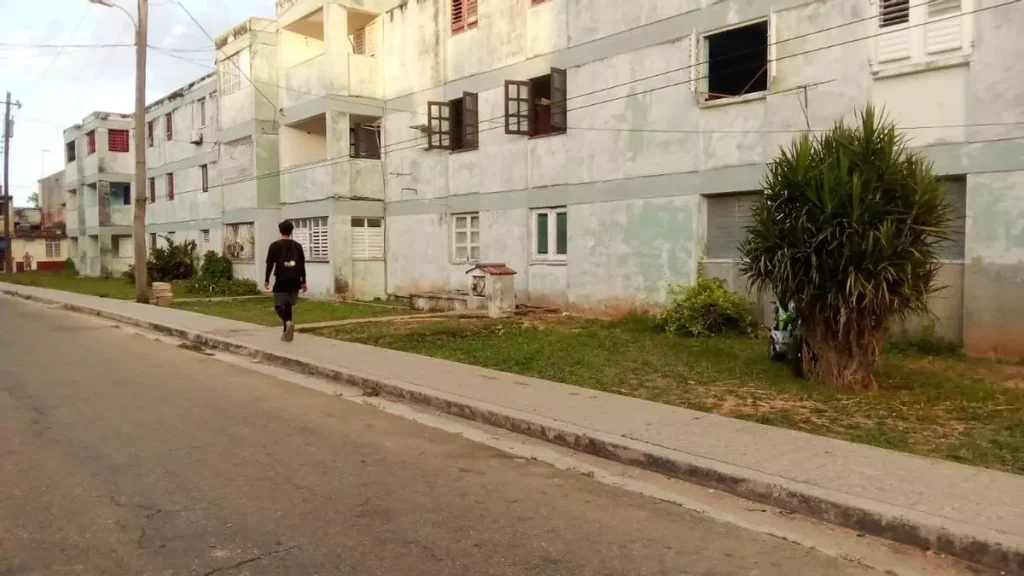
In the multifamily buildings that line Vía Blanca, peeling façades, balconies left open to catch a bit of breeze, and gardens ravaged by neglect conceal a routine marked by scarcity. From the street it looks like any other neighborhood: a neighbor chatting under a doorway, a child crossing the hallway of a block, a motorcycle parked by the entrance. But just crossing the threshold of the buildings is enough to find rows of buckets, empty containers, and cisterns that no one expects to see full anymore.
“The power comes on for a little while every 48 hours, and there isn’t enough time to pump the water up to the rooftop tanks. No matter how quickly the pump switches on, there’s no way to supply the 24 apartments in this building,” Marianela tells 14ymedio. At 61, she lives alone and says she never imagined hygiene would become a luxury. “I bathe with a bucket, wash dishes with a little pitcher, and clean the house when I can. If I’m struggling, imagine what it’s like where four or five people live. If this keeps up, we’ll have to haul water from the bay, because the Government promises a lot and doesn’t send so much as a single tanker truck.”
“The power comes on for a little while every 48 hours, and there isn’t enough time to pump the water up to the rooftop tanks. No matter how quickly the pump switches on, there’s no way to supply the 24 apartments in this building”
The desperation is made even more bitter by the fact that a water treatment plant stands just a few blocks away. And yet its proximity does nothing to stop many neighbors from having to buy five liters of water for 650 pesos or walk to an evangelical church where they are allowed to fill a couple of containers. The everyday landscape has filled with people carrying containers of every size, which have become an extension of their arms.
“There have been days when we’ve only washed our faces and the sweatiest parts of our bodies,” says a state employee, pointing to the four-story building where he lives with his wife and young daughter. “The elevated tanks should be filled every day, but with the blackouts they go two, even three weeks empty.” Only a few hours earlier the family had traveled across half the city to El Naranjal to shower at his in-laws’ house. “We at least have that option. But what do people who have nowhere to go do?” he asks.
In his building the problem doesn’t end with the lack of electricity. Water also fails to reach the cistern with enough pressure, so the entire supply chain breaks down. Complaints to the Poder Popular, he says, have only ever received the same explanation. “It all ends up running into the wall of the internal blockade,” he says wryly. Tired of waiting, several neighbors organized a collection to hire a tanker truck unofficially, off the books.
“It costs us 15,000 pesos each time,” he explains. “It’s a huge amount of money, but at least we fill the tanks and families have less to deal with. The sad part is that there are already people who can’t chip in and get left out. Now there are even social differences over something as basic as having water.”
In another nearby block, Arturo has lost count of how many times the building’s pump has been repaired. In the last quarter alone, he says, the unit has been fixed five times after breaking down due to the constant power outages and restorations, which often come with voltage surges.
“Sometimes they leave it uncovered and it ends up full of mosquitoes, frogs, and all sorts of bugs. That’s the water we bathe with and even cook with”
“I’ve had to fill buckets directly from the cistern,” says the interprovincial bus driver. “Sometimes they leave it uncovered and it ends up full of mosquitoes, frogs, and all sorts of bugs. That’s the water we bathe with and even cook with. You boil it, but you know that doesn’t solve every problem.”
As he speaks, an elderly woman slowly climbs the stairs with a small bucket in her hand. In another nearby building, a group of neighbors chats beside two parked mopeds. The façades show decades of wear from lack of upkeep, but it is inside the apartments where the crisis leaves its deepest marks: dishes piled on the counter, sticky floors, laundry waiting for a wash that never comes, and empty tanks turned into the symbol of a city surrounded by water yet unable to get it through its pipes.
Arturo remembers when coming home from work meant turning on the shower and letting the water run without a second thought. “In this country we’ve ended up folding into our routine the lines, the food shortages, the blackouts, and now the thirst as well,” he laments. Then he looks out toward the bay, so close it seems within arm’s reach.
Translated by GH.
______________________
COLLABORATE WITH OUR WORK: The 14ymedio team is committed to practicing serious journalism that reflects Cuba’s reality in all its depth. Thank you for joining us on this long journey. We invite you to continue supporting us by becoming a member of 14ymedio now. Together we can continue transforming journalism in Cuba.