The price of a gas cylinder is equivalent to 22 monthly minimum wages at today’s exchange rate.
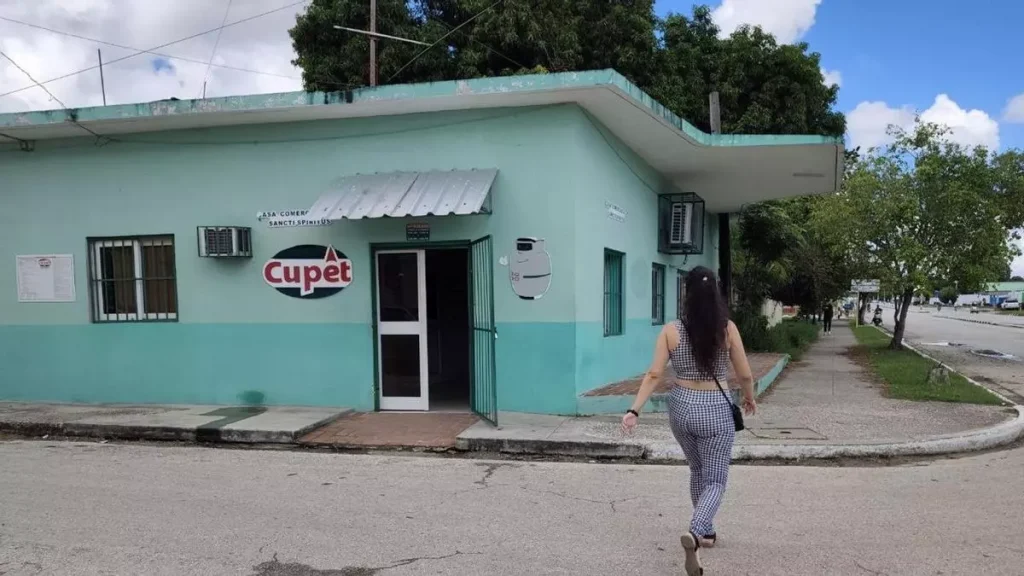
 14ymedio, Mercedes García, Sancti Spíritus, October 31, 2026 – The state-owned company Unión Cuba-Petróleo (Cupet) charges as much as 80 dollars for a liquefied gas cylinder in the city of Sancti Spíritus, as 14ymedio was able to verify. The new 20-pound cylinders, filled and supplied with their fittings, are offered at that price at the state company’s main outlet and at two other locations in the city, one in the Colón neighborhood and the other in Los Olivos.
Payment must also be made in cash. And that does not make buying gas any easier: those interested must put their names on a list and wait their turn, depending on availability.
At the Cupet outlet on Santa Elena Street, in the same city, the arrangement is different. There, a cylinder is offered for 55 dollars, provided the customer hands over an empty one to be refilled. These sales are restricted to healthcare workers, bank employees, and employees of previously authorized workplaces.
To put the cost of the product in perspective, the minimum wage in Cuba is 3,210 pesos per month, equivalent to about 3.65 dollars at the informal exchange rate of 880 pesos per dollar recorded today. Thus, an 80-dollar cylinder costs almost 22 times the monthly minimum wage, while a 55-dollar cylinder costs the equivalent of about 15 times that amount.
The new 20-pound cylinders, filled and supplied with their fittings, are offered for 80 dollars at the state company’s main outlet and at two other locations in the city
Sancti Spíritus had gone without regular state sales of liquefied gas since October 2025. The interruption had fueled the black market, where 10-kilogram cylinders came to be offered for as much as 70,000 Cuban pesos, equivalent to the 80 dollars they cost today. The resumption of Cupet sales provides an alternative for those who can afford it, but dollar-denominated prices and restrictions on access do little to meet the population’s needs.
This situation has contributed to crime in the province. Earlier this month, two people from Sancti Spíritus were sentenced to 12 and 10 years in prison, respectively, for stealing gas cylinders from more than 20 homes. Two other people involved received prison sentences of two and a half years and two years for participating in the resale of the stolen cylinders and illegally marketing the fuel using other consumers’ contracts. The case illustrates the extent to which scarcity has turned a household necessity into a prized commodity for criminals.
The resumption of state gas sales, now in dollars, and the outrage it has provoked among customers in Sancti Spíritus coincide with reports of a similar situation on the Isle of Youth. According to accounts posted on social media by residents of the special municipality, Cupet sells cylinders there for 89 dollars.
“This is a complete lack of respect for the Cuban people, an outrageous contempt and an unjustifiable abuse toward us,” a woman complained on Facebook. The post reflects consumers’ frustration with prices that are beyond their reach. “It’s the feeling that you scream and nobody listens; that you file complaints and everything stays the same. And that wears you down. It exhausts you. It hurts,” the woman from the Isle of Youth wrote.
“This is a complete lack of respect for the Cuban people, an outrageous contempt and an unjustifiable abuse toward us”
In response to the energy crisis and supply shortages on the Island, the Cuban Government has presented the sale of liquefied gas in foreign currency as an alternative for financing fuel imports. However, the experience of recent months shows that having sales outlets that accept dollars does not guarantee a stable supply or resolve the difficulties faced by those who do not have foreign currency.
Last June, 14ymedio confirmed that the gas cylinders sold by ProGas through the KMCero platform were priced at 24 dollars and resold for 50, although some buyers in Havana reportedly paid as much as 100 dollars for a single cylinder. The company, presented as a private business, used facilities and logistical channels linked to the state-owned Cupet, while numerous consumers continued to go without their usual allocations.
Two months later, in August, ProGas sales outlets closed again after running out of stock, according to accounts gathered by this newspaper. Customers complained that they could not obtain gas either in pesos or in foreign currency.
Last June, the United States added state-owned Cupet to its list of sanctioned entities, a measure that blocks the company’s assets under U.S. jurisdiction and prohibits transactions with it. Washington justified the decision by citing the company’s relationship with the military conglomerate Gaesa. The sanctions add obstacles to fuel import, processing, and distribution operations in Cuba and worsen the energy crisis the country has been experiencing for years.
Translated by Regina Anavy
______________________
COLLABORATE WITH OUR WORK: The 14ymedio team is committed to practicing serious journalism that reflects Cuba’s reality in all its depth. Thank you for joining us on this long journey. We invite you to continue supporting us by becoming a member of 14ymedio now. Together we can continue transforming journalism in Cuba.