“I fear that supposed liberation may be approaching, which is an offense and a humiliation for the people of Cuba,” says Ramón Saúl Sánchez.
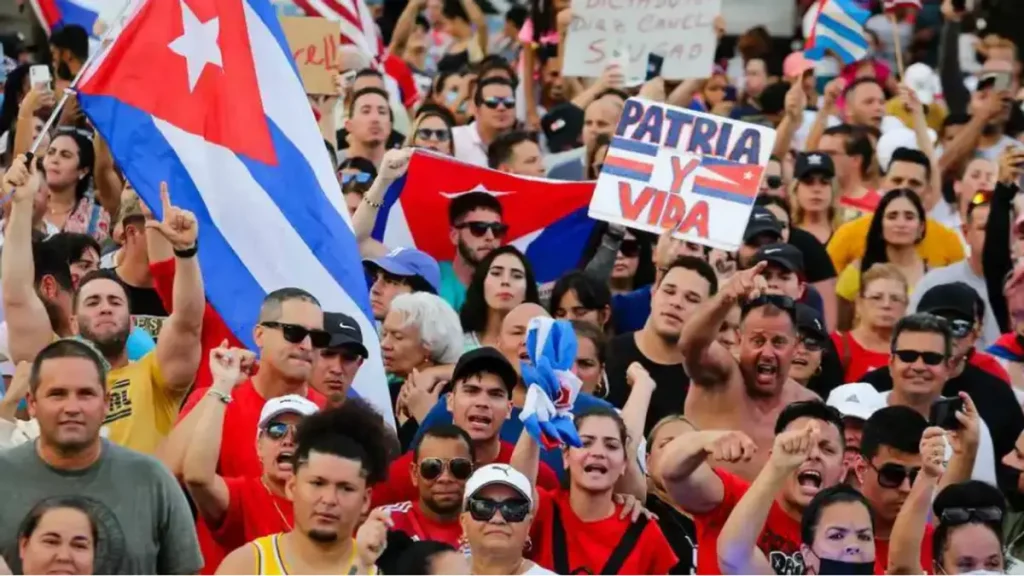
 14ymedio, Madrid, March 11, 2026 – Emotions have heated up in Florida since last Sunday when USA Today published an exclusive report claiming that the White House was very close to announcing an agreement with the Cuban regime, mainly of an economic nature. The pact, revealed by two sources close to the U.S. Government, supposedly contains concessions to Washington in the areas of energy, tourism, and ports. In exchange, the ban on Americans traveling to the Island would be lifted, while also providing an exit for Miguel Díaz-Canel and allowing the Castros to remain in the country.
The uproar spread quickly on social media in the early hours, but exile leaders remained cautiously silent, possibly waiting for clarification or a denial that never came. Thus, more than 24 hours after the puzzling report, José Daniel Ferrer exploded: “If after capturing Nicolás Maduro, if after eliminating Ali Khamenei and other high-ranking leaders of the Iranian regime, President Trump and Secretary of State Marco Rubio end up closing only an economic deal with the Castros and they remain in Cuba, then when the current administration ends, the United States would once again have to confront dangerous enemies on the continent,” he wrote on the social network X.
The former political prisoner and leader of the Patriotic Union of Cuba (UNPACU) did not directly attack the supposed contents of the agreement but warned about the consequences of leaving the Castros in control of the Island. “The United States would have new October Crises with Russian and Chinese missiles, and many Castros, Chávez, Evo, Correa, and Ortega,” he said.
“The United States would have new October Crises with Russian and Chinese missiles, and many Castros, Chávez, Evo, Correa, and Ortega.”
The White House did not respond to this statement either, but it did impel Ramón Saúl Sánchez, leader of the Democracy Movement, to publish a video on Tuesday in which he appeared visibly saddened. “Apparently, according to information coming out in credible press outlets and from statements by our officials, the President of the United States and the Secretary of State, Marco Rubio, I fear that this supposed liberation may be approaching, which is an offense and a humiliation for the people of Cuba,” he said.
These statements were the first in which a historic exile figure accepted the supposed plan as plausible, which he says confirms something he had “unfortunately” predicted. Sánchez, who faced a deportation process that he won in 2023, believes his message could put his stay in the United States at risk, but he argues that he will not remain silent. “Are they now going to tell us that because corporations buy or extract nickel or cobalt from Cuba we will be free? That the Castros can stay there while corporations come to extract minerals? Is that freedom?” he asked.
In a report published this Wednesday by El País, Sánchez reiterates his hopes: “I don’t want to die without seeing my homeland free, but I also don’t want to see it occupied by American corporations, squeezing out the last remains of our country with those henchmen in power,” he insists.
Luis Enrique Ferrer, brother of José Daniel and also an opposition leader in exile, spoke Tuesday on Miami television, where he stated that the regime’s only path to survival is repression, but with the Castros still inside there will be no freedom. “The real change is removing the Castro family from power, Díaz-Canel, and all the accomplices of the dictatorship, and letting the Cuban people have the opportunity to choose their leader.”
Although he maintains some faith in Donald Trump’s administration, his indirect mention of Delcy Rodríguez reflects his fears. “We can see something similar with what is happening in Venezuela. The dictatorship buys time and plays with the timelines of democracy.”
Florida politicians have begun fearing the worst, and this Tuesday some timid denials began circulating that have not fulfilled their goals. “We cannot leave any Castro behind. If they are speaking with any Castro it is only about when they are leaving, how they are leaving, and under what conditions, but not for anyone to stay,” said Republican congresswoman María Elvira Salazar, implying that negotiations with the son or grandson of Raúl Castro, both named by international media as interlocutors (especially the latter), are indeed taking place.
More uncertainty was generated by the response of the usually hard-line Mario Díaz-Balart, who did not even want to deny the possibility. “The goal is that this regime no longer exists. How is that done? You have to trust Secretary of State Marco Rubio, who is very clear about it,” he told Univisíon.
“The goal is that this regime no longer exists. How is that done? You have to trust Secretary of State Marco Rubio, who is very clear about it.”
The ambivalence of the ever-contradictory Trump also does not help calm the staunch opponents of rapprochement. The U.S. president said last week that the “taking control” of Cuba could be friendly and, in the next sentence, added that it might not be. Nevertheless, the Speaker of the House of Representatives, Mike Johnson, almost completely ruled out the military option on Tuesday. “I don’t think there is a need. I don’t think there is an appetite for putting boots on the ground in Cuba. I think some of this happens organically,” he emphasized.
More clues favoring a friendly option came Monday from the Vatican. There, the powerful Secretary of State Pietro Parolin confirmed that he is mediating to “promote a negotiated solution to the crisis.” The cardinal mentioned contacts with Cuban Foreign Minister Bruno Rodríguez, head of U.S. mission in Havana, Mike Hammer, and other diplomats to address a solution through dialogue, highlighting that the Holy See “has taken the necessary steps” in its conversations. Not much has been revealed, but history shows that Vatican intervention has been a decisive lever in numerous agreements, from the so-called thaw during Barack Obama’s administration to the recent release of more than 500 prisoners in exchange for being taken off the list of state sponsors of terrorism for one week.
On Tuesday, influencer Alexander Otaola also intervened in the debate and argued that the information from USA Today comes from an attempt to manipulate public opinion against Donald Trump before the midterm elections. In his view, the report, whose accuracy he accepts, about the creation of a task force within the Department of Justice to study a possible criminal indictment of the regime’s leadership is incompatible with this kind of agreement, and he calls for trust and calm.
However, the debate on social media again features a persistent specter. “It’s the same thing they did in Venezuela. Take the oil, the gold mines, and whatever else they can grab. In Cuba they bring in American companies and install Cuban millionaires. They take over all the hotels and make billions from tourism, which is what they were doing under Batista. If they allow that agreement to be signed, they will leave us in the same conditions we’re in now, because they are not interested in the Cuban people, only in business. Hopefully I’m wrong.”
Translated by Regina Anavy
______________________
COLLABORATE WITH OUR WORK: The 14ymedio team is committed to practicing serious journalism that reflects Cuba’s reality in all its depth. Thank you for joining us on this long journey. We invite you to continue supporting us by becoming a member of 14ymedio now. Together we can continue transforming journalism in Cuba.