Sad Highways


Photo: Claudio Fuentes Madan

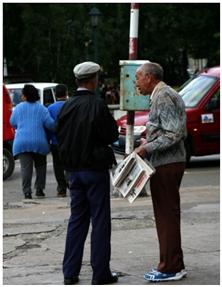
Practical woman that I am, I thought I would take advantage of my trip to Santa Clara to buy, along the highway, products which, in the capital, are hard to get or very expensive. From when I was little I remember the peasants by the road side selling what they themselves had planted and grown, trading their wares directly with travelers.

The lack of vendors on foot for miles and miles, surprised me, as I know these farmers have a very precarious economy, and I had to believe that the police dedicate themselves to punishing those who sell what they grow with their own hands. From their wooden houses, with their government-registered cows, they could earn enough from the sale of a few pounds of cheese to feed their families for some days.

There are still some, maybe fewer than twenty, along the miles that separate Havana and Santa Clara. Fearful, when a car stops they approach with caution, because the National Revolutionary Police hunts them by posing as customers.

The boy who finally sold me some cheese couldn’t have been more than 25. I asked him what happens when the police catch them: he said they run as fast as they can, trying to save at least some of the goods, while the police chase them back into the woods.

“They chase you into the woods?”

It’s hard to take seriously the ridiculous image of a uniformed officer knocking a peasant down into the grass to seize twenty bananas. As the poor boy hadn’t come to hear a lecture from me, I simply paid him and left, but the idea was making my head spin. Are there not, according to Raul Castro, a million unproductive people in Cuba earning salaries? Why don’t they start by getting rid of the jobs of these predators on the family economy and allow the farmers to sell their products wherever they want?

To comment on this article please visit:

Claudia’s Blog: Octavo Cerco / English

A Short Story for Distant Granddaughters

A few months ago, a friend, who was going to travel abroad, surprised me by offering to take whatever I wanted to my granddaughters.  It was a unique opportunity, but he caught me at a time when I did not have any money. I then had to use my imagination. I began to go through my drawers where I keep my things in the hopes of fashioning something, given my available means, which would be lasting and above all, something that the girls would like.

It was then that I remembered the beautiful drawings that they send me and I decided, that based on the drawings, I would come up with a story, made up of patchwork squares that would later become a quilt. This would be accompanied by a story.

That is how I came up with the idea of the story that I now transcribe below.

Grandmother with a big heart.

In a small country, long and green like a lizard, lives a grandmother that has a big heart because she constantly feeds it with pieces of love, from her other hearts, which are far away, very far away and dispersed, like the stars.

Since the distance is enormous and one can only get there by air she prays to God that he lend her a pair of angel’s wings, just so that her big heart can fly, fly, fly and finally arrive at the different countries where her other hearts are located.

As she passes by the castle where the Princess is, the Princess gives her a kiss on each cheek and invites her to follow the path until she finds herself on the beach with a Little Blue Whale who will take her on his back to the moon itself.

On the way, she makes a stop to pick flowers to fill an old wheelbarrow that she will take as a gift.  She will then be able to give out daisies, tulips and violets to her three granddaughters.

On her travels she runs into Mr. Radiant Sun and she gets closer to him in order to feel his heat. She is careful not to get too close so that she does not burn her brilliant wings so that she can continue to fly, fly, fly until she reaches her destination and is able to reunite with all of the hearts, to make her own heart bigger and stronger.

Once all are together, they will reunite under the shade of a large tree and from there, they will send messages of love to all the other countries, leaving room in the wide branches to hang more hearts.

Translated by: Amante de una Cuba Libre

Using the Criminal Law for Political Purposes

In principle, States enjoy sovereign power, which they are able to express through the actions of their government bodies and the enactment of laws. The latter are the suitable instrument for exercising their right to prescribe crimes and penalties (the right to punish). But it is disturbing how the Cuban government uses the coercive force of criminal law for political purposes.

Supposedly, the criminal law and the activity of the coercive state apparatus should protect society in general. Their purpose is to prevent and suppress acts that injure or endanger fundamental interests that affect the lives of human beings. For example, protecting property against theft, and human life against acts committed against one’s person, etc.

The precarious economic situation of the nation determines in part that conduct which qualifies legally as crimes, may be welcomed, supported and tolerated by society. For example, theft in the context of labor relations with the state. In other cases, socially accepted behaviors are penalized for political reasons. The sale of goods between individuals is prohibited by law. Economic activities are the exclusive province of the Socialist State.

There are also actions that are not prohibited by law, but which are suppressed by law enforcement. For example, having an official address in a province other than the capital, and staying in the capital without authorization, can result in being detained for illegally being in Havana.

Carrying on critical journalism independent of the official media is another example of prohibited conduct that does not represent a danger to society. Law 88 of February 16, 1999, “On the Protection of National Independence and the Economy,” popularly known as “the gag law,” punishes those who publish their opinions by any means – on radio and television stations, in newspapers, or in magazines or other foreign media.

It is clear that the repressive apparatus of the Cuban state has deviated from its fundamental objective and the principal reason for its existence. While Cuban society is sinking into decay, it uses the right to punish to suppress and persecute conduct perceived as undesirable by those who wield political power.

Laritza Diversent

Translated by Tomás A.

“Carné d’idá”


In the popular slang of my little planet, this is what we call the Identity Card (DNI).

This slang has been adopted by the police. Almost all the members who make up this repressive body have been imported from the eastern provinces; in general, people in the capital refuse to participate in this work. The police are almost always characterized by the low educational level and equally low stature, where normally it could be resolved with just one, well that’s one way to reduce the unemployment numbers.

Yesterday was one of those days when it took all morning, or all afternoon, to settle a little matter that really shouldn’t have taken more than hour, as they brag in the propaganda posters in these offices: Rectifying a mistake, even if it’s their fault, as for any other kind of issue, means you begin by standing in line. Soon a voice emerging from somewhere over there says, “Number three.” You go into a little office, where they ask you what you’ve come about, your name, et cetera, which they dump into a computer. Then they send you out again to wait, until they call your name. After a great deal of time has gone by, another voice from the back of beyond calls your name and takes you to another office where you are asked the same questions all over again. Then they take your old card, three photos, two stamps at 5 pesos each, and tell you to go down to the end of the hall and wait to be called. I was with my sister who is physically disabled, which no one seemed to notice despite its being completely obvious, since she can hardly walk on her own.

There, in the final waiting room, we stayed nearly four hours. Each time I approached an employee to explain the physical condition of my sister, they told me her card still had not arrived. It was as if to get from the little office at the entrance to the last room of the building, the paperwork had to make an inter-provincial journey on the back of a turtle.

Finally, after checking the new card, and correcting the accent which was missing from her last name, they had taken my poor sister’s ten osteoarthritic fingerprints twice, which is twenty prints as if to say, AY! We left there at noon, happy, despite the ordeal, to have had issued a new and correct carné di dá.

Fidel Castro Counterattacks

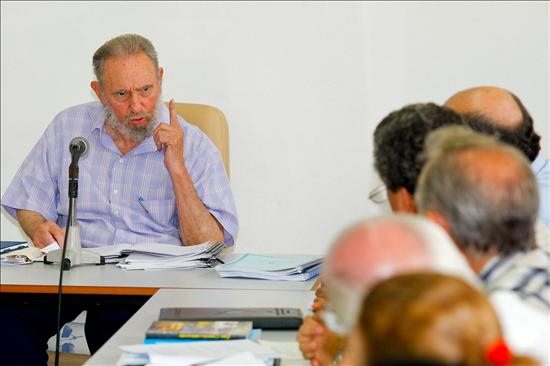
The bearded Castro is a loose cannon. He always has been. His behavior is unpredictable. Foreseeing his next move on the political chessboard is unimaginable even for people with the abilities of Nostradamus.

But something on the Cuban scene smells like it’s burning. There is a sort of forced cohabitation. Two-headed power. His brother, General Raul Castro, governs, but Fidel does everything possible to distract his management.

Castro I resists retirement. The only word is “Comrade Fidel.” In fact and law he remains the Only Commander. The glorious old man with delusions of being father of his country. The guy who sees more than anyone else. The world-class statesman.

A Caribbean soothsayer who equally predicts the path of a hurricane, the decline of U.S. imperialism, or his proverbial ability to foretell slaughters.

Now his laser points to a nuclear war between Iran and the Western nations. He is watching for it. Castro is a textbook narcissist. His gloomy reflections on the Middle East conflict interests no one in Cuba.

Ordinary people are focused on other things. On their own struggle. Trying to get two decent meals a day. And getting money however they can to buy clothes and shoes for their children and to repair their house.

Castro reappeared just at the moment everyone had forgotten him. For the first time since 2006 he hit the streets. The strategy was to overshadow the real news: the release of 52 political prisoners. He returned to fray at the same time that news was announced.

Then, when seven prisoners of conscience were flying towards Madrid, the old guerrilla came to the fore in a television interview, chatting and predicting misfortune in his new role of necromancer.

In local circles the emergence of Castro I is being called a desperate gesture of leadership. And it is evidence of tensions and disagreements with his brother Raul.

The signs are not new. The rebellious and unrestrained language of Fidel has placed the government of Castro II in more of a problem. He is like the senile grandfather that the family tries to give the best care, but at the first opportunity manages to put them through a public embarrassment with his incoherent behavior.

I have no doubt of the respect that Raul feels for the historical figure of Fidel. The General tries to manage the island in his image. But when he wants to disconnect from the policies of his predecessor, the ghost of Fidel appears.

Now the Single Commander counts for little in the real politics of Cuba. Or anything. His brother had the foresight to fire two dozen ministers, officials and secretaries of the party in different provinces. He replaced them with leaders who had his full confidence.

Unlike Fidel, Raul is known to have much lower political talent. But he is a team player and appreciates his unconditional friends. Fidel only had interests. He was above everything. Raúl bases his government on the spirit of clan.

There is a key point that causes friction between the two brothers. In essence, both have the mentality of a dictator and Olympic contempt for democracy and the rule of law.

The brothers born on a farm in Biran, Holguin, like and want power. The means that each of them use to keep it is what raises concern in Castro I.

Fidel is convinced that his younger brother is inept, that without his help he would never succeed in the arena of political subtleties. And Raul intends to show the contrary.

It is time to let him govern. For Fidel to rest in a clinic and be devoted to writing about the topics of his choice or a memoir. But the One is reluctant to go out of style.

He does not want the authoritarian power with which he ruled for 47 years (1959-2006) to go to waste. The old Castro no longer has the support of the armored divisions and the salute of the generals.

But he mastered the art of words and knew how to manipulate the media. It is an uncomfortable burden. Especially at this time, when the General savored his political triumph with the release of 52 political prisoners. A couple of things can result.

As has often happened, the younger brother bows his head and let’s his idol take the reins of power. The General has already adapted and apparently feels comfortable as second fiddle.

The other is that Raul Castro wants to leave a legacy to the country and a consolidated power in the future for his immediate circle. And these are the upstarts in local politics who really hate the unpredictable output of Fidel Castro.

Although they only say it quietly. For now.

Iván García

Photo: European Pressphoto Agency.

Judicial Power in Cuba

In Cuba, the power to administer justice belongs to the People’s Courts. The Supreme People’s Court (TSP), under Article 121 of the Constitution of the Republic, is the highest judicial authority and its decisions are final. But it is not recognized as the highest organ of “the People’s Power.”

Not having the status as the highest organ of the State means that the TSP does not have sole and exclusive jurisdiction to administer justice. It means that another state body may exercise those functions. For example, the general and compulsory interpretation of current laws is the prerogative of the State Council (Paragraph Ch of Article 75 of the Constitution of the Republic).

The defense of the Supreme Law is a function of the National Assembly. The parliament decides the constitutionality of the laws that it issues, the legal decrees, decrees and other general provisions (Paragraph C, Section 75 of the Constitution of the Republic). They also revoke judicial decisions that contradict the Constitution (Paragraphs Ch, R, and S of Article 75).

The Council of State has this same authority (Subsection O of Article 90) regarding the decisions of lower bodies. They can even suspend the decisions of the Council of Ministers and those of the local assemblies, when they do not comply with the constitution or laws.

Consequences:

  • The legal system does not have a Court of Constitutional guarantees or of Constitutional jurisdiction;
  • The judicial bodies cannot rule on constitutionality or unconstitutionality, to control and guide the actions of the government and the legislature;
  • Judicial power is void in Cuba, and with it the rule of law. Higher state bodies are immune and unaccountable for the excesses of government.

Laritza Diversent

Translated by: Tomás A.

The Church and Mediation: Pérez Serántes

Monseñor Enrique Pérez Serantes, born in Galicia, Doctor of Philosophy and Theology, ordained in 1910 and professor of the Seminary San Carlos and San Ambrosio for six years. In the diocese of Cienfuegos he held the positions of Visor and Vicar General, where he founded the St. Paul Council of the Knights of Columbus. In 1922 he he was ordained as a bishop and was appointed second bishop of Camaguey by Pope Pius XI. In 1948 the Holy See appointed him archbishop of Santiago de Cuba.

Pérez Serantes was the bishop most committed to the social problems of Cuba, he called attention to the working world, became the prototype of a missionary bishop and one of the leading apostles of the Cuban church. His activity was inspired by the Rerum Novarum Encyclical (1891) of Pope Leo XIII, who favored the creation of groups, associations and Catholic unions, the germ of the current Social Doctrine of the Church. When the Moncada Barracks were assaulted on July 26, 1953, he assumed an attitude of commitment, as reflected in the circulars with which he assaulted the Batista government, and that involved the Church in the convulsive sitaution in Cuba.

The first circulars were Peace for the Dead, on July 29 of that year, and the Letter to Col. Rio Chaviano, the following day. Later he issued To The People of the East, on May 28, 1957, a pronunciation for social peace; We Want Peace, on March 24, 1958, a new call to seek peace, aimed at mediating between the government and the guerrillas; the circular With Regards to the Explosion of the Powder Keg of Cobre, on April 16, 1958, where he tried to show that those who set off the explosion didn’t think it would cause major damage at the National Sanctuary, avoiding any accusation against the Rebel Army; We Invoke the Lord, on August 22, 1958, issued during the counteroffensive of the Rebel Army; Walk Macabre, on October 7, 1958, where he castigates the parading of the corpse of a young rebel through the streets of the city and calling it a barbarism; and Enough of War, on December 24, 1958, in which he stated that “no one should idly enjoy themselves, while millions of Cubans writhe and groan in the anguish of intense pain and misery.” This position explained that in the act celebrated on January 2, 1959 in Santiago de Cuba, on hearing Fidel Castro for the first time, Monsignor Pérez Serantes was the first to make use of the word.

I heard one version that says Sarría saved him because he was following orders, and Fidel’s wife was the daughter of a politician very close to Batista, who had interceded for her husband. Regardless of which version may or may not be true, the fact that I want to emphasize is that, in the Letter to Col. Rio Chaviano of July 30, Pérez Serantes established his determination to intercede for the fugitives and his readiness to serve as a guarantor for their lives, a decision that allowed him to participate in the transfer of Fidel from the place he was captured to Santiago de Cuba, preventing his assassination. This latter was confirmed by General Juan Escalona Reguera in an interview with the journalist Luís Báez, in which he said that, being in Siboney, near where Fidel Castro was arrested, he could observe the moment when Sarría and Pérez Serantes were talking on the road with Col. Perez Chamont, who demanded that they turn over Fidel Castro, who was in custody.

In May 1960, after Fidel declared the socialist character of the Revolution, Pérez Serantes issued a circular in which he defined the position of the Church with regards to such a definitive turn of events: With communism nothing, absolutely nothing. After an ecclesiastical life, characterized by a commitment to social problems in Cuba, before and after the Revolution, and interceding for the life of Fidel Castro, Monseñor Enrique Pérez Serantes died in Cuba on April 19, 1968.

The contradictions between Church and Revolution were becoming more acute event to the point of open conflict. A proof of the worsening of relations was the detention for several hours in Camaguey — in December 1960 during a return trip to Santiago de Cuba — of the first speaker of the event held on January 2 in Santiago de Cuba, where Fidel Castro addressed Cubans publicly for the first time.

After a prominent ecclesiastical life, characterized by a commitment to social problems before and after the Revolution, and interceding for the life of Fidel Castro, as did other men of the Church in conflict situations in the history of Cuba, men such as Pedro Agustin Morell, Antonio María Claret and Olallo José Valdés, Monseñor Enrique Pérez Serántes died in Cuba on April 19, 1968, at 84 years of age.

Pedro Agustín Morell, Antonio María Claret, Olallo José Valdés and Enrique Pérez Serantes are not alone, but are representative of the importance of ethics, courage, commitment and willingness to confront conflict. The facts, which are part of our history, are little reported and they contain many lessons for the present case of Cuban prisoners of conscience and for many other problems faced at the negotiating table.

The Happiness of the Long Distance Runner

The calendar displays May 20, 2010. It’s half past ten in the morning. In my hometown of Bayamo it’s another hot muggy day that makes foreheads sweat and engenders moods very close to irritation. But that’s outside, in the unsheltered streets. In this office with its inlaid walls where I am now, an air conditioner set into the wall transforms the surrounding reality into something serene and peaceful.

In front of me an official waits, sitting behind his desk. Telephone in hand. Since my entry into the premises he has only interrupted his dialog to say to me, “Good morning Ernesto, take a seat,” as natural as if he had been expecting me to appear. A little later he finishes his conversation, and pressing two numbers with intentional precision, he asks after the presence of some of the institution’s employees. He asks them to come to the office immediately. No one tells me, but I guess: it is the Board members.

The official has a serene expression on his face, no sign of severity. His name: Ernesto Douglas Bosch. His job: Director of Provincial Radio Bayamo Broadcasting, in the eastern province of Granma.

The seconds crawl by, we are alone in his office waiting for the others, the weight of silence forces him to speak.

“Let me tell you something,” he finally says, acknowledging my existence. “You have no idea of the esteem I have for you. First, for your talent, and second, for your attitude as an employee of this Broadcaster, since the time you started more than a year ago now. But there are things that are difficult for me to accept, that I have a hard time believing,” he says, and he leaves the sentence unfinished, as if it’s not worth the trouble to continue.

I listen to him, and although he doesn’t know it, I study the circumstances with an obsessive interest. I have the feeling (just in the last ten minutes since he warned me) that something definitive is going to happen in my life, and I get ready to capture the essence of whatever is said, whatever is breathed this morning.

My arrival at the institution where I have worked as a Cultural Journalist since I finished my university studies in 2008, was marked today by a coercive act I’d never before had occasion to experience.

The receptionist had been prepared; I’d barely stepped foot in the door when she informed me, with great seriousness: the Director was waiting for me in his office. I thanked her for the information. But as I could meet with the director after saying good morning to my colleagues, I chose to go first to my office, understanding in passing that this time it was about something serious. I smelled it in the curt gestures and distance of some of my colleagues, and seconds later, more explicitly, I knew it by the Safety and Security Officer, who was charged with personally taking me to the Board. So there would be no more detours along the way.

So now, when three employees from different areas came through the door almost in unison, and sat down next to me, I had no doubt that I was present at a scene (and in a starring role) for which, to be honest, I’d been prepared, though I hadn’t imagined it would come so soon.

The silence was absolute. Ernesto Douglas limited himself to reaching for a document that (only now did I notice) was conveniently located at his right hand, on the desk. He handed it to me saying,

“Read this. When you’re done we’ll talk.”

My reading lasted much longer than the general patience desired. A comprehensive understanding of this Resolution 12 of 2010, plagued by wherefores, acronyms and legal references, and edited in parts to be nearly incomprehensible, was a real academic exercise.

The essence, however, of what I had in my hands admitted no doubt: By Resolution 12 of this year the Director of the Institution expelled me from the same. Permanently.

Was I taken by surprise? Again, no. My only surprise came from the haste with which this had occurred. And, also, by the reason put forward for doing so.

Let’s see.

Behind this meeting (which although it pains me to do so, I can only classify with one term: repression), figure four names in particular. They are the base of the iceberg. The first three are proper names: Yoani Sánchez, Reinaldo Escobar, Orlando Zapata Tamayo. The third is the name of an artistic group: Los Aldeanos (The Villagers).

Just recently I had published two articles on the internet that centered on these people. First, an article (Revolution in the Village) based on Mayckell Pedrero’s documentary about this rap duo, analyzing musical, social and ideological aspects of this controversial and talented group. Then, under the title, The Death That Never Should Have Been, I published an assessment of the tragedy of Orlando Zapata Tamayo, a case increasingly hidden from the Cuban population. And finally, there was an extensive interview, A Limit to All The Hatred, with the blogger of Generation Y and her husband, also a journalist, Reinaldo Escobar.

Knowing the dismal situation of the media in my country, I didn’t have the naiveté to try to publish these articles in some official space, say a magazine, web, newspaper, or website on the national network. And knowing (also) the disregard for freedom of expression in my country, I did not suppose that, after exercising the right of my own voice to critically question the attitudes and decisions taken at the highest level, I would pass unscathed by any reprisals. Cause and effect.

But the reason Resolution 12 2010 cited as serious misconduct on my part appeared to be the fruit of a creative mind capable of emulating the best of George Orwell, and here my adaptation to the absurd, my resistance to astonishment, could only give way entirely.

What was I accused of? That, in my capacity as a journalist with a personal Internet account (only available at my workplace), I had disproportionately, in my navigation, accessed sites I did not have authorization to access, specifically those of a subversive and counterrevolutionary character attacking our country. Make no mistake: the miserable wretch who wrote this letter should sweat ice for not mentioning, expressly, the true cause of my expulsion. But not talking about this apparently was more difficult than it seemed, as the writer yielded to the impulse. He said, “The publication of articles on the before mentioned sites is also verified.” Only that.

Let us, then, clarify the argument: I was not sanctioned for publishing. No way. Doing so would have confirmed certain accusations about the violation of individual rights, freedom of expression and other demons, that it was better not to awaken in these turbulent times. Then, on further analysis, all the masks fall away and institutional anger against a journalist who dared to be true to himself came bursting to the surface, but in the two pages of horrifying evidence, my articles figure only as an argument of fifth-rate importance and are only mentioned in passing.

So then, I was punished for reading.

For reading what other voices, both inside and outside my country, say about a hundred political, cultural and social aspect so connected to the journalism I practice, as to human reason. but in essence and without make-up, I was expelled for reading what I should not. For doing exactly what the overseers in the cane fields forbid the slaves to do, under threat of violent punishment. And also, what the leader of the Cuban Revolution Fidel Castro once promulgated as a maxim of the process. “We do not tell the people to believe,” he said back then, “we tell them: read.”

Returning to the Board Room of Radio Bayamo Broadcasting, I finished my risky reading, and faced the same silence, the same dense atmosphere that doesn’t allow anyone present to say a word, or even feel comfortable.

I returned to the document to the Director, and with his, obeying his mental plan, he asked,

“Do you have anything to say?”

I didn’t know if my face betrayed my thoughts, but internally I had to smile. With perplexity.

Racing through my mind at the speed of light are the memories of so many expelled, so many censored in the most recent history of Cuba, which is not studied in any school on the Island. And not the memory of a Virgilio Piñera or a María Elena Cruz Varela in particular. I think of all the ones who say no, the unknowns who stories of abuse against their rights, or reprisals like this one, are never seen, never known.

“Of course I have something to say,” although really, I don’t want to. The size of the injustice, the arbitrariness, I’m at a loss for words.

But, finally, I speak. For the space of twenty minutes. I speak of violations, and of the amnesia my country seems to suffer from. Forgetting the results methods such as these have led to for decades, that we still haven’t come to terms with the shameful and seemingly immortal Five Grey Years, dedicating conferences to it or publishing volumes about it. I speak of my rights to information and free expression. I speak of the legal loopholes that, even without a lawyer, can be detected in a simple glance at this libelous accusation. I speak knowing that my restrained catharsis is nothing more than the right to kick the hangman. And when I finish, after a two second pause, my Director turns to the others present,

“Does anyone else want to say something?”

Heads shake, no. And to my surprise, with no more to-do, the meeting ends, though not without informing me that I have seven days under the law to submit a demand for my reinstatement.

His voice is toneless. His gestures are as indifferent as those he received me with while talking on the phone. And I think, the terrible thing is not that they are directors who give in to the temptation to use their powers in the most arbitrary and brutal way. The terrible thing is, I am sure that later today, Director Ernesto Douglas Bosch will sleep peacefully through the nights, with his wife and family relatively happy.

“You have nothing to say to me,” I ask him before getting up. “You have nothing to say after all the time I spent arguing against this punishment?”

His answer, rigid, now ruthless, comes without thinking,

“I have nothing to say. I heard you but everything that needs to be said is in that document you have in your hands. We’re done. Good day.”

At that very moment, in the second when I look into his passive eyes behind his magnifying glasses, I understand that during the entire meeting his ears remained closed to my voice. His ears, and everyone’s. No one listened to me in this spectral encounter.

Why? How evil of this Director made speaker, whose joviality at times borders on a lack of character and authority? No, I tell myself. The reason is something else. The true reason is that this man with his power to separate me from the entity he directs, is just following orders.

Explicit orders (“Take drastic measures in this case”) or implicit (“If I were you, I would handle this matter intelligently”). Or even worse, interior orders, incorporated into thought, that warns of the risks of not being assertive with a mistaken employee and in consequence being judged as an irresponsible and lazy worker. Orders of a thousand different kinds. But in the end, orders.

So even in this moment as I walk through the hallway to the exit, with the notable perception that those who look at me do with a, (yes, it’s so), humiliating pity, with eyes showing a solidarity that, if there were no danger, could sympathize with me; not even now, when I know that the link has been permanently cut, can I find any animosity against the one whose stroke of the pen it was.

Ernesto Douglas Bosch did not expel me, I think. Whether he recognizes it or not, his sad function is to be the puppet of other minds, minds that at any moment would hesitate to throw him into the fire, just as he did to me today. He is the executor of a firmly drawn direction, but at bottom, I will never know whether or not he agrees. Since none of the thousands of Cubans expelled from their jobs, removed, condemned to work in steel factories or cane fields, will ever know if the one who told him of his exile internally agreed with the measure, or if he had no choice but to carry it out for his own good.

It’s almost noon in Bayamo of my island Cuba. Under the same desert sun I once again wander the city where hundreds of years earlier a fervent and lacerated people sang the first verses of our national anthem. We, and them, we are no longer the same, I think, before losing myself in the busiest shopping street of the city.

And I think, also, that none of the people now passing me, nor those behind me, have been commenting on my case, nor could Director Ernesto Douglas Bosch back in his office with its inlaid walls, understand the state of mind with which I turn my steps toward personal and professional independence. This kind of inner harmony is similar to that of a long distance runner who, apart from the crowd (it doesn’t matter if he is ahead, behind or next to them) runs on air, without others understanding his lightness, and his smile of happiness.


Ernesto’s Blog: The Little Brother

Exclusion, the Real Counterrevolution

The term “revolutionary” has a different meaning in the Cuba of today than we would find in any Spanish language dictionary. To deserve such an epithet it is enough to exhibit more conformity than criticism, to choose obedience over rebellion, to support the old before the new. To be considered a man of the cause, requires one to manage a convenient silence and to watch arbitrariness and excesses March by without pointing them out to the highest levels of responsibility. A word that once gave rise to thoughts of ruptures and transformations, has evolved into a mere synonym for “reactionary.” Paradoxically, those who believe in safeguarding the essence of the “revolution” are precisely those who show a greater political immobility and who promote — with more animosity — the punishment of the reformers.

Esteban Morales, who until recently enjoyed the privilege of appearing live in front of the TV microphones, learned of such semantic mutations by dint of suffering them. A Communist Party member, academic, and specialist on issues relating to the United States, he had the dangerous idea of writing an article against corruption. His questions dealt primarily not with the daily diversion of resources — as we call stealing from the State — which is how many Cuban families manage to make it to the end of the month, but rather the ethical decay that has established itself higher up, in the estates of power, where embezzlement and misappropriation reach lavish levels. He had the unfortunate experience of putting into writing that, “there are people in government and state jobs who are positioning themselves financially for when the Revolution falls.” It is a conclusion anyone can draw just by looking at the fat necks of the managers, the shiny Geely cars belonging to the officers of CIMEX corporation, or the high railings surrounding the houses of the commercial hierarchy, but Morales committed the audacity of pointing it out from within the system itself.

Imbued with the calls for constructive criticism, calling things by their name, speaking openly, Esteban Morales thought his article would be read as the healthy concern of one who wants to save the process. He forgot that others with similar intentions had already been labeled as divisive, manipulated from the outside, addicted to the honey of power, and ideologically deviant. For less than this, journalists had lost their jobs, students their places at the university, and economists, lawyers and even agronomists had been stigmatized. Once punished with an indefinite suspension from the core of the PCC, the previously trusted professor has started down a road that we know well where it starts, but not where it ends. Experience says that the route of sanctions is never traversed in the reverse direction. Those ousted eventually realize that those they used to consider the “enemy,” could at some point prove to be people imbued with the original meaning of the word “revolution.”

To comment on this article please visit:

Yoani’s Blog: Generation Y

Who Benefits From the Release of the Cuban Political Prisoners?


The recent release by the Cuban government of the 52 detained prisoners in the spring of 2003 can be interpreted in several ways. We shall examine some possible strategies or possibilities. And in all of them, the one gaining the most is General Raul Castro’s regime.

Certain national and international analysts think that the release of the nonviolent opponents displaces the fragmented internal dissidence. Maybe they are right.

In any case, the national opposition is weak, with a political project unknown to the majority of the population on the island and it is infiltrated to its marrow by the intelligence services.

To make things easier for the Castro government, in the last decade certain opponents have been focused on strife, nepotism, excessive profanity and an immeasurable protagonist role.

Among so much quarrel, corruption of certain leaders, warlordism and messianic projects that do not correspond with the reality of the country, and serve only so that American agencies give them money, which evaporates into questionable conduct, one can reach the conclusion that the release of the 52 opponents did not score points, nor will it pave the way for a possible dialogue between the government and the dissidence.

The Cuban dissidence is not at its best. It’s a trivial opposition. It hurts to say it, but that’s the way I see it. Its aims and premises are the same that the majority of the Cuban population wish. But its working methods have devalued.

The clever ones who work with General Castro did their math. The death of the dissident Orlando Zapata and the constant walks of the brave Ladies in White, together with the hunger strike of Guillermo Farinas, warmed the track and instigated critics across half the world.

Something had to be done. And it was Raul Castro’s loyal generals who lead the country. All the enterprises which function and generate an income one way or another are controlled by the olive-green entrepreneurs.

The antiquated Russian tanks have been, for many years, falling apart in the underground shelters. Just like the outdated MiG fighters and the antiaircraft guns. In the absence of a war against the North, which will never happen, the Cuban nomenklatura dedicated itself to business.

They learned marketing, costs and benefits. So that they could improve their financial situation on the island, they received big commissions and abundant diets from capitalist entrepreneurs. When they look at themselves in the mirror, they notice how much better they look in tailor suits, rather than in their rough military uniforms.

To these generals, who like to say Sir rather than colleague, who prefer the good table, Spanish wines and Scottish whisky to the sugarcane rums, they are the ones who encouraged Castro II to launch a truce.

They made a deal with the Cuban Church and the Vatican. With Spain, and underneath the table, with some sectors of the Obama administration.

They are willing to dialogue with any actor inside or outside the country, except with local opposition, for the simple reason that our dissidence, between the harassment of State Security, its quarrelsome language and its inertia, has dug its own political tomb.

Another of the variants, calculated with care by those who govern the destinies of the country, is that the economy is sinking with no remedy in sight.

If people still think that their future is in Miami or Madrid, that working is not worth it because wages are a joke in bad taste, that their pantries and wallets are empty and that the displeasure of the ordinary citizen towards the regime constant increases, then the policy change is imposed in an accelerated way.

For a logical and forceful reason. If the depressed living standards of Cubans are not improved, they will lose power. And they bet on controlled changes. They look at Vietnam and China. While they take advantage of the oil that the impertinent Hugo Chávez offers at a rock bottom price.

Next, the jails had to be emptied. It is a first step. Also the language moderated. Insults will be saved for better occasion. The generals believe that they have the situation under control with respect to the opposition. They calculate that their leading role is strengthened if they can bring a glass of milk, food and meat other than pork to the family table.

A dissidence with more a broader playing field could be a fertile ground for new proposals, in tune with the realities of the people. Even if they have no space in the media or public participation.

The government will continue to watch them with its bulldog face. But there are interesting loopholes. If 52 peaceful dissidents are released, going forward there would be no rational argument to imprison anyone just for writing or wanting to organize a political party.

The ball is in the opposition’s court. They will have to even the score. Right now they are losing 1 to 0.

Prison Diary (1) (La Cabaña Prison)

OUTSIDE OF EVERY imaginable world, is the extreme awareness of reality, you live in cell twelve feet by six feet, usually with four inmates, sometimes sixteen who have to stand up, and when it comes time to sleep they fall slowly, like fainting, like sugar canes thrown on top of one another, creating a deformed mass, you couldn’t guess which extremity belongs to whom.

The air is not enough for two, not even one, and the sound of gasping, of shortness of breath, sounds like an instrument out of tune. But this asphyxia turns into chronic asthma, it’s worse than being alone. Many times, according to the treatment, they leave you alone so the madness will come more quickly. In this case, for some moments, the only thing you can see, other than your own body, are some fingers on a hand that disappears, as if it were the product of your imagination, when they open, three times a day, a small rectangular window in the bottom of the door to put the trays in. Then you have to settle for observing, in those few moments, how one or the other hand pushes the tray into your cell and beans or soup spread across the floor, mixing with the rice that you collect with your spoon, because in these circumstance you can’t waste a single grain.

Sometimes you want to touch the hand, hold it, kiss it, ask forgiveness, mercy and that it would be moved and let you out of there, end the anguish; but it’s not worth the trouble, this hand only knows how to threaten, push and hit.

Request for Review Presented to the Minister of Justice

Havana, April 26, 2010

“Year 52 of the Revolution.”

To: Director Maria Esther Reus Gonzalez

Minister of Justice

I, Ines Ramos Napoles, resident of Calle 4, number 119, between 1st and 3rd Playa, Havana, with ID Number 40012108557, in the name of my son, my family and myself, request the URGENT REVIEW of case No. 11/2008 of the Second Criminal Chamber of the People’s Provincial Tribunal of Havana. where Yamil Dominguez Ramos was sentenced to ten years in prison for the crime of trafficking in persons.

Yamil has always declared that he is innocent of these charges. To the court if was enough to judge him based on the initial declaration of Marleny Gonzalez Rodriguez, previously manipulated by an official of State Security, and so to find him guilty and not by virtue of an oral judgment, a declaration that had already been thrown out of court in a previous motion, showing clearly that it had been gotten from his wife under pressure, by telling her that it would benefit her husband.

We appeal for an annulment of the sentence. The Supreme Court overturned the ruling of the lower court and ordered a reconsideration and drafting of a new ruling eradicating the defects identified. (Attached is a copy of the Ruling No. 2929/2008 of the People’s Supreme Court).

However, on returning to the actions referred to the Provincial Court, with a change of date, roll number, and typography of the letter, it drafted the ruling in the same terms as the first and with the same errors. However, when we brought back the Appeal for an Annulment to the Supreme Court, far from questioning the role of the judges sanction by the court in the first place, for having ignored the order given, we found to our sad surprise that this time the Supreme Court, with other judges, ratified the second ruling of the Provincial Court. From then my son has served a sentence for a crime he did not commit. The process of review through an attorney cost us 500.00 CUC that we do not have. So today I am preparing this report to ask for a review of the case and with it, that JUSTICE be done. The decision is urgent, more so when Yamil, in claiming his civil rights which he was cruelly stripped of, has been on a hunger strike since April 14.

To continue, we explain the reasons that Yamil should not have been sentenced and deprived of his liberty:

First: Yamil has no need to traffic in human beings. He is a worker and a good father to his family. He emigrated legally to the United States of America on 7 December 2000, with his second wife and his two younger daughters. When he arrived in that country he worked hard to get ahead. First in a construction company, while studying for a university degree, with the objective, through his own efforts, of owning his own company. This allowed him to be successful financially. From the point of view of economics and finance, I repeat, my son Yamil has no need to traffic in persons.

Second:Yamil had no reason to take his family illegally out of the country. In February 2005, I went to the United States of America which he arranged. In September 2007, my sister and I had a passport visa and in October we received the letter of invitation to return on a visit to the United States, scheduled for the end of the year. In August of that year his elder daughter, from his first marriage, who was 13 at the time, was reunited with him, which he also arranged. By the way, since October 13, 2007, she has been without the protection of both of her parents, because her mother lives in Cuba. From August 24, 2007, he had from the U.S. Department of State, the paperwork for the visa process for Marleny Gonzalez Rodriguez, a visa that would allow his current wife to travel with her son to be reunited with him, so there was no reason to look for illegal means, let me repeat that the visa was already authorized for his current wife from the date previously mentioned and the file is open at the U.S. Interest Section until Yamil’s situation is resolved.

Third: My son has no need to enter this country illegally. He has visited Cuba seven times, four of them through Cancun. At 8:00 in the morning on October 13, according to what he told me on the phone on the 10th, he headed to Cancun on his own boat to participate in a marine event and then was planning to fly to Havana, carrying in his luggage 54 music CDs, a video camera, $1,900 U.S., the documentation for his oat and his passport in order, including the Cuban passport visa good until 2010. Due to two storms on the open sea (the Meteorological Institute of Cuba has confirmed these storms as actually occurring and not merely forecasts as written in the ruling) he sought assistance to enter the International Port at the Marina Hemingway. This was the only reason he approached the Cuban coast.

Yamil was forced into the nearest port by force majeure, which is allowed under international standards of navigation and, although he was not able to give prior notice of his arrival, Article 215, Paragraph 2 of the Criminal Code Act 62, exonerates him from criminal responsibility. On the other hand, every crime must be duly proved, as the sanctioning Board should not rely on the initial testimony of Marleny (his wife), which contrasts with that made Yamil and without a shred of evidence to support it, the reason that the Supreme Court in Case No.2929 signals the trial court; besides, my daughter-in-law accused, prior to the trial, the official of manipulating her and inciting her to declare false testimony, which she stated in oral testimony where she told the reality of the process, as well as the legal paperwork for the fiancée visa with which she could travel along with her son and that, as said before, the court omitted in its ruling, but that should be taken as documentary proof and that I am attaching in the form of a certified copy of this document.

If Yamil really intended to pick up Marleny in the area of La Puntilla (coastal zone separated from the Havana seawall at the mouth of the river Almendares) and, if Marleny really was in that place, why didn’t he do so, if the boat was in perfect physical condition, with two GPS receivers to inform him of his position and the distances of the Cuban boats, with sufficient fuel to get to Cancun or return to the United States? Yamil entered Cuban waters in the area of Habana del Este and traveling west, a mile from the coast, headed toward the Hemingway Marina International Port, being spotted by the Coast Guard ship around the Hotel Triton, where with his engines off he awaited the arrival of the Coast Guard and they escorted him to the international port, an action that corresponds to the testimony of the witness who escorted him. The route followed infers that my son passed through the area where supposedly Marleny was waiting but never came to pick her up. This act shows, without any doubt, that Yamil never had the intention to illegally pick up Marleny.

Fourth: The decision made by the disciplinary tribunal has ERRED IN THE LAW by stating that the participation of Yamil in these events is “proven,” and considering my son an intentional action of the crime of TRAFFICKING PERSONS , sanctioned in Article 348, Subsections 1 and 2, of the Criminal Case, which no doubt has influenced the decision handed down, punishing him with ten years’ imprisonment for a crime he did not commit. On the other hand, the sentence is not consistent with the evidence presented during the trail that might have influence on the verdict.From reading the narrative of events, recorded in the proven evidence of the sentence, it is not possible to understand precisely and clearly, what is the profit motive that is present in the actions allegedly undertaken by my son, or allegedly taken for him? It is evident that if true the argument that seeks to be substantiated in the sentence, such actions would be motivated exclusively by purely sentimental reasons and family reunification, particularly that the tribunal admitted as true in the fifth paragraph of the judgment in question where it says, “…the accused only intended to smuggle out of Cuba his fiancee and sin, not other people, nor did he have any interests other than sentimental and impressionable because he also endangered his own life…”If this is true as stated, I can assert that the facts, reported in the proven evidence, do not meet the legal significance required by the legislature to charge someone with the crime of trafficking, as erroneously charged. In the facts related and the proven evidence for which my son was punished, the element of criminality is not present, perhaps the most important for this offense which is “THE PROFIT MOTIVE.” In the Judgment No.476 of January 17, 2001, issued by the Criminal Chamber of the Supreme People’s Court, published in the pages of the 50 to 58, the Bulletin for the year 2001, the Supreme Judicial Body, ratifying such an approach by saying: “… Traffic in Persons (Art. 347.2 and 348.1 in relation to Articles 9.1.2 and 12.1 of the Criminal Code). The criminal provisions of Article 347.2 of the Penal Code has a body and life itself, its wording is clear and is violated by those who, “without being permitted to do so, motivated by profit, organize or promote the exit of the country people within it to third countries …. ” This ruling itself admits that in classifying this type of crime it can be omitted, including undertaking this kind of effort with no motive to profit, and one of the recitals says: “… assume the specific activities endorsed in these types, which do not fit any association or linkage of people who are in the country with others who are in other countries and vice versa, and much less when engaged in the Trafficking in Persons in violation of immigration regulations, or dedication does not exist, these activities are motivated by profit, because when there is such a connection and purpose with which we participate is to obtain economic benefit or personal gain of any kind, reflecting the broad sense that this term has , the conduct falls within the normal offense against the Immigration …. ” These fragments I have quoted illustrate the error of law committed by the Second Chamber and the Supreme Court in Case No. 2929/2008. From the above I consider that, based on the facts of the ruling of the Second Chamber of the Provincial Tribunal of Havana as “tested” the correct legal description could be then UNLAWFUL ENTRY IN THE NATIONAL TERRITORY. Such a misunderstanding of the Board is of extraordinary significance to the extent of the penalty that was applied (Ten years of imprisonment), for the crime described by the Board, even when made use of the 239 Agreement by the Governing Council of the Supreme Court, has a penalty under twenty to thirty years imprisonment or life imprisonment, while the crime allegedly committed by my son, is a framework of penalties of one to three years imprisonment or a fine of three hundred thousand shares. The adoption of the legal qualification I suggest, on the facts “proven” in the sentence, would bring an invaluable benefit for my son, who, besides being an honorable person, has no criminal record either in Cuba or the United States, and with appropriate consideration of his social and moral behavior there would be a substantial change in the length of the sentence, which would already have been served as he has been in custody for two years and eight months.

However, Yamil Dominguez should not spend even one more minute dispossessed of that which has no price, his freedom, and much less for a crime he did not commit. In addition to being a man of excellent hum qualities, of revolutionary origin, without a criminal record, and even were all the elements declared in the sentence to be “proven” were true, in our Penal Code Article 13.1 it is not punishable when a subject spontaneously avoids the criminal act. From the above it follows that if his intention had been to illegally collect his wife and son, he abandoned, by his own will, that act, and never even entered the area where they supposedly were waiting for him.

In hopes that the truth will win out and an error in the Justice will be amended, before the effects are worse for Yamil Dominguez and, in consequence, for his family.

Inés María Ramos Nápoles mother of Yamil Domínguez, and other relatives.

“In justice there can be no delay: and he that interferes with its fulfillment, turns it against himself.”

José Martí. (Complete works, volume 13, pág.320)

PD: Attached

Copy of the Ruling No. 2929/2008 of the People’s Supreme Court

Copy of the notarized document from the United States Interest Section in Havana attesting to a visa for Marleny Gonzalez and her son.

Copies of the Letters of Invitation from Inés María Ramos Nápoles and Migdalia Nery Ramos Nápoles.

CC: Council of State

On Olga Guillot’s Death

Olga Guillot has just left us. Another matchless Cuban patriot is gone without having returned to a free Cuba. In Cuba and in exile there is the same feeling, pain and nostalgia. When I received the news of her death, I remembered Celia Cruz, and like those of my generation here in Cuba, I could not nor will I ever see her. I will have to be content with listening to her music and taking pride in her having been born in Cuba.

Her dying without seeing her homeland free, and her artistic life linked to her patriotism, give us one more reason not to falter in this noble effort.

Those of us who continue living and fighting, are depended on by many others, like Olga, in order for them to be able to return to this beautiful and unique Cuban land of their birth. It’s no wonder that our apostle said, “There is no ground more firm than the ground on which one was born.”