The Manipulative Dossier

Image downloaded from buenosenlaces.com

In Cuba we have six television channels, but at 8 p.m. our options narrow, because the national news (the primetime program) is broadcast repeatedly on three of them (channels 4, 6, and 27), we are treated to sports news on channel 2, on channel 21 they show a documentary (the ones during that half hour are generally less interesting), and on channel 15 they rebroadcast (they never show it live) the “friendly” news show from TeleSur. Our satellite newscaster “informs” us how well things work in Cuba in contrast to other countries, mainly capitalist, of the world. He tells us of the abundance of products in the markets, “satisfied consumers” are interviewed, and the magnanimity of our government is sugarcoated daily. So in the face of such “marvels” I am quick as a hare with the remote control, surfing through channels and looking around in the scraps of programming for topics which I expect won’t make me nauseous.

There is a journalist on the TeleSur program who wears an eye patch in the old style of buccaneers and pirates. They say he lost that eye in a helicopter accident during a mission. His image strikes me as somewhat grotesque, because I think that his warlike nature and the blackened eye-socket which highlights it are part of a well-modeled image of the militant journalist committed to a 21st century socialism without manual or program, who bases his raison d’être on the perpetuity of the power of the strongmen and on the fight against the “Empire of the United States”. I have to give credit to this man, the anchor of “Dossier”, which opens and closes with a catch-phrase, saying that it broadcasts “from our beloved, contaminated, and only (here he raises an index finger) spaceship”, referring to Earth. I credit him and his production team, because it seems that they are getting their signal out to various corners of the Milky Way. That feeling leaves me every time he uses that unnecessary sentence to refer to his location. It wouldn’t surprise me if on the same program we found another host wearing a surgical mask because he had a decaying smile or was missing his teeth. It would simply be yet another eccentricity.

TeleSur, with its headquarters in Caracas, and which counts on financing from Ecuador, Nicaragua, Venezuela, and Cuba, among others, is transitioning on its journalistic path toward the “Cuban disinformation style”, evidence of the protective and consultative role of the largest of the Antilles in that Latin American media outlet with international distribution. It is an echo discordant with democracy and anachronistic in a particularly fashion to repeat the formulas of this long-lived, mature, and failed sociopolitical and economic experiment, and to adapt them to a project which claims to promote regional integration in societies where, despite the influence of our Antillean archipelago, plurality still survives. What would be fairer with respect to the realities of our brethren to the south is the exercise of objective, impartial, and truthful journalism in which there is no need, as there is in Cuba, for recourse to the “censorship patch” or the “surgical gag” to violate their people’s rights and deceive them with disinformation and manipulation.

Translated by: Adam Cooper

December 20 2011

Recurring Arguments

Image downloaded from the site: jorgegamezusa.blogspot.com

Cuba’s elderly leaders must be celebrating, because once again their Cuban-American adversaries in the U.S. Congress have served up to them, on a golden platter, the old, spruced-up reasons that provide their cadres and officials the banquet of arguments with which they justify and “feed” the rigidity of the model. It’s the recurring, long-distance slap from the extremists under a fossilized policy which hasn’t worked, which is almost 53 years old, and which even so they refuse even to reconsider for the welfare of Cuban society.

On December 13 the front page of the daily Granma informed us that the United States Congress was considering a bill which would again restrict travel by Americans and Cuban-Americans to our archipelago, as well as remittances to Cuba. The article cites the Chicago Tribune and points out that the initiative is sponsored by Mario Díaz-Balart, a Republican representative for the state of Florida. It goes on to say that the measure is intended “to reinstate the restrictions approved during the George W. Bush administration, such as a single trip every three years for Cuban-Americans for the purposes of ‘family reunions’ and a limit of $1200 per year on remittances”, and that the relaxing of the sanctions approved by President Barack Obama would be annulled ipso facto. It is a strategy designed to slam the doors on any possibility of dialogue, instead of extending a hand in national reconciliation.

Some time ago, in these parts, the country’s leadership announced — among the timid reforms they inserted due to the burden of the disaster that is rotting Cuba — the abolition of the exit visa and the facilitation of travel for Cuban émigrés to our common home. In the measures announced most recently they have neither commented nor legislated on the matter. I don’t know if they’ll be supported given this senile strategy which divides and serves both sides so that they can defend their respective territories and rhetoric. I will go on defending the truth, and as in a game of dominoes, I choose a third position so as not to be a wild card for either faction; I pound the table and act in accordance with what I consider best for the Cuban nation: Stop bickering!

Translated by: Adam Cooper

December 20 2011

Onomatopoeia of Tears

From "elmundo.es"

It seems that the Honey of Power is addictive and that many civilians and military consume and permanently succumb to this sweetness. Like a psychotropic leadership it collects bosses, subordinates and entire peoples. It doesn’t matter if they aren’t in the same spectrum of colors, yellow and red hallucinogenics mix just the same in Asia and America like a dusk in modernity. We already suspect what will happen in North Korea when Kim Jong-Il is no more, the former “daddy’s boy”; it’s normal now that another “brilliant” descendent will take the reins of that country. After all, it doesn’t matter to real power if a toddler is recognized, stealing the cameras, the microphones and all the attention, they always allow them to enjoy absolute domination and impunity.

I imagine the austere North Korean soldiers pompously breaking the news to them of the death of the “Supreme Leader” and the brave soldiers tearing up at the loss. I suppose those who worked most closely with the “Great Leader” of the Workers Party of Korean forged a halo of genius over the offspring of the Korean “Dear Leader” as a prelude to the announced succession.

The Cuban television cameras showed us the village women and men in the streets crying over the death of the”Beloved Guide.” Perhaps because of this in this Oriental country, psychoanalysts and politicians, noting the identification of people kidnapped with their kidnappers, coined the term “North Korean Syndrome” to refer to the collective psychological reaction on the death of a dictator.

Although with logical cultural differences, perhaps the descendants of the Cuban “Juche” will look closely at these events through the prism of their genetic relationship with the highest office in the country for which their parents fought and which allowed them to enter, as in Korea, the “progressive” caste of the “enlightened” owners of power in Cuba. Hopefully I’m mistaken.

December 27 2011

The Party of a Democrat

Photo from: "anothereyeopens.com"

As peaceful pro-democracy fighters in Cuba we are filled with deep regret at the news of the death of the Czech playwright and politician Vaclav Havel. I’m sure there was also consternation in all democratic countries in the world. This distinguished intellectual born in Prague, condemned by the Soviet invaders who stole the Prague Spring in then Czechoslovakia and who then banned his works and repeatedly harassed and imprisoned him for defending human rights.

He founded, in 1977, the Charter 77 movement in which he stated his disagreement with the single-party political system prevailing in his country. He was also one of the architects — from his leadership of the opposition group Civic Forum — of massive public protests that brought down the communist regime, the so-called Velvet Revolution, in that republic in Central Europe.

He left us a springtime of hope for those who peacefully work toward the same goals for which he fought. In friends like Havel — a symbol of the peaceful struggle for freedom — we Cuban democrats find helpful solidarity in the demand for respect for human rights in Cuba and for our civil and political rights. His example confirms to us the inspiration to continue paving the way for justice, democracy and national freedom.

I hope the day is not too distant when we will have our own forum of good will and complementarity, where “the power of the powerless” allows a role for all Cubans, in the common and highest purpose of peaceful national reconciliation. That would be our best tribute to this great man of the world.

December 27 2011

Sequences and Consequences

There are expectations on Cuba’s “multiple shores” regarding the new immigration law that the government of Raul Castro is working on. It’s not the first time we’ve heard about it; it’s already been alluded to more than once and the news has leaked out that it is in advanced stages. I wonder how much so. Because there is a precedent in a “memo” published by a news agency a few years ago about the sale of Russian Lada cars, which turned out to be a fiasco.

It’s likely that this trick to learn about public opinion on a topic is part of the strategy of the administration that took the helm in 2006. It’s a recourse that is becoming repetitive and that arouses suspicions. Perhaps he’s waited so long to make reforms that now he turns to tactics to tranquillize and entertain the population in order to gain time for his team to move the pieces of the legal framework to arm the new puzzle. How to return to Cubans the travel rights they enjoyed before 1959 that were violated? Therein lies the dilemma.

They have scammed us so many times for so long that people wonder whether the new measures won’t also be saddled with restrictions. Most of the people you talk to about the issue display their skepticism regarding a right. If they don’t publicly and legitimately respect all the rights of Cubans, it would be discriminatory, unfair and misleading — repeating the historic error of droit de seigneur in the matter — leaving it to State’s different agencies of control to decide what to implement and what not to.

Thus, they would establish a legislation of doubtful guarantees of the capabilities and dignity of Cubans in opposition, relative to the known and accepted norms of the international community, in which they selectively support the authorities when and how it corresponds to their interests.

On the other hand, Cubans need to be educated on this fundamental topic to establish a culture of rights in our society — contrary to the intolerance and outrage fomented — and this is achieved by recognizing and respecting everyone. This happens, as is natural, by implementing human rights, which are inalienable and indivisible and which the government has “no right” to continue violating. They cannot legitimize some few without transgressing others.

They have subjected people to so many abuses of power, that we are justified in distrusting reforms in general and those relating to the new immigration law now in progress. I hope they won’t repeat the old carrot-and-stick trick where, in Cuba, the carrot is usually rotten.

They have subjected people to so many abuses of power, that we are justified in distrusting reforms in general and those relating to the new immigration law now in progress. I hope they won’t repeat the old carrot-and-stick trick where, in Cuba, the carrot is usually rotten.

Translator: Unstated

December 27 2011

My Tree of Hope


I want to share with readers, colleagues and visitors, the good wishes that radiate from my Cuban tree of hope.

[On the tree: Implementation of Human Rights. Market Economy and Social Solidarity. Free and Democratic Elections. Separation of Powers. Subsidiary Principle. Participative Democracy. Respect for Diversity. Direct and Secret Vote. Citizen Sovereignty. National Dialog. Multiparty State. Common Good. Justice. Peace.]

May the light of Bethlehem light your way this Christmas and in the coming year, and the Family of Nazareth be a permanent and living reference for us to defend with discernment, prudence, and wisdom our rights and desires for peace, justice, freedom and democracy for all.

A very Merry Christmas and a prosperous 2012.

Havana, December 2011.

Diversity vs. Demagoguery

Freedom. Truth. Graphic taken from elmatinercarli.blogspot.com

For some time here the leaders of the Cuban government have been given to talking about diversity and defending the importance of respecting this in different groups of people in our national home. It’s a positive discourse, of course, but something rather “tricky” if we take into account that it only refers to the social and cultural which in our country is always imposed with militaristic criteria from the seats of power. But perhaps it is the sowing of a seed — I tell myself — of the context for a transition towards which Cuba seems to be beginning to “crawl,” toward a society of openness in which we all can walk. I don’t want to be too innocent, but neither do I want to be too skeptical about some curtains that seem to be moving, although they still won’t let us open the window.

The Cuban government is going to integrate “in its own way” into the world and needs to legitimize itself with slow and calculated steps, into the community of democratic nations in the world, most concretely in Latin American, where it is the only one that currently has a single-party system. With its radar focused on this hemisphere — keeping in mind the recent creation of the Community of Latin American and Caribbean States, CELAC; its partial reconciliation with the Catholic Church which covers the majority of the continent and is a force for action — although with great fear of losing power; timidly instructing and ordering as Party concession the spaces and socio-economic achievements and policies we used to enjoy in society and that they took from us on violently coming into power.

After almost fifty-three years, these steps are the tacit acknowledgment that their model failed and they are preparing the society for its incorporation into the democratic world when they are no longer. However, it is illogical to talk about diversity only for a part of the social fabric. For a people subjected for decades to assimilate this concept, it should cover the entire spectrum of national life, including the political. It should legitimize political parties and respect for the human rights established by the United Nations. Diversity in everything and for everyone should be the motto, which is synonymous with pluralism and rule of law; if not it is a euphemism for the repression of progress. To offer it in a partial sense, according to the interests of the state is demagoguery, at least I think so.

December 13 2011

The Pineapples of Wrath

I’m not referring to John Steinbeck’s novel The Grapes of Wrath written in 1939. I’m talking about the culinary experience that led me to the farmer’s market: I decided to make a cold salad with a pasta base. For any mortal in another country, it’s probable they would have the option of buying the dish ready-made, or if they wanted to make it at home, of buying all the ingredients at one time, or perhaps making a second trip because they forget something, but everything would be available.
In Cuba it’s an exercise in mental hygiene requiring huge portions of patience. This recipe calls for — at the least the one we make at home — lots of mayonnaise and white onions, as well as boiled potato cut in small pieces. Some reinvented their own recipe for mayonnaise, and by saving great quantities of oil (a scarce product selling dearly in hard currency), make it by giving the oil body with mashed potato, milk with cornstarch, or some other ingenious and available substitute.

Rafa and I preferred, this time, to spend the hard cash — I don’t think mayonnaise is sold in Cuban pesos — to give it the familiar taste. For a customary exercise in survival, we Cubans often forget to eat, and so to feed ourselves is a pleasure.

Recovered from the horror of the fiftieth anniversary of Castro, I didn’t want to find myself surprised by the usual shortages and was collecting some of the ingredients several days in advance. After roasting the quarter chicken I was going to throw shredded into the salad, I tossed my lucky coin and went out shopping to buy what I lacked. As we were packed like sardines in the farmer’s market I searched quickly for what I needed so I could get away from so many people rabid for food. The onion cost me very dear, I bought it with a little mountain of national currency, and I also acquired the mayonnaise easily — notwithstanding the excessive price which I paid in hard currency — but it is the third ingredient that led to this post.

Incredibly, the farmer’s market near my house only sold green pineapples. To avoid disgracing my salad with sour pineapple, I walked from market to market and found the same thing at some while others had none at all. After two hours and so as not to waste the whole day, I went to a stall and asked the seller for a ripe one. “Señora, all that I have are ready to eat and very good.” As she had them in front of her and I am not colorblind, I responded and we got into an argument because she wanted to tell me that a green rind is a sign of ripeness, and that I shouldn’t “be picky” and ask for “difficult things,” but just be grateful there was pineapple at all.

In the end, as I didn’t have enough cash to substitute apples — which are only sold in convertible pesos — and I left the crush of people disgusted by the dispute, wanting to punch myself for my stupidity in demanding “ripe tropical fruits in the tropics” and in frustration for “leaving the party” empty handed.

I left mentally fuming, making an analogy with the title of the Pulitzer Prize novel of 1940 which is considered a major work: The Grapes of Wrath. I also remembered the phrase attributed to the late Armando Calderon — anchor and host of the long-gone Sunday TV show, “The Silent Comedy” — who said that one morning he had modified his usual chatter for the children present: “This is de piña*, dear little friends!”

*If you substitute “ng” for the letter “ñ” in “piña” (pineapple), we have the name of the masculine sex organ which is a part of so many expressions and expletives in the vulgar Spanish of Cuba.

Translator’s note: This text in the original Spanish plays with longer words that include the letters “piña”; unfortunately this wordplay cannot be reproduced in translation.

November 15 2011

The Church Taken by Parishioners

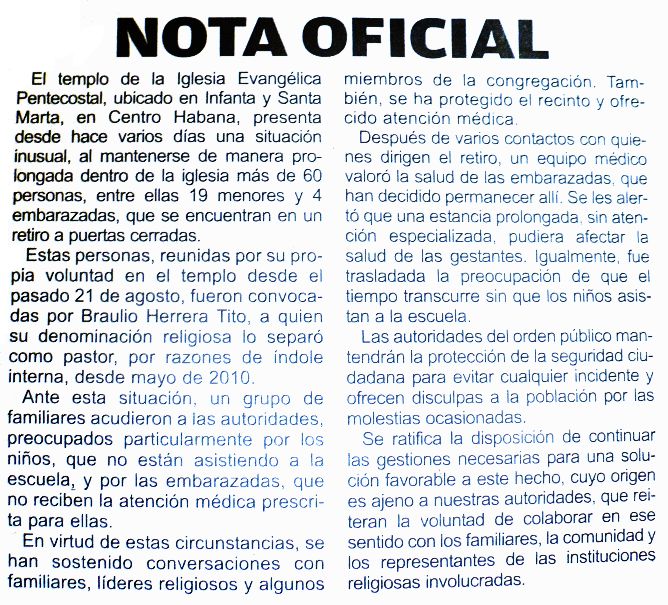
The temple of the Evangelical Pentecostal Church, located at Infanta and Santa Marta in Central Havana, displays an unusual situation since a few days ago, in that more than 60 people, among them 19 minors and 4 pregnant women, have remained in the church for a lengthy period of time, found in withdrawal behind closed doors.

These people, reunited on their own volition in the temple since this past August 21st, were summoned by Braulio Herrera Tito, whose religious denomination removed him as a pastor since May 2010 for reasons of an internal nature.

In light of this situation, a group of family members reached out to the authorities, particularly worried about the children, who are not attending school, and for the pregnant women, who do not receive the medical attention prescribed for them.

By virtue of these circumstances, conversations have been held with family members, religious leaders and some members of the congregation. The premises have also been protected and people provided with medical attention.

After various contacts with those directing the site, a medical team assessed the health of the women, who have decided to remain on site. Medics alerted them that a prolonged stay, without specialized attention, could affect the health of the expectant mothers. They expressed equal worry about time passing without the children attending school.

The public order authorities will maintain protection of the citizens’ security to avoid any incidents and offer apologies to the population for troubles caused by the situation.

The order has been confirmed to continue the necessary procedures for a favorable solution to this situation, whose origin is beyond our authorities, who reiterate the desire to collaborate with the family members, the community and the representatives of the religious institutions involved.

Translated by: Courtney Finkel

September 20 2011

Increase of Dengue in Cuba

Image taken from miniatlas.com.ar
Participants of an anti-insect fumigation brigade from the Cuban public health system commented on November 3rd that there is an elevated number of cases of dengue in the Havana municipality of La Habana del Este.

Calling our attention is the recent increase of this acute viral illness — transmitted by the female aedes aegypti mosquito — and the official silence on the subject, explained by the overused pretext of not alarming the public, but with the result of disinforming society about topics of fundamental interest. Due to public service announcements on national television and the intensity in calls by health workers to eliminate the possible focus — reproduction springs and breeding grounds — already there is popular distrust, “he has read straightness in the twisted lines,” and suspicion of the increase in cases for this pandemic in our country. They further mention that the reported patients are being attended to in their houses for the number of infected people and the people’s distrust of being admitted to the hospital, given their substandard hygienic/sanitary conditions. This illness, that the aedes albopictus also spreads, is known as “bone breaking” and produces fever, headaches, and aching joints; it lasts approximately a week and can lead to death. The increasing incidence of outbreaks has also been detected in other capital area municipalities like Arroyo Naranjo, Old Havana, Central Havana, and Diez de Octubre, but for the lack of informative transparency we do not know the rates of dengue in the rest of the nation.

The causes of the proliferation of this transmitter fundamentally stem from entrance areas, the lack of water in many households, and the shortage of places to store it. In zones lacking daily supplies of this vital liquid, inhabitants are obliged to store it in 55-gallon tanks with improvised caps that do not close properly and facilitate the entrance of these insects which then consequently start reproduction. This is brought about by people arriving in our country with the sickness, which then encounters adequate conditions for its propagation. The state sells plastic tanks in convertible currency and at exorbitant prices in hard currency stores that are not within reach of the average Cuban.

Many distrust the magnitude of the problem and the fact that they are asking citizens to open their doors to the fumigators without hesitating. Secrecy by the authorities in almost all levels of national life is traditional practice and secrecy concerning dengue is no exception. It is taking place just as we arrive at the high tourist season in Cuba.

Translated by: M. Ouellette

November 8 2011

My Baptism By Fire

Photo by mariacelys.wordpress.com

It was 6:30 in the morning and we rode on a cart pulled by a tractor that shook from the uneven dirt roads.

The guardrail moved and didn’t offer any guarantee that it would support our weight–moving involuntarily as if we have neurological problems–we sat on the floor so that at least the rustic planks of the guardrail would protect us from the dew and cold of dawn. It was the first “school in the countryside” for everyone, except the responsible teacher who traveled with us. I was twelve years old, a girl who had still not had her period.

Our breath condensed in the air and the silence overcame us the night before, when a melancholy student from our shelter fell prey to the mockery of the group because she missed the privacy of her own room and bed when it was time to sleep. They began to call her “coward”, “weak”, and with these “little bourgeois attitudes” she wouldn’t be a good communist. One of the tests of stoicism that we “autoimposed” (as an policy and a political guide common to all schools), was that of spending the 45 required days in the countryside, without leaving no matter what happened–unless it was a compelling reason–and to be an example by working the furrows, which amounted to working like a beast for a simple and invisible recognition–that no one could confirm–in the school record. Breakfast that morning, in a little aluminum jar as hot as the scorching midday summer sun, consisted of burnt milk. Washing our faces in the washtubs with icy water from the tap–at Camp “La Concordia”, like in others, sinks did not exist–had the advantage of waking us up as if we were in the Siberian tundra and we had the “high honor” of forming part of the Komsomol.

On our inexperienced expectations, the day arrived, and even though the thick fog robbed us of our view of the landscape, we watched the faces in silence, listening to the song of the rooster, the moo of some cow, the warble of the birds, and the rumble of the tractor. We dressed in androgynous clothing that the revolution had “fatherly and generously” provided for us so that we could freely accomplish hard agriculture work during the next month and a half. To break the mist and the muteness that we dizzy and inexperienced aspiring communists were suffering from, the teacher in charge of our group sang a chant copied from from the indoctrination program made in USSR that she repeated over and over again so we could learn it.

I even remember the wet grass covering and moistening my canvas tennis shoes and pants to celebrate my baptism by fire and “our battle against the softness and hereditary diseases of capitalism”. We looked like test tube girls abandoned in the laboratory of the New Man. They lost us in the winding literary paths and we jumped from fairy tale to political fable. To the schools in the countryside, I thank you as I thank the revolution: the deep deception and thanks to the voracious appetite that I had from working the earth, I learned to eat peas with weevils; this eagerness has transformed over the years to a hunger for freedom. That was my “collision” in the Cuban countryside, my baptism by the colored earth.

Translated by: Meg Anderson

November 8 2011

Of Errors, Terrors and Horrors

“It is not about trying to forget everything that has happened, but to reread it newer understanding, precisely from experiences suffered, that only love can build, while hate produces destruction and ruin.”

– Pope John Paul II

I still remember the indignity and sadness generated by the terrorist attack against a Cuban airplane in Barbados in 1976 and how I went, of my own accord, to pay tribute to the 73 victims in the Plaza de la Revolucion. I am sure that many went spontaneously to demonstrate solidarity with the fallen, as I did, feeling saddened by this barbarism. The Cubans in the archipelago felt a great sense of brotherhood after terror pointed and fired at us, wounding us profoundly and demonstrating that hate, impotence and malignancy also result from bombs.

There are wounds that never heal, and losing a loved one to a criminal act is something that impedes the psychological recovery of family members and those close to them. But if this loss is a sad, cruel and irreparable action on one hand, it is much worse when the person who committed the act goes unpunished. It is then compounded by the Cuban authorities who constantly bring this up, not just to commemorate the event, but with propagandist political objectives. Moreover, because they intend to clarify their goals and explain to their followers why political inflexibility is needed, they repeatedly talk about the threat that emanates from the north, bringing a catechism of terror, sculpted in murderous plaster. They lie openly and repeatedly from the state leadership, conveniently casting disparaging generalizations about all of Cuba’s exiles, because this is the convenient narrative about an enemy who has “besieged the plaza”, guaranteeing a long, rigid and inflexible presence in power.

Manipulation of historical information — common practice among our national leaders — foments anger that divides, degrades, influences and exhausts people. No one should exacerbate hatred in order to justify coercion and repression. Rereading with new ideas, putting constructive strategies into practice that contribute to understanding, and healthy coexistence is the path toward common good.  Repeatedly reopening old wounds with belligerent manipulative intent, is a cruelty to society. In order for governments to be considered responsible, they should learn to end these practices; the Cuban government is no exception. Our relations with the Spanish government would not be the same if we had not forgiven and refocused on a more edifying vision, and instead brought up Valeriano Weyler‘s role in 1897 during the Cuban War of Independence. What would have become of the European Union with Germany — one of the region’s economic engines — if Israel and the world had not forgiven them for the Holocaust?

It seems inconsistent and unjust that our national leaders campaign to defend the rights of people all over the world, while ignoring the rights of their own compatriots. I urge then the eradication of any government that establishes and practices civic terrorism, without considering the rights of its own citizens. When the good of the people is not considered, but is rigidly ordered from the seat of government, the interests of both the people and the government become disassociated, leading to totalitarianism. There should be no room in modern society for terrorism — neither from governments that sow fear or those that violate the fundamental rights of its citizens — nor should there be any justification for any sort of crime. I raise my voice  to demand a democratic coexistence that respects differences and in which the state guarantees the people’s rights, peace and pluralism.

Translated by: Erico

October 31 2011

My House’s Ants

Tambochas are carnivorous ants, feared for their venom, resembling a wingless wasp that has a green body and a red head. Their relatives, the termites, seized my home a while back.

My house was built from precious woods and had a solid structure and architectural design that stood out in the urban environment. Over the years, I have tried various methods to eradicate these destructive occupants, but the methods have been useless. Some beams have already given way to the constant piercing of the insects and of the passage of time. I ask for advice to remedy my case, while the property is in a state of deterioration, so much that I am afraid the breakdown is irreversible. I don’t know if the ones that dominate my floor, roof and walls, are of the neoptera or arthropod family, if they’re termites, tambochas, or a hybrid of both, but in any case I will continue combating them to see if I can at least neutralize the plague that has seized my house since 1959.

Translated by: Alicia Fremling, Josephine Larke

October 31 2011

Antics of the New Class

lecciones.btiburrillo.net

It is nobody’s secret that we Cubans are comiendo el cable (“eating the cable”).  This is an expression of the popular argot in Cuba used to allude to a person or group that is going through a hard time, that feels itself to be a victim of neglect and that accumulates many unresolved needs.  Many cannot visualize a horizon where satisfying their needs doesn’t entail moving beyond our borders; others, have the luck of belonging, maybe even from a seminal accident, to the olive-green royalty, and enjoy the benefits that their relatives or contacts trained in the ideology of the chat in time and the public and opportune praises for the historical leader can allow them.

They are the children and grandchildren of the so called Revolution, the paragon of “those who don’t traffic in influences” nor do they stoop to oligarchic behaviors to establish their own — because it would be immoral to practice that which led them to armed struggle first and then to power; those who are models of loyalty and its problems, as long as they haven’t committed a disloyalty or problem of principles, who minimize themselves through a thoughtful gift and stereotype it as an antic, never as corruption.

They are the descendents and unconditionals of the sharks who fear freedom of information, those called to work side-by-side with the foreign investors, those enabled to occupy a position that results in juicy returns with “enemy money” in the accounts that they probably have overseas providing for the inevitable change, while Cuban workers are exploited with symbolic salaries and a currency turned evil.

Despite the official excessive secrecy that they have turned into tradition, by different means the comments of a new scandal of corruption reach them, associated with the higher echelons and reliable businessmen installed by the nomenklatura in mixed enterprises and foreign corporations.

The fiber optic conduit that left Venezuela, arrived in our territory in February this year, and should have been operational in July, but it was a disaster because those chosen by the authorities were so busy planting dollars in their own financial grove, that they bought the cheapest technological cable, one without the shielding required to protect against bites from sharks that inhabit the Caribbean.

Hasn’t it been a policy directed by the caste of the country that products be acquired elsewhere so we can save our currency reserves? There is also talk about the abduction of funds destined for the cable’s activation, that have frozen its implementation.  I don’t know if this is real or if it’s an information cocktail that they allowed to filter to continue violating  Cubans’ rights to the internet.

In any event, any skullduggery by the state elites and their partisans is credible when they train their chosen in the practice of their capitalism.  It is also rumored in Havana that the media grave weighing in this matter is due to the lineage of those involved and their hangers-on, and that soon they will get the blow required in such cases.

To simple citizens, we who know of unripe and ripe, we get spoiled and it looks as if we continue to be witnesses to the crumbling of this deja vu dictatorship and the immobility they hold on to, like the chrysalis of rock discordant with the modern world’s democratic symphony

Our anguish to scream sticks in our throats; but the death rattles of the model are so evident that the opportunists of the upper class leadership risk exchanging their Communist party red cards for green paper money, and we wonder how many more of these are hidden, still shouting out empty slogans in exchange for favors, which is to sin against ideology. While these hindrances of a discredited system fatten their personal fortunes with their influences and their false doctrine, we ordinary Cubans the true sharks that for these last few decades eat the cable of hope, and of undelivered promises that, in a model like this, will never come.

Translated by: lapizcero

October 4 2011

License for Another Kind of Enterprise

Proyecto Demócrata Cubano  (“Cuban Democratic Project”) is an opposition association in Cuba that was founded in 1996 and is a member of the Organización Demócrata Cristiana de América (“Christian Democrat Organization of the Americas”), ODCA, since 1998.  Now that the Cuban government brought back the fashion of permits for nationals to erect their own micro or medium enterprise, I ask myself why they don’t authorize as well the peaceful opposition organizations based in Cuba, as an initial step to recognize the democratic rights of all Cubans.  It is fair and necessary that they grant license to these kinds of institutions of the emergent and independent civil society, so that from them they can try out openly and legally – under the rule of law – the democratic values that our foundational forebears bequeathed us, to exercise and savor democracy and give ourselves the banquet of working with political diversity based on ethics and “with all and for the good of all”, for the present and the future of our nation.

Translated by: lapizcero

October 27 2011