Potatoes with Police

Image from stockphotos.mx

I heard it when I was in the patio taking in some clothes I had washed because it looked like rain.  I don’t know who shouted to someone on the block that there were potatoes with police. I perked my ears because, like the smartest of the bunch, I was intrigued by this pronouncement.  The person addressed asked and got an explanation that there were potatoes in the store, but they were only giving ten pounds of potatoes per person, and that the queue and order were being controlled by the police.  In Cuba, the same way that what the authorities call liberty and democracy aren’t, ten pounds aren’t ten, because the scales are damaged by the corruption that gangrenes at almost every level.

We Cubans are accustomed to persuading our young children of the importance of eating “la papa” — potatoes — to grow strong. For the Cuban adult population, not only has this staple disappeared for five decades, they have been weakened by being made to run from one place to another in our country in the search for food,but their time and energy has been diverted to prevent them from using it to think about other topics.

If a product is scarce for many years, as has been the case with this root vegetable – and for most everything in Cuba – it’s natural that people want to buy the largest quantity permitted by their budgets, so as to guarantee variety in the diet of their family for a greatest number of days.  Others, perhaps, place it on the table as the only option, but we would all like it to be on sale all the time, accessible to whomever wishes to consume it, in the amount desired and not when the authorities want or direct it.  But we are a country blocked by inefficiency, incompetence and lack of order.  These, among others, are some of the prejudicial signs that cause the necrosis of our economy.

I started fantasizing during my domestic chores and imagined how my city should be in this 2011; without piles of garbage in the corners, without rats and other disease-carrying vectors running through it, with houses with a coat of paint (not only the facades), with gutters also dressed up and with well executed ramps to prevent handicapped people from encountering architectural barriers; children reciting childhood texts and not poetry about a soldier who died firing his weapon for the politicized morning school assembly; a press that is free and truthful  – reliable rather than “realigned” – unions equally free, trade associations, political pluralism, a civil society that is independent from the state, monitoring and observance of human rights and fundamental liberties, where people aren’t jailed for wanting to promote democratic change by peaceful means, where all Cubans can enter and exit our country freely, independent executive, legislative and judicial branches of government, a mixed economy, etc.

I was also of a mind to solve, also in my imagination, Cuba’s food problems when the strident voice of a street vendor – not mindful of grammar – returned me to my routine:  “Sponge mops, sticks to hang clothes, floor mopppps …!”

Translated by: lapizcero

October 27 2011

Sugarcane Flower

Ecuación gráfica del daño ocasionado con el cierre de las dos terceras partes de los centrales en Cuba.

(diagram)  Closing of sugar mills >> reduces direct employment of workers in the sugar agro-industry >> diminishes planting of sugarcane >> reduces production of derivatives of sugarcane >> depresses services and production related to the sector >>  impoverishes the quality of life of communities of farm workers >> affects in general sugar production >> hurts the country’s economy.  (end diagram)

As if we were dealing with an erotic passage, each day, the arbitrary and improvised nature of the system or policy of prices in Cuba gets undressed.  Like the policy itself – being designed by the pyramid of power, we find it capricious and illogical sometimes – permeates all societal strata and impacts the actions and speech of diverse aspects of our reality, including household finances.  Like a well established culture of sultanístico volunteerism, many prices seem to be determined from the fly of the pants of some leaders, independent of the law of supply and demand; even more, after a process as long as the Cuban, January 1 of 2012 will mark fifty-three years of doing and undoing at the whim of the original “guides”.

I say this because after “digesting”and concatenating certain news offered in different occasions by the newspaper Granma, mouthpiece of the Communist Party, regarding the sugar cane agro-industry, sugar cane itself, the mills and the equipment required for its exploitation, I reflect on this important sector which for centuries was the fundamental industry of our country.

The problem is not simple, happening first because a bad decision to close two thirds of the sugar mills in Cuba with the consequent decapitation of the economic activity of the sugar mill communities and the whole infrastructure created around the mills, affecting other rural communities that exist around these agro-industrial centers; which led to a reduction in the number of jobs in planting and harvesting of the cane, depressed production of syrups, electric energy and other derivatives of sugarcane such as alcohol, animal feed, waste for furniture making, etc.

It may be central to the economy to diversify agricultural production, but fighting the monoculture should not be accomplished by destroying the sugar industry, but rather through the creation of other productive sectors or agro-industrial bases so as to avoid dependency on a single product.  The bad decision to close sugar mills occurred in the very moment when it was booming and expansion of ethanol in an international scope was occurring; which suggests a lack of foresight and resulted in the lack of one important source of income for the country.

The economic determinations of a state should be subject to satisfying the needs of citizens and always oriented towards that purpose, it is not fair or smart to subject them to the irresponsible or irrational whims of one person or group of them in detriment to the well-being and quality of life of the majority.  Another element of importance is evidenced by the potential loss of sugar traditions by reducing the number of employees involved in agricultural industry; moreover, the waste of the resources invested in developing intangibles over the centuries to foment sugar culture.  Equally it seems they forgot or ignored the importance of multiple sugar mills to insure sugar culture areas that are as near as possible to the mills.

In the newspaper they also pointed out the reduction in price for inputs and the doubling in what independent producers are paid for a ton of sugarcane. Here I go back to the old proverb “better late than never”, but why did we wait this long?  It would be good if the population knew who sets the prices for plows and other agricultural implements.  The extinction of the Sugar Ministry transpired as well and the creation in its stead of an Entrepreneurial Group of the Sugar Agro-industry.

In the same way, they mentioned the deficiency in diverse aspects in the Ministry of Agriculture and “(…) the approval of instructions from the President of the State Council and the Ministers to shed light on the general policies and work plans of the entities, Organisms of the Central Administration of the State, other national entities and the Local Administrations of Popular Power.”  Isn’t it the excessive centralization that has damaged ostensibly their development and prevented the positive functioning of Cuban society in the economic, political and social realms?  So many contradictions persuade us that we cannot advance with the controlling way of thinking of the mega-proprietors of a country.

Production is stimulated precisely by decentralizing and interesting workers in a common project, and in the results of their labor, the opposite of what they have done for more than 50 years and apparently intend to continue doing.  If they are unwilling to institute the foundation so society grows and develops healthy in support of better individual and collective productive yields, it is time for a real liberation of mindsets and a transition towards more just and efficient models for the development of Cuba.

Translated by: lapizcero

October 4 2011

Refoundation and Pluralism

It is true that José Martí founded a political organization, the Partido Revolucionario Cubano (Cuban Revolutionary Party), Fidel Castro founded the Partido Comunista de Cuba (Cuban Communist Party), and many people in our country and the world, just like them, have maintained their membership in the different institutions that they have erected so that from them they can work towards and develop their respective proposals. Notwithstanding, they disrespect or do not know the rights of the rest of their compatriots to legally create organizations and launch them towards their Motherland’s paths of history for the benefit of the nation and the interests of all her children wherever they might be.

The justification so often bandied about by the Cuban government and its mouthpieces — that in Cuba we have a single party system because Martí founded only one party — is ridiculous. If we depart from that weak argument, then we must answer that we should have refounded Martí’s party a few years ago – we owe it to him – as a political alternative to the existing Communist party.  Or is it that this is a right that only pertains to descendants of the Movimiento 26 de Julio (26 July Movement)?  That they respect everybody’s rights – not only a part of them – and legalize Cuban organizations, is the best way to honor Marti, the Apostle.  Let us unfurl one of the mottoes of his profound political thinking, collaborating with all and for the benefit of all which is the best way to  truly fulfill his dream, and restore, based on ethics, the inalienable right for all times of creating new parties.

Translated by: lapizcero

October 18 2011

Laura and Courage in White

Photo from Barefoot Rose's files

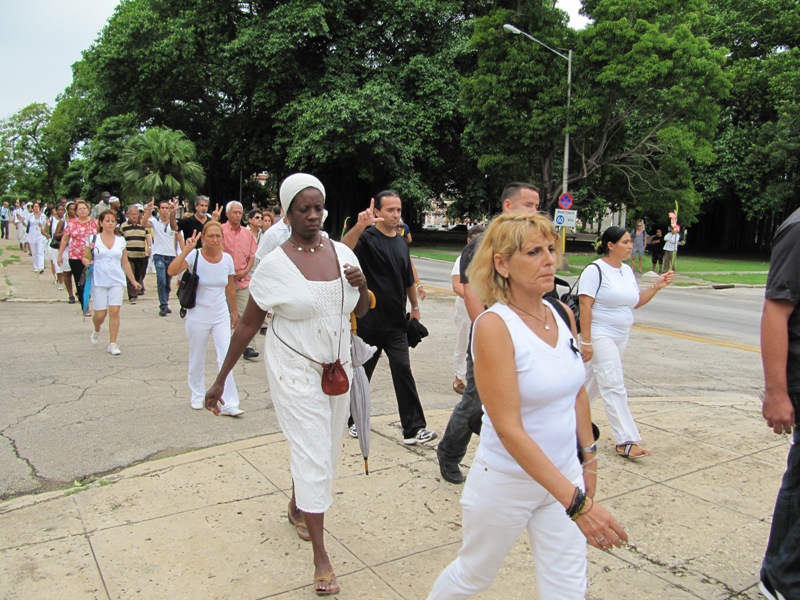
Laura leaves us. This time she has undertaken the longest of all walks: that of eternity. A lot of walking had to be done by this courageous Cuban woman who at the start, without political leaders in government to offer protection – just the contrary, without an army or firearms to defend her, with only courage as her armor, together with other women, faced the mobs sent by the powerful – as coercive cannons – with no other shield than the love for her husband, for freedom and for peace. The church of Santa Rita was witness for almost eight years to the steps and prayers of this heroic lady who, together with other political prisoners’ families, close relations or sympathizers, decided to dress their courage in white each Sunday as a symbol of protest and without permission from the Cuban government. The price they have paid for “such impudence” is great, but not as great as the strength of character of these women who have remained firm in their demands in spite of the official scorn to which they have been despicably subjected without any possibility of responding. They got the world to cry out with them to end the Cuban political prisoners’ unjust imprisonment. That is how our Ladies from Cuba became great, and Laura with them; that is how they showed themselves on the streets, with their gladioli as symbols and standards of peaceful struggle, resistance and love of justice.

This photo courtesy of Ana Torricella (Primavera Digital)

This October 16th was the first Sunday without Laura’s physical presence at mass and in the traditional march along 5th Avenue of the Miramar neighborhood, and I went with my husband to pay homage in that House of God located on 5th and 26. The parish priest mentioned her in the religious service – in spite of its being an ordinary mass, not a mass for the dead – and made reference to the years that she had been attending that temple, and prayed for peace for her spirit and eternal rest. Once the rite ended, we joined more than one hundred compatriots on a poignant walk along the usual route with the attendance of many independent journalists and members of the press corps.

From wanting to do and live so much her health suffered, already affected by diabetes. She spent her last days away from her modest home, which she generously made the home of all who visited her. Various imprecise medical reports kept her away from her loved ones, keeping her in intensive care for 7 days. Laura was a simple woman who was not in favor of the regime, so she was not eligible to be treated in elite clinics or hospitals that offer comfortable facilities, more competent medical personnel and all the medical advances, where the local chosen few and unconditional supporters are taken, as well as international VIPs. In my country medical care is free and universal, but it is very deteriorated, and the most impoverished hospitals and polyclinics are the ones within reach of the average Cuban.

It has rained a lot in Havana. During the last few days it has almost never stopped raining in the capital. They are Cuba’s tears that are cleansing the sorrow off the streets for her eternal march through history. Rest in peace, indefatigable lady defender of the rights of Cubans.

More pictures of Sunday’s mournful event, also through Ana Torricella’s generous collaboration. Click on each miniature to enlarge it.

You can sign the book of condolences for Laura Pollán’s death that we will deliver to her widower and daughter. We have and will keep an image with a permanent link on the side of this page to facilitate access to those who wish to express their sorrow by signing. Thank you for your support.

Translated by: Espirituana

October 18 2011

The Cuba We Have and the One We Want

A collaboration with Rafael Leon Rodriguez, General Coordinator of the Cuban Democratic Project from the event “Cuba today, Cuba tomorrow” that took place Saturday, September 17 in Miami, FL.
The latest measures adopted to make self-employment more flexible, after the publication by the Official Gazette of the extraordinary issues 28 and 29 last Friday September 9th, containing the resolutions and law decrees  that legalize them, drive one to think that the political will of the highest Cuban authorities exists so as to continue down the path of economic reforms.  Some reductions in tax quotas, the raising of the number of customers allowed in private eating establishments (“Paladares“) to 50, and the lowering of minimum quotas for renting rooms by 25% attest to this.

Despite many material limitations, since wholesale markets have not been established, an important sector of society directs its interest toward these new modalities of employment and economic pursuits, that already amount to 181 approved activities.

On the other hand, expectations regarding modifications to Resolution 259 (private profit from use of productive land) that entail being able to hold farms beyond ten years, the possibility of building permanent housing on them and the long-awaited increase of areas assigned to this production mode, push forward this new sphere of agricultural production.

Since the Sixth Congress of the Communist Party last April, during which the nominated Guidelines for Economic and Social Policy of the Party and the Revolution were approved, to date, one can state that a deceleration in the implementation of some of the measures that affect the population directly, such as elimination of subsidies for the basic family basket, and the reduction of payrolls in some work centers, which would increase unemployment. These government political decisions certify that there is a preoccupation on the part of authorities with preventing social irritants that would endanger their control and public order. Nonetheless, one can visualize their intention to confront State bureaucratic resistance to changes, since these, in some measure, affect the special interests of the strata of society dedicated to the administration of the State.

In the midst of a global economic crisis, when unconditional supporters of Cuba’s governing elite continue to diminish and with unfavorable prospects of their being able to stop this process, it is significant that they stay the course in the direction chosen for the transformations that have been proposed. We know that the conservation of political power has been, and is, the first priority of the authorities, guaranteeing thus dynastic succession, and from this comes the immobility towards recognizing an independent civil society and political opposition and the signing of the United Nation’s Pact of Civil, Political, Economic, Social and Cultural Rights.

Nonetheless, and independently from the causes that motivated it, Cuban authorities decreed an amnesty last year that benefited a large number of political prisoners or prisoners of conscience and allowed many of them to leave the country with their relatives.  They have reiterated that by the end of the year they will liberalize, in some measure, travel restrictions from or into Cuba for Cuban citizens, and will end legal obstacles for the sale, purchase and transfer of houses and automobiles.  All these measures have been happening and developing without external increased flexibility towards the authoritarian government by the forces that participate and in fact have influence on the Cuban topic: the government of the United States with their embargo and the European Union with their Common Position.

On several occasions the thesis of the double blockade has been supported:  the embargo of Cuba by the US government  and the blockade from Cuban authorities toward the people with regards to innumerable restrictions to liberty and rights that limit their chances of reaching a dignified standard of living.  In some fashion, we find ourselves now in a transitional context that can facilitate, after a fifty-year wait filled with obstacles and failures, a peaceful aperture towards a democratic state based on the rule of law that will allow us to succeed in the search for liberties and the common good.  Any way you look at it, the so-called Government Economic Model is a failure and has no solution.  Against it conspire, not only the natural laws of economics but also the State bureaucracy, with its endemic petty corruption and the aging of the ruling caste.

With regards to civil society, independently of a specific cases and facts, the non-violent political opposition has not demonstrated, to date, that it possesses the ability to mobilize the population so as to impose its demands, although increasingly it has become the popular reference point for the nature of real change.  Nonetheless, Cuban totalitarian authorities, certainly concerned by the current events in the North of Africa and other potential conflict areas, seem irritated and react, in certain occasions disproportionately, to situations that don’t justify it.

There is an imaginative collection of varied prospective visions regarding Cuba, arising as much from current living circumstances as from our recent history and the supposed events that, in a near future, could develop.  A part of these visions includes specific elements that are shared and essential for Cuba to steer in the direction of liberties and democracy.  Among them are:

  • The liberation of all prisoners held for non-violent political motives that still remain in prison, after the last amnesty.
  • Ratification and implementation by Cuban totalitarian authorities of the United Nation’s Pact of Civil, Political, Economic, Social and Cultural Rights.
  • Recognition by the Cuban totalitarian authorities of an independent civil society and of political pluralism in Cuba.
  • Implementation of the right to information, the right to inform others and access to the Internet

Another topic of transcendental importance is the participation of the Cuban diaspora in the reconstruction of the nation.  Not only from necessary economic considerations, but also towards the reconstitution of the plural national spirit and restitution of its traditional unique traditions.  In this direction, the totalitarian authorities of the islands have an obligation to recognize the nationality of all Cubans who live in foreign lands, including recognition of double nationality in those cases where new legislation created to this effect deem it appropriate.

In another sphere, ingrained opinions are debated regarding the need to obtain unity among the different sectors of the non-violent political opposition.  Some prefer joining rather than uniting.  Historically, the Cuban non-violent opposition has been plural, and this has defended it from the insidious activities of the political police, among other matters.  Joining, based on common arguments and aspirations, appears to be what is most convenient.

There is a long list of potential steps that could be taken to move in the direction of nursing and providing impulse to the irreversible political changes in Cuba; in summary, it would be enough to bring back the magic formula of creating bridges and removing obstacles, so as to bring closer, in trust, in solidarity and in peace, all of us, the Cubans.

Rafael Leon Rodriguez
General Coordinator
Cuban Democratic Project
San Cristobal de la Habana, 11 September 2011

Translated by:  lapizcero

September 19 2011

Almost Coffee

Since Raul Castro announced that they would go back to blending chicory into the coffee they sell us through our ration cards and in local currency, I took up this topic; but the repulsiveness of the product they shipped from warehouses which results in a brew that is neither coffee nor porridge, motivated me to consider it one more time.

It is true that many have referred to this product, with its comic luggage from the fiasco – as happens in almost all categories – that was the significance of the announcement.  Along came the “black nectar” with its powdered ammunition to reinforce what we already knew from experience: that they improved the brewing experience, but also reduced it, and hence now we have to serve it in a “tiny container”.  But nobody swallows the pill that comes as with a perfume; on the contrary.  We no longer offer visitors the luxury of a cup of that aromatic grain we used to have, but instead we save it for people who are not always welcome.

With the new despicable potable, they changed even the act of drinking this elixir and introduced an inelegant rite in the form of using both hands to drink it:  one to hold the cup and the other to pinch our nose so the sip is less disagreeable.  If you are feeling in need of a pickup and consider you need a stimulant such as caffeine, I advise you to try an alternative or some other kind of coffee, because that which we obtain with our ration coupons can cause stomach influences that will confine you to the restroom, and maybe chicoryflour is not the invigorator you need.  Recently I advised a friend who wanted to annoy an adversary that constantly threw barbs against him in front of the group, that he make him a present of a package of ration coffee in front of all.  It was in this way – and this is not a tall tale – that the problem was ended.

Something quite different happens when you have the money to pay for a package of the good stuff – if its available – in those establishments that sell in exchange for convertible currency.  It’s been more than a week since the ground fruit-seed is absent from what should be honestly called the “hard currency collection centers” and other such establishments.  There is a rumor in Havana that, as a result of the audits being conducted by the government to the younger of the Castros, 6 tons of the product was found missing at Cuban roasters, and that because of the investigative process, coffee has become absent from the store windows of those places that deal in hard currency.

If you visit these days the home of somebody with economic solvency it is possible that, against their wishes, they cannot share with you a sip of the infusion because of the current deficit.  In my case, if I visit the home of humble persons and they offer me a cup, I will hurriedly drink it, even if the developing nausea brings tears to my eyes, I will pretend I liked it and thank them with alacrity.  But since the old and hospitable “grass” has been converted indirectly into a measure of a host’s esteem, once the coffee supply is stabilized and I visit the home of others who have “good money” and they invite me to a cup of this potage or almost coffee, I will know what awaits me.

Translated by: lapizcero

September 20 2011

Dragon’s Breath

It seems that an anti-kissing and anti-closeness strategy has been in place for some days in Havana: toothpaste went missing. The humble consumer who micromanages the pennies in strong currencies obtained from his meager worker’s incentive or received from relatives who have emigrated – workers exploited by capitalism who plan their vacations, travel and invest around the world without permission, and in spite of that financially help their oppressed loved ones in the Cuban paradise – mostly buys strictly the basic goods in the markets that sell in foreign currencies.

But in Cuba we are vulnerable to the dictatorship of anti-consumerism and prey of the State oligopoly, since when they want to get rid of a Cuban product that no one buys, they stop stocking the foreign alternative so that we will be forced to buy the domestic one, which is almost always of poor quality and with a minimal price difference. That is, they substitute domestic products for the imports, mocking the rights of the buyers, whose ability to choose they arbitrarily limit imposing a lack of options: take it or take it! No alternatives. They choose the shortest and most dishonest route instead of working to ensure the excellence of the domestic products.

The State controls all trade and, in a way that is inefficient and unfair to society, prevents competition from the private sector in those businesses. They do not allow the private citizen to set up a store, nor offer what he produces in one of the many State chain stores. So, whether it’s bad or mediocre, we must be satisfied with whatever the State offers, and furthermore reward them with a smile.

After several days using numerous water-and-salt rinses, this September 22nd the citizens of Havana were pleasantly surprised with a domestic toothpaste of the “Sonríe” (Smile) brand. That state-manufactured concoction with scant menthol is not acquired through workers’ merit, volunteer work, diplomas or passwords, but with strong Cuban pasta [money]: the CUC [Cuban convertible currency]. They charge 90 cents for it, which is equivalent to 22 pesos in national currency. As is natural, there will surely be people who will continue gargling in order to be able to smile without having foul-smelling dragon’s breath. When times are bad, put on a happy face, and if you have bad breath – no options – use Cuban toothpaste.

Translated by: Espirituana

September 28 2011

The Mambisa Virgin

In Cuba we celebrated with joy a new anniversary of our beloved patroness: Our Lady of Charity of El Cobre. On the occasion of the 400 years that have passed since her apparition in the Bay of Nipe, a replica of her image toured Cuba under the slogan “Charity unites us,” and many faithful paid tribute to the Holy Queen of the Cuban people. She, who watches over us and blesses us every day with her love and peace, joined our Mambises during the war of independence, we entrust ourselves to her maternal protection. To our Cachita whom we adore, we offer to her with simplicity and humility our writings and we ask her as our loving Mother to protect us from wars, hate and grudges so that together we, the Cuban people, can work with dedication and love for the future of our homeland.

Our Sovereign Mother is blessed, because Cuba is under the protection of her womb and mercy. For the prize of the triumph of love in our people, in our divided families, and for the reunion of her Juanes in our national home. Because she strengthened us in the hope and sacred love of God and country, which is the sublime expression of our capacity to love. For the ultimate birth of freedom, that inevitably and fortunately will come to pass, for all the children of our soil, and always for her loving joy and charity.

This September 8, 2011, I ask that she, from this fount of goodness and mercy that is the Sanctuary of El Cobre, intercede for the reconciliation and peace of all her children. May we grow in humility and learn to understand and forgive, knowing that to forgive is also to have charity, and that charity is patient, is helpful (Corinthians 13, 3-8) and all it can and hope. This, we have an insight into our prayer, entrusting ourselves to her, Miraculous Virgin Mary of Charity of Cobre, and ask her to anoint us with Her grace to make us better Christians and to be prepared from our beloved country, for the future of humanity.

Translated by: A.A.A.

September 14 2011

The Eye Behind the Door

The eye you see is not
the eye because you see it,
it is the eye because it sees you.

Antonio Machado (Proverbios y Cantares)

In Cuba, we often visit homes where their residents hang, on the inside of the main door, the image of an eye. It is a symbol associated with African-originated religions, such as one that shows a tongue traversed by a dagger.

There are several eyes on our country and its citizens; Foreign and native eyes, focused on the civil society that emerges and on the changes that are urgently needed in all aspects of national life. I don’t mean to lean on beliefs to illustrate my point of view about these themes: they have just been ingrained in our reality for decades now and call many people’s attention.

At present, the authorities are immersed in the implementation of their “procedures for good intentions,” a plan that they refer to as “an updating program” of its model, and in which they enumerate what they understand still needs to be accomplished—solely on the economic front; Nothing to put at risk their sacrificed and historical status—without a specification on how to achieve it, nor the steps and deadlines for its application. Cuban television reporters show us, via their informative audiovisuals, the representatives of the higher hierarchy of government involved in constant reprimands against their municipal and provincial cadres, who have either not advanced in the process or have hardly done so. How to put forward what, up until now, has been taboo, could very well be one of the questions.

In assemblies of “moral table-slammings” and “shouted, public scoldings,” it seems evident that not only frustration abounds, but also despair. As they have built a government based on the “price of propaganda” and on looking for the straw in the American and, in general, all other capitalist countries’ eye. But they disregarded looking into their own country, and, today, in spite of the quality of life enjoyed in Cuba up until 1959, and of the human potential it possesses, we are like a discordant Polyphemus, lacking in freedoms and democracy in full modern times and looking clumsily to reestablish a more just order to rescue our rights and all the constitutional guarantees we enjoyed when they came to power. Ambiguous procedures are not needed: What is needed is that they acknowledge they were wrong and that they revert what they changed for the worst with the purpose of subjecting society and cling to power forever.

Their constant preaching is not fair, nor is the fact that they refuse to acknowledge their role in the economic, political and social mess that, for decades now, has lacerated Cuba. After so many years of programs and suggestions from the part of the Cuban political opposition, it becomes clear to us today how they have been incorporating some of those ideas in the fore-mentioned pamphlet, even when they don’t know this opposition and condemn it to illegality. But this time around, the authorities appear to have a real will to hop on the train of much-needed reforms. We are going from an almost paralyzed “gradualism” with which they lulled us, to a galloping transition that seems to be conditioned by the illness of the Venezuelan president, even when they don’t admit it.

But a real process of reform in Cuba, if it is to last, must ensure an authentic state of law and cement itself in the acknowledgement and legitimacy of political options. Even if they traverse our tongue with a dagger, we must continue in our insistence on these fundamental premises for the health of our nations, and in keeping “our eye” focused on our national life. Because there is still much to do.

Translated by T.

August 9 2011

Scar Case

Taken from http://www.uncuyo.edu.ar/

Dictatorships leave indelible scars that neither a psychiatrist nor the best plastic surgeon can repair. We Cubans, forced to ignore the definition or concept of a personal computer, organize ourselves within our families to work in an orderly way on the computer. Disciplined by lines and trained in the art of waiting, we bite our nails waiting for our turn to use the machine that allows us to reveal that scholarly and cybercompatible vein that hides in our DNA. As if they were prehistoric tools, we no longer take paper and pencil to color our opinions; our fingers travel more rapidly on a keyboard than tied to a pen, and it is easier to “cut and paste” changes in our writing, than to use the old eraser from our childhood, with which we began to smudge our written language.

I have taken to dreaming nonsense to the fullest. I dream I can say what I want without being labeled by the political police; that I can travel to any country, that I can claim my rights without being told I am subversive or going against the usual traffic. I dream I can receive any foreign books without the censorship of an authority, start a newspaper, see unions and syndicates arising, associate myself according to my opinions, see my country’s workers exercise their right to strike, and the disproportionate desire, almost unattainable, of having internet at home.

The postures of liberty we have been planted for years, have become trees, and their branches threaten to spread too far for official taste. Maybe the answer is for the electric company to cut them a bit, producing a lasting black out for our dreams. Sometimes, the mere olive green presence of its employees with light interrupting guns, paralyze the act of dreaming. But it’s a recipe that doesn’t always work, and every time a right is violated, a scar is left, like a new scar left in the face of this sad period of more than half a century of our nation.

Translated by: Claudia D.

September 8 2011

Conversion

It was a bright and well nourished blue ferret. He belonged to Carlos Enriquez‘s magic lineage, dressed with a guayabera made of talent, was giving and making life, art and beauty… creating, in short. But he got sick when they took off his clothes, oversaturated him with doctrine, vilified him with betrayals and adulations and put him in a tank. Such was his frustration that he felt trapped in the words’ coffin, the wings’ tomb. He made vows of silence and apathy and ended up being a gray mouse.

Translator’s Note:
Carlos Enriquez Gomez (1900-1957) was a Cuban painter, writer and illustrator. He named his home “The Blue Ferret” and it now functions as a meeting place for a small group of Cuban artists, under the same name.

Translated by : Adrian Rodriguez

August 12 2011

Supercalifragilisticexpialidocious

Summer hits Havana hard these months. Its scorching ferocity makes us sweat over the texts and the words melt us. I know I exaggerate, but if the heat were a product in high demand around the world, Cuba would be a rich country. I’m sure we were exporting it for years; I don’t know if it was canned, or “crude” in barrels at wholesale, what I am sure of is that the countries with “friendly presidents” may have been selling the excess “Cuban heat” that we send them as solidarity assistance. This concept of solidarity, gives me an idea: don’t we help the needy? When someone resells something they’ve been given it’s because they don’t need it any more. Isn’t that speculation? If it’s motivated by profit, then, why do we offer solidarity when we’re not a first world country?

What remains to us of August, we pass along signalling to the sky to send us a snowfall. I would settle for air conditioning to help me sleep, to rest all night, because my system of air displacement is insufficient. The fan pulls warm air in that is suffocating rather than cooling, and of it occurs to the bureaucrats to save the electric company they cut off our service, and we wake up “in the devil’s cauldron.” No even Mary Poppins can invent a word to describe what one feels in these circumstances!

August 9 2011

Convict 1959-0711

She was one of so many recluses of misfortune, of those by failing to use the olive green conscience were deprived of liberty. They gave her permission to go out and she left without baggage, like the images they like to give to poets. She thought that with her backpack on her back with the most necessary items was enough. That resulted in correspondence documentation being indispensable in the country in which she sought safe conducts. At the exit port, the accredited officer, after reviewing her papers three times, put on six seals and authorized her licence. She got on the sky blue boat towards a new life without looking back. She did all this quickly, because she feared that someone inconvenient would grab her arm at the last minute.

She took her first lungful of air breathing deeply and stunningly full. She realized then that she should repeat the act slowly, for as hungry for emancipation as she was, it was preferable to gradually assimilate her recent condition. She delighted in rescuing forgotten scents; tastes that she’d already lost and to discover new ones that were pleasingly new. She felt small and disoriented in this unknown environment, but she rejoiced to see how others exercised the rights that had been stolen from her.

She didn’t wait long to look for work; she liked to be independent and satisfy her desires without asking permission from anyone. She began by cleaning the bathrooms at an establishment for a salary which, after paying the rent and the rest of her bills, only allowed her one daily meal and a café con leche at night. It wasn’t much, but winter was making its entrance and there wasn’t time to choose.

The first days were spent beautifully, like a romance novel. After, they seemed more like a melodrama, with nostalgia for what was left behind mixed with the asphyxiating smell of bathroom disinfectants. Her first overcoat of good quality took almost a whole week’s salary and she had to look for an extra job to make up for the rest of her expenses. At night, she fell so brokenly into bed that her dreams decomposed into fragments. As she put together the scattered pieces by insomnia, she began to give names to the objects to lessen the thirst for human warmth in the midst of her existential snows. In the morning, she woke up dizzy, because poor sleep all night on her pillow kicked her in the neck.

After six months she had a better wardrobe than she had ever dreamed of. This way she learned that starting from scratch — without any inheritances — and receiving an adequate salary, she could obtain the most necessary things and live from the fruits of her labor. But she noticed that recently the line of her life refused to bend, that she was a prisoner of the apathy produced by daily sameness and repetitive acts, and the sap was drying out – that with which she seasoned her distant life.

At one year, she began to reexamine her past conduct and old concepts. She asked herself if she hadn’t been too intolerant in judging certain acts of others or if she hadn’t known how to defend her rights when she felt cheated. Also, if it was normal to bear grudges because they had penalized her dreams. She was so mesmerized in her meditation that she began to think that she might be suffering a type of tropical “Stockholm syndrome”. Anyway, she packed what she could of what she had acquired during that period, took its weight, and she found herself next to a metal bird again. She took one last look at what she could see of that beautiful and generous territory; she got on board the airplane and returned to Cuba.

Translated by: JT

August 1 2011

Gilipolladas* of Etiquette

The realities imposed on us during the time of the “Special Period”*[2] and the foreign investments, brought with them new forms of expression that involved part of the Cuban society. Those nationals linked to the tourism, to the diplomatic community and those working with foreigners and their currency or the exchange market, integrated into their language words such as “sir, madam, or miss” to address someone — As if the “comrades”*[3] of so many years, men or women, had emigrated — and other Anglicisms such as “llámame para atrás” (call me back) or verbal crutches such as “tú sabes” (you know); and the spanish ones, “¿vale?” to agree or assent to something, the “gilipollas” (idiot) in substitution of the ultra-Cuban “comemierda“*[4] (shiteater). I didn’t find an etymological dictionary to check whether or not the origin of this word is Cuban, but it is an image that reflects how much identified we are in our slang with such vulgarism. Also, due to the presence of Spanish businessmen and tourists in recent years, and our interaction with them, we acquired additional words of erotic content, that I prefer to avoid here.

The foreigners, who travel to Cuba as tourists, are seeking for “chicas“*[5] and “chicos” *[5]; not muchachas*[5] or muchachos*[5], young people, women and men to get involved with. People around the world have their own jargons and language traits and their customs which define them as a nation, even if we share the same language. The inclusion of foreign expressions and practices in a sector of our society is not a local phenomenon that has political overtones, as two friends argued recently, they are due to globalization, which is connecting us worldwide in various spheres of life; the internet, which allows us to interact in real time with many places of the world and to the opening to foreign tourism in our country after nearly three decades of staying stuck in snow crystals incubators “for better handling,” as the wolf of Little Red Riding Hood would say.

Therefore, it doesn’t worry me too much that our language is nuanced with foreign words. I can listen a youth calling another “brother”,  assenting with a “that’s ok”, or leaving with a “see you…”, that does not wake me up from my dreams; what really concerns me is the frantic emigration with which we Cubans have been naturalized as world citizens. That’s more important and significant that the locutions of our vernacular spanish. Let’s leave those misgivings to more conservative specialists.

I disapprove of false behavior, such as those who, in their environment, uncork their repressions and unleash their own churlishness in their element and in others, laminate in plastic their attitudes and with this label places, as if they ignore that we should behave in an educated way, regardless of where we are.

That’s how we, a large portion of the Cubans living in our country, are going these days: the Penelopes weave their dreams — with imported yarn — while waiting for the democracy ship; the believers in religions of African origin don’t  offer drums to their African pantheon ‘orishas’*[6], now they revere them using violins*[7] more often than before; and the majority still waits in frustration because “a malicious man” seized our rights and our freedom. With the permanent production chain of poverty that most Cubans inherited, they leave us also with the sad reality of the everyday ordinary fellow citizen who, to offset the economic hardships, is adorning his language with foreign gems to experience at least how the vocabulary is “being enriched.”

*Translator’s notes:
(1)- Gilipolladas is a Spain’s bad word  meaning foolishness , idiocies, therefore a gilipollas is an idiot , a fool and can be use as an asshole etc…
(2)-The special period was the name given by the Cuban government to the economic situation after the fall of the USSR and the eastern Europe socialist governments.
(3)- Comrade was the usual way to address another person in Cuba since 1959.
(4)- Comemierda is a Cuba’s bad word for fool, idiot, asshole, etc.. although literally means shit eater.
(5)- chicos, chicas, muchachos and muchachas all have the same meaning: young men and women, but in Cuba muchachas and muchachos are used.
(6) An Orisha is a spirit or deity that reflects one of the manifestations of Olodumare (God) in the Yoruba spiritual or religious system.
(7) violins are played to revere Oshun, who has been syncretized with Our Lady of Charity , Cuba’s patroness.

Translated by: Adrian Rodriguez

July 20 2011

Crazy Propaganda

Since June, Cuban television seems like Chavezvision, as its five channels have focused on following the evolution and process of recuperation of the Venezuelan president Hugo Chavez, and all the direct and telephone communications between Cuba and the people in his cabinet, and every one of his appearances and actions since his return to Venezuela. They rebroadcast it over and over as if they are preparing us for an exam. As we no longer suffer from the long speeches of prior days, now they grind away at us with those of the oil barons.

This narcissistic soap opera that we Cubans have already lived with for far too long has made us suspicious of the tools used by the caudillo rogues to maintain themselves in power. On their Latin flutes they play romantic melodies pleasing to the ears of the majority, to enchant the masses. It even comes to the point that I tend to doubt if the illness of Hugo Chavez is real.  This new version of the tropical “reality show,” seems woven by people very skilled in the art of remaining in power and their similarity and relationship with Havana is not coincidental.

But much is at stake, not just the arrogant personal victory of a man of the party — here they mixed, confused and personified the concepts of state, nation and country and focus those on one man — but an entire country and three generations of Cubans who have worked hard for the consolidation of a utopia that is terminally ill.

We are, by adversity, a country hampered by dependency. To our own  idiosyncratic anchors we must add historic events that have cemented the subordination. For more than four centuries (from 1492 to 1899) we depended on Spain, until 1959 on the United States,  for almost 30 years (until 1989) on the former Soviet Union, and now on Venezuela. If we can point to something comforting in our favor, it is that the durations of our dependency have been diminishing. What is not cut short is the corresponding adulation that is levied, as evidenced with the “native volunteers” in service to Spain during the time of the colonial period, and that is reflected today in the elite of power of our country,  when generally (not just now when they say they are sick) they give more media coverage to a foreign president then to the leader of Cuba.

There is a concern in Cuban society with relation to the future if the condition of the Bolivarian leader is real.  What will become of Cubans if we stop receiving the daily tons of oil sent to us from Venezuela?  Will we return to the Special Period?  These are the doubts that are in the street; although many think that the old oligarchic and nepotistic formula of the caudillos will not find an exception in the Venezuelan case and that Chavez will perpetuate himself in power with the naming of his brother as his successor.  In any event, I champion the recovery of the leader,  but we must look to our own mental health and delete these repeated propagandistic exaggerations  that alienate our daily life. Perhaps the illness of Chavez contributes to the inauguration of true reforms with perspective and without the laying manipulations, the structures to put us on the path toward a democratic state of rights and common good. Meanwhile, this is precisely what we must focus on and we must not lose our minds.

July 18 2011