The Disenso Foundation reopens the debate over unpaid debts and the lack of transparency in the management of Havana’s debt to Madrid.
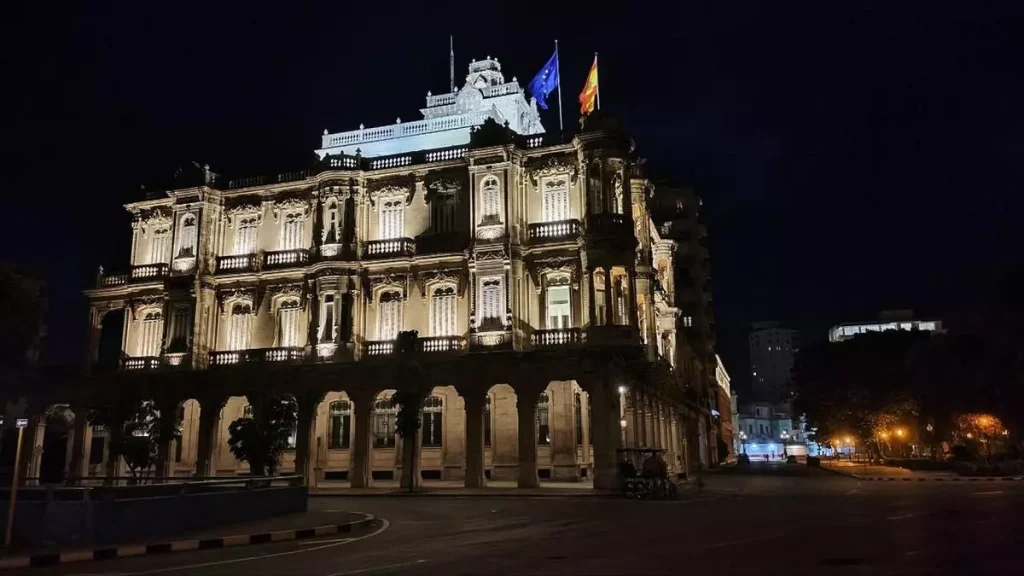
 14ymedio, Havana, August 16, 2026 / The Disenso Foundation, the think tank linked to Vox, Spain’s radical right-wing party, has published through its Foro Madrid platform a report whose title leaves no doubt about its intention: Cuba, a criminal regime sustained from abroad. The document reviews 67 years of repression, Soviet and Venezuelan subsidies, and concludes with a series of recommendations for Spain to break with the Cuban “kleptocracy.”
It is openly a text aimed at influencing public policy, but among its pages there is an issue that deserves attention: Cuba’s debt to Spain, one of the least transparent chapters in the bilateral relationship.
The report puts that debt at 1.97 billion euros, a figure that the Spanish Government acknowledged in 2020 in response to a parliamentary question from Vox. The figure is correct, although already outdated. At the end of that year, the Ministry of Economy certified Cuban public debt of 1.93755 billion euros, almost two-thirds of everything owed to Spain by Ibero-American countries. In 2021, it even rose to 2.03 billion. Since then, it has become much more difficult to publicly reconstruct the exact evolution of the balance.
Just three months ago, the Supreme Court opened a crack in that opacity. The high court accepted that the records of the Paris Club could remain secret, but rejected the Government’s automatic invocation of foreign relations as grounds for concealing how Spain applied the debt write-offs, restructurings, and extensions of payment terms granted to Cuba and Venezuela.
In 2021, researcher Guillermo Rocafort requested, under the Transparency Law, the files relating to those operations. The ministry refused
The case dates back to 2021, when researcher Guillermo Rocafort requested, under the Transparency Law, the files relating to those operations. The ministry refused. Among the Treasury officials responsible during that process was Carlos Cuerpo, who later became Minister of Economy and is now first vice president of the socialist government of Pedro Sánchez.
The history of the debt write-offs is summarized in the report. In 2015, 201 million euros were restructured and 110.8 million were forgiven. A year later, another operation affected 2.242 billion euros, of which 1.492 billion were canceled. The 2016 agreement also included a debt-conversion program for up to 375 million euros which, after remaining pending for years, was finally activated in July 2025.
The Juan de Mariana Institute has attempted to put a figure on the opportunity cost of those concessions. In a calculation published in July, the institute argues that if the 2.444 billion euros in 2016 debt had accrued compound interest of 8% annually, the theoretical balance would today exceed 5.28 billion euros. Although this is a hypothetical exercise, it is useful for showing how much that capital would have grown had it remained intact and earned interest at that rate.
On the private-sector side, the Foro Madrid report falls short. It speaks of “around 300 million euros” owed to more than 300 Spanish companies and questions why some of those unpaid debts have not been covered through public export credit insurance, as companies victimized by Havana are demanding.
“It has not gone down because it was collected,” the PP argued, “but because some creditor companies have closed or entered insolvency proceedings (gone bankrupt)”
The Senate currently uses a considerably higher figure. In May, during a motion by the Plural Parliamentary Group, Senator Maria Teresa Pallarès recalled that the debt to Spanish companies was estimated at around 350 million euros in 2017 and stated that it has now “risen to more than 500 million.”
Senator Manuel Milián Querol, of the People’s Party, did not dispute that magnitude and spoke of “nearly 200 companies,” mostly small and medium-sized businesses, still waiting to collect hundreds of millions of euros. He added another paradox reported by those affected: some companies may even have had to pay taxes in Spain on profits recorded on their books that they never actually managed to collect in Cuba.
But official statistics present a different picture. According to data from the Economic and Commercial Office of Spain in Havana cited during the same debate, “registered” commercial debt stood at around 255 million euros, below the 284 million recorded in 2023.
How much does Cuba really owe Spain? How much has been forgiven? How much remains outstanding? How many companies have suffered the consequences of the unpaid debts?
That is precisely one of the questions the Government has yet to resolve. The Spanish Socialist Workers’ Party (PSOE) attributed the decline in the recorded figure to “the monitoring carried out” by the Commercial Office and collection efforts. The PP offered a very different explanation: “It has not gone down because it was collected,” Milián argued, but because some creditor companies have closed or entered insolvency proceedings (gone bankrupt), meaning they disappear from certain statistics while the debt remains unpaid.
In light of that discrepancy, on May 5 the Senate approved a demand that the Government provide a rigorous accounting of unpaid debts through February 2026, broken down by economic sector, company size, and age of the debt. It also called for the creation of an audited census of creditors and set a maximum deadline of three months. That deadline has already expired.
The Foro Madrid report thus has the merit of once again putting an issue that rarely makes headlines on the table: how much Cuba really owes Spain, how much has been forgiven, how much remains outstanding, and how many companies have suffered the consequences of the unpaid debts.
The opacity surrounding Cuban debt is not an invention of Vox or the PP, nor is it a recent anomaly. It has spanned Spanish governments of different political orientations, which for decades have combined credits, renegotiations, write-offs, and payment deferrals without taxpayers being able to easily reconstruct the final balance. That is, beyond Foro Madrid’s political conclusions, the thread that still has much more to unravel.
Translated by Regina Anavy
______________________
COLLABORATE WITH OUR WORK: The 14ymedio team is committed to practicing serious journalism that reflects Cuba’s reality in all its depth. Thank you for joining us on this long journey. We invite you to continue supporting us by becoming a member of 14ymedio now. Together we can continue transforming journalism in Cuba.